
The Grapes of Wrath: Complete Chapter-by-Chapter Summary

Welcome to the world of *The Grapes of Wrath* by John Steinbeck. This isn't just a story; it's a raw, unflinching look at what happens when the land itself turns against you. Imagine a family uprooted from their home in Oklahoma, forced to leave everything they know behind. They travel across the Dust Bowl, chasing a "promised land" in California, only to find a reality far more bitter than they ever imagined. It's a chronicle of struggle, of the human spirit tested by forces beyond its control, and of the desperate journey to survive when the earth offers nothing but dust and despair.
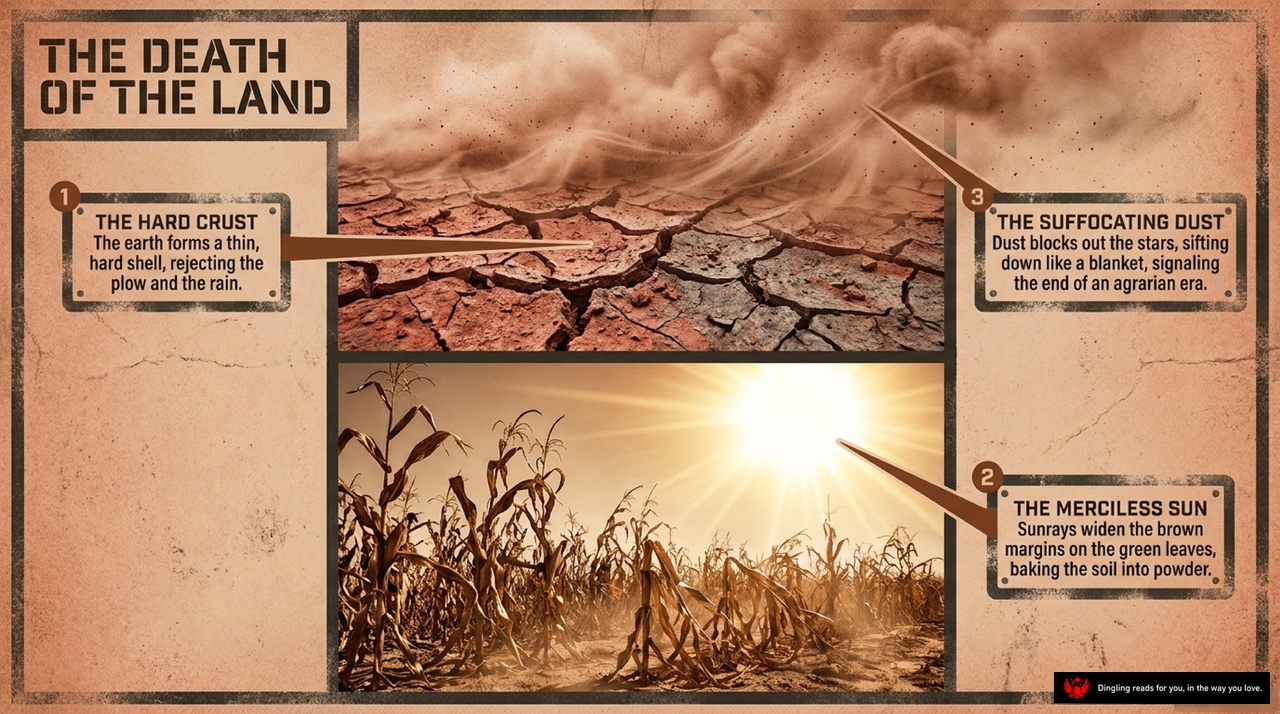
The Death of the Land. Look at this scene. It's not just a drought; it's a slow, violent execution of an entire way of life. The image breaks down the tragedy into three brutal stages.
First, the Hard Crust. See how the earth has formed a thin, hard shell? It's rejecting the plow and the rain. The soil is so parched it's turned into an impenetrable armor, trapping everything beneath it.
Then, the Merciless Sun. The sunrays widen the brown margins on the green leaves, baking the soil into powder. Look at those corn stalks—they are withered, brittle, and dying under a heat that feels personal, almost malicious.
Finally, the Suffocating Dust. This is the killer. Dust blocks out the stars, sifting down like a heavy, suffocating blanket. It signals the end of an agrarian era. Men, women, and children are being buried alive by the very ground they tried to farm.
This isn't just about weather; it's about the collapse of a promise. The land that fed generations is now a tomb, and there is no going back.

The Dust Bowl didn't just blow away the soil; it blew away the very soul of the American farmer. Look at this stark contrast: on one side, the Tenant Farmer, connected by blood, birth, and death, who feels the warm, living pulse of the earth. On the other, the Bank and the Tractor—cold, mechanical forces connected only by mathematics, deeds, and margins. This is the true monster of our time.
The farmer understands the seeds and the weather; the tractor driver, wearing goggles and a rubber mask, is just a robot on an iron seat, severed from the land. He doesn't care about the roots; he only cares about the three-dollar-a-day wage and the straight line of the plow. The bank isn't a collection of men; it's a force that profits from interest while the farmers starve. As the text reveals, every man in a bank hates what the bank does, yet the bank does it anyway. It's a system where logic has replaced humanity, where a machine crushes a home just to satisfy a ledger. This is the inevitable clash: the warmth of the earth versus the cold iron of capital, and the earth, unfortunately, is losing.

The Great Depression didn't just hit people; it broke the land itself. In Oklahoma, the dust storms were so violent they tore right through the cornfields, uprooting crops and burying homes under a suffocating blanket of gray. Families were forced to flee, leaving behind everything they owned, heading west on Route 66 in the desperate hope of finding a better life in California. But the reality they faced was a cruel deception.
Farm owners in California had no intention of helping these desperate families. Instead, they used a calculated strategy known as "The False Promise." They printed thousands of handbills, promising high wages and easy work to attract as many workers as possible. Once the desperate families arrived, they were forced to compete against each other for the very few jobs available. This drove wages down from 30 cents to starvation levels of just 15 cents. It was a trap designed to keep labor cheap while maximizing profits.
The image you see here breaks down this sinister scheme into three parts. On the left, "The Bait" represents the false hope distributed across the Midwest, luring starving families away from their homes. In the center, the core promise: 800 pickers wanted, with good wages all season. This was the lie that drew thousands. On the right, "The Volume" shows the scale of the deception: printing 5,000 handbills to attract 20,000 desperate people. Finally, at the bottom left, "The Trap" reveals the outcome: forcing families to bid against each other until wages plummeted. What looked like an opportunity was actually a system designed to exploit human suffering for profit.

Welcome to the final stop on our journey along Route 66, the Mother Road. As we look at this timeline, we see the heartbreaking transformation of the Joad family. It starts with Grandpa's death, a moment that severed their connection to the land, forcing them to realize they were just tenants, not owners. This shared suffering pushed the Joads to merge with strangers like the Wilsons, forging a new, collective family out of necessity.
But the journey takes a heavy toll. We see Noah departing, leaving behind the splintering of their biological family under the crushing weight of the trip. Finally, we reach the tragic end: Grandma's Passing. Ma Joad silently guards her husband's corpse through the night, ensuring the rest of the family can cross the deadly desert to safety. This image captures the ultimate sacrifice of a mother—protecting her children even after the father is gone. It's a stark reminder that on this road, survival often demands the most painful choices.

Look at this scene: "The Architecture of a Hooverville." It's not just a random pile of tents and cars; it's a society built on three unspoken laws that kept thousands alive when the world had collapsed.
First, notice the right to privacy. In a place where everyone was starving, families fiercely guarded their sleeping space. Unwritten laws demanded respect for a family's resting room. You couldn't just wander in; you had to knock, and if you weren't invited, you were out. This wasn't about luxury; it was about dignity.
Second, look at the fire in the center. That's "The Obligation to Share." Here, the hungry had a right to food, and those with food had a duty to divide it. If someone found a potato, they didn't hide it. They brought it to the common fire. This shared economy was the only thing that prevented total starvation.
Finally, see that figure walking away on the right? That represents "The Ultimate Punishment." There were no jails here. If you stole, if you violated the rules, you didn't go to prison; you were banished and ostracized. You were cast out into the desert, where the real punishment was death.
Every night, they built a world complete with furniture and rules. Every morning, the wind tore it down again. This was the fragile, terrifying, and surprisingly complex life of the Hooverville.

On the left, we see the promise: endless rows of peaches and grapes, soft green hills, and the promise of a fresh start. It's the California dream—the "Promised Land" that drew thousands of families from the Dust Bowl, hoping to escape hunger and find a new life. But on the right, the reality hits hard: hostility born of terror. Locals arm themselves, fearing the sheer numbers and desperate hunger of the migrant wave. The word "Okie" becomes a weapon, turning neighbors against each other.
This slide captures the brutal clash between expectation and reality. The book reveals that California was never the utopia they were told about. Instead of open doors, migrants faced a wall of prejudice and violence. Landowners, terrified of losing their grip on power, used fear to keep workers down. The image of armed men in the rain isn't just fiction; it reflects the real threat many families faced every single day. While the left side shows abundance, the right side shows survival. The dream of the "fresh start" was quickly replaced by a fight for basic dignity. This is the true story of the Great Migration—not a fairy tale, but a struggle against a system designed to keep them hungry and afraid.

Imagine a massive, rusted gear system grinding against itself, trapped in a deadly cycle of destruction. This isn't just a machine; it's the "Economics of Starvation," a trap designed to keep millions of families like the Joads trapped in poverty.
Look at the top of our cycle: **Over-Advertise**. Landowners don't hire the workers they need; they print flyers calling for twice as many people. Why? To create panic. This artificial desperation forces desperate, landless migrants—300,000 of them—to flood into the fields, creating a massive **Labor Surplus**.
When the supply of workers skyrockets, the price of labor crashes. That's **Plummeting Wages**. Owners exploit this fear, slashing pay from 30 cents a day down to a mere 2.5 cents a box. They aren't just paying less; they are buying the right to starve their workers.
And finally, the cycle closes on itself with **Starvation & Disease**. Children die of pellagra and black tongue, their bodies wasting away. Yet, this tragedy doesn't break the system; instead, it curdles the workers' fear into a unified, dangerous anger. The gears keep turning, feeding on their own children, proving that in this economy, survival is a luxury only the owners can afford.

Look at this image. It's a powerful visual of rotting fruit—apples, oranges, peaches—all covered in mold and decay. The title, "The Crime of Rot," sets a dark tone, suggesting that the problem isn't natural disaster, but something human-made.
The slide breaks this down into two main points. First, "Artificial Scarcity." The text describes shocking examples: coffee burned for fuel, potatoes dumped into rivers and guarded with guns, and oranges sprayed with kerosene. This illustrates how the wealthy create hunger on purpose. They destroy food not because it's spoiled, but to keep prices high and maintain control. It's a crime against humanity, turning abundance into scarcity just to profit.
Second, "The Ultimate Sin." This refers to the men who graft the trees and improve the seeds. They have the power to grow more food, yet they cannot find a system to let the hungry eat the fruit. It's a failure of morality and leadership. They hoard the bounty while others starve.
At the bottom, the slide quotes a famous line: "A failure that topples all our success... In the souls of the people the grapes of wrath are filling and growing heavy, growing heavy for the vintage." This connects the physical rot of the fruit to the moral rot of society. The "grapes of wrath" are the growing anger of the oppressed people. They are fed up with this artificial scarcity and this ultimate sin. The harvest of this anger is coming, and it will change everything. This image captures the moment right before a revolution, where the weight of injustice becomes too heavy to bear.
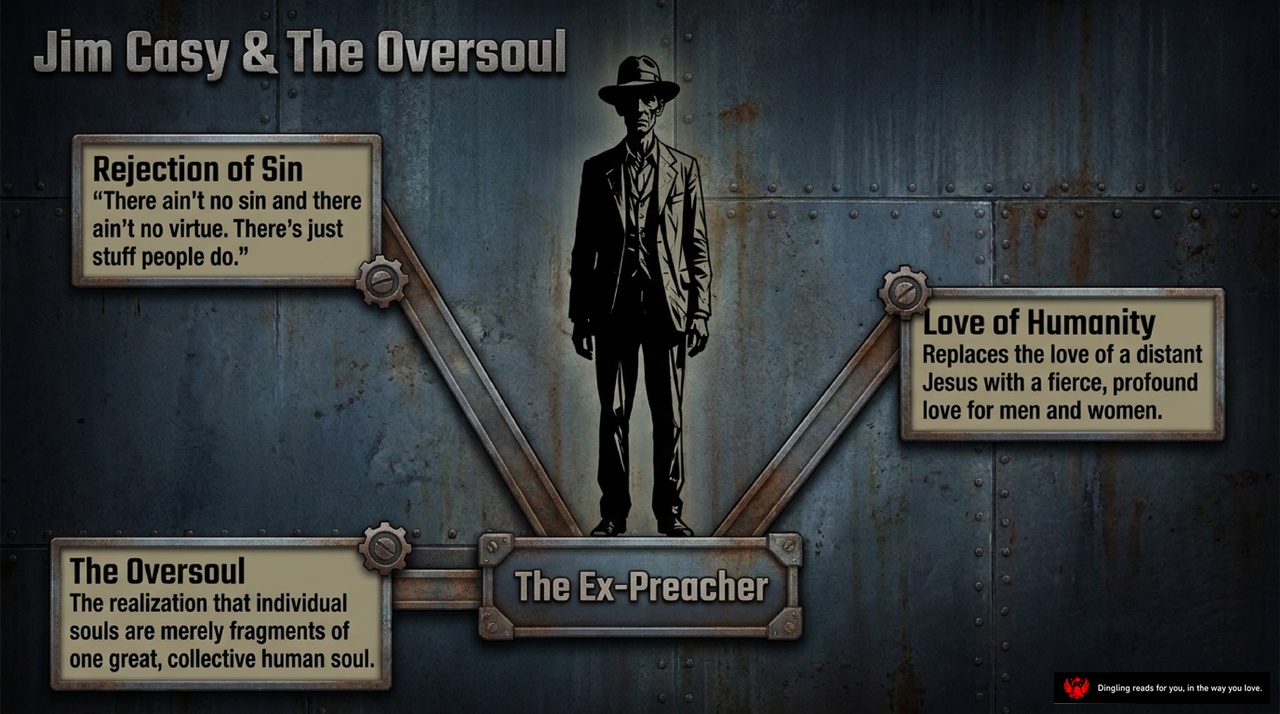
Look at this silhouette of Jim Casy, the former preacher. He stands at the center of a transformation, moving from a man of doctrine to a man of shared humanity. Notice the first point on the left: the Rejection of Sin. Casy realizes there is no such thing as absolute sin or virtue; there is only what people do. He stops judging individuals and starts seeing the common humanity in everyone.
This shift leads directly to the concept of the Oversoul, shown at the bottom left. Casy understands that individual souls are just fragments of one great, collective human soul. We aren't isolated; we are all part of the same living thing. This realization breaks his old way of thinking.
On the right, we see the Love of Humanity. Casy replaces his love for a distant Jesus with a fierce, profound love for real men and women right in front of him. He stops preaching abstract rules and starts living by the truth of human connection. That's why he's labeled "The Ex-Preacher"—he left the pulpit to embrace the people themselves, finding the divine not in a church, but in the bond that ties us all together.

Picture content analysis:
The slide illustrates a profound thematic shift from "I" to "We". It uses three distinct sections:
1. **I lost my land**: Depicts an individual family's isolated misery caused by a single tractor.
2. **The Intersection**: Shows two men sharing a fire and meat, representing the moment where individual struggles meet.
3. **We lost our land**: Represents the birth of collective consciousness, realizing that unity is the only defense against the "Monster" (the oppressive system).
The visual metaphor of chains connecting the "I" and "We" emphasizes that this shift isn't just about words, but about the physical and emotional connection formed through shared suffering.
Matching book content:
From Chapter 3 ("Westward Journey"), the text explicitly discusses this transition: "When one man cries, 'I lost my land,' he is just an isolated weakling; but when two men who have both lost their land squat by a fire in a dry ditch, turning 'I' into 'We,' there is a different kind of power." It further explains that sharing bread, covering a sick infant with a blanket, and mutual help are the seeds of this power. It contrasts this with the landowners who are trapped in the "I" cage, using violence to keep people divided, while the migrants are forming a new community where "children are everyone's children, pain is everyone's pain, and even the hope of survival belongs to everyone."
Drafting the script:
The script needs to be engaging for an American audience, avoiding direct translation. It should start with the visual of the "I" vs "We" and weave in the story of the Joads and other migrants. It should explain *why* this shift matters using the specific examples from the text (the fire, the shared meat, the shared blanket). It needs to highlight the contrast between the individualistic mindset of the oppressors and the collective power of the oppressed. The tone should be serious but hopeful, emphasizing that unity is a survival strategy, not just an ideal.
Final Polish:
Ensure the flow is natural. Start with the visual hook, move to the narrative of the migrants on Route 66, explain the philosophical shift using the text's examples, and conclude with the power of this collective identity. Keep it around 400 words.

Look at this image of Ma Joad, the unyielding anchor holding her family together. On the left, we see "The Male Experience: Life in Jerks," describing men's lives as a series of violent disruptions—babies born, men dying, land lost, homes destroyed. On the right, it contrasts this with "The Female Experience: Life as a River," where women face life as a continuous, flowing stream. Even with eddies and waterfalls, the river keeps moving forward.
Ma Joad embodies this river-like strength. She enforces the family's survival at all costs, wielding a jack handle to keep the family from splintering, absorbing their panic, and transforming it into forward momentum. While men often freeze in the face of chaos, Ma Joad ensures that the family never stops moving. She takes their fear and turns it into the energy needed to survive. In a world of sudden disruptions, she remains the steady current, carrying everyone toward a safer future, no matter how turbulent the waters get.

Look at this image. We see Tom Joad, his face etched with the weight of his past, staring into a darkness that feels less like night and more like a prison cell. But this isn't just about his physical release; it's about his awakening. The text on the slide contrasts two paths: "The Parolee," who is stuck reacting to immediate threats, climbing fences only when he's at the fence, versus "The Disciple," who embraces a new philosophy: "Two are better than one."
This shift is the turning point of the story. Earlier, Tom was defined by survival—putting one foot in front of the other, reacting to the whip of hunger or the threat of the law. But as he leaves prison and walks back into the dust of Oklahoma, he begins to realize that isolation is a death sentence. The text captures this transformation perfectly when Tom declares, "I'll be all around in the dark... Wherever they's a fight so hungry people can eat, I'll be there. Wherever they's a cop beatin' up a guy, I'll be there."
This isn't the thinking of a man who just climbed out of a cell; it's the voice of someone joining a collective struggle. He moves from being a passive victim of circumstance to an active agent of rebellion. He realizes that the "dark" isn't just the night sky or the prison walls; it's the systemic cruelty that crushes families like his. By choosing to be part of "two" and then "many," Tom finds a strength he never had alone. He stops climbing fences to escape and starts breaking them down to let others through. This is the moment Tom Joad stops being a parolee and starts becoming a man who belongs to the people.

Look at this image. We see a gathering storm. The sky is dark, the rain is pouring, and the ground is churning into a violent flood. This isn't just weather; it's the physical reality of the Joads' journey.
First, there is the flood. As the text describes, winter rains trap the migrants in boxcars and tents, bringing starvation, pneumonia, and death. But look deeper at the water. It represents the relentless pressure of the Great Depression. It's the dust bowl that has turned their home into a grave, and now it's the river that threatens to drown them on the road.
Then, notice the watchers. In the image, the storm rages, but there is a sense of observation. The women are watching the men to see if they will finally break under the weight of suffering. They know that fear is a fragile thing. When the storm hits, when the hunger sets in, fear can transform.
And finally, look at the transformation. The fear in the men's eyes leaves, replaced by a cold, hard anger. The women know they are safe only when the men have stopped being afraid and started being angry. Fear has definitively transformed into wrath. This is the moment the storm breaks, not with a crash, but with the realization that they must fight back to survive.

The image presents a powerful reflection on *The Grapes of Wrath*, framing it not just as a story of people moving across a map, but as a stark critique of a society that values profit over human dignity. It highlights how this system, by starving the many to protect the surplus of the few, inadvertently creates a shared consciousness among the displaced—a collective awakening born from shared suffering.
This slide asks a haunting question: Are we planting the seeds of our own destruction by designing systems that enforce starvation? In the book, this is vividly realized as the Joads and thousands of others are pushed off their land. The "mechanical profit" mentioned here is the engine that drives the tractors to crush homes and the banks to ignore human lives. The "starvation of the many" isn't just about hunger; it's about the erasure of community and the reduction of people to mere statistics.
But the slide also points to the "unbreakable collective consciousness" that emerges from this chaos. As the Joads join the dust bowl migration, they realize their individual struggles are part of a larger pattern. The moment an individual says "I lost my land," they are alone. But when they say "We lost our land," they find strength. This shift from "I" to "We" is the book's core message. It's the realization that their survival depends on each other, transforming a group of desperate refugees into a force capable of reclaiming their dignity. The text reminds us that when systems fail the people, the people eventually rise, not with weapons, but with a unified voice and a shared soul.