
The Great Gatsby: Complete Chapter-by-Chapter Summary

Welcome to our deep dive into F. Scott Fitzgerald's timeless masterpiece, *The Great Gatsby*. Tonight, we're not just reading a story; we're dissecting the very soul of the Jazz Age.
This book is far more than a romance; it is a thematic deconstruction of an era defined by excess and illusion. Fitzgerald takes us on a journey to understand the anatomy of a dream that was beautiful, yet fundamentally broken from the start. As we explore the tragic decay of the American Dream, we see how wealth, love, and class collide in a way that no one could have predicted.
The image before us captures the essence of the novel perfectly: a dark, mysterious ocean under a night sky, with a single, piercing green light cutting through the darkness. This isn't just scenery; it is the central symbol of the entire story. That distant green light represents the unattainable ideal that drives every character, especially the protagonist, Jay Gatsby. It is the beacon of hope that promises everything but delivers nothing.
Through the eyes of the narrator, Nick Carraway, we witness the rise and fall of a man who believed money could buy back the past. Fitzgerald masterfully portrays how the glittering surface of the 1920s hid a deep moral emptiness. The characters we meet—from the reckless Tom and Daisy to the ambitious Gatsby—are all trapped in their own illusions, chasing happiness that slips through their fingers the moment they grasp it.
As we turn the page, we will uncover the secrets behind Gatsby's transformation, the tragic consequences of a careless collision, and the ultimate realization that some dreams are simply not meant to be realized. Get ready to experience the magic, the madness, and the heartbreaking truth of the American Dream as it was written by one of literature's greatest voices.

Welcome back to the book club. Today, we're diving deep into the soul of *The Great Gatsby*, specifically looking at the character who holds the entire story together: Nick Carraway.
As our slide beautifully illustrates, Nick serves as the "Midwestern moral compass" navigating the decadent East. He is the grounding tether in a world of untethered wealth. Think of him not just as a narrator, but as a dual-force: he is both "The Anchor" and "The Seduction."
On one side, we have The Anchor. This represents his Midwestern traditionalism, tolerance, and grounded reality. For Nick, reserving judgments is a matter of infinite hope. He refuses to be cynical about the world around him, which allows him to remain objective even when everything else is spiraling out of control. He is the reader's proxy, standing in that world of careless aristocrats and doomed dreamers, but he never fully gets swept away by the chaos.
On the other side, we have The Seduction. Despite his moral compass, Nick is inevitably drawn to the gorgeous, intricate sensitivity of Gatsby and the glittering allure of New York's bond markets. He is enchanted by the romance and repelled by the corruption simultaneously. This internal conflict is what makes him such a compelling character. He is the bridge between the old money of East Egg and the new money of West Egg, yet he belongs to neither.
Ultimately, Nick is simultaneously enchanted and repelled by the inexhaustible variety of life. He serves as our eyes into this tragic world, watching the rise and fall of the American Dream with a mix of awe and horror. As we move forward, keep this duality in mind: Nick is the only one who sees the truth, even as he is slowly seduced by the very lies he tries to expose.
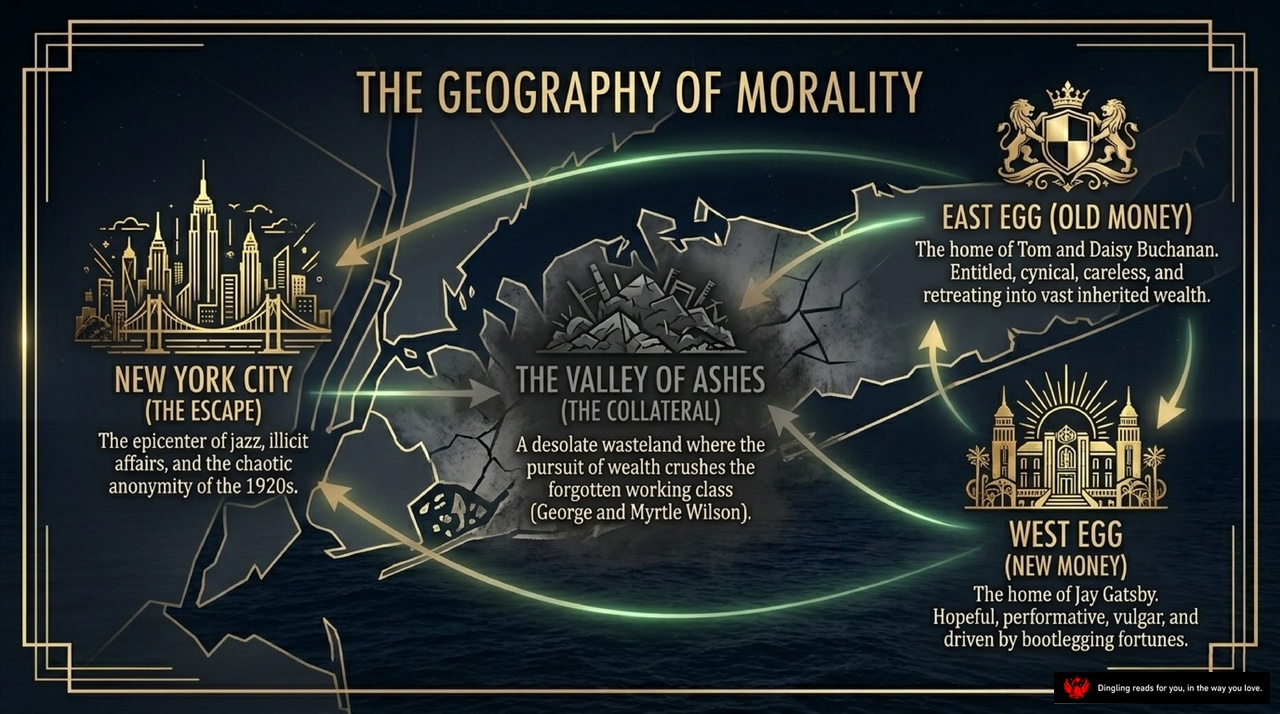
The map before us isn't just a geography lesson; it's a blueprint for the American Dream's fatal flaw. We see the "Geography of Morality," where location dictates destiny. On the right, we have the East Egg, the realm of old money. This is where Tom and Daisy Buchanan live—entitled, cynical, and utterly careless, retreating into vast inherited wealth. Just below them is the West Egg, the home of Jay Gatsby. Here, the new money struggles to be heard. Gatsby is hopeful and performative, driven by bootlegging fortunes, trying desperately to bridge the gap between his origins and their world.
But the true tragedy lies in the center: The Valley of Ashes. This desolate wasteland is the collateral damage of the pursuit of wealth, where the forgotten working class, like George and Myrtle Wilson, are crushed under the wheels of the rich. On the far left stands New York City, the escape. It's the epicenter of jazz and illicit affairs, offering chaotic anonymity for those who can't find a home in the Eggs. The green arrows show the flow of this toxic cycle: wealth flows from the Valley to the Eggs, while the moral decay and the victims remain trapped in the ash, unable to escape the geography that has been drawn for them.
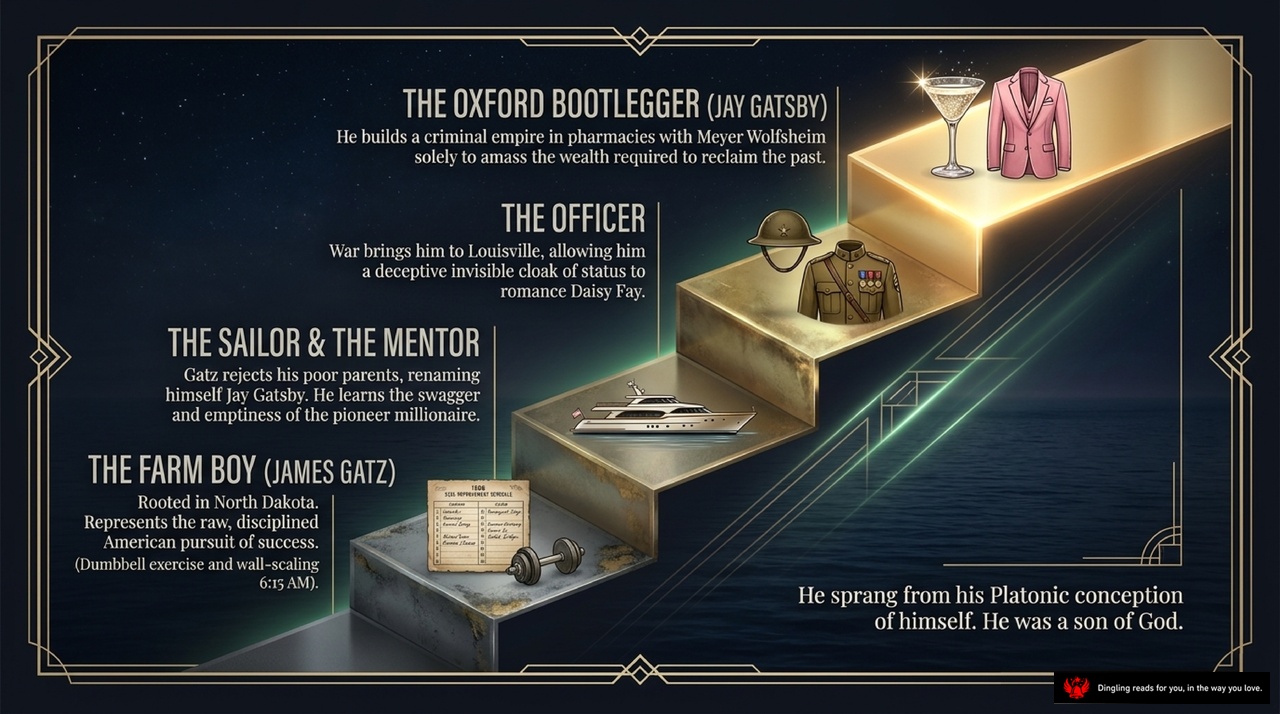
Look at this staircase. It's not just a graphic; it's the entire life story of Jay Gatsby, rising from the dust of North Dakota to the glittering top of the East Egg.
At the very bottom, we see "The Farm Boy," James Gatz. Rooted in the Midwest, he represents that raw, disciplined American drive for success. He's the one doing the dumbbell exercises at 6:15 AM, fueled by a "Platonic conception of himself"—he truly believed he was a son of God, destined for greatness.
But James Gatz didn't stay James. He rejected his poor parents and reinvented himself as "Jay Gatsby." As the slide shows, he became "The Sailor & The Mentor," learning the swagger and emptiness of the pioneer millionaire. He learned how to move in high society, how to charm, and how to hide the truth behind a perfect facade.
Then, the climb continues to "The Officer." War brought him to Louisville, giving him a deceptive, invisible cloak of status. He used his military uniform to romance Daisy Fay, creating the illusion that he was someone she was supposed to marry.
Finally, at the very top, stands "The Oxford Bootlegger." This is the Jay Gatsby we know. He built a criminal empire with Meyer Wolfsheim solely to amass the wealth required to reclaim the past. He bought the pink suit, the mansion, and the martini to prove he belonged.
The tragedy, however, isn't just about the rise. It's about the destination. At the top of these steps, the slide reminds us that he sprang from his own fantasy. He was a son of God in his own mind, but the world saw a bootlegger. He built an empire to buy back a moment that never existed, only to find that no amount of money could bridge the gap between who he was and who he thought he was.
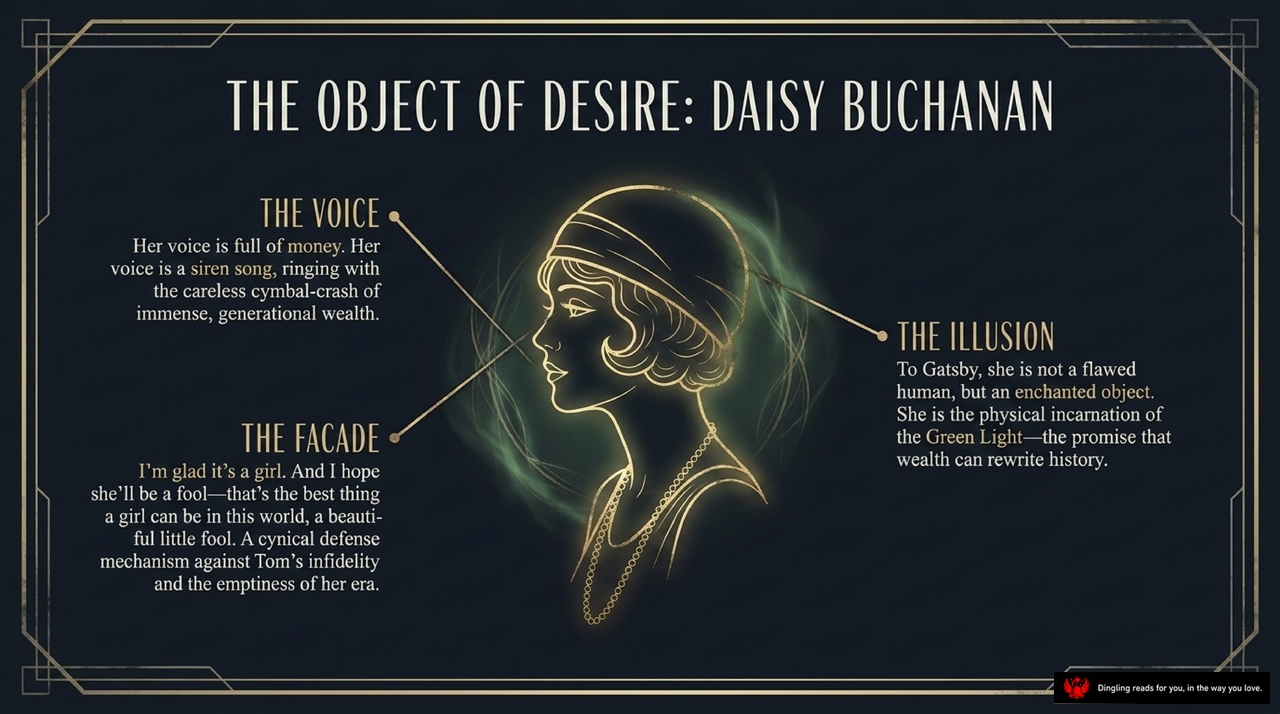
The tragedy of Jay Gatsby isn't just about one man's lost love; it's a brutal indictment of the American Dream itself. Look at the slide: "The Object of Desire: Daisy Buchanan." To Gatsby, she wasn't a flawed human being with a messy past and a selfish nature. She was an enchanted object, a physical incarnation of the Green Light—the promise that wealth could rewrite history.
Notice the section labeled "The Voice." The text says her voice is "full of money," a siren song ringing with the careless cymbal-crash of immense, generational wealth. That sound haunted him. It represented a class he could never truly belong to, no matter how much he spent. And look at "The Facade." Gatsby desperately wanted Daisy to be "a beautiful little fool," a cynical defense mechanism against the emptiness of her era. He needed her to be innocent, unaware, and perfect so his dream could survive. But reality was far crueler. She was aware, she was complicit, and she was willing to let him die to protect her own comfort.
Finally, consider "The Illusion." Gatsby refused to see Daisy as she truly was. He ignored the years she spent with Tom, the child she had, and the hollow marriage she was in. He saw only the girl from five years ago. This delusion is the core of the tragedy. He believed that if he could just buy her back, he could undo time. But as the book shows, money cannot rewrite history, and no amount of wealth can bridge the gap between a new rich man and an old rich girl. Gatsby's dream was built on sand, and when the tide of reality came in, it washed everything away.
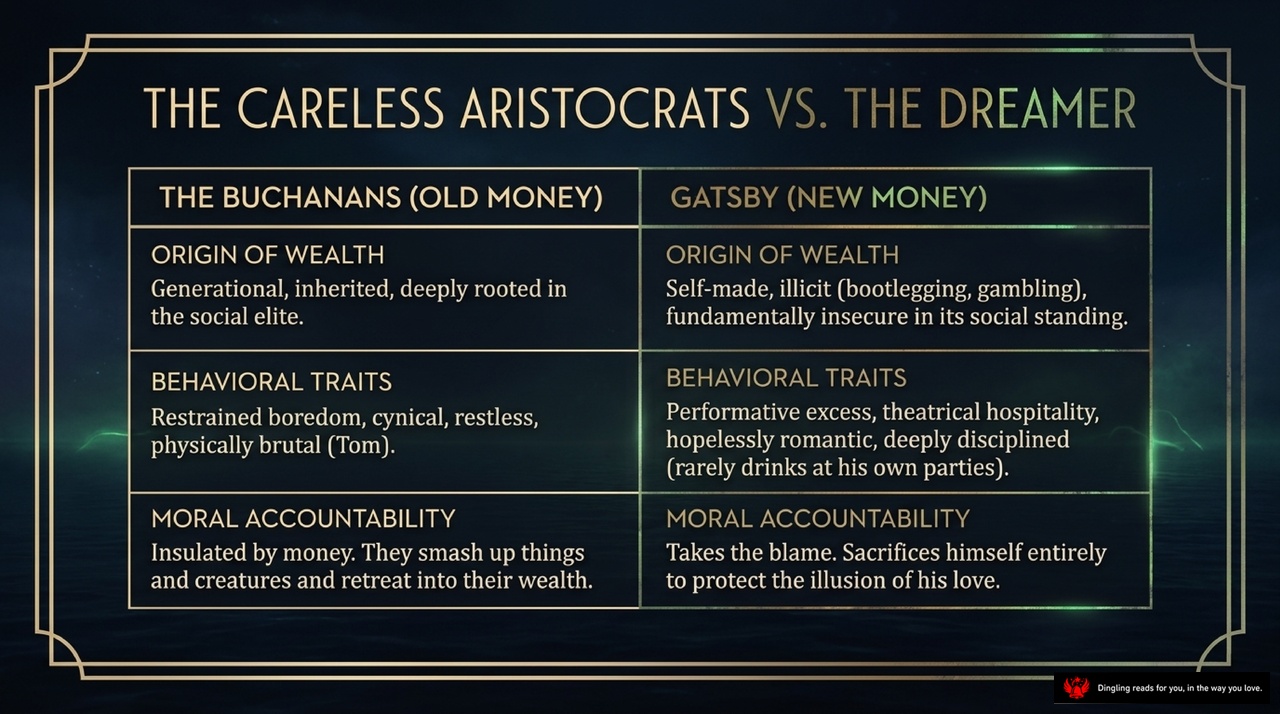
Look at this slide comparing "The Careless Aristocrats" versus "The Dreamer." On the left, we have the Buchanans, representing old money. Their wealth is generational and deeply rooted in the social elite. But look at their behavioral traits: restrained boredom, cynicism, and even physical brutality, as we saw with Tom. Most critically, their moral accountability is non-existent. They are insulated by their wealth; they smash up things and creatures and simply retreat back into their safety.
On the right, we have Gatsby, the self-made man with new money. His origin is different—illicit and built on bootlegging, which makes him fundamentally insecure about his social standing. Yet, his behavioral traits are the opposite of the Buchanans. He performs excess and offers theatrical hospitality, but he is also deeply disciplined. And here is the tragic irony: while the Buchanans retreat, Gatsby takes the blame. He sacrifices himself entirely to protect the illusion of his love.
This slide perfectly captures the core conflict of the novel. The Buchanans are careless because they know they can escape consequences, while Gatsby is the ultimate dreamer who believes he can pay for love, only to be destroyed by the very people he tried to win over.
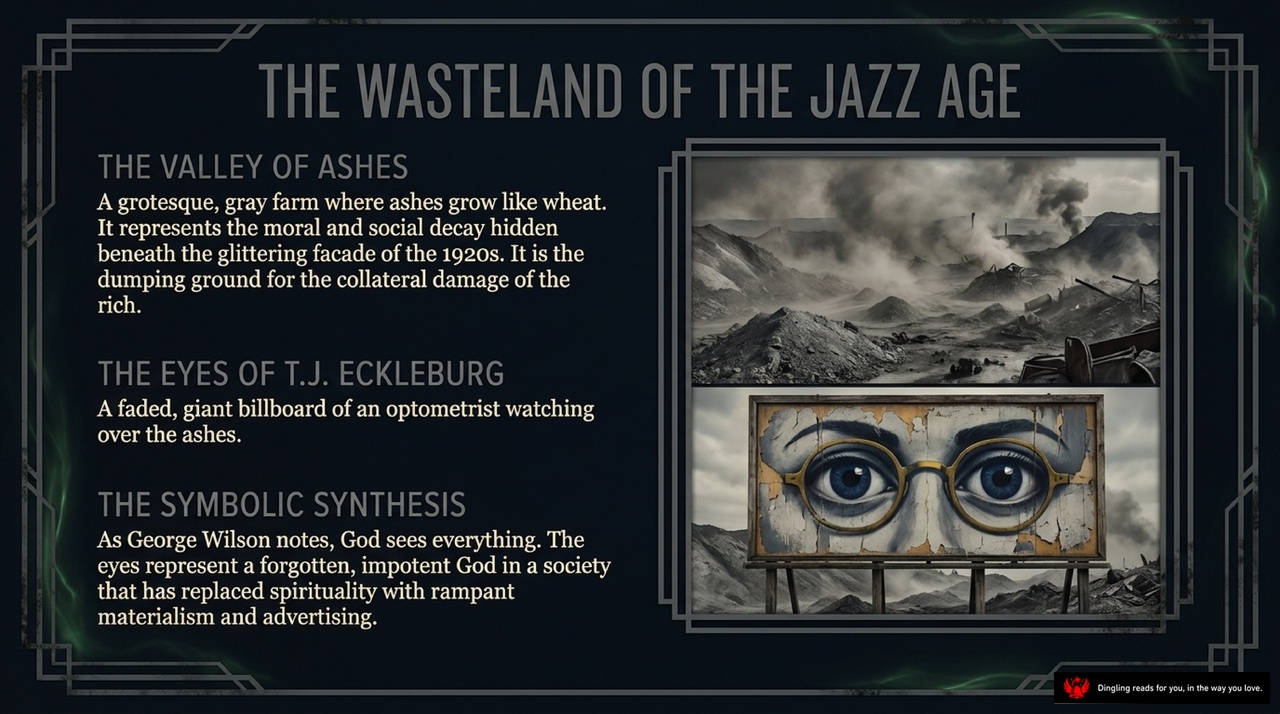
Look at this slide titled "The Wasteland of the Jazz Age." It captures the dark underbelly of the 1920s, peeling back the glittering facade to reveal a landscape of moral decay.
First, we see "The Valley of Ashes." Imagine a grotesque, gray farm where ash grows like wheat instead of crops. This isn't just a setting; it's the dumping ground for the rich, representing the social and moral rot hidden beneath the surface. It's where the collateral damage of the era—people like Myrtle Wilson—gets crushed.
Dominating this wasteland is "The Eyes of T.J. Eckleburg," a faded, giant billboard of an optometrist staring blankly over the ashes. These eyes represent a forgotten, impotent God in a society that has completely replaced spirituality with rampant materialism and advertising. They watch everything, yet they see nothing.
Finally, look at "The Symbolic Synthesis." As George Wilson notes, God sees everything. But in this world, those eyes symbolize a godless society. We have traded our faith for consumerism. The eyes are just another commodity, a billboard among billboards, watching the tragedy unfold without ever lifting a finger to stop it. It's a haunting reminder that in the Jazz Age, the only thing left to watch is the destruction of the human soul.
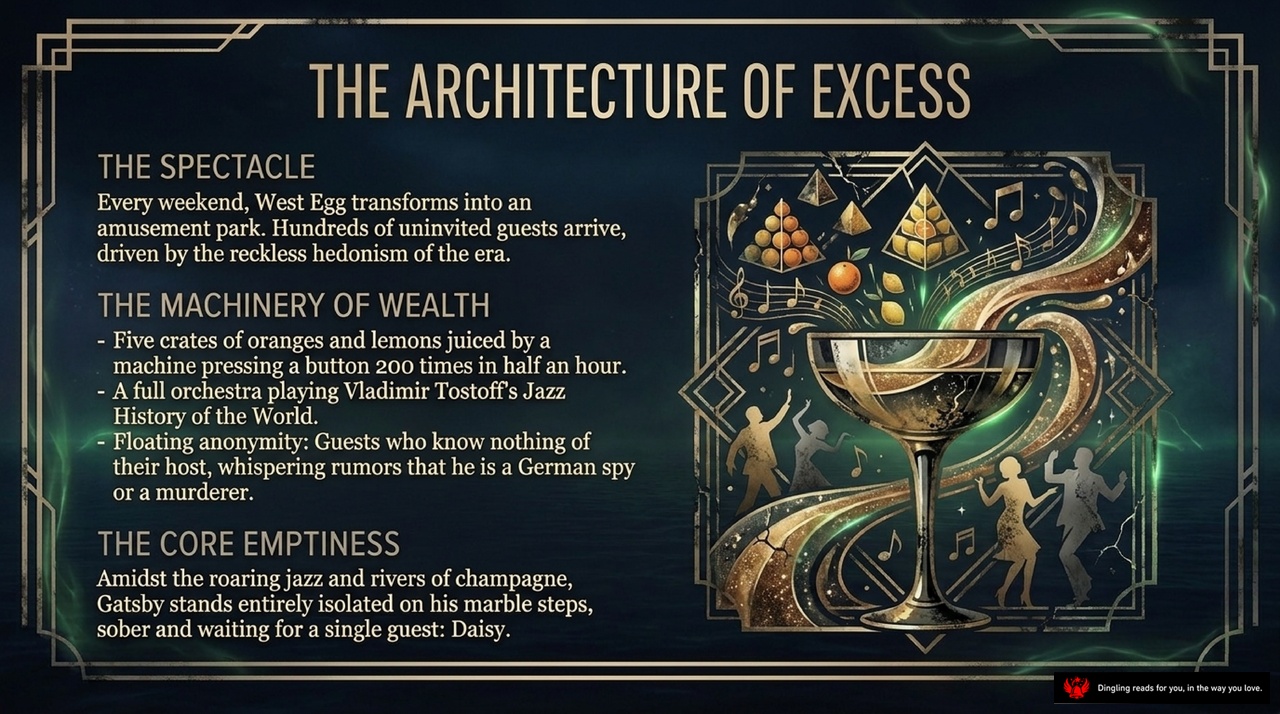
Look at this image, titled "The Architecture of Excess." It perfectly captures the chaotic, glittering, yet hollow reality of the Jazz Age as described in *The Great Gatsby*.
On the left, we see the three pillars of this world. First, "The Spectacle." Every weekend, West Egg transforms into an amusement park. Hundreds of uninvited guests arrive, driven by reckless hedonism. It's not about connection; it's about the show.
Next is "The Machinery of Wealth." Look at the details here: five crates of oranges and lemons juiced by a machine pressing a button 200 times in half an hour. A full orchestra playing Tostoff's *Jazz History of the World*. And then, "floating anonymity." Guests whispering rumors that their host is a German spy or a murderer, knowing absolutely nothing about him. This is the essence of the era—wealth bought with speed, noise, and lies.
But look at the right side of the image, the visual centerpiece. Amidst the roaring jazz, the floating musical notes, and the rivers of champagne, there is a single, stark contrast. Gatsby stands entirely isolated on his marble steps. He is sober and waiting for a single guest: Daisy. While the world around him is a blur of dancing silhouettes and golden excess, he is the only one who is truly awake, staring into a dream that no one else seems to see. This image tells us that the architecture of excess is built on a foundation of profound emptiness.

The tension graph on this slide perfectly maps the tragic arc of Gatsby's final confrontation with reality. It begins with **The Setting**: a stifling, oppressive heat in the Plaza Hotel, mirroring the boiling point of their relationship. As the tension rises to **The Demand**, Gatsby insists on erasing history, demanding Daisy tell Tom, "I never loved you," to validate his five-year crusade. But this absolute perfection is impossible. The curve hits **The Fracture** when Daisy breaks under the pressure, admitting, "I did love him once—but I loved you too." That simple sentence shatters Gatsby's uncompromising dream, colliding it with the messy, unerasable reality of human history. Finally, the graph peaks at **The Fatal Blow**. Tom casually exposes Gatsby as a common bootlegger, and the magical facade drops. Gatsby looks as though he has killed a man; the illusion is dead, and the collision of dream and reality leaves nothing but ruin.
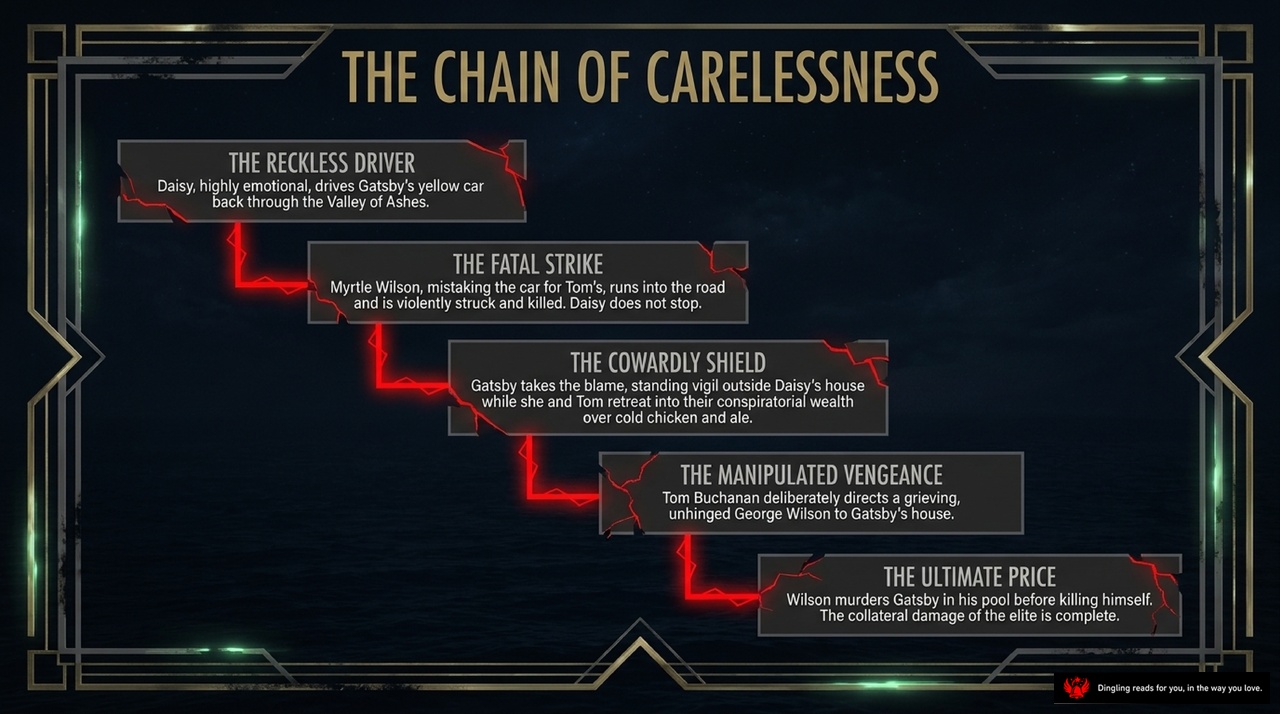
The Chain of Carelessness isn't just a title; it's the tragic blueprint of the entire story. Look at this timeline. It starts with Daisy, acting on pure emotion, driving Gatsby's car back through the Valley of Ashes. That single reckless act sets everything in motion. Myrtle Wilson, mistaking the yellow car for Tom's, runs into the road and is struck down. And here is the first crack in the foundation: Daisy doesn't stop. She leaves the scene.
Then comes the cowardly shield. Gatsby, seeing the chaos he helped create, takes the blame. He stands vigil outside Daisy's house while she and Tom retreat into their conspiratorial wealth, eating cold chicken and ale. They are safe behind their money. But Tom isn't just hiding; he is actively manipulating. He deliberately directs a grieving, unhinged George Wilson to Gatsby's house, feeding him lies and fueling his rage.
This leads to the manipulated vengeance. Wilson, convinced that Gatsby killed his wife, storms into the pool. He murders Gatsby before turning the gun on himself. The ultimate price is paid. The collateral damage of the elite is complete. Tom and Daisy simply vanish, leaving the mess for the poor to clean up. This chain shows us that in this world, the wealthy never pay the real cost of their carelessness.
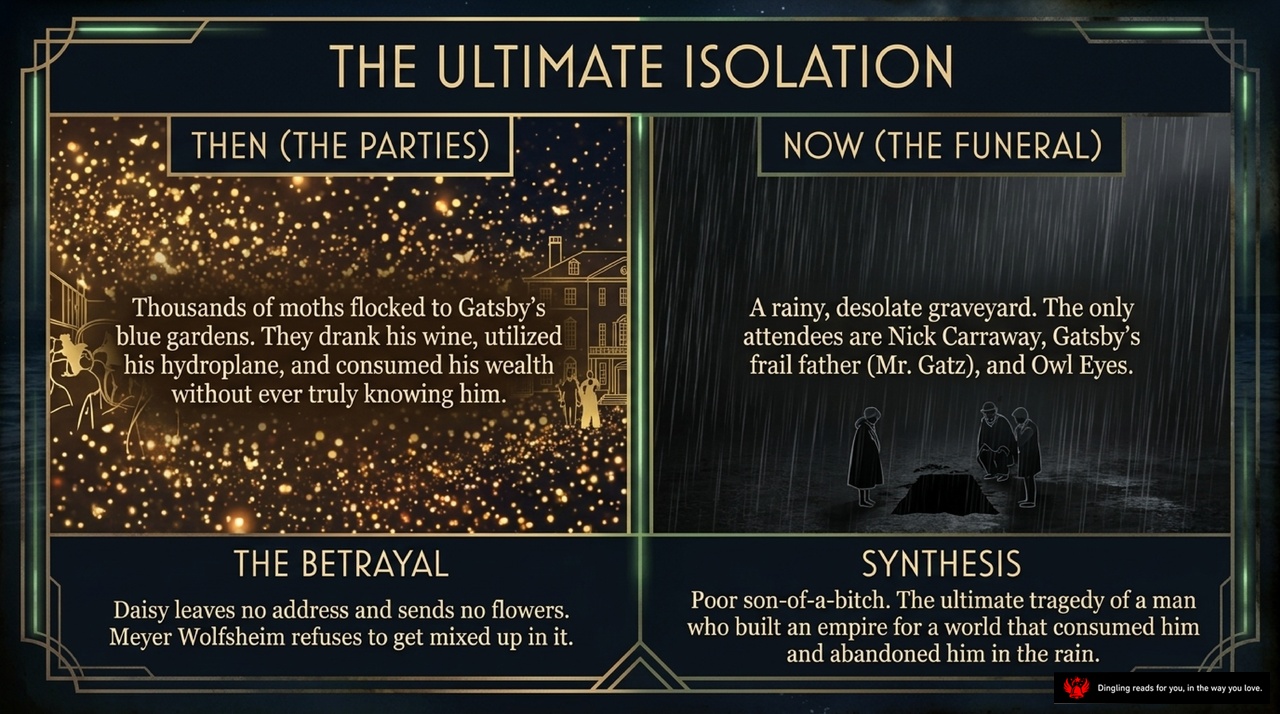
Look at this stark contrast between the roaring parties and the silent funeral. On the left, we see "Then," where thousands of moths flocked to Gatsby's blue gardens. They drank his wine, utilized his hydroplane, and consumed his wealth without ever truly knowing him. It was a spectacle of hollow admiration, a betrayal where Daisy leaves no address and sends no flowers, and Meyer Wolfsheim refuses to get mixed up in it at all.
Now, look at the right side: "Now (The Funeral)." The scene shifts to a rainy, desolate graveyard. The only attendees are Nick Carraway, Gatsby's frail father, Mr. Gatz, and Owl Eyes. It is the ultimate isolation. Poor son-of-a-bitch. This is the ultimate tragedy of a man who built an empire for a world that consumed him and abandoned him in the rain. While the world celebrated his money, no one stood by him when his dream finally crashed.

The Translator's Insight: An Elegy for an Era. This slide isn't just about literary history; it's about understanding the soul of an entire generation. Let's break down why this novel still hits so hard.
First, the Literary Context. T.S. Eliot called this the first major step forward in American fiction since Henry James. Why? Because it stopped looking at the world from the outside and started dissecting the American psyche from within. It's not just a story; it's a masterclass in modern storytelling.
Then, we have The Jazz Age. Wu Ningkun describes Fitzgerald as the chronicler of the 1920s—a time of dizzying prosperity where the American Dream swelled like a colorful balloon. But look at that background image of the jazz band. That music wasn't just entertainment; it was a soundtrack for a society running on adrenaline, trying to fill a void with noise and luxury. It was a party that refused to end, even as the foundation beneath it crumbled.
This brings us to The Lost Generation. The novel is fundamentally an elegy. Fitzgerald participated in the revelry but observed it with cold judgment. He was right there in the middle of the chaos, watching the excess, the arrogance, and the inevitable crash. He didn't just document the era; he mourned it before it was even over.
Finally, The Tragedy. Gatsby is the tragic embodiment of a generation devastated by war, pursuing an empty, materialistic utopia that was doomed to collapse. He thought money could buy happiness and rewrite the past. He thought he could just walk into a room and make someone love him again. But the world he built was made of glass. One wrong move, one careless driver, and the whole dream shatters.
So, when we read this, we aren't just reading about Gatsby. We are reading about ourselves. We are reading about the desperate, beautiful, and ultimately heartbreaking pursuit of a future that we think we can control, but often, we can't. This is the story of the American Dream, and it is a story we are still living today.

Synthesis: The Fading Green Light. This slide distills the entire tragedy of Gatsby into three powerful concepts. First, we have The Promise, or The Future. Originally, that green light at the end of Daisy's dock wasn't just a signal; it represented the organic future—the uniquely American belief that tomorrow will always be better, richer, and more perfect than today. It was the ultimate promise of the American Dream.
But then we move to The Illusion, or The Present. Gatsby believed he could buy his way back into the past. He failed to realize that his dream was already behind him, lost in the vast obscurity beyond the city. He thought he could recapture a moment that had already evaporated.
Finally, we arrive at The Universal Vector. The light is not just Gatsby's love for Daisy; it is the human condition. It is the endless, futile, yet intensely beautiful pursuit of a receding horizon. We all chase that fading green light, hoping to touch something that is always just out of reach.

Look at that boat drifting away into the dark current. It captures the essence of Jay Gatsby's tragic journey: a man who sacrificed everything at the altar of a manufactured illusion. He mistook wealth for true class, the past for the future, and a careless aristocrat for a divine ideal. The tragedy of the Jazz Age wasn't just about moral decay among the rich; it was the crushing realization that the American Dream is a beautiful, unwinnable current that inevitably carries us back into the past.
So, if the green light is an illusion, and the current will always beat us back, is the beauty of life found in the victory of reaching the shore, or in the tragic magnificence of the rowing? That question lingers long after the lights go out.