
The Hero’s Journey: Complete Chapter-by-Chapter Summary
Welcome to the journey of the human soul. Today, we step into the cosmic map drawn by Joseph Campbell, the legendary mythologist who taught us that we are all heroes. As you see the title, "Hero's Journey," this isn't just a story about a distant prince or a warrior; it is a cartography of our very own spirits. Campbell reveals a single, universal story that connects ancient myths, modern art, and our ultimate search for meaning.
He believed that the call to adventure is destiny's signal, pulling us away from our dull, everyday lives toward a strange, unknown realm filled with both treasure and danger. This journey begins not in adulthood, but in childhood. Campbell's own path started with a magical moment visiting the Natural History Museum, where he was captivated by totem poles, sparking a lifelong love for mythology. He discovered that stories from distant cultures, like Native American legends, shared deep secrets with the Catholic faith he grew up with. This realization became the foundation for his life's work.
Campbell taught us that the hero's journey is a map for navigating the human experience. It connects us to the natural world and helps us find the sacred in our own lives, right here and now, rather than looking for it in far-off places. Whether you are an artist, a scientist, or simply living your life, this ancient pattern offers a way to understand your place in the universe. So, let's begin exploring the timeless adventure that we all share.

On this slide, we see a profound duality that Joseph Campbell explores: the Outer World and the Inner World. On the left, under "The Outer World," Campbell describes it as "The Wasteland." He argues that while we live in an age of factual and scientific abundance, we suffer from a loss of the metaphors that connect our inner lives to the cosmos. We have the data, but we lack the story.
On the right, "The Inner World" is labeled "The Void." Here, Campbell suggests that without living myth, individuals are trapped in an existence of social conformity and routine, completely disconnected from the vital force of nature. We become lost in the noise of the outer world, forgetting our spiritual roots.
But look at the center. This is the crucial pivot. Campbell challenges our deepest assumption. He says, "People say that what we're all seeking is a meaning for life... what we're really seeking is an experience of being alive." This is the heart of his message. We often think we are searching for a grand purpose or a specific definition of success. But Campbell insists that the true quest is simply to feel alive. It's about reconnecting with that raw, vital energy that flows through nature and us. He wants us to move from the sterile wasteland of facts and the empty void of routine, into a state of vibrant, authentic existence. That is the true hero's journey.
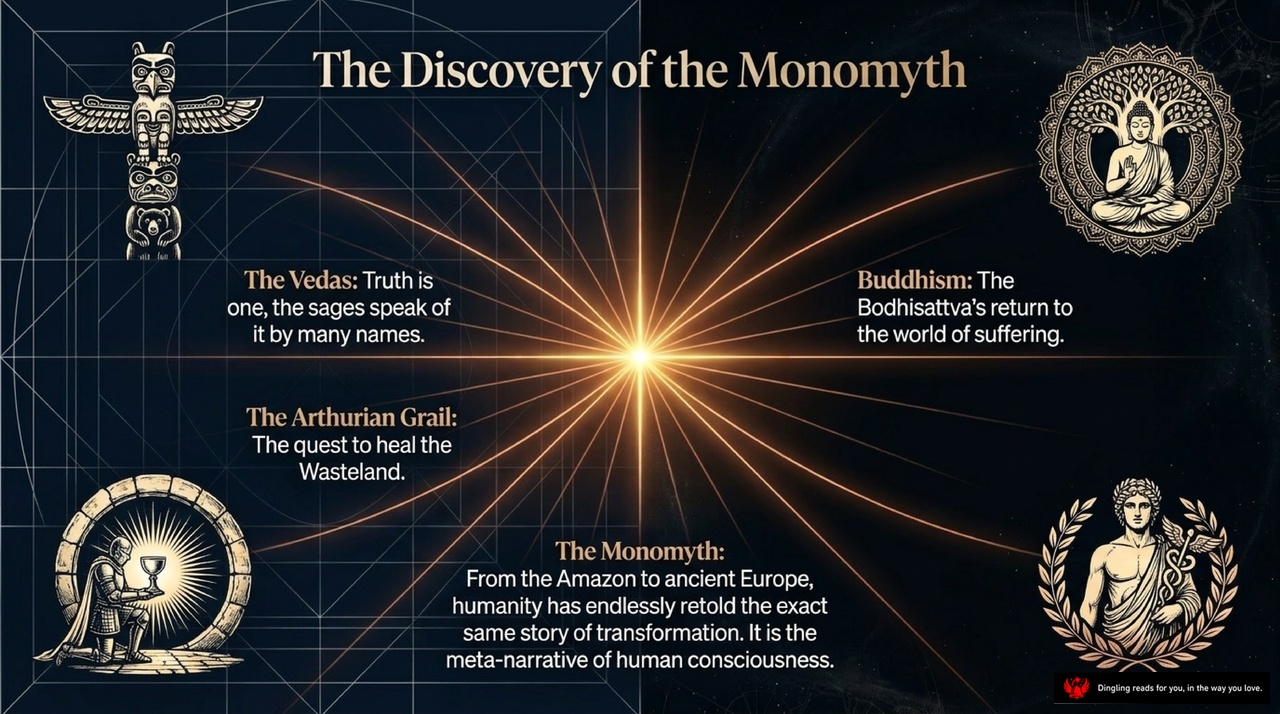
Imagine a single, blinding light at the center of our human experience, radiating outward to connect the most disparate corners of our spiritual history. This slide reveals what Joseph Campbell calls "The Discovery of the Monomyth"—the profound realization that from the Amazon to ancient Europe, humanity has been endlessly retelling the exact same story of transformation. It is the meta-narrative of human consciousness itself.
Look at the four paths converging on this central truth. In the top left, we see the Vedas, where sages speak of a singular Truth using many different names. To the right, Buddhism teaches us of the Bodhisattva's compassionate return to the world of suffering. Below, the Arthurian Grail story emerges as the quest to heal the Wasteland, a metaphor for restoring life to a barren landscape. And finally, the Monomyth itself stands as the unifying thread, proving that despite our cultural differences, we all share this deep, archetypal journey.
As Campbell famously said, "Any place is the center of the world." Whether you are standing before an Indian totem pole, meditating under a Bodhi tree, or kneeling before the Holy Grail, you are participating in the same cosmic drama. We are not separate stories; we are all chapters in the same ancient book, constantly seeking that one, unifying truth that lies right here, in our own transformation.

Look at this intricate gear system in the center of our slide. It perfectly visualizes the idea that myths aren't just old stories; they are the operating system of human consciousness, driving four distinct but interconnected functions.
First, we have the Mystical function. Think of this as opening the mind and heart to the sheer mystery of existence. It's about experiencing awe, realizing that the universe holds a transcendent reality that goes beyond what we can simply explain.
Next, the Cosmological function. This is about mapping the universe. Myths provide an image of the cosmos that aligns with the scientific understanding of that time, revealing the shape of the world and helping us feel our place within the grand design.
Then, the Sociological function. This is where myths validate order. They support specific moral structures and social hierarchies, acting as the glue that binds a community together and tells us how to behave within our society.
Finally, the Pedagogical function. This is about guiding the individual. Myths carry us through the inevitable stages of a human lifespan—the crises, the transitions, and the growth. They act as a map for the hero's journey, helping us navigate from childhood to adulthood and beyond.
So, whether we are looking at the stars, building our communities, or navigating our personal lives, myths are the four pillars holding up our reality.

Imagine a world where symbols are treated as literal facts rather than poetic metaphors. This is the dangerous trap of literalism, and Joseph Campbell spent his life warning us against it. On the left side of our slide, we see "The Opaque"—the realm of rigid historical fact. When we treat myth as literal history, we don't just misunderstand stories; we create fundamentalism, exclusion, and sick mythologies. In this mindset, God becomes a barrier rather than a gateway, and the symbol turns into a closed door that shuts us off from deeper truth.
But look to the right, where we find "The Transparent." This is the power of metaphor. Campbell argues that treating myth as poetry opens the mind. He famously stated that deities are not literal beings, but projections of our own internal psychological forces. This approach makes the symbol "transparent to transcendence." Instead of worshipping a statue as a physical god, we see it as a mirror reflecting the divine potential within ourselves. By shifting from the opaque to the transparent, we stop fighting against the mystery of life and start using ancient stories as a map to navigate our own inner landscape.
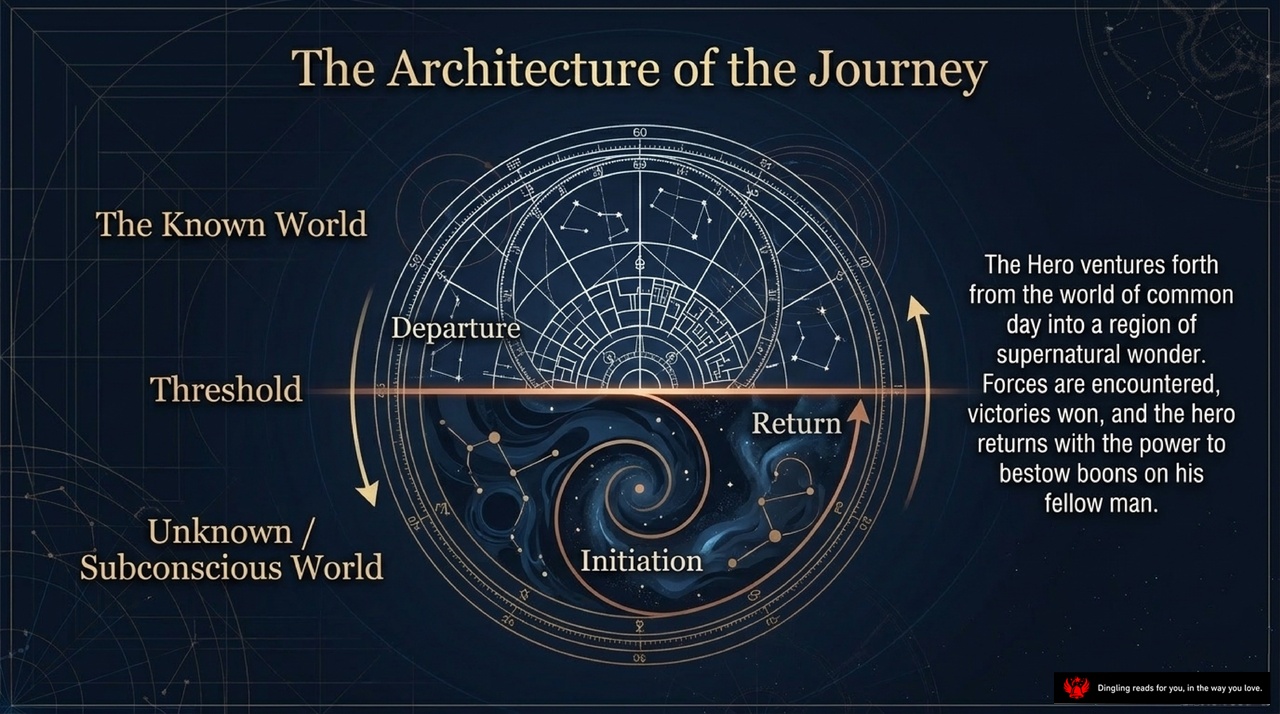
The Hero ventures forth from the world of common day into a region of supernatural wonder, crossing the threshold between the known and the unknown. Forces are encountered, victories won, and the hero returns with the power to bestow boons on his fellow man. This is the architecture of the journey—a spiral path where departure leads to initiation, and initiation leads to return. It is not just a physical trek but a profound transformation, where the individual confronts the depths of the subconscious and emerges with renewed wisdom. The hero's return is not about escaping the world, but bringing the insights gained from the mysterious realm back to everyday life, bridging the gap between the mundane and the magical. By understanding this cycle, we see that every great story, from ancient myths to modern epics, follows this same sacred structure, guiding us through the darkness toward a brighter, more empowered existence.

The journey of the hero starts not with a grand fanfare, but with a crisis—a deep sense that the old system, the "Wasteland," no longer sustains the spirit. This is the Call to Adventure, a signal from fate pulling the hero away from the mundane and into the unknown. As the slide illustrates, crossing the threshold means abandoning societal expectations to enter the dark forest of the subconscious. It is a terrifying step, because if there is a path, it is someone else's path. You must enter the forest at the darkest point, where there is no way.
This concept of the "Wasteland" is central to Campbell's work. He argues that we often live in a state of spiritual exile, disconnected from our true nature and the natural world. Just as the modern world has shifted from sacred cathedrals to cold office towers, we have lost our connection to the biological and spiritual roots of life. Campbell reminds us that myths are not lies; they are metaphors that help us navigate this inner landscape. They are the public dream of humanity, connecting us to the ineffable mysteries that science cannot reach.
To truly live, we must follow our bliss—not just the superficial fun, but the deep, abiding sense of purpose that drives us even through pain. It is about finding the "Ananda," the bliss that is the core of all existence. When we align our lives with this inner truth, we stop fighting against the current of the universe. We realize that we are not separate from nature, but part of its grand, cyclical flow. This shift in perspective is what transforms a mere survival story into a true hero's journey, turning the darkest moments into the gateway to ultimate freedom and wholeness.
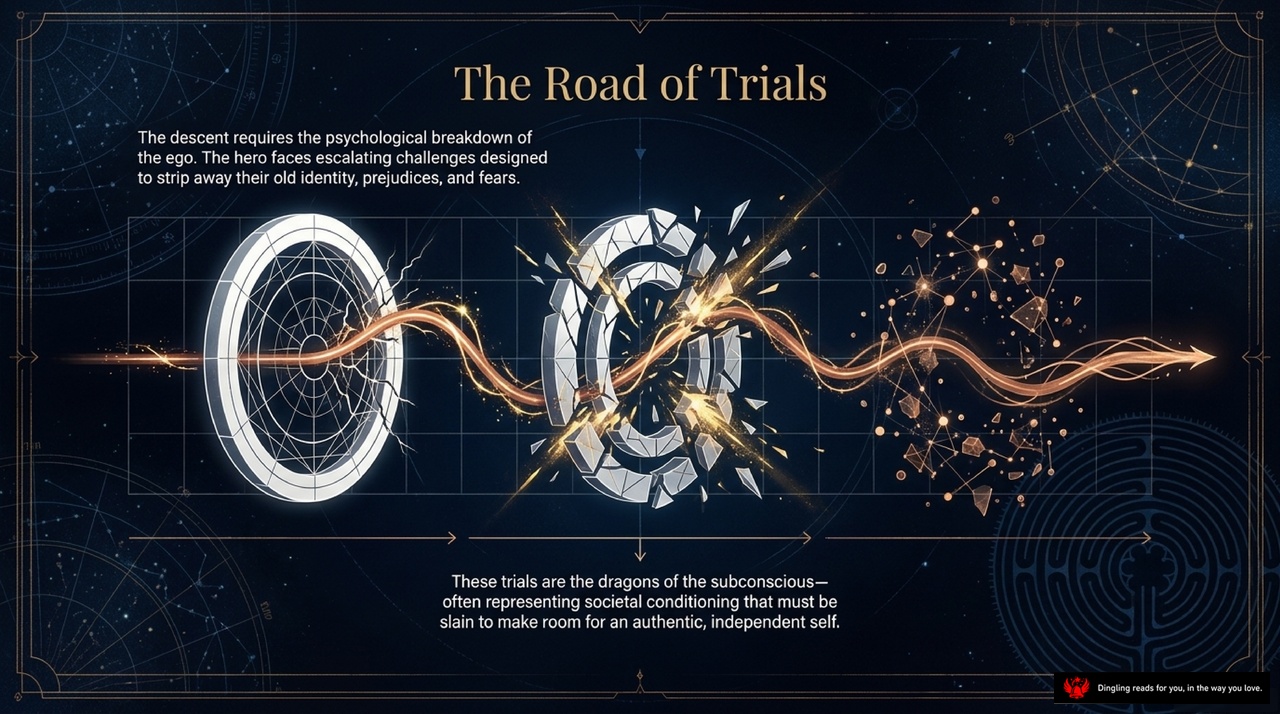
The hero's journey is not a linear path but a profound descent into the unknown, where the ego must face its most terrifying enemy: itself. As we see here, this "Road of Trials" begins with a psychological breakdown. The hero isn't just facing external monsters; they are confronting escalating challenges designed to strip away their old identity, prejudices, and deep-seated fears. It is a necessary shattering of the self.
These trials are the dragons of the subconscious. They often represent the societal conditioning we've absorbed our entire lives—the scripts we've been told to follow. To become authentic, the hero must slay these dragons. Only by destroying the rigid structures of the "old self" can they make room for a new, independent identity to emerge.
This transformation mirrors what we see in the image: a solid, circular form of the ego cracking under pressure, eventually dissolving into a scattered constellation of light and possibility. It's a chaotic but liberating process. As Joseph Campbell reminds us, we cannot reach the authentic self while clinging to the comfort of who we think we are. We must be willing to let the old world break apart so the new one can be born.
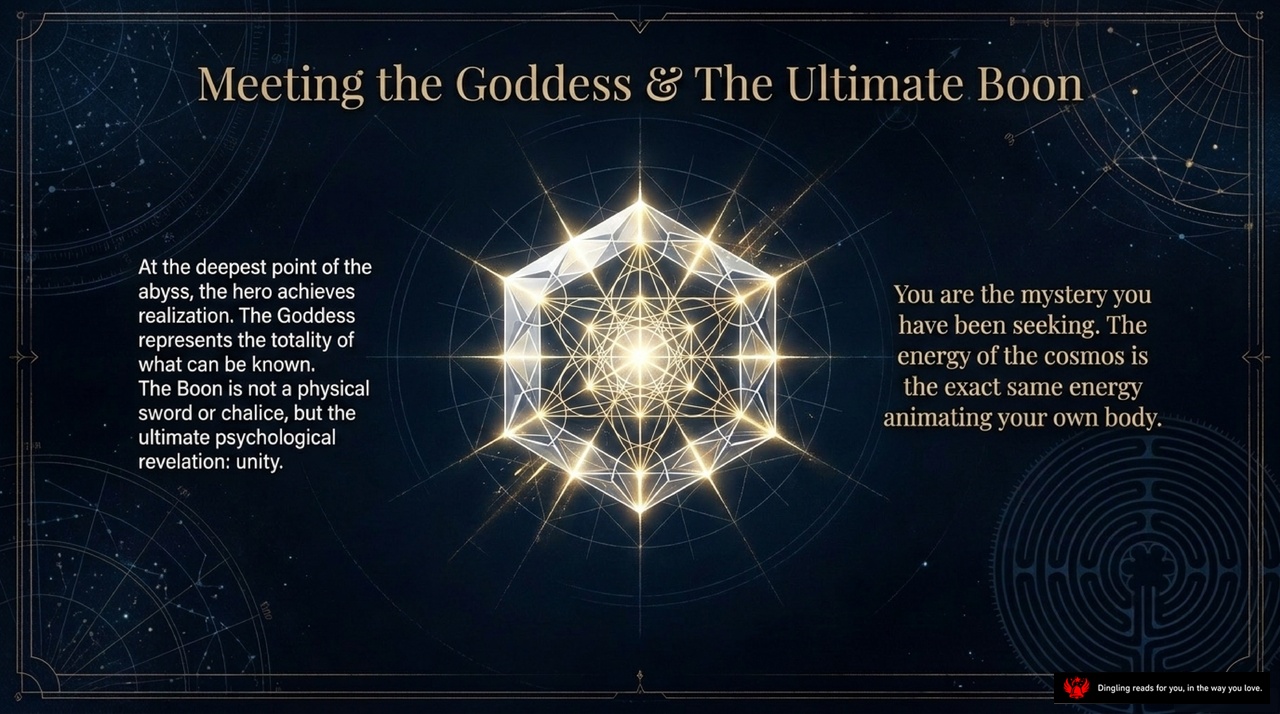
Welcome to the final, most profound stage of the hero's journey: the meeting with the Goddess and the discovery of the ultimate boon.
As the hero descends to the deepest point of the abyss, they don't find a physical treasure. Instead, they achieve a radical realization. The Goddess they encounter represents the totality of what can be known—she is not just a character, but the embodiment of the whole. And the Boon? It is not a sword or a chalice. The ultimate psychological revelation is unity.
This is the core message: You are the mystery you have been seeking all along. The energy of the cosmos is the exact same energy animating your own body. There is no separation between the inner self and the outer universe.
In the text, we see this unity reflected in the idea that the hero must realize that the divine is not a distant god to be worshipped, but the very life force within them. Just as the ancient myths teach us that the spirit of the world flows through every living thing, the hero discovers that their own consciousness is a reflection of the cosmos. This moment of realization transforms the entire journey. The struggle, the separation, and the search were all necessary steps to uncover this truth.
When the hero returns from the abyss, they carry this knowledge back to the ordinary world. They understand that the sacred is not hidden in a distant temple or a mythical past; it is right here, right now, within the rhythm of their own life. The ultimate boon is the awakening to the fact that we are all one. We are all expressions of the same divine energy. This realization dissolves fear, heals division, and connects us deeply to the world around us.
So, the journey ends not with a trophy, but with a transformation of perspective. The hero becomes the hero of their own life, realizing that they were never lost, never separate, and never without the divine. They simply had to look inward to find the Goddess and the Boon that were always there, waiting to be known.

The magic flight is only half the journey; the true test begins when the hero returns to the ordinary world to heal the wasteland. As the slide illustrates, achieving enlightenment is merely the first step—the real challenge lies in translating the ineffable language of light into the practical language of the dark. This is the core dilemma of the Bodhisattva: finding the courage to joyfully engage in the world's sorrows and bring the elixir of wisdom back to those who do not yet understand it.
Think about this: we often retreat into our own spiritual bubbles, but the hero's path demands we step back into the chaos. It requires us to take the profound insights gained in the "magic flight" and apply them to the gritty reality of our daily lives. Whether you are a leader, a parent, or an artist, your mission isn't just to find your own truth, but to become a bridge that connects that truth to the people around you. The light you carry must be translated into actions that can actually touch the darkness in others. Without this return, the journey remains incomplete. So, ask yourself: are you staying in the sanctuary, or are you stepping out to heal the world?

Welcome to the core of the Hero's Journey. As we dive deeper into Joseph Campbell's model, we move beyond the physical world and enter what he calls "The Anatomy of Bliss." Think of this as a five-layer onion, or five sheaths, that wrap around our true self.
At the outermost layer is the **Food Sheath**. This is simply your physical body—the vehicle you inhabit, which is ultimately destined to return to the earth. Moving inward, we find the **Breath Sheath**. This represents the biological spark of life, the act of oxidation that animates your cells and keeps you alive.
Next, we encounter the **Mind Sheath**. This is the reactor that processes everything around you: external pain, pleasure, and the rules of society. It's where our daily anxieties and judgments live. But inside that lies the **Wisdom Sheath**. Campbell calls this our "autonomic, deep biological intelligence." It's the part of us that knows how to survive and thrive without needing to overthink, a profound intelligence that operates beneath our conscious thoughts.
And finally, at the very center, is the **Bliss Sheath**. This is the core. It is the spontaneous, natural life force—the source of all existence. Campbell teaches us that the entire Hero's Journey is literally a descent through these layers. We must travel from the turbulent, reactive Mind, through the layers of biology and wisdom, all the way down to unlock that pure, unadulterated Bliss at the center. This isn't just a spiritual concept; it's the map for finding our true power.

Imagine standing at the center of a vast, glowing maze, where a single beam of golden light cuts through the darkness, illuminating the path forward. This is the journey of following your bliss, a concept that Joseph Campbell believed was the key to unlocking a life of true meaning and spiritual fulfillment.
To follow your bliss, you must first identify that specific pursuit that makes time stand still and causes your ego to dissolve. It is a call to find the activity that feels so natural and effortless that you lose track of time and yourself. But this path demands heroic courage. It requires the bravery to sacrifice the safety of social expectations for the deeper necessity of your soul. In a world that constantly tells us what we should want, choosing your own bliss means stepping away from the comfortable crowd to answer your inner calling.
When you commit to this path, you place yourself on a track that has been waiting for you all along. You might not see it at first, but the universe aligns to support your journey. Doors will open in places where you never thought there would be any. Opportunities, people, and experiences that seem impossible will suddenly appear, guiding you toward your destiny. This is the promise of the hero's journey: that by listening to your heart and following your passion, you are not just creating your own life, but stepping into a pre-written story of significance.
So, don't be afraid to let go of what others expect of you. Embrace the unknown, trust the process, and follow that golden light. Because when you follow your bliss, you are not just finding yourself; you are discovering the world's need for the unique contribution only you can make.

Myth in the Modern Age. Look at this image: on one side, we see the film reel, representing the contemporary forms of storytelling, and on the other, the ancient, carved mask, symbolizing the eternal archetypes that have always guided us. Modern creators take these timeless archetypes and clothe them in these very contemporary forms. Their task is to make the modern world transparent to transcendence, providing the vital myths required to heal the modern Wasteland. In a world without cohesive global rituals, the artist, the filmmaker, and the storyteller are the modern shamans. They stand between our fragmented reality and the deeper unity of existence, translating the invisible forces of the soul into stories we can see and feel. Without these new myths, we risk losing our way, drifting through a landscape that feels increasingly empty and disconnected. But when these creators succeed, they don't just entertain; they heal. They remind us that the hero's journey isn't just a story from the past; it is the blueprint for our own lives, guiding us from the mundane to the magical, helping us find the sacred in the ordinary and reconnecting us to the vast, living web of life that surrounds us.

The Hero's Journey is not merely a blueprint for ancient storytelling; it is the fundamental rhythm of human growth. It demands that we leave the comfort of the known, face the crucible of the subconscious, and return with a renewed spirit to revitalize our world.
Think of it this way: your life is a labyrinth, and right now, it might be quietly offering you a Call to Adventure. But here is the hard truth you must face to cross the threshold: what old version of yourself must you leave behind?
We often get stuck because we cling to our current identity, our past successes, or our familiar fears. But true transformation requires a radical act of letting go. You cannot add new growth to an old foundation; the structure itself must be dismantled to make room for something new. This isn't about losing who you are, but rather shedding the limiting layers that no longer serve your highest potential.
The ancient myths—from the hero who slays the dragon to the seeker who finds the treasure—all share this same core lesson. They teach us that the "crucible" we fear is actually the necessary fire for our rebirth. Without stepping out of the comfort zone, without confronting the unknown parts of our psyche, we remain stagnant. We cannot revitalize our world, or even our own lives, if we refuse to evolve.
So, ask yourself today: What part of me am I holding onto that is actually holding me back? Is it a fear of failure? A need for approval? Or perhaps a rigid belief about who I am supposed to be? The Call to Adventure is not a distant event waiting to happen; it is an internal shift that begins the moment you decide to stop clinging to the past and start embracing the mystery of what comes next. To truly grow, you must first be willing to disappear into the fire, so that a stronger, renewed version of you can emerge on the other side.