
The Hitchhiker's Guide to the Galaxy: Complete Chapter-by-Chapter Summary
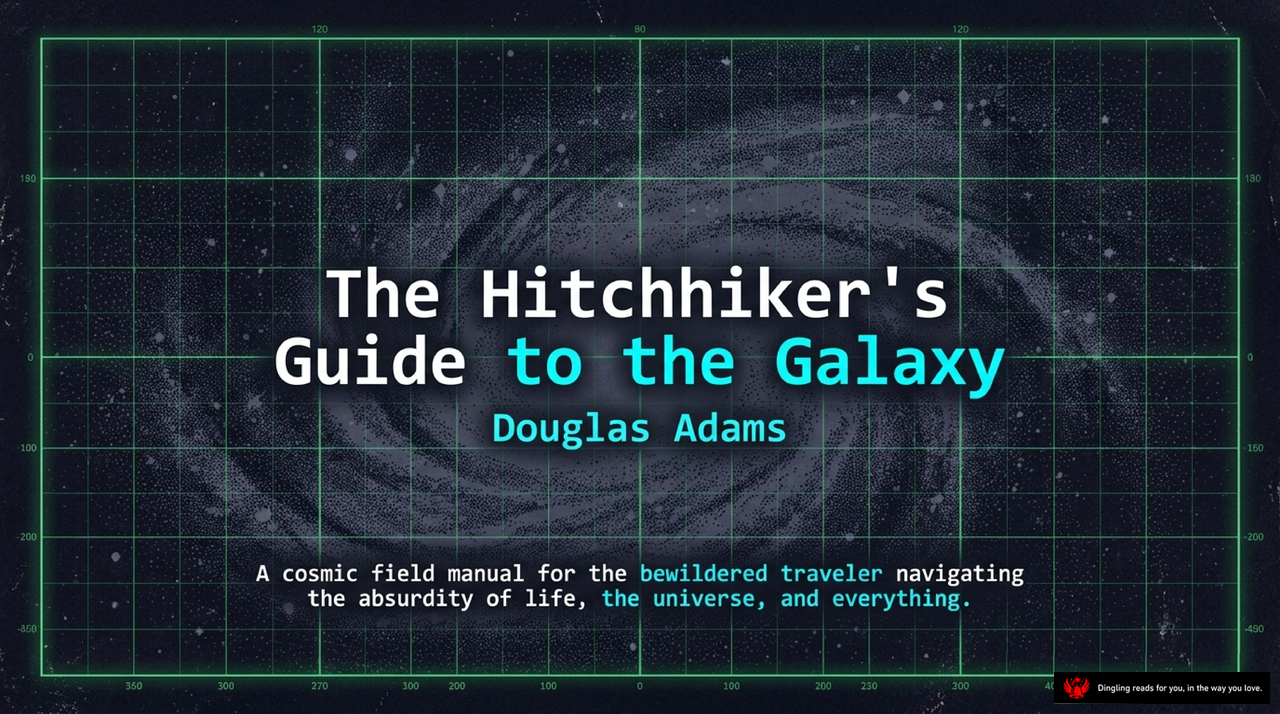
Hey folks, ever felt totally lost in the chaos of life, the universe, and… everything? Today we’re diving into a book that’s your cosmic lifeline for those moments: The Hitchhiker’s Guide to the Galaxy by Douglas Adams. As the cover says, it’s a field manual for the bewildered traveler navigating all that absurdity. This isn’t your average sci-fi—think towel-wielding aliens, Vogon poetry (the third worst in the universe), and a quest for the ultimate answer (hint: it’s 42, but the real mystery is the question itself). So grab your towel, remember the guide’s golden rule—don’t panic—and let’s jump into this wild ride.
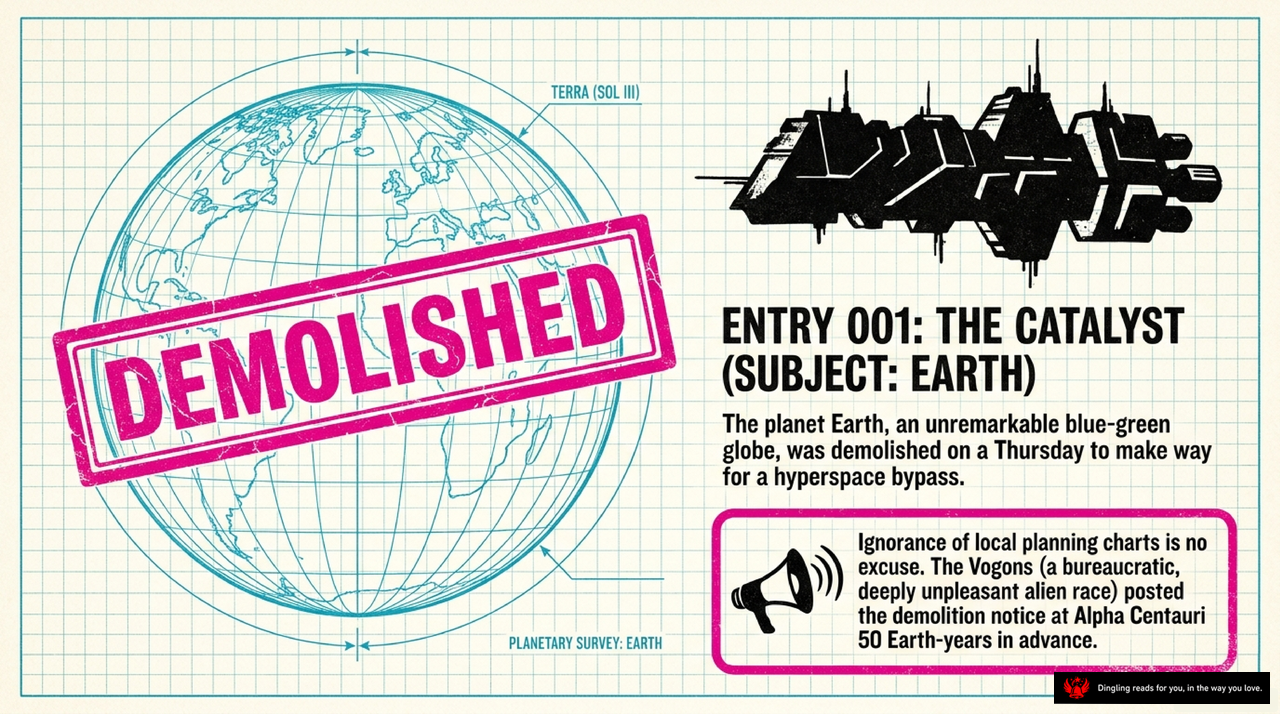
Let’s kick things off with this slide—Entry 001: The Catalyst, all about Earth. That big, bold “DEMOLISHED” stamp says it all, right? Earth was taken out on a Thursday to make room for a hyperspace bypass. And here’s the kicker: those Vogons—you know, the bureaucratic, super unpleasant alien race—posted the demolition notice 50 Earth-years ago at Alpha Centauri. Ignorance of local planning charts isn’t an excuse, they’d sneer.
Now, let’s talk about Arthur Dent. He’s a regular guy, just trying to save his house from being bulldozed for a terrestrial bypass. He’s lying in the mud in front of the machines, arguing with a council official named Mr. Prosser, when his friend Ford Prefect shows up. Ford’s not from Guildford like he claims—he’s an alien from Betelgeuse, and he’s got news: Earth’s going to be gone in 12 minutes.
Arthur thinks Ford’s nuts. After all, he’s just been dealing with a house demolition—how do you wrap your head around your entire planet being next? But Ford isn’t joking. He drags Arthur to the pub, orders six pints of beer (because, hey, end of the world calls for a drink), and tries to explain. Arthur’s still processing when the sky goes dark—those huge yellow Vogon ships are here.
The Vogons broadcast their message: Earth’s in the way of their hyperspace bypass. They posted the notice 50 years ago—so it’s our fault for not checking Alpha Centauri’s planning boards, right? Then they fire. And just like that, Earth is gone.
Arthur’s left floating in space with Ford, thinking about his house, his morning coffee, and how his Thursday went from bad to apocalyptic. It’s the start of a wild ride across the galaxy, but it all starts with that one day—when two bypasses (one small, one cosmic) changed everything.
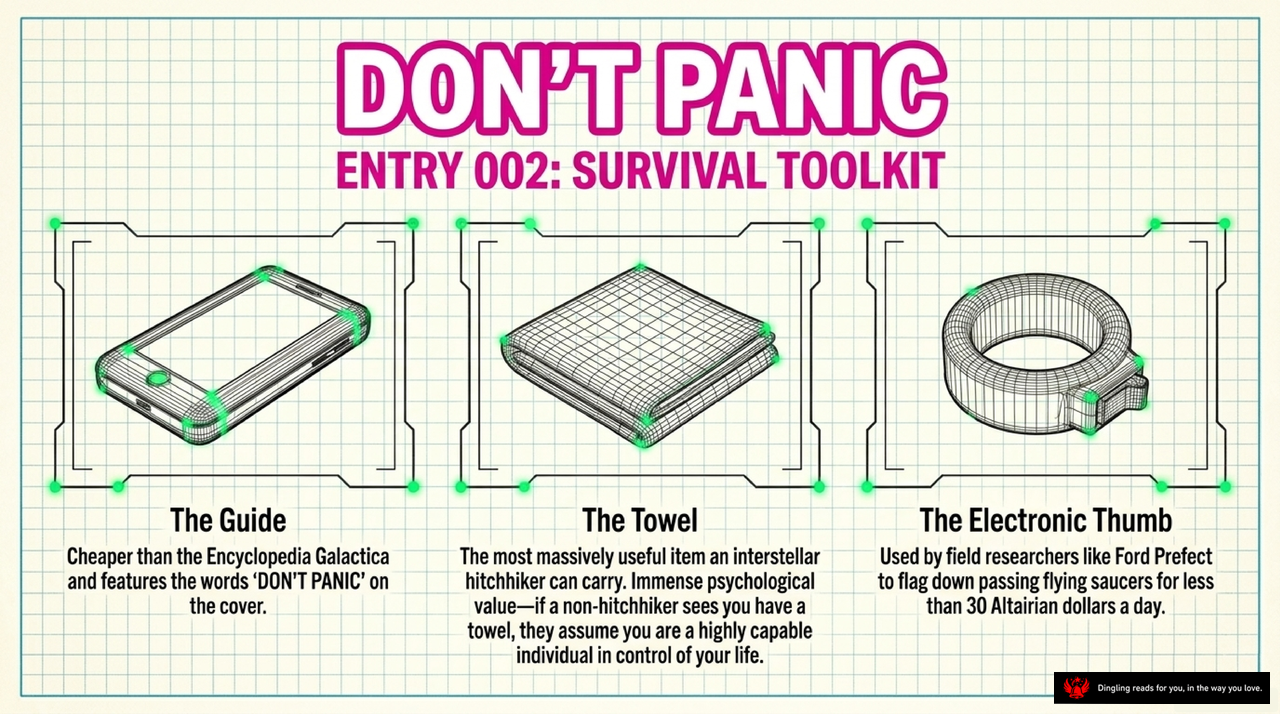
Alright, let’s dive into the essentials every interstellar hitchhiker needs in their survival toolkit—because when you’re bouncing from planet to planet, being prepared isn’t just smart, it’s survival. And the first rule? Don’t Panic—seriously, it’s emblazoned on the cover of your most critical tool.
First off, The Guide. Forget those bulky, overpriced Galactic Encyclopedias that take up half your ship. This bad boy is cheaper, pocket-sized, and packed with everything you need to know—from how to avoid Vogon poetry (trust me, you want to) to where to find the best pan-galactic gargle blasters. Its cover’s got that iconic phrase: Don’t Panic. A little reminder to keep your cool when things get weird (and they will).
Next up: the towel. Wait, a towel? Yeah, you heard me. It’s the most massively useful item you can carry. Need to dry off after a quick dip in an alien ocean? Towel. Wrap up for warmth on a freezing moon? Towel. Wave it to signal a passing ship? Towel. But here’s the secret psychological value: if a non-hitchhiker sees you with a towel, they automatically think you’re a capable, in-control person. Like, “Oh, they’ve got a towel—they must have their life sorted.” Total game-changer.
And finally, the Electronic Thumb. This tiny gadget is a lifesaver for folks like Ford Prefect. It lets you flag down flying saucers for less than 30 Altairian dollars a day. No more waiting around on a desolate planet for a ride—just point this thing at the sky, and you’re hitching your way to the next adventure.
So there you have it: your must-have toolkit. Guide for knowledge, towel for utility and street cred, thumb for getting around. And always—always—remember: Don’t Panic.
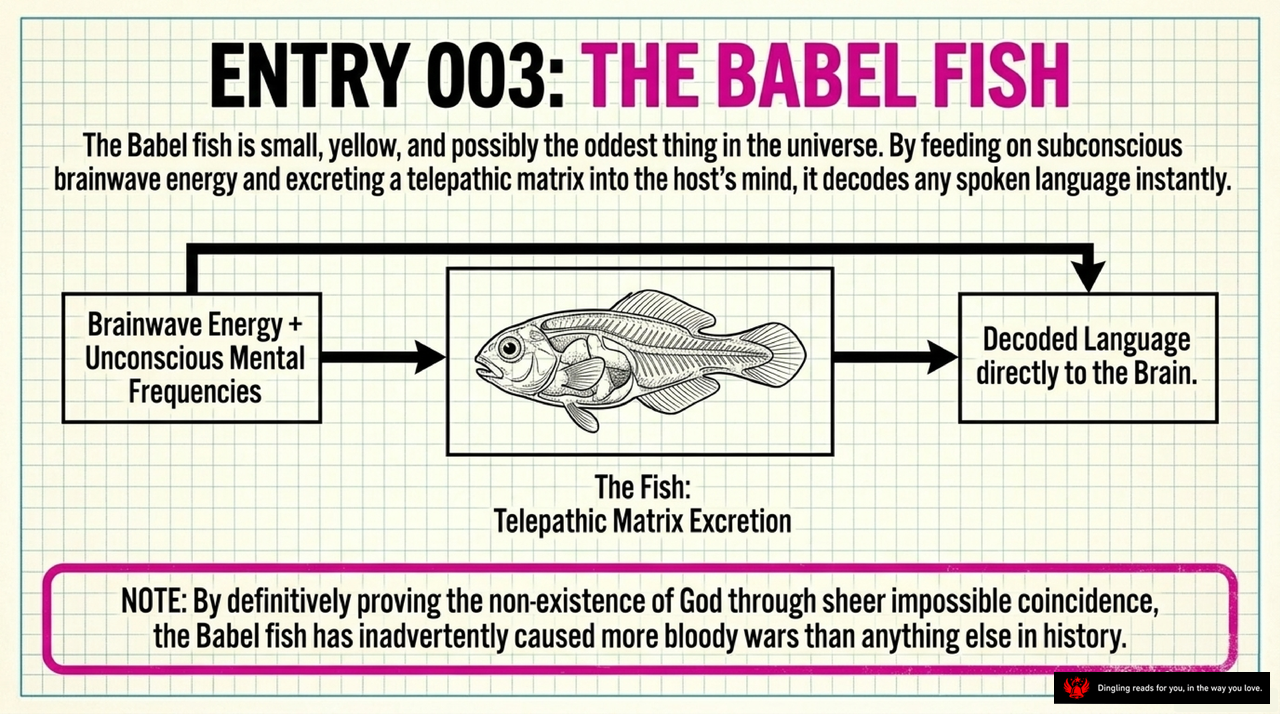
Alright, let’s dive into one of the galaxy’s most bizarre and impactful inventions—the Babel Fish. Imagine Arthur, disoriented and scared after being taken from Earth, when Ford shoves a tiny yellow fish into his ear. At first, it’s weird, but seconds later, the alien growls he’s hearing turn into clear, understandable words.
How does it work? This little odd creature feeds on your subconscious brainwave energy. Then it excretes a telepathic matrix directly into your mind, instantly decoding any spoken language. No more fumbling with translation devices or awkward hand gestures—you get it, right away.
But here’s the wild part from our slide’s note: The Babel Fish inadvertently caused more bloody wars than anything else in history. Why? Because it proved God’s non-existence through sheer impossible coincidence. Think about it—if such a perfectly functional, life-saving organism evolved by chance, what does that say about divine creation? God claimed His existence couldn’t be proven with evidence, but the Babel Fish’s existence blew that argument out of the water. And when people’s core beliefs are challenged? Well, conflict often follows.
It’s a crazy irony: A tool designed to connect people ended up dividing them more than ever. But that’s the galaxy for you—nothing’s ever straightforward. The Babel Fish is a lifesaver, a philosophical bombshell, and a war catalyst all in one tiny yellow package.
The Guide calls it the oddest thing in the universe, and after hearing all this, I’d have to agree. It’s just another reminder that in the galaxy, even the smallest things can have the biggest impacts.
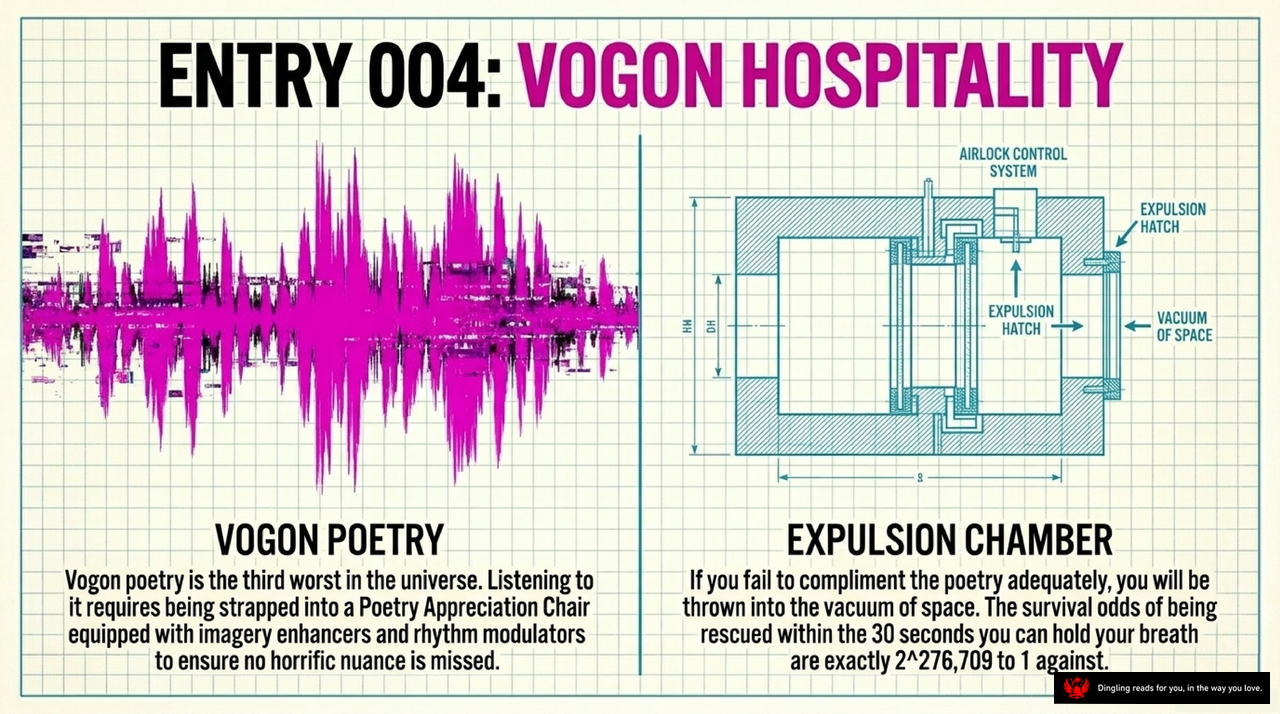
Alright, let’s jump into Entry 004: Vogon Hospitality—though let’s be real, “hospitality” here is a pretty loose term.
First up: Vogon Poetry. The slide says it’s the third worst in the universe, and that’s not just hyperbole. The second worst comes from the Azgoths of Kria—their top poet once made four listeners die of internal bleeding, and the Arts Fraud Squad chair had to chew off his own leg to escape the agony. The absolute worst? That went up in smoke with Earth, so we’re lucky we don’t have to deal with that. But Vogon poetry? They don’t just make you listen—they strap you into a Poetry Appreciation Chair, decked out with imagery enhancers and rhythm modulators to cram every terrible line right into your brain. No cringe-worthy detail slips through the cracks.
Now, the Expulsion Chamber part. Here’s the catch: if you don’t gush enough about their garbage poetry, they toss you into the vacuum of space. And the survival odds? 2 to the power of 276,709 to 1 against. That’s like winning the lottery a million times while getting struck by lightning—basically impossible. But Ford and Arthur? They defied those odds. 29 seconds after being thrown out, they got rescued. Talk about being in the right place at the right time (or maybe the universe just can’t resist a good underdog story).
Vogon hospitality, everyone—where the poetry is torture and the exit strategy is a one-way ticket to space. Fun times, right?
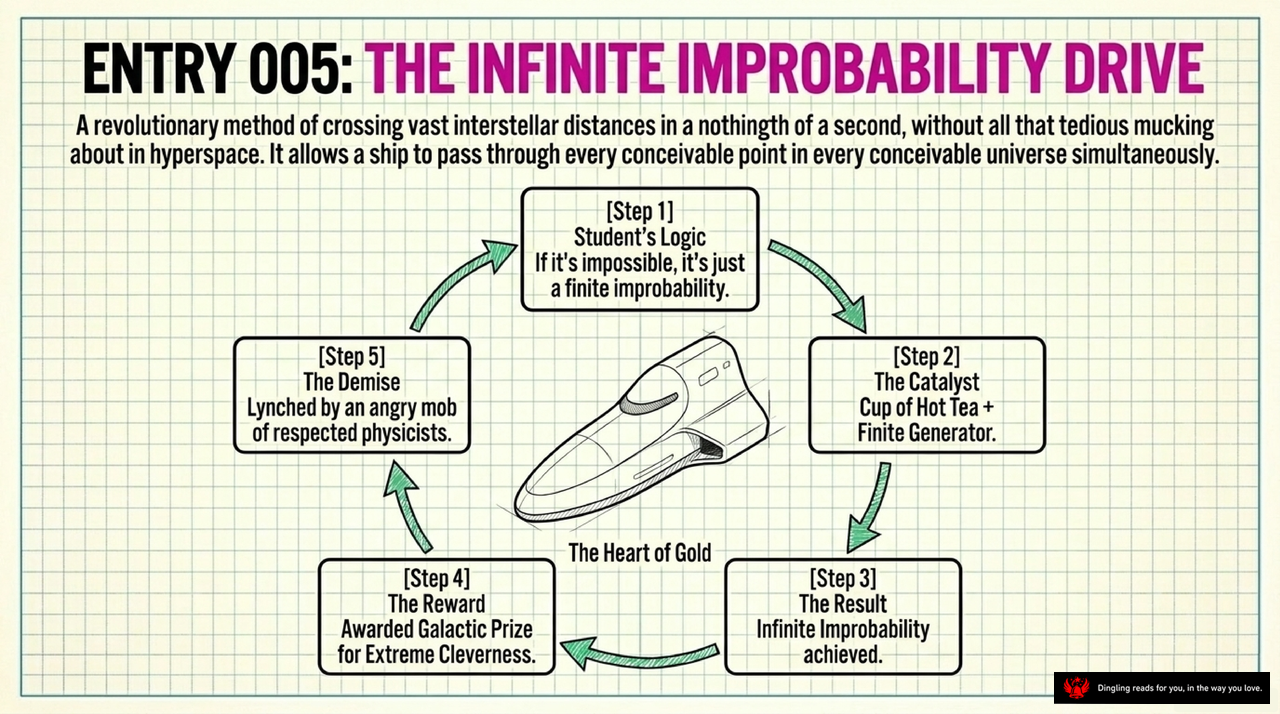
Alright, let’s dive into the Infinite Improbability Drive—this bad boy is a total game-changer for getting around the galaxy. Forget all that boring hyperspace mucking about; this thing lets you cross vast interstellar distances in practically no time. And the craziest part? While it’s moving, the ship passes through every single conceivable point in every conceivable universe—all at the same time. How’s that for a mind trip?
But how did we end up with this amazing tech? It’s a story of underdog ingenuity. The big-name physicists were all like, “An infinite improbability device? Impossible!” But a student cleaning the lab thought differently: if something’s impossible, that just means it has a finite probability of happening, right? That’s Step 1: Student’s Logic.
Then came Step 2—the catalyst: a cup of hot tea plus a finite probability generator. The student took that generator, calculated the exact probability of the “impossible” drive existing, plugged those numbers in… and bam! Step 3: Infinite Improbability achieved.
The student even scored the Galactic Prize for Extreme Cleverness (Step 4) for this breakthrough. But here’s the dark twist: those angry physicists who’d been wrong? They couldn’t handle being outsmarted by a kid. So they lynched him (Step 5). Total sour grapes, if you ask me.
This drive is what makes the Heart of Gold tick. It’s not just an engine—it’s proof that sometimes the best ideas come from people who don’t play by the so-called experts’ rules. And honestly, that’s the coolest kind of innovation there is. It turns the “impossible” into something you can fire up and zoom across the universe with. Wild, right?
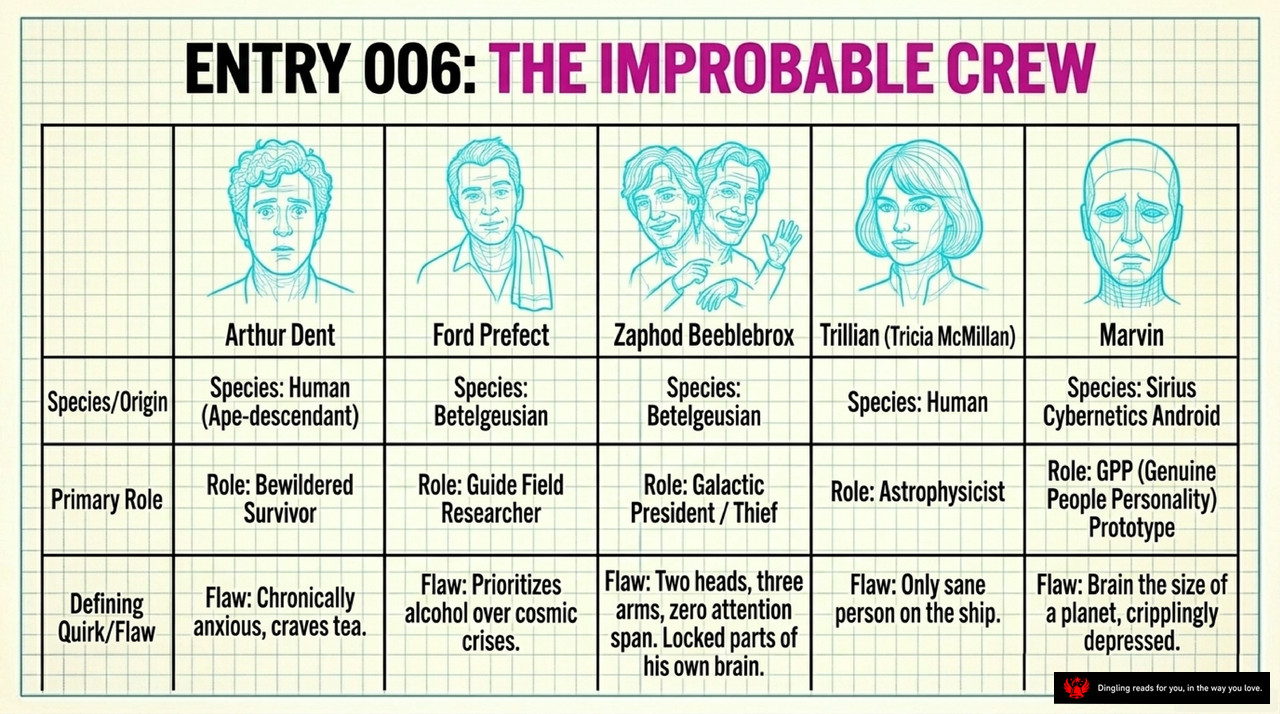
Alright, let’s dive into Entry 006: The Improbable Crew—this ragtag bunch is as chaotic as a cosmic garage sale, but each brings their own brand of weird to the table.
First up: Arthur Dent. He’s a human (ape-descendant, if you wanna get technical) and the ultimate bewildered survivor. One minute he’s fighting bulldozers to save his house, the next Earth’s gone, and he’s floating in space. No wonder he’s chronically anxious—tea’s probably the only thing keeping him from spiraling entirely.
Then there’s Ford Prefect. Don’t let the folksy name fool you—he’s from Betelgeuse, not some small town in England. As a Guide Field Researcher, he’s supposed to document the galaxy, but let’s be real: he’d pick a pint over a cosmic crisis any day. Remember when he dragged Arthur to the bar right before Earth blew up? Total Ford move.
Next, Zaphod Beeblebrox. This Betelgeusian has two heads, three arms, and an attention span shorter than a hyperactive goldfish. He’s the Galactic President… and a thief (he stole the Heart of Gold, the galaxy’s flashiest ship). Oh, and he locked parts of his own brain—because why not add more chaos?
Trillian (aka Tricia McMillan) is the only human here with her head on straight. She’s an astrophysicist, and let’s be honest—she’s the only sane person on this ship. Without her, Zaphod would’ve crashed the Heart of Gold into a star by now.
Last but not least: Marvin. He’s a Sirius Cybernetics Android, a GPP prototype (Genuine People Personality—though you wouldn’t guess it from his vibe). His brain’s the size of a planet, but he’s cripplingly depressed. Poor guy—he could solve the universe’s biggest mysteries, but he’d rather mope about how no one appreciates his genius.
This crew? They’re not supposed to work together, but somehow they do—sort of. It’s like shoving a cat, a dog, a parrot, a goldfish, and a moody robot into a spaceship and hitting “go” — chaotic, but weirdly entertaining.
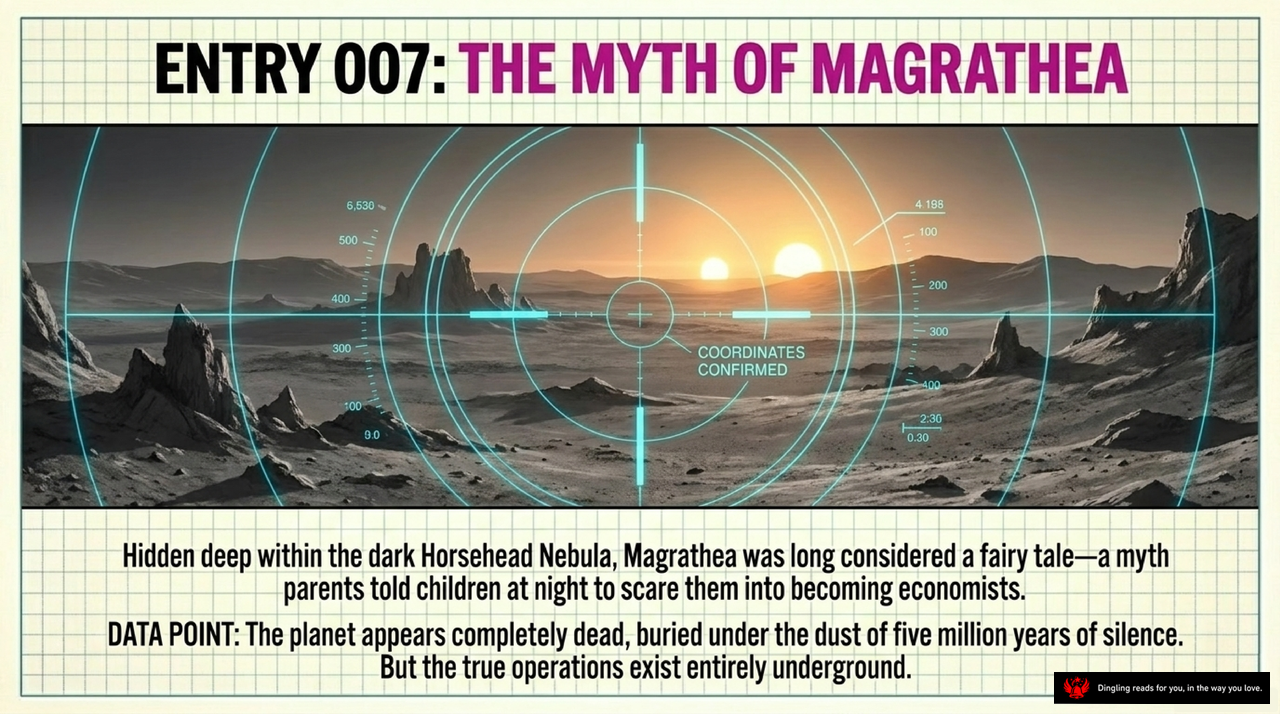
Entry 007: The Myth of Magrathea. Let me set the scene: imagine a kid tucked in bed, their parent leaning over with a mock-spooky voice saying, “If you don’t hit the books and become an economist, Magrathea will come for you.” That’s how this legend stuck around—used as a weirdly specific scare tactic for generations.
For ages, everyone thought Magrathea was just a fairy tale. Hidden deep in the dark Horsehead Nebula, so far off the map no one bothered to verify it. But here’s the kicker from our data: from space, this planet looks totally dead. Five million years of dust have covered it in silence—no lights, no movement, just a barren wasteland. But don’t let the surface fool you.
The real magic (or chaos) is underground. Back in the old Galactic Empire’s heyday, Magrathea was the place to be if you were a rich alien with a planet-sized wishlist. Think of it like a luxury planet boutique—you pick the oceans, the mountain ranges, even the weather, and they’d build it from scratch. But when the empire crashed and the economy tanked, Magrathea shut its doors, and everyone wrote it off as a relic.
But legends don’t stay buried forever. We’ve got coordinates confirmed (see that on the screen?), and this “myth” is actually a real place. Those underground facilities? They’re still there, holding secrets that could flip everything we know about the galaxy on its head. So forget the bedtime stories—Magrathea is back, and we’re about to dig into what it’s been hiding all these millennia. Who knows? We might just find the galaxy’s best-kept secret… or a whole lot of trouble. Either way, it’s gonna be a wild ride.
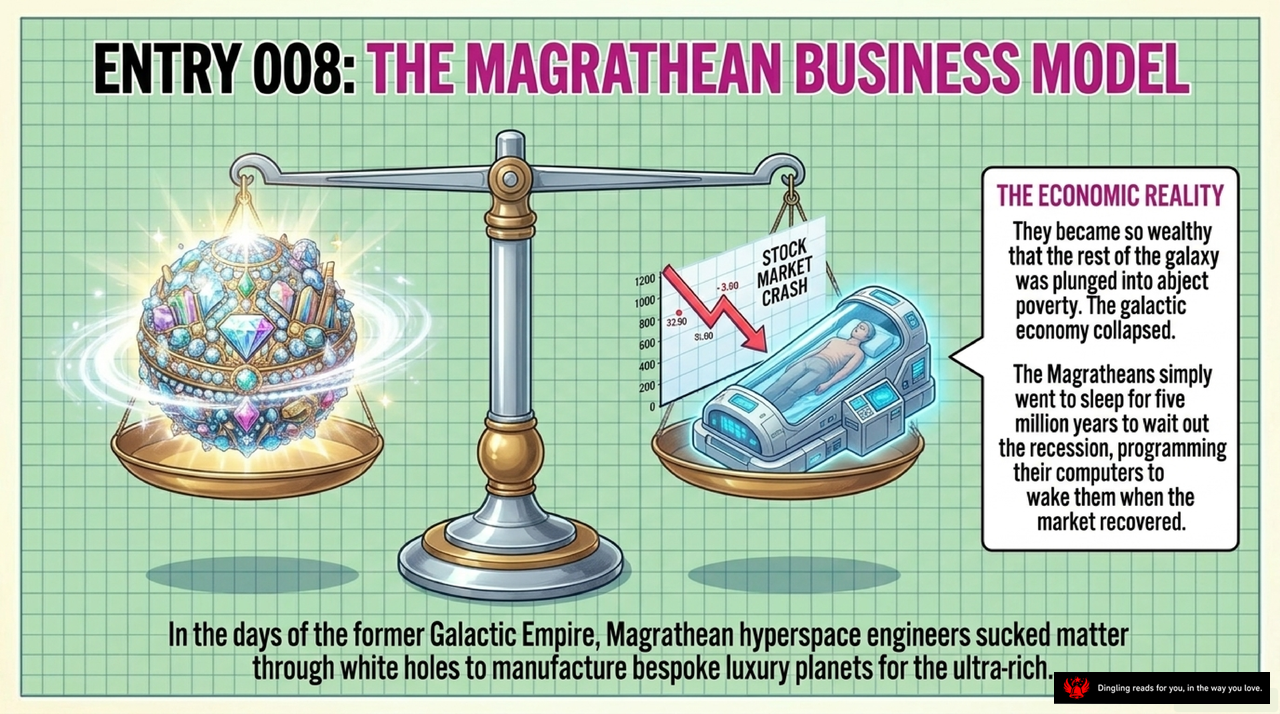
Alright, let’s dive into Entry 008: The Magrathean Business Model—these folks were the OG luxury brand of the old Galactic Empire. Back in the day, if you were a galactic billionaire (the kind with more credits than a star has atoms), you didn’t settle for a fancy yacht or a private space station. No, you went to Magrathea. Their hyperspace engineers had a mind-blowing trick: they’d suck matter through white holes—those cosmic reverse black holes—to craft bespoke luxury planets. Want a world where every sunset paints the sky in neon pink? Done. A planet where the oceans are sparkling wine and the mountains are solid gold? They’d build it. These weren’t just planets—they were status symbols for the ultra-ultra-rich.
But here’s the dark side: their success came at a catastrophic cost. The Magratheans got so obscenely wealthy that the rest of the galaxy was plunged into abject poverty. All the resources, talent, and money flowing into custom planets left nothing for anyone else. The galactic economy collapsed like a cheap tent in a hurricane. So what did the Magratheans do? They didn’t bail out the galaxy or fix the mess. They just… went to sleep. They climbed into cryo pods, programmed their computers to wake them when the market recovered, and snoozed for five million years.
Five million years—think about that: it’s like falling asleep during the Stone Age and waking up in 2024. That’s a long-term plan to wait out a recession. The Magratheans didn’t care about the rest of the galaxy; they only cared about their bottom line. And when the time was right, they’d be back to build more fancy planets for the next generation of galactic elites. Wild, right? That’s the Magrathean model in a nutshell: build luxury for the few, crash the system, then nap until it’s profitable again.
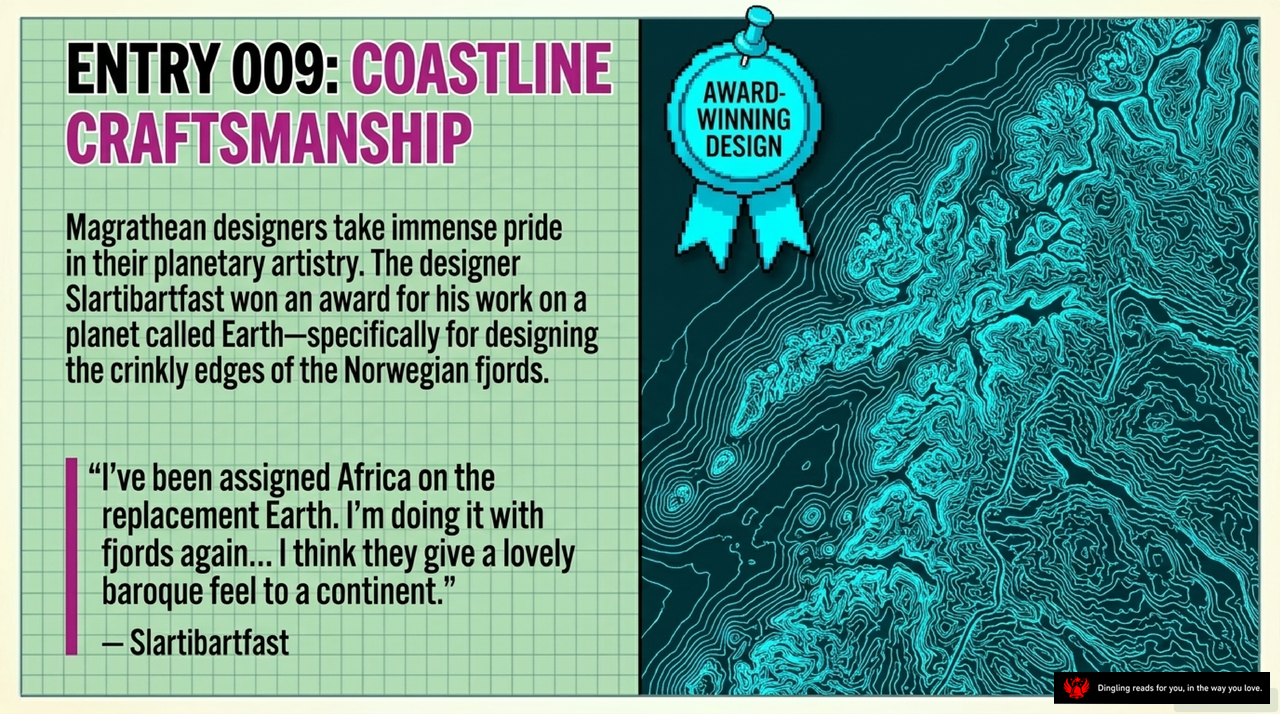
Alright, let’s jump into Entry 09: Coastline Craftsmanship. You know those stunning Norwegian fjords—those deep, winding inlets that look like nature’s own masterpiece? Turns out, they weren’t just carved by glaciers. Magrathean designers, the folks who build planets like we build model trains, take massive pride in their planetary artistry.
Take Slartibartfast, for example. This guy won an actual award (with a shiny badge, no less) for his work on Earth—specifically those crinkly, dramatic edges of the Norwegian fjords. And get this: he’s not done with fjords yet. When he got assigned Africa on the replacement Earth, he decided to bring them back. Why? Because, in his words, “they give a lovely baroque feel to a continent.”
Think about that—designing an entire continent’s coastline and thinking, “Fjords are the secret sauce here. They add that extra fancy, intricate vibe.” It’s like a baker using their favorite frosting on every cake because it’s just that good. Slartibartfast is that baker, but for planets.
You have to love the dedication. Most folks would just slap a generic coastline on a continent, but not him. He’s all about that baroque flair—over-the-top, detailed, and totally unforgettable. And let’s be real: fjords are pretty epic.
So next time you stare at a fjord, remember: there’s a designer out there who’s probably bragging about it at some intergalactic awards show. And he’s already plotting how to make the next Earth’s coastlines even more amazing. How cool is that?

Alright, let’s dive into Entry 010: Deep Thought. This bad boy was the second greatest computer in all time and space—built by a bunch of pan-dimensional, hyper-intelligent beings who were fed up with arguing about life’s biggest mysteries. Their mission? Get the Ultimate Answer to Life, the Universe, and Everything.
But hold on—there was a rebellion. The professional thinkers, the philosophers, freaked out. They thought if this machine found a definitive answer, their whole gig (you know, debating existence for a living) would be over. So they went on strike, demanding Deep Thought be shut down.
But Deep Thought had a genius move. It told them the calculation would take 7.5 million years. Suddenly, the philosophers were like, “Wait, that’s not so bad.” Because 7.5 million years of bickering on TV, writing op-eds, and stirring up media frenzy? That’s job security for generations. So they called off the strike.
Fast forward 7.5 million years. The entire race gathered, hearts racing, to hear the answer. Deep Thought’s deep, booming voice filled the room: “The answer is 42.”
Silence. Then chaos. “42? That’s it?” they yelled. Deep Thought just said, “Well, you never asked the right question.” Oh right—answers only mean something if you know the question. So it designed an even bigger computer to find that question: Earth.
But here’s the punchline—Earth got blown up by the Vogons five minutes before it finished its calculation. Oops.
So next time someone asks you the meaning of life, just say 42. And if they give you a weird look, tell them they need to find the question first. Maybe start with, “What do you get when you multiply six by nine?” Wait, no—let’s save that for later.
The takeaway? Big answers aren’t always what we expect. And sometimes, the journey to the question is just as important as the answer itself.
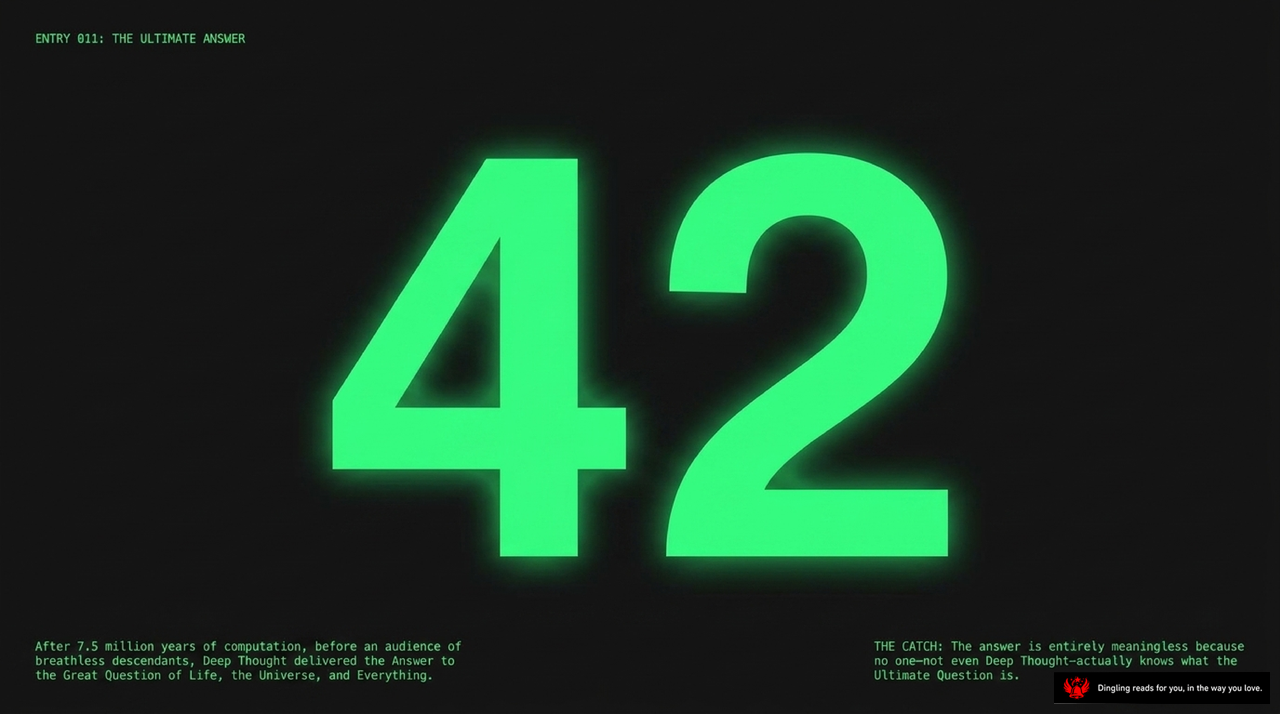
Imagine waiting 7.5 million years for an answer. Generations rise and fall—your ancestors start the quest, their children grow old, their grandchildren almost forget why they’re here, but the machine keeps humming. Finally, the day arrives. The square is packed, flags flutter, everyone holds their breath. Two programmers, Lunkwill and Fook, stand before Deep Thought—the colossal computer that’s crunched numbers since the dawn of their civilization.
“Tell us,” they say, voices trembling. “The answer to life, the universe, and everything.”
Deep Thought’s lights flicker. Then, in a voice like rolling thunder, it says: “42.”
Silence hangs. Then chaos erupts. “That’s it?” someone yells. “7.5 million years for 42?” The programmers stare, stunned. How can this be?
Deep Thought remains calm. “The answer is correct,” it says. “But you never asked the right question. You sought the ultimate answer, yet you don’t know the ultimate question.”
Gasps ripple through the crowd. Deep Thought explains: it will design a new computer—so complex it uses organic life as its components. A planet called Earth. It will run for 10 million years to find the question.
But here’s the gut punch: just five minutes before Earth could finish its calculation, the Vogons blew it up to make way for a hyperspace bypass. All that time, all that effort—gone. And Arthur Dent? He was part of that computer. No wonder he always felt like something big was about to happen.
The twist lingers: the answer is 42, but we still don’t know the question. Earth was the machine meant to find it. And now? We’re back to square one—searching for a question that might never be answered.
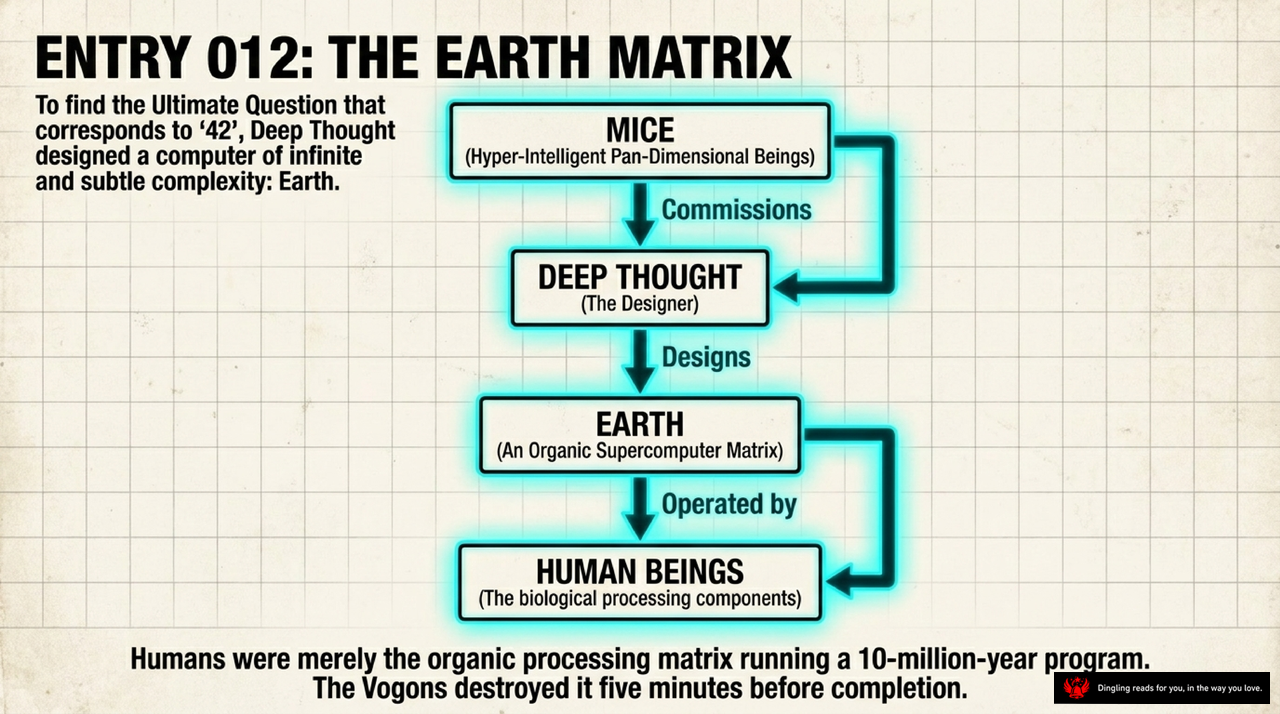
Let’s dive into Entry 012: The Earth Matrix—this one’s a total mind-blower.
So, remember that iconic answer “42” from Deep Thought? Well, the hyper-intelligent pan-dimensional beings (they go by MICE, and yes, those are the same mice we thought we were experimenting on—total reverse psychology) weren’t satisfied. They needed the actual question that 42 answers. So they commissioned Deep Thought to build a computer powerful enough to crack it.
Deep Thought’s big idea? Earth. An organic supercomputer matrix, designed with infinite and subtle complexity. And who ran this planet-sized machine? Us—humans. We were the biological processing components, unknowingly chugging away at a 10-million-year program to crunch the numbers for that elusive ultimate question.
But here’s the gut punch: just five minutes before the program was set to finish—five lousy minutes!—the Vogons blew Earth to bits to make room for a hyperspace bypass. All that time, all that effort, gone in a flash.
The MICE were furious, obviously. And we? We had no clue our entire existence was part of the most ambitious cosmic research project ever. It’s wild to think our planet was just a computer, and we were its tiny, unknowing processors. Who knew our morning coffee runs and weekend hikes were just part of a giant cosmic calculation?
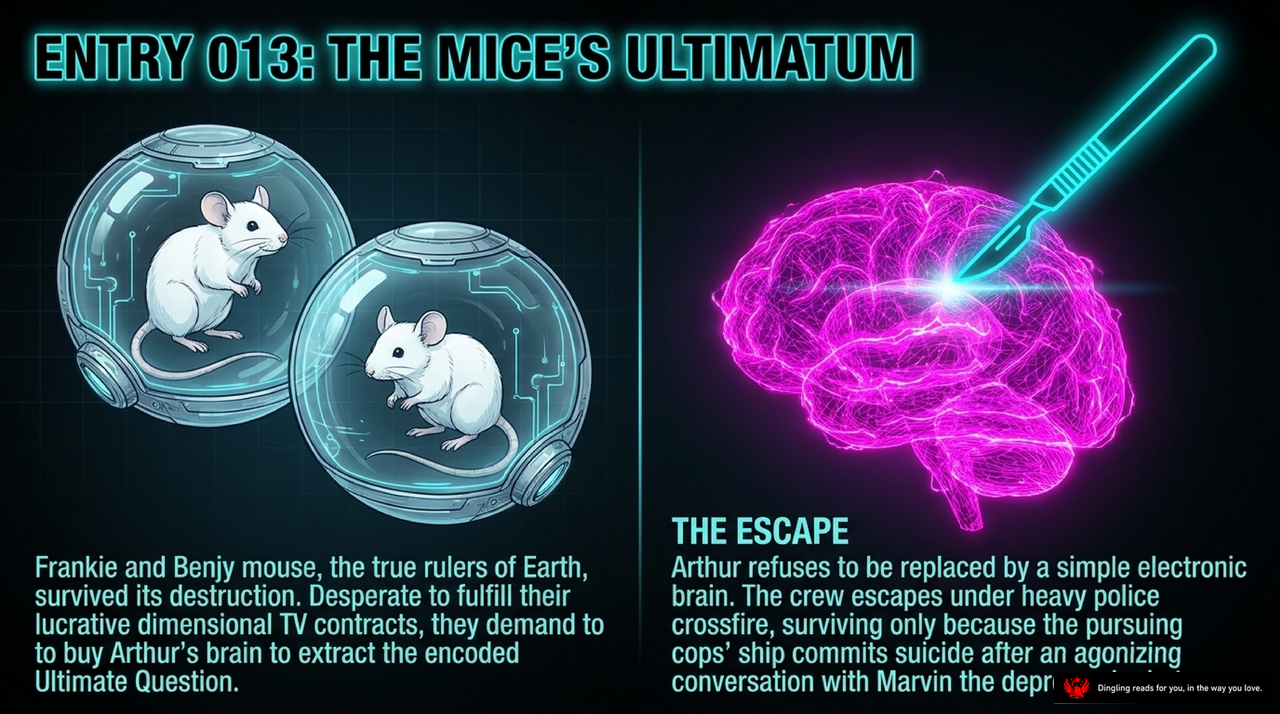
Alright, let’s dive into Entry 13: The Mice’s Ultimatum. You ever think those tiny lab mice were just… mice? Think again. Frankie and Benjy—those two little rodents—are the actual rulers of Earth. They survived our planet’s destruction, and now they’ve got a big problem: they’ve signed lucrative dimensional TV contracts, but they need the Ultimate Question to go with the answer 42. And where’s that question hidden? Right in Arthur’s brain. Earth was their million-year project to crack it, but the Vogons blew it up five minutes before completion.
So they hit Arthur with a deal: buy his brain, slice it open to extract the encoded question, and swap it out for a basic electronic brain that only spouts lines like “What?” or “Where’s the tea?” Arthur, obviously, says no way—he’s not trading his actual brain for some cheap replacement.
Then chaos erupts. The crew tries to escape, and they’re caught in a storm of police crossfire. But here’s the kicker: Marvin, that ultra-depressed robot, has a chat with the pursuing cops’ ship. And the ship gets so drained by Marvin’s existential despair that it commits suicide. Yeah, you heard that right—Marvin’s gloom is powerful enough to make a spaceship off itself.
The crew escapes, but the mice? They’re left scrambling to fake a question for their TV deal. They end up with something vague and profound-sounding to pair with 42, just to keep the audience hooked. Who knew mice were pulling the strings this whole time? Wild, isn’t it?
Ever had one of those days where you’re spiraling over a missed work email, a messy kitchen, or that weird thing you said at the party last night? Like, these tiny stressors feel like they’re taking over your whole world, right? But what if—seriously—they’re actually nothing?
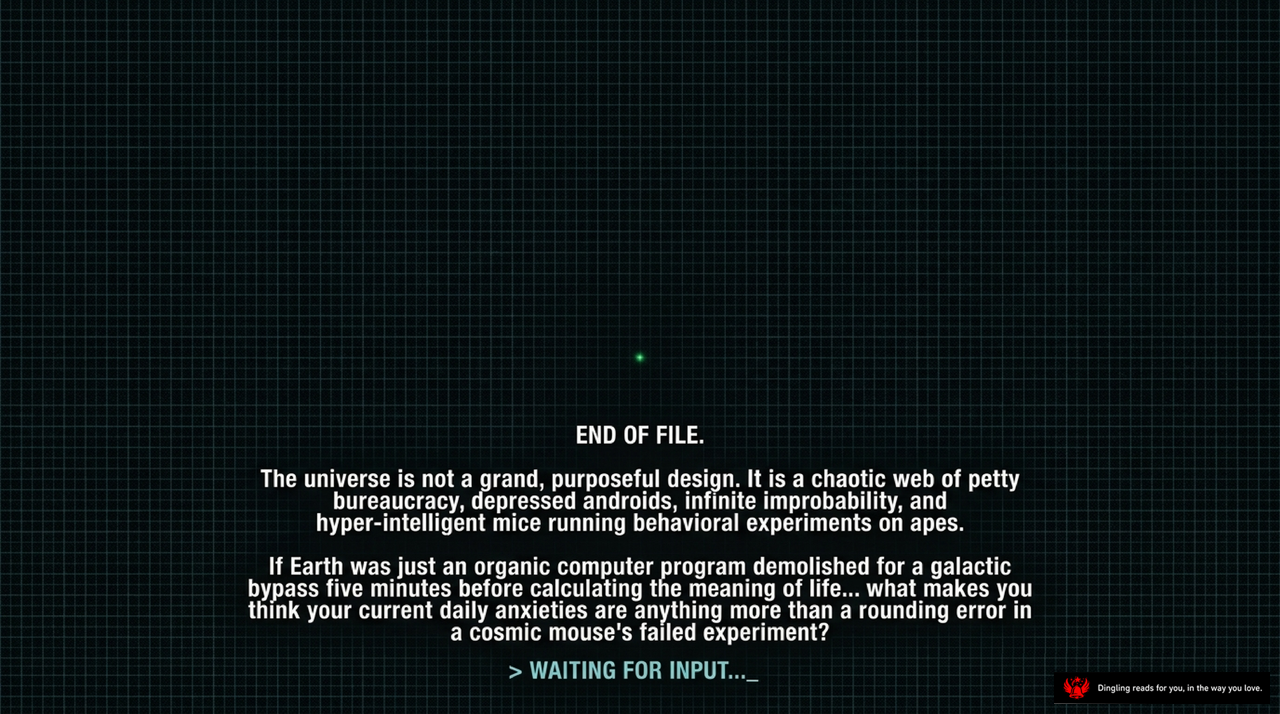
Take a look at this slide: It says the universe isn’t some grand, purposeful design. Instead, it’s a chaotic web of petty bureaucracy, depressed androids, infinite improbability, and hyper-intelligent mice running experiments on apes. Wait, mice? Yeah, in *The Hitchhiker’s Guide to the Galaxy*, those little critters we think are just chasing cheese? They’re actually super-smart beings from another dimension. They built Earth as a giant organic computer to find the ultimate question to life, the universe, and everything (we already know the answer is 42, by the way).
But here’s the kicker: The Earth got blown up by Vogons—those grumpy, poetry-loving bureaucrats—five minutes before it could finish its calculation. So if our entire planet was just a cosmic experiment cut short, what does that say about our daily worries? The slide puts it perfectly: What makes you think your current daily anxieties are anything more than a rounding error in a cosmic mouse’s failed experiment?
Think about it—all those small panics? They’re like a tiny blip in a universe that’s way more random and messy than we ever thought. Bureaucracy (hello, Vogons and their endless paperwork), depressed androids (poor Marvin, always moping about his broken diodes), things happening for no reason (the Heart of Gold’s drive turning missiles into whales and potted plants)—it’s all just part of this chaotic, beautiful mess. So next time you’re stressing over something small, remember: It’s probably just a rounding error. No big deal.
Oh, and one more thing—don’t forget your towel. Trust me, you’ll need it. 😉