
The Human Condition: Complete Chapter-by-Chapter Summary

Welcome to our exploration of Hannah Arendt's masterpiece, *The Human Condition*. This slide sets the stage for a profound journey into what it truly means to be human.
On the left, we see the ruins of ancient Greece—a symbol of the "public realm" where free citizens once gathered to speak, act, and create history. This was the world of *Vita Activa*, the active life, defined by three fundamental activities: Labor, Work, and Action. These aren't just tasks; they are the very conditions that make us human.
Contrast that with the right side of the image: the churning gears of a modern machine, shattering the ancient stones. This represents our current reality—a shift away from the public realm and toward an endless cycle of labor and consumption. Arendt warns us that in our rush to survive and consume, we are losing the space where our unique humanity can shine.
Let's break this down. In the ancient view, "Labor" was tied to our biological survival, a never-ending cycle of producing and consuming. "Work," however, was different; it created a stable, durable world of objects—a home, a table, a chair—that outlasted us. But the third element, "Action," was the most vital. Action happens only in the company of others. It is the moment we reveal who we truly are, through speech and deed, creating something entirely new and unpredictable.
Arendt argues that modern life has dangerously prioritized the cycle of labor over the freedom of action. We have replaced the vibrant, unpredictable world of human interaction with a predictable, mechanical process of production and consumption. The gears in the image aren't just machinery; they are the trap of a society that values efficiency over existence.
So, as we move forward, ask yourself: Are we living to survive, or are we acting to create meaning? The book challenges us to reclaim our public space and rediscover the power of truly being human, rather than just being a worker in a machine.

So, we're looking at a slide that breaks down the ancient distinction between two ways of living: *Vita Contemplativa*, or the quiet life of the mind, and *Vita Activa*, the active life. The text here makes a crucial point: human conditions aren't our fixed nature; they are simply the parameters within which life is given to us.
Historically, philosophical tradition elevated passive contemplation over action, often blurring the critical distinctions that actually exist within the active life itself. But let's be clear about what *Vita Activa* really encompasses. It's not just about being busy; it encapsulates three fundamental human activities that correspond to the basic conditions of human existence on Earth.
Think of it this way: the active life isn't a single track. It's a complex interplay. It includes the physical labor that binds us to our biological cycles, the work where we shape the world into durable objects that give us stability, and the political action that happens only in the presence of others. These aren't just random tasks; they are the very conditions that allow us to be human. While ancient thinkers often tried to silence this active side to focus on eternal truths, we cannot ignore it. Without these activities—labor, work, and action—our life loses its meaning, even for those who choose to withdraw from the world. The active life is the ground upon which our existence is built.

Welcome back to our deep dive into Hans Blumenberg's *The Legitimacy of the Modern Age*. Today, we're zooming in on the very first pillar of human existence: **Labor**, or what the text calls *Animal Laborans*.
Look at the diagram on your screen. We are breaking down human activity into three distinct modes, and right now, we are focusing on this leftmost column. Labor is defined by a very specific condition: biological life itself. It is the cycle of survival, metabolism, and death. Think of it as the raw, physical rhythm of being alive.
The product of this labor is what we call ephemeral consumer goods. These are things like food or fuel—items that are immediately destroyed or consumed just to sustain life. They don't last. A loaf of bread is eaten; it doesn't become a permanent part of our world. This is the key distinction. Unlike "Work," which creates durable objects that build a stable human world, Labor's nature is purely cyclical and endless. It is private, driven strictly by necessity, and it keeps us tethered to the biological cycle of nature.
In this mode, humans are essentially functioning like animals, driven by the urgent need to survive. We are not yet creators of a lasting world; we are participants in a natural process, constantly consuming and reproducing to keep the cycle going. This is the foundation upon which all other human activities rest, but it is also the mode that keeps us bound to the earth's rhythms.

Welcome back. Today, we're diving into a pivotal concept that reshaped how we understand human life: the distinction between the Private Realm and the Public Realm.
On the left, you see a simple house representing **The Private Realm**, or *The Household*. Think of this as the domain of necessity. It's where we deal with the bare necessities of the physical body—survival, biological needs, and the natural inequalities that come with them. In this sphere, life is driven by what we must do to stay alive. It's a necessary space, but one that, in ancient Greek thought, had to remain somewhat hidden because it deals with the raw mechanics of existence rather than our highest potential.
Now, look to the right at the grand stadium, symbolizing **The Public Realm**, or *The Polis*. This is the realm of freedom, equality, and excellence. Here, the rules of survival don't apply in the same way. Instead, this is a space of appearance where individuals distinguish themselves through great deeds and great words. It's the stage where we step out of the biological cycle and enter the world of politics and glory.
The key takeaway here, highlighted in the red box, is profound: **True freedom is the liberation from necessity**. In the private realm, you are bound by your needs. In the public realm, you are free to act, to speak, and to define who you are. This separation was the foundation of the ancient city-state, creating a clear boundary between the private struggles of the household and the public life of the citizen.

The Rise of the Social Realm is the story of how the clear boundaries between our private lives and public world have completely dissolved. Look at this visual progression: we started with distinct spheres for the "Private" and the "Public," separated by a clear line. But then came "The Blur." As strict boundaries dissolved, housekeeping and even biological survival became matters of massive public concern. The private realm lost its intimate shelter, and the public realm lost individual excellence.
This blurring created what the slide calls "The Monolith." Society now demands conformity, replacing spontaneous, unpredictable action with standardized, predictable behavior. We are no longer a collection of unique individuals; we have transformed into a family of national economies, where everyone plays the same functional role.
The consequence is a mass society where the public realm loses the spark of individual excellence, and the private realm can no longer offer us a place to hide. We are trapped in a system that expects us to be the same. This is the modern dilemma: we have gained the ability to see the whole world, but we have lost the space to be truly ourselves.

Today's slide, "The Web of Human Relationships," visualizes a core truth about our existence: we are not isolated individuals, but nodes in a vast, interconnected network. As the diagram shows, action is the only activity that happens directly between people, without the intermediary of things. It is the engine of our social reality.
This web is built on four pillars. First, Direct Interaction. This is the raw, unmediated contact between us. Second, Natality—the human capacity to begin something entirely new. As the quote on the left reminds us, "To act is to take initiative, to begin, to set something in motion." Every time we act, we introduce a new variable into this web. Third, Identity. Through our speech and actions, we answer the question "Who are you?" rather than "What are you?" We define ourselves not by our static traits, but by our dynamic choices.
Finally, we have the concept of The Authorless Story. Because our actions constantly collide with the existing web of conflicting wills around us, no single person can fully control the outcome. The true author of a human story is never the actor themselves. We are the protagonists, but the plot is written by the complex interplay of everyone else's actions. We are all co-authors in a story we never fully designed.

Look at this slide titled "The Tragedy of Action." It breaks down why taking action is so dangerous and binding for us. The image highlights two core concepts: Unpredictability and Irreversibility.
First, let's talk about unpredictability. The graphic shows dominoes tipping over in random directions. This perfectly captures the book's point that action sets off an infinite chain reaction in the web of human relationships. Once you act, its ultimate consequences can never be reliably foreseen or fully controlled. A single decision ripples out, creating stories we couldn't have planned.
Then, look at the second side: Irreversibility. The image depicts a heavy shackle chained to the ground. The text explains that once a deed is done, it cannot be undone. The actor becomes permanently chained to the consequences of their actions. Unlike a thought, which can be revised, an action creates a permanent link to reality.
The slide concludes by noting that this inherent fragility has historically driven philosophers to despise the realm of human affairs. Because action is so risky and irreversible, thinkers have often sought refuge instead in the predictability of making things—what we call Work—or the quiet of thinking, known as Contemplation. They preferred the safety of the static over the chaos of the active.

Today's slide, "The Remedies of Plurality," tackles a profound question: how do we survive the chaos of human history? The image presents two powerful tools for healing our fractured existence: Forgiving and Promising.
On the left, we see Forgiving, which the text calls a cure for irreversibility. Life is full of mistakes and past deeds that seem to trap us forever. But forgiveness releases us from those eternal consequences, giving us the freedom to begin again. It stops the past from dictating our future.
On the right is Promising, described as a cure for unpredictability. The future is an ocean of uncertainty, but promises create isolated islands of certainty. By binding people together through mutual commitment, we stabilize our lives and make the unpredictable future feel manageable.
Crucially, the bottom section highlights a deep dependency: both remedies rely entirely on plurality. You cannot forgive yourself alone, nor can you keep a promise made only to yourself in isolation. These acts require a community, a "we." Without the diversity of human voices and the presence of others, neither forgiveness nor promises have meaning. This slide reminds us that our ability to heal and build a stable future is rooted in our shared humanity.

Homo Faber and the Artificial World. This slide captures a profound tension at the heart of our modern existence: the double-edged sword of being the maker.
On the right, you see the visual metaphor: a saw cutting through a tree to create a table. This illustrates the core paradox of Homo Faber. First, we are builders. We create a durable, artificial world that houses human life, providing stability against the devouring cycles of nature. Without these man-made objects—like the table shown here—our lives would remain fragile and transient.
However, look at the cost. To build this world, Homo Faber must destroy nature. Unlike the laborer who simply submits to natural rhythms, the maker has to break trees, mine metals, and reshape the raw world. This is an act of destruction necessary for creation.
But there is a deeper danger lurking here, labeled as "The Danger of Utility." When we operate purely on a means-to-an-end logic, something insidious happens. Everything becomes just a tool for something else. The tree isn't valued for its life; it's valued for the table. The table isn't valued for its beauty or history; it's valued for its function. Left unchecked, this utilitarianism infects everything, making all things—and eventually, people themselves—mere means to a higher end. We strip the world of its intrinsic meaning, leaving behind a functional but hollow existence.
So, as we move forward, remember this: while building our world gives us stability, we must be careful not to let the logic of utility erase the very meaning that makes us human.

Welcome back. Today, we're diving into a pivotal moment in human history, a shift that fundamentally changed how we see ourselves and our place in the universe. Look at the slide: "The Modern Reversal I: The Archimedean Point." This concept is everything.
It all started with something seemingly small but incredibly powerful: the scientific instrument. Think about Galileo's telescope. The modern age wasn't ignited by political revolutions or wars, but by this simple tool. It allowed us to find an "Archimedean Point"—a vantage point outside our own planet. Suddenly, we could view Earth not as our home, but as just another object in a vast cosmos. This distance created a profound "World Alienation." We learned to see our world from the outside, separating ourselves from the immediate, earthly surroundings we once took for granted.
This shift triggered a deep philosophical crisis known as "Cartesian Doubt." Because we could no longer trust our senses to tell us the absolute truth, certainty became impossible to find externally. We realized that human senses were unreliable. So, where did we look for answers? Inside. Certainty was found only through internal introspection. We stopped relying on what we saw and started relying on what we thought.
Consequently, the pursuit of truth changed entirely. Doing and making—taking action—were elevated over passive contemplation. We stopped waiting for the universe to reveal its secrets and started actively creating our own reality. This is the essence of the modern reversal: we moved from being observers of a fixed world to being active shapers of an uncertain one.

Today's slide, "The Modern Reversal II: The Victory of Homo Faber," captures a profound shift in how we understand human progress. Look at that flow on the left: it starts with **Contemplation**, moves down to **Making**, and finally settles on the spinning **Process**. This visual tells a story of a complete inversion of values.
In the beginning, true knowledge was found in quiet thinking. But as the modern age arrived, we elevated the maker. We stopped looking for truth by simply pondering and started finding it by making, experimenting, and building instruments. This was our first step: doing over thinking.
However, the story didn't end there. Our focus rapidly shifted away from the durable product being made. Instead, we became obsessed with the production process itself. We stopped caring about the stable world the maker created and started worshipping the endless cycle of doing.
The result? As the slide warns, man ceased to see himself as a creator of a permanent world. Instead, we became mere participants in massive, unstoppable natural and historical processes. We are no longer the authors of our reality; we are just gears turning in a machine we built, but one that now controls us.

The Final Reversal: The Triumph of Animal Laborans. Look at this striking visual metaphor. On the left, we have the gear—a symbol of the "Maker," the craftsman who builds a durable world. On the right, we see the cell, representing the biological drive for mere survival. The image shows the gear dissolving into the cell, illustrating a profound historical shift.
First, consider the defeat of the Maker. Ultimately, Homo Faber was defeated by what we call Animal Laborans. Society stopped valuing the creation of lasting objects and instead elevated biological survival as the highest possible good. Life itself became the ultimate goal, surpassing freedom, excellence, or a durable world.
This shift led to the reduction of humanity. Every human activity—even art, deep thought, and political action—was reduced to the concept of making a living. We stopped building for the future. Instead, durable use objects were entirely replaced by ephemeral consumer goods. We traded a stable, crafted world for a cycle of endless consumption. The triumph of the biological over the creative marks the end of the age of the Maker and the beginning of the age of the animal.
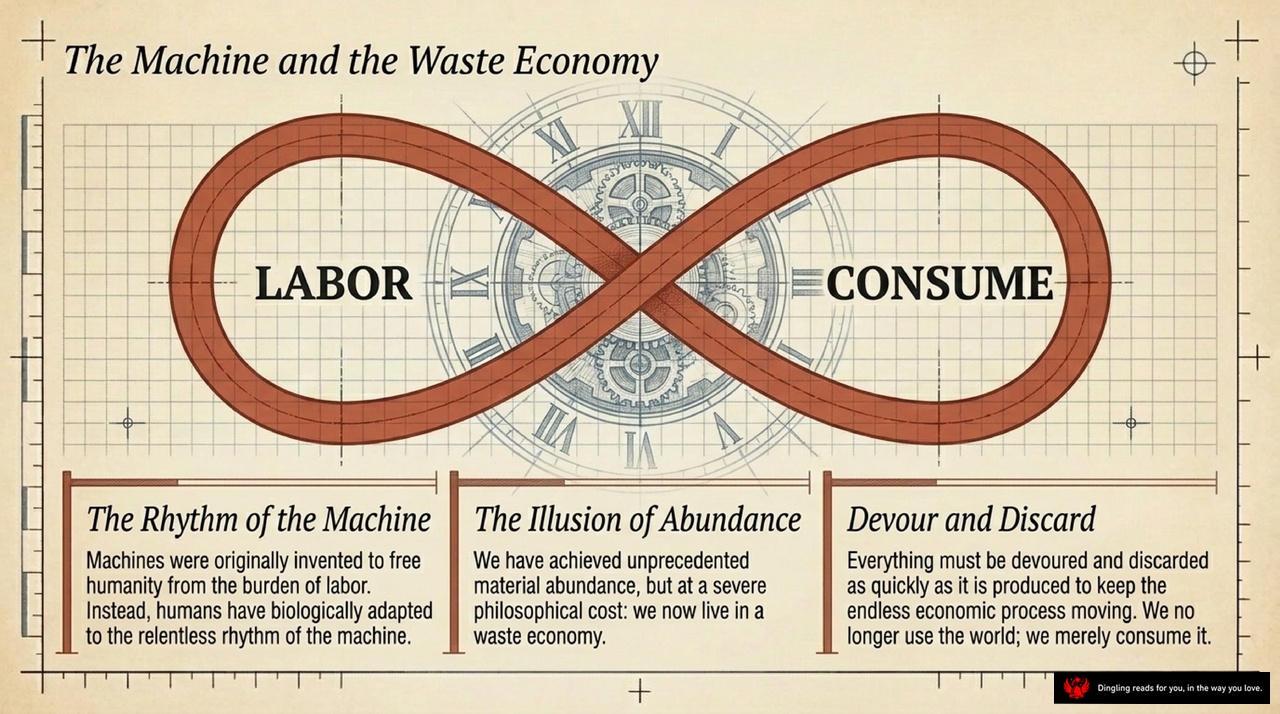
The Machine and the Waste Economy. Look at this infinity loop. On the left, Labor. On the right, Consume. This graphic perfectly captures the trap we've built for ourselves.
Originally, machines were invented to free humanity from the burden of labor. But instead, we biologically adapted to the relentless rhythm of the machine. We no longer use the world; we merely consume it.
We have achieved unprecedented material abundance, yet at a severe philosophical cost: we now live in a waste economy. Everything must be devoured and discarded as quickly as it is produced, just to keep this endless economic process moving.
The result? A society where we are no longer creators of a durable world, but just consumers in a cycle of production and destruction. We've traded the stability of "work"—which builds a lasting human world—for the fleeting satisfaction of "labor," which only feeds our biological needs. We are trapped in a loop where the only purpose of our existence is to keep the machine running, consuming resources we don't truly need, and discarding them before we can even feel their loss.
This is the illusion of abundance. We think we have everything, but in reality, we have nothing but the constant pressure to consume. We've lost our connection to the world, reducing it to a mere source of raw materials for our endless cycle of labor and consumption.

Look at this slide, "The Loss of the World." It maps a tragic trajectory: we move from **Action**, where we live in the public realm and exercise true freedom, down through **Work**, where things become just means and ends, all the way to **Labor**, defined here as endless consumption.
The text on the right explains the core problem. Modern society has successfully liberated our laboring capacity. We can now conquer natural necessity better than ever before. But here is the cost: in doing so, we have destroyed the very public realm where true human freedom exists.
We have transformed ourselves into a society of laborers. The issue isn't that we work too much; it's that we lack enough *meaningful* labor to keep us satisfied. Instead of behaving as unique individuals creating history, we act like a single, automated biological species. We are driven strictly by metabolic consumption—eating, working, consuming, and repeating the cycle. We have lost the world, not because we lack resources, but because we have lost the space to be free.

We've conquered the basics of life and unlocked unprecedented technological power, yet we've inadvertently traded our durable, meaningful human world for an endless, thoughtless cycle of biological consumption and automated labor. Think about it: we built a world based on unique action, deep relationships, and lasting creation, only to replace it with a system where survival is automated and the planet is consumed.
As we continue to automate our survival and consume our world, a terrifying question arises: what remains of our humanity if we forget how to act, how to think, and how to build something that outlasts ourselves? In a society obsessed with efficiency and instant gratification, we risk losing the very things that make us human—the ability to create meaning, to connect deeply with others, and to leave a legacy that transcends our brief existence. If we let the machine dictate our lives, we might find ourselves trapped in a loop of empty consumption, having everything but nothing of real value. The challenge isn't just technological; it's existential. We must choose to reclaim our agency, to value the process of building and connecting over the mere act of consuming, before it's too late to remember what it truly means to be human.