
The Idea of a University: Complete Chapter-by-Chapter Summary

Welcome to our deep dive into "The Idea of a University" by John Henry Newman. Set against the backdrop of a grand, timeless library, this presentation explores Newman's vision for what higher education truly is. As the title suggests, we are here to discuss the core philosophy of the university itself. Newman argues that a university isn't just a place for vocational training or accumulating facts; it is a sanctuary for cultivating the intellect and integrating universal knowledge. His blueprint emphasizes that true education shapes the ideal citizen by fostering a calm, steady mind capable of seeing the connections between all things. In this space, surrounded by centuries of wisdom, we will explore how Newman believed the university must balance secular sciences with theology, and how it serves as a haven for intellectual freedom rather than a tool for mere utility. Join us as we unpack these enduring principles that continue to guide us today.

Welcome to the next chapter of our journey into the heart of higher education. Today's slide, titled "The Essence of a University," brilliantly captures a distinction that is often blurred in modern discourse: what a university truly is versus what it is not.
Look at the blueprint on the left. It defines the university as a place for the diffusion of universal knowledge, not isolated advancement. Its core object is intellectual education, and its primary subjects are students. This is crucial because it highlights a key distinction: to discover and to teach are distinct functions. As the text notes, someone who spends their entire day dispensing existing knowledge to all comers is unlikely to have the leisure or energy to acquire new things. This explains why the university model, with its dedicated student body, is essential for both the seeker and the teacher.
Now, let's look at what the university is *not*. The slide contrasts it sharply with two other institutions: The Academy and The Seminary. An Academy, like the Royal Academy mentioned in our text, is a research academy. Its sole object is scientific and philosophical discovery. If that were its only goal, it wouldn't need students at all. Similarly, a Seminary is dedicated purely to religious training. If its focus were solely on that, it couldn't be a comprehensive seat of literature and secular science.
The slide even includes a powerful quote from Cardinal Gerdil to seal this argument: "Universities are established to teach sciences to students; Academies are dedicated to new research." This reminds us that the university's unique mission is to integrate the teaching of established knowledge with the formation of the student, distinguishing it from pure research labs or theological seminaries. It is about the holistic cultivation of the mind, not just the production of data or the instruction of faith in isolation.
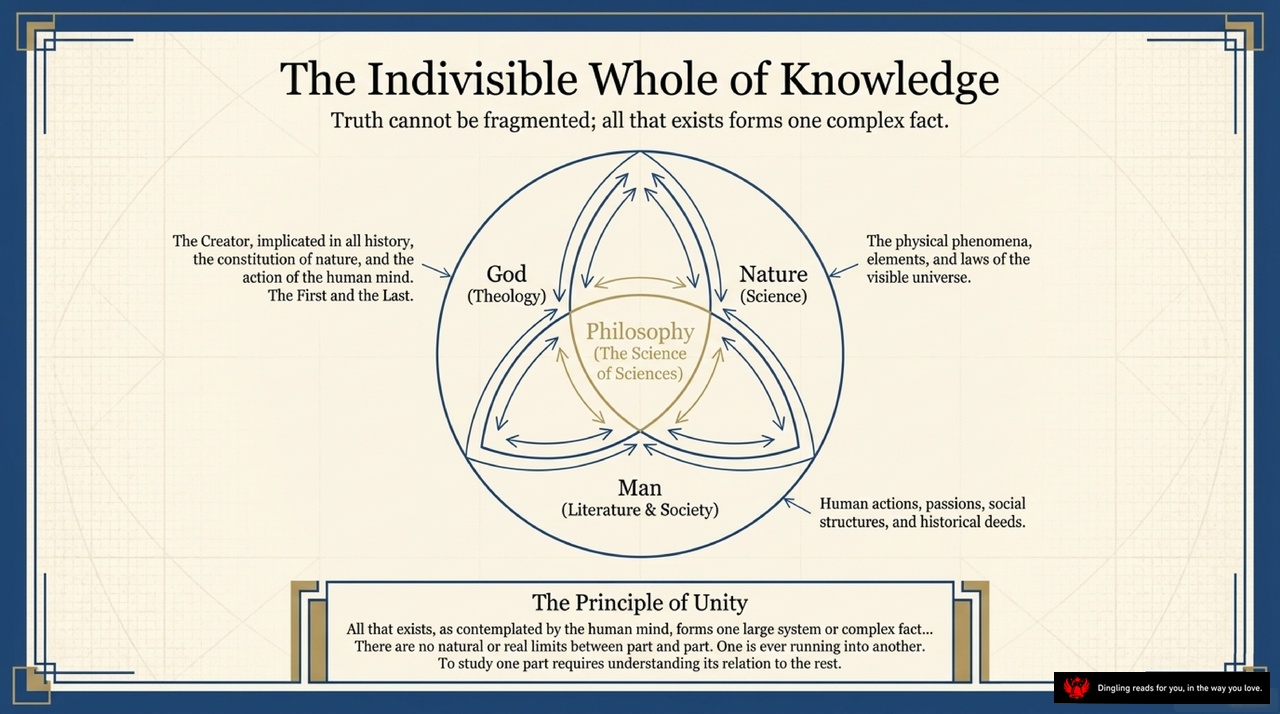
Imagine a world where every field of study stands alone, a collection of isolated islands with no bridges connecting them. This is the danger we face when we exclude theology from the university. The slide before you illustrates the "Indivisible Whole of Knowledge," reminding us that truth cannot be fragmented; it is one complex fact. When we try to study God, Nature, and Man in isolation, we don't just lose a subject; we lose the ability to understand reality correctly.
Look at the diagram. It shows God, Nature, and Man as three interconnected circles, with Philosophy at the center weaving them together. But what happens if we remove one part? If we pull out the circle of God, the entire structure collapses. The slide warns us that when theology is missing, science inevitably oversteps its boundaries. Physics, for instance, might try to explain moral evil or the purpose of redemption using only natural laws. But nature, by itself, cannot answer questions about the soul or the divine. It's like trying to understand the meaning of a poem by only analyzing the ink; you miss the soul of the work.
The slide highlights a specific danger: the "crossing of boundaries." When a discipline loses its context, it becomes arrogant. Political economy, for example, might claim that accumulating wealth is the highest moral good, ignoring the spiritual warnings about greed. Comparative anatomy might try to prove the soul is just a brain function, denying the spiritual reality. Without theology to act as the "science of sciences" and check these overreaches, each field becomes a tyrant in its own corner, distorting the truth.
The core message here is about unity. The text reminds us that to study one part of existence, you must understand its relation to the rest. You cannot truly understand the laws of nature without understanding the Creator who set them in motion. You cannot fully grasp human history without understanding the divine plan behind it. By keeping theology in the university, we ensure that our knowledge remains humble, coherent, and true to the interconnected nature of reality. We protect the integrity of all sciences by remembering that they are all reflections of the same, indivisible truth.

When we look at the slide titled "The Danger of Omission," we are immediately confronted with a powerful visual metaphor: a crumbling temple labeled "Universal Truth." Notice how the pillars for "Physics" and "Economics" are tilting and breaking under the weight of the structure. This isn't just an artistic choice; it illustrates a critical flaw in modern education. As the text warns, excluding any branch of knowledge prejudices the accuracy of all the rest.
Let's break down this collapse into four stages shown on the screen. First, "The Omission." When a university excludes a major science, like theology, to avoid controversy, it treats objective knowledge as mere sentiment. This creates a vacuum. Second, "The Vacuum." Because the universe is a single, interconnected reality, removing a piece—like the study of God or the soul—leaves a gaping conceptual hole. The foundation is no longer solid.
Consequently, we move to the third stage: "The Encroachment." This is where the real danger lies. Other sciences stretch beyond their natural boundaries to answer questions they were never designed to solve. Without the corrective lens of theology, physics tries to explain moral evil, and economics attempts to measure human worth solely by wealth. The physicist might try to explain the soul via atoms, while the economist reduces human value to a bank balance. This is the "Man of One Idea."
The result, as the final box indicates, is that experts become bigots. When we strip out the context of the divine and the moral, our sciences become tools for self-justification rather than the pursuit of truth. As the quote at the bottom reminds us, when Newton can dispense with the metaphysician, we can too. We must reject this dangerous omission if we want to build a stable structure of knowledge that truly reflects universal truth.
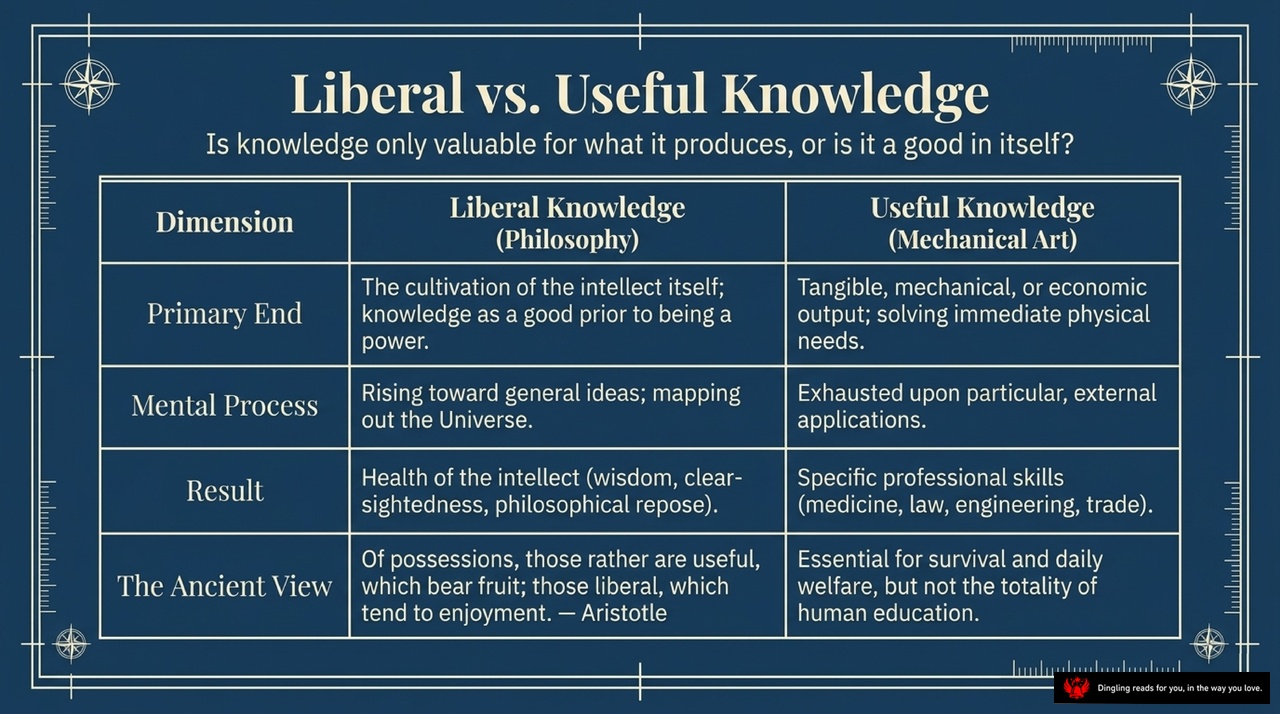
Let's dive into the core tension that defines the modern university: the battle between Liberal Knowledge and Useful Knowledge.
As our slide illustrates, we are asking a fundamental question: Is knowledge valuable only for what it produces, or is it a good in itself? This distinction isn't just academic; it shapes everything from what we teach to how we live.
On the left, we have Liberal Knowledge, rooted in philosophy. Its primary end is the cultivation of the intellect itself. It values knowledge as a good prior to being a power. The mental process here involves rising toward general ideas and mapping out the universe. The result? A health of the intellect—wisdom, clear-sightedness, and philosophical repose. Aristotle called this "liberal," noting that true freedom comes from things that bear no fruit but are for enjoyment, rather than things that merely produce utility.
On the right, we see Useful Knowledge, often labeled as mechanical art. Its goal is tangible, mechanical, or economic output—solving immediate physical needs. The mental process is exhausted upon particular, external applications. The result is specific professional skills like medicine, law, engineering, or trade. While the Ancient View acknowledges that useful knowledge is essential for survival and daily welfare, it insists this is not the totality of human education.
The slide challenges us to choose a side. Are we building universities that are merely factories for producing skilled workers for the economy, or are we nurturing minds capable of free thought and universal understanding? The answer defines whether our students are tools for the market or free citizens of the world.

Today's slide contrasts two very different ways of thinking: the "Illusion of Learning" versus the "Reality of Enlargement." On the left, we see a funnel pouring facts into a box. This represents the illusion—passive reception where we simply swallow information without processing it. It creates a superficial smattering of knowledge, like knowing bits of astronomy or history but having no integrated understanding. The result? A narrow mind loaded with disjointed facts, easily distracted and lacking deep principles.
But look at the right side. This is the reality of true enlargement. Here, ideas aren't just dumped in a box; they are actively digested. The mind takes new ideas and compares them with old ones, systematizing them until they become part of who we are. Notice the "Mental Center" in the middle. This is the crucial element: creating a central point of gravity to which all new knowledge relates. Without this center, our minds are just scattered collections of data.
True enlargement leads to clear-sightedness and sagacity. It gives us the power to discriminate truth from falsehood. So, education isn't about accumulating more facts; it's about the active digestion of ideas. It's about building that mental center so we can understand the world not as a list of isolated items, but as a coherent, connected whole.

Science and literature represent the two great books of human reason: the Book of Nature and the Book of Man. As we explore the university's role, we must understand how these two realms interact, sometimes harmoniously, sometimes in tension.
On the left, we see Science. Its focus is on realities, objective facts, and universal laws. It is impersonal and eternal, independent of any author. Because it relies on universal symbols like the multiplication table, it can be easily translated across languages. You can play Beethoven's piano music on a hurdy-gurdy; the mathematical truths remain unchanged regardless of the tongue.
On the right lies Literature. Its focus is on ideas, human thoughts, passions, and history. It is highly personal; style is essentially thinking out into language, the expression of Logos. This makes perfect translation nearly impossible. You cannot transfer Shakespeare's idiosyncratic genius into another tongue, nor can you easily replicate the specific emotional resonance of a literary work. Literature is the domain of the individual, the unique, and the historical.
Yet, both spheres converge in the center under the banner of Human Reason. This is the crucial intersection. The university's mission is to teach all branches of knowledge, meaning it must embrace both the objective truths of science and the subjective depths of literature. If we exclude literature because it resists easy translation or seems less "universal" than science, we fail to teach the whole of human experience.
However, this balance is delicate. Science risks overstepping its boundaries when it tries to explain moral evil or redemption—topics that belong to the realm of faith and history, not just natural law. Conversely, literature, while essential for understanding the human condition, can become dangerous if it loses its moral anchor. Without the guiding light of faith, literature might celebrate human passion without distinguishing between virtue and vice, turning into mere entertainment or even a corrupting force.
The university must therefore act as a guardian of this balance. It must protect the integrity of scientific inquiry while ensuring that literature remains a vessel for truth and moral reflection, not just a mirror for human folly. By integrating these two great books of reason, we cultivate a mind that is not only intellectually rigorous but also deeply human, capable of understanding both the laws of the universe and the complexities of the soul.
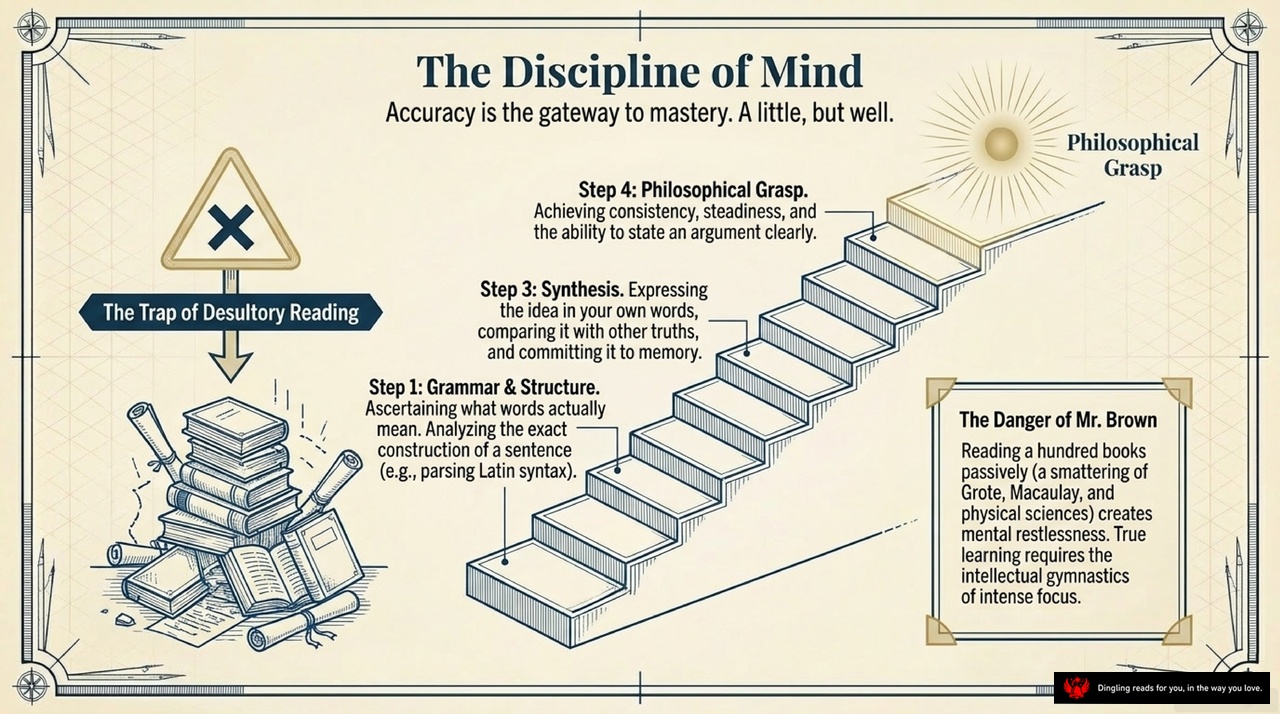
The Discipline of Mind: Accuracy is the gateway to mastery. A little, but well.
On the left, we see the trap of desultory reading—piled books without direction, a warning against passive consumption. True learning isn't about reading a hundred books; it's about the intellectual gymnastics of intense focus. As the infographic reminds us, reading passively creates mental restlessness.
To climb out of this trap, we follow four steps. First, Grammar and Structure: we must ascertain what words actually mean and analyze the exact construction of a sentence. Second, Synthesis: we express ideas in our own words, compare them with other truths, and commit them to memory. Third, and most crucially, Philosophical Grasp: achieving consistency, steadiness, and the ability to state an argument clearly. Only then do we reach the sun at the top of the stairs—true philosophical understanding.
This disciplined approach is what separates true mastery from the danger of Mr. Brown, who represents the fool who reads everything but understands nothing.
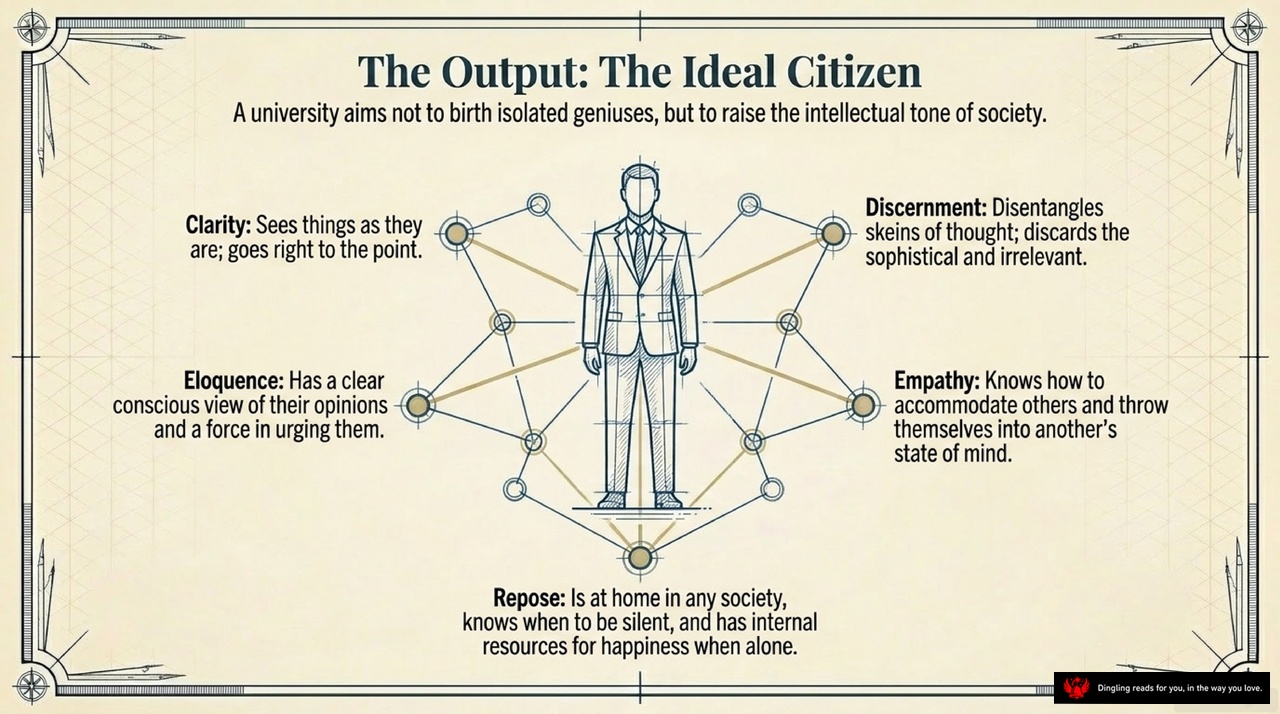
Welcome to the final output of our journey into the ideal university. Today, we define the blueprint for the "Ideal Citizen"—the ultimate goal of higher education. As the slide illustrates, a true university shouldn't just manufacture isolated geniuses; its higher calling is to raise the intellectual tone of society as a whole.
At the center of this vision stands a figure embodying five critical virtues. First, **Clarity**: the ability to see things exactly as they are and go straight to the point, cutting through the noise. Second, **Discernment**: the skill to disentangle complex skeins of thought and discard what is merely sophistical or irrelevant. Third, **Eloquence**: possessing a clear, conscious view of one's opinions and having the force to urge them with conviction. Fourth, **Empathy**: the capacity to accommodate others and truly step into another person's state of mind. And finally, **Repose**: the wisdom to be at home in any society, knowing when to remain silent and possessing internal resources for happiness even when alone.
Together, these traits create a citizen who is not just knowledgeable, but grounded, adaptable, and wise. This is the standard we must aim for.
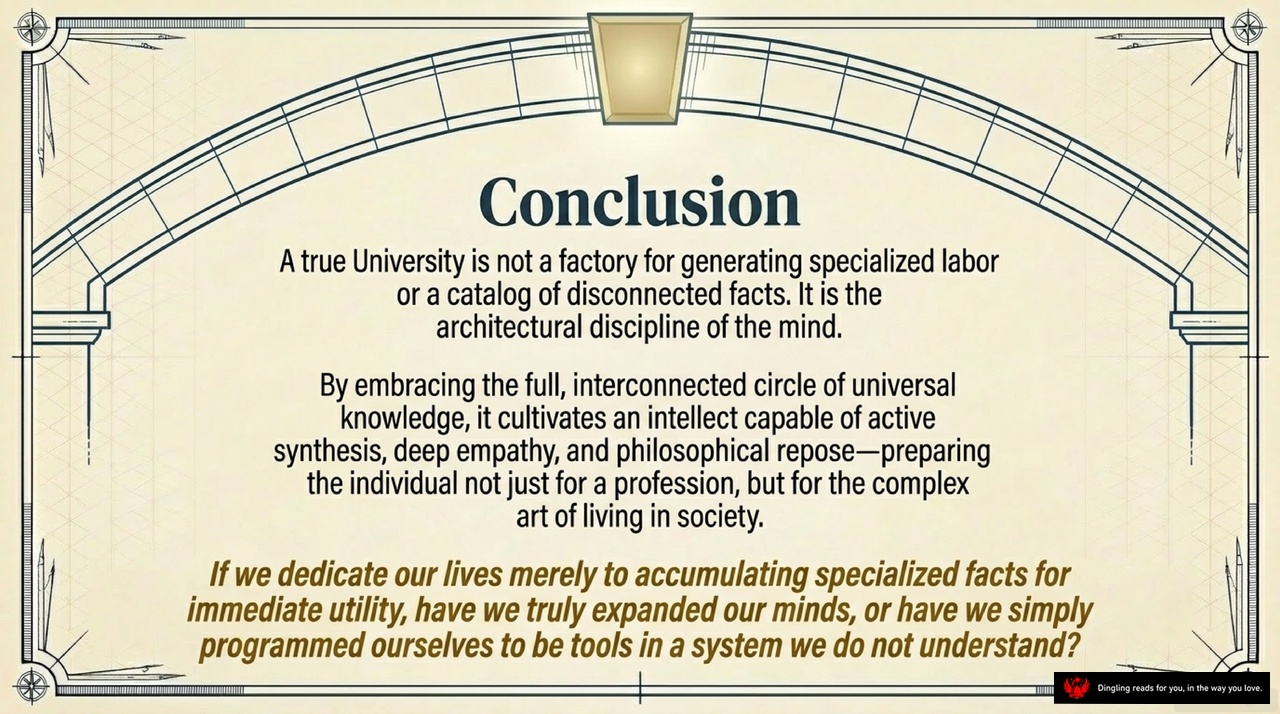
Let's bring our journey to a close. As we look back on everything we've discussed, remember this: a true University is not a factory for generating specialized labor, nor is it merely a catalog of disconnected facts. Instead, it is the architectural discipline of the mind. By embracing the full, interconnected circle of universal knowledge, it cultivates an intellect capable of active synthesis, deep empathy, and philosophical repose. This prepares the individual not just for a profession, but for the complex art of living in society.
But I leave you with a final question to ponder: If we dedicate our lives merely to accumulating specialized facts for immediate utility, have we truly expanded our minds, or have we simply programmed ourselves to be tools in a system we do not understand? The choice is ours.