
The Lady of the Camellias: Complete Chapter-by-Chapter Summary
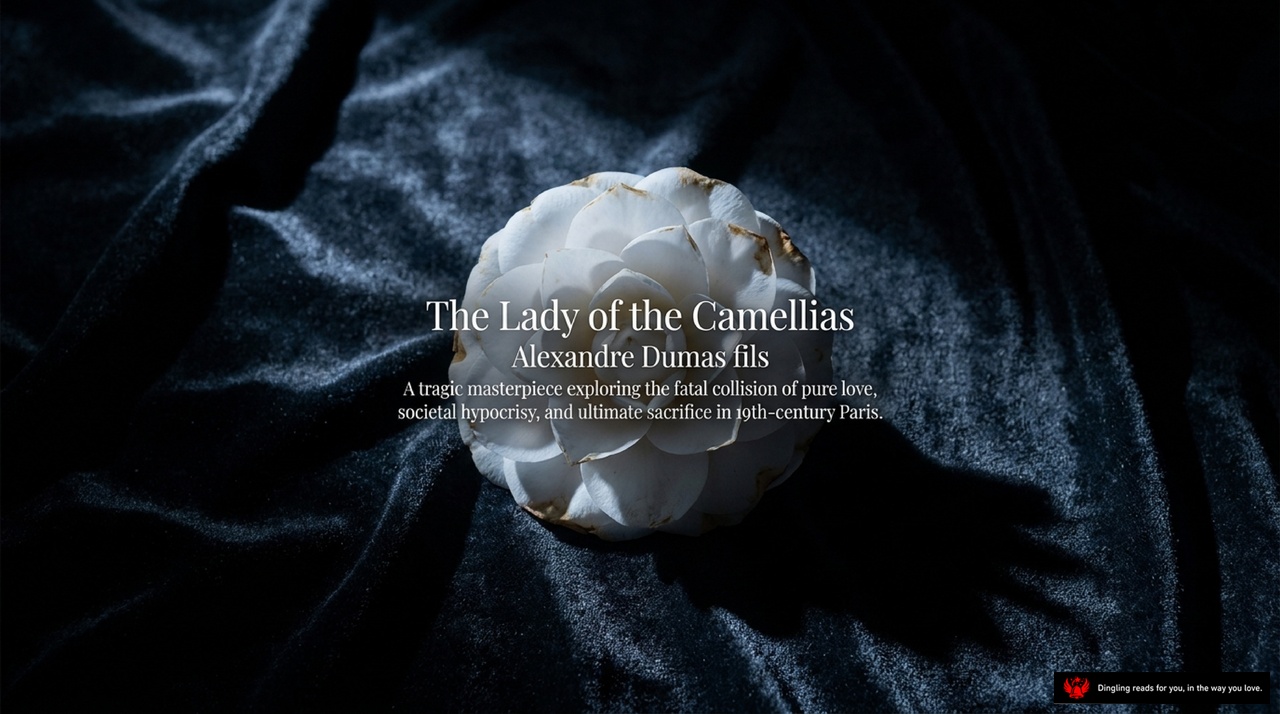
Welcome to today's session on *The Lady of the Camellias* by Alexandre Dumas fils. Set against the dark, velvet-draped backdrop of 19th-century Paris, this story is a tragic masterpiece exploring the fatal collision of pure love, societal hypocrisy, and ultimate sacrifice. At the center of it all stands Marguerite, a celebrated courtesan whose life was defined by white camellias—the very flower you see here. She was the most dazzling figure on the Champs-Élysées, yet behind her glamorous facade lay a fragile body fighting a relentless lung disease. This tale isn't just about romance; it's a heartbreaking look at how a society's rigid moral judgment can crush an innocent soul, forcing her to make the most devastating choices to protect the one man she truly loves.

The End is the Beginning. The story opens not with romance, but with an auction. Marguerite Gautier is dead at 23, and her once-glamorous life has been reduced to a public spectacle. High society—the same women who shunned her in life—now ravage her apartment for gossip and luxury goods. They strip her of everything, turning her final moments into a financial balance sheet. The ledger of her life reveals a total estate value of 150,000 francs, yet it tells us nothing about the woman who lived it. Death sanitizes the flesh trade, leaving behind only cold numbers and a crowd of vultures circling for profit. But while the world sees only the end, the truth is that this moment is actually the beginning of a profound reckoning. The auctioneer's gavel falls, sealing a tragedy that started long before the first bid was placed.

So, let's talk about the two forces driving this entire tragedy: the Cynic and the Idealist. On the left, we have Marguerite Gautier. She's the Cynic. Her worldview is purely transactional; she sees love as a commodity to be exchanged for survival and luxury. She's marginalized by society yet wealthy, existing only at the pleasure of rich men. Her motivation? To escape the physical pain of her illness and the relentless boredom of her trade. She's trapped in a cycle of consumption.
On the right stands Armand Duval, the Idealist. He believes in romance above all else. His conviction is that true love can conquer any societal boundary and even heal past sins. He's a respectable bourgeois with high social standing, though he lacks the deep financial means Marguerite enjoys. His motivation is pure passion, possession, and a desperate savior complex to rescue a fallen woman.
The tragedy here isn't just that they are opposites; it's that the Idealist's refusal to see the harsh reality of the Cynic's world creates the very conflict that destroys them both. Armand sees only the flower, not the thorns, and that blindness is what leads to their inevitable, heartbreaking separation.

Look at this slide: "The Courtesan's Economy." It lays out a brutal, mathematical truth that destroys the illusion of the "Lady of the Camellias."
First, the numbers. Her operating costs are a staggering 100,000 francs a year. Think about that: carriages, diamonds, the Bougival estate, and a staff of servants. This is the "Illusion of Luxury"—the price of maintaining her status in Paris.
But here is the hard part: her primary income is only 70,000 francs a year, paid by the Duke's stipend. This creates a massive deficit. This gap is labeled "The Deficit of Romance." It means the Duke's money covers only a fraction of her lifestyle. She is constantly in debt, which necessitates a rotating cast of wealthy secondary lovers just to bridge the gap.
And that leads us to "The Brutal Reality." Armand's modest inheritance simply cannot sustain her. Love cannot pay creditors. Her extravagant lifestyle is fundamentally mathematically incompatible with a relationship with a man of his means. The tragedy isn't just emotional; it's economic. She is trapped in a cycle where her love for Armand requires her to return to the very world that is destroying her, because the alternative is poverty she cannot survive.

Picture shows a graph tracking "Emotional Defenses" over time, highlighting a sharp drop caused by "The Tear." This visualizes how Marguerite's armor cracks when Armand weeps at her coughing blood, shifting her from seeing men as transactional buyers to feeling genuine human compassion.
So, let's dive into that pivotal moment. For Marguerite, life had been a series of transactions. She was used to men buying her body, expecting lust in return. But when Armand sees her coughing blood, he doesn't recoil; he weeps. That single tear is the catalyst of true affection. It breaches her armor, proving that genuine human compassion is the ultimate seduction. While immense wealth could never have awakened her soul, that tear did. It forced her to see a man not as a client, but as a person who cared for her suffering. That moment of vulnerability is what truly changed everything.

The Bougival Idyll: The Illusion of Escape. Inside the Bubble, Marguerite experiences physical rebirth and spiritual purification. They attempt to live purely for love, isolated from the city. But look closely at the cracks forming around this paradise. On one side, she is secretly liquidating assets, selling horses and pawning shawls to survive. On the other, the encroaching Parisian reality is relentless, accumulating 30,000 francs in debt that she cannot escape. The isolation is a mirage. The Parisian ledger always demands payment. No matter how far they run into the countryside, the city's weight pulls them back. Her sacrifice was real, but the system she tried to outrun was too strong.

So, let's talk about who the real villain actually is. Look at this pyramid. It's not just about one person; it's about the entire structure of society that crushed Marguerite. The text calls this "Societal Architecture," and that's the true antagonist.
At the very top of this pyramid, we see "Bourgeois Honor" and "Family Name." This represents the rigid class system and the obsession with reputation that Marguerite's father, Monsieur Duval, embodies. He isn't a mustache-twirling evil guy; he's just a product of his time, terrified that his daughter-in-law's past will stain his family's legacy. He represents the machine that demands perfection and purity from women.
Below that, we have "Respectable Marriage." This is the golden rule of their world. The system cannot tolerate a "marginalized woman" polluting a respectable family line, no matter how much she sacrificed, how much she loved, or how redeemed her soul became. Marguerite tried to break free, she chose a country life, she gave up her wealth, but the system simply wouldn't allow it.
And at the base of this crumbling tower sits "The Courtesan." This is Marguerite's position. No matter how much she changed, how much she loved Armand, or how much she suffered, the structure refused to let her climb out. She was defined solely by her past.
Finally, there's "Monsieur Duval" listed on the side. The text reminds us that while he is the face of this oppression, he is just a symptom of the larger problem. And then there's "The Arrival"—his arrival at Bougival signaled the inevitable crash of their romantic bubble. The moment he showed up, the fragile happiness they built was doomed because the societal architecture simply could not hold them together.
In the end, Marguerite's tragedy wasn't about one man's cruelty; it was about a society that offered no place for a woman who didn't fit the mold. She was crushed by the very walls they built to protect their honor.

Look at this scale. On the left side, we have Armand's burning passion and Marguerite's desperate spiritual redemption. But look at the right side—Armand's future career, his innocent sister's impending marriage, and that untouchable bourgeois family honor. The image is stark: the weight of social order is simply too heavy for her fragile life to lift.
The verdict here is brutal but clear. Marguerite accepts the cruel logic of her era. She realizes that her past renders her permanently unworthy in the eyes of the world. She understands that she must be the one to pay the price for the preservation of the social order. It's a tragic calculation where her sacrifice becomes the only currency left to buy Armand a place in respectable society. She chooses to become the villain in her own story so that her love can survive as a hero's.

The tragic paradox of her choice lies in a heartbreaking fork in the road. If she chooses to stay with Armand, she keeps him, but in doing so, she ruins his family, destroys his sister's marriage, and guarantees his future resentment. It is a path paved with destruction for the very people she loves.
Yet, the alternative is equally devastating. If she chooses to leave, she saves his family and his future, but she must deliberately break his heart by returning to her old life and taking a new lover. There is no easy way out. This leads to the ultimate martyrdom: to truly love him, she must force him to despise her. She realizes that her only chance to protect his happiness is to become the villain in his story, sacrificing her own soul so he can live his life in peace.

The Cruelty of Asymmetrical Knowledge reveals the tragic heart of *The Lady of the Camellias*. On the left, we see Armand's perspective: he believes Marguerite sold her love for luxury, blinded by jealousy, he publicly humiliates her, flaunts his new mistress Olympe, and throws gambling winnings at her feet as payment. But on the right lies Marguerite's reality: she endures rapid physical deterioration from advanced tuberculosis, suffers his public cruelty in absolute silence, absorbs his intense hatred entirely alone, and ensures his family remains permanently safe from scandal. This split isn't just a misunderstanding; it's the ultimate sacrifice. While Armand plays the role of the betrayed lover, Marguerite is the silent martyr, dying to protect the very man who hates her. Her love was a shield against his pain, even as his actions became her executioner.

Let's talk about the ultimate price of love. Look at this timeline: "The Deathbed Expiation." It tells the heartbreaking story of Marguerite, who was "abandoned by the wealthy lovers who bought her health" and "shunned by the high society that eagerly consumed her youth." She spent her life giving everything to others, only to be left with nothing when it mattered most. Even her creditors waited "literally outside her door to seize her belongings the moment she stops breathing." There was no safety net, no second chance. She died in "agonizing isolation," leaving behind only a diary—a "Posthumous Confession" that finally reveals the brutal truth of her sacrifice to Armand. It's a tragic reminder that sometimes, the greatest act of love is a silent sacrifice that the world never gets to see until it's too late.

Thematic Synthesis: The Meaning of the Camellias. Let's break down the tragic symbolism behind Marguerite's life. Think of her existence as a calendar, split into two distinct phases. For twenty-five days a month, she radiates purity and availability, offering the beautiful illusion of love to the Parisian elite. But for the other five days, she is completely unavailable, trapped by the physical reality of her chronic illness. This stark contrast defines her entire world.
The metaphor here is hauntingly clear. The camellia is visually stunning, yet entirely odorless. It represents Marguerite's life in the eyes of society: a breathtaking, expensive surface that lacks deep roots or true essence. She is destined to be worn briefly and ruthlessly discarded the moment she begins to wither. Just like the flower, she offers a visual spectacle but no lasting scent or substance, a tragic beauty that the world admires only until it fades away.

Look at this withered flower against the darkness. It's a perfect, silent metaphor for the story we just explored. Marguerite Gautier traded the fleeting luxury of her flesh for the eternal purity of her soul, sacrificing her own life to uphold the very societal laws that condemned her. It forces us to ask a haunting question: If a society demands the destruction of a redeemed soul merely to preserve its own appearance of virtue, who is the true sinner—the fallen woman, or the world that refuses to let her rise? This isn't just a tragedy about lost love; it's a brutal indictment of a culture that values reputation over humanity. The flower reminds us that even when the world turns its back, true love can bloom in the most unlikely places, even if only for a moment before the cold sets in.