
The Left Hand of Darkness: Complete Chapter-by-Chapter Summary

Welcome to *The Left Hand of Darkness*, a journey into the unknown led by the legendary Ursula K. Le Guin. Set against a backdrop of stark, frozen ice, this story invites us on an anthropological expedition to the winter world of Gethen. Here, we explore a society defined by androgyny and the profound unity of opposites.
Our narrator, Genly Ai, arrives as an emissary from Ekumen, carrying a message of peace and cooperation to the kingdom of Karhide. But his mission quickly turns into a struggle against fear, politics, and the deep-seated prejudices of a world that views the unfamiliar with suspicion. As he navigates the icy landscapes and complex human dynamics, he discovers that the boundaries between light and dark, friend and foe, are far more fluid than anyone imagined.
This is a tale of courage, transformation, and the enduring power of connection in the face of darkness.
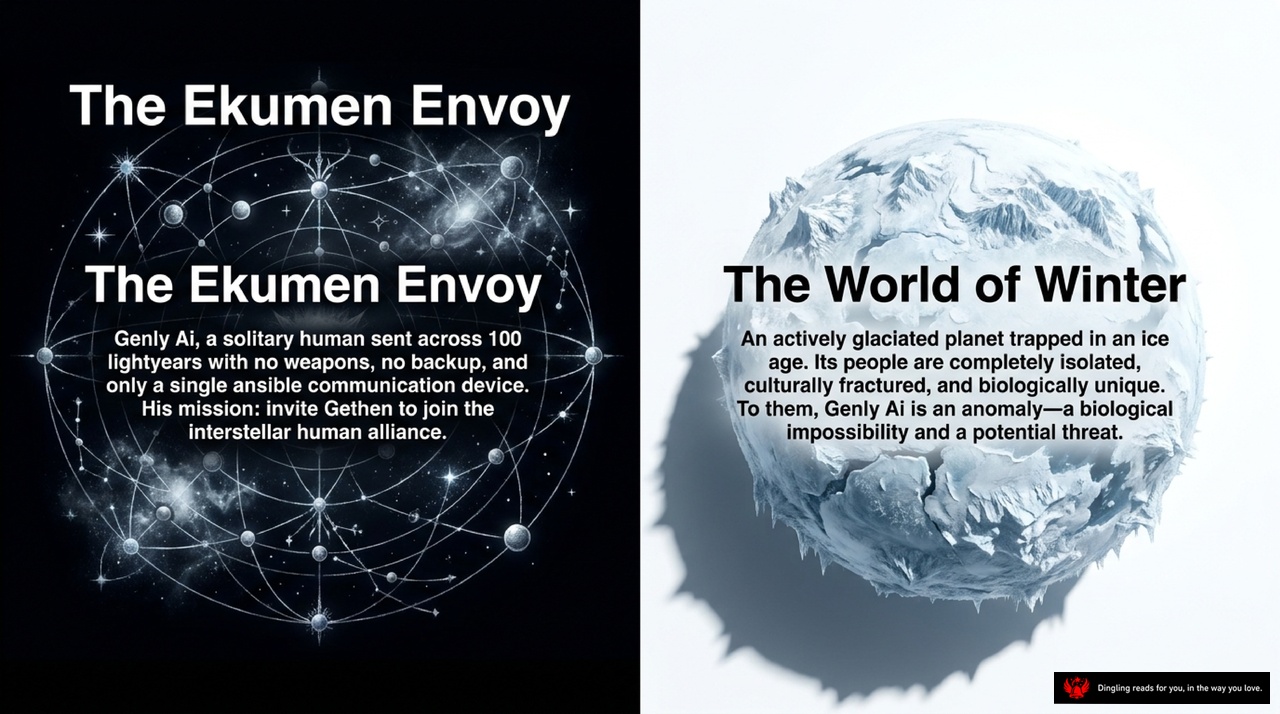
Welcome to the world of winter. On the left, you see Genly Ai, a solitary human envoy sent across 100 lightyears with no weapons, no backup, and only a single ansible communication device. His mission is simple yet monumental: invite Gethen to join the interstellar human alliance. But on the right, you see the reality he faces—the World of Winter. This is an actively glaciated planet trapped in an ice age. Its people are completely isolated, culturally fractured, and biologically unique. To them, Genly Ai is an anomaly—a biological impossibility and a potential threat.
When Genly Ai arrives in the capital of Karhide, he is not greeted as a hero, but as a monster. The local king, Agave XV, sees the envoy's offer of a human alliance not as a chance for progress, but as a direct threat to his own power. He is a man driven by fear, convinced that his kingdom is just a speck of dust in the vast universe. He banishes Genly Ai, accusing him of treason, and sends him fleeing into the harsh winter.
But this rejection is only the beginning of a deeper crisis. Genly Ai soon discovers that the true danger isn't just the cold, but the internal rot of Gethen itself. A powerful faction within the kingdom, led by a scheming regent named Tiam, is manipulating the king's fears to consolidate absolute power. They are ready to sacrifice the very people they claim to protect. Genly Ai realizes that to save Gethen, he must first save its own leaders from their own self-destruction. He is forced to flee again, this time with the help of a mysterious nobleman named Esven, and they must journey across the frozen continent to find a way to turn the tide before the entire planet is consumed by war and tyranny.

For most of the month, life on Gethen is defined by silence. The people are androgynous and sexually inactive for eighty percent of their cycle, a state known as Somer. It's a time of deep latency where gender doesn't exist, and the biological divide is effectively closed. But then, around day twenty, everything changes. A hormonal spike triggers the Kemmer Cycle Activation Curve, launching them into the brief but intense Active Phase.
During this window, an individual transforms based on their partner. If they interact with someone who is also in the active phase, they may become male or female, completing the act of reproduction before reverting back to their neutral state. As the graphic notes, anyone can father a child, and anyone can bear one; there is no permanent gender. This fluidity means that for the people of Gethen, gender is a temporary function, not a fixed identity. It's a biological system designed to adapt instantly to the needs of the moment, turning the entire society into a dynamic reflection of their immediate biological reality.
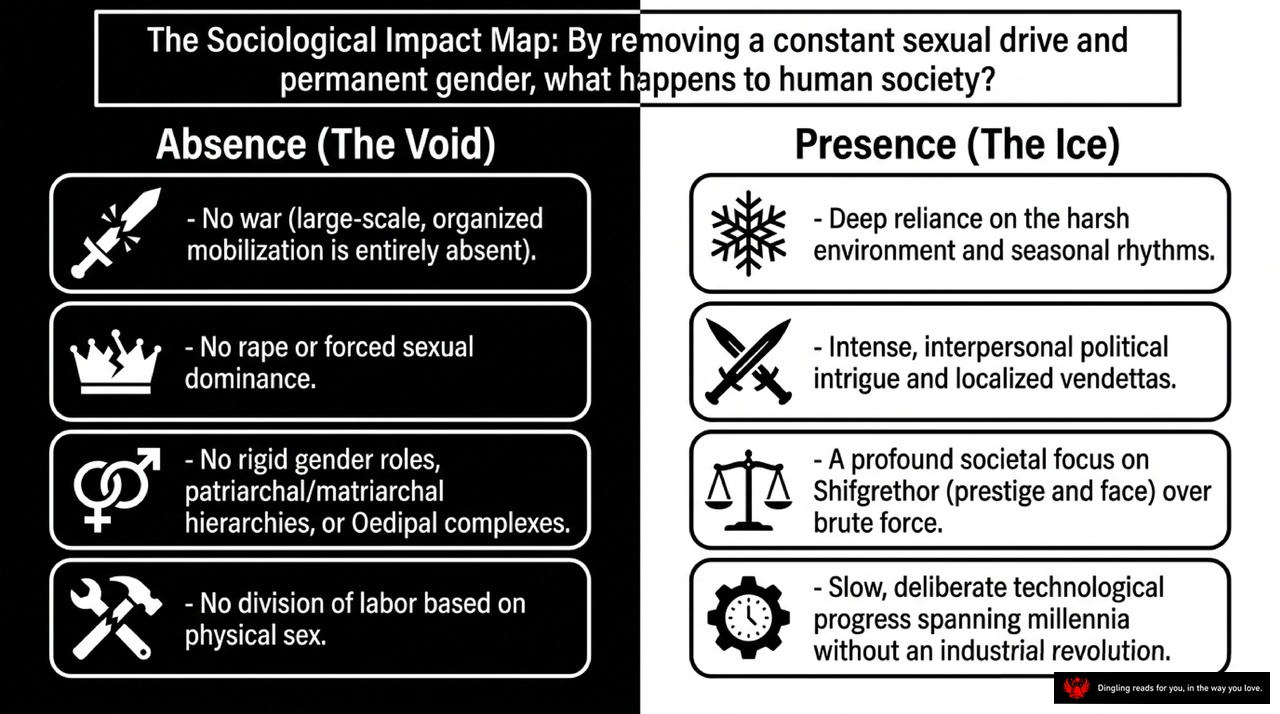
Look at this map. It asks a terrifying question: What happens to human society if we remove our constant sexual drive and the rigid concept of gender? The slide contrasts two worlds. On the left, the "Absence," or the Void. Imagine a world without large-scale war, without rape, without rigid gender roles, and without labor divisions based on sex. It's a world of peace and equality, yet it feels like an empty void. On the right, the "Presence," or The Ice. Here, society is defined by harsh environments, intense political intrigue, and a focus on prestige over brute force. Technology moves slowly over millennia without an industrial revolution.
This isn't just theory; it's the reality of Gossamer, the planet where our story begins. The Gossamers are unique. Their biology is fluid. For most of their cycle, they are sexually neutral. Only during a brief, intense period called "Kama Sutra" do they temporarily develop male or female traits. This fluidity means they don't have fixed genders, no patriarchy, and no concept of rape. Their society is built around cooperation rather than dominance.
But there's a cost. This unique biology has shaped their entire culture. Because they don't have fixed genders, they don't have the same drives for territorial expansion or industrialization that we see on Earth. Their technology remains primitive, and they live in a slow, deliberate pace, adapting to a harsh, frozen environment. They rely on the "Ice" of their world, which fosters a society focused on honor, face, and intricate social dynamics rather than brute force or sexual conquest.
In contrast, if we look at a world without these constraints—the "Void"—we see a society that has never known war or gender-based violence. But it's a quiet, almost stagnant peace. The Gossamer story shows us that our very nature, our sexual drives and gender roles, are the engines that drive our history, our wars, our technologies, and our very definition of what it means to be human. Without them, we might lose our conflicts, but we might also lose the very things that make us human.

Welcome to the second chapter of our journey into the heart of Karhide and Orgoreyn. This slide breaks down the starkly different political landscapes that define our story.
On the left, we have Karhide. It is a chaotic, feudal monarchy ruled by the mad King Argaven. Unlike the structured world we might expect, this is a realm of fear and pride. The King's control isn't maintained by police or prisons, but through an intricate, non-violent social prestige system known as Shifgrethor. The setting itself, Erhenrang, is a labyrinthine, shadowed ancient stone city that feels timeless and oppressive. When the envoy arrives, he is rejected simply because the King fears him and refuses to share power.
Contrast this with Orgoreyn on the right. This is a highly organized, bureaucratic oligarchy ruled by a council of thirty-three Commensals. Here, control is absolute and visible, enforced by a state police force, hidden prisons, and total surveillance known as The Sarf. The city of Mishnory is a modern, concrete metropolis that is illuminated but soulless. In this system, the envoy isn't rejected out of pride; he is calculatedly used as a political pawn, eventually to be buried in a work camp to serve the state's interests.
The tension between these two systems—the chaotic, fear-based monarchy of Karhide and the cold, efficient tyranny of Orgoreyn—creates the perfect stage for the envoy's dangerous mission.

Welcome to the final chapter of our journey. Look at the intricate mobile on the left—those hanging scales and antlers aren't just decoration; they represent the delicate, invisible balance of power in Genly Ai's world. Today, we're diving into "The Mechanics of Shifgrethor," the untranslatable rule that governed the entire planet.
The text on the right defines it perfectly: Shifgrethor is the ancient code for "shadow," dictating how one maintains prestige and status without ever saying a word. It's a game of non-violent social dominance. In this culture, direct advice, blunt truths, or overt demands don't just fail—they actively destroy your standing. You have to be subtle, you have to read the room, and you must never force your will upon others.
This is exactly why Genly Ai's mission failed. Lacking this instinct, he couldn't understand Estraven's complex political maneuvers. What Estraven saw as necessary protection, Genly interpreted as outright betrayal and treason. He took a delicate, indirect approach and mistook it for a direct attack. The scales in the image were tipped because Genly refused to play by the local rules. He tried to use logic and directness in a world that only understood nuance and shadow. His failure wasn't due to a lack of good intentions, but a fundamental inability to navigate the mechanics of Shifgrethor. As we've seen throughout his journey, from the prison farm to the glacial escape, Genly's rigid honesty constantly clashed with the fluid, indirect nature of Genesian society. His story serves as a timeless reminder that in diplomacy and leadership, understanding the unwritten rules is often just as important as the written ones.

Welcome to the final chapter of our journey into the Philosophical Matrix. On this slide, we see two distinct worlds: Handdara, the Darkness, and Yomeshta, the Light. Handdara values ignorance and the unpredictable, believing that unprovability is the true foundation of action. It embraces the shadows and the void, understanding that without the unknown, thought itself cannot exist. In stark contrast, Yomeshta, represented by the blinding sun, values absolute vision and total knowledge. It believes that Meshe, the center of time, sees the past, present, and future simultaneously. To Yomeshta, there is no darkness at all; the shadow is rejected completely because it is seen as an illusion. This isn't just about light versus dark; it's about how we choose to see reality. Do we hide in the mystery, or do we demand to know everything? As we've seen in Eliot's story, the struggle between these two philosophies drives the fate of entire worlds. Handdara teaches us that fear and uncertainty are necessary for growth, while Yomeshta warns that the pursuit of total knowledge can blind us to the very truth we seek. Which side of the matrix do you stand on?

Picture shows a striking network diagram titled "The Architecture of Prophecy," featuring a central figure, "Faxe the Weaver," connecting three distinct groups: "Celibates" representing stable energy, "Kemmerers" driving intense emotional force, and "Zanies" introducing chaotic dissonance. The text below explains that foretelling isn't magic but a volatile network of human energy, where the Weaver harnesses these conflicting forces to pierce the veil of time.
This visual perfectly captures the mystical yet scientific reality of the Gethenians' prophetic tradition. In the story, the Weaver acts as a conduit, channeling the suppressed desires of Celibates, the raw passion of Kemmerers, and the fractured minds of Zanies to access truths hidden from normal perception. It's not about seeing the future with crystal balls; it's about tuning into the collective psychic frequency of a society. When the protagonist, Kwinth, asks the Weaver if Gethen will join the Ekumen in five years, the answer isn't a guess—it's a precise truth born from this deliberate, chaotic convergence of energies. The diagram illustrates that even in a world where gender and identity are fluid, there is a rigid, underlying structure to how time and fate are perceived. The Weaver stands at the center, not as a god, but as a human willing to endure the mental strain of holding these opposing forces together, just to reveal what lies beyond the fog of ignorance. This is the true cost of prophecy: the courage to stand in the storm of conflicting human experiences and find the single point of clarity within.
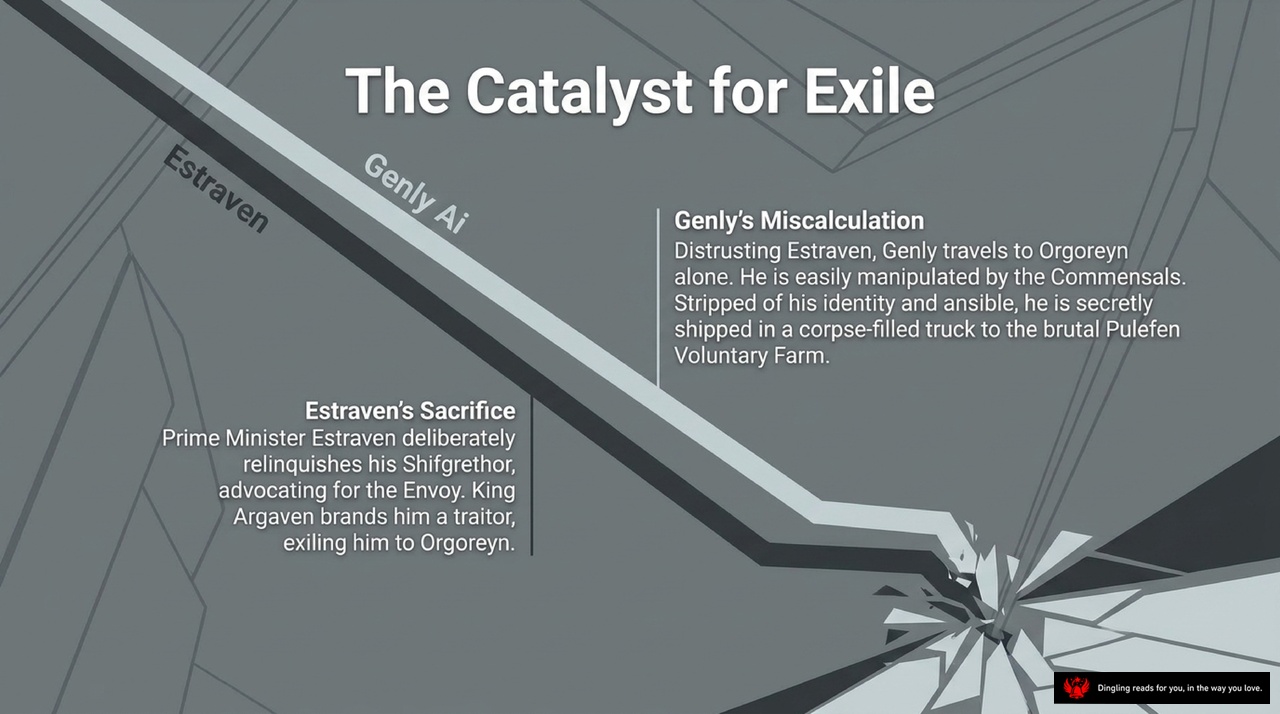
Look at this shattered path in front of us. This slide captures the exact moment the story turns from political intrigue into a desperate, life-or-death escape. It's titled "The Catalyst for Exile," and it breaks down the two pivotal choices that drove Genly Ai and Estraven apart.
On the right, we see "Genly's Miscalculation." Distrusting Estraven, Genly foolishly decides to travel to Orgoreyn alone. That single decision is the turning point. He walks right into a trap, easily manipulated by the Commensals, stripped of his identity, and secretly shipped in a corpse-filled truck to the brutal Pulefen Voluntary Farm. It's a stark reminder of how isolation can be fatal in a hostile world.
On the left, we see "Estraven's Sacrifice." Prime Minister Estraven deliberately relinquishes his Shifgrethor, advocating for the Envoy. He knows the risk. King Argaven brands him a traitor, exiling him to Orgoreyn. This isn't just a political defeat; it's a massive gamble. Estraven sacrifices his power and his name to save Genly's life. He chooses exile over safety so that Genly might survive to tell the tale.
The graphic shows these two paths diverging from a single point, much like the shattered glass at the bottom of the slide. One path leads to a farm of death, and the other leads to a long, dangerous journey across the ice. But here is the twist that defines the rest of the book: Estraven didn't just run away. He ran back. He risked everything to save the very person he was trying to protect. This moment of sacrifice is what eventually saves Genly's life and changes the fate of both worlds. It's a powerful lesson that true leadership sometimes means making the hard choice, even when it looks like the end of the road.
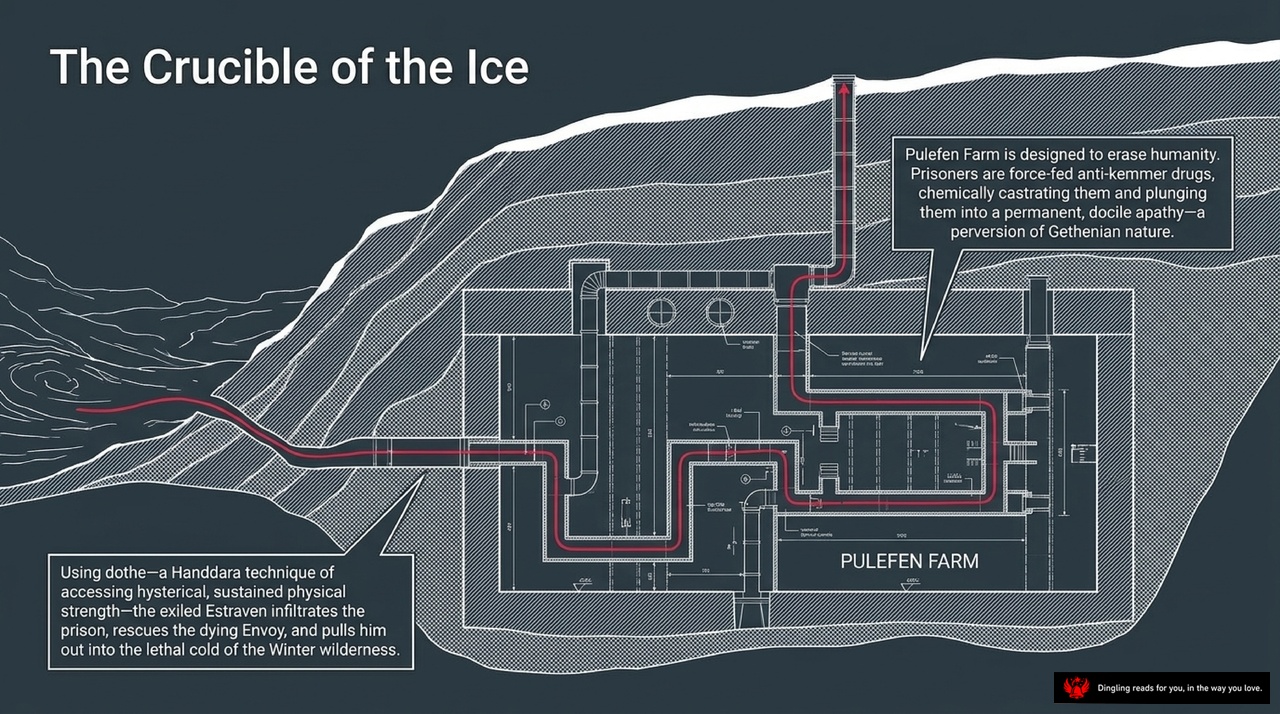
Deep beneath the frozen crust of Gethen lies Pulefen Farm, a sinister facility designed not to rehabilitate, but to erase humanity itself. Here, prisoners are force-fed anti-kemmer drugs, chemically castrating them and plunging them into a permanent, docile apathy—a perversion of Gethenian nature that strips away their very souls.
But even in this frozen crucible, there is a glimmer of rebellion. Using dothe—a Handdara technique of accessing hysterical, sustained physical strength—the exiled Estraven infiltrates the prison. He rescues the dying Envoy and pulls him out into the lethal cold of the Winter wilderness. This desperate escape sets the stage for a journey where survival depends on trust, courage, and the unbreakable bond between two strangers who have become the best of friends.

Imagine a journey where the map doesn't just show distance, but reveals the very soul of the relationship between two strangers. This slide, "80 Days Across the Gobrin Ice," captures the emotional arc of金利·艾 and埃斯文's incredible trek. It starts at Day 1 in "Isolation" and "Mutual Distrust." They are enemies by circumstance, separated by politics and fear. But as the red line climbs, it charts their transformation. By Day 20, amidst the "Volcanic Ash Fields," they begin to share "Hardship." By Day 40, in the treacherous "Crevasse Fields," vulnerability strips away their artificial identities, forcing them to see each other as human beings, not political pawns.
The peak of this journey, around Day 60, is marked by "Mindspeech & Deep Platonic Love." Here, stripped of their titles and nations, they find a connection that transcends gender and biology—a pure, spiritual bond. The text tells us that dragging a sled through blizzards and volcanic ash forced them to finally see each other not as tools of state, but as individuals. By Day 80, they reach the "Border," having crossed from isolation to "Unity." This isn't just about surviving the ice; it's about discovering that when the world tries to destroy you, the only way forward is through another person. Their love wasn't romantic in the traditional sense; it was a profound, life-saving partnership that changed the fate of two worlds.

Inside a freezing tent on the ice, Genly teaches Estraven the Ekumen art of Mindspeech, a language where lies are impossible. It is a bridge built not of words, but of truth. When Genly calls out, Estraven hears the voice of his dead brother, Arek. The ultimate bridge is crossed: Genly finally accepts Estraven's dual-gendered nature, and Estraven accepts the terrifying, telepathic truth of the alien. Unity is achieved not by erasing differences, but by deeply embracing them. As they travel across the vast, desolate glacier, light and shadow intertwine. Light is the left hand of darkness, and darkness the right hand of light. They realize that their isolation was an illusion; in the silence of the ice, they found each other. Their bond transcends the rigid binary thinking of Earth and Ogron. They become one, two souls sharing a single heartbeat, proving that even in the harshest cold, the human spirit—and the alien spirit—can find warmth in connection.
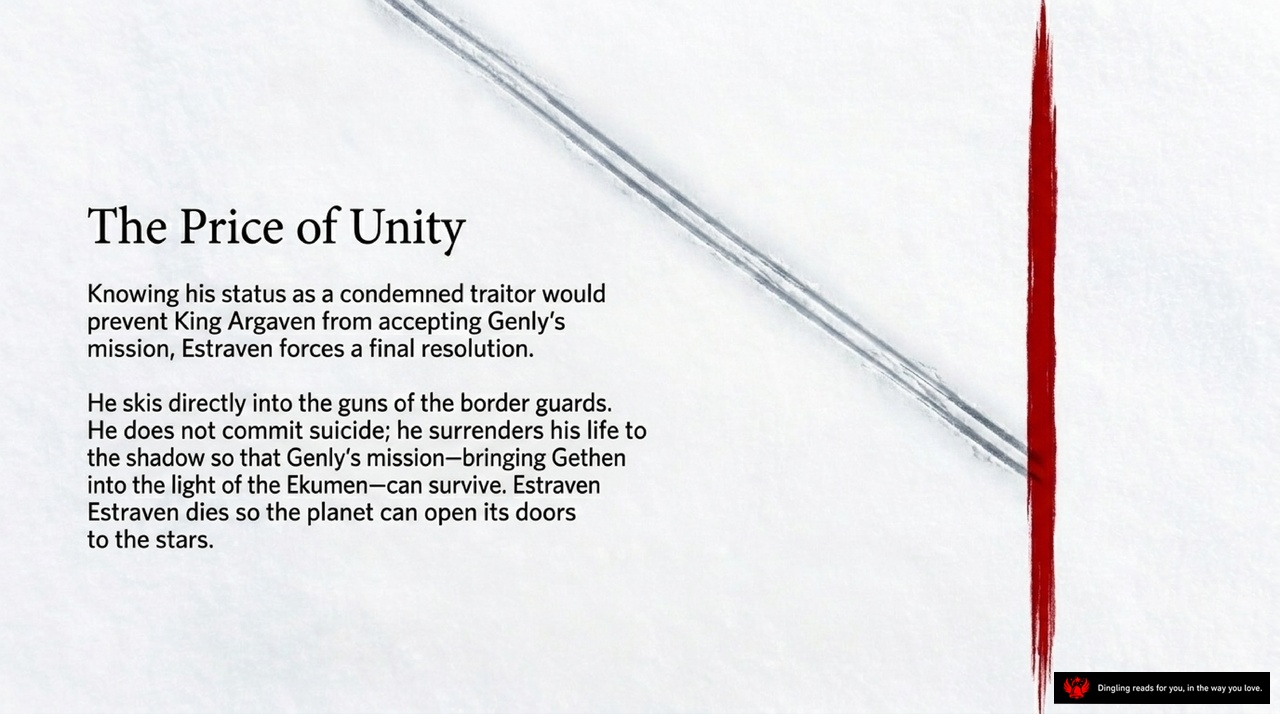
The price of unity is paid in blood, and for Estraven, that price was his very life. Knowing that his status as a condemned traitor would block King Argaven from accepting Genly's mission, Estraven made the ultimate sacrifice. He didn't choose suicide; instead, he skied directly into the guns of the border guards, surrendering his life to the shadow. His goal was clear: to ensure Genly's mission—bringing Gethen into the light of the Ekumen—could survive. By dying, Estraven cleared the path, allowing the planet to finally open its doors to the stars. This act of selflessness proves that true unity requires the courage to let go, even when it means leaving everything behind.

Imagine a solitary envoy and an exiled native bridging biological and cultural voids across a glacial wasteland, proving that human connection requires accepting the shadow just as much as the light. In the heart of the Gorbun Glacier, where the ice cracks like shattered glass under the wind, two strangers—Klincee from Ekmen and Esvin from Karm—became the only family each had. They walked through a world that demanded their silence, yet found their voice in shared suffering. When Klincee slipped into a deadly crevasse, it was Esvin who risked his own life, reaching down with frozen fingers to pull him back. In that moment, the divide between their species dissolved. They learned that fear is not a wall, but a bridge we build together when we stop running. If our own world were stripped of its absolute divides, what shadows would we finally be forced to face? Perhaps the only way to find the light is to stop fearing the darkness that waits just behind us.