
The Logic of Collective Action: Complete Chapter-by-Chapter Summary
Welcome to the world of *The Logic of Collective Action*, a groundbreaking book by Mancur Olson that completely changes how we understand why people get together. This isn't just another theory about groups; it's a paradigm-shifting revelation that explains a frustrating reality: why rational individuals rarely act to advance their common group interests.
Think about it. If you and a hundred others all want higher wages, why doesn't the group simply organize and demand it? Olson's answer is counterintuitive but brilliant. In large groups, individual effort feels meaningless. You might think, "If I join this union or lobby group, I'll help everyone. But if I don't, someone else will do it, and I'll still enjoy the benefits." This is the classic "free-rider" problem. No one wants to pay the cost of organizing because they can ride on the coattails of others.
This logic applies everywhere. Whether it's workers trying to unionize, consumers demanding lower prices, or taxpayers wanting better public services, the math is the same. Small groups can often succeed because every member's contribution matters, but large, potential groups remain paralyzed by self-interest. Without external force or special incentives, these groups simply won't act.
Olson challenges the old idea that people naturally band together for the common good. Instead, he shows us that the path to collective action is much harder than we think, and understanding this logic is key to explaining everything from corporate lobbying to the limits of democracy.
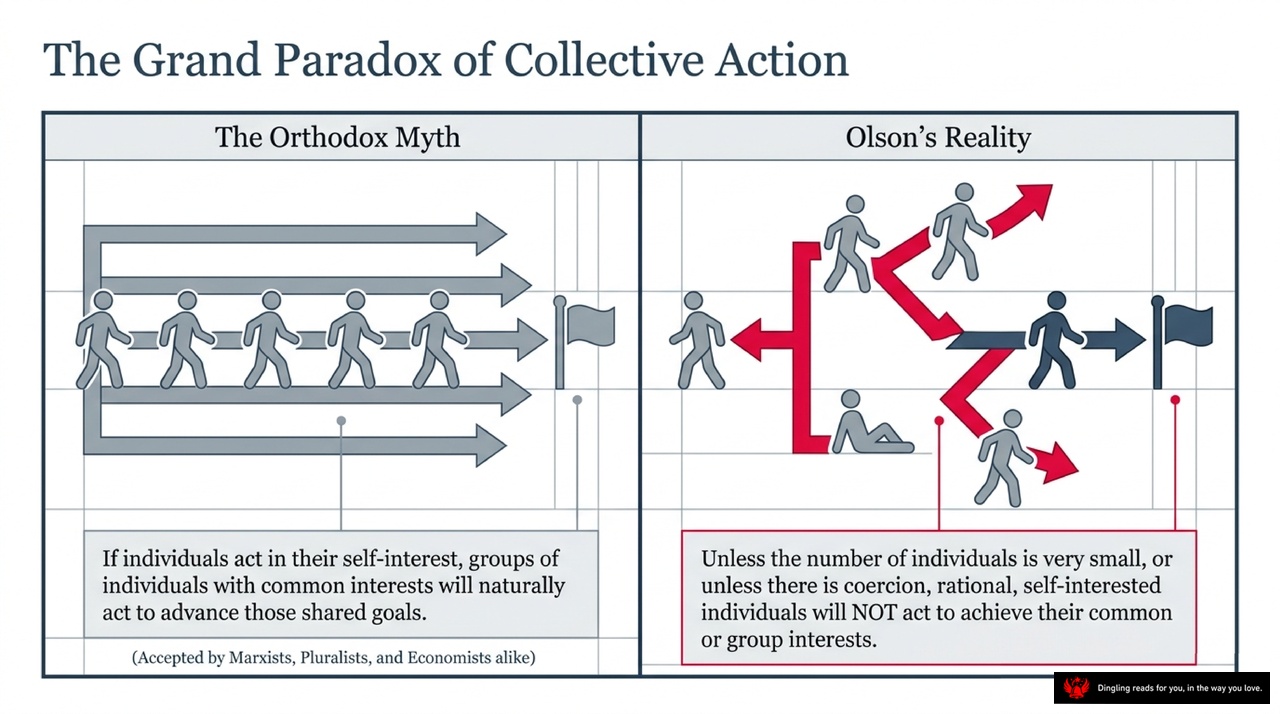
Welcome to the reality of collective action. Look at this slide: it contrasts "The Orthodox Myth" with "Olson's Reality." On the left, you see a perfect line of people marching in unison toward a shared goal, believing that if everyone acts in their self-interest, the group will naturally succeed. That's the traditional view held by many economists and political scientists. But on the right, we see the messy truth. Here, individuals are scattered, some are left behind, and only a few make it to the finish line.
Why the disconnect? The slide explains it clearly: unless the group is very small or relies on coercion, rational, self-interested individuals will NOT act to achieve their common goals. Think about it: if you are part of a massive group, your individual effort makes zero difference to the outcome. You will always choose to free-ride, letting others do the hard work while you enjoy the benefits. This is the grand paradox. Large groups, even with shared interests, often fail to organize themselves because no single person has the incentive to sacrifice for the whole. Only small groups or those with forced participation can actually get things done.

Have you ever wondered why, despite having a shared goal, large groups often fail to act? Look at this diagram: "The Trap of the Public Good." It perfectly illustrates the "Free Rider Logic" that paralyzes big organizations.
The image shows a giant umbrella labeled "The Public Good." A few people are holding it, while others stand underneath, labeled as "Free-Riding," doing nothing but enjoying the shade. This visualizes the core concept on the left: public goods are strictly non-excludable. If one person gets the benefit, everyone does.
Now, let's follow the logic on the right. Step 1 is the goal—something everyone wants, like higher wages or national defense. Step 2 is the rational calculation. An individual thinks, "My single effort won't noticeably affect the outcome." So, why should I pay the cost or work hard? Step 3 reveals the inevitable outcome: if the good is achieved, you benefit whether you contributed or not. Therefore, the most rational individual action is inaction.
This explains why large groups struggle. As the text notes, in big organizations, an individual's effort is negligible. Just like in a perfectly competitive market where no single firm can raise prices alone, a single worker or taxpayer cannot save the union or the nation alone. If everyone thinks, "I'll let others do the heavy lifting," the result is that no one lifts the umbrella at all. This is the fundamental dilemma of large groups: individual rationality leads to collective failure.
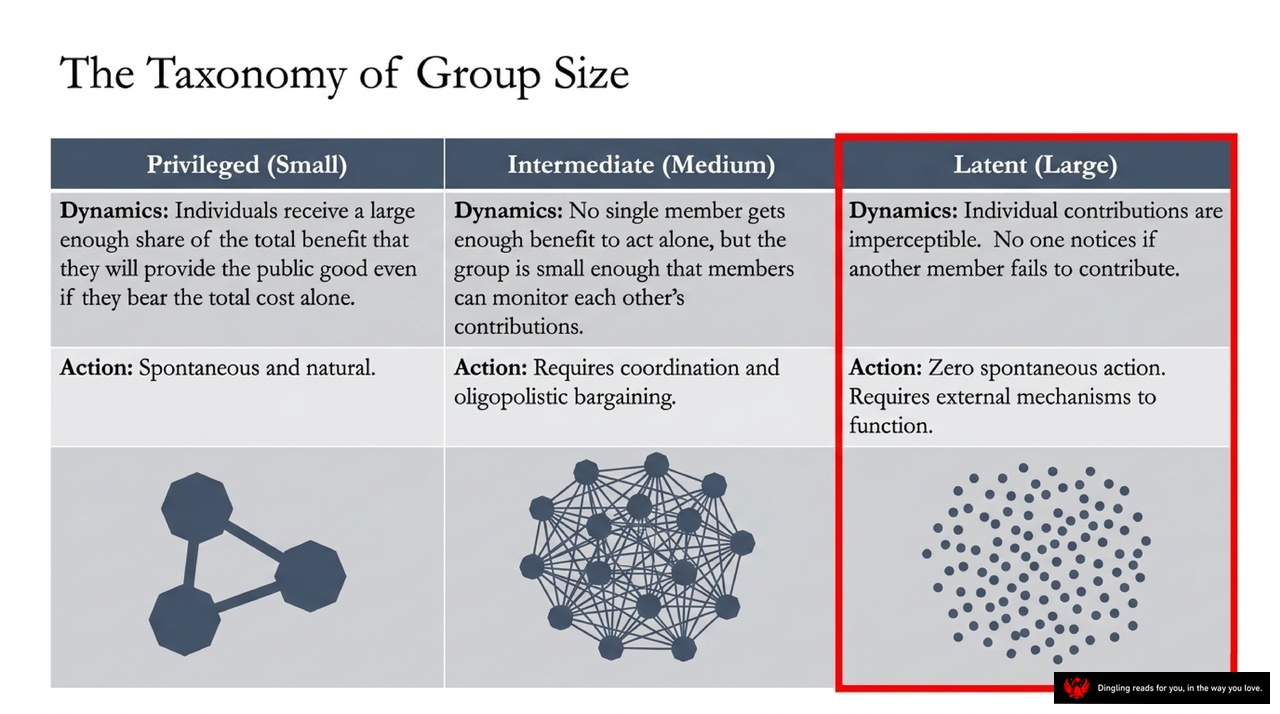
Welcome back. Today we're diving into the "Taxonomy of Group Size," a framework that explains why some groups act while others remain silent.
Look at the chart on your screen. It breaks groups into three distinct categories based on their size and internal dynamics. On the left, we have "Privileged" or small groups. Here, individuals receive such a large share of the benefits that they are willing to bear the total cost alone. Because the action is spontaneous and natural, these groups can achieve their goals without any external help.
In the middle, we see "Intermediate" or medium-sized groups. In these scenarios, no single member gets enough benefit to act alone, but the group is still small enough that members can monitor each other. This requires coordination and what we call oligopolistic bargaining to succeed.
Finally, on the right, highlighted in red, are "Latent" or large groups. This is where the real problem lies. In large groups, individual contributions become imperceptible. No one notices if another member fails to contribute, and no single person feels responsible for the group's success. Consequently, there is zero spontaneous action. Without external mechanisms or forced participation, these large groups simply cannot function on their own.
This distinction is crucial because it reveals why many large organizations struggle to act, while small groups thrive naturally.

In small groups where members aren't equal, the burden of getting things done falls in an incredibly arbitrary way. Look at the diagram here: we have a "Large Stakeholder" on one side and a cluster of "Small Stakeholders" on the other. The logic is simple but ruthless. The member with the largest stake gains the most from the collective good. Because they want it the most, they will often pay disproportionately to secure it. Meanwhile, the smaller members realize that the "great" member will pay for it anyway, so they stop contributing entirely. This creates a dynamic where the smaller members effectively exploit the larger one. The takeaway is clear: the larger the stakeholder, the more they are exploited by the smaller stakeholders. This explains why big groups often struggle to act voluntarily while small, tight-knit groups can mobilize instantly.
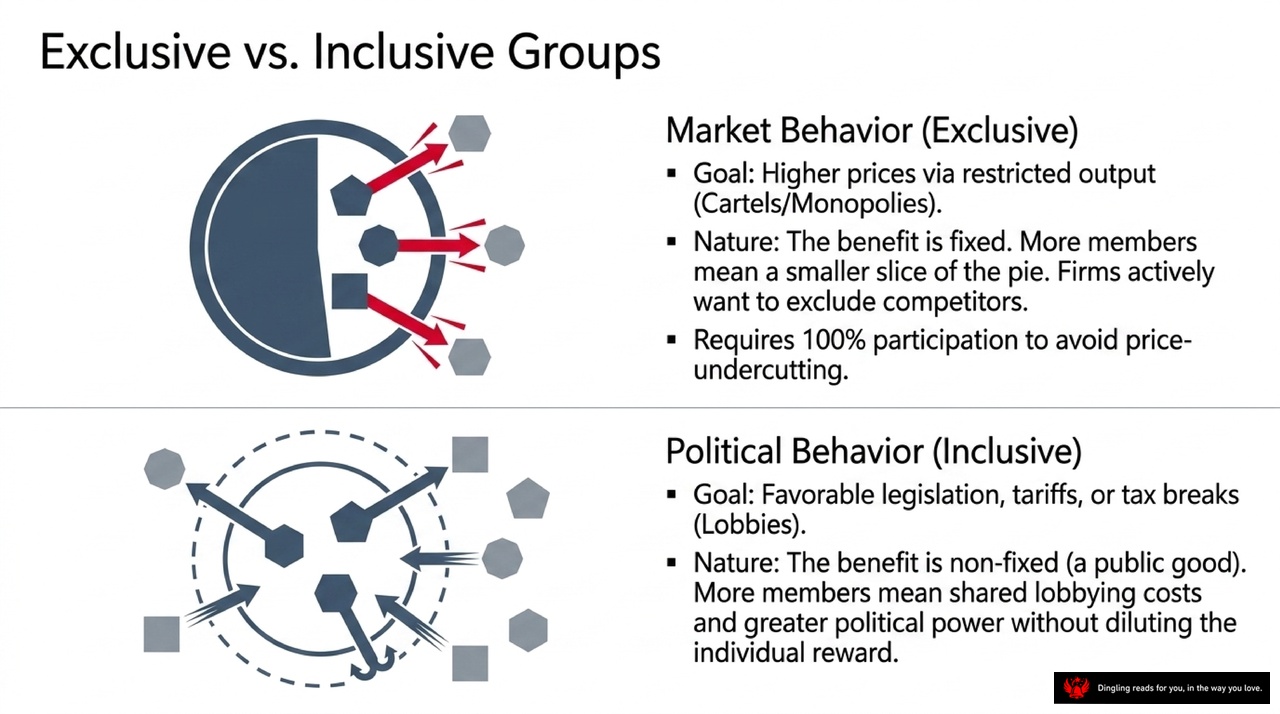
Look at this slide comparing how exclusive market groups and inclusive political groups actually behave. The visual on the left shows a closed circle pushing people out, representing the "Market Behavior" of exclusive groups like cartels or monopolies. Their goal is simple: higher prices by restricting output. Because the benefit is fixed, adding more members just means a smaller slice of the pie. To prevent competitors from undercutting prices, these groups require 100% participation; if even one firm cheats by increasing output, the whole scheme collapses.
Now, look at the bottom half. The dashed circle expanding outward illustrates "Political Behavior," which is inclusive. Here, the goal isn't to fix a price but to win favorable legislation, tariffs, or tax breaks through lobbying. Unlike the market, the benefit here is a public good—it's non-fixed. Adding more members doesn't dilute the reward; instead, it spreads the lobbying costs and amplifies political power. This explains why industries often form small, tight-knit associations to fight for specific tax loopholes rather than trying to organize the entire industry. It's a fundamental shift: in the market, you must exclude everyone to succeed, but in politics, you invite everyone in to build strength.

Look at this slide titled "Illusion I: The Marxist Fallacy." It challenges a fundamental assumption about how revolutions happen. The core argument here is simple but powerful: Marx defined social classes based on pure economic self-interest. He believed that if workers were truly economically rational, they would spontaneously revolt against their exploiters.
But this slide contrasts two very different realities. On the left, we see the "Orthodox Expectation." It assumes that because an oppressed class shares a common experience of exploitation, they will naturally unite and launch a spontaneous, violent revolution. It treats the worker class as a monolith driven by shared grievances.
However, the right side shows "Olson's Reality," which flips the script. It starts with the "Rational Worker." This worker doesn't just feel anger; they calculate the risk of death versus the reward of a better life. They realize that a successful revolution is a "Public Good." Here's the catch: a successful revolution benefits all workers, regardless of who actually fought. If you stay home and let others fight, you still get the benefits of the new system.
The logic at the bottom explains why this happens. Participating in a revolution carries massive individual costs—death, imprisonment, and lost wages. But the benefits are shared by everyone. Since no single worker can guarantee the revolution's success, and everyone can enjoy the victory without contributing, the rational choice for the individual is to stay home and let others fight.
This insight destroys the Marxist fallacy. It proves that historic "Marxist" revolutions were never spontaneous uprisings of the entire working class. Instead, they were the work of highly organized, small elites—like Lenin's vanguard—who could force the issue when the masses rationally chose to free-ride.

Welcome back. Today we're tackling a powerful concept that often blinds us in everyday politics: The Pluralist Mirage.
Look at the graphic on your screen. It illustrates a common belief known as "The Orthodoxy." Many people, including scholars like Bentley and Truman, argue that politics is a perfect equilibrium of pressure groups. The logic is simple and appealing: if a policy hurts consumers, those consumers will naturally form a group to push back and protect themselves. It feels like a fair, self-correcting system where every interest gets a seat at the table.
But here is where the illusion breaks. The image reveals the "Blueprint of Asymmetry." This perspective ignores the critical reality of size. A small group of manufacturers—a "Privileged" group—can easily organize, coordinate, and lobby effectively. In contrast, the millions of consumers they exploit, whom we call a "Latent" group, face insurmountable organizational costs and the free-rider problem. It is incredibly difficult for a scattered majority to organize against a focused minority.
The conclusion is stark: the political scale is structurally rigged in favor of small, special interests. What looks like a balanced democracy is often just a contest where the organized few consistently outmaneuver the disorganized many. This isn't just a theoretical flaw; it explains why we see powerful corporate lobbies dominating policy while the consumer majority remains silent. Understanding this asymmetry is the first step to seeing through the pluralist mirage.

Here is the spoken script for Slide 8, tailored for an American audience with a natural, engaging tone.
**Slide 8 Script:**
"Let's look at the anatomy of power within labor unions. This slide highlights a fascinating paradox: over 90% of workers vote for mandatory union dues, yet less than 5% voluntarily attend union meetings. Why such a disconnect?
The graphic breaks this down into a funnel. At the top, we see 'Voluntary Membership,' which is approaching zero. If workers acted purely on individual rationality, almost no one would join because they can enjoy the benefits—like higher wages—without paying the personal cost of dues or striking. This is the classic free-rider problem.
But unions survive because of the middle layer: 'Coercive Mechanisms.' This includes closed shops and picketing. These aren't just side effects; they are the fundamental engine of the union. By making membership compulsory, unions solve the free-rider dilemma. They force everyone to pay their share so that the group can actually deliver on its promises.
The rational explanation at the bottom ties it all together. Workers want the public good of higher wages, but no single rational worker wants to pay the individual cost if they can get the benefit for free. The solution is simple: labor unions only survive when membership is compulsory. Without these coercive tools, the group would collapse under the weight of individual rationality. In short, the union's power isn't built on voluntary enthusiasm, but on the structural necessity of forcing collective action."
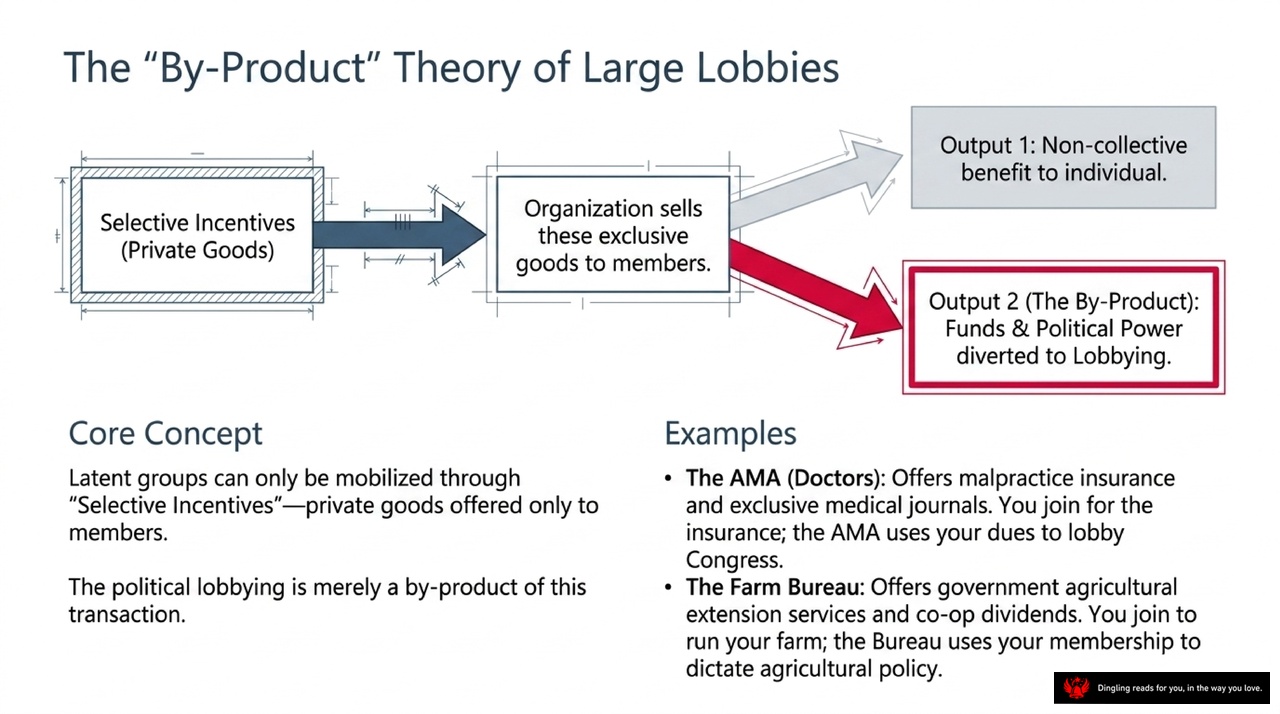
Let's dive into the mechanics of why some massive organizations become political powerhouses while others fade into obscurity. Look at this diagram: "The 'By-Product' Theory of Large Lobbies." It flips the script on how we think about lobbying. We often assume groups lobby just to get power, but this theory argues the opposite: lobbying is actually a side effect, or a "by-product," of something else entirely.
The core concept here is simple but profound. Large groups, or what the book calls "latent groups," are hard to mobilize because no single member feels their effort makes a difference. If you're just one doctor out of thousands, or one farmer out of millions, your individual action won't change the outcome. So, why would anyone pay dues or spend time organizing? The answer lies in "Selective Incentives."
As the flowchart shows, these organizations start by selling "Private Goods"—exclusive benefits that only members get. Think of the American Medical Association. Why do doctors join? Not primarily to lobby Congress, but to get malpractice insurance and exclusive medical journals. You join for the insurance; the AMA uses your dues to lobby. The Farm Bureau works the same way: you join for government extension services and co-op dividends, and they use your membership to dictate agricultural policy.
The organization sells these exclusive goods to members, creating a financial base. From that foundation, two things happen. Output number one is the non-collective benefit to the individual—the insurance, the journals, the dividends. That's the real reason people join. But Output number two, highlighted in red, is the by-product: funds and political power diverted to lobbying.
The political lobbying is merely a by-product of this transaction. Without the promise of those private, exclusive goods, large groups like the AMA or the Farm Bureau simply wouldn't exist. They couldn't solve the free-rider problem where everyone waits for others to do the work. By offering something tangible and private, they turn a scattered crowd into a powerful, organized force capable of influencing the government. It's not that they want power for power's sake; they have power because they successfully sold members a product they couldn't get on their own.
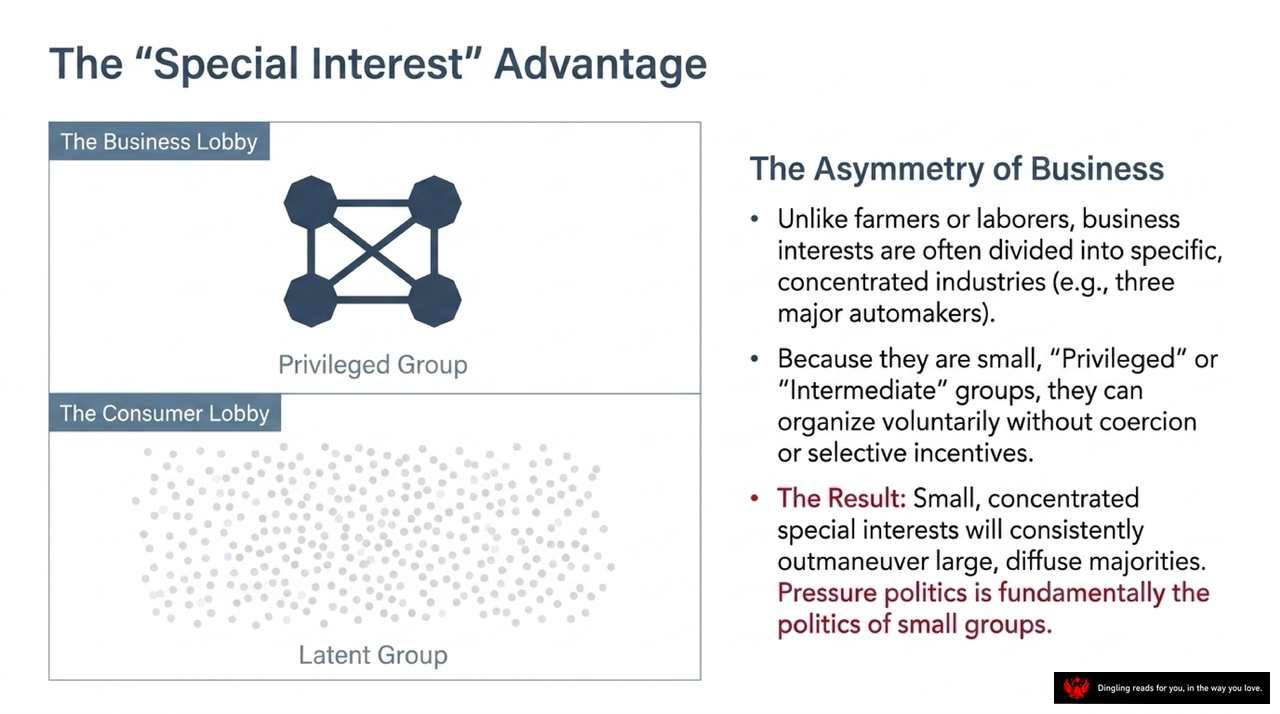
Let's dive into the core mechanism of how special interests actually win in our political system. Look at the slide: we see a sharp divide between the "Business Lobby," organized as a tight-knit "Privileged Group," and the "Consumer Lobby," which looks like a scattered cloud of dots—a "Latent Group."
Why does this structure matter? It comes down to what we call the "Asymmetry of Business." Unlike farmers or laborers, business interests often break into specific, concentrated industries—think of just three major automakers dominating the market. Because these groups are small and focused, they can organize themselves voluntarily without needing coercion or special incentives to get everyone on board.
The result is clear and often frustrating: small, concentrated special interests will consistently outmaneuver large, diffuse majorities. The business lobby, with its tight connections, can mobilize quickly to protect its niche. Meanwhile, the consumer lobby, representing millions of individuals, remains a latent group. No single consumer feels their voice matters enough to act, and no one wants to pay the cost of organizing. This is why pressure politics is fundamentally the politics of small groups. The few, organized and motivated, always beat the many, who are organized and motivated.

Look at this diagram: The Catalyst, The Political Entrepreneur. It illustrates a powerful dynamic where a scattered "Latent Group" transforms into organized "Collective Action" through a single central figure: The Entrepreneur.
Here is the core insight: A latent group will sit dormant forever without an external spark. Just because people share a common interest doesn't mean they will act on it. In fact, the larger the group, the harder it is to organize because everyone hopes others will pay the cost while they enjoy the benefits. This is the classic collective action problem.
The Political Entrepreneur is the innovator who solves this. They don't just rely on altruism; they invent and provide "Selective Incentives." These are rewards—like power, prestige, or a cut of organizational resources—that make it rational for individuals to join and contribute. The entrepreneur absorbs the initial bargaining and organizational costs, essentially extracting a "profit" from organizing the unorganized. They act as the catalyst that turns a passive mass into a forceful collective, bridging the gap between shared desire and actual action.

Have you ever wondered why, in a democracy supposedly ruled by the majority, the policies we live under are often dictated by a small, organized few? This slide poses a piercing question: Are we truly governed by majority rule, or merely by the most efficiently organized minorities?
The answer lies in a fundamental flaw in modern society. As the text on your screen highlights, the defining feature of our world isn't the triumph of the many, but the systematic dominance of the organized few over the disorganized many. Think about it: the great, latent majorities—consumers, taxpayers, and ordinary citizens—remain perpetually unorganized. They are trapped by their own rational calculations, silently bearing the costs of special interests that govern them.
Why does this happen? It comes down to the nature of large groups. When a group is too big, individual members realize their contribution is negligible. If I join a protest or a union, my single voice won't change the outcome, but I still get the benefit if someone else succeeds. This creates a "free-rider" problem where everyone waits for others to act. In contrast, small groups can coordinate easily because each member's effort directly impacts the result.
Consequently, our democratic policies often reflect the demands of these organized minorities—like powerful industries or professional associations—rather than the silent majority. These small groups can mobilize resources, hire lobbyists, and fund campaigns, while the vast public remains fragmented and voiceless. The slide challenges us to confront this reality: if our policies are dictated by those who can organize, rather than those who cannot, are we truly living under democracy? Or have we simply allowed the most efficient minorities to rule us all?