
The Logic of Life: Complete Chapter-by-Chapter Summary

Welcome to "The Logic of Life" by Feng Lun. This book isn't just about abstract theories; it's a practical guide to untangling the deepest anxieties we all face by shifting our perspectives. Think of life as a complex knot of relationships, decisions, and emotions. Whether you're navigating the challenges of raising a child, managing family dynamics, or understanding the nature of wealth and power, this book offers a fresh lens. It breaks down the hidden rules behind everything from filial piety and health to friendship and even the very concept of happiness. By understanding these underlying logics, we can move from confusion to clarity, transforming our struggles into opportunities for growth. Join me as we explore how to rewrite the story of our lives through these new, powerful viewpoints.

Think about the last time you felt truly stuck—like your thoughts were tangled in a knot you couldn't untie. That feeling isn't just random; it's what the book calls "Mental Gridlock." It happens when we face hardship without a rational way to interpret it, leaving us trapped in confusion and anxiety. But there is a way out. The core thesis here is about breaking that gridlock through a simple yet powerful shift: changing your lens. Instead of getting stuck in your existing worldview, you need to seek perspectives outside of it—through reading, deep dialogue, or philosophy. This "Lens Shift" acts as the catalyst. It transforms your suffering by giving you the cognitive flexibility to rewrite the narrative and find a rational explanation for what you're going through. True freedom, as the book reminds us, isn't about having no problems; it's about possessing the mental agility to make sense of them. When you shift from being a victim of chaos to an observer who can find meaning, the tangled mess in your mind suddenly straightens into a clear, forward-moving path.

Look at this diagram: "The Architecture of True Health." It breaks down wellness into two distinct pillars. On the left, we have Pillar One: Physical Health, labeled as "The Vessel." This is your biological hardware. It's built on three foundations: your genetics, which set your inherited baseline; your environment, including things like pollution and water quality; and your behavior, which is all about daily maintenance like sleep, exercise, and resisting bad habits. Think of this as the container that holds you.
But the right side is where the real magic happens. Pillar Two: Mental Health, or "The Operating System." If the vessel is just the body, the operating system is your mind and spirit. It runs on five critical drivers. First, Optimism: the ability to make sense of failure and find a consistent explanation for it. Second, Integration: finding a community where you truly belong and share values. Third, Ambition: having a forward-looking purpose that drives you. Fourth, Hobbies: cultivating joy for its own sake, like the "fishing without catching" principle—doing things just because they feel good, not for utility. And finally, Empathy: deriving deep existential value from helping others.
Here's the key takeaway: you can have a perfect "vessel" with great genetics and habits, but if your "operating system" is broken—if you lack purpose, community, or empathy—you aren't truly healthy. True health requires both a strong body and a resilient, well-tuned mind.
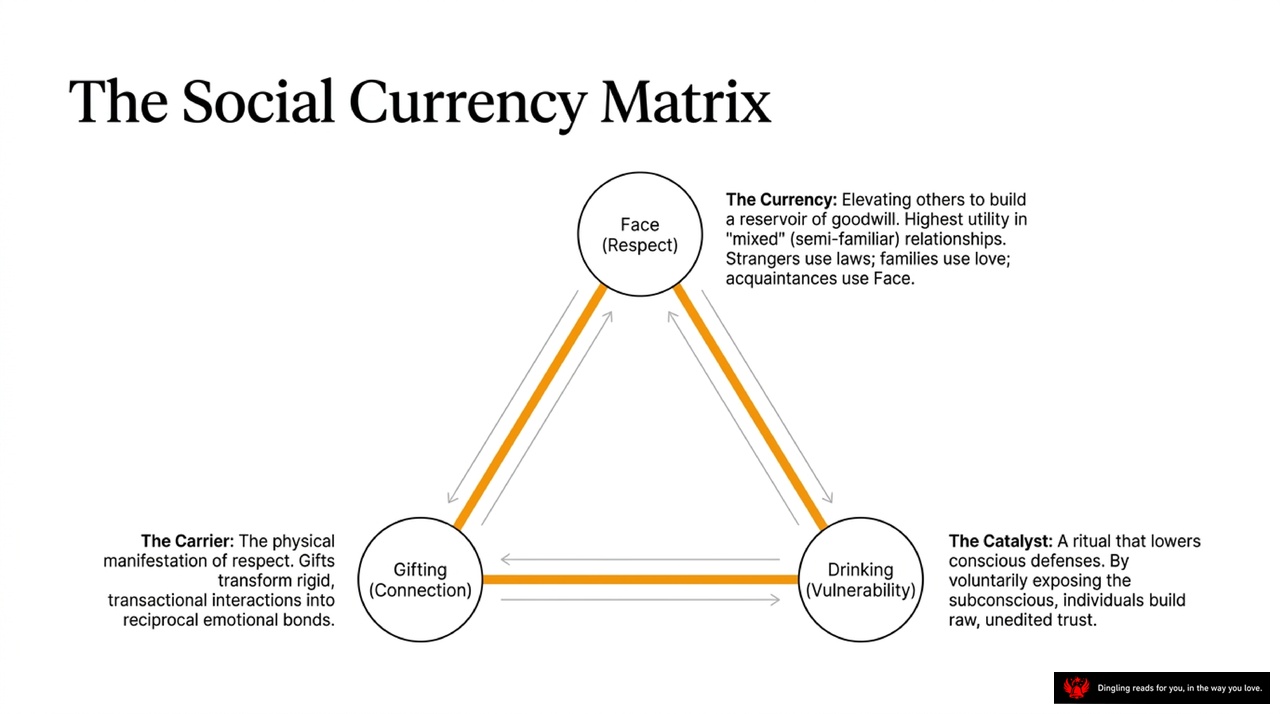
Think about the last time you felt a sting of jealousy—maybe a colleague got a promotion you wanted, or a partner showed more attention to someone else. We call it "eating vinegar," but there's a deeper logic here that goes far beyond just a bad mood. It's actually a fundamental mechanism of human connection.
First, you need an emotional community—a bond with a spouse, a pet, or even an object. Then, a third party enters the picture, threatening that bond. Your reaction, whether it's a cold stare, a slammed door, or a sharp comment, is simply a signal to make that intruder back off. Even animals do this; kittens will hiss at anything that tries to distract their mother while she nurses.
But here is the crucial part: eating vinegar doesn't have to be destructive. It can be a powerful fuel for growth. Take my friend's wife, for instance. Her mother-in-law constantly praised her ex-daughter-in-law's noodles, which naturally sparked some jealousy. Instead of letting that turn into resentment or sabotage, she quietly studied the recipe, practiced relentlessly, and eventually made noodles so good that the mother-in-law admitted they were even better. The tension dissolved, and the family harmony improved.
The key is control. If you let that "sour" feeling mutate into pure jealousy, it can spiral into hatred, lies, and even self-destruction. But if you channel that energy into self-improvement, you transform a potential poison into a nutrient for your relationships. So, next time you feel that twinge of acidity, don't suppress it or explode. Ask yourself: how can I use this feeling to become better? That's the real secret to mastering the art of "eating vinegar" and keeping your life flavorful.

We are living through a profound shift in how we view marriage, moving from a rigid institution to something far more fragile and personal. Look at this timeline: on the left, **The Past**, marriage was a solid brick wall—an institution designed purely as a survival tool to protect private property and ensure inheritance, enforced by strict social and legal punishments. But today, we are in **The Present**, a chaotic transition. The core survival functions of marriage, like economic safety and child-rearing support, are increasingly being outsourced to modern society, welfare systems, and technology. The bricks are falling away.
And that leads us to **The Future**, which is purely about emotion. Stripped of its economic utility, modern love remains a deeply personal moral and emotional bond. It is beautiful and deeply human, but it is also inherently fragile and constantly evolving. We are trading the security of an institution for the risk of a connection based solely on feeling. It's a paradox: we have the freedom to love without obligation, but we've also lost the safety net that once guaranteed our stability.
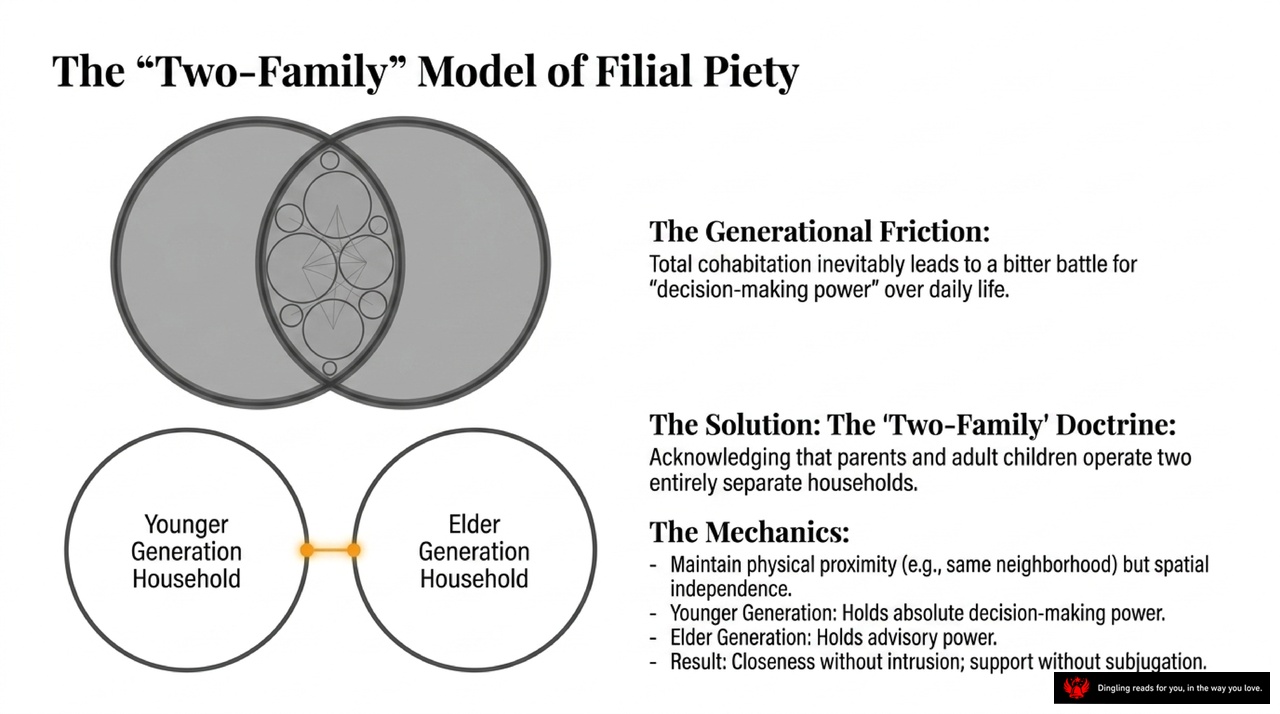
Today's slide breaks down the "Two-Family" Model of Filial Piety, offering a practical solution to the generational friction that plagues so many families. As the diagram illustrates, total cohabitation often leads to a bitter battle for decision-making power over daily life, creating unnecessary conflict between parents and adult children.
The solution lies in the "Two-Family" Doctrine: acknowledging that while you live together, you operate as two entirely separate households. The mechanics are clear: maintain physical proximity, perhaps in the same neighborhood or even the same building, but strictly preserve spatial independence. In this arrangement, the younger generation holds absolute decision-making power over their own life, while the elder generation retains advisory power.
This approach delivers the best of both worlds: closeness without intrusion, and support without subjugation. It allows families to stay connected and care for one another, while respecting the boundaries and autonomy that every adult needs to thrive.

Let's talk about the logic of "Big Brother." It's not about being the loudest in the room or having the biggest title; it's about a very specific, heavy set of responsibilities that only a true leader can carry. Think of it as an inverted pyramid of accountability, where the weight gets heavier as you go down.
At the top, the Big Brother must "Point the Way." When the team is lost or paralyzed by uncertainty, you need to provide absolute, unwavering direction. You are the compass. But pointing the way isn't enough. Below that, you must "Carry the Burden." This means shielding your group from external threats and, crucially, absorbing the impact of internal mistakes. You take the hit so they don't have to.
Then comes the practical reality: you must "Pay the Bill." This is about resource allocation. You are continually funding the survival, growth, and even the collective mistakes of the organization. You are the engine that keeps the ship running. But the ultimate test of this archetype is at the very bottom, highlighted in that bold yellow section: "Make the Sacrifice." This is ultimate accountability. When a crisis becomes insurmountable, true leadership requires offering oneself as the ultimate price to save the group. It's a simple but terrifying truth: no escape, no surrender. If you can't do this, you aren't just a leader; you're just a manager. A Big Brother is defined by what he is willing to lose to save those he leads.

The logic of the Emperor, the logic of the Prison, and the logic of the Pet—they all share the exact same mechanism of total control. This is the dark anatomy of domestication.
Imagine a circle with "The Subject" right in the center. As you move outward, you see the layers of control tightening. The first step is the removal of agency. We strip the subject of the ability or even the desire to rebel, reducing their existence to merely pleasing the master. It's about taking away their power to choose.
Next comes information isolation. We cut off external inputs and force-feed a single-channel narrative to reshape the subject's reality. Think about it: if you only hear one story, you can't imagine any other world. That narrative becomes your entire truth.
The core insight here is terrifyingly simple. Whether it's a tyrant ruling an empire, a prisoner locked in a cell, or a pet trained to obey, the underlying logic is identical. True freedom, therefore, demands something very specific: diverse information and total financial independence. Without access to different perspectives and the power to support yourself, you remain trapped in the center of that circle, unable to break free.
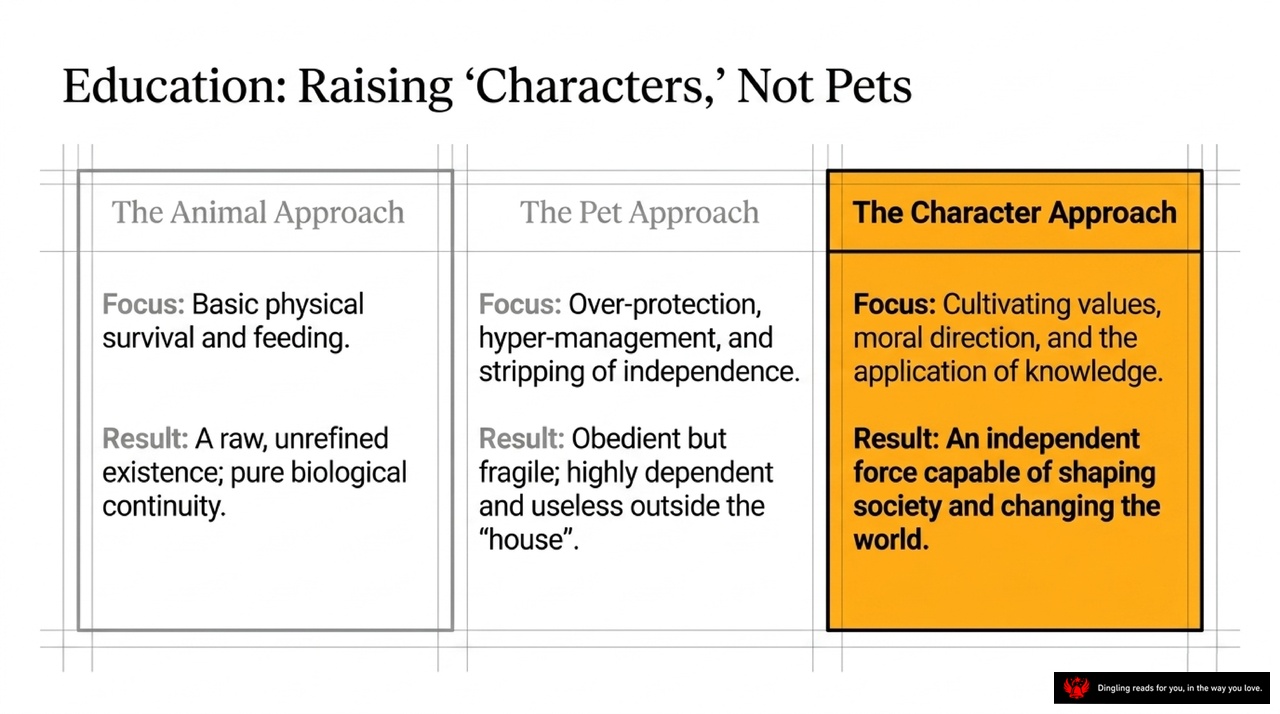
Education isn't about raising pets or keeping animals; it's about cultivating true characters. Let's break down the three distinct approaches. First, the animal approach focuses solely on basic physical survival and feeding, resulting in a raw, unrefined existence that is purely biological. Second, the pet approach prioritizes over-protection, hyper-management, and stripping away independence, which creates obedient but fragile individuals who are useless outside the comfort of their "house." But the third option, the character approach, is the one we must choose. It focuses on cultivating values, providing moral direction, and teaching the practical application of knowledge. This method doesn't just produce followers; it creates an independent force capable of shaping society and changing the world. True education is about empowering children to become the architects of their own future, not just the beneficiaries of our care.
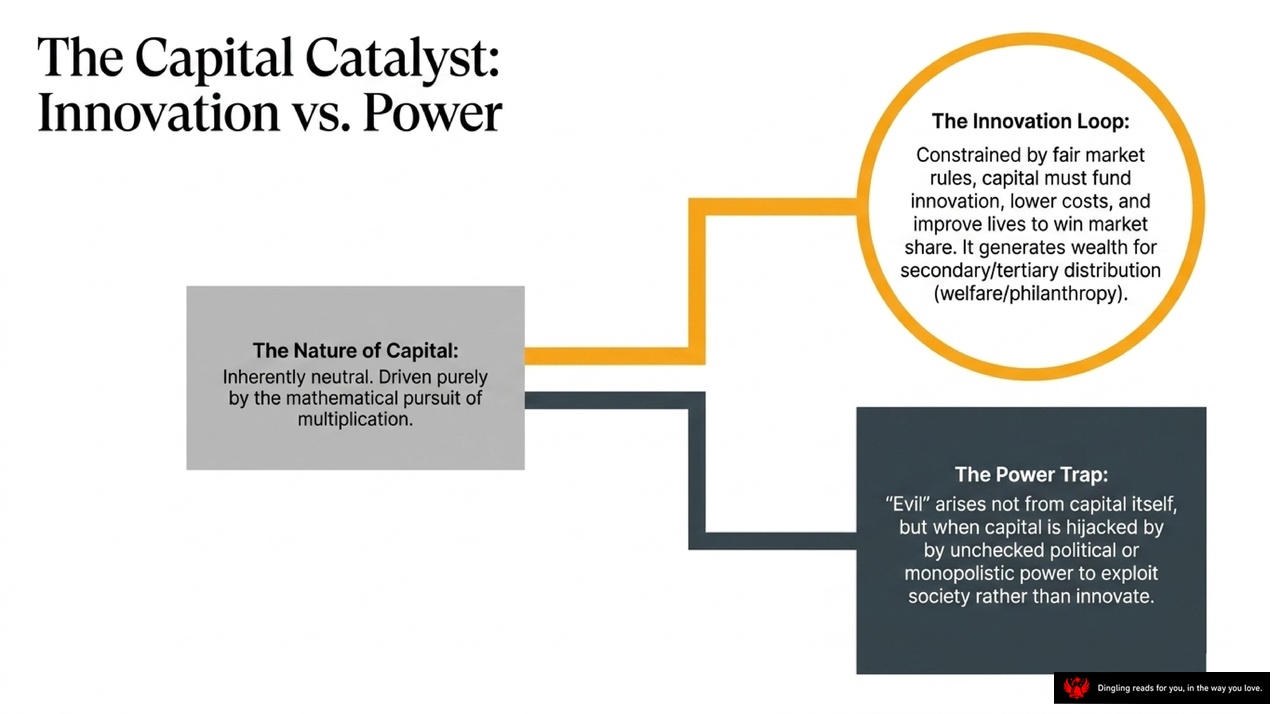
The Capital Catalyst: Innovation vs. Power. At its core, capital is inherently neutral, driven purely by the mathematical pursuit of multiplication. But how it behaves depends entirely on the environment it operates in. When constrained by fair market rules, capital enters what we call the Innovation Loop. In this mode, it must fund innovation, lower costs, and improve lives just to win market share. This healthy cycle generates wealth that eventually flows into secondary and tertiary distribution—think welfare and philanthropy. It's a virtuous engine for progress. However, the story takes a dark turn when we hit the Power Trap. Here, "evil" doesn't arise from capital itself, but when it gets hijacked by unchecked political or monopolistic power. Instead of innovating to create value, capital is exploited to extract from society. So, the real battle isn't about demonizing money; it's about ensuring capital remains a catalyst for innovation rather than a tool for oppression.

Welcome to the final shift in the real estate story. We are moving from the "Development Era" of the past into the "Post-Development Era" that defines our present and future.
Look at the contrast on the screen. In the Development Era, the game was simple: focus on scale, speed, and cost. The product was standardized residential housing, driven by rapid urbanization and raw wealth accumulation. It was about building as much as possible, as fast as possible.
But today, the rules have completely changed. We are now in the Post-Development Era. The focus has shifted from construction to operations, services, and asset management. The product is no longer just a house; it is curated spaces—think logistics hubs, healthcare facilities, and tech-enabled smart environments.
The driver behind this shift is no longer just raw land value. It is about maximizing the "yield per square meter" through human experience, community building, and deep technological integration. The industry is evolving from a builder of boxes to a curator of lifestyles. The future belongs to those who can manage assets and create value through service, not just those who can pour concrete.

We are often told that life is a series of inevitable tragedies, but the truth is far more structural. As we see in the diagram, despair isn't just a feeling; it's an architecture built by two specific forces: an unresolvable grievance, where your self-identity clashes fatally with society's judgment, and a total loss of hope, often triggered by economic ruin or the threat of losing physical freedom.
But the real question is: how do we stop this collapse? The image outlines three critical pillars of prevention that act as a safety net. First, we need a robust rule of law. This isn't just about laws on paper; it's about ensuring objective justice so that no individual gets crushed by the arbitrary "morality" of a mob or a powerful few. Second, we must build an economic safety net. This means providing a basic floor of dignity so that financial ruin does not equal physical death. Without this, the pressure becomes unbearable. Third, and perhaps most psychologically vital, is social mobility. We must preserve the belief that tomorrow can be better than today. If people feel trapped with no path forward, hope evaporates, and the structure of despair takes over.
These three pillars—justice, security, and hope—are the only things that can hold back the forces pushing us toward the edge. Without them, even the strongest individuals can be overwhelmed by the weight of their circumstances.

Think about this: reading isn't just about passing time; it's the ultimate mental expansion. It breaks the illusion that your immediate surroundings are the "whole world," injecting new variables into your worldview and providing the ultimate mental healthcare. This openness acts as a catalyst for societal evolution, giving us the courage to see others, endure criticism, and fuse diverse ideas to create universally accepted rules.
But remember the core truth: a closed system breeds dogma and decay. True human growth requires absolute freedom—both intellectual and economic. Just like opening a window, we must dare to let fresh air in, allowing our minds to evolve beyond the walls of our own experiences.

Synthesis: The Engine of a Fulfilled Life. Imagine your life not as a collection of random events, but as a self-sustaining system powered by three core pillars. First, you need Material Competence—the Hands. This is about acquiring the practical means, like capital, skills, and social safety nets, to solve tangible problems without losing your moral compass. Without this foundation, your dreams remain out of reach. Next, you need Social Mastery—the Heart. This is the art of navigating relationships with empathy, maintaining healthy boundaries across generations, and understanding the unspoken currents of human connection. It's about building a network of trust that supports you when things get tough. Finally, you need Cognitive Autonomy—the Mind. This is your ability to continuously build a reservoir of new explanations through reading and openness, allowing you to remain resilient against life's inevitable absurdities. When you master your mind, you stop being a victim of circumstance and start becoming the author of your story. Notice how these three elements form a continuous loop? Your competence fuels your social connections, your relationships broaden your perspective, and your new insights drive you to acquire even greater competence. It's a dynamic engine that, when running smoothly, transforms chaos into a fulfilled life. Don't just focus on one; integrate all three to create a life that is not only successful but deeply meaningful.

True freedom isn't about conquering the outside world; it's about mastering the one inside your head. By understanding the hidden rules of society, wealth, and human connection, we can break free from the mental scripts that control us, rewrite our own stories, and take back our autonomy.
Think about it: if your current suffering is just a story being told from the wrong angle, what becomes possible the moment you decide to turn the page?
The logic is simple yet profound. Many of us are trapped by narratives we didn't choose. Whether it's the fear of failure, the pressure to succeed, or the pain of betrayal, these feelings often stem from how we interpret events, not the events themselves. When we realize that our suffering is often a construct of our own perspective, we gain the power to change it. We stop reacting like victims and start acting like authors of our lives.
This shift is the key to reclaiming your autonomy. It means looking at your struggles not as permanent facts, but as chapters you have the power to edit. Once you master this internal landscape, external challenges lose their grip on you. You become less defined by what happens to you and more defined by how you respond. That is the essence of true freedom.