
The Low-Desire Society: Complete Chapter-by-Chapter Summary

Welcome to the book club. Today, we're diving into a provocative concept from Kenichi Ohmae's *Low-Desire Society*. The cover sets the tone perfectly: a futuristic, grid-like cityscape that feels less like a thriving metropolis and more like a cooling system. This isn't just about architecture; it's about a new kind of wealth where nations grow rich not through ambition, but through psychological stagnation.
The book argues that we are entering an era where the definition of success has fundamentally shifted. Instead of chasing growth, companies and individuals are prioritizing stability. Ohmae suggests that this shift, while it may seem like a retreat, is actually a clever adaptation to a world where traditional expansion is no longer possible. It's a survival strategy for a society that has run out of room to grow.
So, as we turn the page, let's explore what it really means to be part of a "Low-Desire Society." Is this the end of capitalism as we know it, or is it the birth of a more sustainable, albeit quieter, way of living?
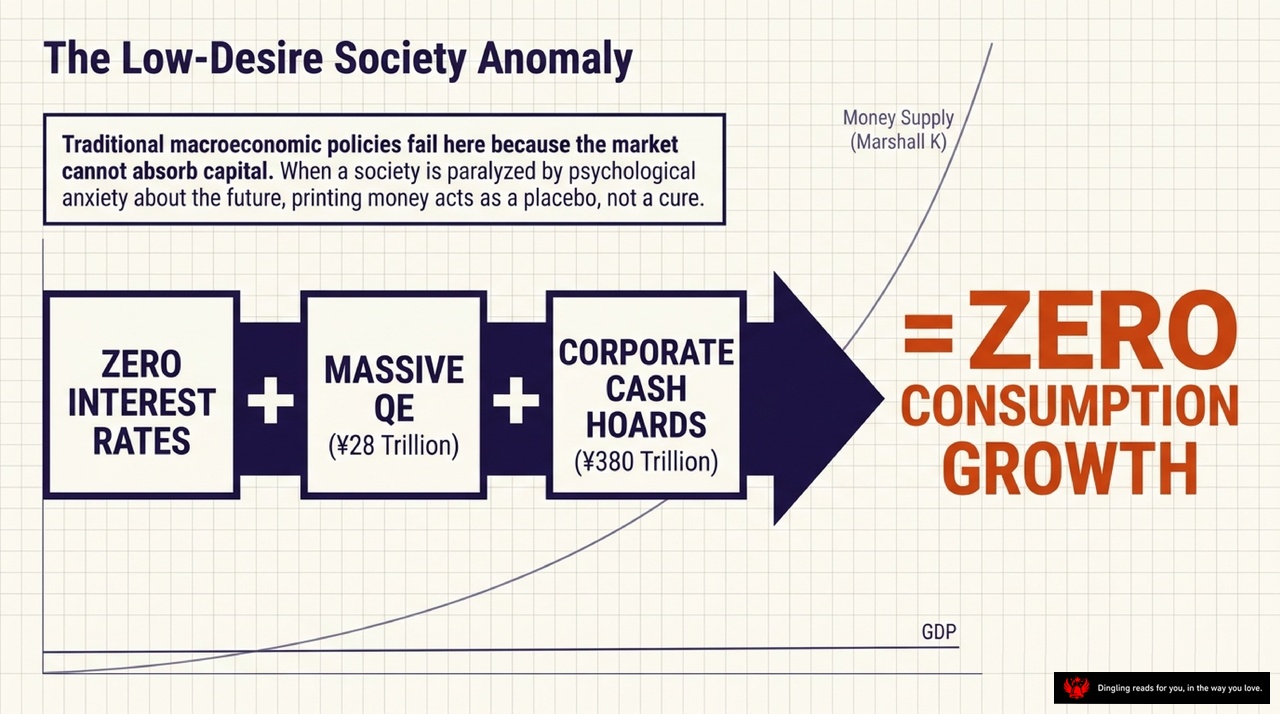
Look at this slide: "The Low-Desire Society Anomaly." It lays out a stark, almost terrifying equation for Japan's current economic reality. On the left, we see the government's traditional toolkit: Zero Interest Rates, Massive Quantitative Easing—28 trillion yen pumped into the system—and the result? Corporate cash hoards sitting at a staggering 380 trillion yen. Yet, the arrow points to a dead end: Zero Consumption Growth.
The chart illustrates a paradox. The money supply curve, labeled Marshall K, is shooting straight up, but the GDP line remains flat. Why? Because traditional macroeconomic policies fail here. As the text explains, "the market cannot absorb capital." When a society is paralyzed by psychological anxiety about the future, printing money acts as a placebo, not a cure.
This is the core of the "low-desire" problem. Japan is a country where the rich are sitting on a mountain of cash, yet no one is spending it. Young people are refusing to buy homes or take risks, and companies are terrified to invest. We have 1700 trillion yen in personal assets and 380 trillion in corporate reserves, but they are stuck. The government's response has been to print more money, hoping it will magically flow into the economy. But without consumer confidence and a willingness to take risks, that liquidity just circulates in financial markets, inflating stock prices while the real economy starves.
The slide captures a critical moment in Japan's history. It shows that despite decades of intervention—zero rates, massive stimulus, and corporate savings—the system has reached a point of stagnation. The "anomaly" is that we have all the tools, all the money, and all the assets, yet we are producing nothing. Until we address the psychological paralysis and the structural barriers preventing capital from moving, Japan risks remaining trapped in this state of zero growth, regardless of how much money the central bank prints.

The 20th-century dream was all about climbing the ladder: taking on massive mortgages, chasing corporate titles, and living a life defined by high consumption and high risk. But the 21st century tells a completely different story. This is the era of the "Satori Generation," where ambition has fundamentally shifted. Instead of climbing, young people are now choosing to stay flat. They embrace hyper-minimalism and rent rather than buy, driven by a deep-seated risk aversion. The logic is simple and rational: why burden yourself with debt when you can survive comfortably on just 500 yuan a day? This psychological shift neutralizes all monetary stimulus. Even with historic low interest rates, young people refuse to take on future debt because they've seen the cost of failure. They've lost the desire to own, lead, and consume. This isn't laziness; it's a survival strategy in a world where the old rules no longer guarantee success.
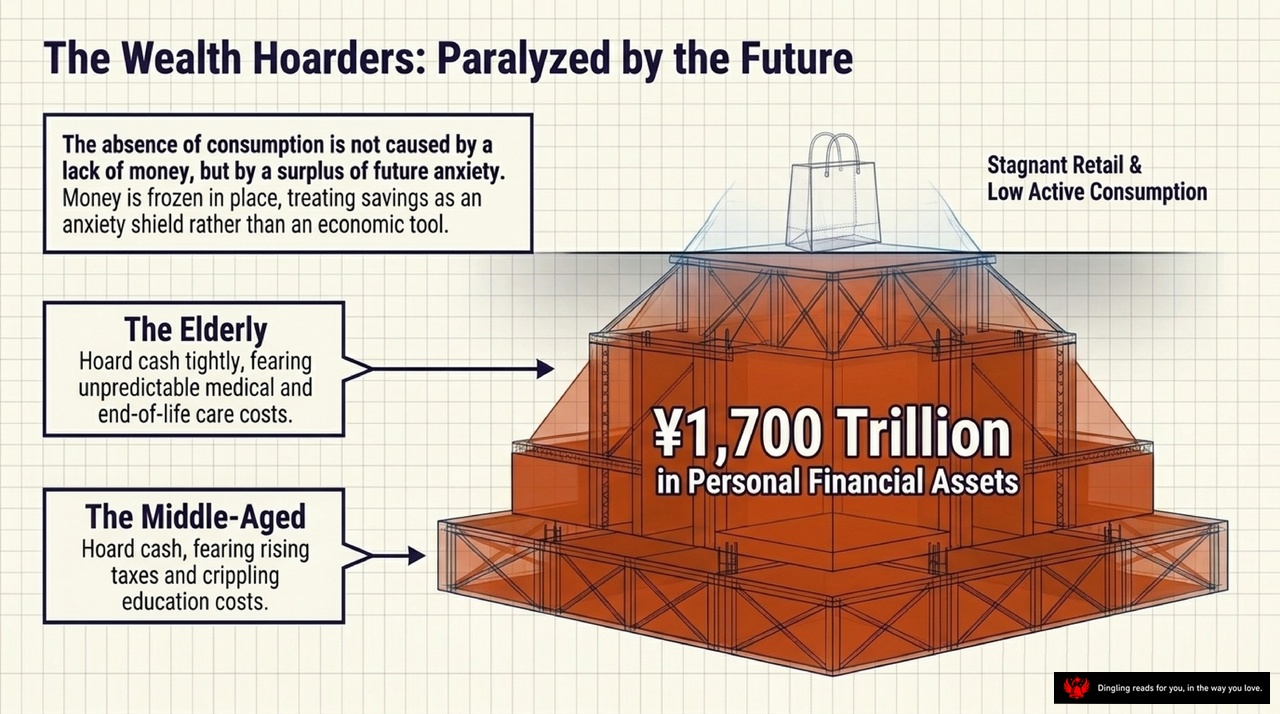
Look at this massive pyramid of frozen assets—$1700 trillion in personal financial assets. It's a visual representation of Japan's core problem: wealth hoarders paralyzed by the future. The slide makes it clear that the lack of consumption isn't about people being broke; it's about a surplus of anxiety. Money is locked up, treated as a shield against an uncertain tomorrow rather than a tool for economic growth.
We see two distinct groups trapped in this cycle. The elderly are hoarding cash, terrified of unpredictable medical bills and end-of-life costs. Meanwhile, the middle-aged are doing the same, bracing for rising taxes and the crushing weight of education expenses. This fear creates a stagnant retail environment with low active consumption.
The real tragedy here is that this "safety" is actually a trap. By freezing their savings, these generations are inadvertently killing the economy. They are building a fortress of cash that no one is willing to spend, leaving the rest of society with nothing to buy. To break this deadlock, we need to shift the mindset from "fear of the future" to "confidence in the present." Instead of letting anxiety dictate our financial decisions, we need policies that reduce that fear—like better healthcare guarantees and stable tax structures—so people feel safe enough to spend, invest, and live. Only then can we unlock that $1700 trillion and turn a paralyzed economy into a thriving one.
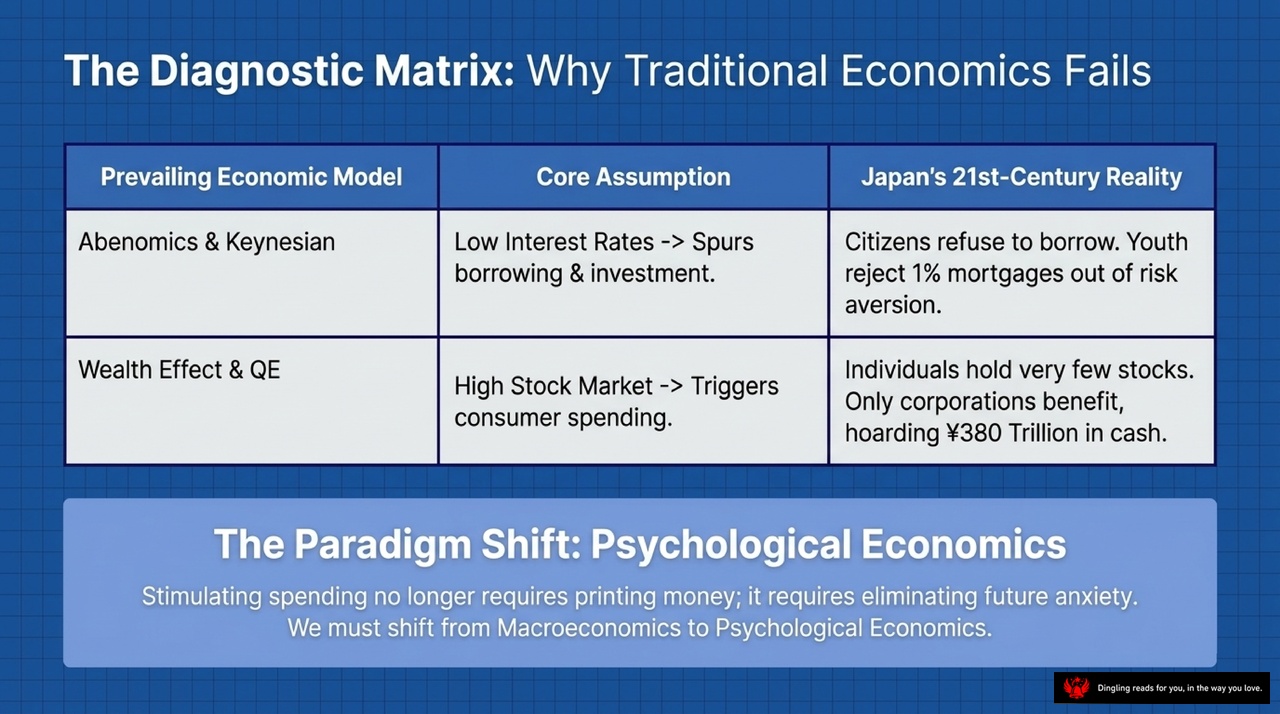
Let's talk about why the numbers on the screen are so frustrating. Look at the "Diagnostic Matrix" here. Traditional economics tells us that if we just lower interest rates, people will borrow and spend. But look at Japan's reality: citizens are refusing to borrow, and young people are terrified of even 1% mortgages. It's a total disconnect. The old model also assumes that a booming stock market automatically triggers consumer spending. Yet, in Japan, individuals hold almost no stocks; instead, corporations are sitting on a massive ¥380 trillion hoard of cash, doing nothing with it.
This is why we must make the paradigm shift highlighted at the bottom: Psychological Economics. The problem isn't a lack of money; it's a lack of confidence. Stimulating spending no longer requires printing money; it requires eliminating future anxiety. We can't keep relying on macroeconomic tricks that ignore human psychology. We must shift from macroeconomics to psychological economics to finally unlock the potential that's been trapped by fear.
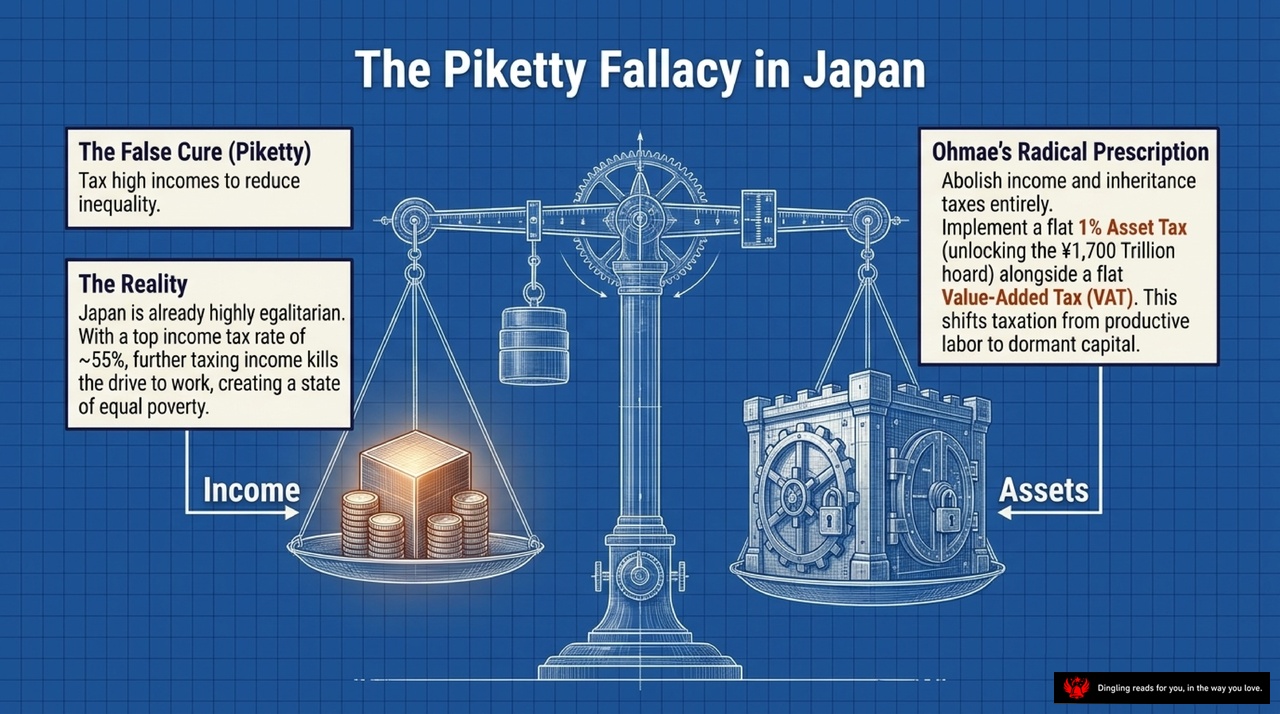
Look at this slide. It highlights a critical misunderstanding in Japan's economic debate: the clash between Piketty's traditional approach and a radical, modern alternative. On the left, we see "The False Cure." This represents the mainstream view, often championed by thinkers like Piketty, which argues that taxing high incomes is the solution to inequality. However, the slide labels this as a fallacy for Japan. Why? Because Japan is already highly egalitarian, with top income tax rates nearing 55%. Pushing this further doesn't fix inequality; it crushes the drive to work, leading to a state of "equal poverty" where everyone is poor together.
On the right, we see "Ohmae's Radical Prescription." This flips the script entirely. Instead of taxing income, the argument is to abolish income and inheritance taxes completely. Instead, we should implement a flat 1% Asset Tax to unlock Japan's dormant capital—trillions of yen sitting idle in savings—and pair it with a flat Value-Added Tax. This shifts the tax burden from productive labor to dormant capital, reactivating the economy. The central image of the scale perfectly illustrates this balance: moving away from punishing "Income" on the left and towards unlocking "Assets" on the right. This isn't just theory; it's about recognizing that Japan's real problem isn't too much wealth, but too much unproductive savings.

The Japanese government has long been paralyzed by a centralizing bureaucracy that stifles innovation and wastes public funds. Instead of empowering local regions to thrive, the state forces a one-size-fits-all approach that ignores local needs and drains resources. A prime example of this inefficiency is the massive waste in digital administration. While the government claims to be modernizing, it has built hundreds of incompatible systems that talk to no one, forcing citizens and officials to repeat the same tasks over and over. Look at the election systems; they cost millions to implement but save almost nothing, while hospitals still make patients fill out the same forms every single time they visit.
The real solution lies in learning from Estonia, a tiny nation that has become a global leader in digital governance. Estonia uses a single, unified "citizen database" connected to every government service. With just a few clicks, residents can vote, pay taxes, access healthcare, and manage their lives from anywhere in the world. This system has eliminated the need for paper forms, reduced bureaucracy to a fraction of its size, and created a government that is transparent and efficient. Unlike Japan's fragmented, costly, and outdated infrastructure, Estonia proves that a small, well-connected digital state can outperform a large, bloated one. Japan needs to stop building silos and start building a unified digital foundation to finally unlock its potential.
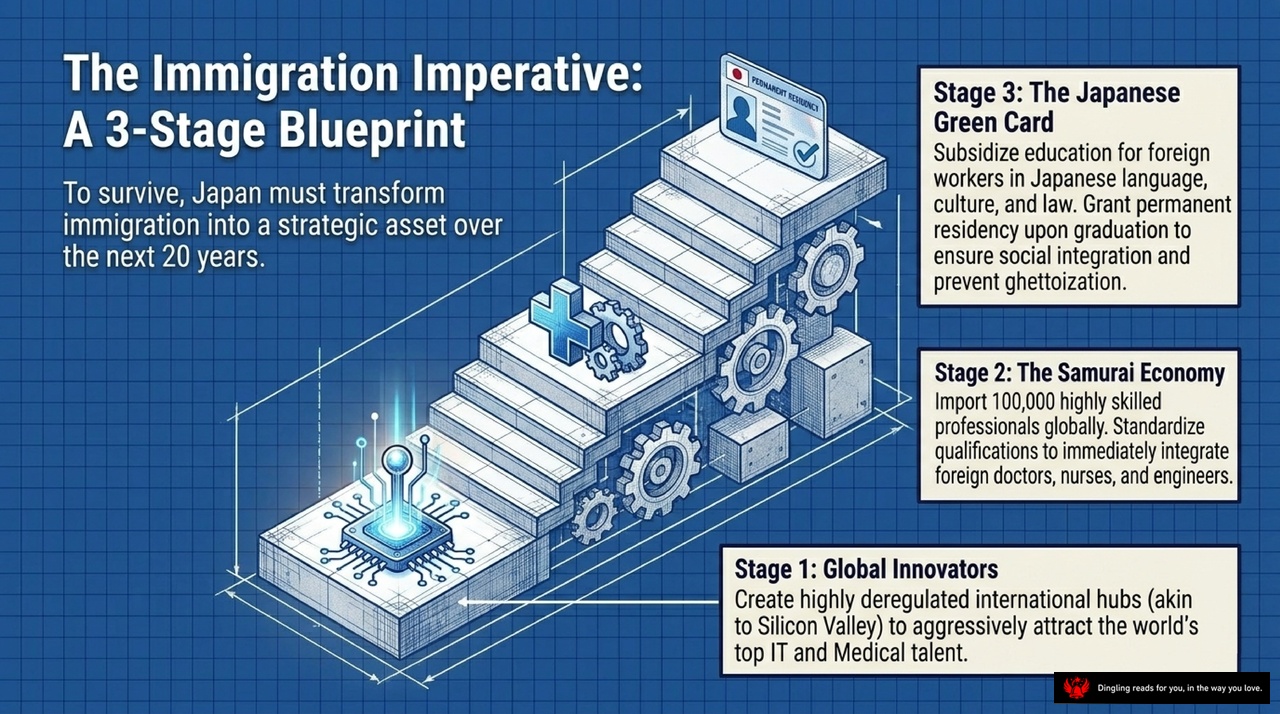
Japan's future hinges on a bold, three-stage blueprint to turn immigration from a political liability into its greatest strategic asset. As the slide outlines, survival over the next two decades demands a complete transformation of how the nation approaches talent and integration.
The journey begins at the foundation with **Stage 1: Global Innovators**. Japan must aggressively create highly deregulated international hubs, modeled after Silicon Valley, to attract the world's top IT and medical talent. This isn't about waiting for opportunities to appear; it's about building an ecosystem where the best minds can thrive immediately.
Moving up the ladder, we reach **Stage 2: The Samurai Economy**. Here, the focus shifts to importing 100,000 highly skilled professionals globally. The key is standardizing qualifications to seamlessly integrate foreign doctors, nurses, and engineers into the workforce, removing bureaucratic barriers that have historically stifled growth.
Finally, the blueprint culminates at the top with **Stage 3: The Japanese Green Card**. To ensure true social integration and prevent the formation of ghettos, the government must subsidize education for foreign workers in language, culture, and law. Crucially, permanent residency should be granted upon graduation. This long-term commitment signals that Japan is ready to welcome these new citizens as part of its future, securing the stability needed for the nation to thrive.

The slide contrasts two opposing economic philosophies: "The Regional Revitalization Myth" versus "The Urban Magnetism Model." On the left, we see scattered dots representing a map where capital is diluted across dying rural towns. The text argues this approach is a waste of capital, failing to generate real economic gravity. On the right, the "Urban Magnetism Model" shines brightly. It illustrates how concentrating resources in a central hub creates extreme efficiency and attracts global foreign capital, much like Tokyo. The core message is clear: survival requires embracing concentration, not spreading capital thin. To make this work, we must deregulate mega-cities by abolishing outdated sunlight rights, allowing for high-density, grid-style rebuilding of aging neighborhoods. Instead of subsidizing the past, we need to build the future by letting cities grow vertically and become the true engines of the global economy.

Transforming Land Use: Agriculture & Leisure. Imagine a complete overhaul of how Japan utilizes its land, shifting from stagnation to high-value growth.
First, look at agriculture. The slide contrasts two models. On the left, we see the old way: subsidized, protected domestic rice farming, often called the "food security myth." It's inefficient and keeps farmers in a cycle of low productivity. On the right is the transformation: the Netherlands Model. This shifts to high-value, globally exported premium agriculture. Instead of just growing rice for local consumption, Japan could adopt smart, tech-driven farming to compete in the global market, turning land into a premium export engine.
Next, consider tourism. The image shows a dilapidated rural house on the left, representing the current state of maintaining empty, dying rural infrastructure. This is a waste of potential. The arrow points to the solution on the right: opening Japan's 3,000 closed fishing ports for premium marine recreation. By repurposing these ports, we can create a new sector for wealthy senior spending. Think of it as transforming unused coastlines into luxury marine destinations, capturing high-value tourism dollars that are currently missing from the economy.
In short, the pivot is clear: stop protecting the obsolete and start exporting value. Whether it's high-tech farms or luxury coastal resorts, reimagining land use is the key to unlocking Japan's future growth.

Look at this visual contrast: on the left, we see the rigid "Factory Model," where identical machines churn out uniform products, and on the right, the vibrant "Outlier Model," where a dynamic neural network fosters elite disruptors. The core problem isn't just technology; it's how we educate our people. Japan's current system acts like that factory line, producing risk-averse workers perfectly suited for manufacturing cathode-ray tube TVs in a world that has long since moved to flat screens. We are oversupplying mediocre universities that create identical skill sets, while the global economy demands unique, innovative thinkers.
The solution lies in shifting our resources. Instead of pouring money into low-quality degree mills, we must invest in rigorous vocational schools and globally integrated institutions where English is the medium of instruction. This isn't about lowering standards; it's about raising the ceiling for the outliers. By cultivating these elite disruptors, we stop churning out cogs and start building the architects of the future. It's time to rebuild the mind, moving from a factory mindset to an ecosystem of innovation.
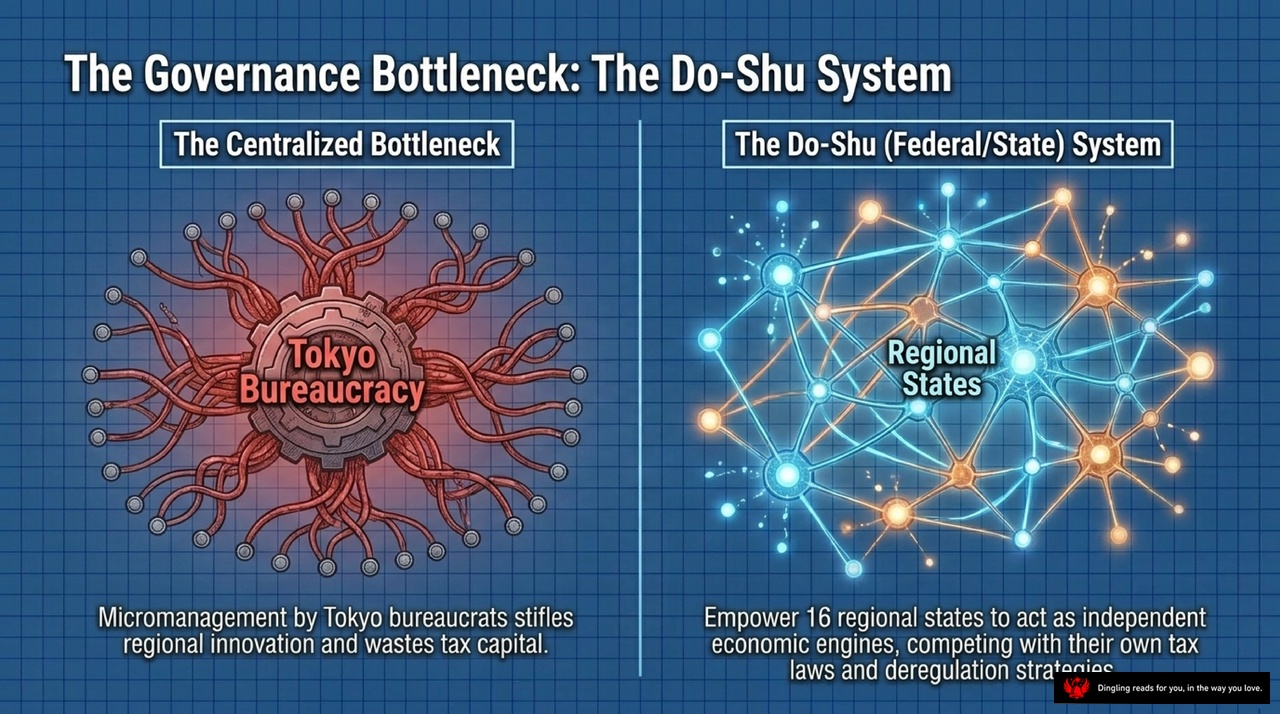
The Governance Bottleneck: The Do-Shu System. On the left, we see the "Centralized Bottleneck," where Tokyo's bureaucracy acts as a single, massive gear choking the entire nation. This micromanagement stifles regional innovation and wastes precious tax capital. Now, look at the solution on the right: the Do-Shu system. Instead of one giant hub, imagine a dynamic network where 16 regional states act as independent economic engines. These states compete with their own tax laws and deregulation strategies, creating a vibrant, self-driving economy. The core message is clear: Japan's stagnation isn't a lack of effort, but a structural failure. We are trapped by a central government that dictates every detail, preventing local areas from finding their own growth paths. To truly revive, Japan must shift from this top-down control to a federal model where power and responsibility are pushed down to the regions, allowing them to thrive as distinct economic hubs rather than mere extensions of Tokyo.

Look at this diagram: The E-Government Revolution. It highlights a critical problem with our current IT infrastructure—it's fragmented, localized, and wildly inefficient. The proposed solution is the Japanese Database, or JDB.
Imagine a single, unified, cloud-based public database at the center. This "Data Core" tracks citizens seamlessly from birth to death. From that central hub, everything connects: Birth, School, Healthcare, Taxes, Voting, and even Tintos. Instead of running around filling out the same forms for each department, your data flows automatically.
The impact is massive. By consolidating everything into one secure system, we exponentially reduce administrative costs and eliminate redundant bureaucracies. It enables secure digital taxation and voting, making government services fast, transparent, and free of human error. This isn't just about technology; it's about freeing up time and money by letting the system work for us instead of us working for the system.

This is the master blueprint for Japan's revival, centered on one non-negotiable truth: **Psychological Security Drives Economic Velocity**. Without this, nothing else works.
Let's break down the four pillars of this strategy.
First, **Taxation**. We need to kill the fear of getting rich. The current system crushes ambition. So, we propose a flat 1% Asset Tax and VAT, while abolishing income and inheritance taxes entirely. This flips the script: instead of punishing wealth creation, we gently tax the idle assets sitting in vaults.
Second, **Human Capital**. Our population is shrinking, so we must become a global magnet. We need a 3-Stage Immigration Blueprint to bring in the best talent, paired with an "Outlier Education" system that stops mass-producing average workers and starts nurturing the innovators who drive the future.
Third, **Spatial Economy**. Stop fighting urbanization. We need to deregulate mega-cities to allow massive redevelopment and premium export agriculture. By concentrating people and capital in dynamic hubs, we unlock the productivity that a scattered, dying rural landscape cannot.
Finally, **Governance**. We must move from a stagnant central bureaucracy to Decentralized Do-Shu States with a Unified E-Government system. Imagine a digital state where you vote, pay taxes, and access services instantly—like Estonia. This cuts waste and empowers local innovation.
But here is the hard reality at the bottom: Failure to implement these combined structural changes guarantees a sovereign debt collapse or hyperinflation. There is no middle ground. We must choose between total transformation or total collapse.

The Low-Desire Society isn't just a temporary slump; it's a deep psychological shift where traditional economic fixes are like giving a placebo for a structural disease. To survive, we need to discard old 20th-century rules, deregulate, welcome global talent, and unlock frozen assets by guaranteeing future security. But here's the hard question: if our society's ambition has fundamentally evolved, why are we still betting our nation's survival on the obsolete blueprints of the past?