
The Master and Margarita: Complete Chapter-by-Chapter Summary
Welcome to our book club session. Today, we're diving into a masterpiece that has captivated readers for over a century: *The Master and Margarita* by Mikhail Bulgakov.
On this cover, you see the title in elegant gold lettering against a dark, textured background, setting a tone of mystery and gravity. The subtitle describes it as "a masterful tapestry of satire, romance, and dark magic." This is exactly what you're in for. It's not just a simple story; it intertwines a sharp critique of Soviet society with the eternal, timeless struggle between good and evil.
But here's the thing that makes this book truly special: it's also a profound meditation on the endurance of art. In a world that tries to silence creativity and punish those who think too deeply, art becomes the ultimate act of rebellion. Bulgakov reminds us that truth, no matter how dangerous it seems, will always find a way to survive. Whether it's through the chaotic streets of Moscow or the ancient courts of Jerusalem, this novel proves that stories have the power to heal, to challenge, and to endure forever.

Good morning, everyone. Today, we're diving into the heart of Bulgakov's masterpiece, *The Master and Margarita*. Look at this slide: "A Literary Testament Forged in Fire." This isn't just a book; it's a story written over twelve grueling years, revised until the author's very last breath. It stands as his ultimate testament to humanity.
Critics from around the world agree on its brilliance. French critics revere it, and even Nobel laureate Gabriel García Márquez called it "exquisite." It is truly recognized as the pinnacle of Soviet literary artistry.
But what makes it so special? The slide breaks it down into three core purposes. First, to satirize. Bulgakov exposes the terror, corruption, bureaucracy, and greed of 1930s Moscow with a sharp, unflinching eye. Second, to philosophize. He forces us to question the nature of good, evil, cowardice, and truth, echoing the ancient debate between Pontius Pilate and Jesus about whether evil is part of a higher good. And finally, to immortalize. The book proves that authentic art and true love can transcend even the most brutal physical destruction.
This story is a perfect blend of the absurd and the profound, a testament to the power of the human spirit against overwhelming odds.
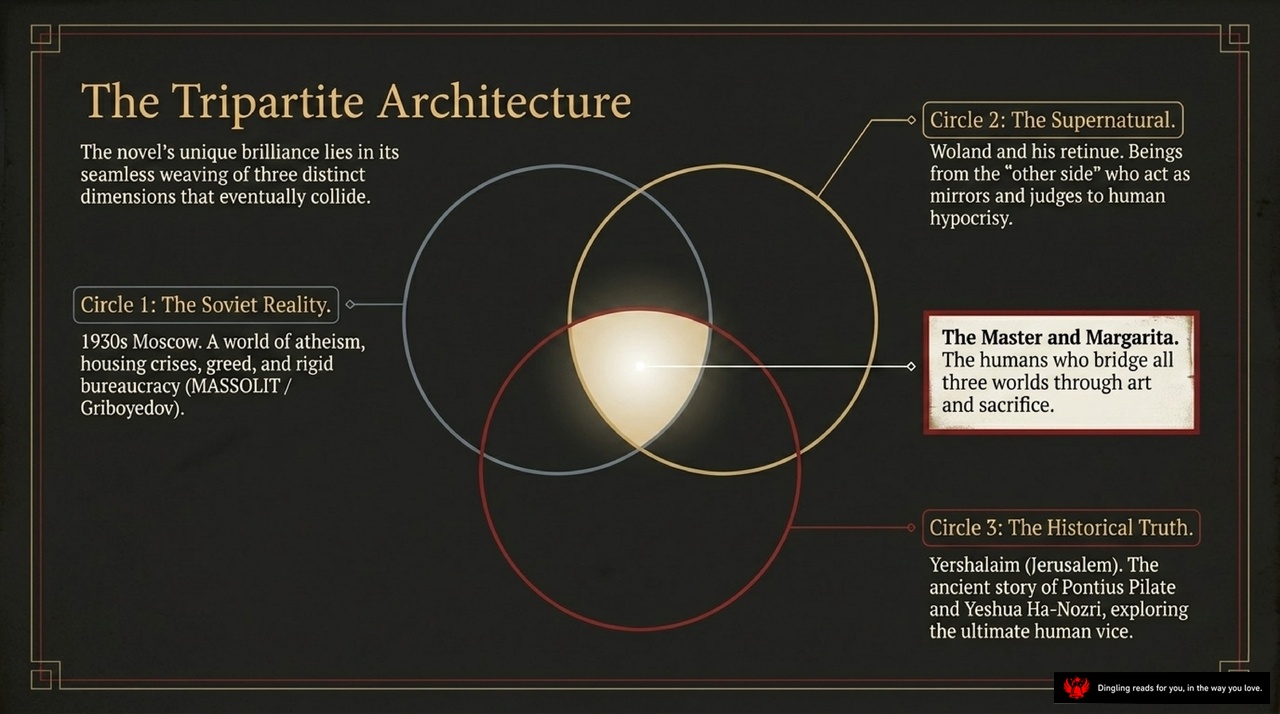
The magic of *The Master and Margarita* isn't just in the supernatural; it's in how these three worlds collide. Imagine a Venn diagram where the Soviet reality of 1930s Moscow—defined by atheism, housing crises, and rigid bureaucracy—overlaps with the ancient historical truth of Pontius Pilate and Yeshua Ha-Nozri in Jerusalem. At the center of this collision stands the supernatural: Woland and his retinue, beings from the "other side" who act as mirrors and judges to human hypocrisy.
This novel's unique brilliance lies in this seamless weaving. It's not just about a wizard causing chaos in Moscow; it's about how the past, the present, and the metaphysical intersect to expose the ultimate human vice. Whether it's the tragic fate of a bureaucrat like Nikanor Ivanovich or the redemption of the Master and Margarita, every thread in this tripartite architecture pulls together to reveal a deeper truth about our own world.

Welcome to the third chapter of our journey into *The Master and Margarita*, where the chaos in Moscow reaches a fever pitch. Today's slide, titled "Realm I: The Absurdity of Moscow," perfectly captures Bulgakov's brilliant satire: beneath the utopian facade of the 1930s Soviet state, a deep moral decay is rotting the society from the inside out.
Let's break down these four key points. First, we see **The Illusion of Control**. The slide mentions Berlíoz predicting his evening, only to be decapitated by a tram. This is the ultimate punchline to the Soviet promise of order. Berlíoz confidently argues that Jesus is a myth, claiming ancient cultures stole his story. He thinks he can control reality through logic and atheism. But the moment Annushka spills sunflower oil, that fragile control shatters. His fate isn't random; it's a direct consequence of a spilled drop of oil, proving that no amount of intellectual arrogance can predict or control the absurdity of life.
Next, **The Trap of Greed**. At the Variety Theatre, citizens eagerly grab falling ten-ruble notes and magical French clothes. It's a scene of blind, desperate consumerism. They are so focused on the free material goods that they ignore the danger. When the illusion breaks, they are left naked and humiliated. This mirrors the Soviet reality where people were promised a better life, only to be left with nothing but shame when the promises failed.
Then, **The Death of Art**. The slide points to MASSOLIT, the state-sponsored literary association. They produce soulless propaganda while systematically destroying true creators. True art is banned or ridiculed, while mediocrity is celebrated. This is the death of the soul of the nation, a direct result of the state's interference in culture.
Finally, **Everyday Hypocrisy**. Citizens lie for apartments, hoard secret stashes, and denounce their neighbors. The slide specifically mentions Aloisý Mogarych betraying the Master for his basement. This is the most chilling part of the satire. The system forces people to become their own executioners. Fear and scarcity turn neighbors into enemies, creating a society built on betrayal and silence.
In short, Bulgakov uses Satan's visit to expose this rot. The magic tricks, the vanished officials, and the chaotic streets are just the symptoms of a deeper disease: a society that has lost its moral compass, trading truth for comfort and loyalty for survival.
After the chaos of the Variety Theatre's performance, Moscow itself began to tremble under the invisible weight of Woland's arrival. The city, already a place of cynicism and hidden greed, suddenly became a playground for supernatural justice.
We see the immediate fallout in the theater's administration. The manager, Shchopka, and his financial director, Rimsky, vanish without a trace. Their offices are left in disarray, phones ringing with frantic calls from those searching for their missing bosses. Even the theater's president, Shchepelyarov, is transformed into a cat-faced creature by a black cat, leaving his secretary to sign documents in his place. It's a surreal nightmare where the rules of reality have been completely suspended.
But the chaos extends far beyond the theater walls. The ticket office is overrun by a massive queue of desperate people, yet the staff is gone. A police investigation yields nothing but confusion, culminating in the arrest of an innocent accountant, Vasily, who is found clutching a bag of foreign currency that wasn't his to have. Meanwhile, the theater's concessionaire, Sokov, is visited by Woland himself. The demon reveals Sokov's secret savings, predicts his death from liver cancer, and turns his counterfeit money into real cash before mocking him and sending him away.
Even the city's officials are not safe. The director of the housing cooperative, Nikanor, is dragged into madness after being blackmailed by Woland's assistant, Karoviev. He is forced to hide fake money in a ventilation shaft, only to be caught and sent to a psychiatric hospital, where he suffers terrifying dreams of being forced to surrender his illicit gains.
The atmosphere in Moscow has shifted from a mundane bureaucracy to a battlefield of the unseen. The demons are no longer hiding; they are exposing the city's corruption, punishing the greedy, the corrupt, and the foolish, turning the entire capital into a stage for their chaotic justice.
Who says love is static? In a world obsessed with the idea that nothing lasts, Marguerite proves the opposite. Her love for the Master isn't just a memory; it's a living, breathing force that defies time itself. While she lives a life of material comfort as the wife of a celebrated inventor, her heart remains anchored to the man she lost. When a strange red-haired man with fangs named Azazello approaches her, he doesn't just offer a date; he offers a key to her past. By applying a mysterious cream, Marguerite isn't just rejuvenated; she is transformed. The lines of age vanish, her hair turns to youthful black curls, and a surge of pure, ancient joy fills her cells. She sheds her old life entirely, leaving her husband and her mundane existence behind to chase the one thing that truly matters: finding the Master.
But the journey isn't just about physical transformation; it's about confronting the supernatural. She flies through the city on a flying brush, destroying the home of the critics who ruined the Master, yet showing a moment of mercy when she comforts a frightened child. She dances with sirens and meets a king who was once a pig, all while her old servant Natasha, now a witch herself, joins her in the sky. They arrive at a gathering in a strange, timeless apartment where they finally meet the Master. He is alive, but he's not the same man she remembers. He's been through hell, confined to a mental institution, yet the moment he sees her, the magic of their reunion transcends all pain.
This isn't just a story about a magical love; it's a profound commentary on the human spirit. The Master, who once burned his manuscript in despair, is now restored, not by magic alone, but by the unwavering belief of someone who refused to let him go. Marguerite's journey shows us that true love can break the chains of time, age, and even death itself. It reminds us that while the world may try to tell us that everything fades, the right kind of love is the only thing that truly endures.

Tonight, we witness the ultimate reunion between the Master and Marguerite. After her terrifying journey through the House of Satan, Marguerite returns to their basement in the alley off Arbat Street. It's as if nothing ever happened; the velvet tablecloth, the lily of the valley, and their burned manuscript are all exactly as they were before. The Master is asleep, and Marguerite, no longer afraid of the magic she just experienced, embraces him with a sense of profound peace.
But the story of Pontius Pilate continues in the background. In Jerusalem, the storm has passed. The governor, Pilate, lies awake on his terrace, haunted by the memory of the execution. He orders the bodies of the three criminals buried in a desolate valley, but there is a twist: the body of Jesus has vanished. Only the two thieves remain. When his servant, Afraan, reports this, Pilate is shaken. He calls for Levi, the tax collector who was present at the crucifixion. Levi, desperate and grieving, refuses Pilate's offer of money or protection. He simply asks for a small, clean piece of papyrus paper. He needs it to write a message, a final testament to the man who was wrongly condemned.
As dawn breaks on the fifteenth day of Nisan, Pilate finally falls asleep, burdened by the weight of his decision. Meanwhile, in Moscow, the Master and Marguerite are about to leave the mortal world forever. They drink wine that once belonged to Pontius Pilate himself—a wine meant to help them transcend their earthly suffering. They burn their past, including the destroyed manuscript and their old life, and take flight on a black horse. They say goodbye to Ivan, the poet who once sought the truth about Pilate, promising him that the truth will eventually be found.
They ascend into the night sky, leaving Moscow behind. Their disguises fall away: the cat becomes a boy, the demon becomes a ghostly figure, and the Master reveals his true, silver-haired self. They ride toward a red moon, seeking the eternal peace and forgiveness that the Master has longed for all his life.

Margaret: The Resilience of Love. Unlike the broken Master, Margaret's love fuels a fierce, unapologetic rebellion against the mundane world.
The journey begins in despair. Trapped in a luxurious but loveless marriage, she mourns the vanished Master, her heart heavy with loss. But her transformation starts with a deal. She accepts Azazello's magical, swamp-smelling cream, willing to pawn her soul to the devil just to learn the Master's fate. This choice leads to her trial: agreeing to endure the agonizing physical and psychological toll of acting as the Queen of Satan's Grand Ball.
Through this trial, she finds ultimate freedom. She becomes an invisible, flying witch. She gleefully destroys the apartment of Latunsky, the critic who ruined the Master, leaving nothing but chaos in his wake. In the end, her love transforms her into a force of nature, proving that true resilience is the power to rise above everything, even the devil himself.
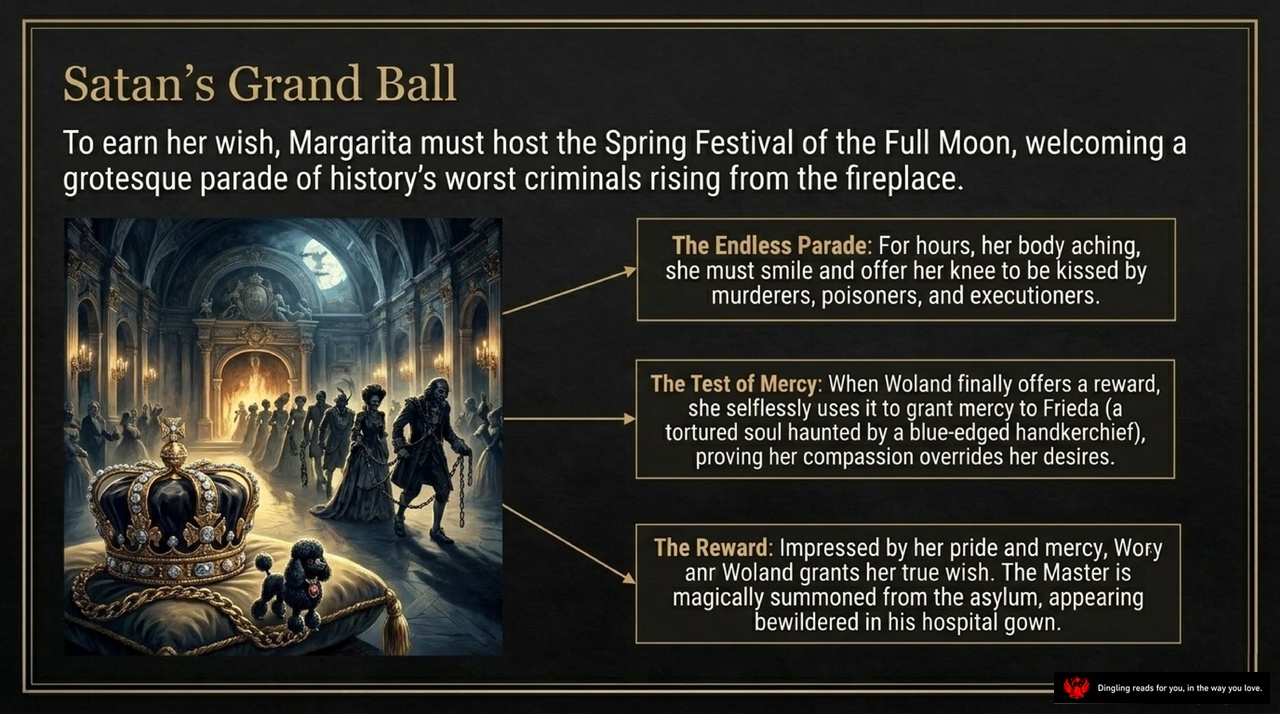
Imagine a ball so dark, so twisted, that it feels like a nightmare you never want to wake from. This is Satan's Grand Ball, the final, terrifying test for Margarita. To earn her wish, she must host the Spring Festival of the Full Moon, welcoming a grotesque parade of history's worst criminals rising from the fireplace.
The Endless Parade is where her true suffering begins. For hours, her body aches, but she must smile and offer her knee to be kissed by murderers, poisoners, and executioners. She is forced to play hostess to the very worst of humanity, a silent sacrifice of her dignity.
But the real challenge is The Test of Mercy. When Woland finally offers a reward, she selflessly uses it to grant mercy to Frieda, a tortured soul haunted by a blue-edged handkerchief. In that moment, her compassion overrides her desires, proving that her love for the Master is stronger than her own survival.
Impressed by her pride and mercy, Woland grants her true wish. The Master is magically summoned from the asylum, appearing bewildered in his hospital gown. He is finally home, and the long night of torment is over.

Imagine a manuscript being tossed into a roaring fire, the paper curling and blackening until nothing remains. In the world of *The Master and Margarita*, this is the defining moment of the novel. The Master, driven by paralyzing fear, admits he threw his life's work into the stove, believing it destroyed forever. But as the flames consume the physical pages, Woland calmly produces the fully intact manuscript from the ashes.
This scene teaches us a profound truth: physical paper can be destroyed, and artists can be silenced, imprisoned, or driven mad by the state. Yet, absolute truth and genuine artistic creation exist on a higher, indestructible plane. Ideas cannot be burned. No matter how fierce the fire, the story itself survives, proving that while the vessel may break, the truth it holds remains eternal and unchangeable.
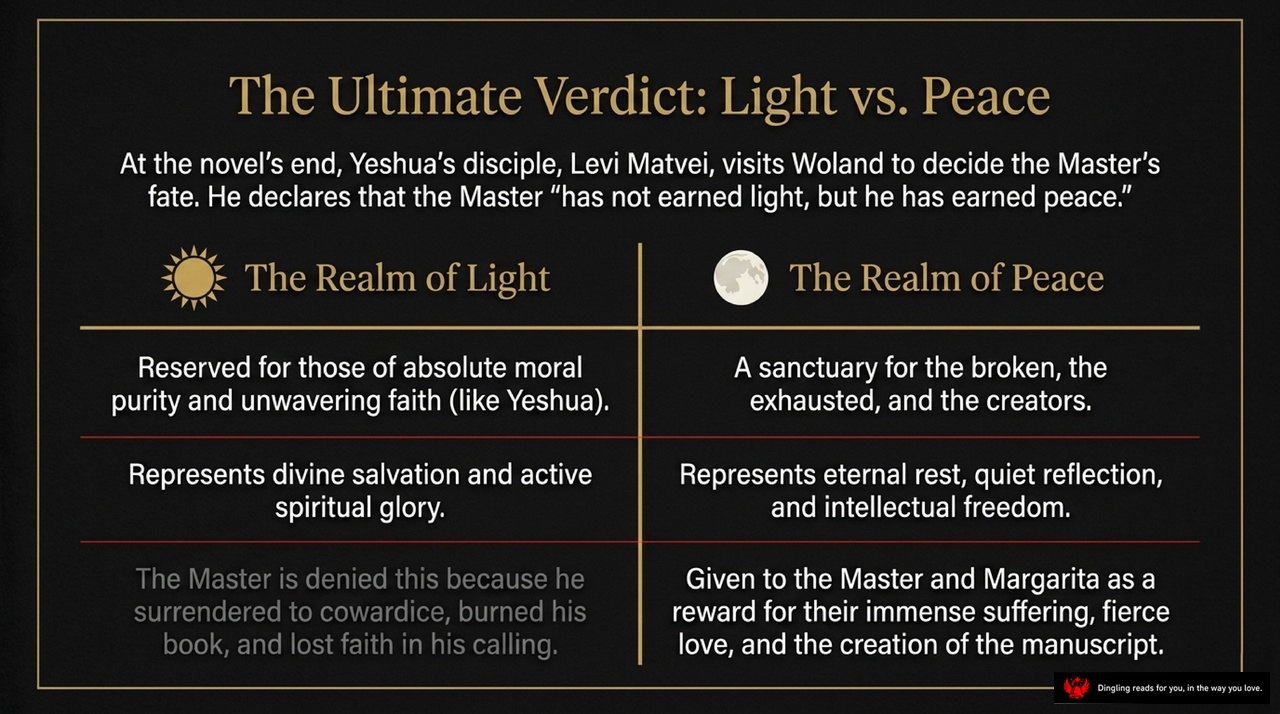
At the novel's conclusion, the ultimate verdict on the Master is delivered not by a judge, but by his own disciple, Levi Matvei. Visiting Woland to decide the Master's fate, Levi makes a profound declaration: "The Master has not earned light, but he has earned peace." This sentence anchors the entire spiritual conflict of the story.
The slide contrasts two distinct realms. On the left, "The Realm of Light" is reserved for those of absolute moral purity and unwavering faith, like Yeshua himself. It represents divine salvation and active spiritual glory. However, the text explicitly states that the Master is denied this realm because he surrendered to cowardice, burned his book, and ultimately lost faith in his calling.
On the right stands "The Realm of Peace," described as a sanctuary for the broken, the exhausted, and the creators. This realm represents eternal rest, quiet reflection, and intellectual freedom. It is given to the Master and Margarita as a reward for their immense suffering, fierce love, and the creation of the manuscript.
So, while the Master fails the test of divine perfection required for the Light, he succeeds in the trial of human endurance. He is not exiled to darkness, but welcomed into a place of serene peace, where his love and sacrifice are honored without the burden of judgment.

Before they claim their eternal refuge, the Master is given one final, profound task by Woland: to free his own creation. For two thousand years, Pilate has sat in the moonlight, agonizing over his cowardice and his unfinished conversation with Yeshua. With a single shout—"You are free! He is waiting for you!"—the Master releases Pilate, breaking the chains of guilt that have bound the Roman governor for millennia.
Woland then leads the Master and Margarita to their eternal home. It is a quiet, Venetian-windowed house where the Master can write with a quill by candlelight, listen to Schubert, and be guarded forever by Margarita's love. As they take their final leave of the mortal world, the Master looks up at the moon, his eyes filled with a peace he never knew in life. He sees Pilate walking toward that same light, finally liberated from the burden of the past. The Master smiles, realizing that true freedom isn't about escaping the world, but about letting go of the regrets that keep us trapped. With the darkness of the night behind them and the eternal light of forgiveness ahead, they fly off into the sky, leaving the chaotic city of Moscow far below, forever at peace.
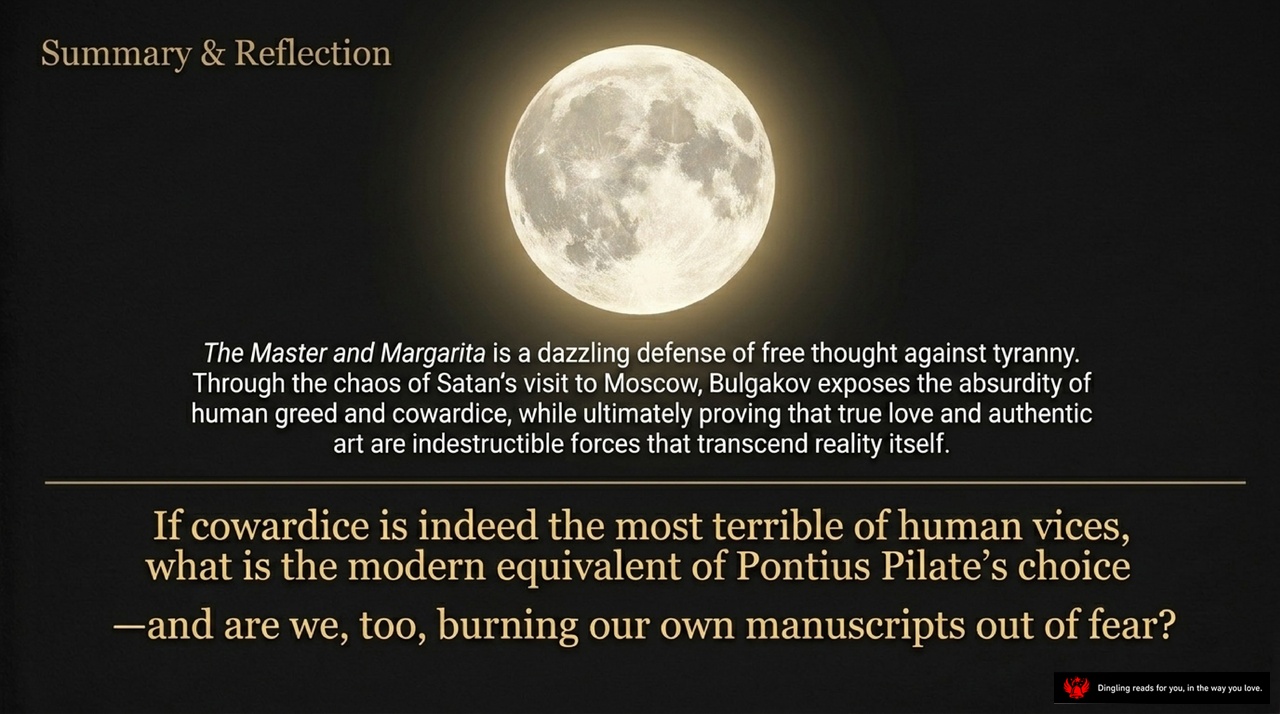
The Master and Margarita stands as a dazzling defense of free thought against tyranny, using the chaos of Satan's visit to Moscow to expose the absurdity of human greed and cowardice. But the story's true power lies in what it proves: that true love and authentic art are indestructible forces that transcend reality itself. This is the promise of the Master and Margarita's journey. Yet, as we reflect on Pontius Pilate's choice—the ultimate act of cowardice—we must ask ourselves a difficult question: what is the modern equivalent of that betrayal? Are we, too, burning our own manuscripts out of fear?