
The Metabolism of Modern Chinese Society: Complete Chapter-by-Chapter Summary

Welcome to today's book share. We're diving into Chen Xulu's *The Metabolism of Modern Chinese Society*.
Imagine a visual split: on one side, the timeless, misty mountains of traditional Chinese ink painting, representing an ancient empire that had been stable for over two millennia. On the other, a complex, steaming steam engine, symbolizing the violent, mechanical shock of the modern world crashing into it.
This book explores exactly that collision. It's not just a history of events; it's a profound look at how an ancient society underwent a painful but inevitable biological process of breakdown, adaptation, and rebirth.
The author argues that China's path was unique. While the West moved from feudalism to capitalism in about 1,100 years, China's feudal system lingered for over 2,000 years. By the time the West was mastering machines and global trade, China was still trapped in a cycle of dynastic rise and fall, where small farmers clung to the land and rigid Confucian ethics held everything in place.
But then, the world changed. The Opium Wars didn't just bring foreign goods; they shattered China's self-image. The "Middle Kingdom" dream collapsed, replaced by a harsh reality of unequal treaties and foreign domination. This trauma forced a slow, agonizing transformation. From the failed self-strengthening movements to the tragic Taiping Rebellion, and finally to the Hundred Days' Reform, China was trying to graft modern technology onto an ancient root system. It often failed, or only partially succeeded.
The book details how this "metabolism" eventually led to a complete overhaul. The abolition of the imperial examination system in 1905 didn't just end a test; it dismantled the entire social structure that had defined China for centuries. It created a new class of intellectuals who would eventually turn against the throne itself.
We see how the old order crumbled under the weight of internal corruption and external pressure, leading to the fall of the Qing Dynasty and the birth of the Republic. Yet, the struggle wasn't over. The chaos of warlords, the resistance to Western culture, and the search for a new national identity continued to define the next century.
Chen Xulu's work reminds us that modernization is never a straight line. It's a messy, violent, and transformative process where an old world must die so a new one can be born. This is the story of how China learned to breathe again in a modern age.
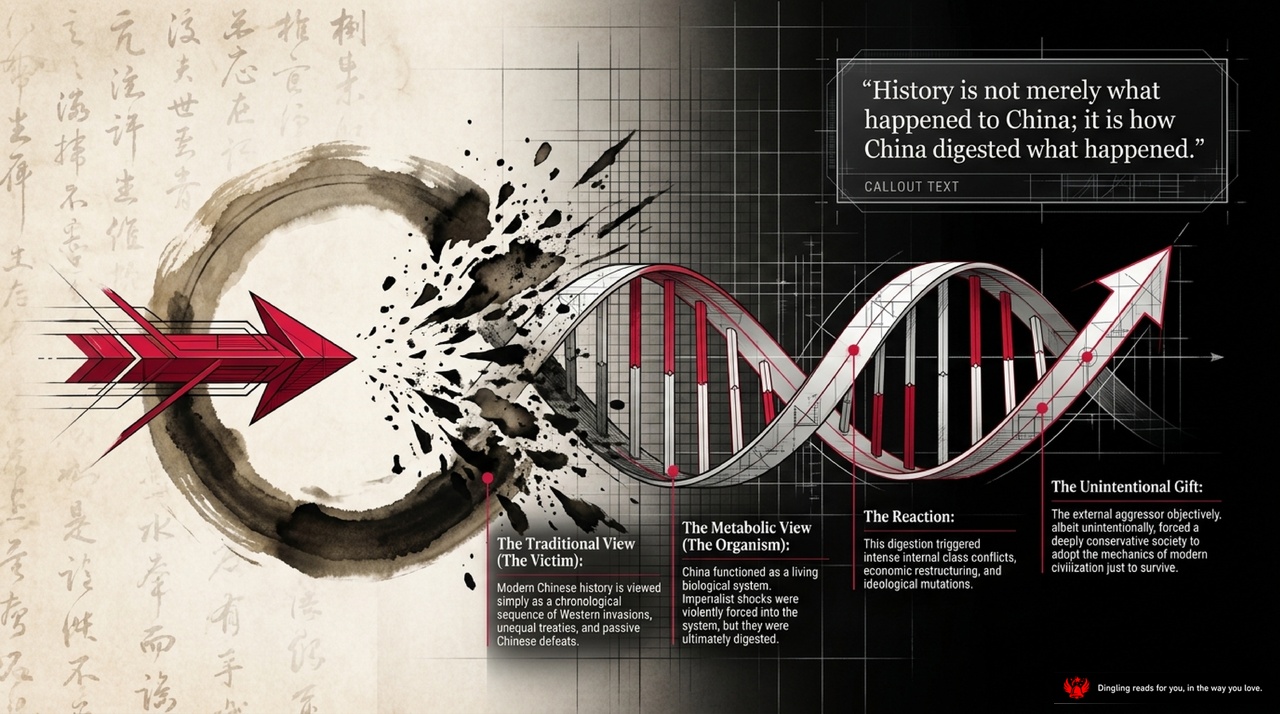
History is not merely what happened to China; it is how China digested what happened. This powerful metaphor lies at the heart of understanding China's transformation. Look at this image: a red arrow strikes a traditional ink circle, shattering it and feeding into a DNA double helix that rises upward. This visualizes the shift from a passive victim to an active organism.
For centuries, the "Traditional View" saw China as a static victim, defined by passive defeats and unequal treaties. But the "Metabolic View" changes everything. It portrays China as a living biological system. When imperialist shocks were violently forced into this system, they didn't just destroy it; they were digested. This digestion triggered intense internal class conflicts, economic restructuring, and ideological mutations.
The reaction was fierce and complex. The Opium Wars and the Taiping Rebellion were not just wars; they were a violent metabolic process. The Taiping Heavenly Kingdom, for instance, blended foreign Christian concepts with deep-rooted Chinese folk beliefs and anti-Manchu sentiment. It was a chaotic but necessary internal adjustment. Even the failed Self-Strengthening Movement and the Hundred Days' Reform were part of this digestion, attempting to integrate Western technology and ideas into the old framework.
Ultimately, this external aggression objectively forced a deeply conservative society to adopt the mechanics of modern civilization just to survive. The "Unintentional Gift" was modernity itself. By trying to resist, China was forced to evolve, breaking its feudal shell and laying the groundwork for the modern nation we know today. This is the story of China's digestion of history.
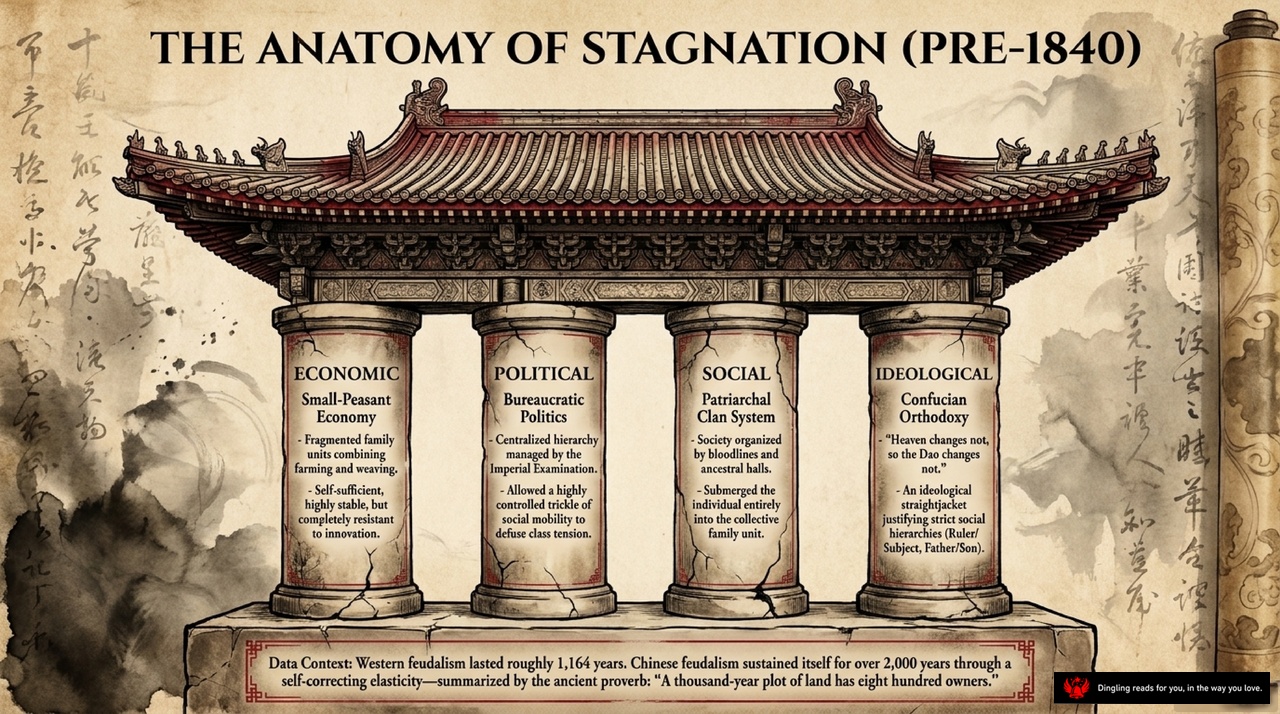
The image you see here is titled "The Anatomy of Stagnation (Pre-1840)," and it breaks down why China's feudal society remained stuck for over two millennia while the West surged forward. Think of this structure as four massive pillars holding up an ancient roof, each representing a different dimension of China's rigid system.
First, look at the **Economic** pillar. It describes a "Small-Peasant Economy." This wasn't about innovation or trade; it was about self-sufficiency. Families combined farming and weaving to survive, creating a stable but completely resistant system to change. As the text notes, this stability was a double-edged sword: it allowed peasants to feed themselves in peaceful times, but it also made them cling desperately to the land, preventing any real economic mobility.
Next is the **Political** pillar, labeled "Bureaucratic Politics." This was a centralized hierarchy managed by the Imperial Examination system. It's important to understand that while this system allowed for some social mobility—giving commoners a chance to become officials—it ultimately served to diffuse class tension rather than eliminate it. It kept the system stable by allowing a controlled trickle of power upward, ensuring the old order never truly collapsed from within.
The third pillar is **Social**, defined as a "Patriarchal Clan System." Society wasn't organized by individuals but by bloodlines and ancestral halls. The family unit was the core of everything, submerging the individual entirely into the collective. This clan structure acted as a local enforcement mechanism, where family laws mirrored state laws, creating a web of control that reached down to the smallest village.
Finally, the **Ideological** pillar stands tall, representing "Confucian Orthodoxy." This was the mental straightjacket that held everything together. The belief that "Heaven changes not, so the Dao changes not" created a mindset that rejected progress. It justified strict hierarchies—ruler over subject, father over son—and bound the emperor's power directly to the mandate of heaven. This ideology made the entire system incredibly resilient.
The cracks you see running through these pillars in the image are symbolic. While Western feudalism lasted roughly 1,164 years before giving way to capitalism, Chinese feudalism sustained itself for over 2,000 years. The text at the bottom even references the ancient proverb: "A thousand-year plot of land has eight hundred owners." This illustrates the endless cycle of land concentration and fragmentation that kept the system in a state of self-correcting elasticity, preventing any permanent structural shift until the external shock of the 19th century finally forced a change.
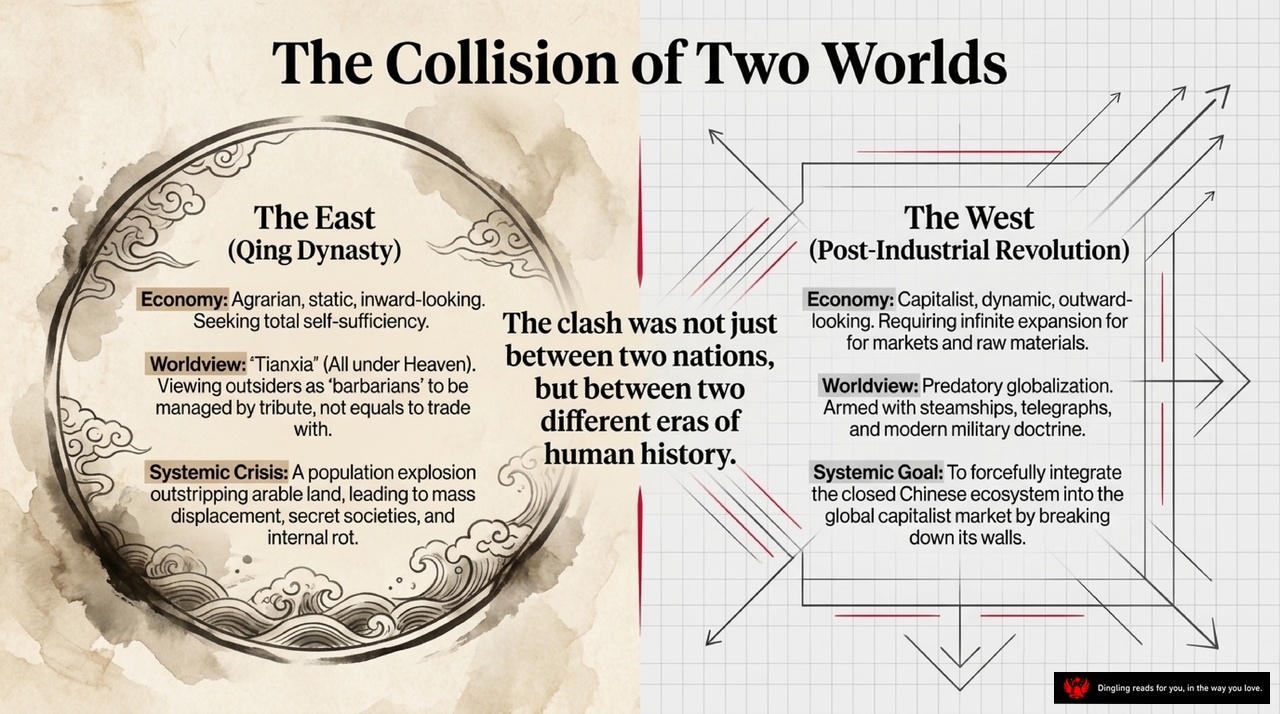
Imagine two distinct worlds crashing together, not just as nations, but as entirely different eras of human history. On the left, we see the East: the Qing Dynasty. Its economy was agrarian, static, and inward-looking, obsessed with total self-sufficiency. Their worldview, "Tianxia," viewed outsiders as "barbarians" to be managed by tribute, not equals to trade with. They were facing a systemic crisis where a population explosion was outstripping arable land, leading to mass displacement and internal rot.
On the right stands the West, post-Industrial Revolution. Their economy was capitalist, dynamic, and outward-looking, requiring infinite expansion for markets and raw materials. They operated on a worldview of predatory globalization, armed with steamships, telegraphs, and modern military doctrine. Their goal was clear: to forcefully integrate the closed Chinese ecosystem into the global capitalist market by breaking down its walls.
This clash wasn't merely a battle between two countries; it was the collision of a stagnant, isolated feudal system with a rapidly expanding, industrialized global power. The arrows in the diagram show this relentless pressure—the West pushing outward while the East remained trapped in its own circle, setting the stage for a century of profound transformation and struggle.

The image we see today perfectly captures a pivotal moment in China's history: the "Splintering of the Old Order." It illustrates how the rigid "Natural Economy"—that ancient pillar of feudal stability—was violently shattered by the Opium Wars and unequal treaties.
Think of that pillar as the traditional Chinese world, where peasants farmed and weaved in a self-sufficient cycle. But then came "Stream 1: The Disintegration." Cheap, machine-made Western goods flooded the coastal ports. Imagine the shock to a local weaver; suddenly, foreign cloth was cheaper and better than anything they could make by hand. This didn't just introduce new products; it ripped apart the ancient, symbiotic bond between farming and household weaving. The natural economy couldn't survive this flood of commodities.
This led directly to "Stream 2: The Pain"—Mass Displacement. Millions of traditional artisans, boatmen, and weavers lost their livelihoods overnight. The image shows these cracks spreading like red lightning, representing a massive, volatile displaced population. People were uprooted, forced to wander, and traditional social structures collapsed under the weight of this sudden industrial shock from the outside.
But destruction often births something new. That's what "Stream 3: The Birth" is about. Out of this chaos emerged entirely new social forces. First, the National Bourgeoisie: Chinese entrepreneurs who tried to build modern industries in the cracks between foreign imperialism and domestic feudalism. They were the first to see that the old ways were dead.
Simultaneously, a new working class was born. By 1894, there were already 90,000 workers, many born early in foreign-owned docks and factories. This group preceded the traditional Chinese capitalist class entirely. They were the first true industrial proletariat in China, forged in the fires of foreign factories.
So, this slide isn't just about war; it's about transformation. The Opium Wars didn't just humiliate China; they forced a metabolic shift. They broke the old feudal shell and created the conditions for the modern bourgeoisie and the working class, setting the stage for everything that followed in the 20th century.
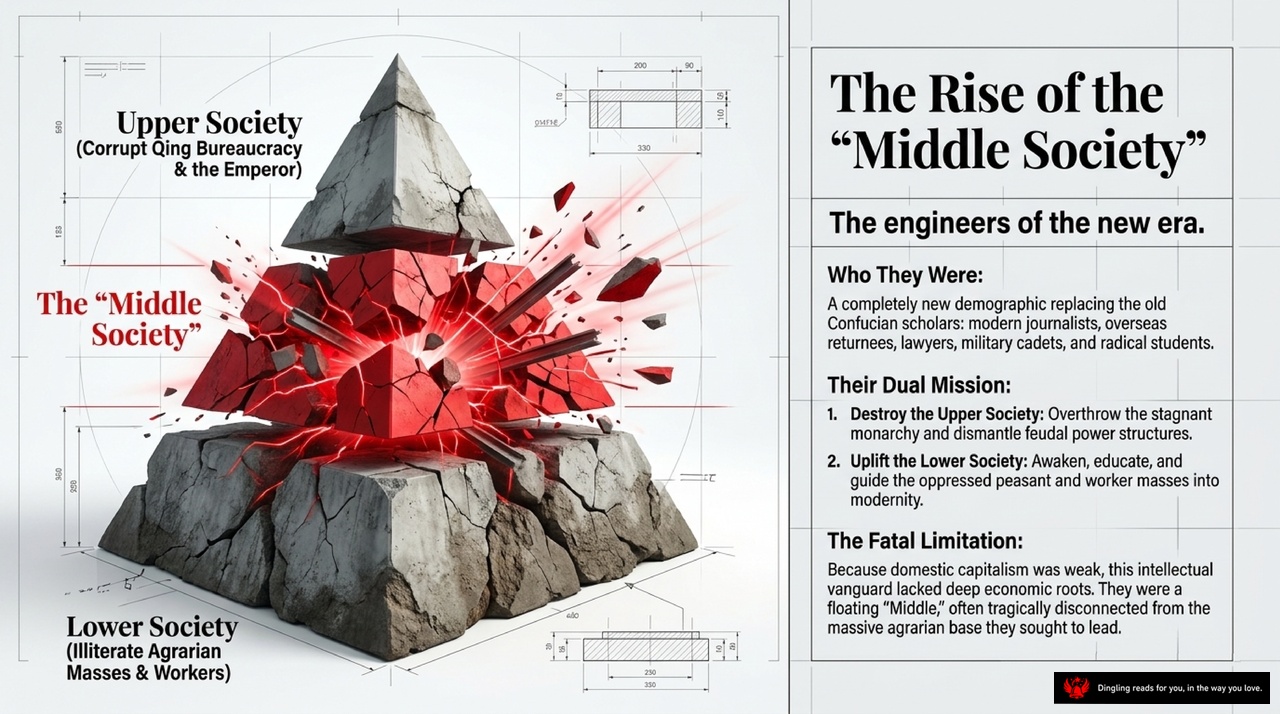
Look at this striking pyramid. It visually captures the chaotic reality of late Qing China: a crumbling "Upper Society" of corrupt bureaucrats and an Emperor at the top, a fractured "Middle Society" exploding in the middle, and an illiterate, oppressed "Lower Society" struggling at the base.
This slide highlights the rise of the "Middle Society"—the true engineers of a new era. Who were they? They weren't the old Confucian scholars. They were modern journalists, overseas returnees, lawyers, military cadets, and radical students. They had a dual mission: first, to destroy the stagnant monarchy and dismantle the feudal power structure above them; and second, to uplift the oppressed peasant masses below, awakening them and guiding them into modernity.
However, the image reveals their fatal limitation. Because domestic capitalism was weak, this intellectual vanguard lacked deep economic roots. They were a "floating middle," often tragically disconnected from the massive agrarian base they sought to lead. This disconnect meant that while they could critique the old order, they struggled to build a stable foundation for the new one, leaving the path forward fraught with instability.
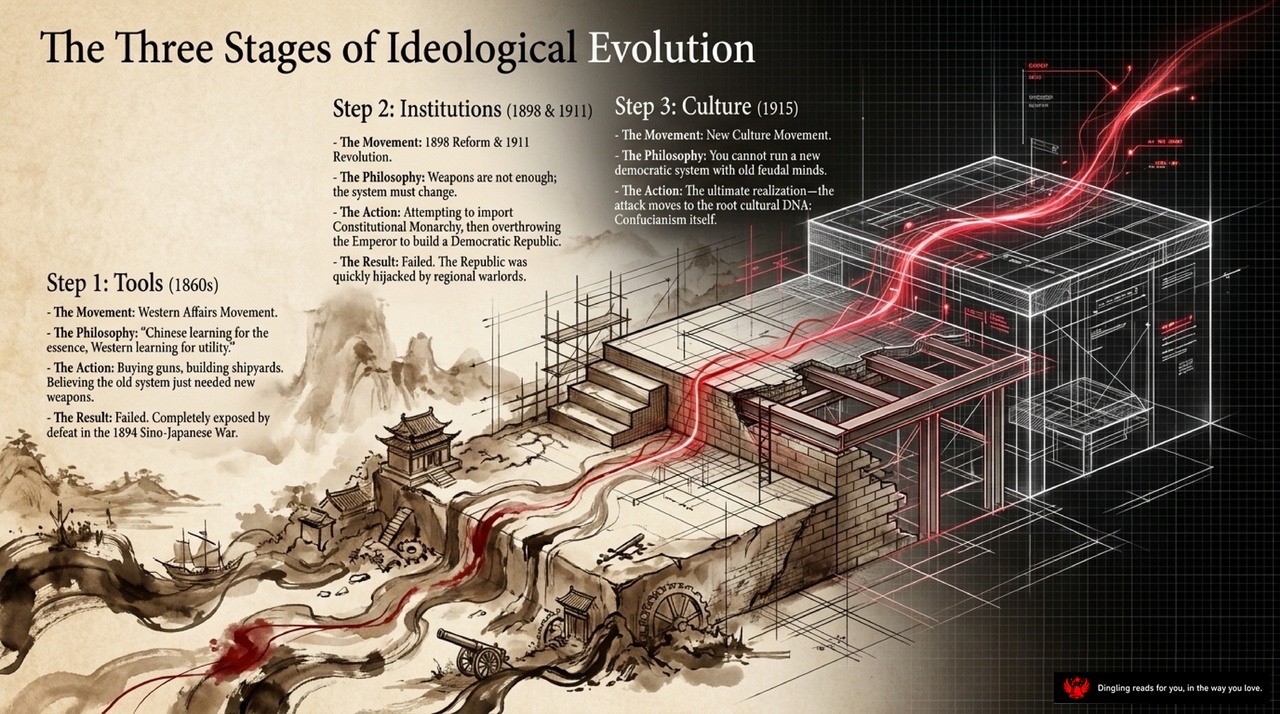
Today, we reach the final act of China's modern transformation: the New Culture Movement. This wasn't just another reform; it was a total mental revolution. After a decade of failed political experiments, thinkers like Chen Duxiu realized that changing institutions without changing the human mind was useless. They declared that ethical awakening was the final and most crucial realization.
The movement targeted the very roots of Chinese society: the Confucian hierarchy. It rejected the "eating people" nature of feudal ethics and demanded a shift from family-centric values to individual autonomy. The fight for democracy and science became the new standard for all things. This wasn't about blending old and new; it was a metabolic process where the new had to replace the old.
This intellectual shift paved the way for a new political path. As various ideologies entered China, Marxism eventually stood out. It offered a solution to China's unique contradiction: an unfinished capitalist stage meeting an urgent socialist vision. This led to the birth of New Democracy. By combining Marxist theory with China's reality, the revolution found its true direction. It shifted leadership from the bourgeoisie to the proletariat, turning the struggle against imperialism and feudalism into a path toward socialism. From the cities to the rural areas, and finally to a united front against Japan, this movement united the nation. It was this decisive turn that allowed the Chinese people to finally stand up after a century of humiliation.
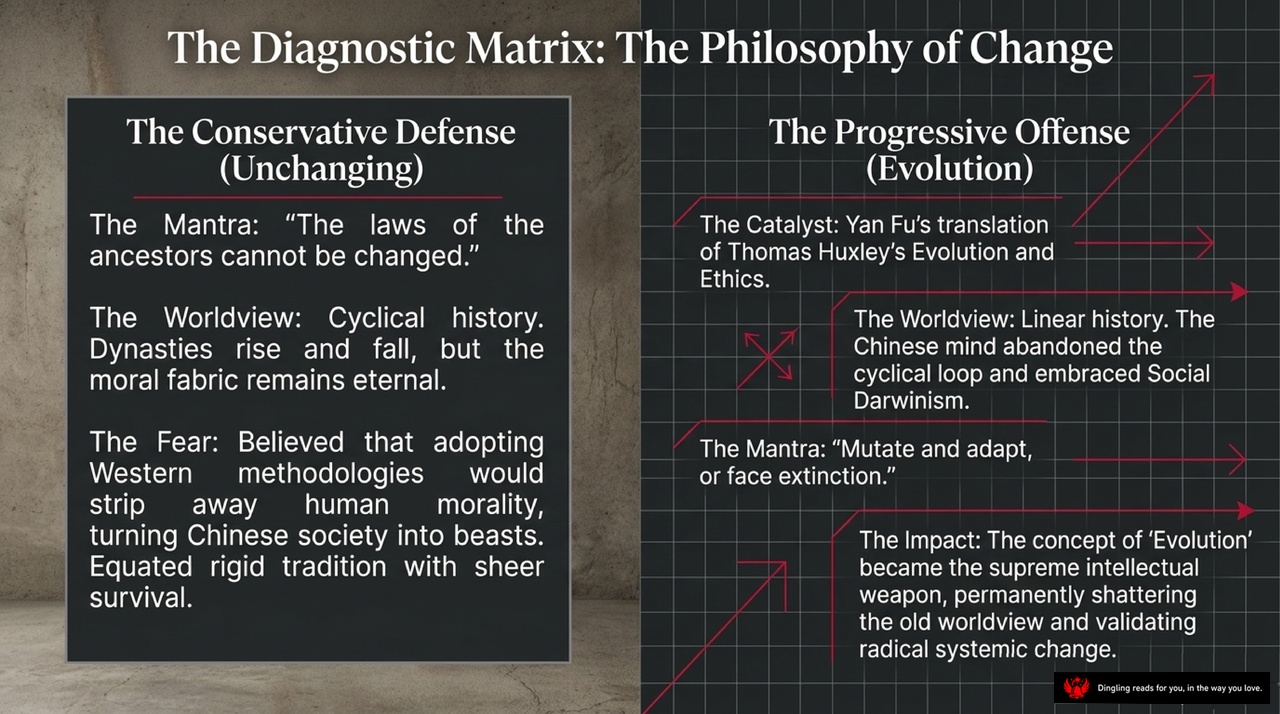
On this slide, we see the "Diagnostic Matrix: The Philosophy of Change," a powerful visual that splits the Chinese historical narrative into two opposing forces: The Conservative Defense and The Progressive Offense.
On the left, we have the Conservative Defense, rooted in unchanging tradition. Its core mantra was, "The laws of the ancestors cannot be changed." This worldview was cyclical; they believed dynasties would rise and fall, but the moral fabric remained eternal. The fear here was that adopting Western methodologies would strip away human morality, turning Chinese society into beasts. In their eyes, rigid tradition was the only path to survival.
Contrast that with the right side: The Progressive Offense, driven by evolution. The catalyst for this shift was Yan Fu's translation of Thomas Huxley's *Evolution and Ethics*. This introduced a linear history, where the Chinese mind abandoned the cyclical loop and embraced Social Darwinism. The new mantra was stark: "Mutate and adapt, or face extinction." The impact was profound; the concept of 'Evolution' became the supreme intellectual weapon, permanently shattering the old worldview and validating radical systemic change.
Essentially, this matrix captures the moment China had to choose between clinging to an eternal past or risking a chaotic future to survive in a changing world. It was a battle between the safety of the familiar and the terrifying necessity of transformation.

Today's slide presents a powerful metaphor: two wheels of the same cart, representing the eternal tension between Reform and Revolution. On the left, we see the Reformers, or the Gradualists like Kang Youwei and Liang Qichao. They feared that violent upheaval would invite foreign partition and the end of China, so they pushed for a constitutional monarchy to modernize the state from within. On the right stand the Revolutionaries, the Radicals like Sun Yat-sen and Huang Xing. They believed the Qing government was fundamentally rotten and could not be saved by mere tinkering, advocating instead for a violent overthrow to establish a Republic.
But here is the crucial insight in the center: Mutual Dependence. Though they fought bitterly, they drove the metabolism of Chinese history together. The looming threat of Revolution forced the Qing state to attempt Reforms. Conversely, the inevitable failure of those Reforms proved the absolute necessity of Revolution. It wasn't a zero-sum game; one side's pressure created the conditions for the other's rise. As the text notes, the failure of the Hundred Days' Reform and the late Qing "New Policies" ultimately paved the way for the 1911 Revolution. History didn't choose one path over the other; it forced them to turn the same cart forward.

The Confucian Shop, once the unshakable foundation of Chinese society, is shattering. As the image vividly depicts, this isn't just a crack; it's a cultural earthquake triggered by the May Fourth Era. The central symbol of the "Confucian Shop"—representing the rigid structures of the Three Obediences and patriarchal loyalty—is exploding outward, signaling the total attack on a system that had long suppressed individual liberation.
This explosion was fueled by two powerful banners: Mr. Democracy and Mr. Science. The New Culture Movement demanded a complete re-evaluation of all societal values, rejecting the "slave morality" that had kept China stagnant for millennia. As traditional orthodoxy collapsed, an unprecedented vacuum opened up, creating what we might call an ideological free market. A flood of global ideologies rushed in to fill the void, including Pragmatism, Anarchism, Guild Socialism, Liberalism, and Marxism. This wasn't a chaotic mess; it was the highest peak of intellectual freedom and debate in Chinese history. It created a fertile, chaotic ground necessary to forge a new national direction, moving the nation away from feudal stagnation toward a modern future where the individual finally mattered.

Today's slide, "The Metabolism of Daily Life," captures a profound transformation: how foreign commodities and ideas irreversibly altered the sensory and moral fabric of everyday existence in China. Let's break down this shift across three key areas.
First, look at Titles and Greetings. Before, life was defined by rigid subservience—kneeling, kowtowing, and addressing elders as "Master" or "Your Excellency." After the influx of new ideas, this gave way to human equality. We see a shift to bowing, handshakes, and using terms like "Mr." or "Comrade," signaling a move from hierarchy to partnership.
Second, consider Fashion and the Body. The "Before" image shows the physical constraints of the past: the mandated queue, bound feet, and long robes. The "After" picture reveals physical liberation mirroring political liberation: short hair, Western suits, and natural feet. This wasn't just about style; it was a declaration of freedom from the body's old shackles.
Finally, examine Marriage and Family. Previously, blind, arranged marriages were managed entirely by clan patriarchs, prioritizing the collective over the individual. The new era brought the rise of individual autonomy. We see the pursuit of free love and the legal right to divorce, marking a decisive break from the collective clan in favor of personal choice and partnership.
Together, these changes illustrate how daily life itself became a site of revolution, where the private sphere was reshaped by the forces of modernity.
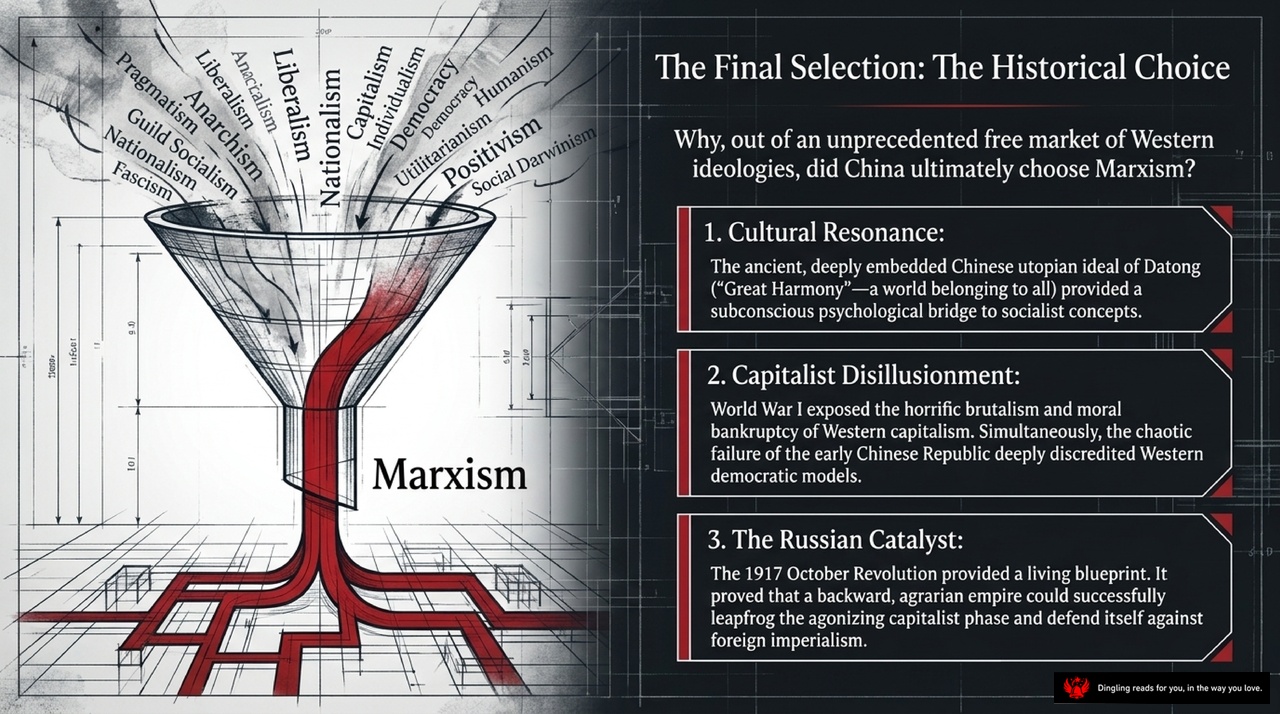
Imagine a funnel pouring over a dozen Western ideologies—liberalism, nationalism, capitalism, democracy, even fascism and social Darwinism. Yet, amidst this chaotic marketplace of ideas, China ultimately chose only one path: Marxism. Why? The answer lies in a unique convergence of cultural resonance, historical disillusionment, and a critical external catalyst.
First, consider the deep cultural roots. The ancient Chinese utopian ideal of "Datong," or Great Harmony—a world belonging to all—created a subconscious psychological bridge to socialist concepts. This wasn't a foreign imposition; it felt like a return to a lost golden age, making the leap to Marxism feel like a natural homecoming rather than a radical break.
Second, there was a profound capitalist disillusionment. World War I exposed the horrific brutality and moral bankruptcy of Western capitalism, shattering the faith in the free market. Simultaneously, the chaotic failure of the early Chinese Republic deeply discredited Western democratic models. When the promises of liberty and democracy turned into chaos and inequality, the Chinese people needed a new answer that offered both equality and national strength.
Finally, the Russian catalyst proved the possibility of the impossible. The 1917 October Revolution provided a living blueprint, demonstrating that a backward, agrarian empire could successfully leapfrog the agonizing capitalist phase and defend itself against foreign imperialism. For a China struggling under foreign domination and internal decay, this was the ultimate proof of concept.
So, out of an unprecedented free market of Western ideologies, Marxism won not by accident, but because it was the only one that resonated with China's soul, answered its historical trauma, and offered a viable path to survival and modernization.
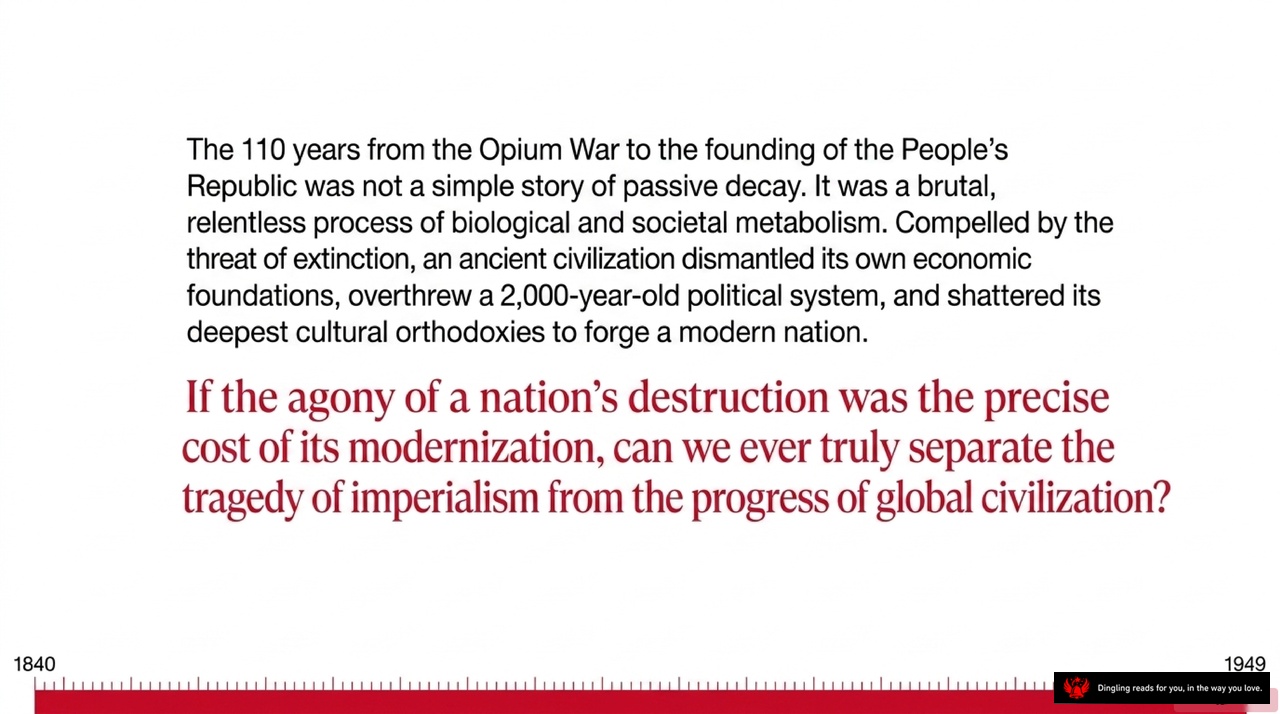
The slide highlights a pivotal question: could the agony of a nation's destruction truly be the precise cost of its modernization? Can we separate the tragedy of imperialism from the progress of global civilization?
This slide captures the brutal, relentless process of biological and societal metabolism that defined China's 110-year journey from the Opium War in 1840 to the founding of the People's Republic in 1949. It was not a simple story of passive decay. Instead, an ancient civilization, compelled by the very real threat of extinction, dismantled its own economic foundations, overthrew a 2,000-year-old political system, and shattered its deepest cultural orthodoxies to forge a modern nation.
This transformation was forged in fire. The Opium War shattered the illusion of the "Celestial Empire," forcing China to confront the reality of Western technological superiority. The Taiping Rebellion, the Hundred Days' Reform, and the subsequent failures of the Self-Strengthening Movement all represented desperate attempts to adapt. Yet, the path was paved with immense human suffering. The late Qing dynasty's "New Policies" and the eventual collapse of the imperial system were not clean breaks but painful, chaotic metamorphoses.
The slide challenges us to look beyond the binary of victim and victor. While the cost was staggering—millions of lives lost, cultural dislocation, and decades of instability—the outcome was the birth of a modern state. We are left to ponder the ethical weight of this history: Was the destruction of the old order an inevitable, albeit tragic, prerequisite for the emergence of the new? As we reflect on this timeline from 1840 to 1949, we see that modernization was never a gentle evolution, but a violent, necessary rebirth.