
The Metamorphosis: Complete Chapter-by-Chapter Summary

Welcome to the anatomy of the Kafkaesque. Today, we step into a world where the absurd, the alienated, and the impossible mundane collide.
Imagine waking up one morning to find your life has been rewritten in a language you no longer speak. You are still in your room, surrounded by the familiar walls and the pile of samples from your job, but you are no longer the person who used to wake up. You are a giant insect. Your back is hard as armor, your belly is rounded, and your legs twitch helplessly before your eyes. It feels real. The rain outside, the ticking clock, the worry about being late for the train—it all feels real, even though your body has betrayed you.
This is the core of Franz Kafka's genius. He takes the terrifyingly ordinary—the alarm clock, the commute, the debt, the family obligations—and twists them into something nightmarish. You are still responsible for your parents' debts, still terrified of your boss, still worried about your sister's future, but now you have the body of a bug. The horror isn't just in the transformation; it's in the fact that the world refuses to change with you. The world keeps moving forward on its normal, human terms, leaving you stuck in a nightmare that everyone else treats as a minor inconvenience.
Kafka explores the alienation of the modern soul. We are all, in some way, trapped in our own invisible cages, unable to communicate our true selves to the people who matter most. He shows us how quickly society can turn from a place of care into a place of judgment and disgust, just because we don't fit the mold anymore. This is not just a story about a man turning into a bug; it is a mirror reflecting our deepest fears about being misunderstood, being useless, and being pushed away by the very people we love.

Imagine a world where the impossible isn't treated as a miracle, but simply as a clerical error. This is the terrifying logic of Franz Kafka's masterpiece, *The Metamorphosis*. Look at this "Classified" file on your screen; it perfectly captures Kafka's unique style. He doesn't write about a monster waking up in horror; he writes about a man waking up in a messy room, surrounded by textile samples and a rainy window, completely indifferent to the fact that he has transformed into a giant insect.
The text on the right highlights this chilling precision. As Gregor Samsa wakes from uneasy dreams, he finds himself transformed, yet his first thoughts aren't about his new body. They are about being late for work. He worries about his boss's anger, his parents' debts, and the missed train. He tries to move his legs, which are now too many and too strange, but he thinks only about the administrative reality of his situation. There is no magic, no scientific explanation, and no dramatic revelation. The impossible is simply presented as an administrative fact. Gregor doesn't scream; he worries about his paycheck. This cold, bureaucratic acceptance of the absurd is the true hallmark of Kafka's world, making the horror feel all the more real and inescapable.

The true horror of Gregor Samsa's transformation isn't the physical reality of becoming a giant insect; it's what happens to his mind. As shown in this diagram, the tragedy lies in a terrifying disconnect. While his body undergoes an "Impossible Event"—transforming into a bug—his mind remains entirely tethered to the mundane anxieties of capitalist bureaucracy and familial duty. He treats this apocalypse as if it were nothing more than a "mundane inconvenience," worrying only about missing his 5:00 AM train. This psychological paralysis is far more devastating than the physical mutation itself. Gregor accepts his fate without question or rebellion, trapped in a loop where the most catastrophic event in his life is processed with the same indifference as a lost job or a delayed commute. He is not horrified by his new form; he is only horrified by the loss of his ability to fulfill his duties.

Gregor Samsa, the traveling salesman, isn't just a man anymore; he's become something monstrous, a creature that repels everyone he once loved. But look at the other side of this table. While Gregor is physically degrading into a vermin, his family is undergoing a radical transformation. They are shedding their humanity, becoming ruthless survivors who are finally independent.
Notice the stark contrast in their mental states. Gregor remains an obedient, dutiful worker, even in his insect form, desperately trying to hold onto his old identity. Meanwhile, his family transforms from dependent, weak individuals into self-reliant survivors. They stop relying on his salary and start building their own lives.
This is what I call the "Inverted Transformation." Gregor is downgraded from a provider to a despised parasite, losing all social utility. In contrast, the family upgrades from idle parasites to self-sufficient providers. The insect did not destroy the family; the family's changing heart destroyed the insect. Their evolution was the true tragedy, while Gregor's physical decline was just the symptom.

Imagine a world where the greatest artist in the circus refuses to touch the ground, demanding a second trapeze bar to perform on. This isn't just a story about gravity; it's a terrifying exploration of the "Artist's Curse." When that single bar is removed, he feels he loses his very soul. It's the ultimate fear of losing artistic balance and the inability to exist in the real world. Now, look at the other side of this cage. Here, a narrator faces the "Weight of the Gaze." He is subjected to the unjustified, relentless hatred of a stranger—a woman who seems to exist solely to torment him. Instead of fighting back, he responds with complete passivity. He mirrors the deep-seated fears of intimacy and relationships that Kafka himself documented. He is paralyzed by the expectations of others, trapped in a psychological prison where he cannot define himself without the judgment of a stranger. These are the invisible cages we all build: one for the artist who cannot survive without perfection, and one for the individual who cannot survive without the approval of others.

Have you ever wondered what happens when an artist's passion clashes with a world that simply doesn't get it? In this story, we meet the Hunger Artist, a man whose art form is nothing less than starvation itself. But here's the twist: he isn't fasting out of spiritual discipline or some grand religious vow. He stops eating simply because he can't find food he actually likes. His art is less a choice and more a symptom of his fundamental incompatibility with the world around him.
Look at the image on your screen. We see the artist confined in a cage, looking emaciated and defeated, while a vibrant red panther walks freely beside him. This visual perfectly captures the story's tragic irony. The impresario, desperate to keep the show running, caps the fast at forty days. Why? Not for the artist's health, but because audience attention fades. Art has been commodified; the crowd wants a spectacle, not a slow, painful journey.
The tragedy reaches its peak when the artist finally dies. Instead of mourning the quiet tragedy of a man who starved because no food satisfied him, the crowd immediately flocks to the new attraction: a young panther. They cheer for the beast's raw, unthinking hunger for life, easily forgetting the artist's silent struggle. The panther, full of vitality and appetite, replaces the man who starved from an empty stomach. It is a haunting reminder of how quickly society can swap a complex human tragedy for a simple, entertaining beast show.

Imagine a world where the most profound connection between a creator and their audience is built on a beautiful, unbreakable lie. This is the haunting reality of Kafka's "The Metamorphosis," and it perfectly mirrors the tragic arc of our own society.
Look at the slide. It highlights "The Artist and the Audience," focusing on a character named Josephine. Josephine believes her singing saves the mouse folk; she thinks she is protecting and leading them. But the audience? They don't hear a savior. They hear nothing but a child blowing a whistle. They tolerate her not because of her art, but out of a paternal instinct to hum a child. This is the "Illusion of Understanding."
We are trapped in this mutual misunderstanding. The artist's true intent is to lead and protect, while the audience's perception is simply to indulge a childlike act. The slide calls this "Mutual Misunderstanding." It's a lightning bolt of realization: the relationship is built on delusion. Ultimately, the artist's uniqueness gets swallowed by the collective history of the swarm. Her voice fades, and she disappears, not because she failed, but because the audience was never actually listening to her. They were only listening to themselves. This is the silent tragedy that defines so many relationships we ignore today.

Kafka's work is bound by a single, terrifying sociological model: The Grand Unifying Theory. Across his stories, one force dominates everything—The Collective. It is an insurmountable power that demands assimilation. If you are different, if you refuse to fit in, the Collective will inevitably consume you.
Look at the four figures here. First, Gregor. He transforms into a giant insect, a literal monster. His family, the ultimate collective, doesn't see him as a son anymore; they see him as a liability. When his utility as a provider vanishes, his existence is no longer valid. He is suppressed until he is destroyed.
Next, the Hunger Artist. He starves himself for perfection, believing his art is sacred. But the audience, the collective, only cares about the spectacle and the duration. When the crowd loses interest, they don't care about his spiritual sacrifice. They discard him the moment his novelty expires. He is consumed by his own inability to compromise.
Then, the Trapeze Artist. He is an irreplaceable genius, yet he clings to a single, fragile bar. When he demands a second bar to perform his art safely, the system rejects him. The collective cannot accommodate his unique needs. He is forced into a corner where he has no place to stand, ultimately pushed out by the very system that needed him.
Finally, Josephine. She sings a simple whistle, a sound everyone knows but no one truly understands. Yet, she demands total worship and exemption from labor. The collective tolerates her because she is useful for their emotional comfort, but they never truly respect her. When she stops performing, they don't mourn her; they simply move on, ready to forget her instantly.
The lesson is clear: Individuals who are different and refuse to be assimilated by the group will inevitably be suppressed or destroyed. Whether it is the family, the audience, or society at large, the collective commodifies your uniqueness only as long as it serves a purpose. Once your utility expires, you are casually discarded. In Kafka's world, there is no room for the individual who stands apart.
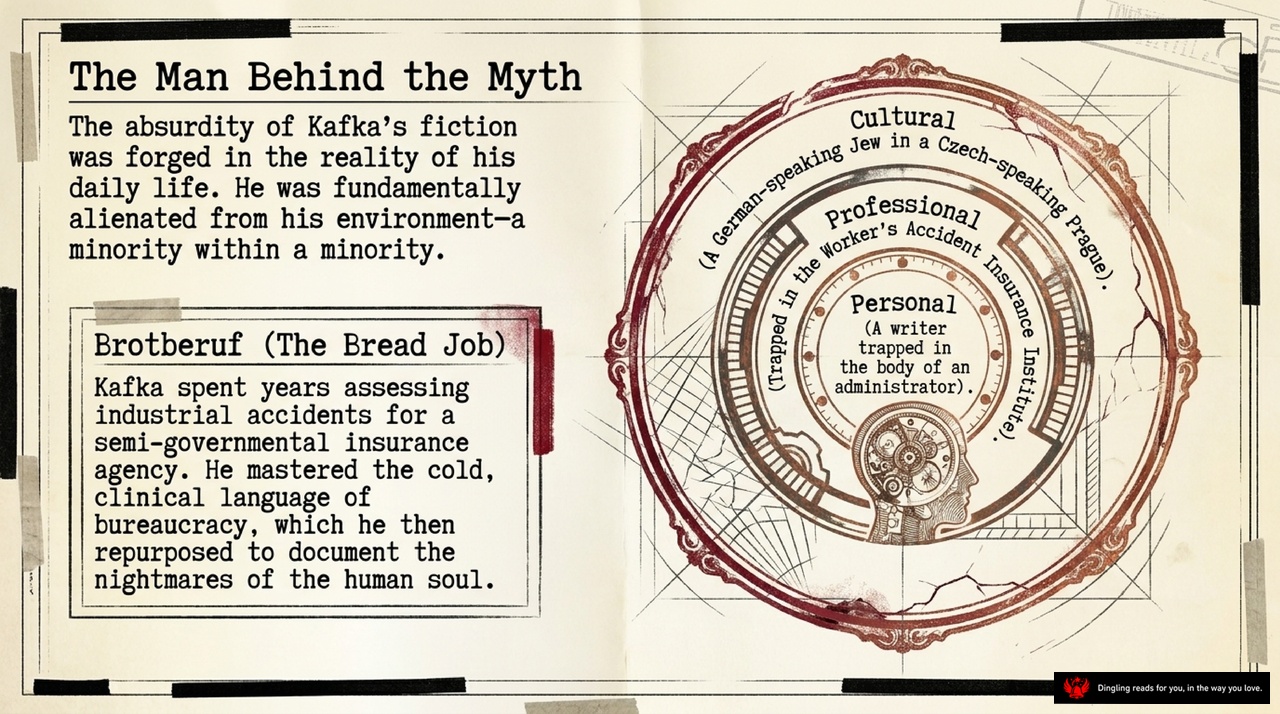
The Man Behind the Myth. Look at this diagram on the right. It perfectly captures Franz Kafka's life: a German-speaking Jew trapped in a Czech-speaking Prague. He was a minority within a minority, fundamentally alienated from the world around him. This sense of isolation wasn't just a plot point in his fiction; it was the reality of his daily existence.
To understand the absurdity of Kafka's work, you have to look at his job, known as the "Bread Job." As the text on the left explains, Kafka spent years working for a semi-governmental insurance agency, assessing industrial accidents. He mastered the cold, clinical language of bureaucracy—the very language he later repurposed to document the nightmares of the human soul.
The graphic breaks this down into three layers. At the center is his Personal life: a writer trapped in the body of an administrator. Moving outward, we see his Professional life: an employee trapped inside the Worker's Accident Insurance Institute. And finally, the outermost ring reveals his Cultural reality: a German-speaking Jew navigating a Prague dominated by Czech culture. Kafka didn't just write about alienation; he lived it every single day, forging the myths of the modern condition from the raw material of his own life.

The image captures the crushing weight of authority that defined Franz Kafka's life. At the center, a massive concrete block labeled "The Patriarch Bureaucracy" pins down a struggling insect, a powerful visual metaphor for the father-son dynamic that haunted him. This isn't just about a difficult dad; it's about an immovable, god-like figure who dominated every aspect of Kafka's existence.
The text on the slide tells us that Hermann Kafka, the father, was a practical, self-made man who viewed his son's writing with absolute contempt. This toxic dynamic created what we call "The Immovable Patriarch." Kafka spent his entire life trying to escape the shadow of this gaze, yet he ironically immortalized it in his fiction, where his protagonists constantly submit to authority.
This struggle is perfectly illustrated by a famous letter Kafka wrote to his father. He described himself in his writing as an insect with its hind legs stuck in the glue of its father, desperately trying to tear itself free with its front legs. It is a haunting image of being trapped, unable to move forward because you are anchored to the past.
The annotation at the bottom sums up this tragic irony: Kafka spent his life trying to escape the shadow of his father's gaze, yet he continually immortalized it in his protagonists' submissions to authority. In his masterpiece, *The Metamorphosis*, this internal battle becomes external. Gregor Samsa doesn't just turn into an insect; he becomes the ultimate victim of the patriarchal system, crushed by the very expectations of duty and obedience that his father embodied. The heavy block in the image represents that unyielding pressure, showing us that for Kafka, freedom was not just a physical state, but a constant, impossible battle against the invisible weight of a father who would never truly let go.

Imagine a world where the soul is quietly starved, commodified, and crushed for the convenience of the collective. This is the mirror we hold up when we read Kafka—a highly ordered, bureaucratic nightmare where humanity is stripped of its essence. But let's go deeper. Consider this: if you awoke tomorrow, completely stripped of your social utility, who would you become to the people you serve?
In Kafka's universe, identity is entirely transactional. You are not who you are; you are what you do. When that utility vanishes, the human self dissolves. Look at Gregor Samsa, the salesman who transforms into a giant insect. The moment his family realizes he can no longer pay debts or earn a paycheck, his humanity evaporates instantly. He becomes a burden, a monster, an obstacle to be locked away or driven out.
Or consider the Hunger Artist, whose entire life is defined by his ability to starve himself. When the public loses interest, he doesn't just lose an audience; he loses his very reason for existence. His art becomes meaningless without the crowd's validation, leaving him to perish in silence, misunderstood by a world that no longer cares.
Even Josephine, the singer of our tribe, believes her voice is the savior of her people. She thinks her singing grants them strength and safety. But the truth is far more cynical: her tribe only tolerates her because she is a convenient distraction. When she stops singing, they don't mourn her; they simply move on, forgetting she ever existed. She was never essential, only useful as long as she performed.
These stories force us to confront a terrifying question: How much of our own identity is built on our usefulness? If we are valued only for what we produce, who are we when we stop producing? In Kafka's mirror, we see a chilling reflection of a society that discards the broken, the useless, and the vulnerable without a second thought. It asks us to look inward and ask: If I were no longer useful, would I still be worthy of love? Or would I, like Gregor, be locked in the dark, waiting to be forgotten?