
The Metaphysical Club: Complete Chapter-by-Chapter Summary

Welcome to *The Metaphysical Club*. This isn't just a history of philosophy; it's the story of how America survived the shattering of its own soul.
Look at this image: ancient stone, representing our old certainties, is breaking apart to reveal a chaotic, electric network underneath. That crack was caused by the unimaginable trauma of the American Civil War. Before the war, the North and South were locked in a stalemate over slavery. Northern elites like Oliver Wendell Holmes, despite their progressive reputation, were often more concerned with preserving the Union than abolishing slavery. They feared that pushing too hard would tear the country apart. It was a time of compromise, of hiding behind "moderation" while the nation bled.
But the war changed everything. The brutal reality of the battlefield, the failure of idealism, and the sheer violence of the conflict forced a generation to ask a terrifying question: Are our old rules and absolute truths actually working? The answer, for many thinkers, was no.
This book explores how that crisis birthed a new way of thinking called Pragmatism. Instead of asking if an idea is true because it matches some abstract, perfect reality, these thinkers asked a much more American question: Does it work? Does it solve the problem? As we move forward, we'll meet the brilliant, flawed, and transformative minds who realized that the future doesn't belong to the perfect theory, but to the idea that gets us through the day.

Before 1861, the American intellectual landscape was trapped in a dangerous illusion of absolutism. Ideas weren't seen as tools for human progress, but as divine, unchangeable facts waiting to be discovered. This mindset fractured society into three rigid camps. First, religion: Calvinism insisted on innate human depravity, while Unitarianism claimed exclusive access to universal moral law based on innate goodness. Both sides refused to compromise on the nature of the soul. Second, science: Harvard's Louis Agassiz championed polygenesis, using taxonomies to argue that human races were distinct, primordial types created separately by God, effectively hardening biological differences into immutable law. Third, politics: Abolitionist William Lloyd Garrison took the ideological extreme, burning the Constitution as a "covenant with death" and demanding immediate partition or war, entirely rejecting the possibility of political compromise.
The key insight here is terrifyingly simple: when truth is viewed as singular, uncompromising, and divinely ordained, principles transform into holy relics worth killing for. This rigid belief that there is only one absolute way to be human or to govern society stripped away the ability to negotiate. It turned differences into mortal enemies and set the stage for a war where no side was willing to listen, because they were convinced they were speaking the only truth. This pre-war rigidity made the eventual conflict not just inevitable, but catastrophic.
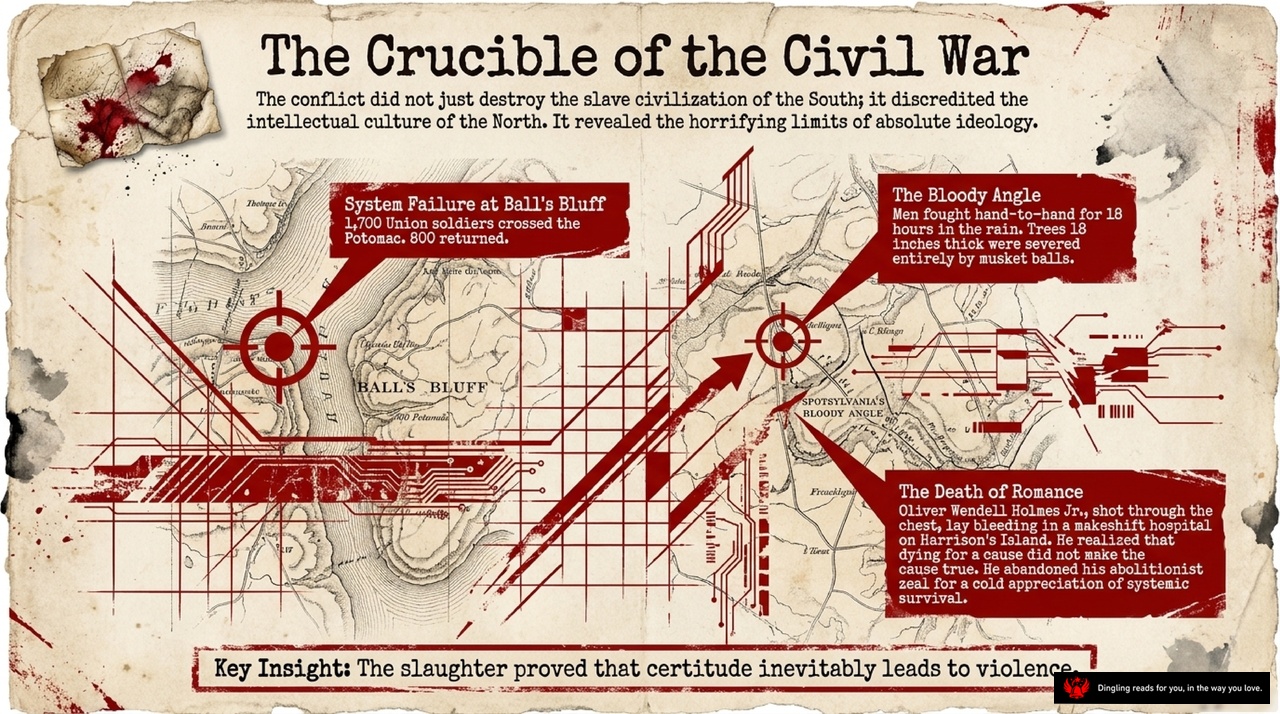
The Civil War wasn't just a war; it was a brutal crucible that shattered the illusions of the North. As this slide vividly illustrates, the conflict exposed the horrifying limits of absolute ideology. Look at the data here: at Ball's Bluff, 1,700 Union soldiers marched across the Potomac, only 800 returned. That's a system failure of catastrophic proportions. Then, over at Spotsylvania's Bloody Angle, men fought hand-to-hand for 18 hours in the rain, severing trees 18 inches thick with nothing but musket balls.
But the real tragedy wasn't just the slaughter; it was the death of romance. Oliver Wendell Holmes Jr., a man of letters and high ideals, was shot through the chest on Harrison's Island. Lying in a makeshift hospital, bleeding out, he realized a profound truth: dying for a cause does not make the cause true. He abandoned his abolitionist zeal for a cold, hard appreciation of systemic survival.
The key insight here is undeniable. This slaughter proved that certitude inevitably leads to violence. When you are so sure of your moral rightness that you ignore the chaos of reality, you don't save the nation; you destroy it.
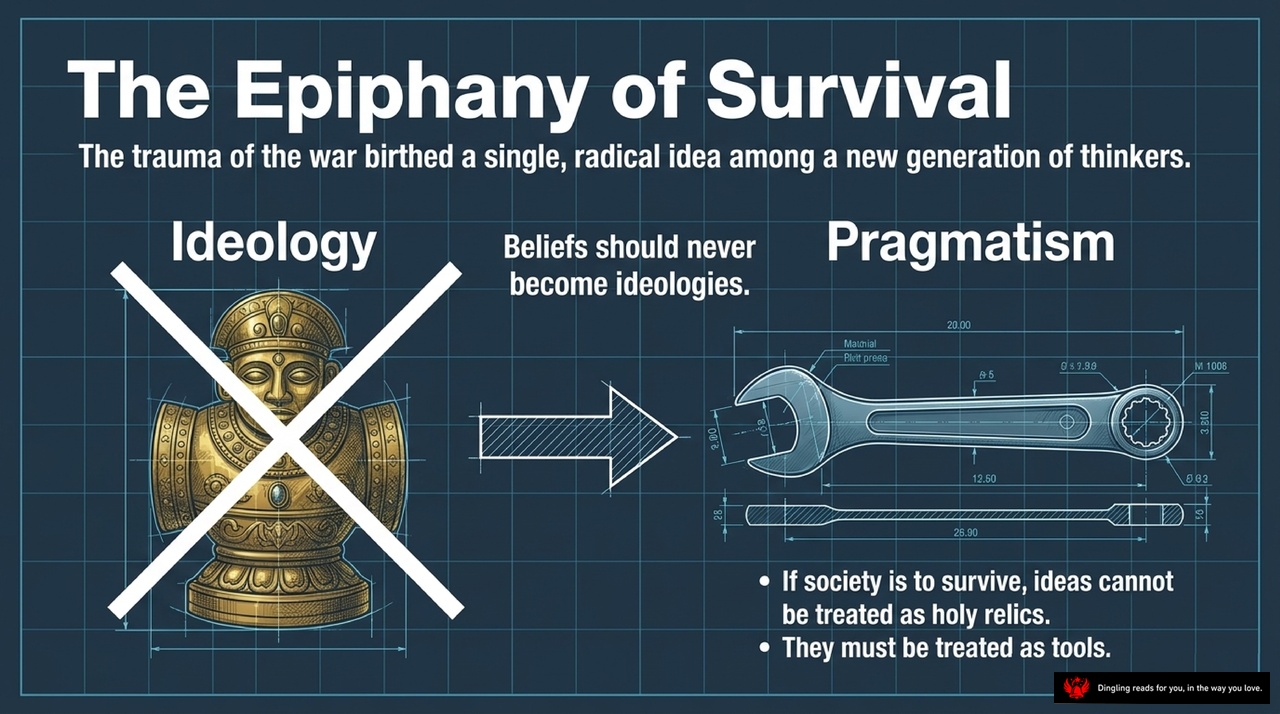
Look at this slide: "The Epiphany of Survival." It captures a radical shift born from the trauma of war. Before the Civil War, many thinkers clung to "Ideology"—treating beliefs as holy relics, like that golden idol on the left. But the brutal reality of the battlefield shattered that illusion. As the slide shows, the arrow points decisively toward "Pragmatism."
This wasn't just a philosophical change; it was a survival instinct. The war taught a new generation that beliefs should never become rigid dogmas. Instead, ideas must be treated as tools. If society is to survive, we can't worship our concepts; we have to use them. Just like the wrench on the right—useful, precise, and designed to solve a problem, not to be admired as a relic. This shift from abstract ideals to practical utility became the foundation for how Americans would approach everything from law to education in the decades that followed.
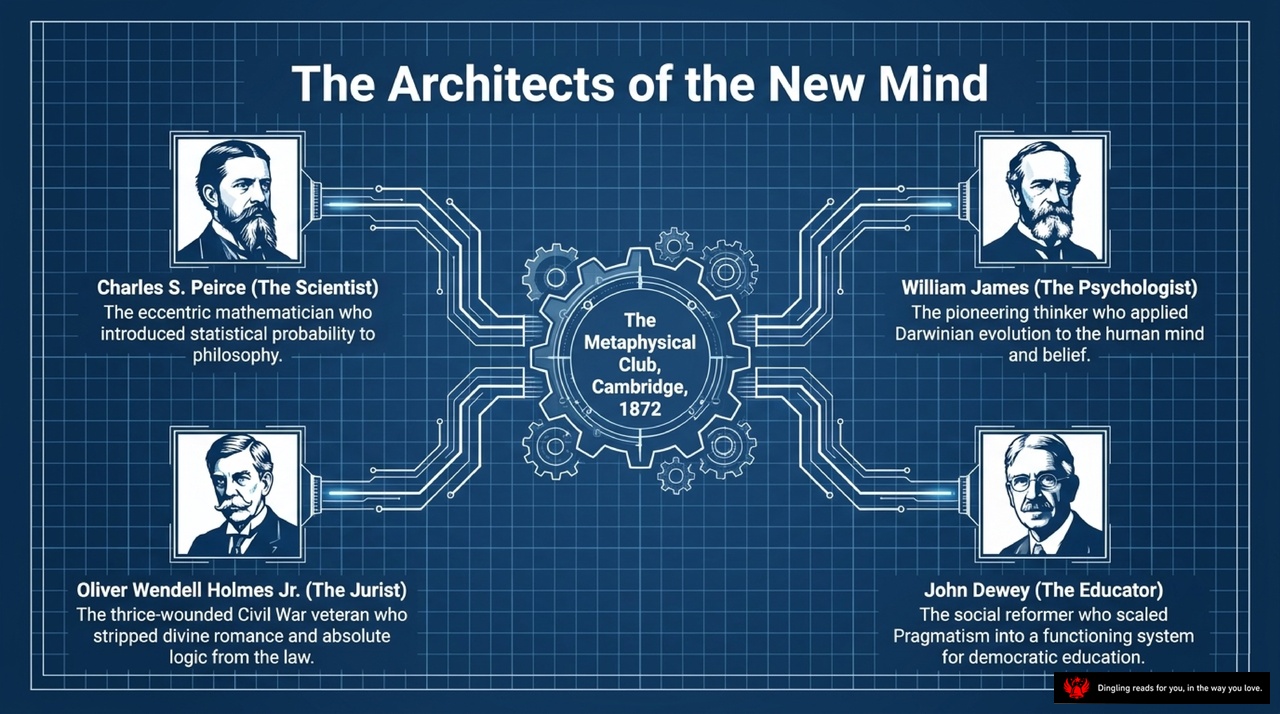
Welcome to the story of America's intellectual revolution. This slide introduces the four architects who built the "New Mind" in the late 19th century, all united by a single, radical idea: the Metaphysical Club in Cambridge, founded in 1872.
At the center of this movement was Charles Sanders Peirce, the scientist. Often called the eccentric mathematician, Peirce introduced statistical probability to philosophy, proving that logic could be a rigorous science rather than just abstract speculation.
To his right stands William James, the psychologist. As a pioneering thinker, he applied Darwinian evolution to the human mind and belief, famously arguing that the truth of an idea is determined by its practical consequences in our lives.
On the bottom left is Oliver Wendell Holmes Jr., the jurist. A thrice-wounded Civil War veteran, Holmes stripped divine romance and absolute logic from the law, famously declaring that the life of the law is not logic, but experience.
Finally, on the bottom right, we have John Dewey, the educator. He was the social reformer who scaled Pragmatism into a functioning system for democratic education, believing that schools should be laboratories for social change.
Together, these four men transformed philosophy from a detached academic exercise into a practical tool for solving real-world problems, laying the foundation for modern American thought.

Welcome to the heart of the Metaphysical Club, where the very air seemed charged with the possibility of a new American philosophy. This wasn't just a group of friends meeting in a Cambridge parlor; it was the laboratory where pragmatism was born, forged from the fires of Civil War trauma and the clash of scientific and religious worldviews.
On one side stood Oliver Wendell Holmes Jr., a man hardened by the brutal reality of Gettysburg and Vicksburg. For Holmes, the battlefield had taught him that abstract logic was useless when bodies were piling up. He needed a philosophy that worked in the real world, one that prioritized experience over rigid dogma. His legal insight—that law is a prediction of what courts will actually do, not a perfect logical system—was the practical application of this mindset.
Then there was William James, the psychologist who saw the world through the lens of human belief. While Holmes looked outward at society's laws, James looked inward at the mind's processes. He challenged the idea that truth exists independently of us, arguing instead that a belief is "true" only if it helps us navigate life successfully. Whether it was solving a math problem or finding comfort in faith, the value of an idea lay in its practical consequences.
Completing this triumvirate was Charles Sanders Peirce, the logical rigorist who originally coined the term "pragmatism." He provided the logical backbone, insisting that the meaning of any concept must be found in its observable effects. Yet, despite being the father of the movement, Peirce remained the tragic outsider. His fierce intellectual independence and personal struggles led to his dismissal from Johns Hopkins, leaving him to wander the country in poverty while his ideas were championed by his friends James and Dewey.
The club also included John Dewey, who would later take these abstract debates and plant them firmly in the soil of education and social reform. For Dewey, the mind wasn't a passive receiver of facts but an active tool for solving problems. He saw the school not as a place to memorize dead knowledge, but as a community where children could learn by doing, turning the classroom into a microcosm of a democratic society.
Together, these men dismantled the old Victorian certainties. They replaced the search for absolute, eternal truths with a focus on what works, what solves problems, and what improves human life. Their conversations in those Cambridge rooms didn't just change philosophy; they rewired the American mind, creating a culture that values experimentation, tolerance, and the belief that the future is something we build together, not something we simply discover.
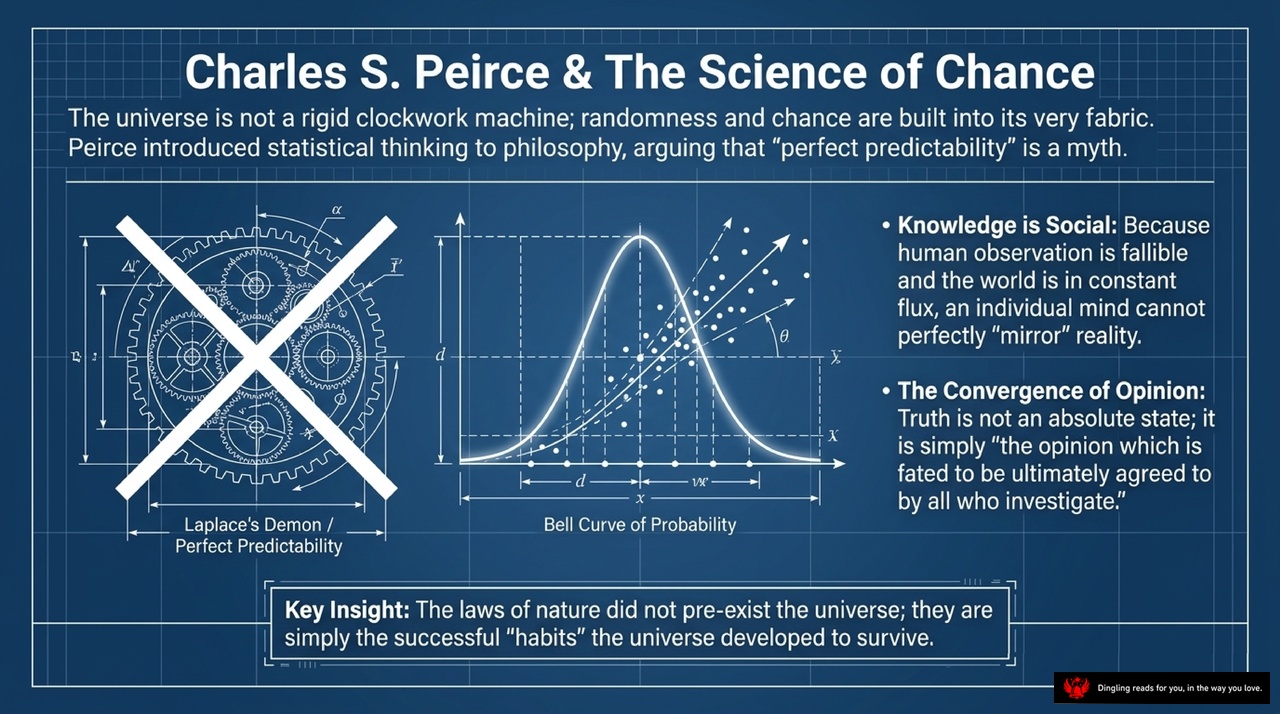
The slide presents Charles S. Peirce and his revolutionary vision of the "Science of Chance," challenging the old idea that the universe is a rigid clockwork machine. Peirce argued that randomness isn't a flaw but a fundamental part of reality's fabric. He brought statistical thinking into philosophy, boldly stating that "perfect predictability" is nothing more than a myth.
On the left, we see a crossed-out diagram of Laplace's Demon, representing the impossible dream of perfect predictability. Peirce dismantled this notion, reminding us that human observation is fallible and the world is in constant flux. Because of this, no single mind can perfectly mirror reality. Knowledge, as he saw it, is inherently social.
Moving to the center, the Bell Curve of Probability illustrates how uncertainty works. Instead of seeking a single absolute truth, Peirce introduced the concept of the "Convergence of Opinion." He believed truth isn't a fixed state, but rather "the opinion which is fated to be ultimately agreed to by all who investigate." It's about finding consensus through rigorous inquiry over time.
Finally, look at the key insight at the bottom. Peirce proposed that the laws of nature didn't pre-exist the universe; they are simply the successful "habits" the universe developed to survive. This shifts our perspective from a static, predetermined world to a dynamic one where logic and chance coexist, shaping a reality that evolves through experience and interaction.

The slide we see here perfectly captures the moment when abstract philosophy transformed into a practical tool for solving real-world problems. It highlights the birth of Pragmatism through the lens of Oliver Wendell Holmes, William James, and John Dewey.
Notice the diagram on the left. It illustrates Holmes' revolutionary legal theory: "The life of the law has not been logic: it has been experience." Holmes argued that judges don't just follow rigid logical rules; they predict outcomes based on what actually works in society. He famously defined law as a "prophecy of what the courts will do," shifting the focus from abstract principles to tangible results.
On the right, we see the core of William James' contribution. He took Holmes' focus on results and applied it to truth itself. For James, truth isn't a fixed fact waiting to be discovered; it's an event that happens to an idea. An idea becomes true when it helps us navigate life successfully—like a basketball player refining a shot until it consistently goes in. He even extended this to faith, suggesting that if a belief brings spiritual comfort and action, it holds a kind of truth for the believer.
Finally, look at the bottom section, representing John Dewey's evolution of these ideas. He turned Pragmatism into a method for social reform. Dewey argued that knowledge is a tool for action. His famous experiment with the Chicago School, where children learned math and science through cooking and building stoves, proved that learning happens best when it solves real problems. He believed that thinking and acting are inseparable parts of the same process.
Together, these three thinkers transformed American thought. They moved us away from asking "Is this logically perfect?" to asking "Does this work?" This shift shaped everything from our legal system to our classrooms, teaching us that the value of an idea lies not in how it sounds, but in how it helps us live.
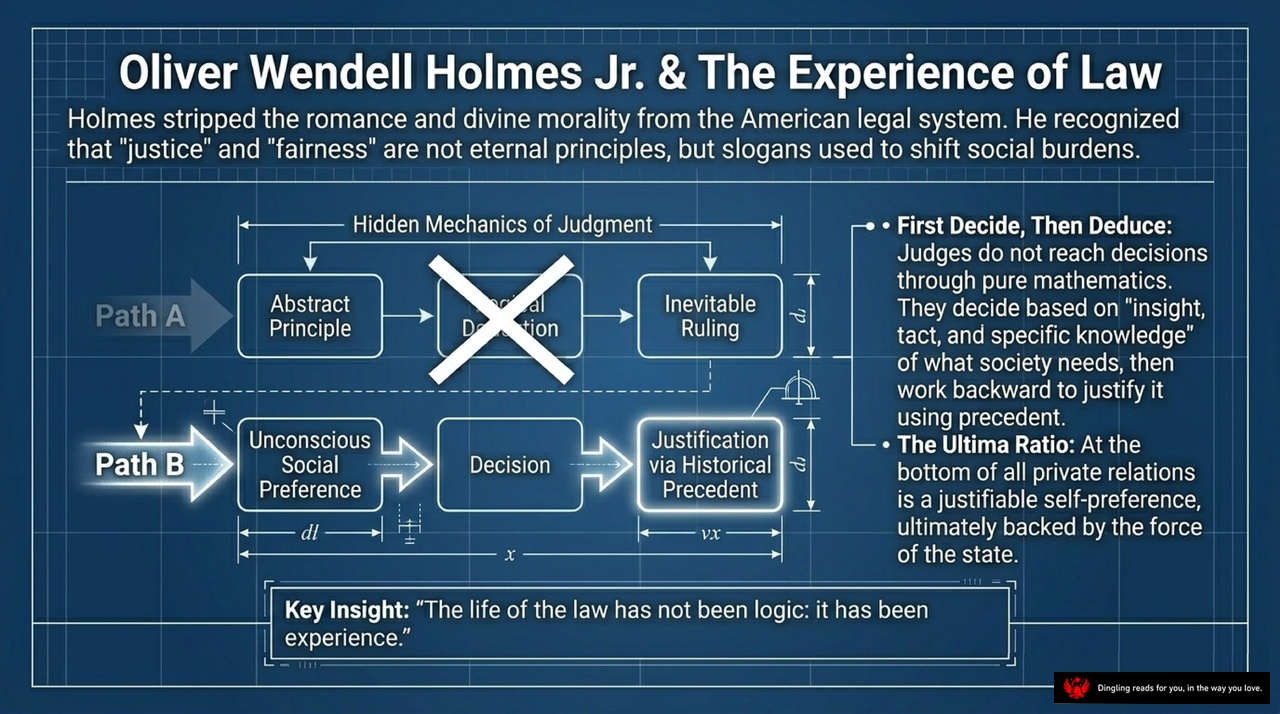
From the blueprint of the law to the marketplace of ideas, we see how American pragmatism reshaped the very concept of freedom. This slide captures the core legacy of our Metaphysical Club: the shift from abstract dogma to lived experience. Look at Path A, the traditional view where logic dictates an inevitable ruling. Holmes shattered this by declaring, "The life of the law has not been logic; it has been experience." He argued that justice isn't a fixed mathematical formula, but a prediction of what courts will actually do based on social needs. This is the essence of his "legal real" approach: law is a tool for social evolution, not a static monument.
Simultaneously, we see James and Dewey expanding this logic beyond the courtroom. James introduced the "will to believe," suggesting that a belief is true if it helps us navigate life effectively, while Dewey transformed education into a laboratory for social experimentation. Their collective insight created a powerful metaphor for liberty: the "marketplace of ideas." Just as Holmes viewed legal disputes as a competition of arguments where the best outcome emerges from experience, Dewey argued that truth and freedom are found through the free clash of diverse opinions. In this view, rights aren't pre-existing absolutes; they are the practical results of allowing different voices to compete. This pragmatic freedom, rooted in the belief that the best idea wins through open competition, remains the bedrock of modern American democracy, proving that our liberties are not given once and for all, but are constantly built and rebuilt through our shared experience.

John Dewey & The Democracy of Education. Look at these two contrasting diagrams on the screen. On the left, we see "The Era of Absolutism," depicted as a rigid pyramid with arrows pointing strictly downward. This represents the old world of fixed truths and top-down control. On the right, we see "The Democratic Experiment," a web of interconnected circles with arrows flowing in every direction. This visualizes Dewey's revolutionary idea: if truth is provisional and evolving, then society itself must be structured as an endless experiment.
Dewey scaled pragmatism from a mere philosophy of mind into a complete social system. He argued that education is not the passive memorization of dead facts; rather, action equals knowing. It is the active process of learning how to live and solve problems within a community. He challenged the illusion of antagonism, suggesting that class warfare often stems from a failure of "affectionate interpretation." When interests are worth securing, they are actually mutual.
Ultimately, the key insight here is profound: democracy isn't merely a political mechanism or a voting system. As Dewey envisioned, it is the ultimate moral outcome of a society learning together. It is a living, breathing network where every individual contributes to the evolving truth of the whole.

Imagine a world where truth isn't a fixed statue waiting to be discovered, but a living tool we build every day to survive. This is the heart of Pragmatism, and today's slide, "The Pragmatist Engine," perfectly captures how this philosophy works in real life. It's not about abstract debates; it's a five-step cycle of action and adaptation.
It starts with Step 1: Doubt. When the environment presents a friction or crisis, our old ways stop working. We need a new idea. That leads us to Step 2: Hypothesis. Our mind invents a provisional tool or idea to navigate this crisis. But an idea is just a thought until we test it. That's Step 3: Action. We apply the idea to reality. We experiment.
Then comes Step 4: Social Validation. The community tests these results against actual experience. Does it work? If yes, we move to Step 5: Provisional Truth. The idea becomes "true"—but only temporarily. As the slide reminds us, this truth lasts "until the environment changes and the cycle restarts."
This engine shows why all four thinkers we've discussed—from Holmes to James—agreed on one thing: humans are active agents. We don't just observe the universe; we vote on reality with our actions. Truth is what works, right now, for us.

Imagine a pyramid crumbling under its own weight on the left, representing Social Darwinism, while on the right, a complex web of interconnected nodes illustrates Pragmatism. This visual perfectly captures the core tension of the Gilded Age: how American thinkers like William James and Oliver Wendell Holmes redefined the meaning of evolution.
While they embraced Darwin's mechanics—chance, adaptation, and environment—they fiercely rejected the idea that "survival of the fittest" was a moral justification for inequality or cruelty. This was the Pragmatist Rebellion. Thinkers like Herbert Spencer argued that laissez-faire capitalism and racial hierarchies were "natural laws," a fatal flaw known as the Fallacy of Fate. But Holmes and James explicitly ruled that a Constitution is not intended to embody a particular economic theory. They argued that natural selection is blind chance; it contains no inherent moral values.
The key insight here is profound: evolution is not a prescriptive rule for human cruelty. Instead, it is the descriptive history of how we acquired the intelligence to cooperate. The image on the right shows that unlike the rigid, destructive hierarchy of Social Darwinism, Pragmatism views society as a dynamic network where every individual is connected. It shifts the focus from a brutal struggle for dominance to a collaborative effort to solve problems. This distinction allowed America to separate the scientific fact of competition from the moral imperative of justice, laying the groundwork for a more humane and flexible approach to law, education, and social progress.

Welcome back. Today, we're diving into the birth of cultural pluralism—a concept that fundamentally reshaped how we understand society, moving away from the old idea of a "melting pot" where everyone must blend into a single, uniform gray block.
On the left, you see that funnel diagram representing the failed "melting pot" model. It shows diverse inputs being forced into a mold, producing an assimilated output. This was the traditional view, often championed by thinkers like Locke, who believed identity was a social fiction that required everyone to fit into a single national mold. But as we learned, forcing such conformity actually demands social subordination. It crushes unique identities into a uniform shape.
Now, look at the right side of the slide. This is the "Symphony Orchestra" metaphor, which perfectly captures the modern concept of pluralism. Instead of forcing everyone into one mold, imagine a diverse orchestra. We have string sections, brass modules, woodwinds, and percussion arrays. Each instrument plays a different role, produces a unique sound, and has its own character. Yet, when they play together under a conductor, they create something far more beautiful and complex than any single instrument could achieve alone.
This is the core insight we need to take away: universality and diversity are not opposites. A healthy democracy doesn't demand that everyone think or act exactly the same. Instead, it thrives because diverse ethnic and cultural identities retain their unique character while contributing to a common standard of living. Just like the symphony, modern society needs the friction and harmony of different voices to function. As the slide states, these are interdependent social practices required for a functional society. So, the next time you hear about diversity, think less about blending into the background, and more about how your unique voice adds a necessary note to the grand symphony of our culture.

Imagine a society built not on rigid dogma, but on engineered resilience. This slide illustrates the profound legacy of unionism and tolerance, framing them not as mere moral niceties, but as essential engineering requirements for a stable democracy. On the left, we see the chaos of 1861—the Civil War battlegrounds where ideological absolutes led to structural collapse. Just as an architect must build a "margin of error" into a steel beam to prevent snapping under pressure, society needs the tolerance to absorb dissenting views without fracturing.
Moving to the right, we see the result: structured resilience in the form of 20th-century civil liberties. This isn't about silencing opponents, but about creating overlapping protective shields and a free speech framework that acts as a democratic crucible. As the text notes, we give space to minority and even "wrong" ideas not just for the sake of difference, but to allow better outcomes to emerge over time. The key insight here is timeless: democracy means keeping the experiment going. We act on what we believe today, but we must always leave room for the truth of tomorrow.
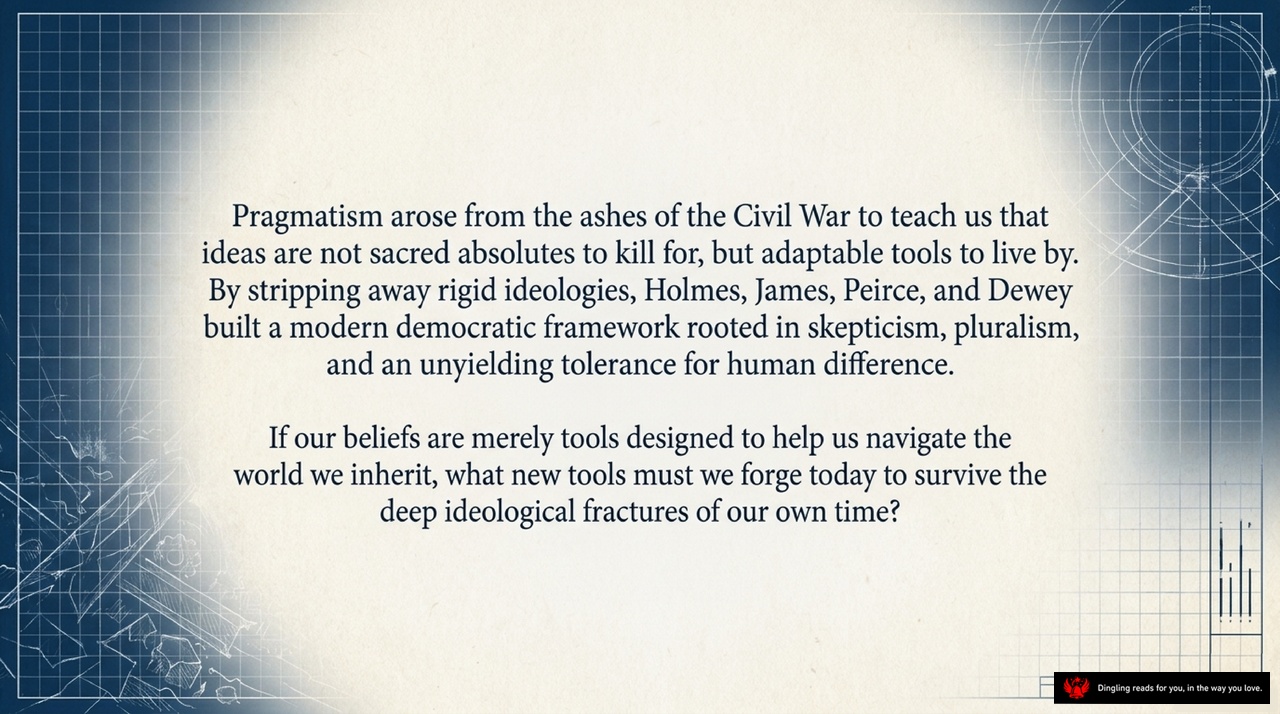
Pragmatism didn't emerge from a dusty bookshelf; it was forged in the fires of America's Civil War. As the slide reminds us, this philosophy taught us a radical truth: ideas aren't sacred absolutes we must die for, but adaptable tools we live by.
Think about the chaos of that era. From Holmes and James to Peirce and Dewey, these thinkers stripped away rigid ideologies to build a modern democratic framework. They championed skepticism, pluralism, and an unyielding tolerance for human difference. In a world often divided by "us versus them," they argued that our beliefs should be flexible enough to help us navigate the complex reality we inherit.
But here is the question that keeps us up at night today: If our beliefs are merely tools designed to help us survive, what new tools must we forge to survive the deep ideological fractures of our own time? Just as pragmatism once healed a divided nation, we now need to ask ourselves if our current dogmas are actually serving us—or if they are the very barriers holding us back.