
The Old-Fashioned Girl's Shopping Route: Complete Chapter-by-Chapter Summary

Welcome to our reading session. Today, we are stepping into a world where a kitchen is not just a room, but a sanctuary of memory and a map of a woman's life.
The image before us captures the essence of this journey: a steaming bowl of tea and a vintage brass ice scoop resting on a rustic wooden surface. This visual synthesis introduces us to Hong Aizhu's profound exploration of grief, heritage, and the culinary landscape of Taiwan and Southeast Asia. It is a story about an "old-fashioned girl's shopping route," tracing how matrilineage and memory shape the way we eat and live.
In this book, the author reveals how her mother's kitchen, once filled with the warmth of shared meals and the scent of homemade soups, became a legacy she carries forward. Even after her mother passed away, objects like a repaired clay pot and a well-cared-for cast iron skillet continue to tell stories of resilience and love. These small items, from a bamboo hairpin bought in Kyoto to a custom-made ice scoop crafted in Changhua, serve as tangible anchors to the past, reminding us that our history is often written in the details of our daily lives.
As we move through the narrative, we see how traditional markets in Taiwan and Southeast Asia become more than just places to buy food; they are living museums of culture and community. Whether it's the bustling streets of Luzhou with its century-old cut noodles, the aromatic herbal shops of Dihua Street, or the vibrant street food scenes of Bangkok and Penang, each location offers a unique flavor of belonging. The author teaches us that true nourishment comes not just from the food itself, but from the connections we build with the people who prepare it and the traditions we honor.
So, let's dive into these pages together, savoring the rich flavors of memory and the enduring power of home.

When a loved one is gone, the act of cooking transforms from a simple chore into a profound mechanism for survival. It becomes a séance, a way to bridge the gap between the living and the memory of those we've lost.
In my own life, this took the form of replicating my mother's daily recipes. When she fell ill, food was the only thing that could bring her back to consciousness. She would suddenly crave something simple, like freshly fried spring rolls, and I would rush to the old markets in Taipei's Datong Road to find the ingredients. Those markets—Yongle Market, Dihua Street—were not just places to buy food; they were living museums of our family's history, filled with the dialects, community bonds, and fresh ingredients that defined our past.
This tradition of "food as resurrection" is deeply rooted in the spaces we inhabit. Traditional wet markets and historic streets act as anchors, keeping our cultural identity alive even when the world around us changes. But it's also about the techniques we pass down. My mother taught me the precise, rigid, and physically demanding rules of old-school cooking: how to stir-fry black pork until it's tender, how to make the perfect congee during a typhoon, how to wrap zongzi with the right amount of love and skill.
These recipes are more than just instructions; they are the DNA of our family. When I cook now, I am not just feeding myself; I am keeping a conversation going with my mother, my grandmother, and all the generations that came before. In every dish, there is a story, a memory, and a piece of our shared history that refuses to fade away.

Today's slide breaks down the "Three Generations of Taste," tracing how our relationship with food has evolved from grandeur to speed, and finally to curation.
Look at the first column: The Grandmother, or Alan. Her era was defined by Grandeur and Tradition in the 1930s. Her kitchen was a bustling hub featuring brick stoves and massive woks, catering daily to over 80 employees and family members. Her culinary signature was uncompromising, large-scale banquets rooted in the elite Dadaocheng heritage.
Moving to the second column, we see The Mother. Her era marked a Transition and Speed, starting in the 1980s. Her kitchen shifted to a Western-style European setup, where she balanced corporate accounting with massive familial duties. Her cooking style was all about high-speed precision and flawless fried foods, perfecting the family Braised Pork while managing a household that demanded everything at once.
Finally, the third column represents The Daughter, or the Author. We live in the era of Curation and Preservation. My kitchen style reflects solitary apartment cooking, often during lockdowns, characterized by meticulous documentation. Instead of large banquets, my culinary signature is about replicating lost recipes as a survival mechanism, integrating Southeast Asian diaspora influences to keep these flavors alive in a modern world.

The Kitchen Heirlooms aren't just tools; they are time capsules holding the DNA of family meals. Take the Taiwanesese sandpot, cracked and repaired with gold lacquer—a reliable old teammate forged for perfect open-fire rice, simmering memories of generations past. Then there's the Kyoto tweezers, sourced from Nishiki Market, designed for the painstaking removal of black pig hair, a testament to the precision required in our heritage cooking.
Every item tells a story. The U-Xin stone chopping block, thirty years old and completely flat, has held the weight of family dinners for decades, now repurposed as a solitary tea tray. And the brass ice scoop, forged by an 80-year-old master in Huatan and stamped with the character for "Luck," represents a spontaneous family road trip taken during my mother's chemotherapy—a moment of joy amidst illness. These aren't just kitchen gadgets; they are the quiet guardians of our history, waiting to be used again.

Welcome to the kitchen of memory, where every dish tells a story of family and time. Today, we explore the recipes that have been passed down through generations, from the humble pork braised in rich sauce to the festive dumplings that bring us together during the New Year.
Imagine a bustling kitchen, filled with the aroma of simmering meats and the clatter of chopping vegetables. This is where my grandmother, my mother, and now I, have found our place. The braised pork, a staple on our table, is more than just food; it's a ritual. My grandmother would stir the pot, ensuring the meat was tender and the sauce was perfectly balanced. My mother learned this art, and now, it's my turn to keep the tradition alive.
But it's not just about the food. It's about the people we share it with. During the Lunar New Year, we gather to make "Doumian," a unique dish made from sweet potato starch and filled with shrimp, squid, and vegetables. The process is labor-intensive, requiring the whole family to work together, stirring the pot and adding ingredients with care. It's a moment of connection, a reminder of our roots and the love that binds us.
And let's not forget the fried treats that make the New Year feel so special. From the crispy fried squid to the sweet taro balls, each dish is a celebration of our heritage. My mother's fried squid, with its delicate batter and golden crust, is a favorite of mine. And the taro balls, soft and sweet, are a treat that we look forward to every year.
These recipes, these traditions, are what make us who we are. They connect us to our past, to our ancestors, and to each other. So, let's raise a glass to the food that has brought us together, and to the memories that will last a lifetime.

Today, we step into a vibrant world where food is not just fuel, but a living history connecting us to our roots. As we explore the flavors of the South Seas, we discover that the true essence of a dish lies in its ingredients and the hands that prepare them. Take the famous Penang Char Koay Teow, for instance. Its soul is found in the wok—the "keng keng" sound of the spatula hitting the iron pan is a warm, familiar signal from childhood, instantly transporting us to a bustling street stall.
But it's the ingredients that truly tell the story. The dish relies on fresh shrimp, egg, and bean sprouts, all tossed together with a secret blend of black soy sauce and chili paste. It's a celebration of local produce, served in simple teahouses that have stood for generations. These spaces are more than just restaurants; they are community hubs where neighbors gather, stories are shared, and the rhythm of life continues.
Similarly, consider the humble "char kuey teow" or stir-fried rice noodles. In Malaysia and Singapore, this dish has evolved into a cultural icon. The key is the "wok hei"—that smoky, breath-of-the-wok flavor that comes from high-heat cooking. It's a technique passed down through families, ensuring that every bite carries the spirit of tradition. Whether it's the rich, dark sauce or the crisp texture of the noodles, each element is carefully chosen to create a perfect balance of flavors.
As we savor these dishes, we realize that they are a testament to the resilience and creativity of the people who created them. From the aromatic spices of Thailand to the bold flavors of Penang, each meal is a journey back in time, reminding us of the rich tapestry of our culinary heritage. So, let's raise our forks and toast to the delicious stories hidden in every bite.

The Anatomy of Family Braised Pork isn't just about cooking; it's about mastering the four non-negotiable rules that separate a home-cooked meal from a restaurant dish. First, you must start with the cut: Tai Xing, a premium neck and shoulder blend with skin and belly, always fresh, never frozen. Second, the sear. You pan-fry that pork with barely any oil, watching closely until the skin blisters and the natural lard renders out before a single drop of liquid touches the pan. This step locks in the texture and flavor. Third, the sugar. You fry rock sugar in that rendered lard until it hits the precise edge of burnt amber, creating the perfect caramel base. Finally, the purity rule: never, ever add tofu, eggs, or bamboo shoots to the main pot. These ingredients introduce moisture and impurities that ruin the pure pork fat, which is the soul of Lu Rou. By following these four steps, you aren't just making a dish; you're honoring the tradition of pure, concentrated flavor.

Look at this step-by-step guide to making Tau-Mi, the festive starch that is absolutely essential for Lunar New Year in my family. It's not just a dish; it's a ritual that brings the whole household together.
The process starts with **Step 1: The Base**. You begin by frying shallots, dried squid, shrimp, shiitake mushrooms, and celery in a hot wok. This creates a deep, savory foundation that you can't skip. Without this flavorful base, the final dish won't have that rich, complex taste we all crave.
Next comes **Step 2: The Starch**. This is where the magic happens. You pour in a dense sweet potato starch slurry to coat all those ingredients. The texture changes instantly, turning from loose bits into a cohesive mixture.
But then, you hit **Step 3: The Struggle**. This is the most intense part. You have to perform the "Tau"—a violent, physically demanding folding and stirring motion against a hot iron wok. You keep going until a thick, translucent, sticky dough forms. It requires real physical strength, which is why traditionally, the strongest family members take the lead at the stove.
The reason we go through all this trouble is beautiful. That dense, sticky starch symbolizes family cohesion. Stirring that heavy dough requires everyone working together, literally and figuratively. It's a delicious reminder that we are best when we stick together.

The Art of the Deep Fry isn't just about cooking; it's about mastering the delicate dance between time and heat. Look at the curve in the center: it's a map of perfection. We start low, then ramp up the temperature, and finally, hit that crucial "flash-fry" moment at the peak. This high-temperature finish violently forces any residual oil out of the crust, ensuring a crisp, golden result rather than a soggy, greasy failure.
On the left, we have Recipe A: Snow White Cuttlefish. Coated in a 90% sweet potato starch mix with no egg, it gets a double-fry for just 10 seconds. On the right, Recipe B: Taro Balls. These are pure minimalism—steamed taro, sugar, and fat, with absolutely no five-spice or trendy additions. Whether you're frying delicate seafood or simple taro, the secret lies in respecting that temperature curve. Don't let the food sit in the oil; give it that violent, final burst of heat. That's the true mastery of the deep fry.

Look at this side-by-side comparison. On the left, we have the "generic" Zongzi—a trendy, soulless package filled with purple rice, scallops, and abalone. It misses the core textural elements and has the wrong ratios. It's a lookalike, a version of a Zongzi that lacks the specific architectural integrity of a family's taste.
But on the right? That's my grandmother's Northern Zongzi. This isn't just food; it's a precise, handcrafted structure. It starts with long glutinous rice soaked for four hours to get that perfect chew. Then, the non-negotiable inclusion of chestnuts adds that essential sweet, earthy crunch. You've got braised pork belly for richness, a halved baked salted egg yolk for that creamy, savory pop, shiitake mushrooms for umami depth, and dried shrimp for a burst of ocean flavor. Every ingredient has its place and its purpose.
The text at the bottom hits hard: "Eating another family's Zongzi is like dating a lookalike of an ex—every subtle difference feels like a betrayal." That's because Zongzi is an architectural representation of a specific family's history. When you eat the generic version, you're eating a copy, and that subtle disconnect feels like a loss of home. It's about respecting the exact architecture of flavor that has been passed down through generations.

Welcome back to our reading club. Today, we're diving into a sensory journey through the author's life, specifically focusing on a page titled "Tea and the Mechanics of Time." This slide beautifully breaks down her daily rituals into two distinct parts: the sacred act of brewing tea and the curated selection of traditional snacks.
On the left, we see "The Ritual." It's not just about drinking; it's a precise ceremony. She brews heavy-roasted Iron Goddess, or Tieguanyin tea, stored in those charming colonial tin boxes. Notice the strict adherence to the 7.5 over 10 fill rule for her grandfather's glass. That specific ratio isn't arbitrary; it's a legacy, a way to honor the past while maintaining a sense of order in her day. It turns a simple cup of tea into a moment of grounding.
Now, look over to the right under "The Snacks." This is where the culture really comes alive through flavor and texture. First, we have Rose Crisp Candy, made with maltose, sesame, and a hint of rose water—a delicate sweetness. Next are Mung Bean Cakes, wrapped in that distinctive red ink paper, which dissolves into a fragrant smoke on the tongue. Finally, there's Butterscotch Peanut Brittle, a hybrid of salted caramel, butter, and nuts. These aren't just treats; they are edible memories of old Taipei, connecting her to her mother and grandmother.
Together, the ritual and the snacks create a complete experience. It's about slowing down, honoring tradition, and finding comfort in the familiar flavors of home.

Welcome back to our journey through "The Diaspora Route." Today, we're tracing the path of a single bowl of dessert across the ocean, from a quiet street in Taipei to a bustling one in Penang.
Look at the map. We start in Taipei, where the text highlights a specific journey to Penang Road. Here, a beloved Taiwanese dessert, Mi Tai Mu, undergoes a tropical transformation. It becomes Chendol. Imagine taking those familiar, chewy rice noodles and infusing them with the vibrant, natural green of pandan leaves. Then, you layer it with fresh, creamy coconut milk and a touch of mineral-rich palm sugar over shaved ice. It's not just a recipe change; it's a story of adaptation.
Now, follow the line back to Bangkok. The map points us to Yaowarat Road, the heart of the Chinatown. Here, the narrative shifts from sweet adaptation to deep heritage preservation. We see Chaoshan culture perfectly frozen in time. The text mentions specific details that bring this to life: Teochew braised goose, antique tin tea trays, and even the vocabulary of the 1930s. It's a place where history isn't just read; it's tasted and heard.
As we reflect on this route, consider how recipes act as time capsules. In Penang, tradition evolves to suit a new climate. In Bangkok, tradition is guarded with reverence. These aren't just meals; they are the living memories of families who traveled, settled, and built new lives, carrying their culinary soul with them across the sea.
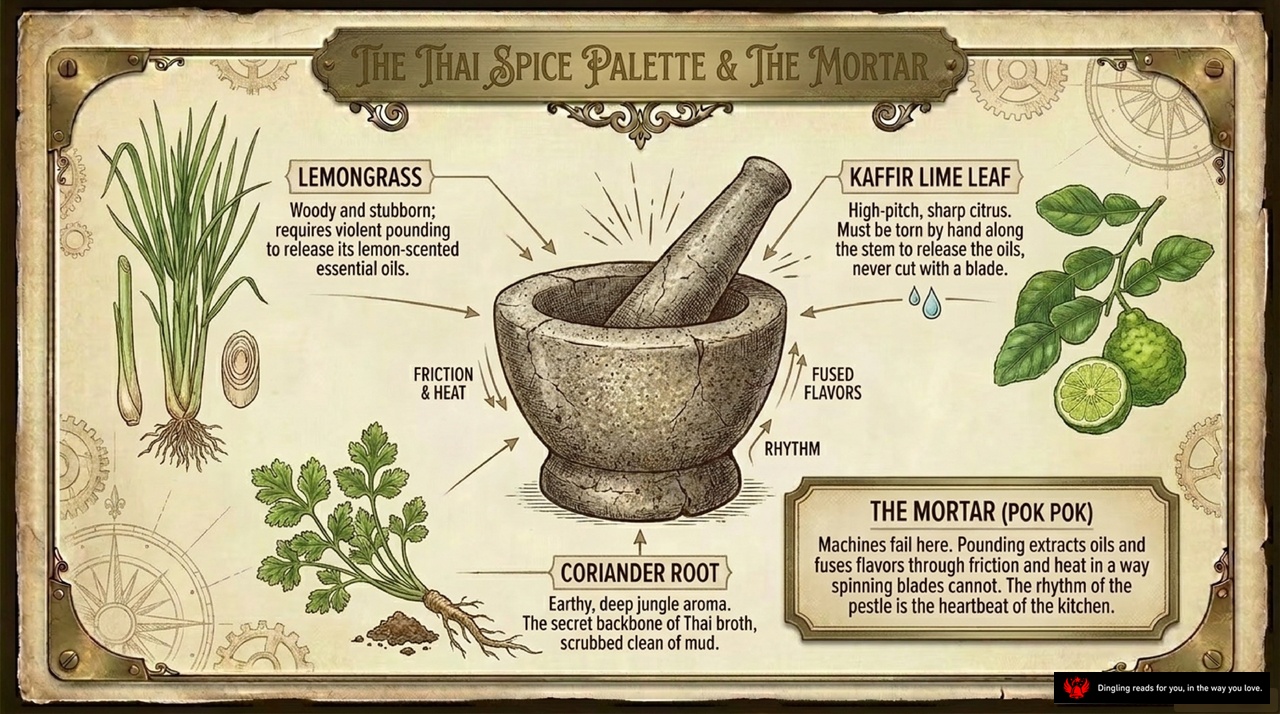
The Thai kitchen isn't just about cooking; it's a ritual of transformation, and at the heart of it lies the mortar and pestle, known locally as the *Pok Pok*. While modern machines promise speed, they simply fail to capture the soul of Thai cuisine. As the infographic beautifully illustrates, the magic happens through friction and heat generated by the rhythmic pounding of the pestle against the stone bowl. This manual effort does more than just chop; it extracts the essential oils from stubborn ingredients like lemongrass and fuses the sharp, high-pitch citrus notes of kaffir lime leaves directly into the dish. The rhythm of the pounding becomes the heartbeat of the kitchen, creating a depth of flavor that spinning blades can never replicate. From the earthy, deep jungle aroma of coriander root to the vibrant fusion of spices, the mortar ensures that every bite is a complex, living symphony of taste.

From the grand banquets of the matrilineal past to the solitary pandemic lockdown, the tools remain, and the recipes endure. To cook the old recipes is to ensure you are never truly eating alone. This is the heart of the solitary kitchen arc.
Imagine a bustling family kitchen, where generations gather around a large table, sharing stories and food. Now, picture that same kitchen, but now empty, with just a single bowl of soup on a cutting board. The transition from the grand banquets of the matrilineal past to the solitary pandemic lockdown is a stark reminder of how much has changed. Yet, the tools remain, and the recipes endure.
In the past, my grandmother's kitchen was a hub of activity, with dozens of people gathered around a large table, sharing food and stories. My mother's kitchen was a different kind of bustling, with a modern Western setup, but still filled with the warmth of family gatherings. Now, in my own kitchen, I find myself cooking alone, but the recipes and the memories of those who came before me are still there.
Cooking the old recipes is not just about feeding oneself; it is about connecting with the past and ensuring that one is never truly eating alone. The tools, like the cast-iron pot and the brass ice spoon, carry the stories of generations, and the recipes, like the braised pork belly and the sweet taro cake, are a testament to the enduring love and care of family.
So, even in the solitude of the pandemic lockdown, let us remember that we are never truly alone. The tools remain, the recipes endure, and the love of family is always there, waiting to be shared.

There is a dish you miss from your childhood that you simply must learn to make again. When the road ahead gets long and you realize there is no one left to look out for you, having a family recipe committed to memory becomes your ultimate mechanism for survival. It's not just about cooking; it's about carrying the warmth of home with you, ensuring that no matter where life takes you, you can always recreate the taste of love and belonging.