
The Omnivore’s Dilemma: Complete Chapter-by-Chapter Summary
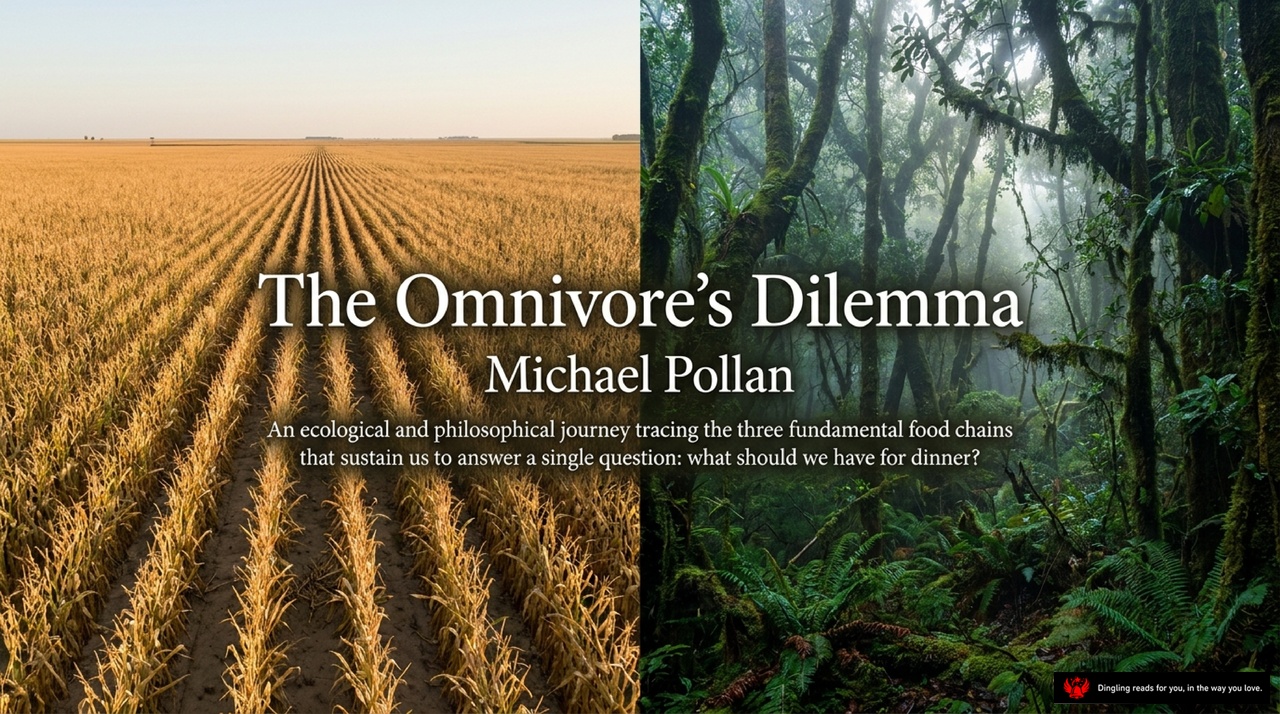
Welcome to the opening of our journey into *The Omnivore's Dilemma* by Michael Pollan. Today, we stand at the crossroads of two worlds, visually represented right before us: the vast, orderly rows of a golden cornfield on the left, and the dense, misty mystery of a wild forest on the right. This isn't just a contrast of scenery; it's the central conflict of our modern food system.
Pollan describes this book as an ecological and philosophical journey tracing the three fundamental food chains that sustain us, all leading back to one simple, yet terrifying question: what should we have for dinner?
The image on the left captures the reality of industrial agriculture—a monoculture of corn that has come to dominate the American diet. As we'll see, this corn has infiltrated everything, turning us into what scientists call "walking corn." The image on the right invites us to imagine an alternative: a wild, biodiverse ecosystem where food grows naturally without heavy intervention.
Our story begins with this very question. In a world filled with choices, we are often paralyzed by the "omnivore's dilemma"—the anxiety of choosing what is safe, nutritious, and ethical to eat. Pollan takes us from the factory farms that feed our supermarkets to the wild forests where our ancestors hunted and gathered, revealing how our relationship with food has shifted from a direct connection to nature into a complex, often hidden, industrial chain.
So, let's step into the shoes of an omnivore and explore what it really means to feed ourselves in the 21st century.
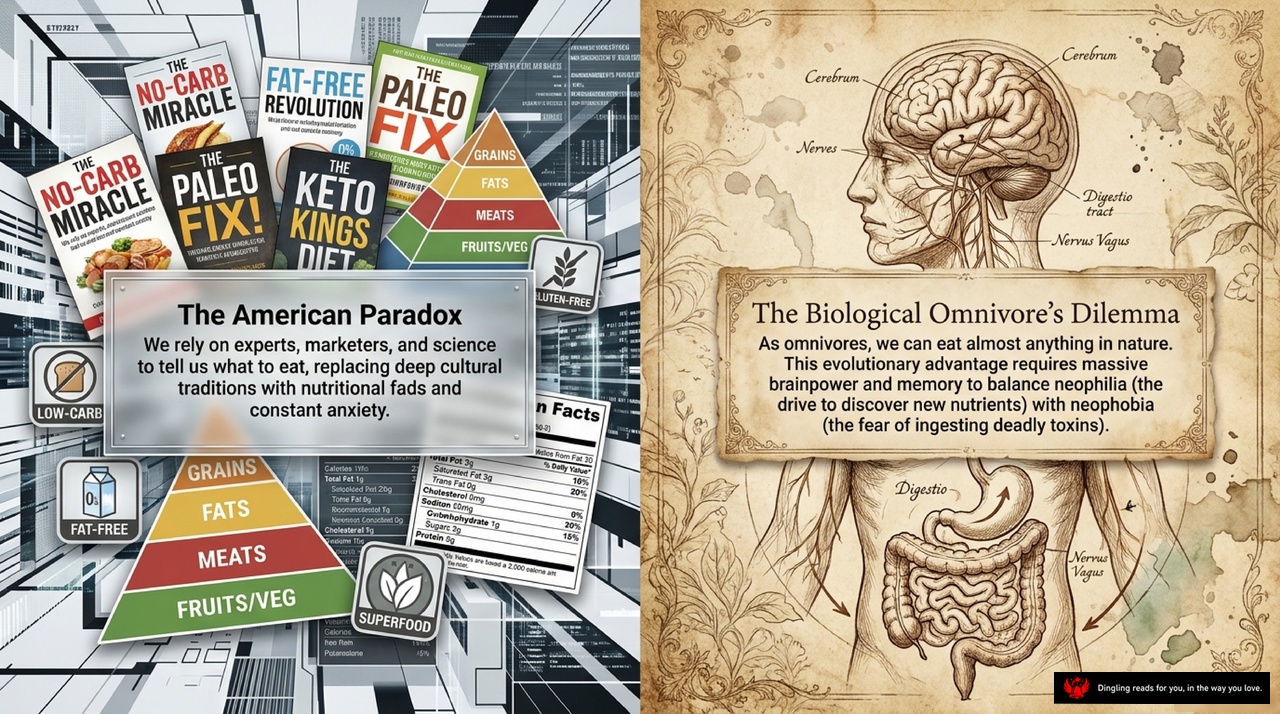
Look at this split screen. On the left, we see the chaotic reality of the American supermarket: a pyramid of conflicting diet advice, endless books promising miracles, and a landscape where corn is the invisible king. On the right, an ancient anatomical drawing reveals the biological truth behind our confusion.
This image captures the core tension of the modern American diet. The left side illustrates the "American Paradox"—we rely on experts and marketers to tell us what to eat, replacing deep cultural traditions with constant nutritional anxiety. We are drowning in conflicting signals like "low-carb," "fat-free," and "superfoods," all built on a foundation of cheap, industrial corn.
But the right side explains why we are so confused. It highlights the "Biological Omnivore's Dilemma." As omnivores, we have an evolutionary advantage: we can eat almost anything. This flexibility requires massive brainpower to balance two opposing instincts. We need neophilia, the drive to discover new nutrients, but we also need neophobia, the deep-seated fear of ingesting deadly toxins.
Our brains are wired to be cautious. In the wild, a bitter taste or an unfamiliar mushroom could mean death. That's why we have a natural aversion to things we don't understand. However, the industrial food system has hijacked this mechanism. It has stripped food of its natural cues—texture, smell, and seasonal variation—replacing them with safe, uniform, but often unhealthy processed ingredients.
Because we can't trust our own instincts anymore, we look outward for answers. We check labels, follow trends, and buy expensive "organic" or "clean" products, hoping to find safety in a system that has deliberately hidden the truth from us. The image on the right reminds us that this anxiety isn't a personal failure; it's an evolutionary mismatch. Our ancient brains are trying to navigate a modern world where nothing is truly wild, yet everything is full of hidden risks. We are stuck in a dilemma where our natural survival instincts are useless, and we have no one else to trust.

Look at this diagram. It's not just a picture of corn; it's a blueprint of how the modern American diet was engineered.
First, notice the top section labeled "C4 Photosynthesis." This explains corn's superpower. Unlike most plants, corn uses a highly efficient 4-carbon atomic structure. This allows it to capture sunlight and carbon dioxide faster than almost any other plant while hoarding water. It's nature's ultimate efficiency hack, making it the perfect candidate for mass production.
Move your eyes to the middle, pointing to "The F1 Hybrid." This is where biology meets intellectual property. Biologists engineered seeds that guarantee high yields for just one generation but become useless the next. This turns a living organism into a self-enforcing biological patent. It's a clever, yet controversial, way to control the food supply.
Finally, look at the roots, which are depicted as gears labeled "The Carbon-13 Tracker." This reveals a shocking truth about our own bodies. Human cellular tissue retains the isotopic signature of what we eat. Scientific analysis proves that modern Americans are largely constructed from corn carbon. We are, quite literally, walking processed corn. From the efficient plant to the engineered seed, and finally into our own DNA, corn has completely rewritten our biological story.
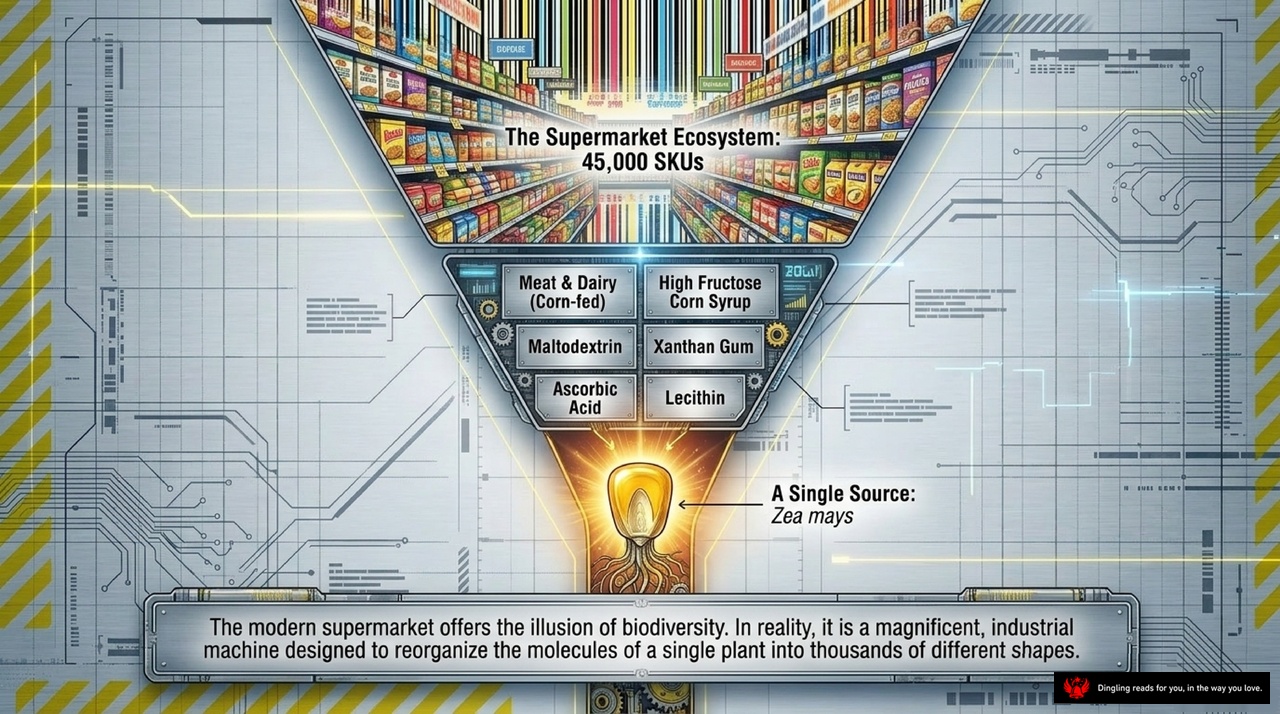
The modern supermarket offers the illusion of biodiversity. In reality, it is a magnificent, industrial machine designed to reorganize the molecules of a single plant into thousands of different shapes.
Look at this diagram. At the top, we see "The Supermarket Ecosystem" boasting a staggering 45,000 SKUs. It looks like a vibrant, diverse world filled with endless choices. But follow the funnel down. Behind the labels for Meat & Dairy, High Fructose Corn Syrup, Maltodextrin, Xanthan Gum, Ascorbic Acid, and Lecithin, there is only one source: Zea mays. Corn.
Every single one of these ingredients—whether it's the corn-fed beef on your steak, the thickener in your salad dressing, or the sweetener in your soda—traces back to that one golden ear. The modern grocery store isn't a celebration of nature's variety; it's a sophisticated factory that takes one plant and endlessly rearranges its DNA to create thousands of new products. We aren't eating a diverse diet; we are simply eating corn in a thousand different disguises.

In this chapter, we explore the ethical tightrope that defines our relationship with meat. It starts with the "Omnivore's Dilemma"—a psychological tug-of-war where our biology craves calories while our instincts fear toxins. For humans, this isn't just about taste; it's a constant calculation of risk versus reward. We've solved this ancient problem through culture and cooking, creating rules that tell us what is safe and what is taboo.
But today, that balance has shattered. We've traded our ancestral wisdom for expert opinions and marketing. Now, we face a new crisis: the moral cost of eating. As we look at the industrial system, we see a profound contradiction. We claim to value intelligence and consciousness, yet we routinely sacrifice animals that possess them. Think about it: we celebrate dogs and grant rights to infants, yet we slaughter pigs and cows who share similar cognitive abilities. This is what philosopher Peter Singer calls "speciesism." The question isn't whether they can speak, but whether they can suffer.
The reality of factory farming makes this impossible to ignore. In concentrated animal feeding operations, animals aren't living; they are biological machines. Chickens are crammed into cages so small they can't spread their wings, living in a state of constant pain and fear. Their natural behaviors are suppressed, their social bonds broken, and their lives reduced to a single purpose: production. This isn't just cruelty; it's a systematic denial of their right to exist as individuals.
However, there is another path. Look at farms like Polivus, where animals live according to their nature. Here, pigs root in compost, chickens forage for insects, and cows graze on pasture. In these ecosystems, animals experience joy, autonomy, and a life that feels like "being" rather than just "producing." The moral argument becomes clear: a good farm doesn't try to eliminate death, but it does ensure that the animal lives a life worth living.
Ultimately, this isn't just about philosophy; it's about our identity. Our history as a species is written in our teeth and our digestive systems, shaped by the hunt and the fire. But acknowledging that doesn't mean we must continue the cycle of exploitation. We have the power to choose a different future—one where we respect the intelligence of other species and honor the life we take.
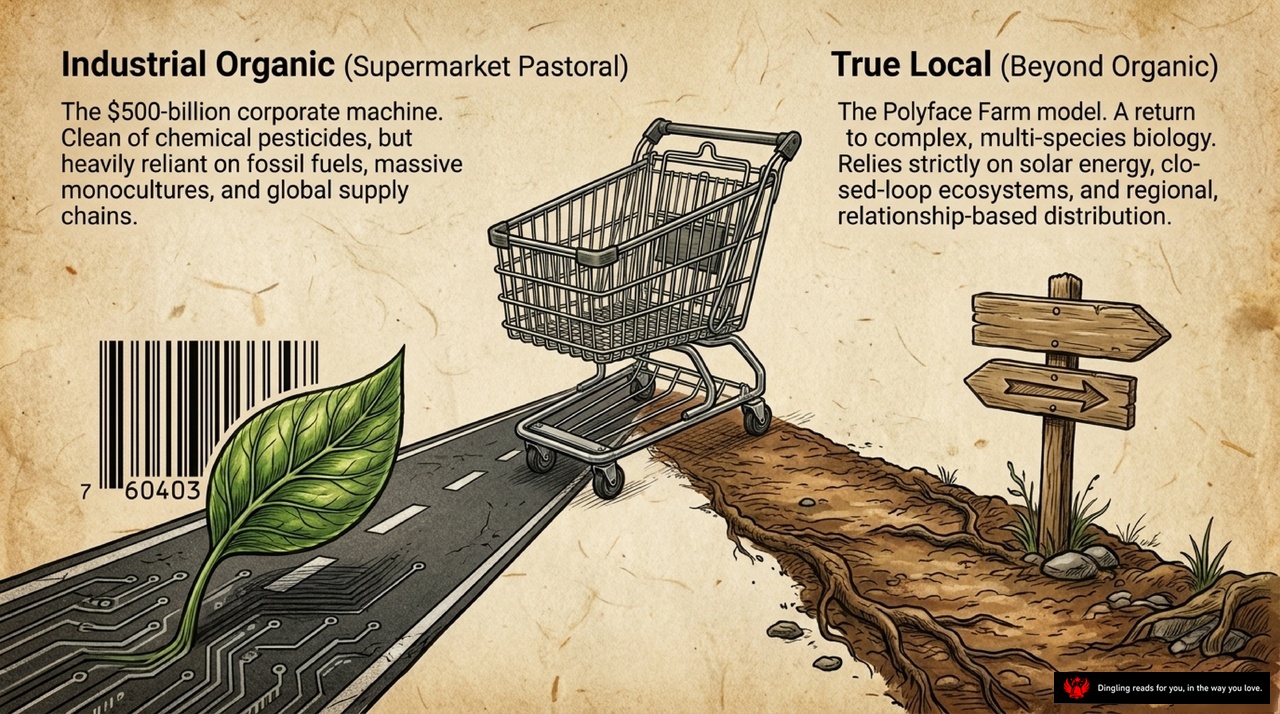
Look at this split path in front of us. On the left, we see "Industrial Organic"—that sleek supermarket aisle where a leaf sprouts directly from a circuit board. It's a $500-billion corporate machine that promises clean produce but relies on fossil fuels, massive monocultures, and fragile global supply chains. It's the "Supermarket Pastoral," a beautiful lie sold to us on a shelf.
But on the right, there's "True Local," or what the book calls the Polyface Farm model. This isn't just about being "organic"; it's about going beyond it. Here, we see a return to complex, multi-species biology. Instead of fighting nature, we work with it. This path relies strictly on solar energy, closed-loop ecosystems, and regional, relationship-based distribution.
The image captures the core conflict of our food system. The industrial path is linear and disconnected, while the true local path is a living, breathing web. It's a choice between a sterile product on a conveyor belt and a resilient community rooted in the land. The signpost isn't just pointing directions; it's asking a fundamental question: Do we want to feed ourselves with a corporate machine, or do we want to rebuild a relationship with the earth?
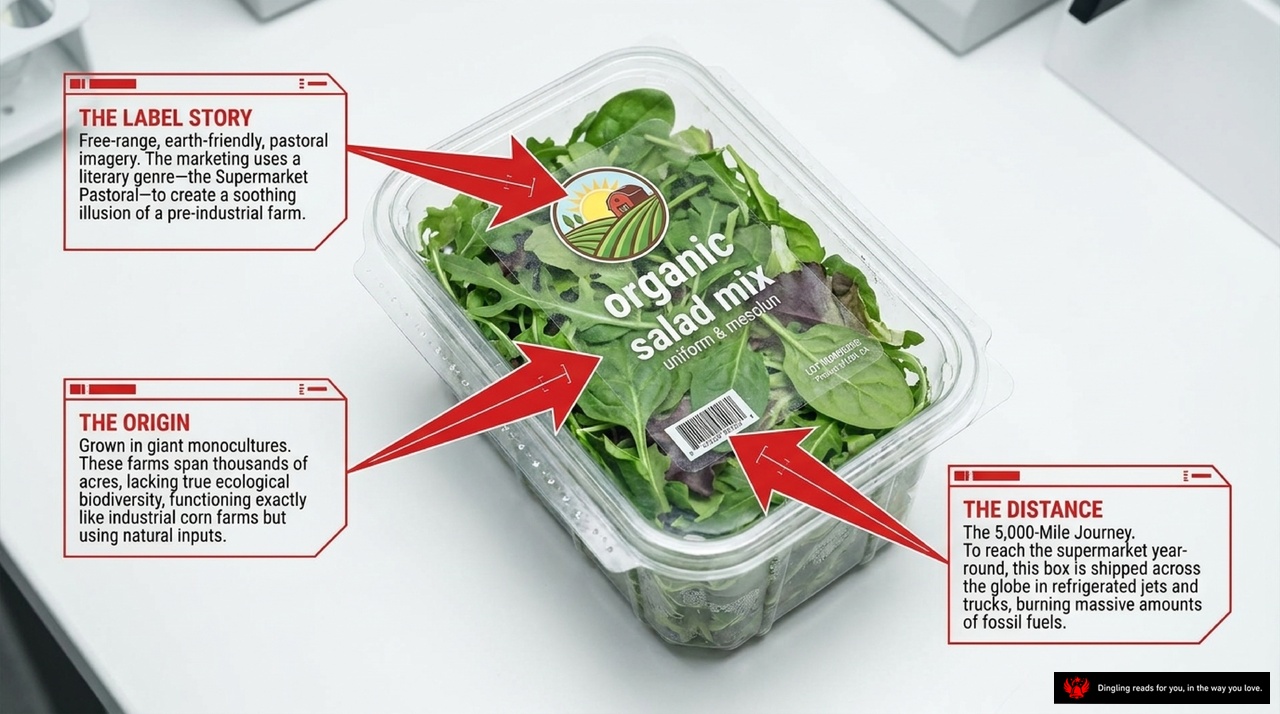
Look at this image. It reveals the hidden truth behind the "organic" label on a simple box of salad. While the packaging tells a soothing story of a peaceful, pastoral farm, the reality is a starkly different industrial machine.
The label creates an illusion of a pre-industrial paradise, but the origin is actually a massive monoculture farm, stripped of biodiversity and functioning just like a factory. Then, consider the distance. This box travels a staggering 5,000 miles in refrigerated jets and trucks, burning massive amounts of fossil fuels just to reach your supermarket.
This disconnect between the marketing fantasy and the industrial reality is exactly what Joel Salatin fights against at his Polyface Farm. He rejects this broken system in favor of a true ecological cycle where cows, chickens, and pigs work together, eliminating the need for long-distance shipping and synthetic inputs. His approach proves that food doesn't have to be a product of a global supply chain; it can be a local, living part of the ecosystem we all share.

Imagine a single meal that doesn't just feed your body, but reconnects you to the earth itself. This is the "Perfect Meal," a culinary experiment built on three distinct food chains, each telling a different story about where our food comes from and what it costs us.
First, we confront the industrial chain. Picture the vast, monoculture corn fields of Iowa, where nature has been stripped away to feed factory farms and processed foods. This path represents efficiency at the expense of everything else: heavy reliance on fossil fuels, rampant antibiotic use, and a complete severing of the link between the consumer and the source. It is a system that produces cheap calories but leaves us disconnected from the land.
Then, we look to the regenerative model, exemplified by Joel Salatin's Polyface Farm. Here, the food web is a living, breathing circle. Cows graze on grass, their manure feeds the chickens, and the chickens fertilize the land, creating a self-sustaining ecosystem. No waste, no chemicals, just a harmonious dance where every animal plays its part, producing food that is as nutritious as it is ethical.
Finally, we return to the primal roots with the hunter-gatherer chain. This involves the sweat and risk of the hunt, like tracking a wild boar in the Sonoma hills, and the patience of foraging for wild mushrooms like morels in the aftermath of a forest fire. It's a raw, honest engagement with nature, where you face the reality of death and life, tasting the unique, unreplicable flavors of the wild that no factory can ever replicate.
This meal isn't just about eating; it's a choice. Every bite is a vote for the kind of world we want to live in. Whether we choose the industrial convenience, the regenerative balance, or the primal connection, we are all deciding the future of our food system. The question isn't just what's on your plate, but what kind of relationship you're building with the earth beneath it.

Look at this side-by-side comparison. On the left, we see "Industrial Efficiency," and on the right, "Ecological Efficiency." This isn't just about farming; it's about two completely different philosophies of how we feed ourselves.
The industrial model on the left is all about simplification. It strips the landscape down to a single species—like corn—and homogenizes everything. You inject fossil fuels to force maximum yield, resulting in a brittle ecosystem that produces high caloric volume but creates massive waste and pollution. It's a system designed for volume, not life.
Now, look at the ecological model on the right. It embraces complexity. Instead of fighting nature, it stacks systems together—cows, pigs, chickens, and timber sharing the exact same 100 acres. This creates symbiotic health across multiple species. The result? You get 40,000 pounds of beef, 30,000 pounds of pork, 10,000 broilers, and 30,000 dozen eggs, all produced with zero waste. In fact, this method builds richer topsoil every single year.
The choice is stark: do we want a factory that churns out calories while destroying the land, or a living ecosystem that regenerates itself while feeding us? The data on this slide tells us that the complex, messy path of nature is actually far more efficient than our simplified industrial approach.
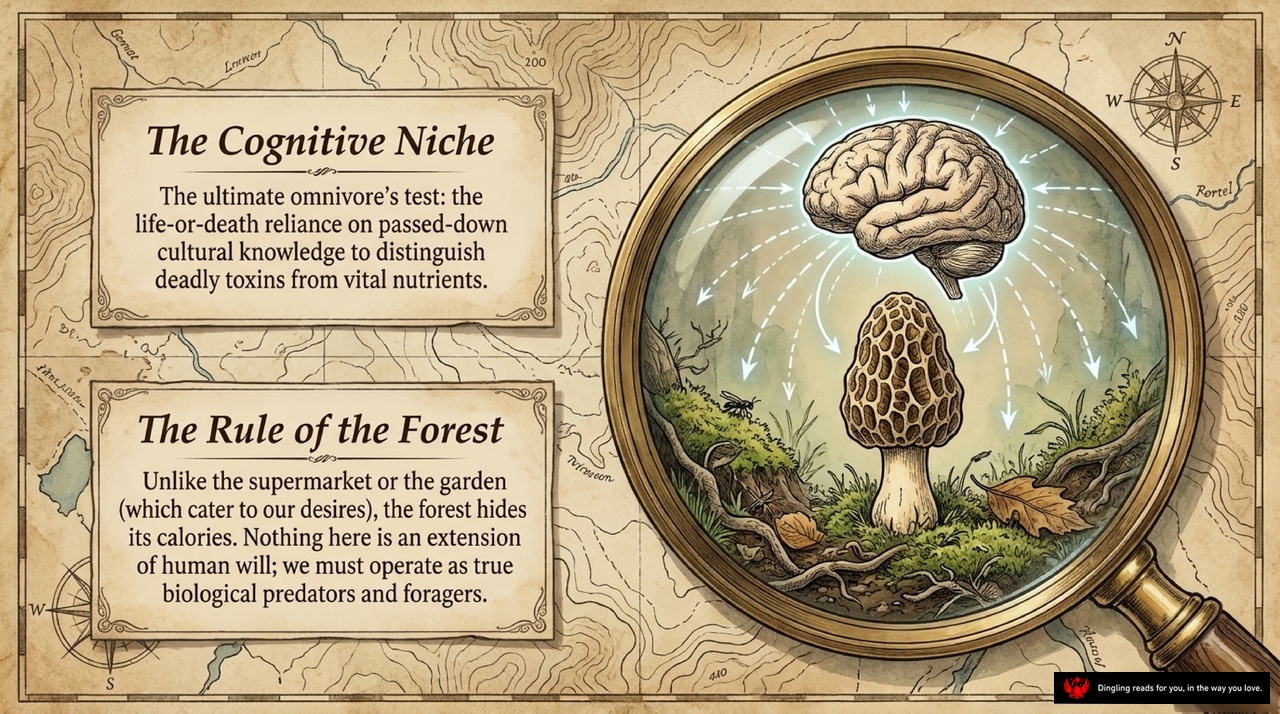
Imagine you are holding a magnifying glass over a forest floor, peering closely at a single morel mushroom. Above it, a human brain floats, connected by invisible arrows, symbolizing a life-or-death connection. This isn't just about spotting a fungus; it is the ultimate test of our species as omnivores. We call this "The Cognitive Niche." Unlike a supermarket where food is neatly labeled and catered to our desires, the wild forest hides its dangers. Every calorie is a gamble. We cannot rely on instinct alone to distinguish deadly toxins from vital nutrients. Instead, we depend entirely on passed-down cultural knowledge—the accumulated wisdom of generations that teaches us which mushrooms are safe and which will kill us.
This reliance on learned tradition defines our survival in the wild. It is the "Rule of the Forest." Here, nothing is an extension of human will; we are not the ones planting or designing the food. We must operate as true biological predators and foragers, constantly decoding the environment. The forest does not give us a menu; it demands we be smart enough to read it. While modern life has insulated us from this high-stakes reality, this ancient cognitive niche remains the fundamental reason we can eat what we eat. It is the bridge between the chaotic, dangerous wild and the safe, structured meal on our plate.
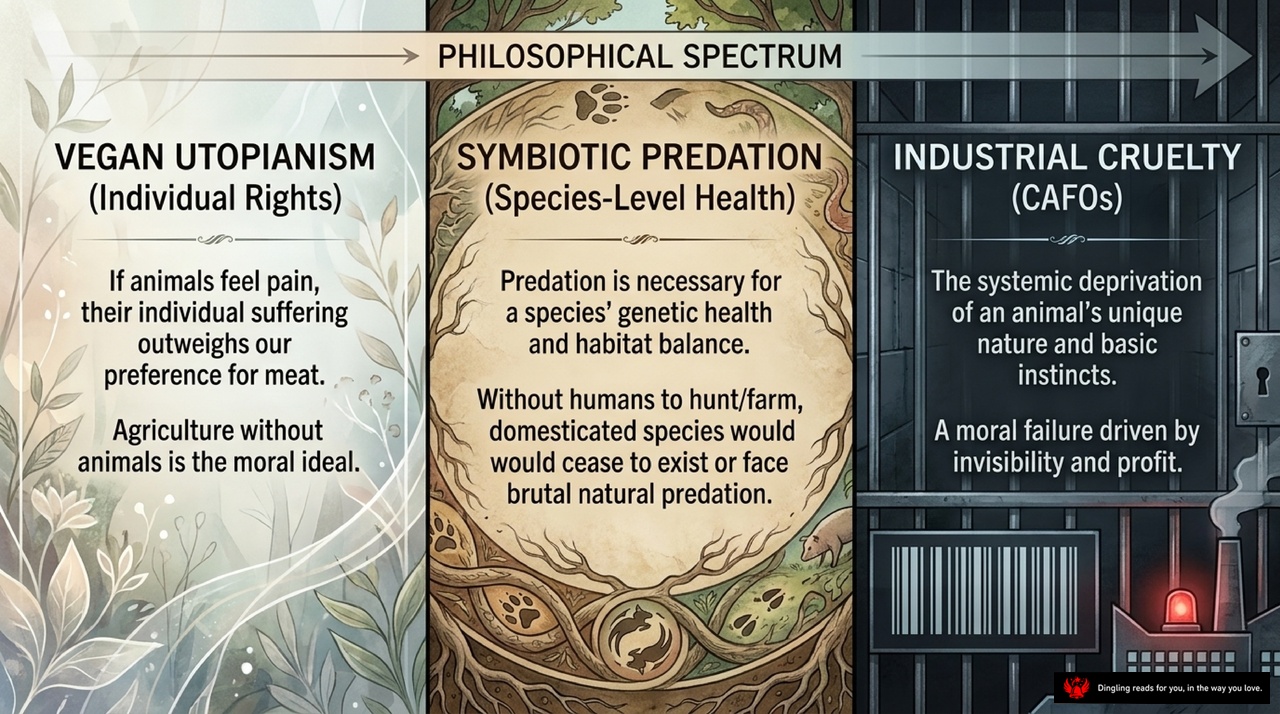
Look at this spectrum of choices we face. On the far left, we see Vegan Utopianism, a philosophy rooted in individual rights. It argues that if animals feel pain, their suffering outweighs our preference for meat, making an animal-free agriculture the moral ideal.
But move to the center, and we find Symbiotic Predation. This view shifts the focus to species-level health. It posits that predation isn't just necessary for genetic diversity and habitat balance, but that without human intervention, domesticated species would either vanish or face brutal natural predation.
Finally, on the far right, lies Industrial Cruelty, specifically the CAFO model. Here, we see the systemic deprivation of an animal's unique nature and basic instincts. It's described not as a natural act, but as a moral failure driven by invisibility and profit.
The image perfectly captures the tension between these three worlds: the ideal of individual rights, the biological necessity of ecological balance, and the harsh reality of industrial efficiency where animals are stripped of their identity to become mere units of production.
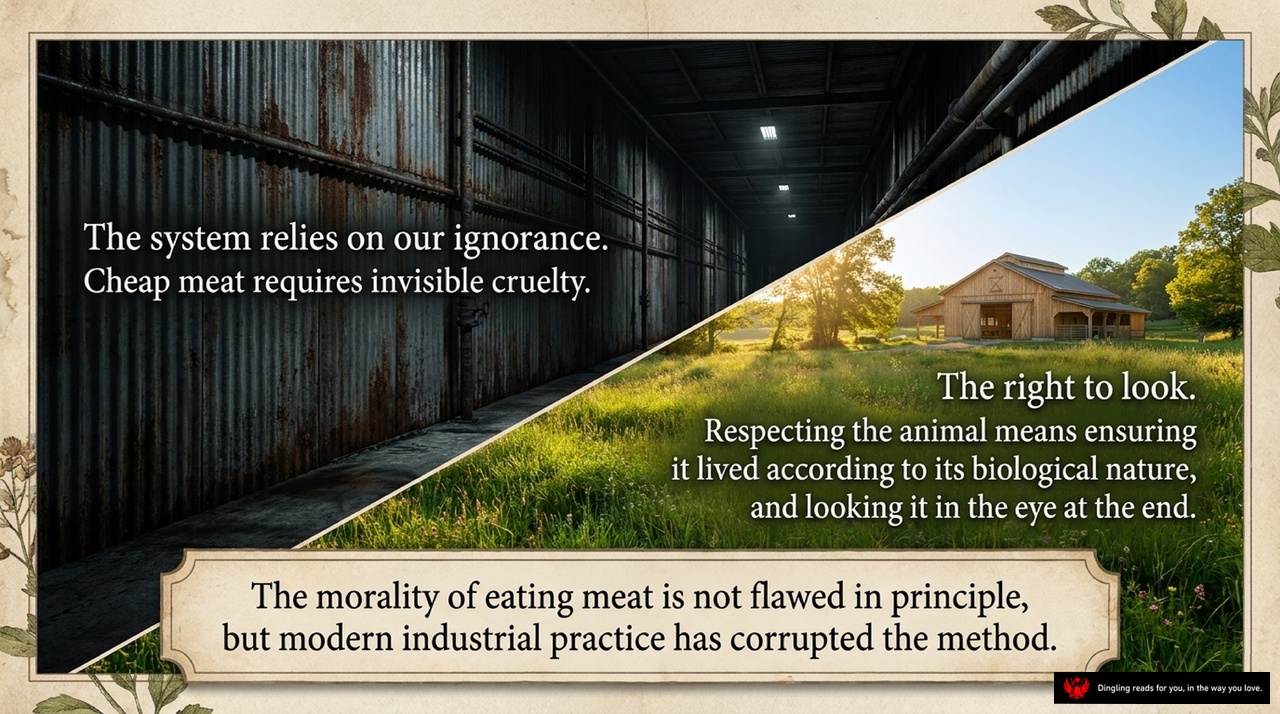
Look at this split image. On the left, we see the dark, rusted interior of an industrial feedlot—a place where the system relies entirely on our ignorance. The text reminds us that cheap meat requires invisible cruelty. This isn't just about hunger; it's about a broken cycle where nature is stripped away to feed the machine.
But look at the right side. That sunlit barn in the green pasture represents a different possibility. The slide argues that respecting an animal means ensuring it lives according to its biological nature. It's about the "right to look"—to see the animal in its true form and, if necessary, to look it in the eye at the end. Modern industrial farming has corrupted the method of eating meat, turning living creatures into mere production units.
The core message here is stark: the morality of eating meat isn't flawed in principle, but the way we do it today has gone terribly wrong. We've created a system where efficiency overrides ethics, hiding the suffering behind a wall of silence. True respect for life demands we change how we produce our food, moving from invisible cruelty to a relationship where animals are treated as individuals, not just ingredients.
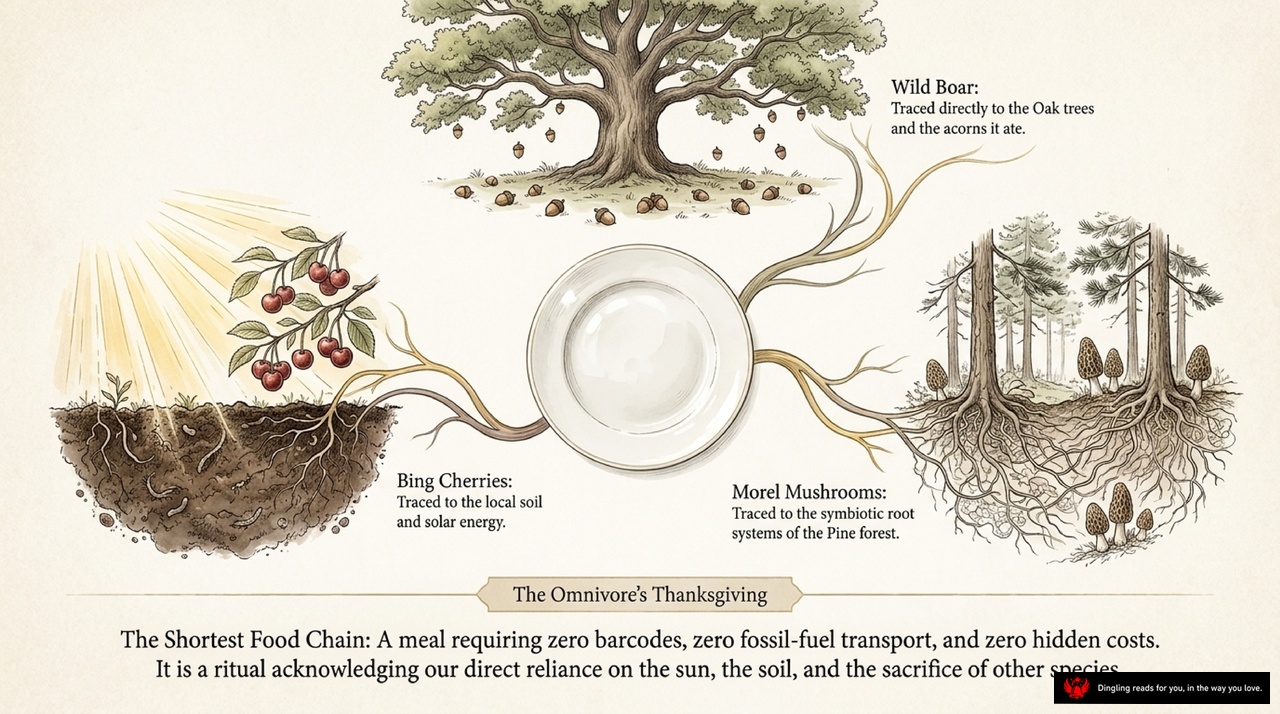
Imagine a plate that holds more than just food—it holds the entire history of our diet. Look at this diagram. On the left, we have Bing Cherries, tracing their energy directly back to the sun and the local soil. On the right, Morel Mushrooms, connected to the ancient, symbiotic root systems of the pine forest. Above, a Wild Boar, its story leading straight to the oak trees and the acorns it ate. This is what I call "The Omnivore's Thanksgiving." It represents the shortest possible food chain: a meal requiring zero barcodes, zero fossil-fuel transport, and zero hidden costs.
This image is a powerful antidote to the industrial reality we live in today. In our modern world, that central plate is usually filled with something far more complex and disconnected. Think about a typical burger. The beef inside wasn't raised on grass; it was fed corn from the Midwest. The lettuce wasn't picked yesterday; it was shipped across the country. Every ingredient has been stripped of its history, its origin, and its connection to the living world. We eat, but we rarely see the web of life that made our meal possible.
By tracing our food back to these simple sources—the sun, the soil, the specific trees and animals that fed us—we reclaim a sense of agency. We stop being passive consumers of anonymous products and become participants in an ecosystem. When we choose the boar, the cherry, or the mushroom, we are choosing a relationship with nature. We are acknowledging our direct reliance on the earth and the sacrifice of other species. This isn't just about nutrition; it's about restoring a broken connection. It is a ritual that reminds us that to eat well, we must first understand where our food comes from and who—or what—it belongs to.
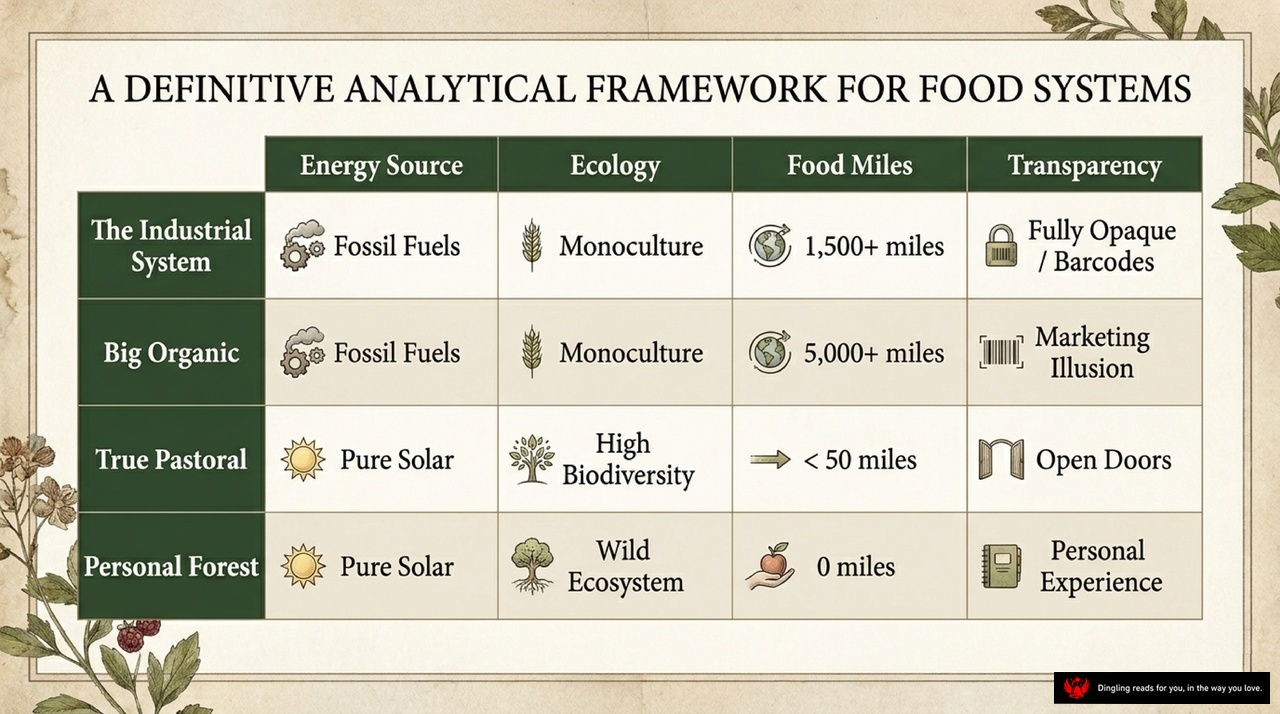
Let's talk about where your food actually comes from. The image you see on screen isn't just a chart; it's a map of four completely different worlds, showing how we get our food.
First, look at **The Industrial System**. This is the current reality for most of us. It runs on **Fossil Fuels** and relies on **Monoculture**. Your food travels over **1,500+ miles**, and the process is **Fully Opaque**, hidden behind barcodes.
Then, there's **Big Organic**. It still depends on **Fossil Fuels** and **Monoculture**, but the food travels even further—over **5,000+ miles**. The transparency here is an illusion, relying on **Marketing** rather than truth.
Now, shift your focus to **True Pastoral**. This model runs on **Pure Solar** energy and supports **High Biodiversity**. Food travels less than **50 miles**, and the system offers **Open Doors**, meaning you can see exactly where your food is grown.
Finally, we have the **Personal Forest**. This is the ultimate in sustainability. It uses **Pure Solar** energy and nurtures a **Wild Ecosystem**. There are **0 miles** of travel involved, and the transparency is based on **Personal Experience**.
The contrast is stark. We are choosing between a system that drains the planet and one that works with nature. The choice isn't just about taste; it's about which world you want to live in.
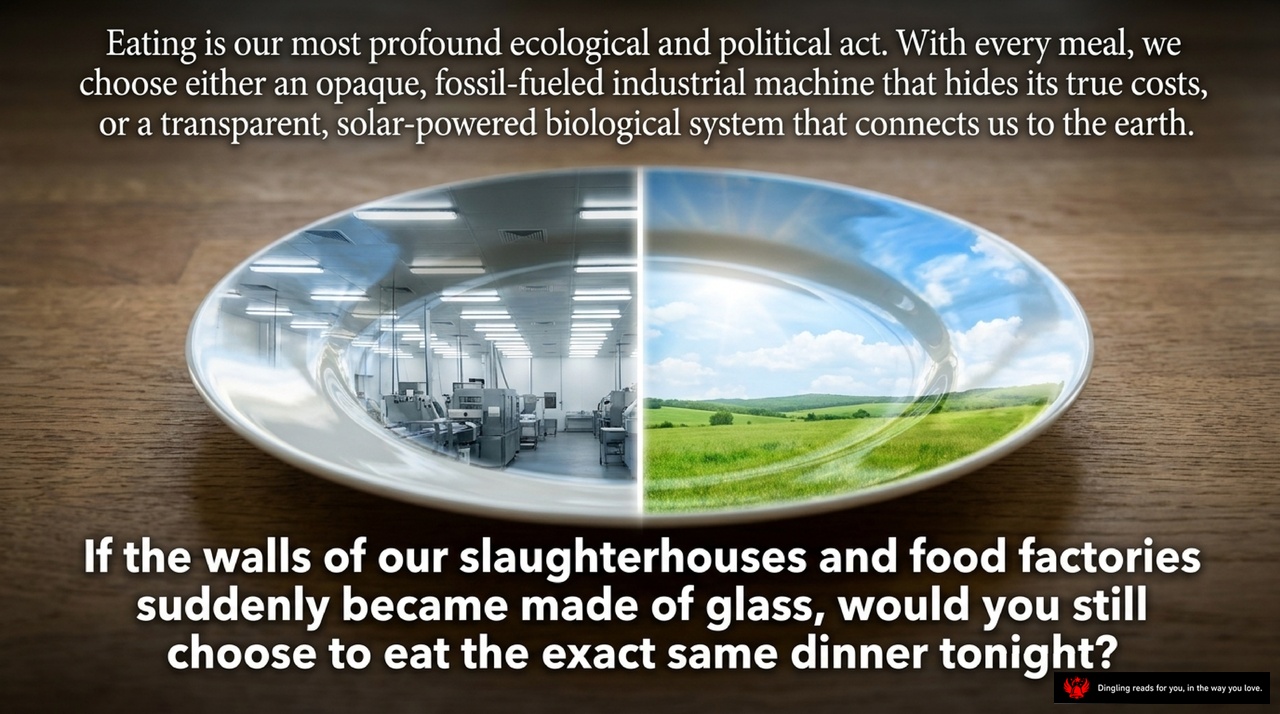
Look at this plate. It's split right down the middle, showing two very different worlds we choose every time we sit down to eat. On one side, we have the opaque, fossil-fueled industrial machine—a sterile factory that hides its true costs from us. On the other, there's the transparent, solar-powered biological system that connects us directly to the earth.
The book asks us a hard question: If the walls of our slaughterhouses and food factories suddenly became made of glass, would you still choose to eat the exact same dinner tonight?
Right now, most of us are eating the industrial version. We're consuming meat from animals that were fed corn in massive feedlots, often pumped full of antibiotics to survive the crowded conditions. We're drinking sugary sodas sweetened with high-fructose corn syrup, a byproduct of that same industrial corn. We are unknowingly eating a diet that is disconnected from nature, relying on a system that pollutes our water, degrades our soil, and threatens our health.
But imagine if that glass wall revealed the reality behind your steak or your soda. Imagine seeing the suffering of the animals, the chemical runoff in the river, and the artificiality of the food. Would you still be willing to participate in that cycle? Or would you reach for the other side of the plate? The choice is ultimately ours, but it requires us to first see what we are really putting on our dinner table.