
The ONE Thing: Complete Chapter-by-Chapter Summary

Welcome to "The ONE Thing," a guide to unlocking extraordinary results through surprisingly simple truths. Today, we're diving into the core philosophy that separates the truly successful from the rest.
At the heart of this book lies a powerful idea: life's secret is doing just one thing. This concept isn't new; it was famously highlighted by a cowboy character in a 1991 film, who stated that everything else is insignificant compared to focusing on a single task. Gary Keller, the co-author, learned this lesson the hard way when his own company faced a crisis. His mentor advised him to stop trying to do everything and instead find just 14 key people to lead the way. By focusing entirely on this one goal, Gary transformed a regional company into a national powerhouse with massive growth.
But the lesson goes deeper. Even after success, Gary realized that without a clear "one thing" to prioritize, teams would still get lost. He eventually asked his team a crucial question: "What is the one most important thing to do this week?" The results were immediate and dramatic.
This book is built on the premise that everyone has the same 24 hours, yet some achieve far more than others. The difference isn't time; it's focus. Success comes from aligning every action with a clear target and eliminating everything that doesn't serve it. As the subtitle suggests, this is the simple truth behind extraordinary results. Whether you are building a business, raising a family, or pursuing a personal dream, the path to excellence starts with narrowing your focus to the single most impactful action you can take today.

Imagine a line of dominoes, starting with a tiny yellow block just two inches tall. At first glance, it seems insignificant. But watch what happens when it falls. It knocks over the next one, which is 50% larger. Then that one hits an even bigger one. This isn't just a straight line; it's a geometric explosion of power. By the time you reach the end of this chain, that single two-inch push has toppled a block as tall as Mount Everest, then the Eiffel Tower, and finally, the Moon itself.
This is the geometric power of the domino effect, and it holds the secret to extraordinary success. Most of us fall into the "linear trap," trying to tackle tasks side-by-side, hoping that working harder on everything at once will yield better results. But that's a myth. When you try to do everything simultaneously, you achieve only average, linear growth. Real success is sequential, not simultaneous. It starts with a single, crucial decision.
Think of your tasks as these dominoes. You don't need to push them all at once. You just need to find your "lead domino"—the one thing that, if done, makes everything else simpler or even unnecessary. This is the geometric truth: when you line up your tasks by priority and strike the most crucial one first, the compounding energy becomes exponential.
So, how do you find that first domino? You start small. You start with the smallest possible action that aligns with your biggest goal. Maybe it's writing one chapter, making one call, or solving one specific problem. Don't underestimate the power of that first move. In the physics of success, a single domino can bring down another that is vastly larger. If you focus relentlessly on that one thing, the momentum will carry you past the Eiffel Tower and toward your own version of the moon. The key is to stop looking at the massive mountain in front of you and instead, just push that first, tiny block. Start small, find the lead domino, and let the rest fall into place.

We often hear that the secret to success is having an iron willpower or achieving a perfect balance between work and life. But the truth is, those are just lies we've been told. Let's look at the reality behind these cultural myths.
First, consider the lie that "everything matters equally." The uncomfortable truth is that equality is a myth. You must unfairly prioritize the vital few over the trivial many. Next, we're told multitasking gets more done, but in reality, it's just a task-switching illusion that kills your focus. Another common lie is that you need a disciplined life. The truth? You only need enough discipline to build a single habit.
Willpower is often seen as an endless resource, but it's actually a finite, depleting daily battery. Trying to balance everything equally is a trap; instead, seek counter-balancing where you focus on extremes in one area to maintain stability elsewhere. Finally, many fear big goals, thinking they are intimidating. The truth is, thinking big opens your mind to exponential models.
So, stop chasing balance and endless multitasking. Instead, recognize that your willpower is limited and your time is finite. Your path to success isn't about doing everything well; it's about ruthlessly focusing on the one thing that truly moves the needle. When you stop trying to be perfect at everything, you finally free yourself to be exceptional at what matters most.

The Multitasking Illusion: The Cost of Context Switching
Here's the hard truth that most productivity gurus won't tell you: multitasking is a lie. It's not about doing more; it's just a juggling act of rapidly switching between tasks, and it's incredibly inefficient. Look at the diagram here. The top section shows "The Multitasking Illusion." You see Task A and Task B, but look at the messy zig-zag lines in between. Every time you switch, you hit a "Reorientation Time" block—those red diamonds. Your brain has to physically stop what it's doing and reload the context for the new task. This happens constantly, draining your mental battery before you've even started working.
Contrast that with the bottom section, "The Focus Channel." Here, you move from Task A to Task B with a solid, uninterrupted yellow beam. No reorientation time. No friction. This is how your brain is actually designed to work. When you try to handle two complex tasks at once, you're not actually doing both; you're just context-switching so fast that you lose everything.
The data backs this up. Research shows workers lose an average of 28% of their entire workday just to the cognitive friction of switching tasks. That's nearly a full workday disappearing into nothing. Plus, your brain's prefrontal cortex simply cannot process two complex attention channels simultaneously. Trying to do so creates a cognitive bottleneck. The result? You don't save time; you double your mistakes, skyrocket your stress levels, and completely destroy your ability to do deep work.
So, stop trying to juggle. The output reality is clear: juggling two tasks doesn't halve the time needed; it destroys your quality and your focus. To succeed, you need to choose one channel and run straight down it.

Willpower is not a superpower you're born with; it's a finite, depleting resource tied directly to your blood glucose and cognitive load. Think of it like a battery that drains throughout the day. In the morning, your battery is fully charged at 100%, giving you the mental strength to resist distractions, make tough decisions, and suppress negative emotions. But by mid-day, after hours of mental effort, that battery drops to 40%. By evening, when you're tired and hungry, it's down to a critical 5%.
This depletion explains why we often fail at the most important tasks when we're exhausted. When your willpower hits zero, you fall into "The Default Trap." You revert to your default settings: mindlessly scrolling on your phone, making poor food choices, or just doing reactive work instead of focusing on what truly matters. This is why the "Timing Strategy" is so powerful. You need to guard your resource by doing your ONE Thing early in the morning when your battery is fully charged. Don't waste your peak energy on trivial decisions that drain your fuel tank before you tackle your most important work. Once you've used up your willpower, every subsequent decision becomes harder, and eventually, you have nothing left. So, protect your energy, do the hard things first, and avoid the trap of running out of steam before the day is over.
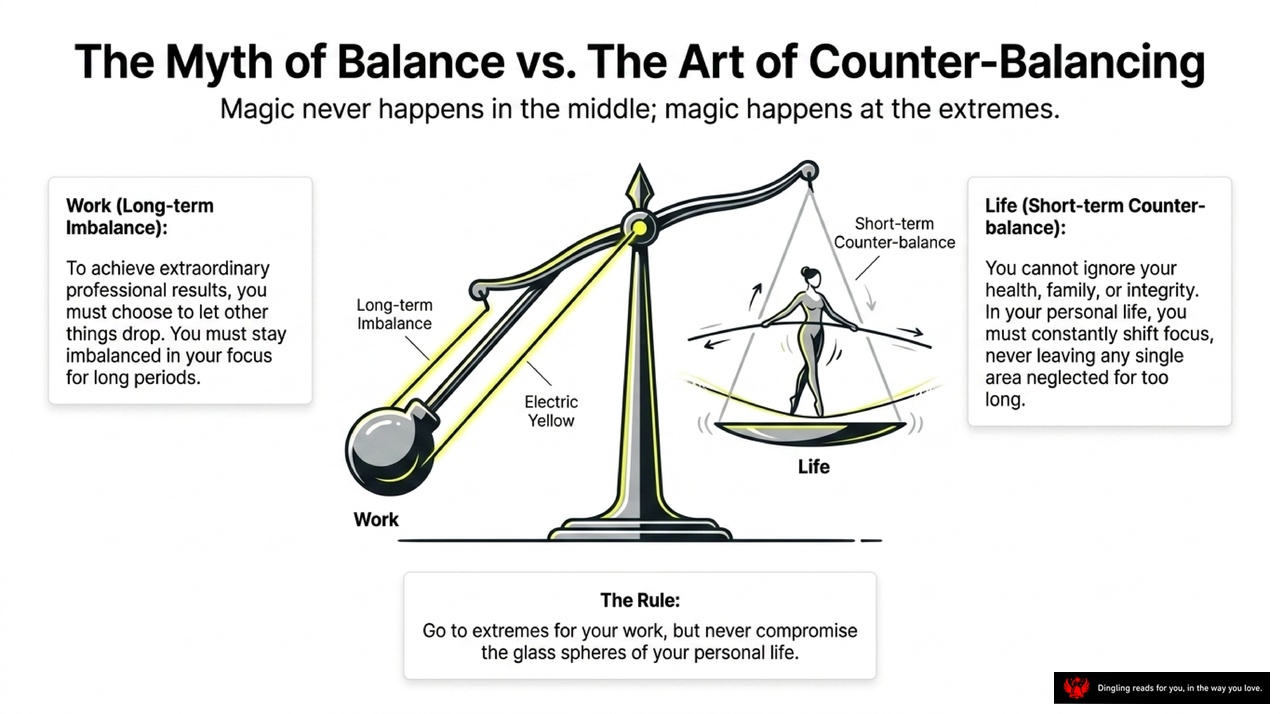
Today's slide challenges the very idea of "work-life balance." It argues that magic never happens in the middle; it happens at the extremes. To achieve extraordinary professional results, you must be willing to stay imbalanced for long periods. This means making the hard choice to let other things drop and focusing intensely on one thing.
But here is the crucial rule: while you can go to extremes for your work, you must never compromise the glass spheres of your personal life. Think of your career as an elastic ball—it can bounce back. But your health, family, integrity, and friendships are glass spheres. If you drop one, it shatters forever. You cannot ignore them.
So, how do we manage this? The answer is counter-balancing. You don't seek a static, perfect middle ground. Instead, you constantly shift your focus. When you lean heavily into work, you might neglect your personal life for a week or two. But the moment that happens, you must immediately swing back and pour your energy into your relationships and well-being. You never leave any single area neglected for too long.
This dynamic approach allows you to thrive in both worlds. You give your work the intense, unbalanced focus it needs to succeed, while using short-term adjustments to keep your life intact. It's not about finding a balance that doesn't exist; it's about mastering the art of counter-balancing so that when you push hard in one direction, you automatically pull back in the other. This is how you avoid the trap of burnout and actually build a sustainable, high-impact life.

Every great answer starts with a single, powerful question. Look at the core concept on this slide: "What's the ONE Thing I can do such that by doing it everything else will be easier or unnecessary?" This isn't just a philosophical musing; it's the ultimate paradigm for success. Think of it as both a map for the big picture and a compass for your very next move.
When you ask this question, you are instantly acting as an anchor. It forces you to ignore everything you *could* do in favor of what you *must* do. In a world full of distractions, this single query helps you cut through the noise and focus on the exact fulcrum where your effort yields exponential results. It's about identifying that one specific action that acts as a lever, pushing everything else into place. As the text suggests, if you can find that one thing, other tasks either become effortless or simply disappear because they are no longer necessary.
So, stop trying to do everything at once. Instead, ask yourself that critical question every morning. Find your lever, push the first domino, and watch how the rest of your life begins to fall into order effortlessly.

Look at this diagram. It's not just a chart; it's a visual manifesto for how we actually win in life. The title here is "The Extreme Pareto: Narrowing Your Focus."
Let's break down what this really means. We all know the standard 80/20 rule—that 20% of your efforts drive 80% of your results. But here, the slide asks us to go one step further. It says, "The 80/20 Rule is Just the Beginning." So, instead of stopping at that 20%, we apply the rule again. We take that vital 20% and ask, "What is the 20% of *this* that actually matters?" We keep drilling down, stripping away the trivial until we hit the "dead center."
The graphic shows this funneling process clearly. On the outer ring, we have 100 tasks. That's the noise, the survival list. Then it narrows to 20 tasks, then 4, and finally, right in that glowing yellow center, we are left with just **1 Task**.
The text on the left explains the logic perfectly: "A standard to-do list is a survival tool. A success list is deliberately built using extreme prioritization." Most of us treat our lists as things we *have* to do to survive the day. But the goal here is different. The goal is to reduce your overwhelming checklist down to a single, high-impact priority.
Think about it: if you try to do all 100 tasks, you end up doing none of them well. But if you ruthlessly filter down to that one task in the center, you unlock a different kind of energy. It's about realizing that success isn't about doing more; it's about doing the one thing that actually moves the needle.
So, when you look at your own to-do list today, ask yourself: Which of these 100 items, if I did it perfectly, would make the other 99 disappear or become unnecessary? That is your one task. That is where your focus needs to be right now.

Goal Setting to the Now isn't just about dreaming big; it's about connecting your ultimate destination to your immediate reality. Look at this flow: from "Right Now" all the way to your "Someday Goal." It's a chain reaction, just like the famous domino effect.
Think about it: if you want to build a massive empire in five years, what is the *one* thing you need to do today? The text reminds us that success isn't about doing everything at once; it's about focusing on the single most important task that makes everything else easier or unnecessary. It's about creating that first domino. When you push this one piece, the rest follows naturally.
Many people get stuck trying to balance everything, but the truth is, you can't do it all. You have to make choices. As the book suggests, you need to work backwards from your long-term vision to find your priority for today. Whether it's building a business, improving your health, or nurturing a relationship, there is always one thing that matters most right now. Don't let fear of failure or the chaos of a busy schedule distract you. Instead, anchor yourself in your goal. Identify that one critical action, commit to it fully, and watch how your life starts to unfold exactly where you want it to. Your future is built by the one thing you choose to do today.

Think of your success as an iceberg. What everyone sees—the visible peak of productivity and profit—accounts for only about one-ninth of the total value. The real magic happens beneath the surface. This is the invisible foundation that supports everything you achieve.
At the very bottom lies your Purpose. It's the guiding compass, the deeply held "why" that gives you the conviction to endure the long journey. Without this foundation, you might have a plan, but you'll lack the drive to stick with it.
Building on that is your Priority. Think of this as the bridge connecting your purpose to your results. It answers the critical question: "What matters most right now?" When your purpose dictates your priority, you stop getting lost in the noise and focus on what truly moves the needle.
Finally, at the top, you have Productivity and Profit. But here's the secret: you can't truly be productive unless your purpose is clear and your priorities are set. Highly successful people don't just work harder; they allow their purpose to dictate their priority, which ultimately drives their performance and bottom line.
Visible success is entirely supported by this invisible architecture. If you want extraordinary results, stop chasing the peak and start building the foundation.

The Blueprint: Time Blocking. Here's the hard truth: time management is a myth, but time blocking is the elite's weapon.
Look at this schedule. The top four hours, from 8 AM to 12 PM, are locked off. This is "The Maker Schedule"—four solid hours dedicated to your ONE Thing. The most productive people don't wait for inspiration; they block out this time early in the day and defend it relentlessly. Think of it as building a bunker. Turn off notifications, put up a "do not disturb" sign, and tell the world you are unavailable. You cannot sustain peak focus without this intentional recovery.
But what happens after 12 PM? Notice the shift. The rest of the day is filled with the "Manager Schedule"—meetings, emails, and trivial distractions. If you don't protect your morning block, the manager takes over, and your day dissolves into chaos.
It's not just about work. Always block your vacations and rest time first. You can't expect peak performance if you're constantly running on empty. And don't forget to block planning time—dedicate one hour a week to review your goals and align your next blocks.
Stop trying to manage time. Instead, design your day around the one thing that moves the needle. Lock in your four hours. Protect them fiercely. That's how you stop chasing time and start making it.

The slide breaks down the "66-Day Habit Cycle," a concept that completely changes how we think about building new routines. It starts by debunking the myth of constant restraint. We often think success is a marathon requiring endless willpower, but the research shows it's actually a short sprint of discipline until a behavior becomes automatic.
The core insight here is the "66-Day Sweet Spot." As the graph illustrates, the discipline or effort required starts high on Day 1 but drops significantly over time. Research proves that, on average, it takes about 66 days to install a new habit. Once you cross that threshold and reach Day 66, you hit a turning point. This is what we call the "Halo Effect." Once your ONE Thing becomes an automatic habit, maintaining it requires near-zero discipline. This frees up your cognitive load, allowing you to tackle your next challenge without burning out.
The key takeaway is simple: you don't need infinite discipline. You just need enough discipline to forge that initial habit. The strategy is to build sequentially, one habit at a time. By focusing on just one thing until it becomes automatic, you create a foundation that makes everything else easier.

Look at this graph. It tells a powerful story about why most people hit a ceiling while the truly great ones keep climbing. We call this "The Mastery Commitment," and it's all about shifting from an "E" mindset to a "P" mindset.
The gray line represents the "Entrepreneurial" or "E" approach. These are the people who rely on natural energy and raw talent. They start strong, but eventually, they hit what we call "The Ceiling of Achievement." Once they hit this plateau, they stay there. They try harder, work longer, or hire coaches, but nothing changes because they are stuck in the same old system.
Now, look at the yellow line. This is the "Purposeful" or "P" breakthrough. When a "P" person hits that same ceiling, they don't just push harder. Instead, they change the game entirely. They seek out entirely new models, build completely different systems, and bring in external mentors. This is the key difference: different results require fundamentally different processes.
The slide emphasizes that doing your best is not enough; you must commit to doing it the best way possible. If you want to break through the "OK Plateau," you have to stop relying on your current abilities and start investing in new ways of working. That is how you turn a flat line into an upward trajectory.

Today's slide breaks down the ultimate defense against distraction: The Accountability Loop.
On the left, you see "The Victim Cycle." This is the trap most of us fall into. When things go wrong, we Ignore the reality, Deny the problem, Blame the environment, and then Wait & Hope for circumstances to magically change. It's a reactive mindset where you surrender your time block to chaos.
But on the right, we have the solution: "The Accountability Cycle." This is where true success lives. Instead of waiting, you Acknowledge Reality. You Own It completely. Then, you actively Find Solutions and Get on With It. The text reminds us that success is an inside job. You must acknowledge the chaos, own your finite time, and engineer your own solutions—like learning to say "no" or securing your personal "bunker" to focus.
Finally, look at the bottom right corner. It says, "Get a Coach." This is the fastest way to hardwire this new mindset. You need a mentor or a peer who will demand your best. Without that external accountability, it's easy to slip back into the victim cycle.
So, remember the four thieves stealing your productivity: the inability to say no, fear of chaos, poor health habits, and toxic environments. Your only defense is total accountability. Stop hoping for change and start owning your reality.

Look at the compass, the target, and those falling dominoes. These aren't just icons; they are the blueprint for an extraordinary life. The message here is clear: Purpose sets your destination, but it is your priority that plots the exact next step.
True productivity isn't about doing everything; it's the disciplined act of walking the path, four hours at a time. You have a finite amount of energy facing an infinite world of distractions. Success isn't about multitasking; it's about doing the right thing.
So, I want you to think about this: If you are the first domino, what is the ONE thing you will push today? Don't wait for the perfect moment. Identify that single lever that, when pulled, makes everything else simpler or unnecessary. Push that one thing, and watch how the rest of your life begins to fall into place.