
The Only Story: Complete Chapter-by-Chapter Summary

Good evening. Today, we are diving into Julian Barnes' *The Only Story*.
Before we get lost in the details of the plot, let's start with the heart of the matter. Look at this broken glass bowl and the question posed right in the center: "Would you rather love the more, and suffer the more; or love the less, and suffer the less?"
This isn't just a philosophical riddle; it is the entire engine driving Paul's life. It's the moment he has to choose between the safety of a quiet, conventional existence and the terrifying, beautiful risk of loving deeply enough to be destroyed by it. Paul chooses the former, and that choice defines every painful chapter that follows.
But this story isn't just about that choice. It's about the cost of that choice. As we turn the pages, we see how love can become a prison. We see how a partner, once a source of light, can become a source of endless worry and fear. We watch as love slowly erodes into something unrecognizable, leaving behind only regret and a hollow silence.
This is a story about the fragility of connection. It asks us to look at our own relationships and ask ourselves: are we loving enough, or are we just surviving? Are we willing to suffer the more, or are we too afraid to take the risk?
Join me as we explore these questions through Paul's eyes, in a journey that will challenge everything you think you know about love, loss, and the one story we all live.

Look at this simple yet powerful diagram. It captures the fundamental dilemma of human connection: The Ultimatum. On one side, we have "Love More," which inevitably means "Suffer More." This path demands absolute emotional exposure. It means being vulnerable to time, trauma, and the inevitable decay of another human being. It's the risk of everything, for the sake of everything. On the other side lies "Love Less," promising "Suffer Less." This is a guarded, detached existence. It buys emotional safety, but at a steep cost: the loss of profound connection. We are constantly balancing between these two extremes. Do we choose the pain of being truly seen, or the safety of remaining invisible? The choice defines not just our relationships, but the very texture of our lives.
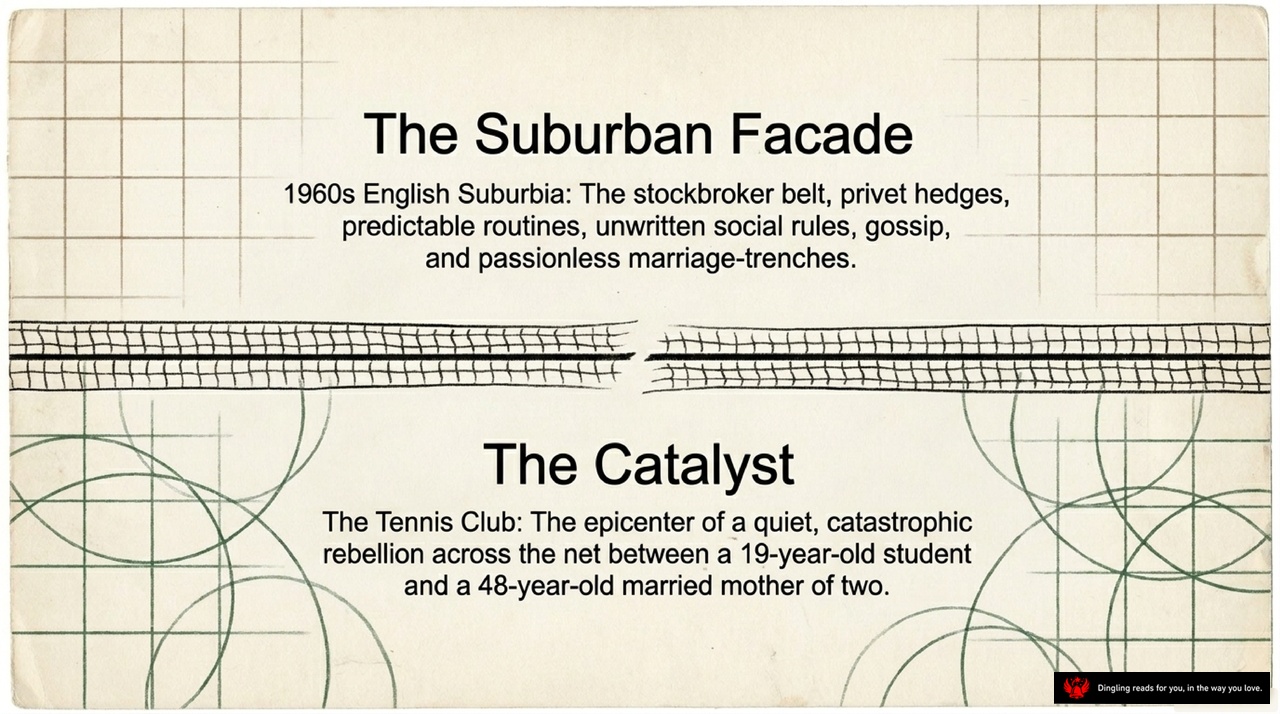
In the 1960s, English suburbia was a carefully curated illusion. Think of the stockbroker belt, the perfectly trimmed privet hedges, and the predictable routines that governed every day. It was a world built on unwritten social rules where gossip was the currency and marriage was a passionless trench we all dug for ourselves. This was the suburban facade, a perfect mask hiding the cracks underneath.
But behind that quiet, orderly exterior, a quiet, catastrophic rebellion was brewing. It started at the tennis club, the very epicenter of this tension. On one side of the net stood a 19-year-old student, full of restless energy and new ideas. On the other stood a 48-year-old married mother of two, trapped in a life that felt increasingly suffocating.
This wasn't just a game; it was a collision of worlds. A young man and an older woman, bound by a secret love that defied the rigid expectations of their age and class. Their relationship became the catalyst for everything that followed, a quiet uprising against the very structure of their society. While the outside world saw a scandal, they saw a lifeline. In a town obsessed with appearances, their love was the only thing that felt real, forcing them to question not just their marriage, but the entire facade they had been living behind.

Look at this slide: "The Triangle of Trauma." It maps out three distinct lives colliding in one household. On the left, we have Paul, nineteen, projecting an arrogant, carefree persona, yet hiding a desperate need for meaning and a naive savior complex. He sees love as an invincible force. In the middle is Susan, forty-eight, outwardly calm and reliable, but internally shattered by deep trauma and marital violence, viewing love as a fragile sanctuary. And on the right, Gordon, the respectable civil servant, whose hidden reality is a bitter, violent alcoholic who views love as ownership and weaponized shame.
This triangle explains the entire tragedy. Gordon's abuse creates Susan's hidden pain, which drives her to Paul, whose own hidden insecurities make him the unwilling, yet desperate, protector. It's a perfect storm where public respectability masks private destruction, and two broken people try to heal each other, unaware they are just trading wounds. This visual perfectly captures how their public personas were lies, while their hidden realities drove them into this inescapable, painful dynamic.

Love equals truth. This was the core belief of the nineteen-year-old absolutist, a dangerous conviction that if an emotion is genuine, reality itself must bend to accommodate it. It was the arrogance of youth, believing passion was a static, eternal state that would never decay or morph. But as the story unfolds, this illusion shatters under the weight of time and trauma. We see the savior illusion in action: the assumption that pure devotion is a sufficient cure for deep-seated psychological trauma and domestic abuse. Paul, convinced his love could fix Susan, ignored the signs of her deteriorating mental state. He saw her bruises and her drinking not as symptoms of a broken life, but as challenges his love could overcome. He lied to doctors, to friends, and even to himself, building a fortress of denial around her pain. He believed he was saving her, but in reality, he was merely delaying the inevitable. The story forces us to confront a hard truth: love alone cannot heal wounds that are too deep. Sometimes, the most loving thing you can do is to let someone face the consequences of their own choices, even if it means watching them fall.

Look at this diagram. It illustrates a "Looped Timeline," capturing the tragic arc of Susan's life and Paul's struggle to understand her. The journey begins with "The Departure," where Susan leaves behind an abusive husband, the gossip of the village, and the constraints of her life. This physical liberation is fueled by the very "Escape Fund" Paul helped her build—a safety net meant to ensure she could walk away if she ever needed to.
But the timeline quickly twists into "The Arrival," offering only the illusion of a fresh start and complete freedom in London. As Paul tries to build a new life, the path doesn't lead forward; instead, it spirals into "The Entanglement." Here, the past catches up. Susan's trauma travels with her, and the realization hits hard: you can escape a physical location, but you cannot outrun psychological damage.
The diagram shows how these forces collide. Susan's alcoholism, the violence she endured, and the lies she tells to protect herself create a tangled knot that Paul cannot untangle. He tries to save her, even lying to doctors and friends, but the loop tightens. Eventually, the timeline breaks down into dementia. Susan forgets the abuse, forgets the love, and forgets Paul, yet she still knows he is a part of her story. The "Entanglement" isn't just about her; it's about Paul's inability to let go. He stays in this loop, visiting her in the hospital, watching her fade, unable to escape the shadow of the woman he loved. The timeline loops because the past never truly ends; it just changes form, trapping them both in a cycle of grief and memory that refuses to close.
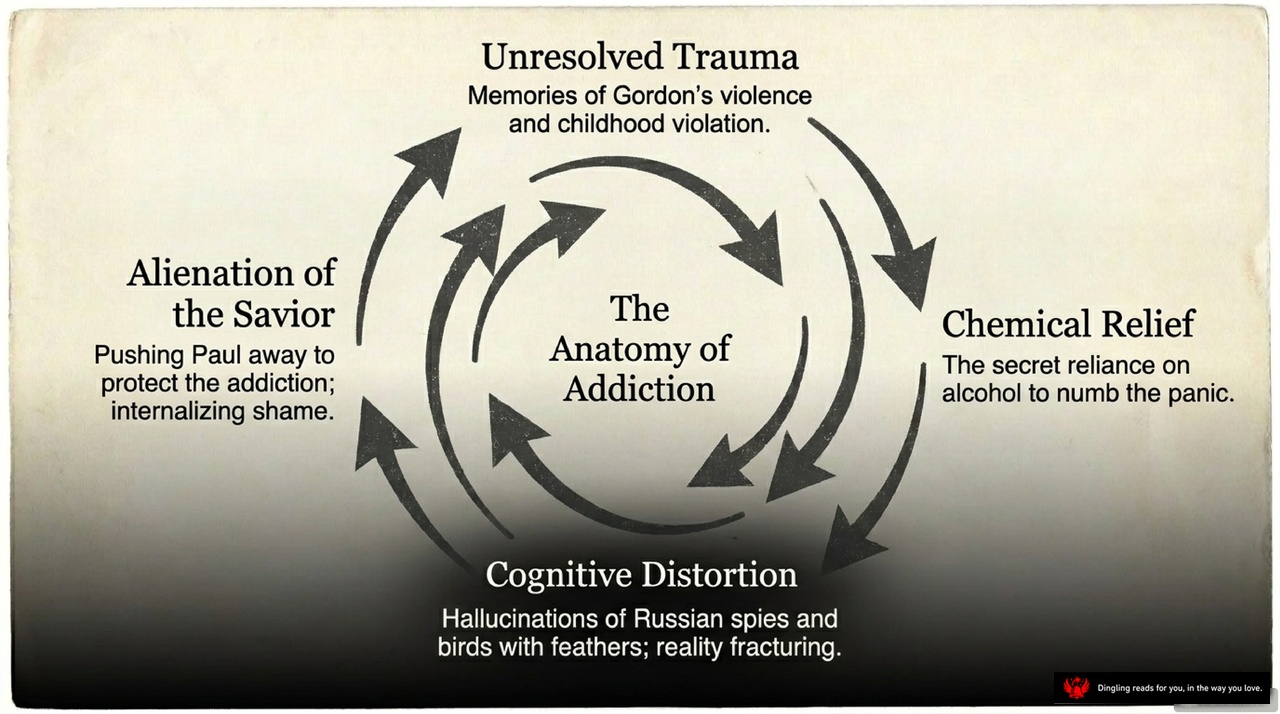
Look at this cycle. It's the anatomy of addiction, and it's a trap that never lets you out. It starts with unresolved trauma—the raw, haunting memories of Gordon's violence and that childhood violation. That pain doesn't just sit there; it forces the brain into a spiral. To cope, the character seeks chemical relief, a secret reliance on alcohol to numb the panic. But this relief is an illusion that triggers cognitive distortion. The reality fractures, and hallucinations take over—seeing Russian spies and birds with feathers where there are none. To protect this fragile, broken reality, the mind pushes away the savior, alienating the very person who could help. By driving Paul away, the addiction protects itself, internalizing shame and ensuring the cycle repeats. This isn't just a diagram; it's the brutal truth of how addiction hijacks the mind, turning love into a weapon and sanity into a distant memory.
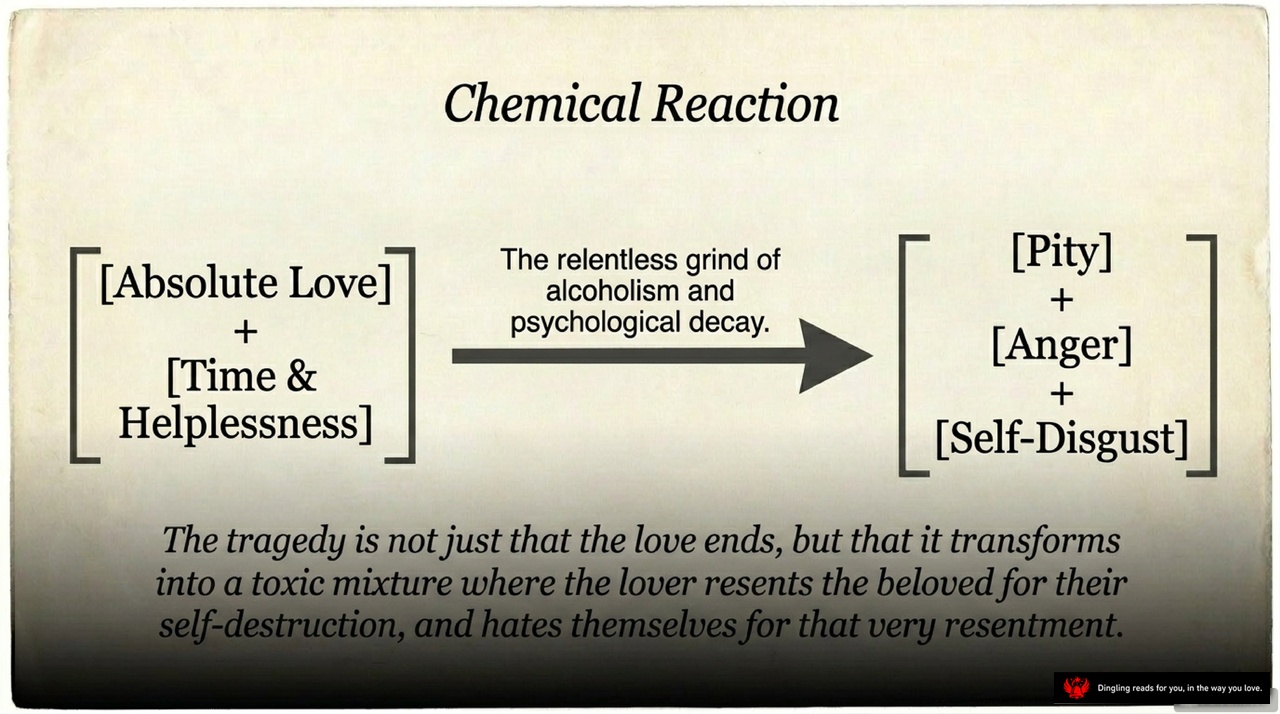
Imagine a chemical reaction, but instead of elements mixing in a beaker, it's a human heart being slowly poisoned. The slide shows a tragic transformation: on the left, we start with "[Absolute Love]" mixed with "[Time & Helplessness]." That's the beginning—the intoxicating rush of falling in love, followed by the slow, grinding realization that you can't save the person you adore.
Then comes the catalyst, the relentless grind of alcoholism and psychological decay. This is where the chemistry turns toxic. The pure love doesn't just vanish; it mutates. On the right side of the equation, we see the result: a toxic mixture of "[Pity]," "[Anger]," and "[Self-Disgust]."
The tragedy here isn't just that the love ends. It's that it transforms into something far more destructive. The lover begins to resent the beloved for their self-destruction, and in that resentment, they turn the anger inward, hating themselves for caring so much. It's a cycle of self-loathing disguised as anger. As the text at the bottom warns, this toxic mix is far harder to survive than simple loss. It's the slow realization that the person you loved has become someone you can no longer recognize, and the love you held is now the very thing destroying you from the inside out.

The Impossible Choice: Save Her or Save Himself. This slide lays out the two paths Paul faces, a brutal fork in the road that defines his entire struggle. On the left, we have The Martyrdom. The action here is to stay and absorb the damage. He becomes an emotional nurse to a hostile, fading ghost, taking on the role of her savior while losing his own future in total self-destruction. It's the path of staying put and letting life bleed out.
On the right stands The Guilt. The action is to flee and survive. This means acknowledging the ultimate betrayal of his absolutist ideals—the belief that love alone can save anyone. The cost here isn't physical survival, but eternal regret. It's the painful admission that love is not enough to save someone from themselves.
Paul is trapped between these two definitions of failure. One costs him his life; the other costs him his soul. He realizes that saving her by staying might destroy him, while saving himself by leaving might destroy the very ideal of love he held dear. It is the impossible choice between becoming a martyr or becoming a traitor to his own heart.

Memory isn't just a recording of what happened; it's a survival mechanism that actively sorts and shifts our past to help us keep moving forward. Look at this Venn diagram: on one side, we have Optimistic Distortion. This is when we recount a story to make ourselves look better, highlighting the joy to validate our existence. On the other side, we have Pessimistic Distortion. This happens when remembering pain prepares us for the void, or when we darken the past to make leaving it easier.
Notice the overlap in the middle? That's The Objective Truth of the Past. It's the rare, often blurry space where reality actually lives. But here's the hard part: our brains rarely stay in that center. Instead, they automatically lean toward whichever distortion helps us survive the present moment. We might romanticize a toxic relationship to feel worthy, or we might exaggerate a failure to avoid future risk.
This is exactly what Paul and Susan experienced. Paul saw their love as a pure, redemptive light, filtering out Susan's abuse and alcoholism to protect his own heart. Susan, meanwhile, might have distorted her reality by inventing fantasies of robberies with feathered men or claiming she was kidnapped, because the truth—that she was trapped and helpless—was too painful to face. Their shared memory wasn't a mirror of what happened; it was a shield they built together to keep from falling apart. So, when we remember, ask yourself: am I seeing the truth, or am I just editing the past to survive today?
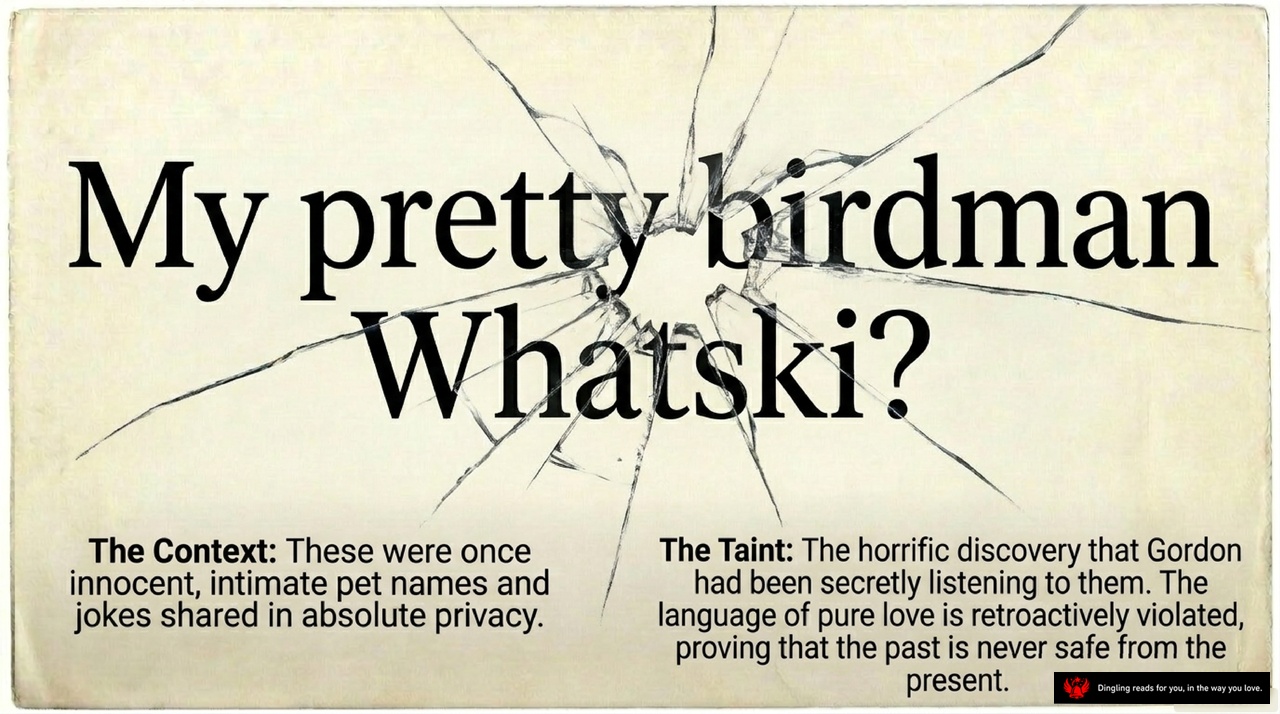
Look at this shattered glass. It perfectly captures the moment everything broke for Susan and Gordon. The text asks, "My pretty birdman, Whatski?"—a twisted, mocking question that reveals the dark truth behind their marriage.
On the left, we see "The Context." These were once innocent, intimate pet names and jokes shared in absolute privacy. It sounds like a happy, normal life, doesn't it? But look at the right side: "The Taint." This is the horrific discovery that Gordon had been secretly listening to them.
That single act of spying retroactively violated the language of pure love. It proved that the past is never safe from the present. Those private moments, those secrets they thought were locked away, were never actually theirs to keep. Gordon wasn't just a husband; he was an intruder in their own sanctuary. He weaponized their intimacy, turning their love into a performance he could watch and judge. This betrayal didn't just hurt Susan; it destroyed the very foundation of their relationship, proving that trust, once shattered, can never truly be rebuilt.

Countless life events—careers, friendships, daily routines, minor romances—pour into a funnel, but time and emotional impact act as a ruthless filter, stripping away the irrelevant until only one story remains. Most people live millions of events, yet only one story ultimately matters. For us, that story was first love. It set an inescapable template for everything that followed, serving as either the ideal we chased or the warning we couldn't ignore. While the world offered countless distractions, our shared history of pain, betrayal, and eventual loss became the single thread that bound our lives together, proving that amidst the noise of existence, only the story that shapes our soul truly counts.

Look at this striking contrast between a nineteen-year-old and someone over seventy. The image captures a profound shift in how we engage with the world. On the left, the young man stands open and vulnerable, his stance defined by a risk-blind optimism. He believes that absolute devotion can cure any trauma, ready to burn the world down just for love. On the right, the older figure is closed, guarded, and detached. He operates as a clinical observer, viewing life not as an adventure, but as a continuous exercise in damage limitation.
This visual metaphor perfectly mirrors the arc of our lives, from the fiery, naive belief that love is the ultimate solution to the hardened wisdom of protecting ourselves at all costs. It's a journey from burning the world for love to carefully calculating how to survive it.
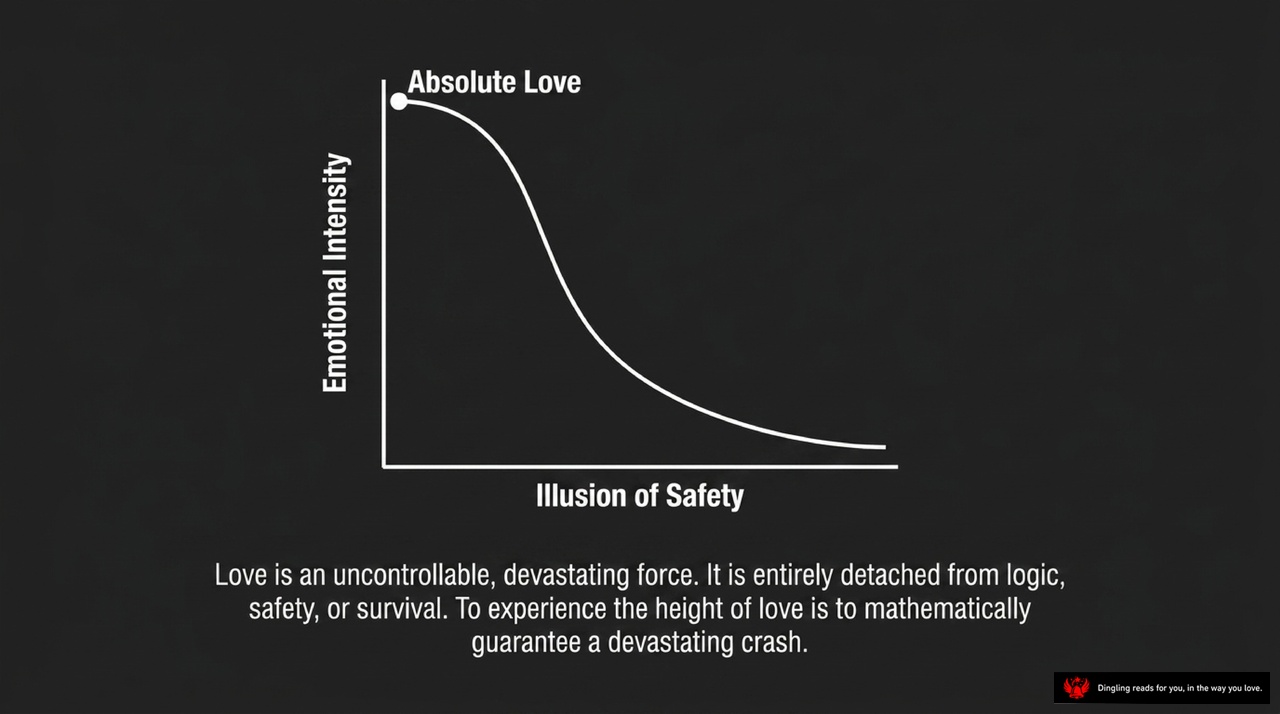
Look at this curve. It shows a harsh but undeniable truth about love: as the "Illusion of Safety" grows, "Emotional Intensity" crashes. We start with "Absolute Love," but the moment we try to build a safe foundation, that passion evaporates. The text below the graph captures this perfectly: love is an uncontrollable, devastating force, entirely detached from logic or survival. To experience the height of love is to mathematically guarantee a devastating crash.
This wasn't just a theory for Paul; it was his reality. When he fell for Susan, he thought he could protect her, shield her from the violence of her husband, and build a stable life. But the moment he tried to impose safety—hiding her bruises, covering up her drinking, lying to her doctor and his own friends—he watched her true self disappear. The safety he built became a cage. By trying to make her life predictable, he inadvertently extinguished the very spark that made her alive.
The tragedy is that safety and passion are often enemies. You can have a secure life, but you lose the wild, terrifying, beautiful intensity of being truly loved. Paul learned this the hard way. He spent years trying to fix her, to make her safe, only to realize that in doing so, he was slowly killing the woman he loved. The graph reminds us that love isn't about controlling the storm; it's about standing in the rain, even when the crash is inevitable.
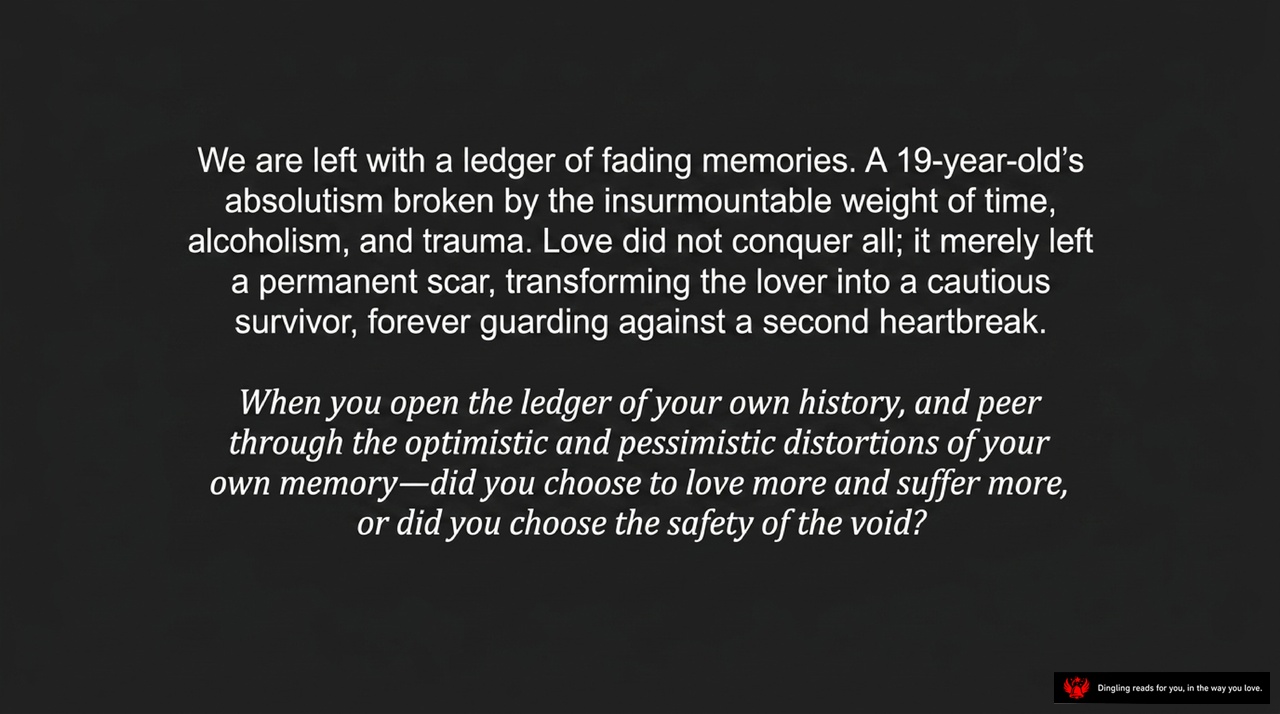
We are left with a ledger of fading memories, a stark reminder that time, trauma, and the weight of alcoholism can shatter even the most absolute faith in love. For the nineteen-year-old narrator, love didn't conquer all; it merely carved a permanent scar, transforming a lover into a cautious survivor forever guarding against a second heartbreak. When you open the ledger of your own history and peer through the optimistic and pessimistic distortions of your memory, you are forced to ask a difficult question: did you choose to love more and suffer more, or did you choose the safety of the void?