
The Operational Logic of Grassroots China: Complete Chapter-by-Chapter Summary
Welcome to today's session. We're diving into a book that attempts to decode the invisible operating system of modern China: *The Operating Logic of Grassroots China* by Nie Huihua.
Think of this not just as a history lesson, but as a manual for understanding how the world's largest bureaucratic machine actually functions. The core argument here is fascinating: China's governance isn't driven by rigid ideology alone, but by a dynamic balance of power between the center and the localities, often described as the "vertical-horizontal" relationship.
The book reveals that China's administrative boundaries aren't drawn on a map based on geography. Instead, they are the result of centuries of strategic bargaining between Beijing and the provinces. You might have noticed that Chinese provincial borders are jagged and interlocking, unlike the neat squares you see in the US. This is intentional. It's a deliberate design to prevent any single region from becoming too powerful or carving out an independent kingdom, ensuring that local autonomy never threatens central control.
Ultimately, the book argues that successful governance in China relies on a delicate equilibrium. It's about balancing order with vitality, and knowing exactly when to centralize power to maintain stability, and when to decentralize to spur innovation. It's a complex dance of incentives, constraints, and human agency that drives everything from rural development to urban expansion.
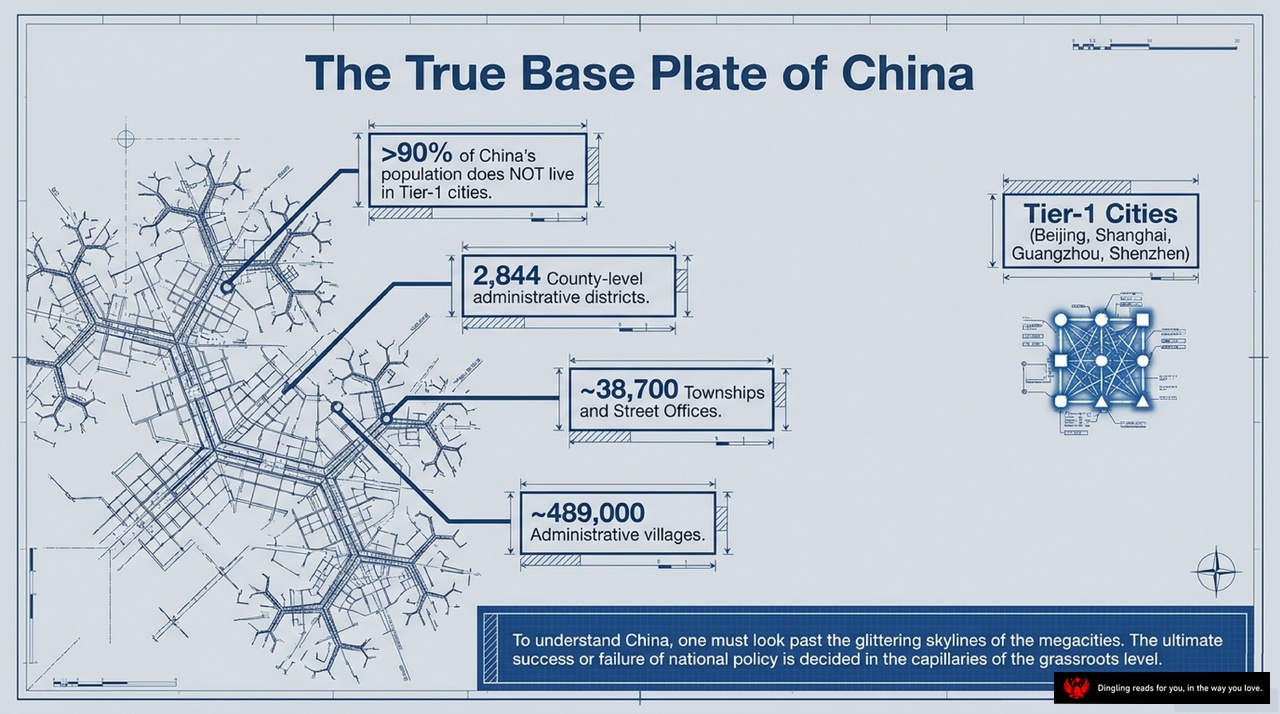
Look past the glittering skylines of Beijing, Shanghai, Guangzhou, and Shenzhen. While these Tier-1 cities capture our imagination, they are actually the exception, not the rule. In reality, more than 90% of China's population lives outside these megacities. The true engine of the nation is hidden in its vast grassroots network.
This is the true base plate of China. It consists of a complex hierarchy: over 2,844 county-level districts, roughly 38,700 townships and street offices, and nearly 489,000 administrative villages. Think of this as a massive, intricate capillary system that delivers lifeblood to the entire body.
The ultimate success or failure of any national policy isn't decided in the capital, but in these distant, local nodes. To understand China, you must look past the top tier and appreciate the sheer scale of this grassroots reality. It is here, in these thousands of counties and millions of villages, that the nation truly lives and breathes.
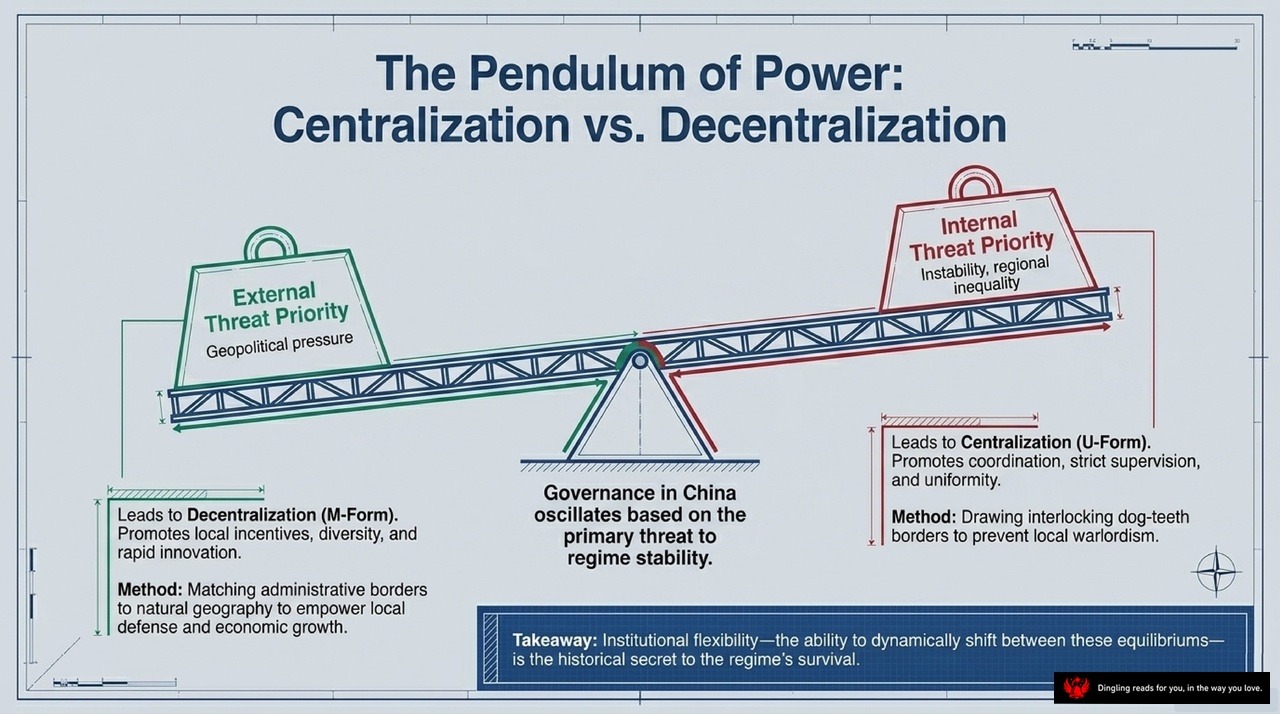
Imagine the Chinese political system not as a rigid machine, but as a living pendulum swinging between two powerful forces: Centralization and Decentralization. This dynamic balance, often called the "Pendulum of Power," is the historical secret to the regime's survival.
On one side, we have **Decentralization**, triggered when the priority is **External Threats** like geopolitical pressure. When the country faces outside danger, the system shifts toward an **M-Form** structure. This promotes local incentives, diversity, and rapid innovation. The strategy here is to match administrative borders with natural geography, empowering local regions to handle their own defense and economic growth. Think of it as giving the front lines the weapons they need to fight.
On the other side lies **Centralization**, activated when the priority shifts to **Internal Threats** such as instability or regional inequality. To maintain order and prevent fragmentation, the system swings toward a **U-Form**. This promotes strict coordination, supervision, and uniformity. The method here is to draw interlocking "dog-tooth" borders that prevent any single region from becoming too powerful or carving out a separate kingdom.
In China, governance constantly oscillates based on the primary threat to regime stability. When the world is dangerous, power flows outward to the provinces; when the internal fabric is at risk, power flows inward to the center. This institutional flexibility—the ability to dynamically shift between these equilibriums—is what has allowed China to navigate centuries of change without collapsing. It's a sophisticated dance between holding the country together and letting it grow.
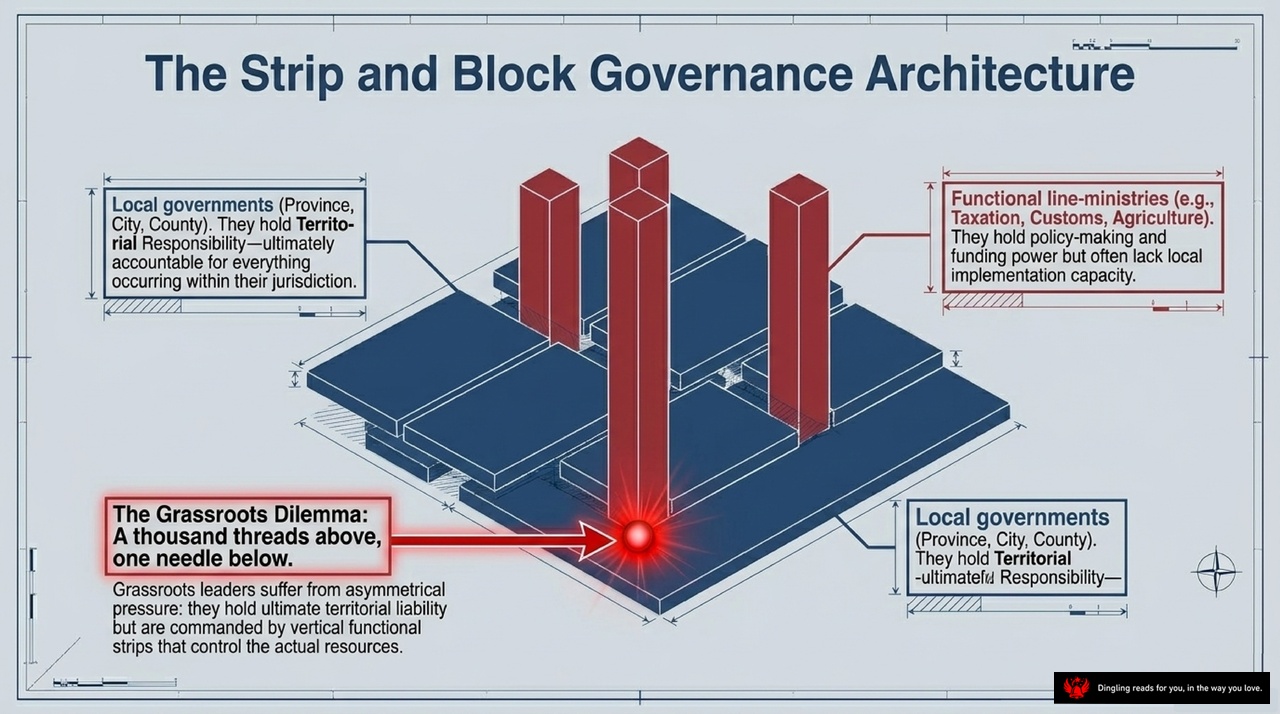
Imagine the Chinese governance system as a complex architectural blueprint where power flows through two distinct, intersecting dimensions: the horizontal "blocks" and the vertical "strips." On the ground level, you have the local governments—provinces, cities, and counties—which hold what we call "territorial responsibility." Think of them as the general contractors responsible for everything that happens within their jurisdiction. They are ultimately accountable for the results, from public safety to economic growth.
However, rising above this flat terrain are the vertical red pillars representing the functional line-ministries, such as Taxation, Customs, and Agriculture. These are the "strips." While they possess the power to make policies and control the funding, they often lack the local implementation capacity to actually execute those plans on the ground. This creates a fascinating but challenging dynamic: the local governments hold the liability, but the vertical ministries often hold the resources.
This structural setup leads to what the slide calls "The Grassroots Dilemma," perfectly summarized by the phrase: "A thousand threads above, one needle below." It paints a vivid picture of the pressure grassroots leaders face. They are the single needle trying to stitch together the complex, shifting threads of vertical commands coming from above. These leaders suffer from what we call asymmetrical pressure; they bear the ultimate territorial liability but are constantly commanded by these vertical functional strips that control the actual resources. It's a high-stakes balancing act where local officials must navigate a maze of directives from ministries that don't always align with local realities, all while being held fully responsible for the outcome.

In China, the logic of resource allocation is fundamentally different from the Western market model. While the West relies on price signals, grassroots China operates on a hierarchy where power dictates the flow of resources. As the slide illustrates, this system functions like a massive pipeline driven by bureaucratic forces rather than market forces.
Look at the concept of "Fiscal Funneling." Instead of funds being distributed based on local needs or population size, budgets are distributed strictly from the top down. Higher-ranked administrative entities secure the largest shares, leaving only a trickle for lower levels like counties. This creates an inherent imbalance where resources follow political rank, not economic demand.
This hierarchy directly shapes where public goods land. Notice how elite universities, like those in Project 985 and 211, and top-tier hospitals are disproportionately concentrated in sub-provincial and direct-controlled municipalities. Their location isn't determined by market demand or population size, but strictly by their political rank. This rigid structure ensures that the most valuable assets are locked in the highest tiers of the administrative pyramid, reinforcing the central role of rank as the primary engine of resource allocation.
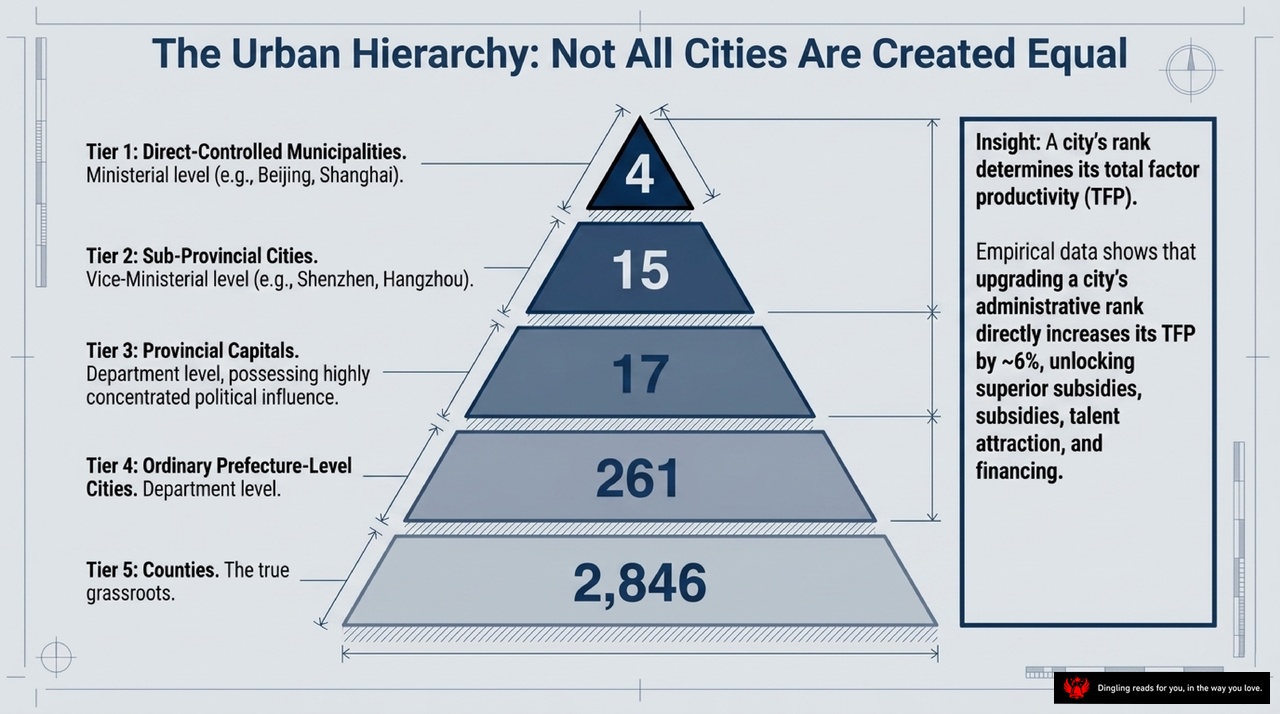
Let's dive into the reality of China's urban landscape, where the old adage "not all cities are created equal" holds true in a very literal, structural sense. As you can see in this pyramid, China's cities aren't just hubs of population; they are strictly ranked by administrative power, and this hierarchy dictates everything from resource allocation to economic potential.
At the very top sits Tier 1: the four Direct-Controlled Municipalities like Beijing and Shanghai. These aren't just big cities; they are essentially provincial-level entities with ministerial status, giving them a massive advantage in accessing central resources. Just below them is Tier 2, comprising 15 Sub-Provincial Cities such as Shenzhen and Hangzhou. These cities hold a vice-ministerial rank, placing them firmly above ordinary prefecture-level cities and granting them priority in funding and talent attraction.
Moving down the pyramid, we have Tier 3, the Provincial Capitals, which hold department-level status and possess highly concentrated political influence. Then there is the much larger Tier 4, with 261 Ordinary Prefecture-Level Cities, and at the base, Tier 5, encompassing a staggering 2,846 Counties that form the true grassroots of the nation. The sheer disparity in numbers here is striking: four cities at the top versus thousands at the bottom.
Why does this matter so much? Because a city's rank directly determines its Total Factor Productivity. Empirical data shows that upgrading a city's administrative rank can instantly boost its productivity by about 6%. This isn't just about prestige; it unlocks superior subsidies, better access to financing, and the ability to attract top-tier talent. In this system, being higher on the pyramid means you get the cake before anyone else gets a slice. It's a clear, rigid hierarchy where administrative status is the primary engine driving economic development, making the climb up this ladder the ultimate goal for any aspiring city.
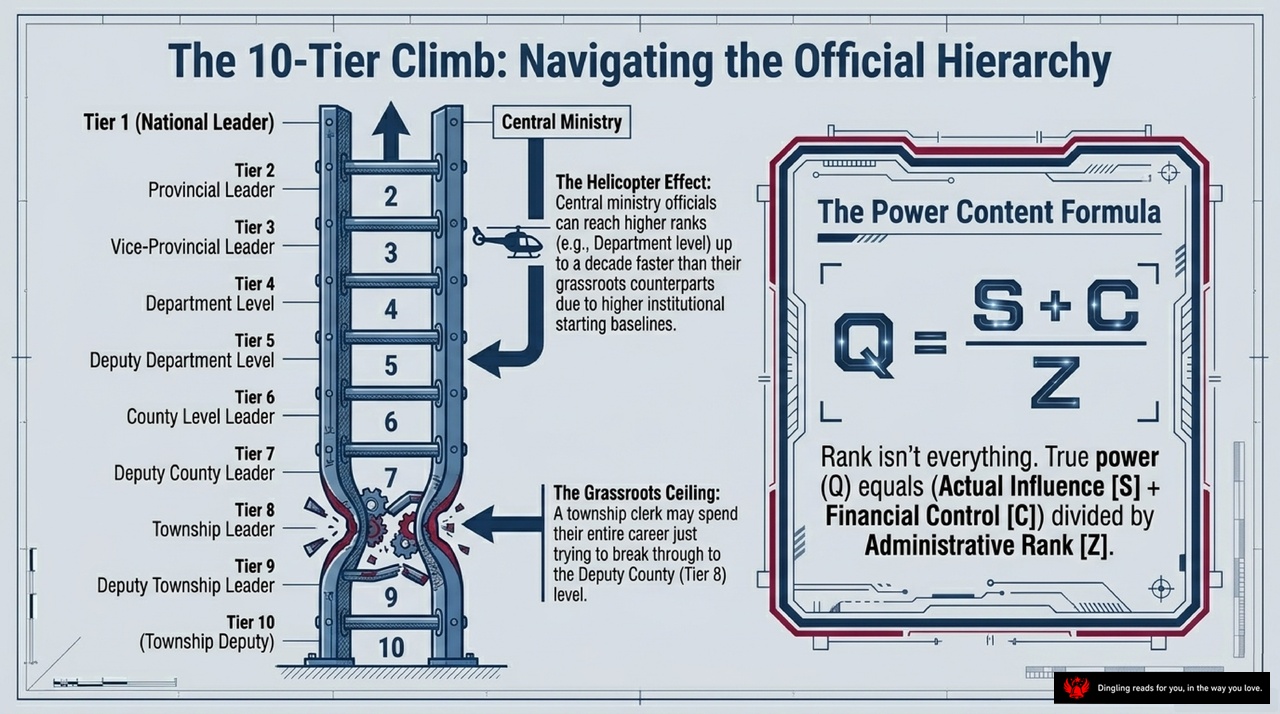
Welcome to the final chapter, where we zoom in on the grassroots level and tackle the most critical question: how does the state actually get things done? It all comes down to the logic of governance under a "pressure-based system."
In this framework, the central government sets ambitious targets, which are then decomposed and pushed down layer by layer. The result? Local officials are forced to mobilize every available resource just to hit their KPIs, often leading to an unhealthy "stacking of requirements." The core challenge here is a fundamental imbalance: local leaders bear "infinite responsibility" for everything from safety to economic growth, yet they operate with "limited power."
Let's look at the county level first. The county is the most complete unit of governance in China. Unlike the townships below, a county has its own independent fiscal authority and land planning rights. In fact, many counties have populations comparable to small European nations. Take Linquan County in Anhui, with nearly 2.3 million people—larger than Slovenia. This means the county party secretary faces a governance difficulty no different from a state governor abroad.
So, what is the secretary's reality? From an institutional perspective, they are the top boss with significant influence over hundreds of thousands of lives. But they are not free agents. They are constrained by the "vertical lines" from above—provincial departments can block their decisions with a simple phone call, regardless of the county secretary's rank. From a human perspective, they are ordinary people with their own ambitions and pressures. They face three massive "mountains": first, maintaining stability, which is a "one-vote veto" metric; second, attracting investment to plug fiscal gaps; and third, managing debt, since counties cannot issue bonds directly.
Moving down to the township level, the dynamic shifts. While townships are the nerve endings of the state, they lack independent fiscal systems and functional departments. The township party secretary here faces a unique set of challenges. Unlike the county level, they don't worry about funding salaries or large-scale industrial planning. Instead, their pressure comes from being the sole executor. They must coordinate multiple superior departments, often doing the work of several people with a small team. Their daily battle involves everything from handling public petitions and responding to endless inspections to managing public opinion in an era where everyone is a media outlet.
Ultimately, this chapter highlights the immense weight carried by those at the very bottom of the hierarchy. They are the ones who translate high-level directives into reality, navigating a complex web of limited authority and unlimited expectations. Understanding this pressure is key to understanding the true engine of China's governance.

Look at this diagram. It captures the intense pressure cooker facing a County Secretary in China. At the center, the title "Vast Power, Infinite Responsibility" isn't just a slogan; it's the daily reality. This official governs a population comparable to small European nations, wielding comprehensive control over local personnel, resources, and policy execution.
But look at the three massive red arrows crushing down on them. On the left, **Investment Attraction** is the engine of growth. It demands intense, almost CEO-like salesmanship, risk-taking, and the relentless pressure to hit quotas. Without it, the local economy stalls. On the right, **Debt Management** represents a dangerous legacy. Local governments are navigating the fallout of land finance and sky-high debt levels, a ticking time bomb that no single official can easily defuse. And at the very top, **Social Stability** acts as a veto power. This is the absolute priority. A single mass incident or a severe public opinion crisis can end a career overnight. One mistake, and it's game over.
The insight at the bottom explains why this system is so stressful: County Secretaries operate on an incomplete contract with the state. They enjoy high autonomy in *how* they get things done, but they assume unlimited liability for the *outcomes*. They have the power of a king, but the responsibility of a martyr. It's a high-stakes game where the margin for error is zero.
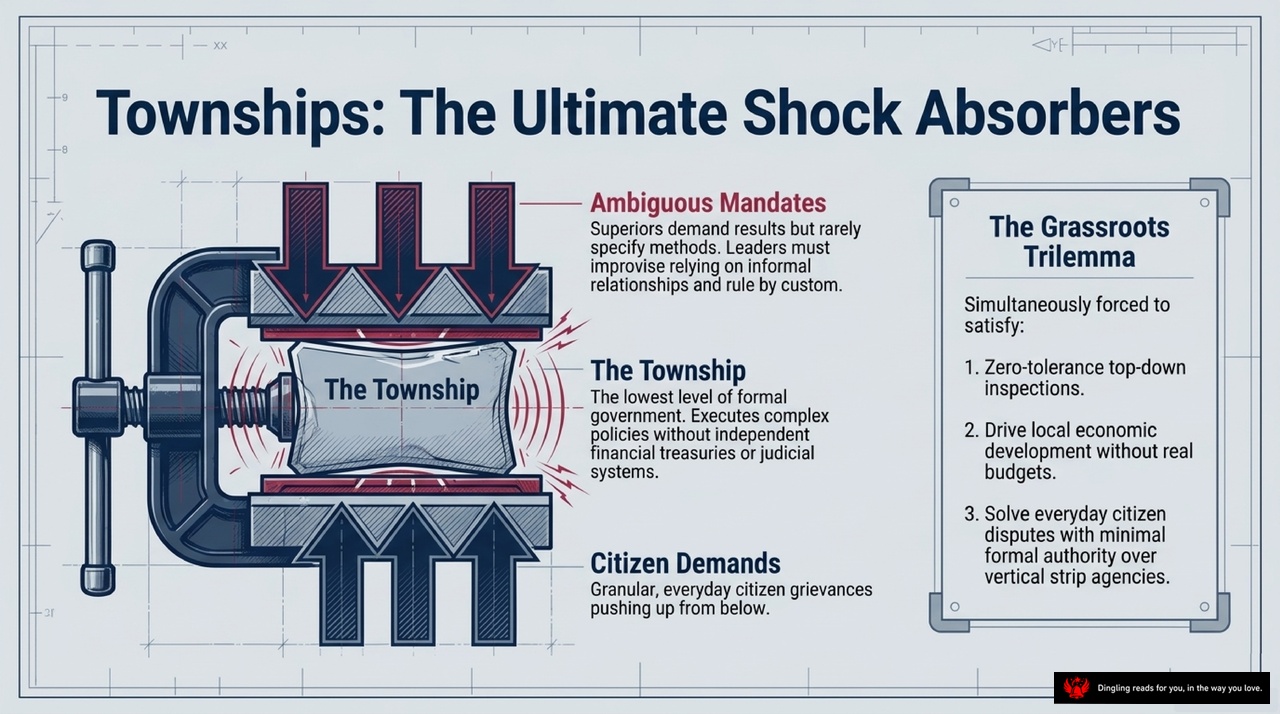
Townships: The Ultimate Shock Absorbers. Imagine the township as a heavy-duty vice squeezing the very heart of China's governance. On one side, you have "Ambiguous Mandates"—superiors demanding results without ever specifying the methods, forcing local leaders to improvise based on informal relationships and custom. On the other, "Citizen Demands" push up from below, creating a constant pressure cooker. This is the "Grassroots Trilemma": townships are simultaneously forced to satisfy zero-tolerance top-down inspections, drive local economic development without real budgets, and solve everyday citizen disputes with minimal formal authority. It's a high-stakes balancing act where the township absorbs all the shock, executing complex policies without independent treasuries or judicial systems. In this unique pressure cooker, the township isn't just a local office; it's the ultimate shock absorber, compressing the gap between rigid central commands and the messy, granular reality of daily life.

Look at this slide titled "Anatomy of the Grassroots: The Capillaries of Governance." It breaks down the four critical layers of China's administrative structure, showing how power, responsibility, and money flow from the top down.
At the very top sits the **County**, acting as a comprehensive government with high financial autonomy. It's the strategic hub, responsible for resource allocation and setting the overall direction.
Below that is the **Township**, which serves as the true grassroots government. While it focuses on policy execution and keeping rural areas stable, it has very low financial independence and relies heavily on the county above it.
Then we have the **Street Office**, or Sub-district. This is crucial because it's not a standalone government entity but a dispatched agency of the city or district. Its job is urban management and community service, but it has zero financial autonomy, relying entirely on the budget sent from above.
Finally, at the very bottom, is the **Village**. Unlike the others, this is a non-government autonomous organization. It handles dispute resolution and local implementation, funded not by the state but by the collective assets of the villagers themselves.
This hierarchy illustrates a clear shift: as you move down from the county to the village, the level of government control decreases, while the focus shifts from high-level strategy to specific, on-the-ground execution and community self-management.
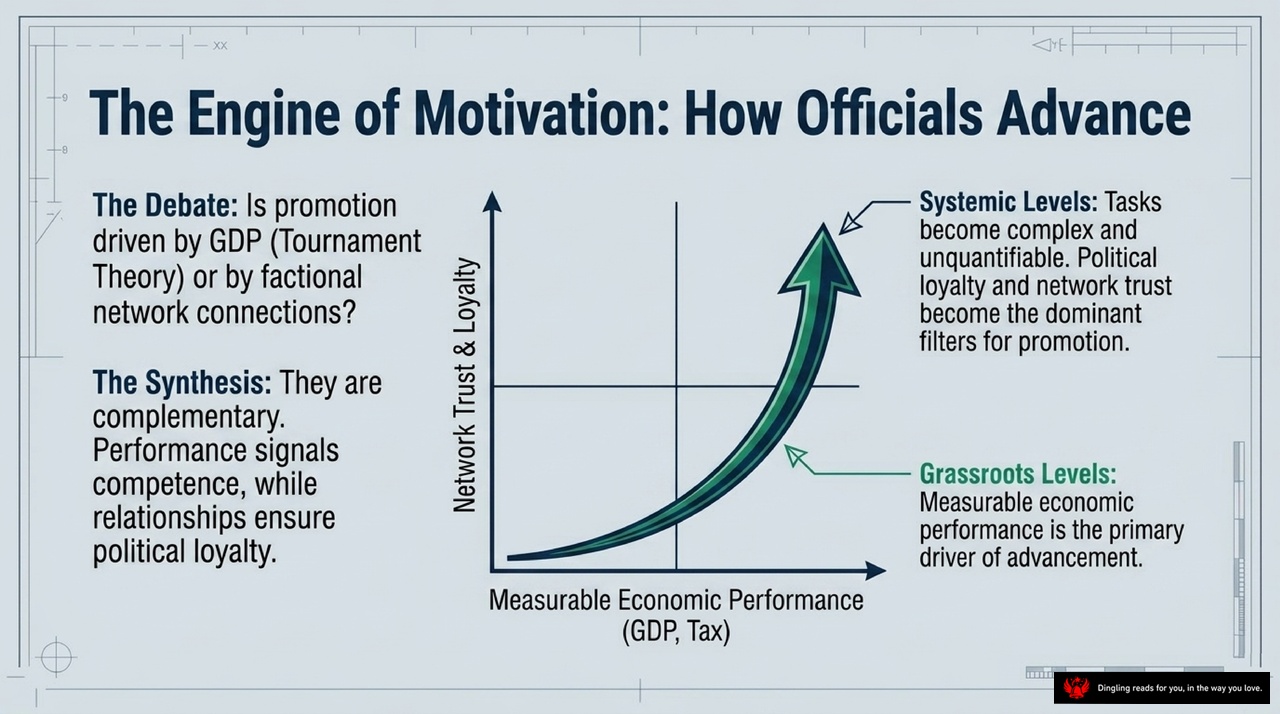
So, we've just unpacked the complex machinery of how officials rise in China, moving from the big picture of central-local power dynamics down to the gritty reality of the grassroots. Today's slide, titled "The Engine of Motivation: How Officials Advance," distills that entire journey into one crucial question: What actually drives a bureaucrat's career? Is it the cold, hard numbers of GDP, or is it the warmth and depth of political connections?
The slide presents this as a classic debate. On one side, you have the "Tournament Theory," which argues that promotion is purely a race for economic performance—like a sports competition where the winner takes all based on GDP growth. On the other side, you have the argument for "factional network connections," suggesting that who you know matters far more than what you achieve.
But here is the key insight from our discussion: it's not an either/or choice. They are complementary. Look at the curve on your screen. At the grassroots level, the story is driven by measurable economic performance. When an official is close to the people and dealing with tangible results, their ability to boost GDP and manage taxes is the primary filter for advancement. It's about competence and visible success.
However, as you move up the ladder to systemic levels, the curve steepens and shifts. Tasks become complex and increasingly unquantifiable. You can't easily measure how well a high-level official managed a crisis or negotiated a treaty. At this stage, political loyalty and network trust become the dominant filters. Relationships ensure that an official is reliable and aligned with the center, while performance signals that they are capable.
So, the engine of motivation is a dual track. You need the hard skills to get noticed at the bottom, but you need the right relationships and loyalty to survive and thrive at the top. Understanding this synthesis is the only way to truly decode the logic of China's governance.
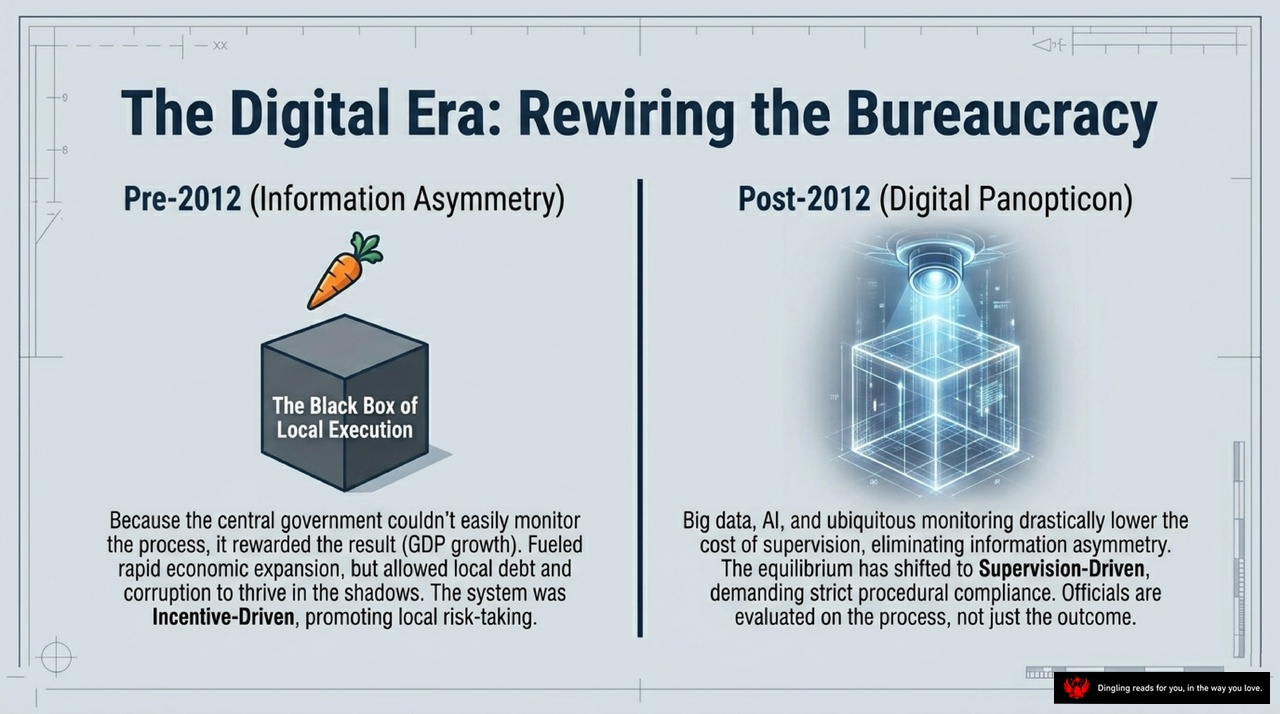
In the pre-2012 era, China's governance operated like a "black box of local execution." Because the central government couldn't easily monitor the process, it rewarded the result—GDP growth. This fueled rapid economic expansion but allowed local debt and corruption to thrive in the shadows. The system was purely incentive-driven, promoting local risk-taking. It was a time of information asymmetry, where local officials had significant autonomy but little oversight.
Then came the post-2012 shift, ushering in the age of the "digital panopticon." Big data, AI, and ubiquitous monitoring drastically lowered the cost of supervision, effectively eliminating information asymmetry. The equilibrium has now shifted to a supervision-driven model, demanding strict procedural compliance. Officials are evaluated on the process, not just the outcome. This transformation represents a fundamental rewiring of the bureaucracy, moving from a system that trusted local initiative to one that relies on constant, data-backed visibility.

Imagine a scenario where a government official's entire career hangs on a single, catastrophic mistake in one specific metric. That is the reality of "The Paralysis of Over-Measurement," a phenomenon where the fear of failure completely freezes progress. As our slide illustrates, this starts with the "One-Vote Veto Trigger." Under this policy, if a single critical metric—like social stability or environmental protection—fails, it instantly cancels all other achievements, no matter how impressive the economic growth or policy innovation might be.
This creates a toxic environment for what we call "The Rational Grassroots Agent." When the stakes are this high, the logical response isn't to innovate or take risks; it is to play it safe. Agents abandon all complex, high-effort tasks that might trigger the veto. Instead of driving economic growth or creating new policies, 100% of their energy flow gets diverted into avoiding mistakes. This leads directly to the "Explosion of Administrative Burden." Time that should be spent solving real problems is entirely consumed by managing top-down inspections, filling out endless digital forms, and just answering chat groups to prove you're doing something.
In essence, when you measure everything perfectly and punish any single slip-up, you don't get a more efficient system. You get a paralyzed bureaucracy that prioritizes safety over results, ensuring nothing ever actually changes.
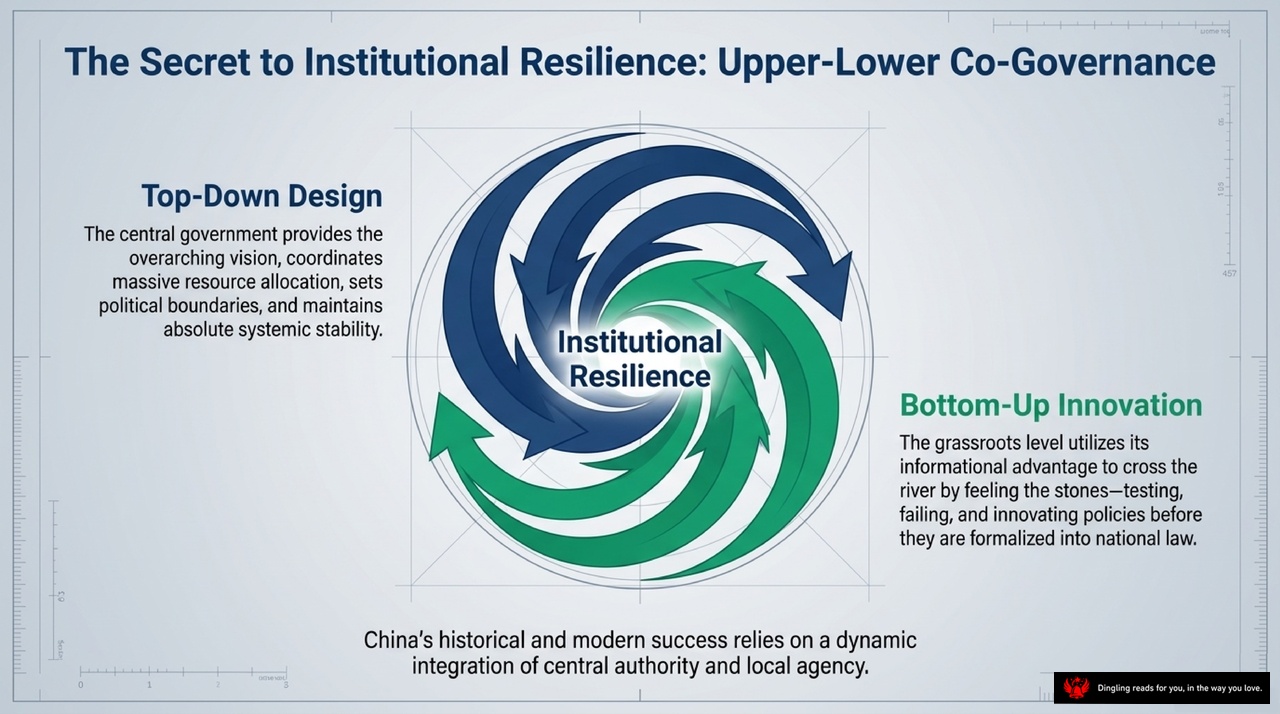
The secret to China's institutional resilience lies in a unique dynamic called "Upper-Lower Co-Governance." Unlike Western models that often pit central and local governments against each other, China's system thrives on a powerful synergy between top-down design and bottom-up innovation.
On one side, we have the **Top-Down Design**. The central government provides the overarching vision, coordinates massive resource allocation, sets political boundaries, and maintains absolute systemic stability. Think of it as the steering wheel and the engine room, ensuring the ship stays on course even in rough seas.
On the other side, we see **Bottom-Up Innovation**. Here, the grassroots level utilizes its informational advantage to "cross the river by feeling the stones." Local officials test, fail, and innovate policies right at the front lines. Once these solutions prove successful, they are formalized into national law. This isn't just theory; it's how China's historical and modern success has been achieved.
The key takeaway is that China's stability doesn't come from rigid control alone, but from a dynamic integration of central authority and local agency. It's a feedback loop where the center provides the framework, and the localities provide the agility, creating a system that is both stable and adaptable.
Grassroots China operates on a delicate, structural balance. It relies on a strict administrative hierarchy to allocate resources, a matrix of strips and blocks to manage accountability, and a dynamic tension between central control and local incentive to drive rapid modernization. But as advanced digital surveillance perfects top-down supervision and replaces high-risk incentives with rigid compliance, will the grassroots retain the vital flexibility required to pioneer China's next era of innovation?