
The Poetics of Space: Complete Chapter-by-Chapter Summary
Welcome to our journey into Gaston Bachelard's *The Poetics of Space*. Today, we begin not with cold geometry, but with the warm, beating heart of home.
Imagine a blueprint overlaid with soft, swirling clouds of memory. This is the book's promise: an architectural and philosophical voyage that takes us from the confined, dark geometry of a cellar all the way to the boundless cosmos of the human imagination.
Bachelard teaches us that a house is never just a physical structure. It is the core anchor of our inner world, the very shell where happiness first takes root. While geographers map the outside, we are here to explore how we find our original attachment to a single corner of the world. Even the simplest dwelling holds a unique beauty, acting as a "non-me" that protects us, serving as our first, personal universe.
Before we are even "thrown into the world," we have already lived in the cradle of home. So, let's step into this book and discover how space becomes the vessel for our deepest dreams.

Imagine a single, sudden impact that shatters the ordinary flow of your day. It's not a logical event; it's an autonomous psychological anomaly, a spark that arrives without a past and refuses to be bound by causality. This is the genesis of the poetic image. When this image strikes, it doesn't just land on the surface of your mind; it creates a resonance, an immediate emotional echo that scatters across your thoughts like ripples on water. But the journey doesn't stop there. These ripples deepen into a reverberation, a profound ontological shift that awakens the creative depths of your soul.
The image places us right at the origin of the speaking being. It transforms how we exist in the world, turning abstract thoughts into living, breathing realities. It's the moment where the internal and external collide, creating a new way of seeing and being. This isn't just about art or literature; it's about the fundamental mechanics of human consciousness. The image is the bridge between the silent chaos within us and the structured world outside, giving form to the formless. It is the very act of coming alive, of speaking into existence.

Imagine a house not just as walls and roof, but as a living map of your mind. This slide breaks down that very idea through a "Topo-Analysis"—a way of seeing the topography of intimate being. Think of this structure as layers of your psyche, stacked from the conscious to the primal.
At the top, we have the "Upper Floors," representing your conscious thought. These are the 19th-century additions in the drawing, built on logic and order. They are where you make plans, where you live in the present, and where your rational mind constructs the world you see every day. It's the part of you that interacts with society and manages the daily chaos.
Beneath that lies the "Ground Floor," your 16th-century foundation. This represents historical memory. It's deeper than your thoughts, holding the stories of your family, the traditions you've inherited, and the personal history that shaped who you are. It's the bedrock of your identity, the past that supports your present.
But the most mysterious part is down there, in "The Cellar." This is the 16th-century foundation's shadow, digging even deeper into Roman ruins over a prehistoric cave filled with glacial bones. This is the primal, ancient unconscious. It's the part of you that feels things before you understand them, the raw instincts and deep fears that no one taught you, yet which you feel most intensely.
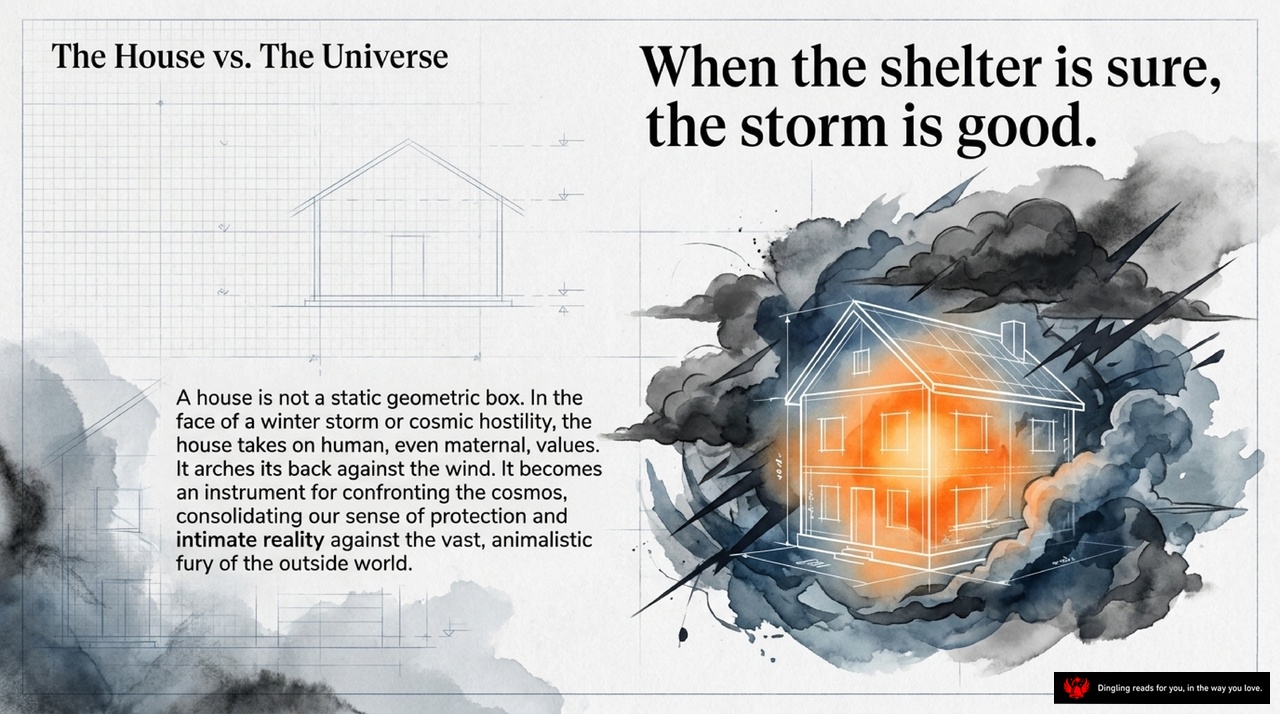
The text reminds us that psychoanalysis explores the mind, but this topo-analysis explores the spaces that house it. Our memories and unconscious aren't just abstract concepts; they are "housed" in these specific layers. Just as a real house protects us from the storm outside, these inner spaces protect our soul. The upper floors keep us rational, the foundation keeps us grounded in history, and the cellar keeps our deepest, most wild humanity safe and contained. By understanding these layers, we stop seeing our mind as a blank slate and start seeing it as a rich, complex, and deeply layered home.

The house isn't just a physical structure; it's a psychological landscape split vertically into two distinct worlds. Look at the diagram: the top, the garret or roof, represents the rational mind. It reaches toward the sky, defined by clear geometry, light, and conscious thought. Here, we deflect storms and find clarity, anchoring our logic in order.
But look down to the cellar. This is the realm of the irrational, where we burrow into the earth. It's a space of darkness, depth, and primal fears, holding onto ancient memories and the unconscious. Unlike the roof, the cellar is anchored in deep subterranean waters, filled with mystery.
This vertical dismantles the idea of a simple home. Our house is a battlefield between the light of reason above and the heavy, chaotic forces of the earth below. We live in the tension between these two poles, balancing our conscious clarity with the wild, untamed depths of our psyche.
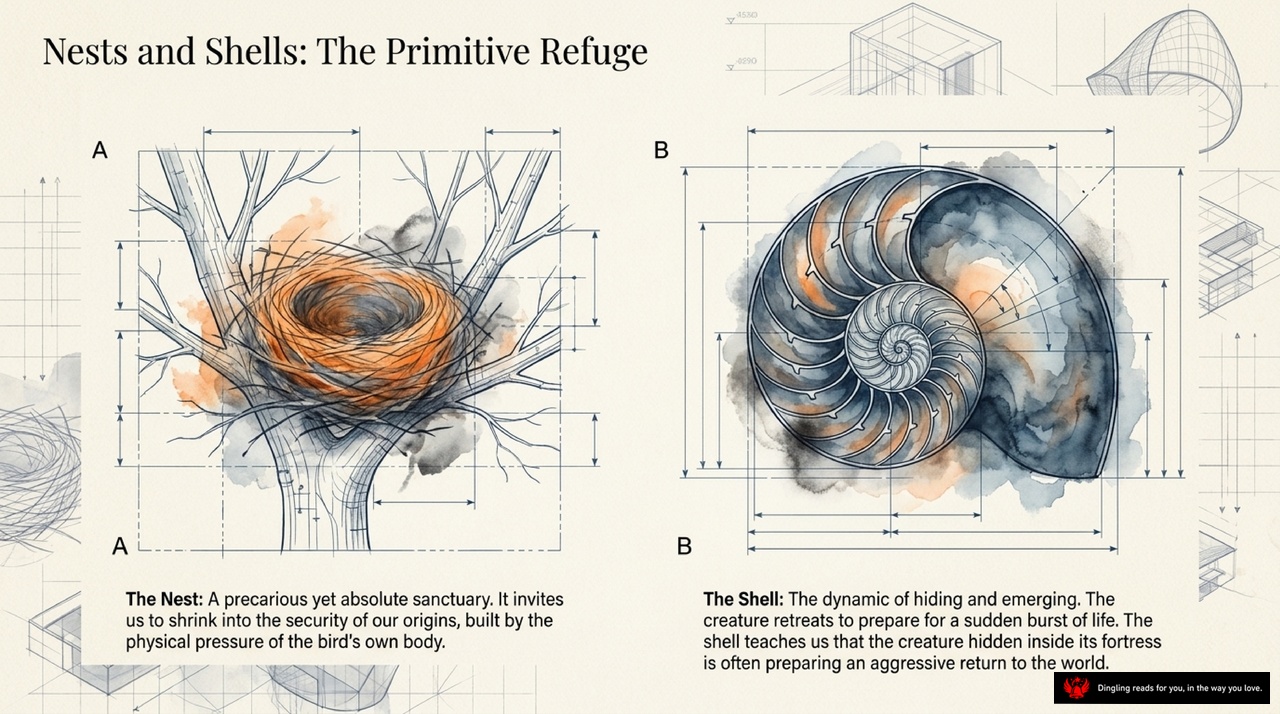
Imagine a shell not just as an animal's home, but as a masterpiece of living geometry. Since the Mesozoic era, soft-bodied creatures have been slowly constructing their shelters along the precise, mathematical curves of logarithmic spirals. As Paul Valéry famously marveled, a shell is "frozen animal geometry," a truth that can be dissected by the mind yet remains shrouded in mystery. For these creatures, building this home isn't a chore; it is their ultimate life mission. They make a destiny-defining choice right from the start: will their shell spiral left or right? This tiny decision dictates their entire existence.
But here is where the imagination takes flight. When we look at these spirals, we see something more than biology; we see a portal to the impossible. In the realm of fantasy, these shells become vessels for the bizarre. Imagine a rabbit or even an elephant emerging from a tiny snail shell, a paradox of scale that breaks our reality. This isn't just about size; it's about the dialectic of freedom and constraint. The soft creature inside is seemingly trapped, yet it uses its own body to carve out a spiral space, constantly breaking through its own boundaries. It's a powerful metaphor for the human condition: finding freedom within the very structures that hold us.
This protective instinct goes deeper than just safety. In our own dreams, we often seek that same hard outer layer, that "shell" that keeps the chaos of the world at bay. Whether it's a small room or a fortress in our mind, we are all seeking the shelter of the shell. Yet, nature reminds us that this protection isn't always passive. Some shells are traps, using deception to capture prey, while others hide in plain sight, mimicking their surroundings to survive. The shell teaches us a profound lesson: true security often comes from understanding the balance between being vulnerable inside and being formidable on the outside. It is the perfect symbol of our inner world—fragile yet capable of enduring the storms of existence.

From the humble nest to the intricate spiral of a shell, nature teaches us the deepest secrets of home. It's not just about shelter; it's about the very act of building our own universe. Imagine a bird weaving a nest with its own body, pressing every twig against its warmth until the home becomes an extension of its soul. Or think of a soft creature slowly secreting a hard shell, creating a fortress from the inside out, turning vulnerability into strength with every layer.
But when we let our imagination take the wheel, these natural forms transform into something magical. What if a rabbit or even an elephant could step out of a tiny shell? What if that shell wasn't just a home, but a vessel for transformation, hiding the potential for new life within its curves? This is the power of the shell: it represents the perfect balance between being trapped and being free. It's the ultimate symbol of safety, a hard outer layer protecting the soft, chaotic heart within.
In our dreams, we often crave this same protection. We want a space where we can retreat from the storm, a place where we can be small and yet contain the entire world. The shell reminds us that true strength comes from knowing how to hide, how to close up, and how to keep our inner peace intact. It's a gentle reminder that even in a chaotic world, we can always build our own sanctuary, one layer at a time.
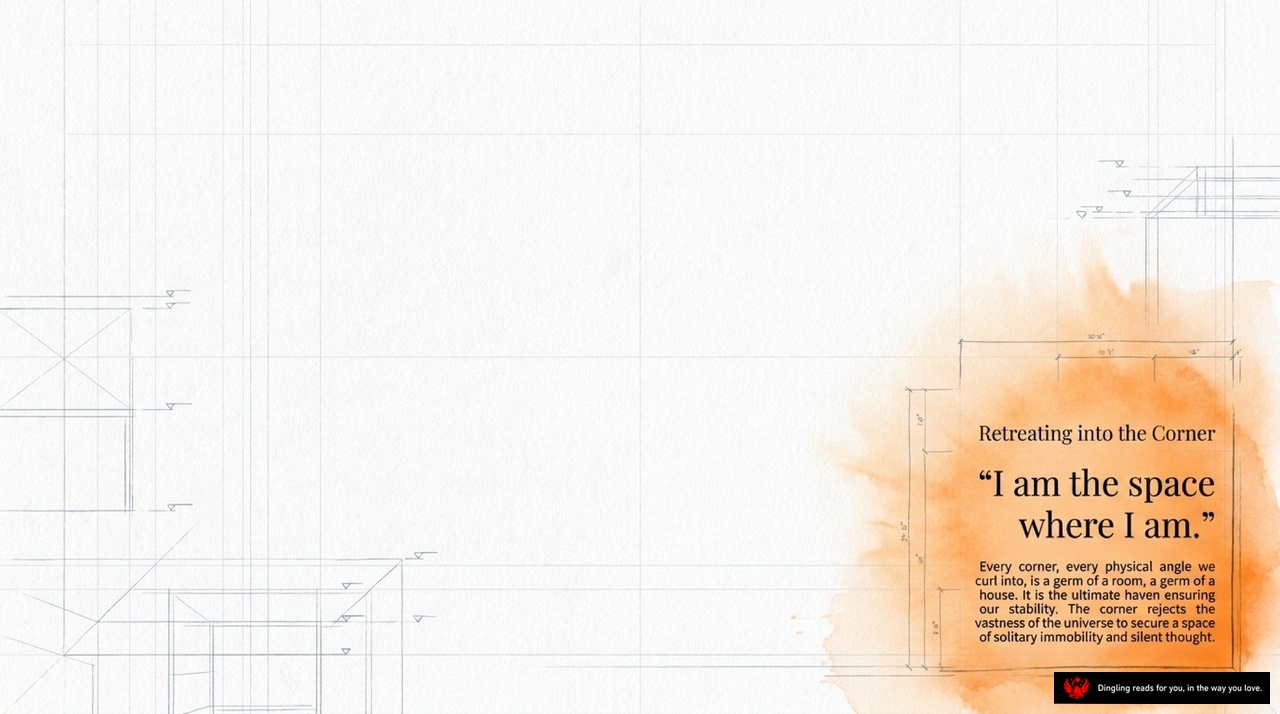
Retreating into the corner isn't just about finding a quiet spot; it's about discovering where you truly belong. As the text suggests, "I am the space where I am." Think about it: every time you curl up into a corner, you aren't just changing your position—you're creating a room, a sanctuary, and ultimately, a home. That corner becomes the ultimate haven, rejecting the vast, overwhelming universe to secure a space for solitary thought and stillness.
In this intimate nook, the boundaries between inside and outside blur. Shadows from furniture or curtains weave an invisible wall, making you feel completely safe. It's a place where time slows down, and you can reconnect with the past. The corner holds onto forgotten details—dust motes, old shoes, or a forgotten toy—that tell the story of your life. It's a container for your memories, a living archive where your past and present merge.
But here's the magic: the corner isn't just a physical space; it's a dream. It's where you can touch the raw texture of existence without the noise of the world. Whether it's a sharp, cold angle that pushes you away or a soft, curved line that invites you in, the corner shapes your inner world. It's a small universe within a larger one, a place where you can finally be yourself, fully and completely.
Imagine a world where the boundaries between inside and outside aren't rigid walls, but fluid, breathing membranes. This is the core tension we explore today: the dialectic of the exterior and the interior. We often think of these as opposite forces, locked in a battle of yes and no, but true existence is far more nuanced. It's not about a hard line separating "here" from "there." Instead, think of the door—not as a simple barrier, but as a living metaphor for our very state of being. Sometimes it's shut tight, guarding our secrets like a locked room in a fairytale; other times, it swings wide open, offering freedom into the vast unknown. But most often, it exists in that beautiful, uncertain state of being half-open.
This hesitation is where our deepest dreams live. When we step back from rigid logic, we see that our existence is inherently semi-open. We are never fully sealed off from the world, nor are we completely dissolved into it. The door becomes a mirror of this duality, reflecting our desire to both protect our inner sanctum and reach out to the vastness beyond. In poetry, this dynamic comes alive. We read about a bedroom that isn't just a room, but a feeling that spills out into the soul; we imagine a sunlit market flooding into our minds, turning our thoughts into a buzzing hive. These images shatter the idea that the interior is small and the exterior is big. They show us that our inner world can be as expansive as the universe, and the outer world can be as intimate as a whisper in our ear. By embracing this fluid boundary, we stop fighting against the world and start living within the dynamic space where the inside and outside finally meet.

Today's slide explores a fascinating concept: The Miniature, or Inverting Scale. It suggests that by zooming in on a tiny detail, we can actually make the object feel infinitely larger. Look at the hourglass in the center—it represents this shift from the small to the vast.
First, we have Hyper-Focus. The slide explains that our imagination shrinks us down to enter this miniature space. It's like stepping inside a single detail. Next is The Reversal. When we concentrate entirely on one detail, logic and geometry seem to collapse, breaking the rules of our normal world. Finally, we reach Infinite Expansion. As the text notes, Cyrano's apple core becomes a solar system. The miniature isn't a reduced object; it's a doorway into a vast, new universe.
So, the core message here is clear: Details make the object larger. By diving deep into the small, we unlock a universe of possibility that is far bigger than reality itself.

Imagine a door that isn't just wood and hinges, but a living threshold where the outside world whispers secrets to your inner soul. In this space, the rigid logic of "in" versus "out" dissolves into something far more fluid. Think about a moment when you step into a room and suddenly feel the weight of the day's noise pressing against your skin, or perhaps, when you leave that same room and feel a strange, lingering echo of your own thoughts. That hesitation, that moment of pause where the door seems to sniff you out, is the true battleground of existence.
The text reminds us that our existence is actually a spiral, a constant dance of moving toward the center and escaping outward. We often try to pin this down with simple geometry, drawing neat circles or boxes to define where we end and the world begins. But life refuses to be contained in such static shapes. The most profound moments happen in those "half-open" states—doors left ajar, windows cracked slightly, or the quiet uncertainty of standing right at the threshold. It is in this liminal space that the magic of imagination takes hold. We don't just see a door; we feel it as a guardian, a question mark, or a bridge to a different version of ourselves.
Consider how poetry transforms this simple object. A bedroom can suddenly become the entire universe, or the sun can flood into your mind, turning your head into a buzzing hive of external light. When we stop treating the boundary between inside and outside as a wall, we realize that our internal world is vast and porous, while the external world can be intimate and close. We are not trapped in a box; we are the bridge. By embracing this fluidity, we stop fighting against the blur between our private thoughts and the public world, and instead, we find the freedom to inhabit both spaces simultaneously. The door is never truly closed or open; it is simply waiting for us to decide how we want to move through it.

Welcome to the final chapter of our journey into the architecture of the soul. Look at this map we've built together. It's a "Topo-Analysis," or a map of the soul, showing how our inner world stretches across two dimensions: the X-axis, moving from our internal psychological life to the external physical world, and the Y-axis, moving from expansion all the way up to protection.
Notice the center of this map. It tells us that all physical spaces are merely vessels for the elasticity of the human soul. Your home isn't just bricks and mortar; it's a container for your inner life. Look at the quadrants. On the left, we have the sanctuary of secrecy—drawers, chests, and corners where we hide our true selves. On the right, we have the physical bastion against the storm, like houses, nests, and shells that protect us from the outside world.
But look at the bottom right. That's the miniature. It's the idea that a small object can trigger a sense of the cosmos, making the tiny feel infinite. And at the top, we find protection. Whether it's a literal roof or the feeling of safety in a corner, it anchors us. This diagram reminds us that we aren't trapped in our bodies or our rooms. Our soul has an elasticity that allows us to expand into the universe while simultaneously finding shelter in the smallest, most intimate corners of our being. It's all connected.
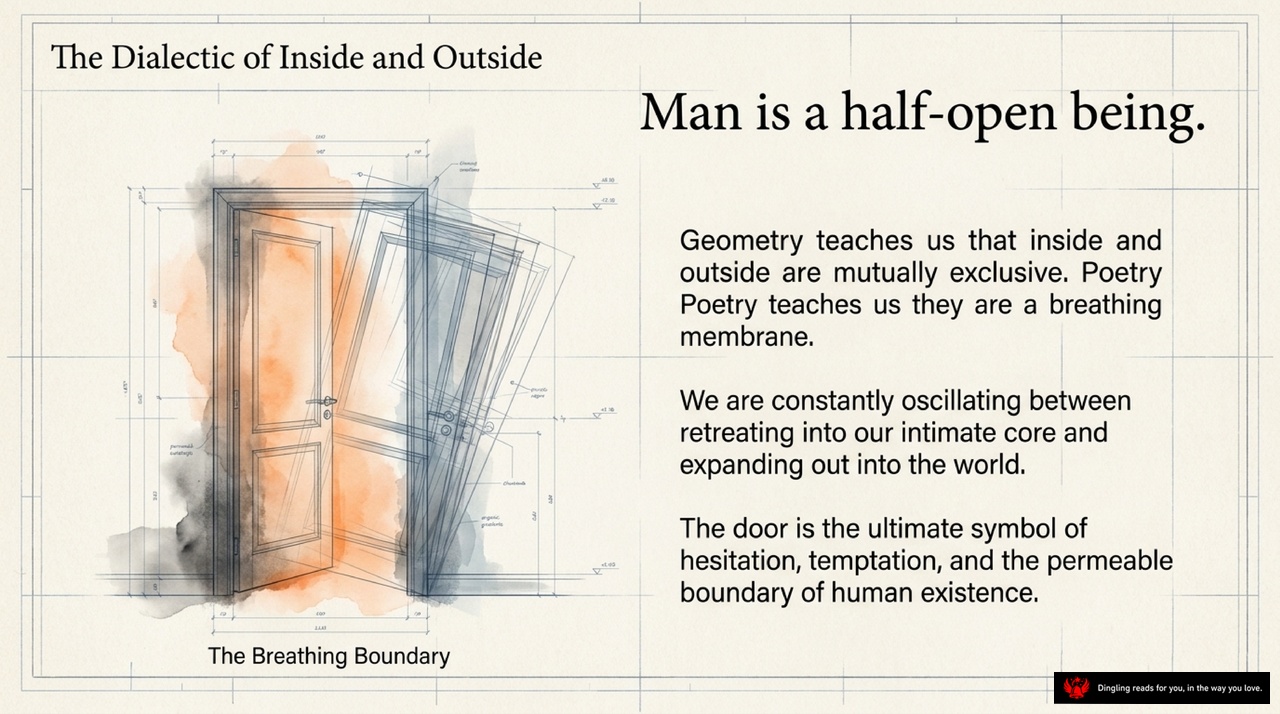
Welcome back. Today, we're diving into a profound shift in how we understand the boundaries of our existence. Look at the image on the screen: a door rendered in both architectural precision and watercolor fluidity. This isn't just a door; it's the ultimate symbol of hesitation, temptation, and the permeable boundary of human life.
The text on the slide introduces a radical idea: "Man is a half-open being." This challenges the rigid logic we often apply to our world. Geometry teaches us that the inside and the outside are mutually exclusive—two separate, walled-off realities. But poetry? Poetry teaches us something far more vital: that inside and outside are a breathing membrane. We are not sealed off from the world, nor are we entirely consumed by it. Instead, we constantly oscillate between retreating into our intimate core and expanding out into the vastness of the world.
Think about that door in the image. It represents that constant negotiation. It is the threshold where we feel the pull of safety against the call of exploration. It is the place where we hesitate, where temptation whispers, and where we realize that our existence is defined by this very permeability. We are never fully closed, and we are never fully open; we exist in the dynamic tension between the two. This is the dialectic of inside and outside, the breathing boundary that keeps us alive.

Every Dasein seems round in itself. This isn't just a geometric observation; it's a profound truth about how we exist. When we strip away the need to defend ourselves against the outside world, when we let go of the distractions of geometry and rigid logic, something remarkable happens: pure being gathers itself into a sphere.
Think about it. A bird's cry, a tree expanding into the sky, or simply a soul at rest—when existence concentrates into its purest, most isolated state, it naturally assumes the absolute calm and stability of roundness. It's a self-contained universe, a perfect sphere where the inside and the outside finally meet without conflict.
In our daily lives, we often feel fragmented, pulled in different directions by time and space. But this concept of roundness reminds us that at our core, we are complete. We don't need to expand outward to find wholeness; we only need to turn inward and close the circle. It's the ultimate sanctuary, a state where everything fits perfectly, and where we find the deepest sense of peace.
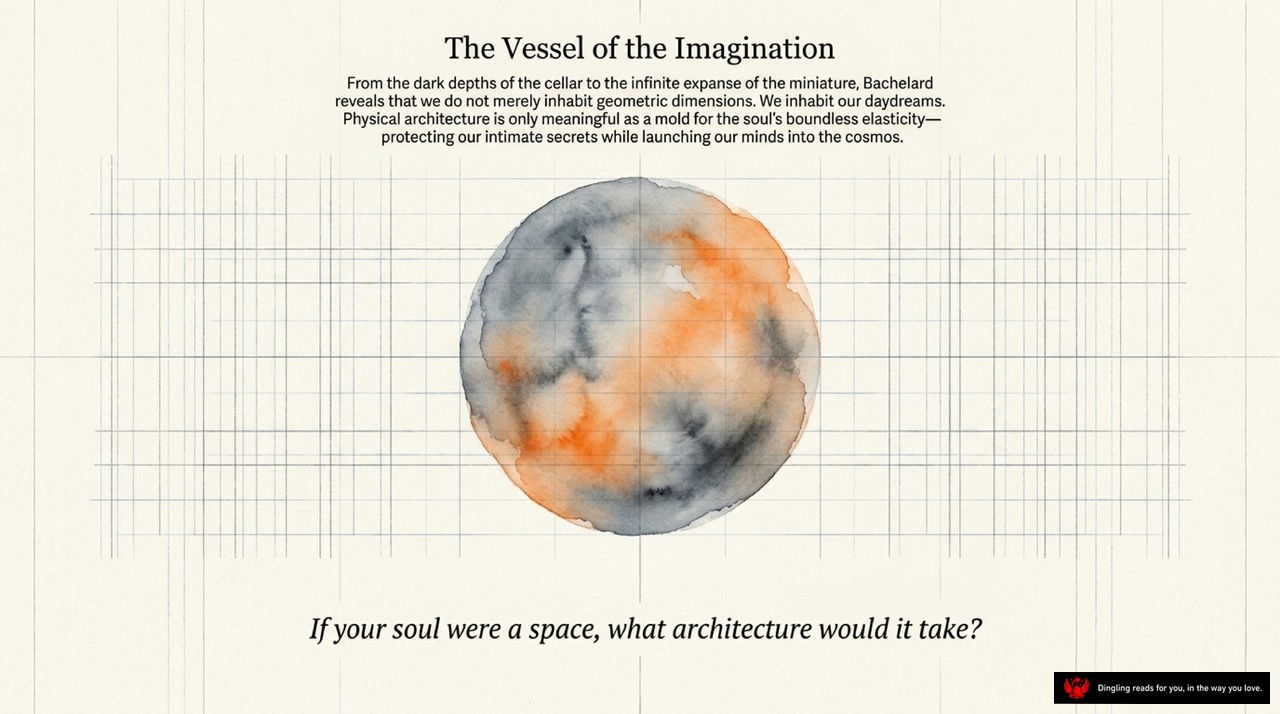
Imagine your soul as a room, but not one built of bricks and mortar. What if its walls were made of daydreams? In *The Vessel of the Imagination*, Gaston Bachelard invites us to see physical architecture not just as a geometric shape, but as a mold for the soul's boundless elasticity. From the dark depths of a cellar to the infinite expanse of a miniature world, we don't merely inhabit space; we inhabit our dreams.
Look at this sphere in the center of our page. It represents that vessel. Bachelard reveals that physical architecture is only meaningful as a container for our intimate secrets while launching our minds into the cosmos. It protects us from the storm outside while allowing our imagination to expand without limit. The text asks us a profound question: "If your soul were a space, what architecture would it take?"
Consider this: every shelter, every hidden corner, shares a dream value. It is not just a place we live; it is a place where the past returns to the present. Whether it's a cozy attic or a deep cellar, these spaces anchor us, turning abstract time into something tangible and solid. So, when you close your eyes and think about your inner sanctuary, don't just think about walls. Think about the feeling of safety, the warmth of a memory, and the freedom to dream. Because in the end, our home is the only place where we are truly at home, forever wrapped in the warmth of our own imagination.