
The Power Elite: Complete Chapter-by-Chapter Summary
Welcome to today's session on *The Power Elite* by C. Wright Mills. Look at the imposing structure behind us—a towering monument of concrete and ambition, rising against a darkening sky. This image perfectly captures the book's central thesis: a unified trinity of corporate, military, and political leaders who dominate modern society and history.
Mills argues that we are not ruled by a chaotic collection of individuals, but by a cohesive group of power elites. These are the people who control the major decisions in our economy, our government, and our armed forces. They don't just exist separately; they intersect and collaborate, forming a powerful network that shapes our world from the top down.
This isn't about blaming a few bad actors or falling into conspiracy theories. Instead, it's a sociological reality. The book reveals how these elites, often from similar backgrounds and educated in the same institutions, share a common perspective. They see the world through the lens of national security and corporate profit, often at the expense of the public good.
As we move forward, we will explore how this power structure operates across three key areas: the local social circles that once held sway, the metropolitan elite like the famous "400 families," and the celebrity system that now distracts us from real power. We'll see how the military, the big corporations, and the political establishment have merged into a single force, leaving the average citizen with little say in the decisions that truly matter.
So, let's dive in and uncover who is really running the show.
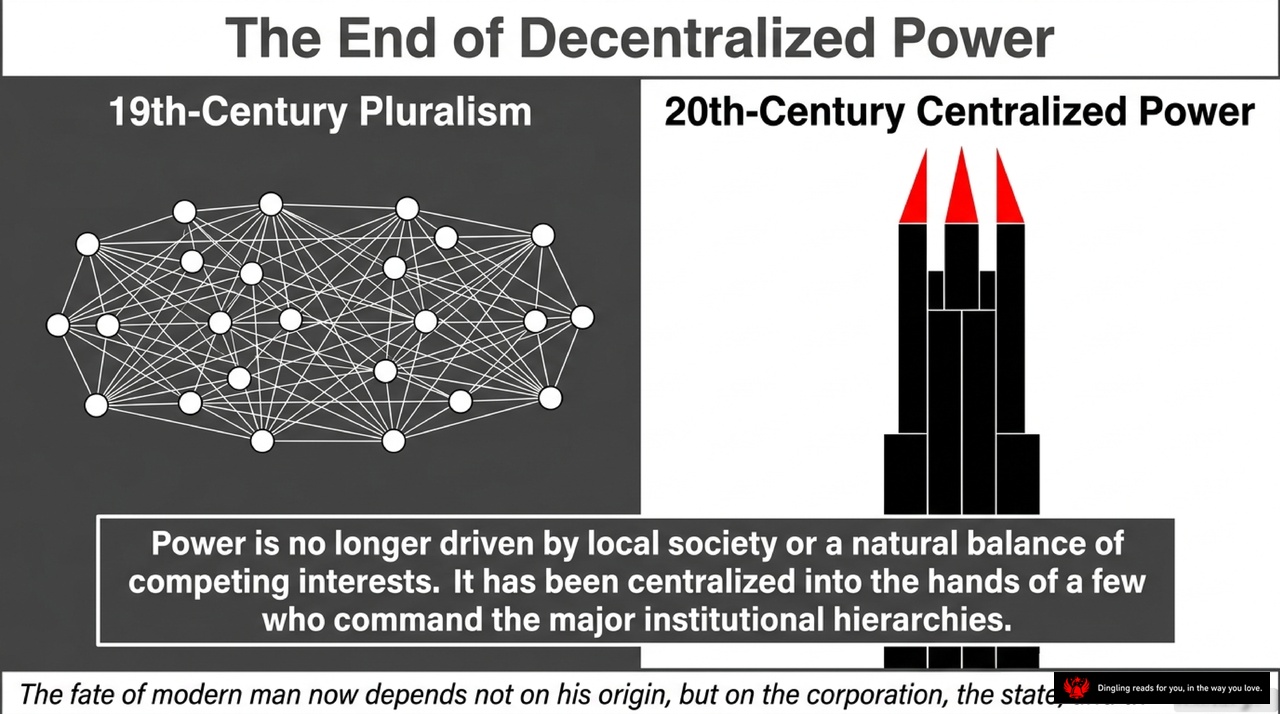
Look at this stark contrast between the 19th and 20th centuries. On the left, we see the ideal of 19th-century pluralism: a web of connections where power was driven by local society and a natural balance of competing interests. It was a decentralized system where no single group held the reins. But look at the right side. That's the reality of 20th-century centralized power. The complex web has collapsed into a few towering spires, representing the state, the corporation, and the military.
As the slide clearly states, power is no longer driven by local society or a natural balance of competing interests. It has been centralized into the hands of a few who command the major institutional hierarchies. This shift marks the end of decentralized power.
The fate of modern man now depends not on his origin, but on the corporation, the state, and the military alliance that dominates them. We are moving from a world where many voices mattered to one where a small, coordinated elite makes the decisions that shape our lives, our economy, and our very survival. The era of the scattered, competing interests is over; the age of the unified power elite has begun.

Let's look at this powerful diagram of "The Tripartite Elite." It illustrates a simple but terrifying truth: in modern America, power doesn't come from one place. It comes from the convergence of three massive circles: The Corporate Warlords, The Military Ascendancy, and The Political Directorate.
At the top, you have the Corporate Warlords—chief executives who have turned personal wealth into class-wide property. On the left, the Military Ascendancy, where high-ranking commanders dominate the permanent war economy. And on the right, the Political Directorate, comprising the executive branch and the inner circle of the centralized state.
But here is the critical point the red arrow is pointing to: The Apex of Power. This isn't a secret conspiracy with a meeting room. It is simply the reality that individuals occupy the command posts in all three of these domains, and their decisions are increasingly merging.
Think about it: a CEO from a defense contractor might eventually become a Secretary of Defense, or a high-ranking general might transition into a top political role. This isn't just coincidence; it's a system where the people running the economy, the military, and the government are effectively the same people. They aren't competing against each other; they are coordinating to shape the nation's destiny. This diagram shows us that the real rulers of America aren't just politicians or CEOs alone, but the unified alliance of all three.
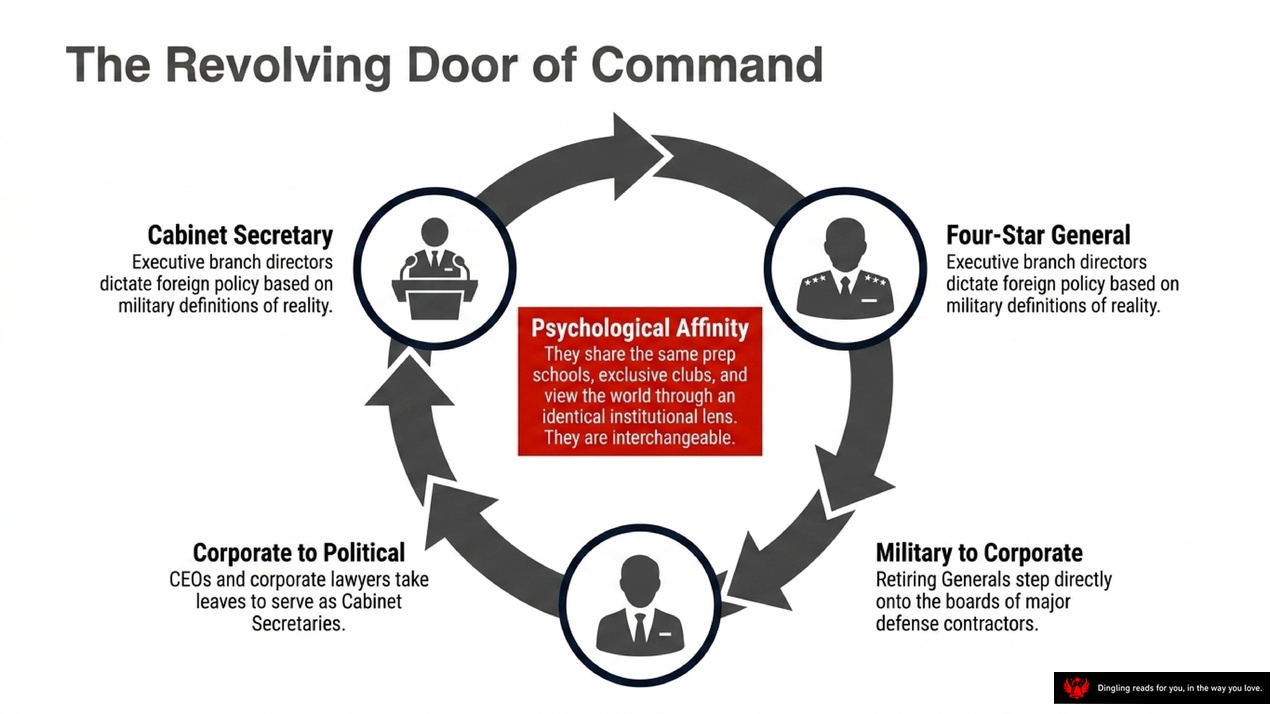
The Revolving Door of Command isn't just a metaphor; it's the operating system of American power. Look at this cycle. On one side, you have Four-Star Generals stepping directly onto the boards of major defense contractors. On the other, CEOs and corporate lawyers leave their boardrooms to serve as Cabinet Secretaries.
This isn't a coincidence; it's a deliberate exchange of personnel. The graphic highlights a crucial concept in the center: Psychological Affinity. These leaders share the same prep schools, exclusive clubs, and view the world through an identical institutional lens. Because they are so interchangeable, they dictate foreign policy based on military definitions of reality, regardless of which branch they are currently leading.
This creates a unified elite where the lines between the military, the corporate world, and the government have completely blurred. When generals run companies and CEOs run the Pentagon, the result is a system where profit and power are inextricably linked, operating with a seamless, unchallenged coordination that defines the modern American state.

Domain I: The Corporate Executive. Look at this slide. On the left, we see "The Past"—a rugged factory and a worker holding a wrench. This represents the myth of the individual entrepreneur, someone who held power through personal ownership and local invention. But look at the arrow pointing to the right. That leads us to "The Present," a towering, complex skyscraper under construction. This is the reality: the corporate bureaucrat holding power not through personal grit, but through institutional position and administrative control.
The key insight here is profound. Corporate wealth has shifted from being the property of a single visionary to becoming class-wide property. These executives no longer manage their own fates; they manage a massive system that is intrinsically linked to national policy and military procurement. This connection separates their immense wealth from any personal accountability. They are the architects of this new era, moving us from the age of the lone inventor to the age of the powerful institution.

Domain II: The Military Ascendancy. Look at this stark contrast between the historic peacetime military and the permanent war economy. While the armed forces were once marginalized during peace, they have now capitalized on a state of permanent emergency, transforming from a tool of the state into a co-director of the state.
This shift is driven by three powerful forces. First, economic integration: defense spending no longer just supports the military; it dictates corporate success, turning the entire economy into a military-industrial engine. Second, political influence: the military now defines reality itself, framing diplomatic and political decisions through a lens of conflict and strategy. Finally, we see the rise of peacetime dominance. The military is no longer just a reactive force; it is a central pillar of power, deeply embedded in the nation's governance.
The text reveals that this isn't about a few individuals pulling strings, but a structural transformation where the military, corporate elites, and political leaders form a unified power structure. By controlling both the means of production and the monopoly on violence, they have created a system where the logic of war permeates every aspect of American life. This is the reality of the permanent war economy.

Welcome to Domain III: The Political Directorate. If you've ever wondered who really runs the show in Washington, this slide reveals the answer: real political power has shifted definitively from the legislative branch to the executive branch. Look at that hierarchy. On the far left, you see Congress, labeled here as "Career Party Politicians." They are now relegated to the middle levels of power, acting more as a rubber stamp than a true governing body.
The true controllers are the red box at the top: The Executive Branch. Notice the description—these are "Corporate/Military Outsiders." The slide explains that the true political directors are now outsiders—corporate lawyers, investment bankers, and military men. They don't run from the bottom up; they are brought in from the top. Finally, look at the bottom right. It states clearly that policy is enacted via executive administration, bypassing traditional democratic debate. The system has been redesigned to prioritize efficiency and elite coordination over public input, leaving the career politicians on the sidelines while the real decision-makers operate from the shadows of the executive suite.

The slide we're looking at today shatters a comforting illusion many of us hold about how America works. The title, "The Myth of the Balance of Power," sets the stage for a hard truth: what we often call a democratic balance is actually a structural reality where power is highly concentrated at the very top.
Look at the left column, labeled "The Romantic Myth." This is the story we tell ourselves. We believe power is balanced across society and that competing interests naturally check and balance each other. We think politicians are neutral brokers who work hard to compromise for the public good, and that ultimately, the sovereign public decides our fate. It's a nice idea, a fairy tale of equal voices and fair play.
But look at the right column, "The Structural Reality." This is the actual operating system of our power elite. Here, power isn't balanced; it's highly concentrated at the top. Instead of competing interests checking each other, elite institutional interests overlap and align—they do not compete. Politicians aren't the masters of the house; they are relegated to minor issues in the middle levels of power, acting as administrators rather than leaders. And far from being the sovereign public, the mass society is manipulated and passive, often unaware that the real decisions have already been made behind closed doors.
This slide illustrates the core argument of the book: the system isn't designed to let the people rule. It's designed to let a small group of interconnected elites—those in business, government, and the military—make the decisions that shape our lives, while the rest of us are left to believe we have a say. The balance of power is not a feature of the system; it's a myth we use to keep the illusion of democracy alive.

The slide reveals a stark reality about the American political landscape: the middle levels are trapped in a "Noisy Stalemate." While Congress, labor unions, and lobbyists debate fiercely, they are locked in a semi-organized deadlock, arguing only over minor or fragmented issues. This constant activity creates an illusion of action, but it fails to link the bottom to the top or drive the epoch-making decisions regarding war, peace, and the national economy.
Above this layer of noise sits "The Apex," where cohesive decisions are actually made. This is the realm of the true power elite—those who control the major corporations, the government, and the military. They operate as a unified group, coordinating their interests to shape the nation's destiny, completely bypassing the chaotic bargaining of the middle tier.
So, when we look at the headlines and hear about endless political squabbles, we must remember: the real decisions happen in the quiet coordination at the top. The middle layer is just the stage set for the elite's actual performance.
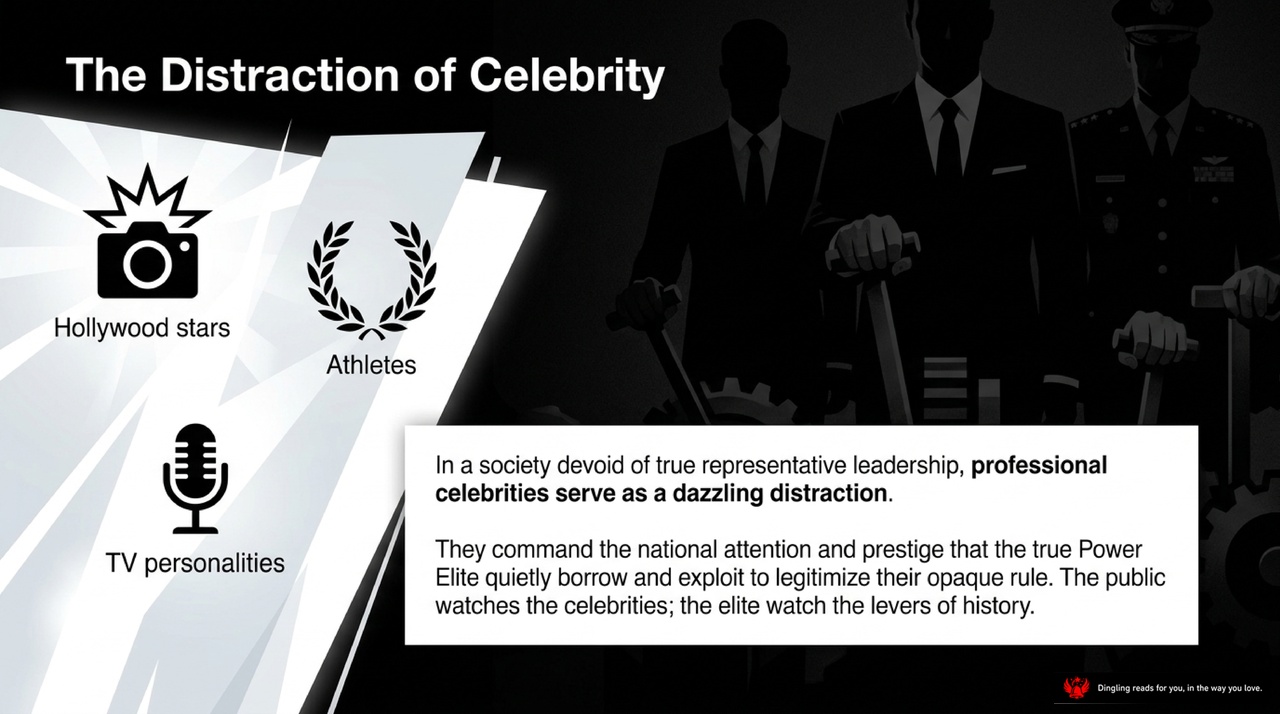
In a society that has lost its true leaders, professional celebrities have become a dazzling distraction. As this slide illustrates, the spotlight is no longer on those who actually run the country, but on Hollywood stars, top athletes, and TV personalities. These figures command our national attention and prestige, acting as a smokescreen for the real Power Elite who quietly borrow this fame to legitimize their opaque rule. While the public is busy watching celebrities, the elite are actually pulling the levers of history. This shift marks a critical turning point where the focus on entertainment and image has successfully diverted us from the real centers of power: the corporate billionaires, political insiders, and military leaders who are making the decisions that shape our future.

Look at this slide comparing "The Public" of the past with "The Mass" of today. On the left, you see a complex web of connections where citizens freely debate, form opinions, and translate them into political action. That was the ideal of a true public. But on the right, the image shifts dramatically to a single megaphone broadcasting downward to isolated individuals. This represents our current reality: the Mass Society.
In this new world, individuals no longer engage in rational debate. Instead, they passively consume information filtered through centralized media. As the text explains, we have moved from a society where people could actively shape their destiny to one where they are isolated from each other and incapable of structural political action. The power to define reality has shifted from the many to a few who control the narrative. We are no longer a public of active participants, but a mass of passive receivers, waiting for instructions from above rather than forging our own path. This transformation is the foundation of how modern power operates today.
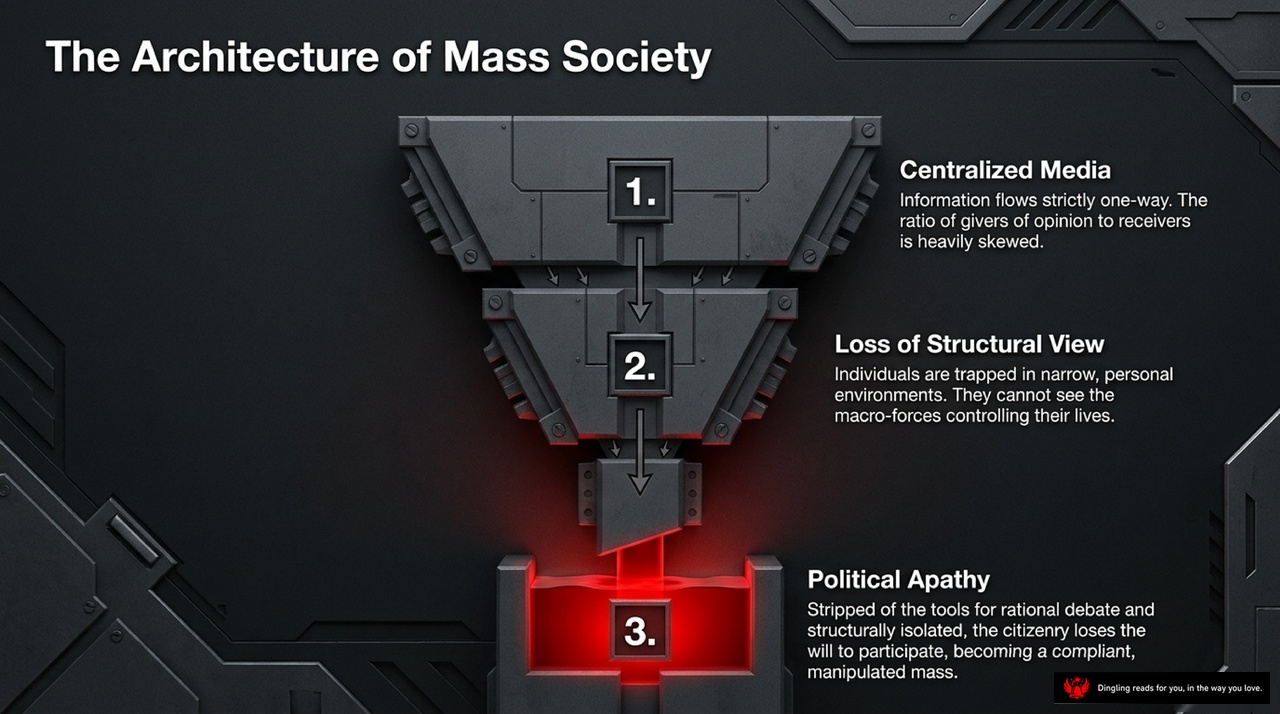
Welcome to the final stage of our exploration into the architecture of mass society. If you look at the diagram on your screen, you're seeing the three-step funnel that shapes our modern world. It starts at the top with **Centralized Media**. Here, information flows strictly one-way, creating a massive imbalance where a tiny group of opinion givers speaks to a silent, overwhelmed audience.
This media dominance leads directly to the second layer: the **Loss of Structural View**. Because we are bombarded with narrow, personal stories, individuals become trapped in their own small bubbles. We lose the ability to see the macro-forces—the huge economic and political systems—that are actually controlling our lives.
Finally, this funnel empties into the third and most critical layer: **Political Apathy**. When citizens are stripped of the tools for rational debate and feel structurally isolated, they simply stop caring. The result is a compliant, manipulated mass that no longer believes it can participate in its own destiny. This isn't just about disinterest; it's about a deliberate erosion of the very structures that allow democracy to function.
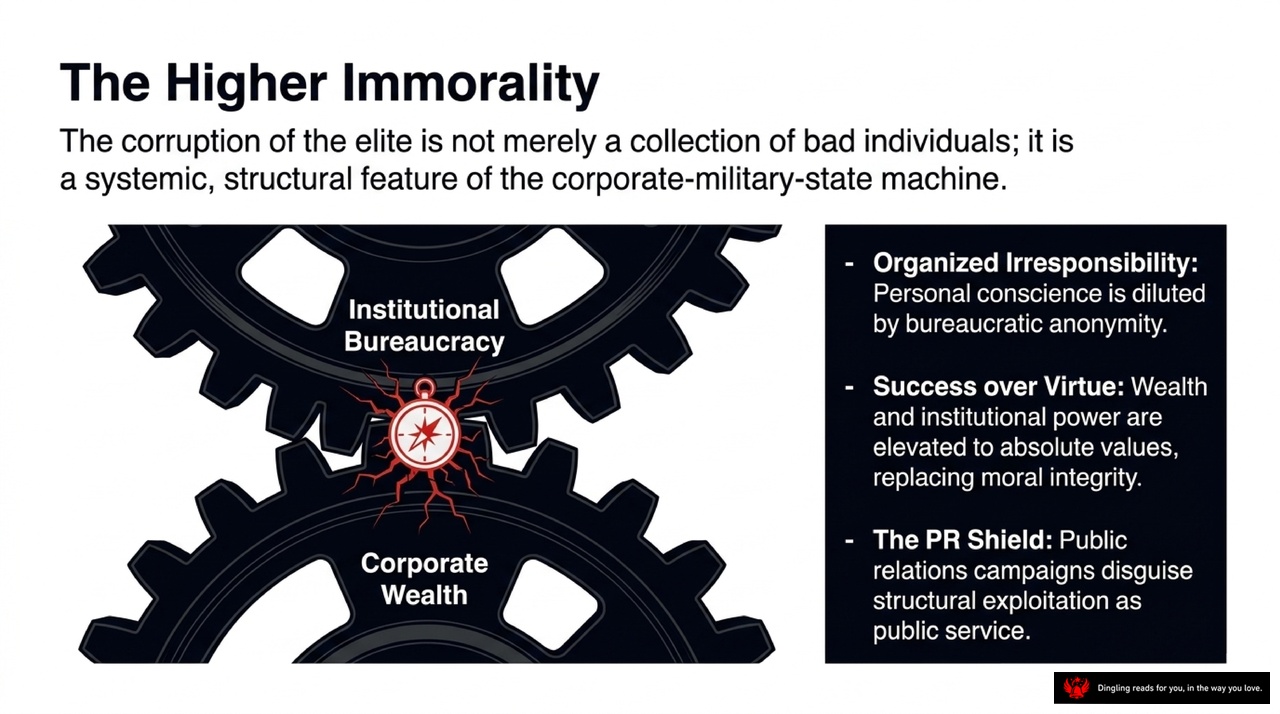
The slide we're looking at today is titled "The Higher Immorality," and it cuts straight to the heart of a disturbing reality: corruption among the elite isn't just about a few bad apples; it's a systemic feature of the corporate-military-state machine. Think of the two gears on the left—Institutional Bureaucracy and Corporate Wealth. They mesh perfectly, driving a machine where personal conscience gets diluted by bureaucratic anonymity, and where success is valued far above virtue.
On the right, the slide breaks this down into three mechanisms. First, "Organized Irresponsibility." This is the ultimate shield: when you're just a cog in a massive bureaucracy, no one feels personally accountable for the outcome. Second, "Success over Virtue." In this system, wealth and power become the only absolute values, completely replacing moral integrity. If you're rich and powerful, you've "won," regardless of how you got there. Finally, "The PR Shield." This is the cleverest part of the machine. Public relations campaigns are used to disguise structural exploitation as public service, making the unethical look like altruism.
As we've discussed, the power elite—comprising corporate giants, political leaders, and military commanders—operate in a zone where these three elements reinforce each other. They don't need to be evil individuals to be corrupt; the system itself demands a specific kind of immorality to function. They prioritize profit and security over the common good, and they have the tools to hide it all behind a veil of professional efficiency and patriotic rhetoric. This isn't a conspiracy of shadowy villains; it's the standard operating procedure of the top tier of American society.

Look at this striking visual: a towering red pillar labeled "POWER" stands in stark contrast to a much smaller, gray column of "KNOWLEDGE." A dotted line connects them, labeled "Public Relations & Slogans." This graphic perfectly captures a dark truth about our modern elite. The power elite are not the philosopher-kings we might imagine. In reality, they are often intellectual mediocrities who treat knowledge strictly as a tool for success and manipulation.
Notice how the diagram shows rational debate has been replaced by memos, clichés, and psychological manipulation. Intellectuals are no longer truth-tellers; they have become hired technicians serving the elite. Instead of engaging in genuine discourse, the powerful use public relations and slogans to bridge the gap between their absolute power and the limited knowledge of the public. They control the narrative, ensuring that their decisions are accepted not through understanding, but through influence. This separation of knowledge and power is the engine driving our current political and social landscape.
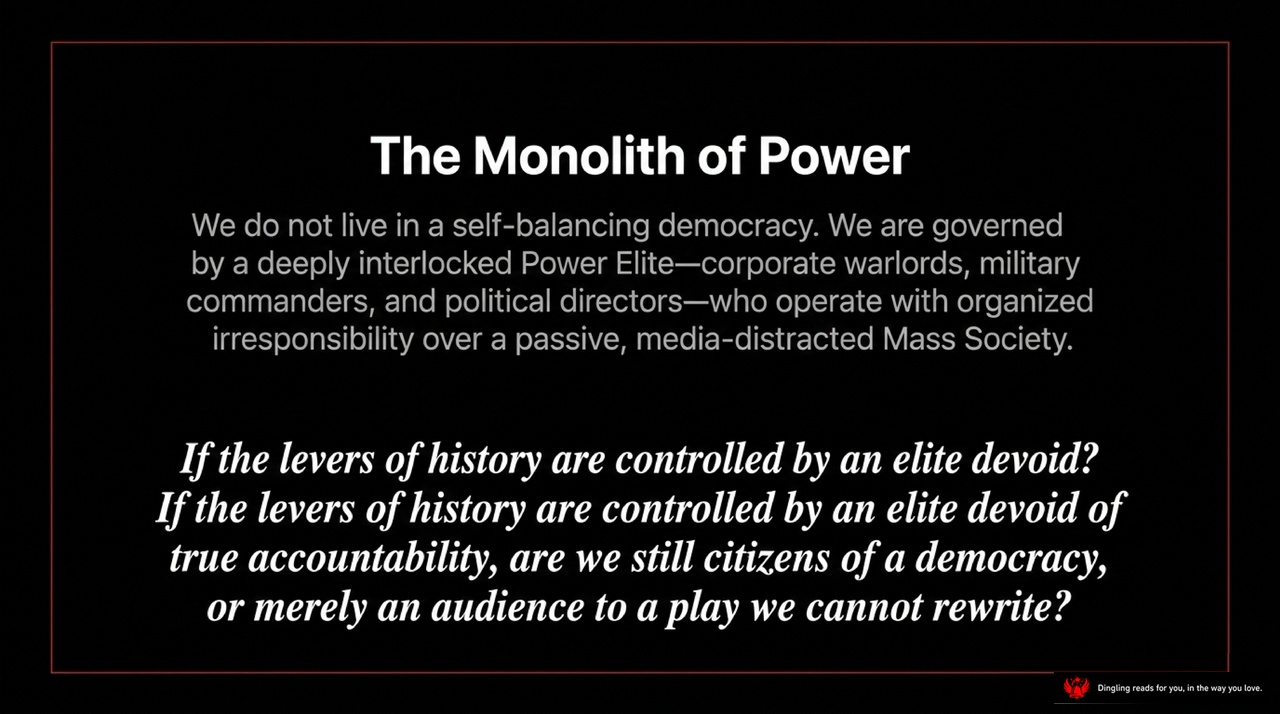
We live in a world where the levers of history are no longer held by the people, but by a deeply interlocked Power Elite. This isn't a self-balancing democracy where interests naturally check each other. Instead, we are governed by a monolith of power: corporate warlords, military commanders, and political directors operating with organized irresponsibility over a passive, media-distracted Mass Society.
Think about it: when history's turning points are decided, who is actually pulling the strings? The answer lies in this elite group, which is devoid of true accountability. They don't operate as a shadowy cabal plotting every move, but through a seamless rotation of careers between the highest levels of business, government, and the military. A banker today might be a general tomorrow, or a politician next. This interchangeability creates a unified class that thinks alike, shares the same elite education, and controls the nation's most critical institutions.
But here is the real question that keeps us awake at night: If the levers of history are controlled by an elite devoid of true accountability, are we still citizens of a democracy, or merely an audience to a play we cannot rewrite? The power elite has successfully turned a vibrant public into a passive mass, manipulating our perception of reality through the very media that claims to inform us. We are left watching a show where the script is written by those who never have to face the consequences of the ending.