
The Price of Inequality: Complete Chapter-by-Chapter Summary

Welcome to the book club edition of *The Price of Inequality* by Nobel laureate Joseph E. Stiglitz. Today, we're looking at the cover, which sets a powerful tone for the journey ahead. That massive golden pillar isn't just a symbol of wealth; it represents the crushing weight of inequality that has come to define our modern economy.
Stiglitz, a true expert on this subject, describes this book as a definitive analysis of how the concentration of wealth and political power threatens our future. He argues that we are living through a crisis where the gap between the top 1% and everyone else has become unmanageable. It's not just about money; it's about the very idea of the American Dream, which is currently under severe stress.
The book promises to show us that this isn't just an economic issue, but a threat to our democratic ideals. As we dive into the chapters, we'll explore how this imbalance has created a society where opportunity is no longer equal, and where the rules of the game seem designed only for the wealthy few. Let's turn the page and start uncovering the real story behind the numbers.

Look at this slide. On the left, we see a perfectly balanced scale labeled "The Myth of the Free Market." It suggests that wealth naturally flows to those who contribute most, that poverty is just a personal failure, and that the rich get richer because they deserve it. But look at the right side: "The Engineered Reality." The scale is tipped heavily to one side. This isn't how our economy actually works.
The truth is, our markets aren't free; they are actively shaped by political forces. We aren't seeing a fair distribution of wealth based on productivity. Instead, rules are being rewritten specifically to benefit the top 1% at the direct expense of the remaining 99%. In this engineered reality, wealth isn't being created through innovation and hard work; it is being extracted from the many and concentrated in the hands of the few. What we call the "free market" is often just a system designed to funnel resources upward, leaving the rest of us behind.

So, we're looking at the mechanics of rent-seeking, and the slide lays out a stark contrast between the myth and the reality of how wealth is actually created—or rather, extracted.
On the left, under "The Myth," we see the idealized version: compensation tied to performance, market dominance won through superior products, and financial advantages that drive societal growth. That's the story we're often sold—that success is purely about value creation.
But look at the red column on the right, labeled "The Reality." This is where the truth gets exposed. Instead of rewarding high performance, we see "Retention Bonuses" handed out even during massive corporate failures or bailouts. Instead of winning in a free market, dominance is sustained through monopolies built on lobbying, anti-competitive practices, and artificial barriers to entry. And instead of efficient capital allocation, we find predatory lending and the exploitation of information asymmetries.
The bottom line, as this slide clearly states, is that rent-seeking transfers wealth from the bottom of the pyramid to the top without adding any new value to the economy. It's a system designed for extraction, not creation, and that's the core engine driving the inequality we've been discussing.
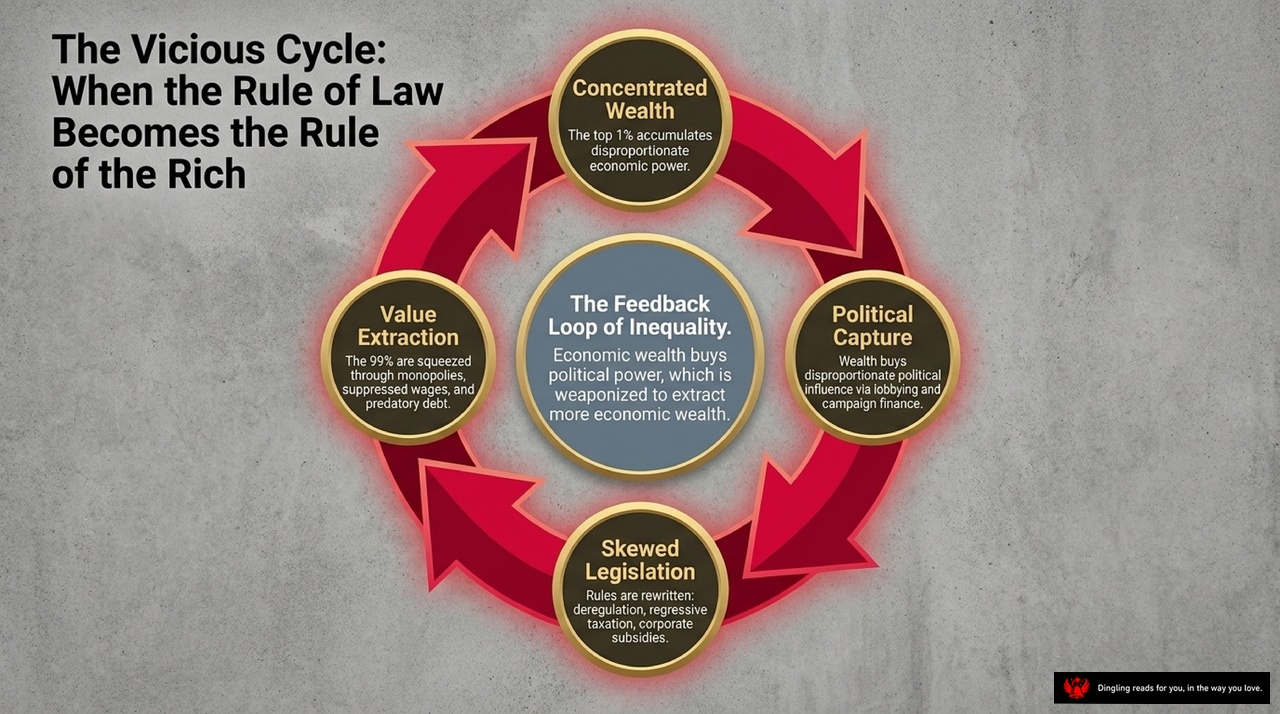
The market isn't just a natural force; it's a system built by rules we write. And for the last few decades, those rules have been rigged in favor of the top 1%.
Think about the unions. In 1980, over one in five workers belonged to a union. By 2010, that number had plummeted to barely 12%. When unions lose their power, workers lose their bargaining chip. Suddenly, companies can slash wages and fire people with impunity, while executives take home sky-high bonuses. This shift alone explains a huge chunk of why the gap between rich and poor has exploded.
But it's not just about labor. Look at how companies are run. For decades, social norms kept CEO pay in check. But that changed. Executives started using "golden parachutes" and poison pills to protect themselves, effectively insulating themselves from the very workers they manage. Even when the economy crashes, companies cut jobs to save costs, but they still hand out massive bonuses to the top. It's a system designed to extract wealth from the bottom and funnel it upward.
Then there's the global factor. Over the last thirty years, financial deregulation and trade deals have created a "race to the bottom." Countries compete to attract capital by slashing regulations and taxes. Meanwhile, multinational corporations threaten to move their factories overseas if they don't get lower wages. This squeezes American workers from both sides: imports from lower-wage countries drive down local pay, while the threat of offshoring weakens workers' ability to negotiate.
And let's not forget discrimination. Despite having similar education levels, women, African Americans, and Hispanics still earn significantly less than white men. The market doesn't fix this on its own; in fact, biases and implicit discrimination often make it worse. During the Great Recession, banks targeted minority neighborhoods for predatory loans, destroying the wealth of millions of Black families. Today, the median net worth of a typical Black family is only one-twentieth of a white family's.
Finally, consider the tax code. It's designed to reward capital over labor. Marginal tax rates for the wealthy have dropped from 70% in the Carter era to just 28% under Reagan, and capital gains taxes are even lower. Meanwhile, loopholes allow massive corporations to pay almost nothing. The result? The rich pay a smaller percentage of their income in taxes than the middle class.
So, we have a perfect storm: shrinking unions, unchecked executive pay, a global race to the bottom, systemic discrimination, and a tax system that favors the wealthy. These aren't accidental outcomes; they are the direct result of policy choices that have prioritized the interests of the top 1% over the rest of us.

The image on your screen reveals a terrifying blueprint of how the top 1% has captured our reality. It's not just about money anymore; it's about "The '1984' Cognitive Capture."
Look at the golden vault at the top labeled "The 1% Wealth." That's the source of power, and it doesn't just sit there. It flows into three powerful pillars: Think Tanks, Media Conglomerates, and Academic Endowments. These institutions act as the engines that manufacture the very ideas we are told to believe.
From these pillars, the system spits out three specific narratives designed to keep us compliant: "Job Creators," "Deficit Obsession," and "Class Warfare." These aren't accidental stories; they are carefully crafted scripts. Their goal is simple but devastating: to create "Voter Disillusionment."
Notice the bottom of the diagram. The 99% of us are accepting policies that actively harm us, all because of confirmation bias and these manufactured narratives. We've been conditioned to think that ideas are just like products, and the 1% has successfully marketed regressive policies as if they were universal solutions for everyone. But the reality is the opposite. We are trapped in a system where our voices are drowned out, and our choices are limited to options designed by the elite. This isn't democracy; it's a cognitive prison where the only way out is to realize the game is rigged and demand a new set of rules.
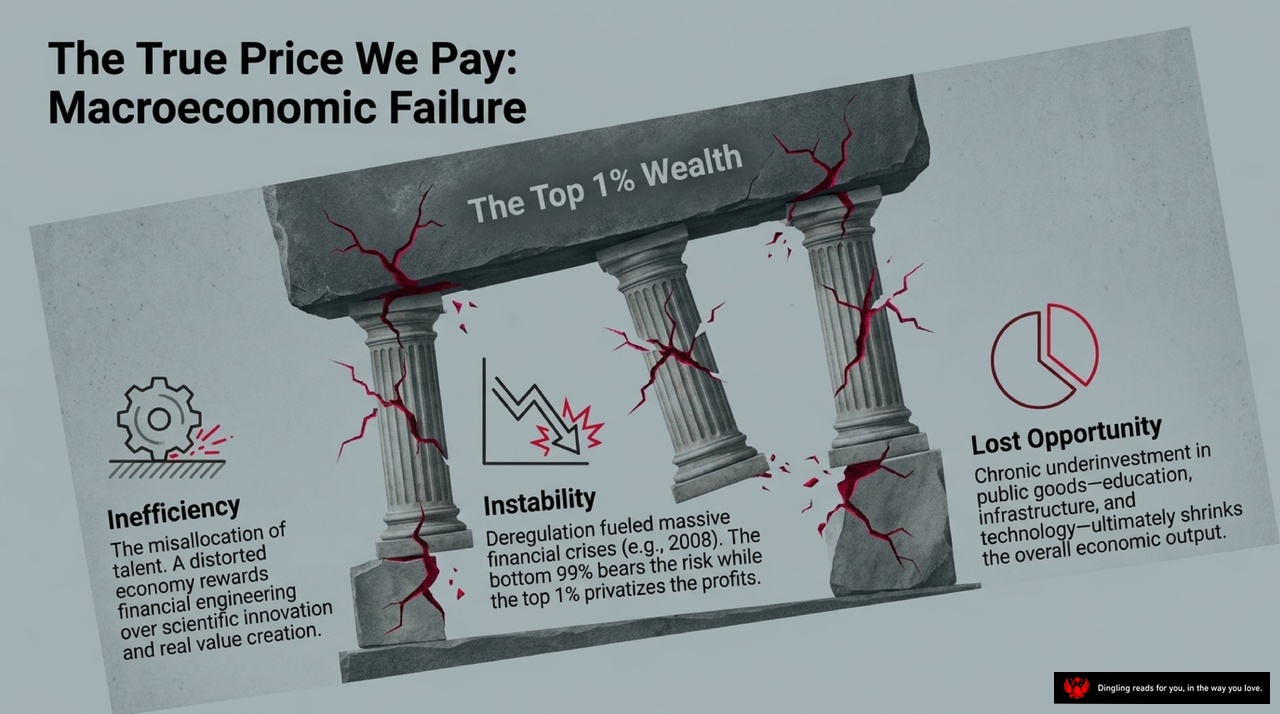
The title "The True Price We Pay: Macroeconomic Failure" sets a stark tone for what we're seeing here. This slide isn't just about abstract numbers; it's a visual warning of how our economic system is collapsing under its own weight. At the top, we see "The Top 1% Wealth" resting on pillars that are cracking apart. This metaphor perfectly captures the fragility of our current model.
Let's break down these three critical failures. First, on the left, we have "Inefficiency." The text explains this as the misallocation of talent. Instead of rewarding scientific innovation and real value creation, our distorted economy now prioritizes financial engineering. We are building castles in the air rather than laying foundations for the future.
In the center, we see "Instability." The graphic shows a crashing graph. This isn't an accident; it was fueled by deregulation. The slide points out a brutal reality: the bottom 99% bears the risk, while the top 1% privatizes the profits. We saw this play out in 2008, where the system was allowed to become too big to fail, leaving ordinary families to pick up the pieces.
Finally, on the right, we face "Lost Opportunity." The pie chart is missing a huge slice. This represents the chronic underinvestment in public goods like education, infrastructure, and technology. When we stop investing in the tools that help everyone grow, we shrink the overall economic output for everyone.
The image of the crumbling columns tells us that this isn't a stable structure. The wealth of the top 1% is currently propping up a broken system, but the cracks are too deep. Without fixing these issues—realigning incentives, restoring stability, and investing in our shared future—we are paying a price that will only get steeper.

Have you ever felt like the news is telling you one story, but your life is living a completely different one? That disconnect is the heart of what we call "The Blind Spot."
Look at this iceberg. The tiny tip above the water represents what our economy officially celebrates: GDP growth, corporate profits, and stock market highs. It's the shiny gold that everyone looks at. But the massive, hidden reality below the water is where the true story of America lives.
Beneath the surface, we see a different picture. While the top keeps climbing, the reality for the other 99% is often a hidden struggle of stagnant incomes, environmental damage, and a loss of hope. The data shows that while the top 1% captures the vast majority of wealth growth, the middle class sees their earnings stall, and social mobility begins to vanish.
Here is the crucial takeaway: if we measure the wrong things, we will inevitably do the wrong things. By obsessing over GDP, we ignore the fact that growth that only benefits the wealthy is an illusion for everyone else. It's time to stop looking at the tip and start understanding the massive, hidden reality that actually shapes our lives.
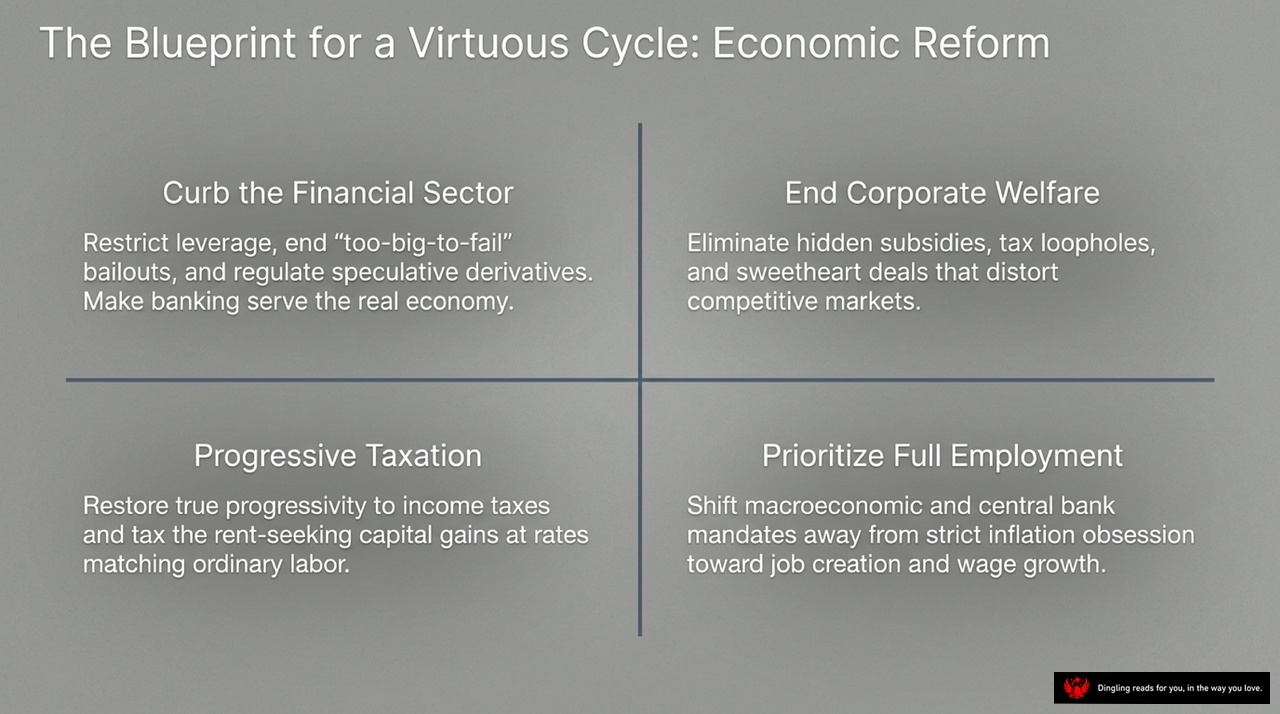
Let's talk about the blueprint for a virtuous cycle—specifically, how we can engineer an economic reform that actually works for everyone.
This slide outlines four critical pillars. First, we need to curb the financial sector. That means restricting leverage, ending those "too-big-to-fail" bailouts, and finally regulating speculative derivatives so that banking actually serves the real economy instead of just gambling with other people's money.
Second, we must end corporate welfare. This involves eliminating hidden subsidies, closing tax loopholes, and stopping sweetheart deals that distort competitive markets. We can't let the system rig the game in favor of the powerful.
Third, we need to implement progressive taxation. It's time to restore true progressivity to income taxes and tax rent-seeking capital gains at rates that match ordinary labor. If you're making money from speculation, you should pay the same as someone making it from work.
Finally, and perhaps most importantly, we must prioritize full employment. We need to shift our macroeconomic and central bank mandates away from an obsession with strict inflation control and toward job creation and wage growth. When people have jobs, the economy grows, and everyone wins.
These aren't just abstract ideas; they are the specific levers we need to pull to break the cycle of inequality and build a sustainable future.
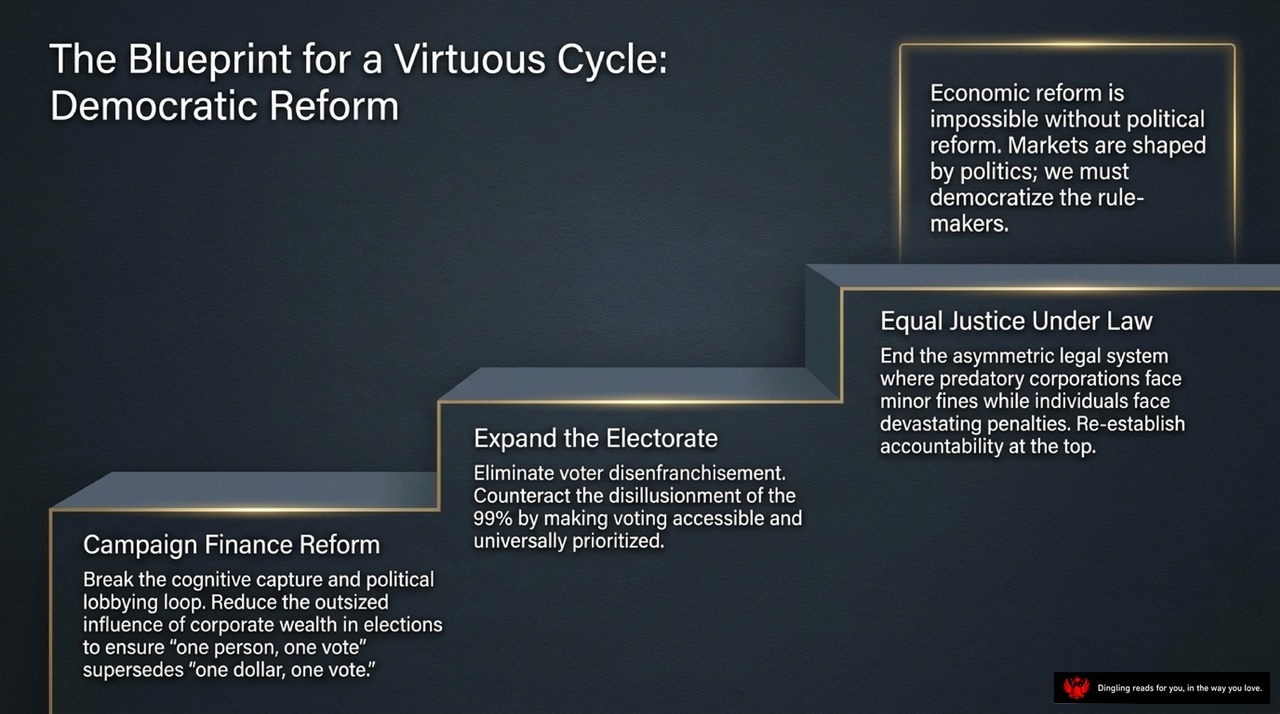
Look at this blueprint for a virtuous cycle: Democratic Reform. The core message here is simple but powerful—economic reform is impossible without political reform. Markets are shaped by politics, so we must democratize the rule-makers.
This slide breaks down the path into four essential steps. First, we need Campaign Finance Reform. We have to break the cognitive capture and lobbying loops that currently dominate our elections. The goal is clear: reduce the outsized influence of corporate wealth so that "one person, one vote" finally supersedes the current reality of "one dollar, one vote."
Next, we must Expand the Electorate. This means eliminating voter disenfranchisement and making voting accessible and universally prioritized. We need to counteract the deep disillusionment felt by the 99% and ensure their voices are heard.
Then, we look at Equal Justice Under Law. We need to end this asymmetric legal system where predatory corporations face minor fines while individuals face devastating penalties. We must re-establish accountability at the top, ensuring the rules apply equally to everyone.
Finally, at the very top, we see that all of this leads to a broader Economic Reform. By democratizing the rule-makers, we create the political conditions necessary for true economic transformation. This is the only way to break the cycle of inequality and build a system that works for everyone.
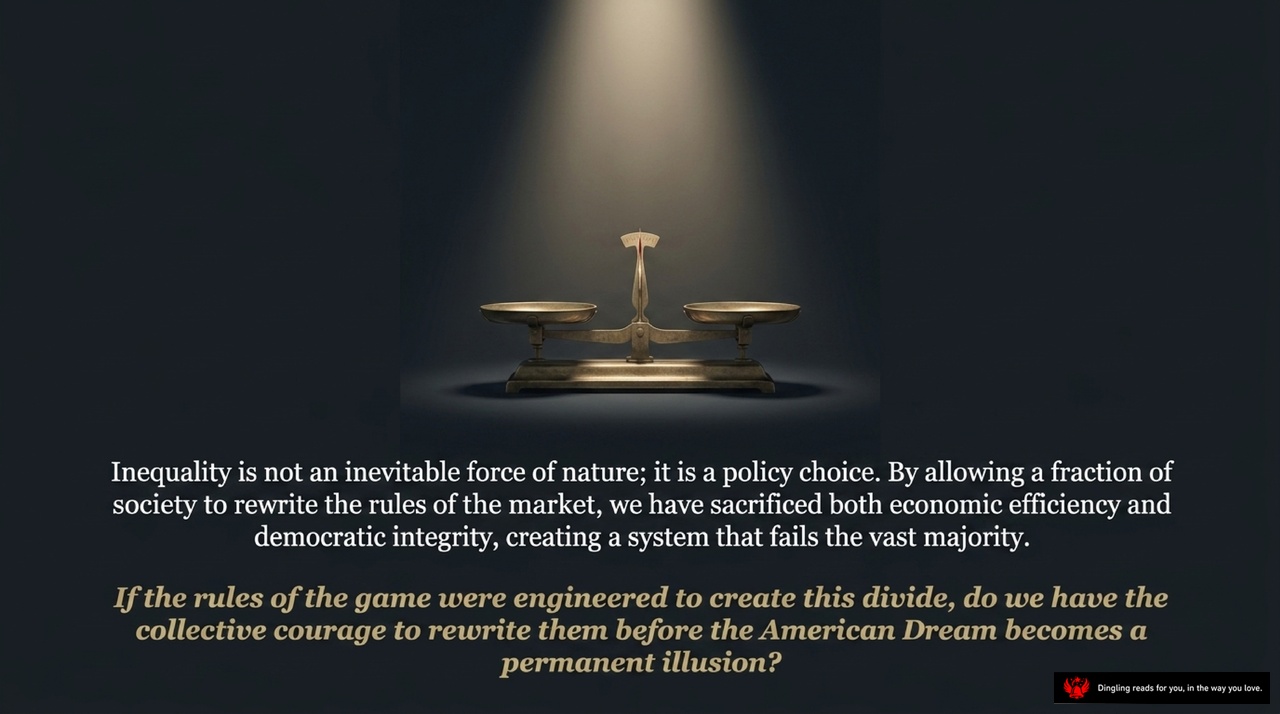
Look at this scale in the center of the screen. It's perfectly balanced, yet the text below it asks a heavy question about our reality: Is inequality a force of nature, or simply a policy choice? The answer is clear: it is a choice we made. By allowing a small fraction of society to rewrite the rules of the market, we have sacrificed both economic efficiency and democratic integrity, creating a system that fails the vast majority.
Think about the game we are playing. If the rules were engineered to create this divide, do we have the collective courage to rewrite them before the American Dream becomes a permanent illusion? The text on your slide captures the core argument: we aren't trapped by fate. We built this imbalance through specific policies that let the wealthy capture the rules, resulting in a society where the top 1% holds over a fifth of all national income while the rest struggle.
This isn't just about money; it's about the very soul of our democracy. When a few can dictate the terms for everyone else, we lose our shared prosperity. The slide challenges us to stop accepting this status quo. We must ask ourselves: Are we willing to stop letting a privileged few engineer our future? The path forward requires us to reclaim the rules, ensuring that the American Dream remains a reality for everyone, not just an illusion for the few.