
The Promise: Complete Chapter-by-Chapter Summary

Welcome to our deep dive into Damon Galgut's masterpiece, *The Promise*. Set against the vast, desolate landscapes of South Africa, this story unfolds as a powerful saga of a white family's gradual decay and the crushing weight of a broken word.
The image captures the essence of the novel perfectly: a lone, withered tree standing defiant yet lifeless under a storm-choked sky. This barren field mirrors the internal landscape of the characters, particularly Amiel, whose life unravels after her mother's death. It is a stark reminder that in this world, an unkept promise doesn't just fade away; it leaves behind a wasteland that consumes everyone around it.
As we journey through the pages, we see how a single lie and a forgotten vow ripple outward, destroying bonds and identities. From the rigid structures of apartheid to the fragile connections within a fractured family, Galgut explores what happens when truth is sacrificed for comfort. It is a haunting tale of guilt, loss, and the inevitable cost of silence. Let's turn the page and explore the lives of those trapped in the shadow of a broken promise.

The Overheard Vow, The Debt, The Witness. These three words on your slide capture the exact moment the story of *The Overheard Vow* takes a terrifying turn.
Let's look at the scene. We see Rachel Swart, dying of cancer, lying in that dimly lit room. She is making a final, desperate plea to her husband, Manie. She extracts a promise: he must legally transfer the deed of the Lombard house to Salome, the Black domestic worker who bathed and cared for her in her final days. This is the debt—a moral obligation that Manie feels he must honor.
But here is the twist that changes everything. Outside that window, in the shadows of the crumbling wall, sits a 13-year-old boy named Amor. He has overheard this vow. He is the witness.
This single moment plants a seed of truth in the mind of a child. For the next 30 years, that seed waits in silence, buried under the complexities of apartheid laws, family secrets, and the harsh realities of their lives. But eventually, that seed will bear fruit, forcing a reckoning that no one expected. This is the engine that drives the entire narrative forward.

This blueprint reveals the fractured heart of the Swart family, a house literally and metaphorically torn apart by a deep, jagged crack running through its center. At the top, we see the source of the destruction: the parents, Manie and Rachel. Manie is defined by hypocrisy and denial, while Rachel, the dying catalyst, pulls the family into a tragic spiral of guilt and religious conflict.
Surrounding them are the observers, Tannie Marina and Oom Ookie, who act as complicit enablers, often prioritizing their own comfort over the truth. Meanwhile, Salome stands as the invisible center, the loyal servant whose humanity is constantly overlooked by the family above.
Below them lie the heirs, each carrying a different burden. Anton represents wasted potential and cynicism, having already lost his way in the army. Astrid embodies material ignorance and vanity, trapped in her own fears and superficiality. And finally, there is Amor, the exiled moral compass. She is the only one who sees the cracks in the foundation, yet she is forced to leave, carrying the weight of her family's conscience into the unknown. This map isn't just about geography; it's a portrait of a family that has lost its way, with everyone playing a role in the collapse.

The image before us lays bare the tragic rhythm of this family's life, a timeline where the nation's history and personal tragedies are inextricably woven together. From 1986 to 2018, we see a cracked foundation that never heals.
In 1986, under the Apartheid State of Emergency, Rachel died, and the promise of a future was made and immediately denied. By 1995, in the post-Apartheid Mandela era, Manie died, bitten by a snake, only for the heir to return. Then, in 2004 during the Mbeki era, rising middle-class crime claimed Astrid in a hijacking. Finally, in 2018, as the nation moved from Zuma to Ramaphosa and called for land reform, Anton took his own life, leaving the promise hollowly kept.
This timeline reveals a heartbreaking truth: the family's internal fractures mirror the nation's external struggles. While the country transitions from emergency to reform, the family cycles through loss after loss, with each death stripping away another layer of hope. The cracks in the earth beneath them are not just geological; they are the result of a society that fails to protect its most vulnerable, leaving families like the Swarts to endure a relentless cycle of grief and broken promises.

Step 1: The Soldier's Return: Anton, aged 19, returns from the military after shooting a Black wo: in the township. He refuses his inheritance.
Step 2: The Patriarch's Denial: Manie insists he never promised anything.
Step 3: The Spiritual Shield: Manie turns to Pastor Alwyn Simmers, using newfound religious fanaticism to legally and morally obscure his duty.
Key Insight: The promise is immediately denied. Religion becomes a weapon against moral obligation.
---
In this pivotal moment, we see the brutal collision between a father's broken promise and the rigid structures of power. The image captures Anton's return—a 19-year-old soldier carrying the weight of having taken a life in the township. He comes home not as a hero, but as a man who has crossed a line, and his immediate response is to reject the very inheritance that defines his family's legacy.
But the story doesn't end with Anton's refusal. Look at the second step: the patriarch's denial. Manie, the father, refuses to accept the moral debt he owes. Instead of honoring the promise he made to his wife and the worker Salome, he insists he never promised anything at all. It's a classic act of erasure, rewriting history to suit his own comfort.
Then, we reach the most chilling step: the spiritual shield. Manie doesn't just lie; he weaponizes faith. He turns to Pastor Alwyn Simmers, using his newfound religious fanaticism to create a legal and moral fog. Suddenly, the promise isn't a moral obligation; it becomes a matter of "church law" or "divine will," obscuring the human cost behind a veil of piety.
The key insight here is devastatingly clear: the promise is immediately denied, and religion becomes a weapon against moral obligation. In this story, faith is stripped of its compassion and repurposed as a tool for the powerful to escape their responsibilities, leaving the vulnerable—like Salome and Anton—to bear the consequences.
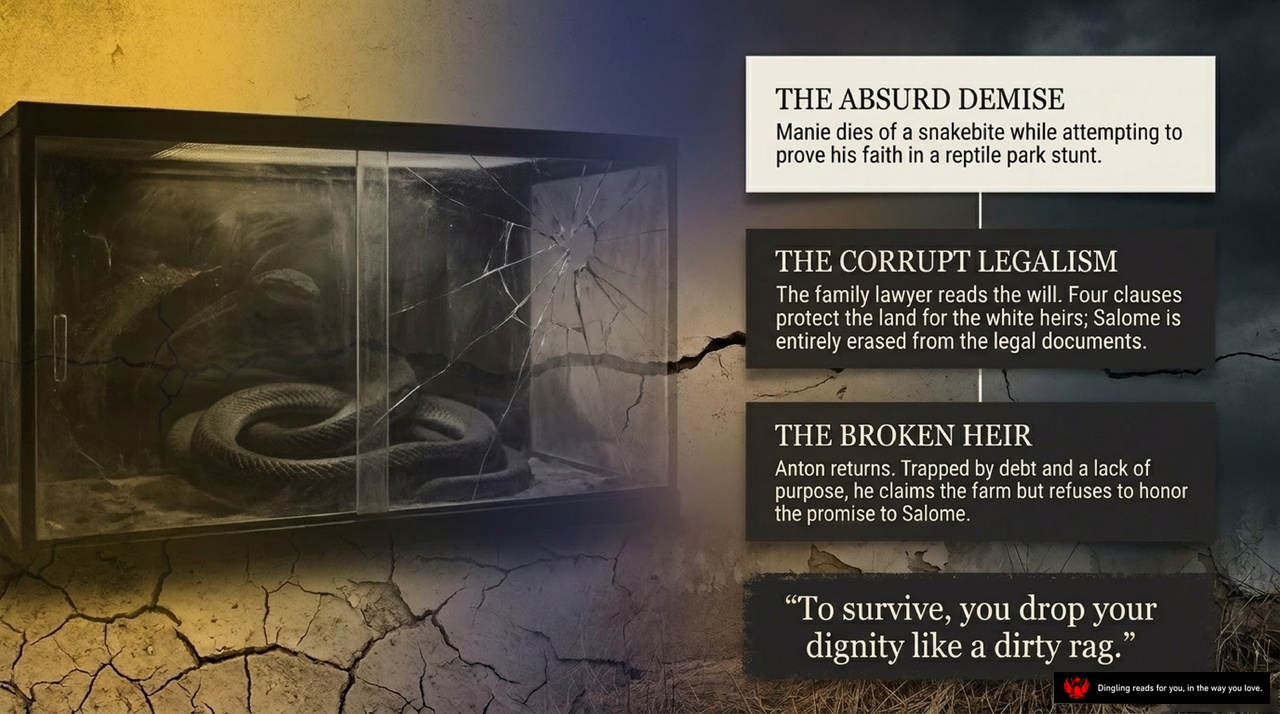
The cracked earth beneath us tells a story of a broken foundation, mirroring the tragic end of Manie, who lost his life trying to prove his faith in a dangerous reptile park stunt. But the real destruction wasn't just in the glass enclosure; it was in the law itself. When the corrupt family lawyer finally read the will, the truth was stark: four clauses protected the land for the white heirs, while Salome, the woman who had served them faithfully, was erased from the legal documents entirely.
This is the moment the family's lie became official. Anton, returning from the army, claimed the farm but refused to honor his father's promise to Salome. He was trapped by debt and a lack of purpose, choosing to survive by dropping his dignity like a dirty rag. As the final quote on this slide reminds us, in this broken system, survival often demands you trade your soul for a piece of land that was never yours to begin with.
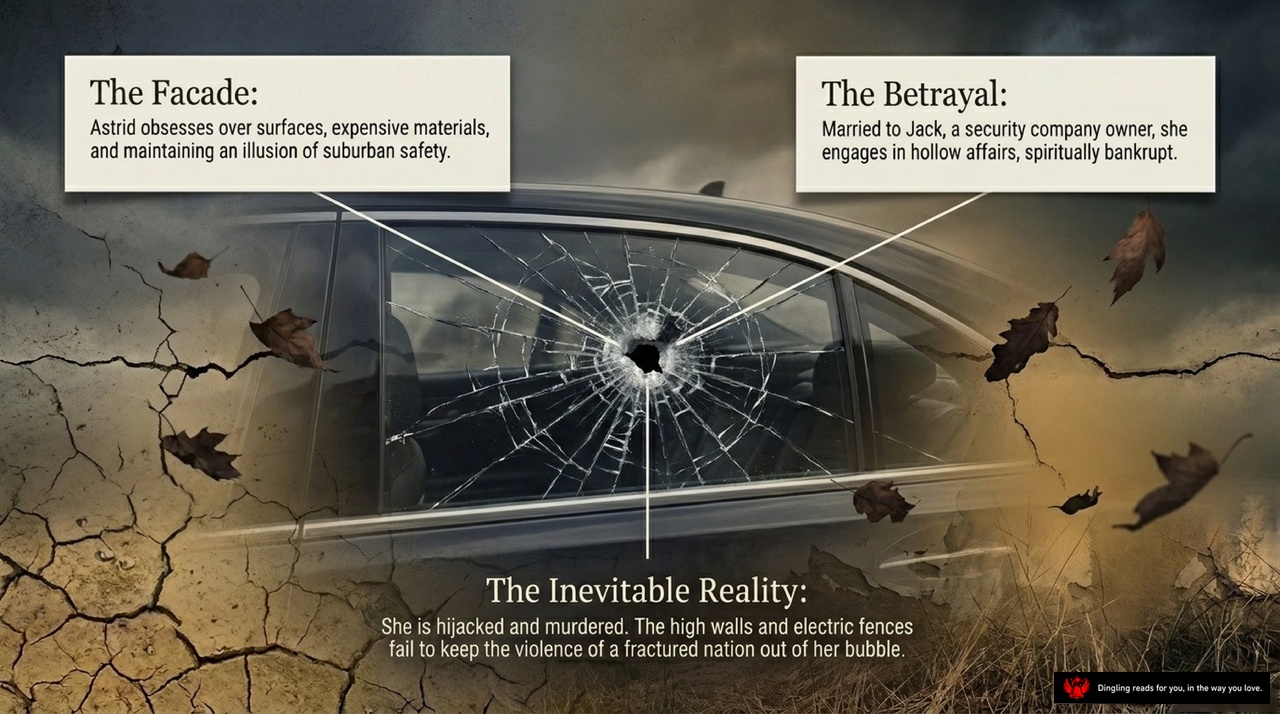
Look at this shattered window. It's the perfect visual for Astrid's life. On the surface, she's obsessed with expensive materials and maintaining an illusion of suburban safety—that's the facade. But behind the glass, the reality is cracking. She's married to Jack, a security company owner, yet she's engaged in hollow affairs, spiritually bankrupt. That betrayal is what drives her to the edge. And here is the inevitable reality: she is hijacked and murdered. The high walls and electric fences she relied on fail to keep the violence of a fractured nation out of her bubble. This is the brutal truth that the book reveals.
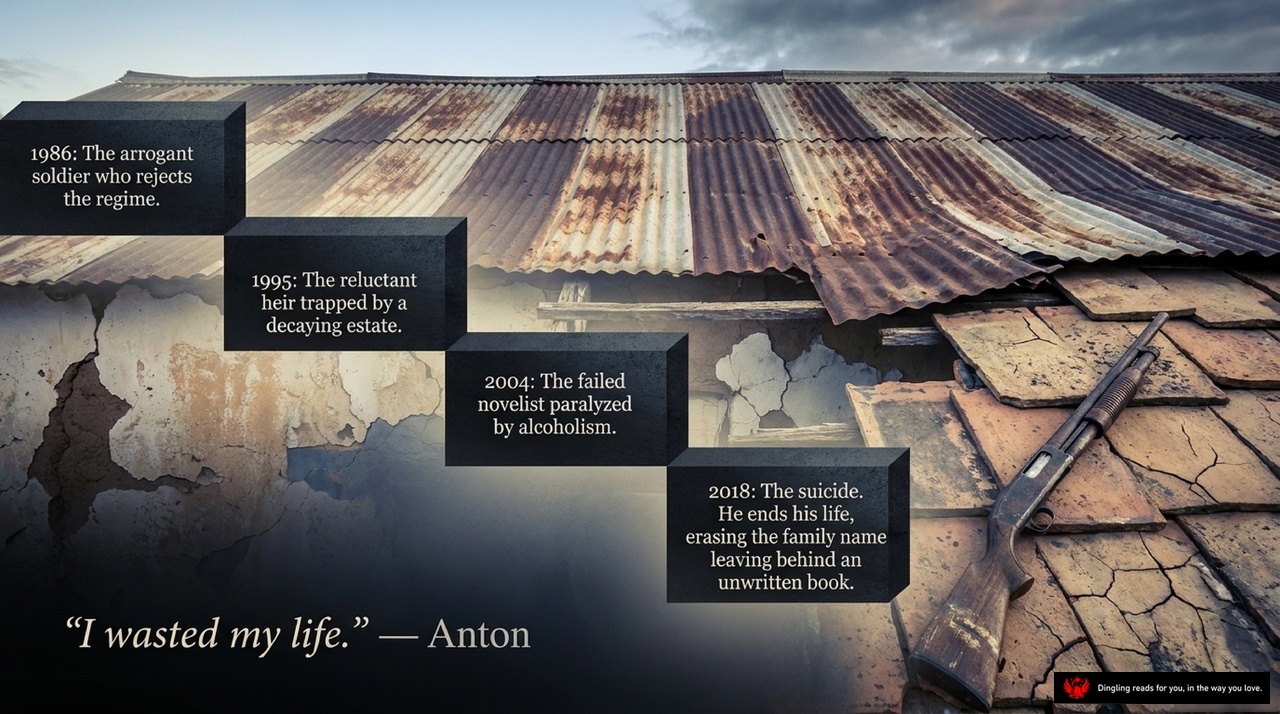
Look at this crumbling roof and the rifle lying on the cracked tiles. This image captures the tragic arc of Anton's life, a story of decline that spans from 1986 to 2018. In 1986, he was an arrogant soldier who rejected the regime, but by 1995, he had become a reluctant heir trapped by a decaying estate. By 2004, the failed novelist was paralyzed by alcoholism, unable to write the book he desperately needed. Finally, in 2018, he ends his life, erasing the family name and leaving behind an unwritten book. As Anton himself lamented, "I wasted my life." His story is a stark reminder of how quickly ambition can turn into despair when one loses their way.

Look at this table. It lays out the tragic destinies of the Swart siblings: Anton, the golden heir; Astrid, the materialist; and Amor, the moral compass. Each of them developed a unique coping mechanism to survive the weight of their history. Anton chose rebellion and alcohol, Astrid hid behind wealth and surfaces, while Amor faced the past through self-imposed exile and nursing.
But their relationship to the land they were born into tells an even darker story. Anton claimed it but let it rot; Astrid fled to suburban fortresses; and Amor refused it entirely, only returning for funerals. Ultimately, their fates were sealed by these choices. Anton ended in cynical paralysis and suicide, Astrid in sudden, violent erasure, and Amor in solitary, delayed atonement. This slide captures the essence of their lives: how their responses to a broken system led them down divergent paths of destruction, none of which offered true redemption.
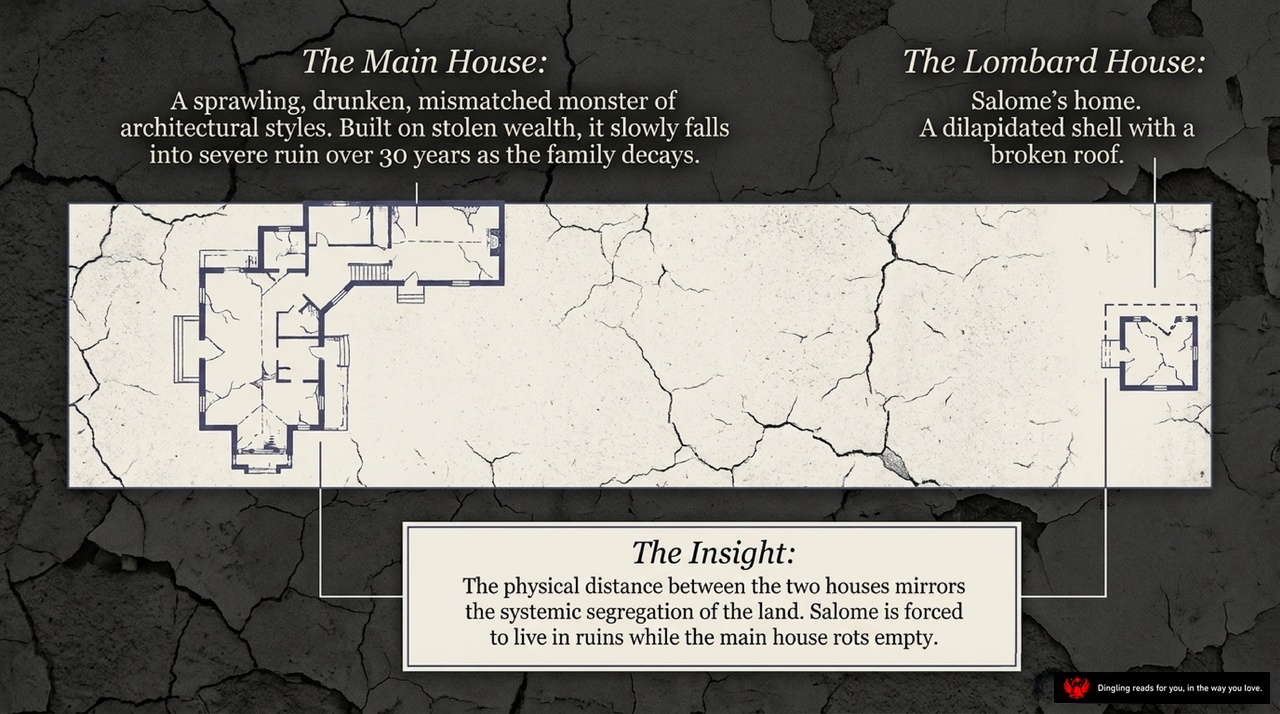
Look at this map of two worlds. On the left, we see the Main House—a sprawling, drunken, mismatched monster of architectural styles. It was built on stolen wealth, and over thirty years, as the family decays, it slowly falls into severe ruin, eventually rotting empty. On the far right, connected by a vast, cracked expanse of land, is the Lombard House. This is Salome's home, a dilapidated shell with a broken roof.
The physical distance between these two structures is not just about geography; it mirrors the systemic segregation of the land itself. While the main house rots away in luxury, Salome is forced to live in ruins, separated by the very soil that divides them. This stark contrast highlights the deep inequality embedded in their lives, where one family's decay is slow and comfortable, while another's struggle is immediate and brutal, trapped in the shadows of a broken world.

On the left, we see "The Invisible Servant": a ghost expected to clean their filth and absorb their moral decay without speaking. On the right, "The Enduring Claimant": Salome waits three decades for a promise the law finally allows her to claim, yet the family continually gaslights her, claiming the promise never existed.
This slide captures the tragic heart of Salome's story. For thirty years, she has been the invisible servant, scrubbing plates and cleaning the Swart family's physical and moral filth, while they treat her as a non-entity. When the law finally steps in and recognizes her claim to the house her mother promised her, the family's cruelty doesn't vanish; it just changes tactics. They don't just ignore her anymore; they actively gaslight her, denying that the promise ever existed.
Look at the image in the center. Salome holds a simple, chipped plate, her face etched with the weight of a lifetime of unspoken labor. That plate represents everything she was denied ownership of. The cracked earth background symbolizes the dry, barren reality of her existence under apartheid, where her humanity was treated as dirt.
This is the ultimate injustice: not just being poor, but being made to believe your own history is a lie. The Swart family, who benefited from her labor for decades, now has the audacity to rewrite history, erasing her mother's kindness and Salome's sacrifice. It forces us to ask: what happens when the people who owe us the most are the ones who convince us we never owed them anything at all?

In the center of our story lies a profound silence, broken only by the memory of a promise. As we look at this image, we see the three pillars holding up the fragile reality of our protagonist's life.
First, we see **The Strike**. It wasn't just a physical event; it was the moment her world fractured. At six years old, struck by lightning, she was the only witness to the truth while her family saw only a tragedy. That lightning scar, visible on her silhouette, marks the beginning of her unique burden.
Then, we move to **The Atonement**. This is her entire existence. She spends her life in exile, working as a nurse, washing the bodies of the dying. It is a penance for a family sin she never chose but carries every day. Her hands, though not shown, are stained with the weight of this sacred, heartbreaking duty.
And finally, **The Memory**. She is the sole living record of a promise made to Salome. In a world where everyone has moved on, she remains the keeper of the truth, the guardian of a legacy that others have forgotten.
This isn't just a story about a woman; it's about the heavy cost of seeing clearly when everyone else chooses to look away.
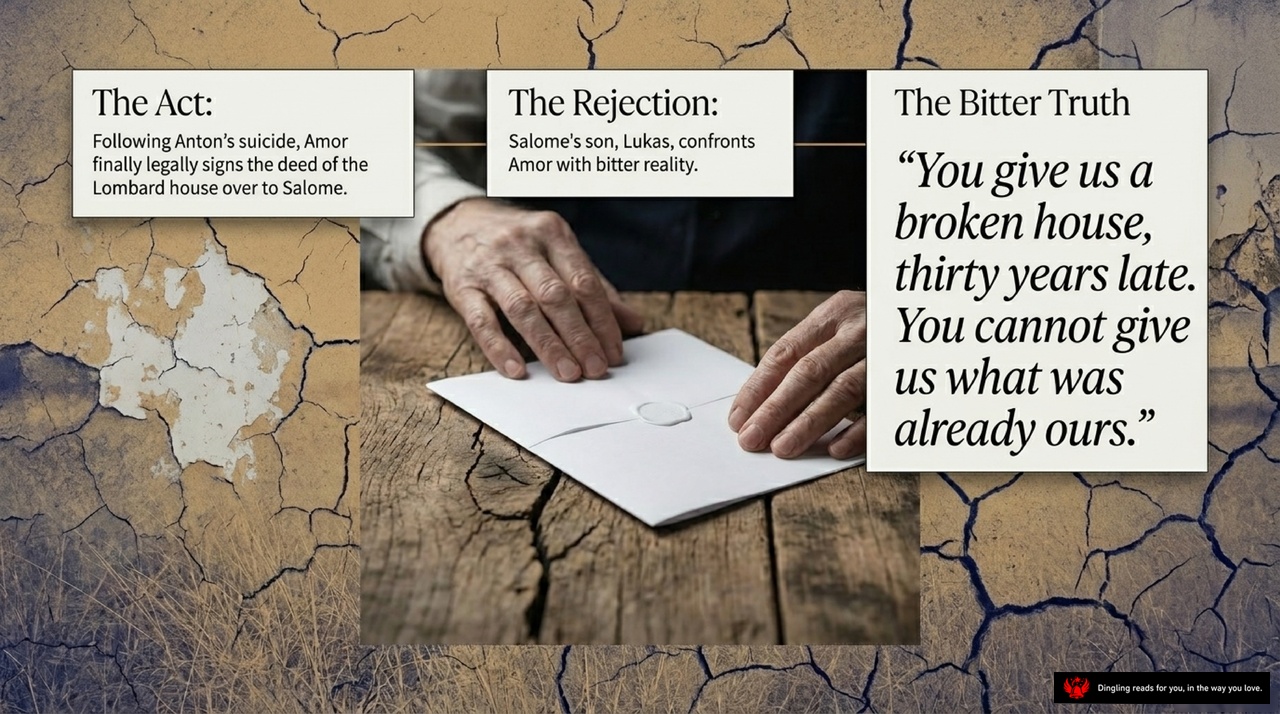
The image captures a pivotal moment of reckoning, laid out across three distinct but interconnected layers: the Act, the Rejection, and the Bitter Truth.
On the left, we see "The Act." Following Anton's tragic suicide, Amor finally takes the legal step she's been waiting for. She signs the deed, transferring the Lombard house to Salome. It's a formal resolution, a long-overdue promise finally being kept on paper.
But the middle panel, "The Rejection," reveals the harsh reality that paperwork alone cannot fix. Salome's son, Lukas, confronts Amor with a bitter truth that the legal signature misses entirely. He represents the living history of that house, the memories that the document can't erase.
And on the right, "The Bitter Truth" delivers the emotional core of the scene through a powerful quote: "You give us a broken house, thirty years late. You cannot give us what was already ours."
This quote speaks to a profound sense of injustice. It's not just about the physical structure of the house, which has clearly decayed over decades of neglect. It's about the time lost, the dignity denied, and the life Salome sacrificed while waiting. The house is no longer the home it once was; it's a crumbling shell. But what Salome and her family truly needed wasn't just a roof over their heads—they needed recognition, they needed justice, and they needed it thirty years ago. Amor's act, while legally correct, feels hollow because it arrives too late to heal the wounds of the past. The house is broken, and the delay has broken the spirit of those who lived there.

Amor stands alone on the crumbling roof of a broken house, staring out at a vast, scarred landscape as dark storm clouds gather overhead. The image captures the raw weight of loss and the elusive nature of redemption. As the text states, "Amor is the last Swart remaining," a poignant reminder that her body is aging, her family has been extinguished, and the land itself is slowly returning to the earth. While the legal promise to give the house to Salome was technically fulfilled, true redemption remains elusive in a land deeply scarred by history. This isn't just about a crumbling building; it's about the final chapter of a family erased by time, politics, and tragedy. Amor has watched her mother die, seen her father pass away, and buried her sister. Now, with Anton's ashes scattered and her own life winding down, she faces a future where she is truly the last one left. The storm brewing in the sky mirrors the turmoil within, yet amidst the decay, there is a strange stillness. Amor accepts that while the world moves on, leaving her behind, she finds her own peace in this quiet solitude, realizing that being the last one standing is both a burden and a strange kind of freedom.

The Swart family's tragedy is a microcosm of a fractured nation—a stark reminder that justice delayed is justice denied, and that the sins of the past will relentlessly consume the future until the debt is fully paid.
If a promise is kept thirty years too late, when the land is ruined and a lifetime has been stolen, is it an act of redemption—or merely the final insult of the privileged?
As Amara finally walks into the small, crooked house that belonged to Salomi, the man she knew as Lucas confronts her with a bitter truth. He accuses her family of withholding this home for decades, only to offer it now as a mere handout. But Amara remains calm. She reveals that she has never touched the money her family sent her while she was away; she saved it all, specifically for Salomi. She warns Lucas that while Salomi might finally get the house, she could also lose it to land claimants.
This moment crystallizes the novel's central question: Is keeping a promise after thirty years of silence an act of redemption, or just the final, hollow gesture of a broken system? Amara climbs the roof to scatter her brother's ashes, stepping into a storm that mirrors the turmoil of a nation still paying the price for its history.