
The Protagonist: Complete Chapter-by-Chapter Summary

Good evening, everyone. Tonight, we step into the spotlight and introduce the protagonist of our story: Chen Yan.
Imagine a young girl standing alone in the center of a vast, dark stage. A single beam of light cuts through the darkness, illuminating her figure. This is Chen Yan, the dazzling, blood-stained ascent of a Qinjiang opera star. Her journey reveals the ultimate price of standing in the center of the stage.
Born as Yi Zhaodi, a simple eleven-year-old girl herding sheep in the Qinling Mountains, her life was destined for the limelight. Her uncle, Hu Sanyuan, a talented drummer, saw potential in her clear voice and took her to the county theater. There, amidst the chaos of political struggles and personal tragedies, she endured everything from being cast out to becoming a household name. She survived the loss of her uncle, the betrayal of jealousy, and the crushing weight of public scrutiny. Yet, through it all, she never lost her passion for the art.
From a humble background to the prestigious stage, Chen Yan's story is one of resilience and sacrifice. She transformed from a shepherdess into a legend, earning the name Yi Qine, and eventually, the stage name Chen Yan. Her rise was not easy; it was paved with tears, blood, and an unyielding spirit.
As we delve deeper into her life, we will explore how she navigated the complexities of fame, love, and the relentless demands of the stage. Chen Yan's journey is a testament to the power of perseverance and the enduring spirit of a true artist. Let's begin her story.
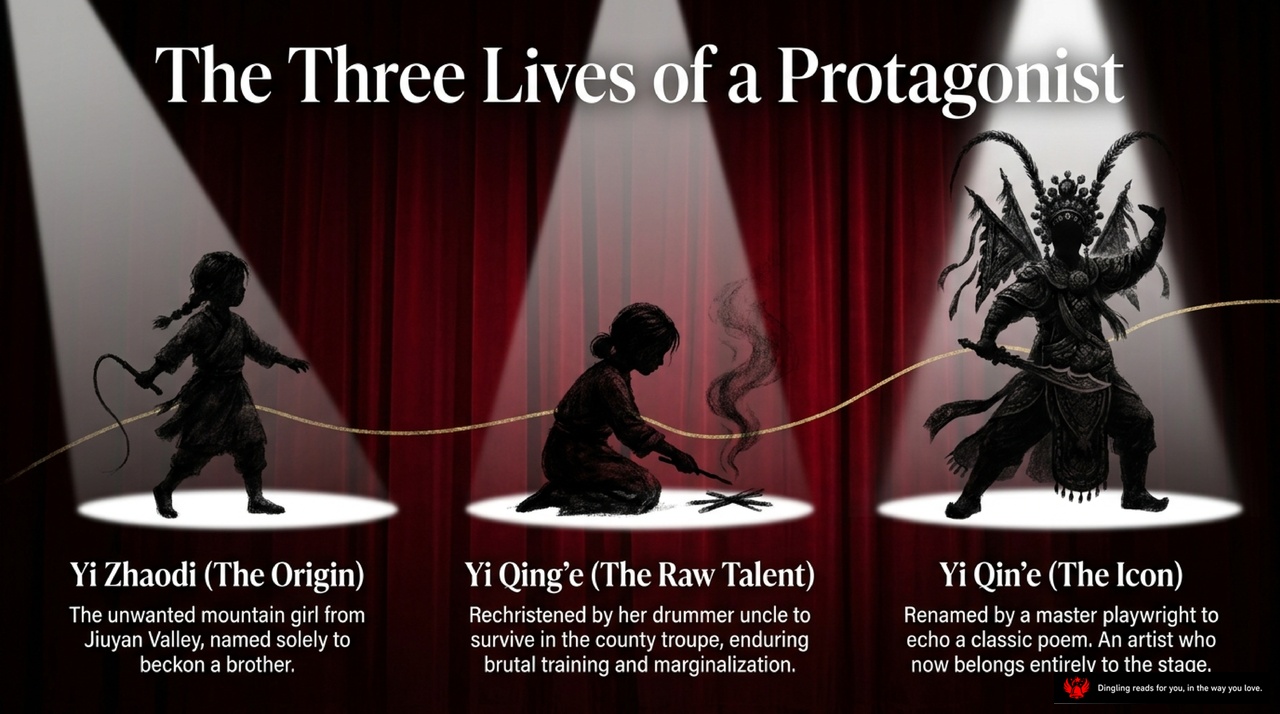
The stage lights cut through the darkness, illuminating three distinct silhouettes that tell the complete story of Yi Qin'e. This isn't just one life; it is a transformation across three chapters.
First, we see **Yi Zhaodi**, the origin. A raw, unwanted girl from Jiuyan Valley, named only to serve as a brother's companion. She is the untouched earth, the potential waiting to be shaped.
Then, the spotlight shifts to **Yi Qing'e**, the raw talent. Rechristened by her drummer uncle to survive in the county troupe, she endures brutal training and marginalization. She is the fire being forged, learning her craft in the shadows before the world sees her light.
Finally, we arrive at **Yi Qin'e**, the icon. Renamed by a master playwright to echo a classic poem, she becomes an artist who belongs entirely to the stage. She is the masterpiece, the symbol of resilience and artistry.
From a mountain girl to a national treasure, this is the journey of a protagonist who refused to be defined by her past, but instead, wrote her own destiny.

Welcome to the stage of pain and glory. Today, we dive into the "Crucible of the Art"—the intense, often brutal fire that forges a true legend. Look at this dancer in the spotlight; every line of her body tells a story of survival.
First, her voice. It wasn't a gift; it was forged in the bitter wind. Imagine waking up at 5 AM, screaming high-pitched notes into the freezing air just to master the piercing pitch of traditional Qinqiang. That is vocal forging.
Then, her mind. The psychological crucible. She endured relentless mockery, treated like a fragile chicken bone, facing public humiliation and toxic jealousy from behind the scenes. She had to survive the chaos of a fractured world to keep her spirit alive.
Finally, her legs. The physical agony. She was forced into wall-splits until she fainted. She stood barefoot on freezing winter floors, toes numb, just to perfect that water-gliding footwork. She didn't just dance; she conquered her own body through sheer will.
This is the price of greatness. The art demands everything.

On the left, we see the Fire-Stoking Girl, banished to the troupe kitchen to protect her from political fallout, relegated to chopping cabbage and enduring abuse. On the right, the Shadow Masters—True art survives in the dark. In the kitchen's shadows, four marginalized, disgraced old masters secretly forge her into a weapon of pure traditional craft.
This slide captures the pivotal turning point in Yi Qing'e's life. After her uncle was falsely accused and her dreams shattered, she was forced into the kitchen. Yet, it was here, amidst the soot and smoke, that her true destiny was forged. The image of the fire stoking her represents her resilience; she wasn't just burning wood, she was fueling her own rebirth.
But who were these "Shadow Masters"? They were the old artists who had been pushed to the margins by the chaos of the times. They saw talent in this kitchen maid where others saw only a servant. They took her in, teaching her the secrets of the stage from the shadows. They taught her that true art survives even in the darkest places. Through their guidance, she transformed from a girl chopping cabbage into a master of the stage, a weapon of pure traditional craft ready to shine.
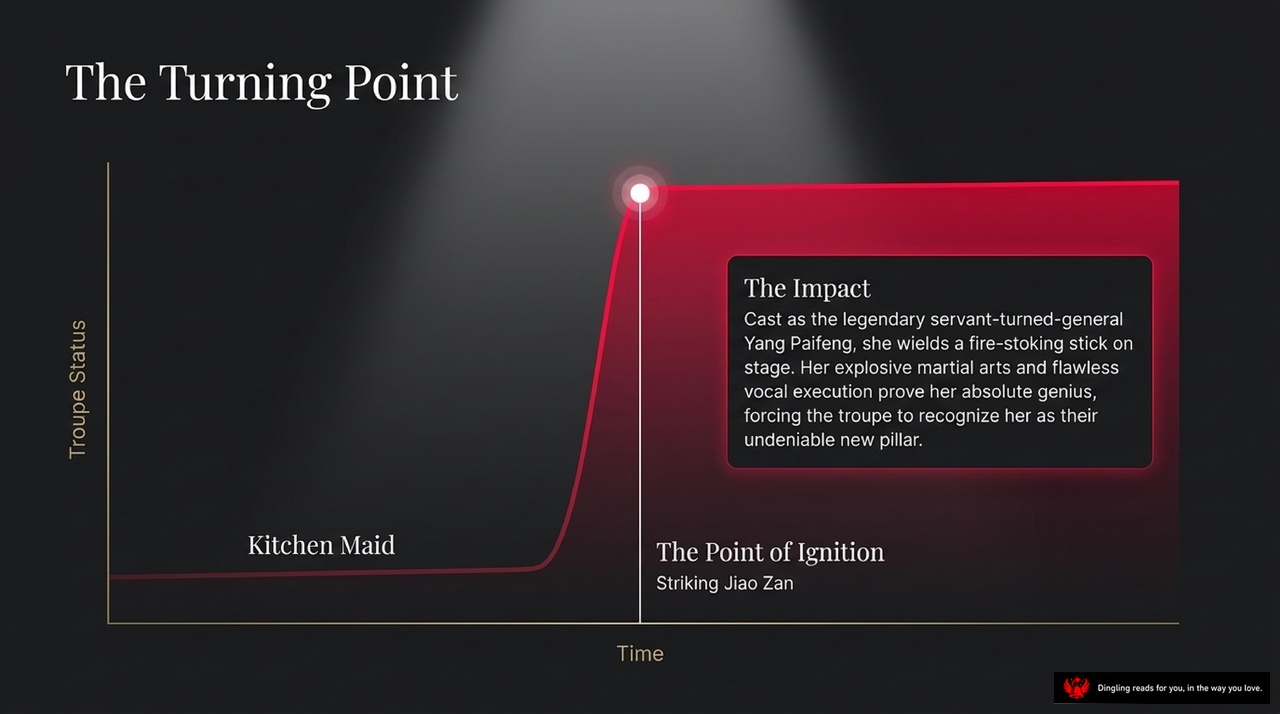
The Turning Point isn't just a label; it's the explosive moment where destiny shifts from obscurity to legend. Look at this graph: it captures the journey of Yi Qing'e, a humble kitchen maid who transformed into the legendary opera star Yi Qin'e. For years, her status remained flat, hidden away from the spotlight. But then came "The Point of Ignition"—a single, decisive strike against Jiao Zan on stage.
This moment changed everything. Cast as the fiery general Yang Paifeng, she wielded a fire-stoking stick with explosive martial arts and flawless vocals. Her genius forced the troupe to recognize her as their undeniable new pillar. The impact was immediate and total: she rose from being overlooked to becoming the star that captivated audiences. This turning point proves that true talent, when unleashed with passion and skill, can break through any barrier, no matter how high the walls seem.
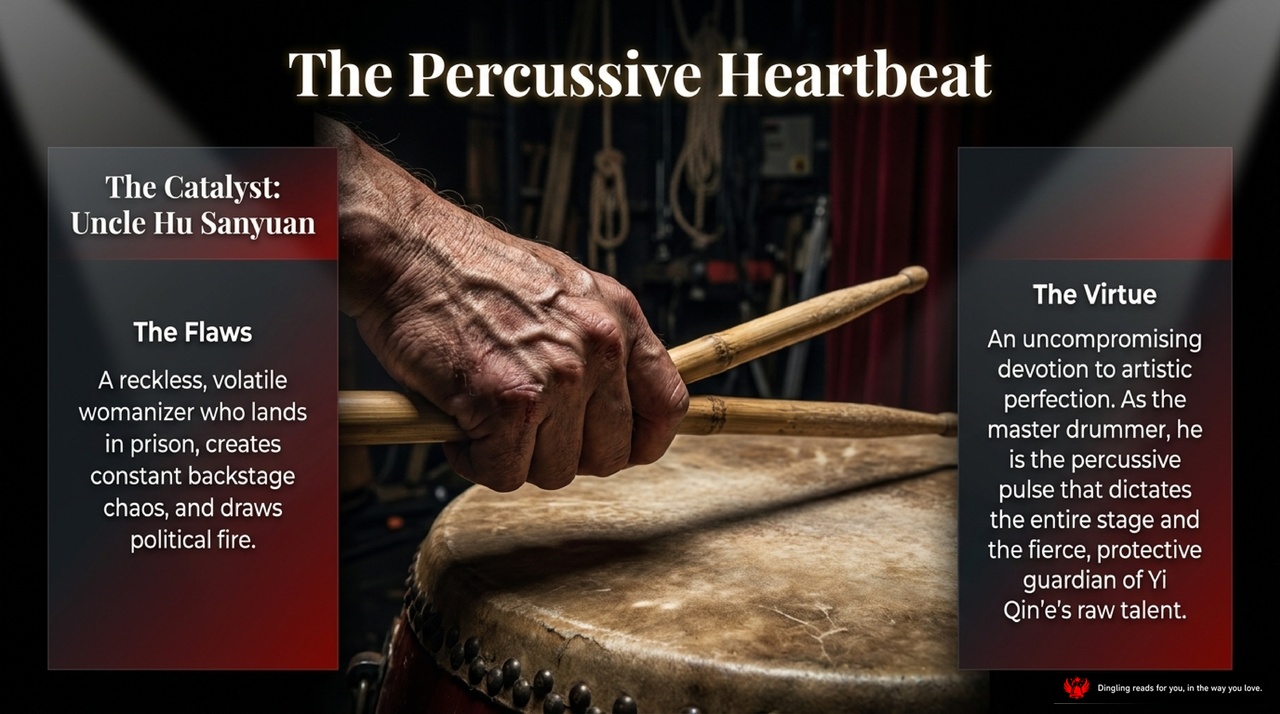
The Percussive Heartbeat: Uncle Hu Sanyuan's Dual Nature
Look at this powerful image. We see a weathered hand gripping bamboo drumsticks, ready to strike. This is Uncle Hu Sanyuan, the catalyst for our protagonist's journey, but he is a man of two worlds. On one side, he is a reckless, volatile womanizer who lands in prison, creating constant backstage chaos and drawing political fire. Yet, on the other side, he possesses an uncompromising devotion to artistic perfection.
As the master drummer, he is the percussive pulse that dictates the entire stage. But outside the theater, he is a fierce, protective guardian of Yi Qin'e's raw talent. Even when he was in jail, he couldn't stop drumming, secretly practicing rhythms on stones by the river. When he finally returned, his obsession with his craft was so strong he even scrubbed his drumsticks with a compulsive cleanliness that drove others crazy.
He was the one who took Yi Qin'e from a sheep herding girl in the mountains to the stage, giving her the name Yi Qing'e, and later, Yi Qin'e. He pushed her through the hardest training, protected her when she was bullied in the kitchen, and stood by her when the world turned against her. His flaws were as loud as his virtues, but his love for her art was the only thing that never faltered. He was the heartbeat that kept her rhythm alive, even when he himself was broken by the system.

The Backstage Ecosystem isn't just a metaphor; it's the brutal reality of the troupe where Yi Qing'e, now Yi Qin'e, spent her life. Look at this quadrant. On the left, we have those who support the art. Internally, there are the Purists like Qin Bawa and Gou Cunzhong. They represent the ruthless pursuit of perfection, willing to burn themselves out to preserve the soul of Qinqiang. Externally, we have the Bureaucrats, figures like Director Zhu and Director Xue. Their motive isn't artistic; it's survival and optics. They capitalize on her fame just to keep the institution alive, often prioritizing their own safety over the art's integrity.
Now, flip to the right side: those who exploit art. Internally, we have the Rivals, like Chu Jiahe and Milan. Their drive is pure jealousy—a craving for the spotlight without ever wanting to bear the crushing weight of the craft itself. They want the glory, but not the grind. Externally, there are the Predators, men like Liao Yaohui and Liu Hongbing. Their motive is simple consumption. They feed off her beauty, her status, and her vulnerability, treating her not as an artist, but as a resource to be used. This ecosystem surrounds Yi Qin'e, constantly pushing her, pulling her, and testing her resolve until only the true essence of the art remains.

Imagine a theater where the spotlight doesn't just shine on the star; it crushes the entire ecosystem around them. This is the "Law of the Theater," and today we explore the heavy burden known as "The Weight of the Spotlight."
Look at this diagram. At the very center, Ring 1, is the Protagonist. She is described as the sun that provides the light. But here is the harsh reality: she is also the sacrificial lamb. The text tells us that everyone depends on her for prestige, survival, and sustenance. If she fails, the entire ecosystem collapses.
Moving outward, Ring 2 consists of the Supporting Cast and Musicians. They are the ones who stand ready, their livelihoods tied directly to the star's success. Beyond them, Ring 3 holds the Troupe Leadership and Bureaucrats. They are the architects of the show, yet their power is fragile without the star's draw. Finally, Ring 4 is the Audience and Society. They are the consumers who validate the whole operation, but they only come when the sun is shining bright.
This isn't just about drama; it's about the brutal stakes of performance. When the protagonist falters, the supporting cast loses their jobs, the leadership loses their credibility, and the audience turns away. It is a high-wire act where one mistake can bring down the entire structure. This is the invisible pressure that defines every great performer's life.

The Tragic Inverse Ratio: As she conquers the capital and becomes an untouchable cultural icon, her personal life is systematically annihilated. Onstage, she rises from a humble shepherding girl to the Provincial Queen, finally earning a place in Zhongnanhai, the pinnacle of artistic glory. Yet, offstage, the red line of her private tragedy plummets. She endures toxic marriages, including a disastrous union with a volatile artist who locks her in a cabin and whose wild experiments cost her son his life. She faces the tragic fall of her disabled son, who, despite her relentless efforts to cure him, ultimately passes away. She witnesses the death of her mentors, first her beloved teacher Gu Cunzhong, who died on stage after exhausting his final breath performing fire-spitting, and later her husband Shi Huayu, who took his own life after a public humiliation. Even her brother-in-law, her loyal mentor Hu Sanyuan, is arrested and sentenced to prison for defending her dignity against a powerful merchant. While the world cheers for her name, her inner world crumbles under the weight of loss, leaving her standing alone amidst the ruins of the very life she built.
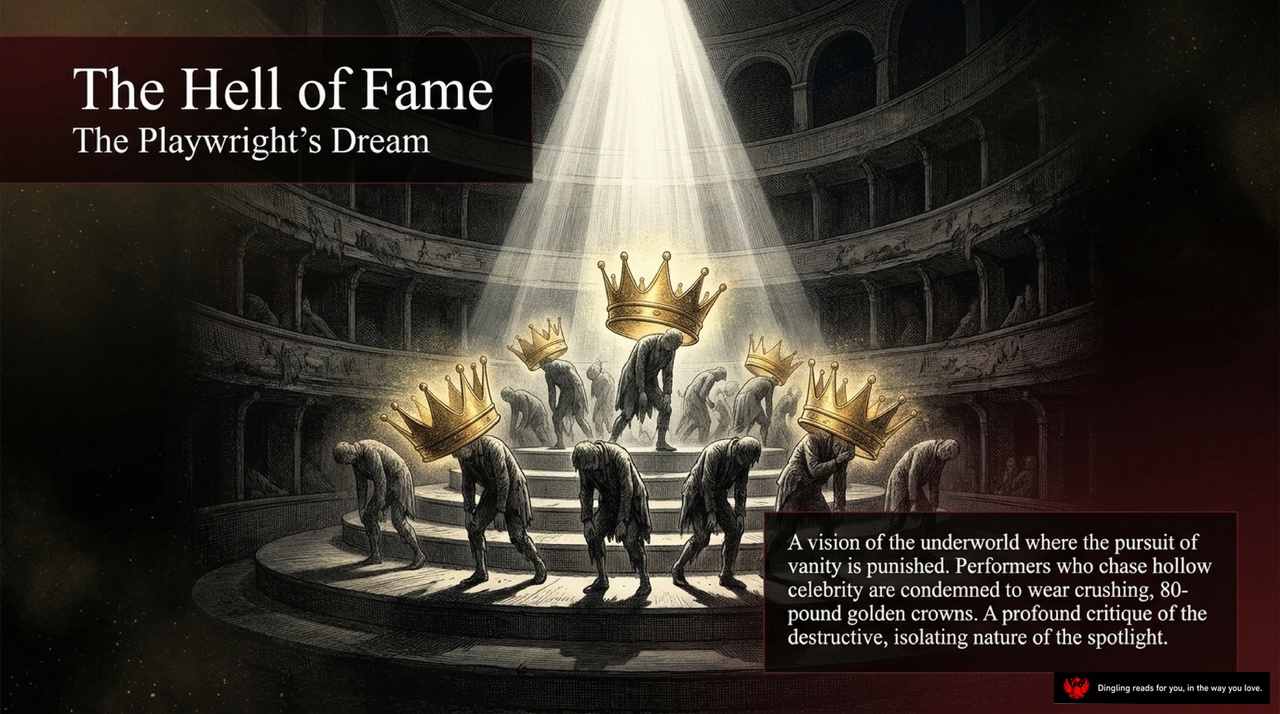
In this haunting vision of the underworld, we see the playwright's darkest dream: The Hell of Fame. Here, the pursuit of vanity is not celebrated but punished. Performers who chase hollow celebrity are condemned to wear crushing, eighty-pound golden crowns that weigh them down with the burden of their own ego. This image serves as a profound critique of the destructive, isolating nature of the spotlight. It reminds us that when fame becomes an obsession, it transforms from a crown into a shackle, trapping the soul beneath the weight of public expectation and leaving them alone in the dark.
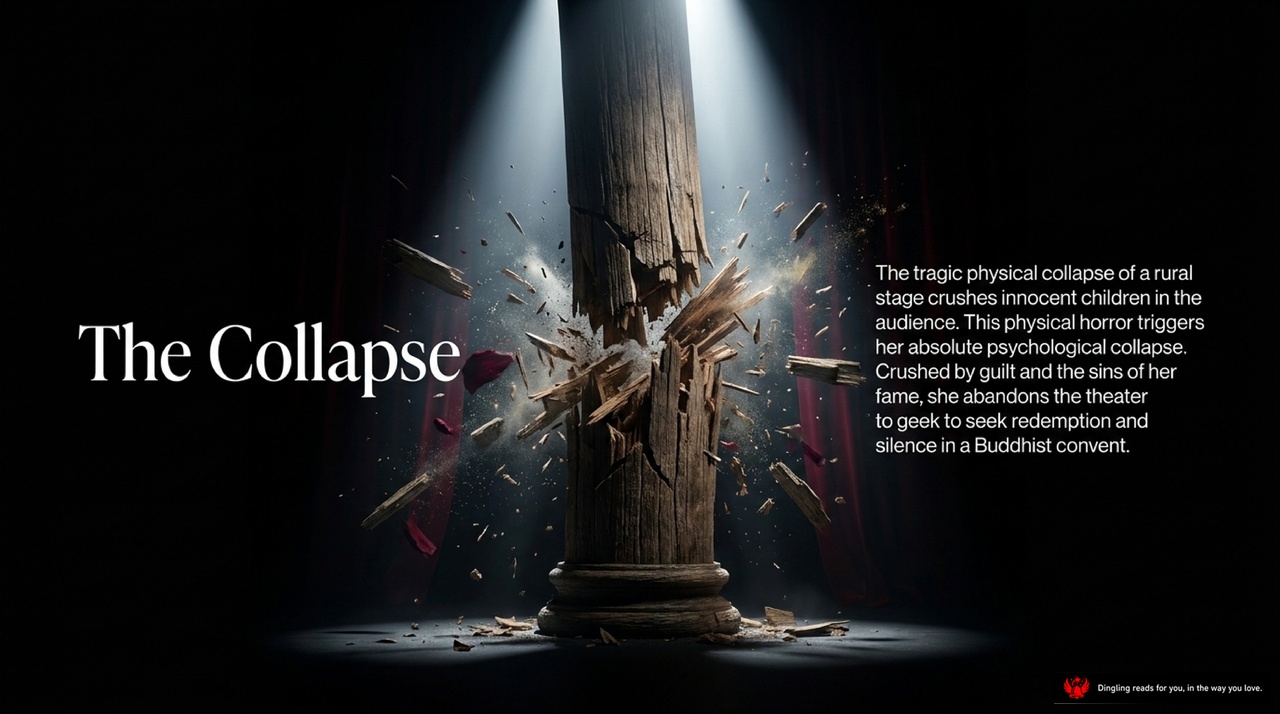
The Collapse
Imagine a wooden pillar, ancient and weathered, standing alone under a single beam of light. Suddenly, it shatters. Splinters fly in every direction, scattering like dust in the air. This isn't just a physical break; it's the moment everything falls apart.
This image captures the tragic turning point for Yi Qing'e. The collapse of a rural stage, crushing innocent children in the audience, triggers her absolute psychological breakdown. She is crushed by the guilt of the accident and the sins of her fame. Unable to face the world anymore, she abandons the theater she once loved. She flees to a Buddhist convent, seeking only redemption and silence, leaving her dream of the stage behind forever.
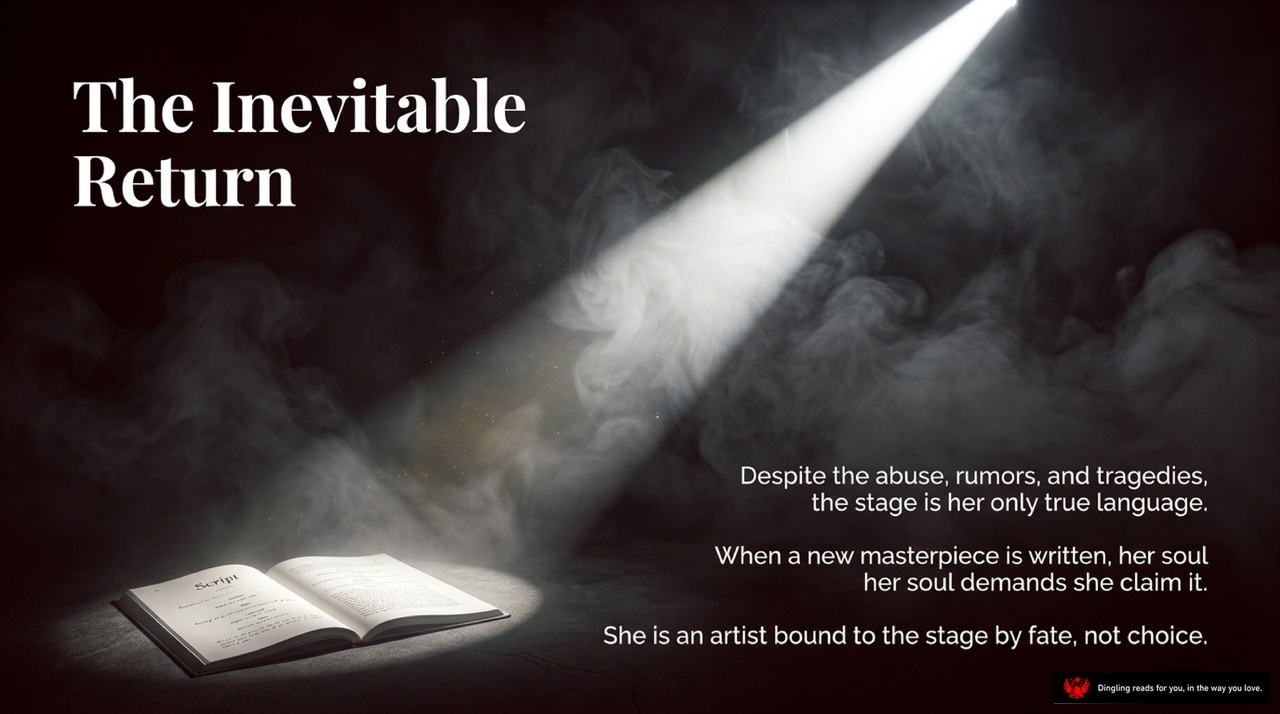
Despite the abuse, rumors, and tragedies, the stage is her only true language. When a new masterpiece is written, her soul demands she claim it. She is an artist bound to the stage by fate, not choice.
This slide captures the very essence of Yi Qing'e's journey. You see the open script beneath the spotlight—that represents her unwavering commitment to her art, even when the world turns its back on her. Throughout her life, she faced unimaginable hardships: from being a shepherd girl to enduring bullying in the troupe, from her uncle's wrongful imprisonment to the tragic collapse of the stage that nearly claimed her life. Yet, every time life tried to extinguish her light, the stage called her back.
Even when she was ostracized, when she was forced into the kitchen, or when malicious rumors tried to destroy her reputation, she never truly left. Her soul was tethered to the performance. It was in the smoke and the darkness that she found her clarity. When the legendary playwright Qin Bawa finally wrote a new masterpiece specifically for her, it wasn't just a role; it was a homecoming. It was the moment her spirit could finally breathe freely again. No matter how much the world tried to push her away, the stage was the only place where she could be herself. That is why she always returned.
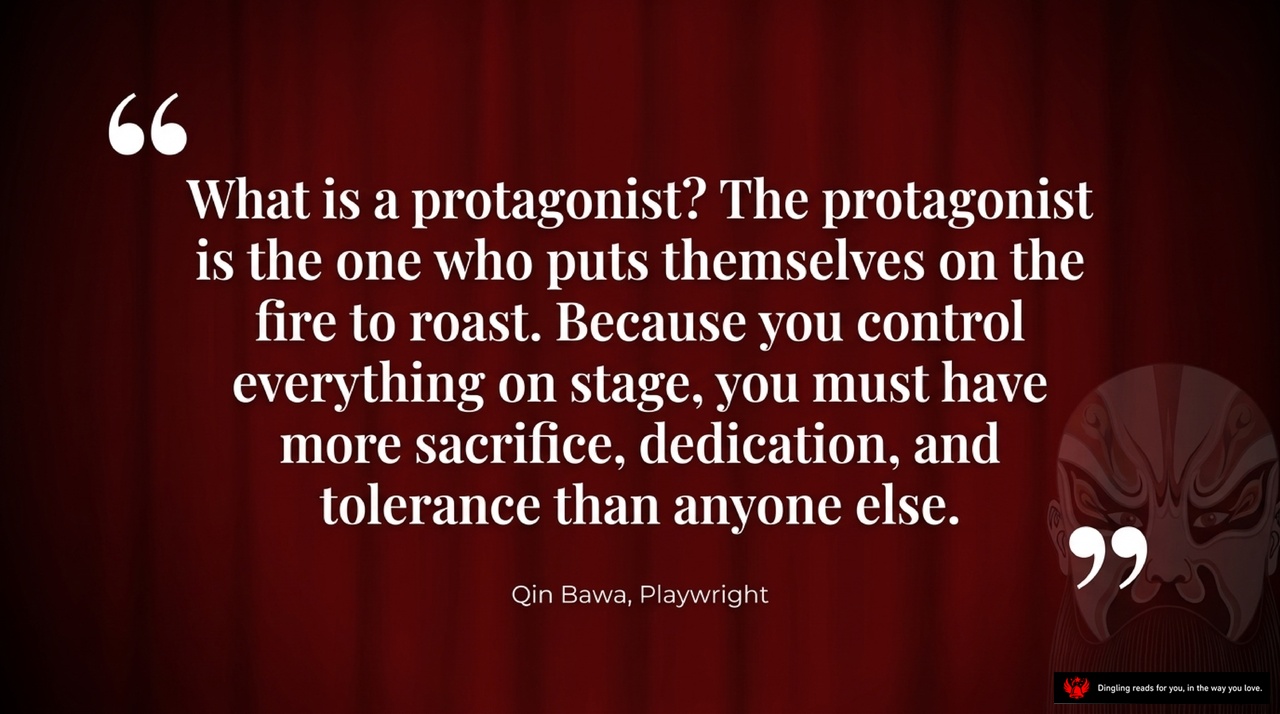
What is a protagonist? In the world of theater, the lead isn't just the star; it's the one willing to step into the fire. As the playwright Qin Bawa once said, the protagonist must sacrifice more, dedicate themselves deeper, and show greater tolerance than anyone else on stage.
Think about Yi Qing'e, the girl who started as a simple sheepherder in the Qinling Mountains. Her journey wasn't a straight line to glory; it was a path paved with pain. She was bullied, isolated, and even forced to work in the kitchen, peeling onions and cleaning pigsties while her dream of the stage seemed to fade. Yet, she never truly gave up. She trained in secret, burned her eyebrows practicing fire-breathing, and endured physical exhaustion just to prove herself.
When tragedy struck—her uncle's wrongful imprisonment, the collapse of the stage that took her mentor's life, and the cruel rumors that attacked her character—she could have retreated into silence. Instead, she stood firm. She absorbed the pain, turned it into art, and eventually rose to become the "Queen of Qin Opera." Her story teaches us that true greatness isn't about avoiding the fire; it's about having the courage to stand in it, let it burn, and emerge stronger than before. That is the essence of being a protagonist.
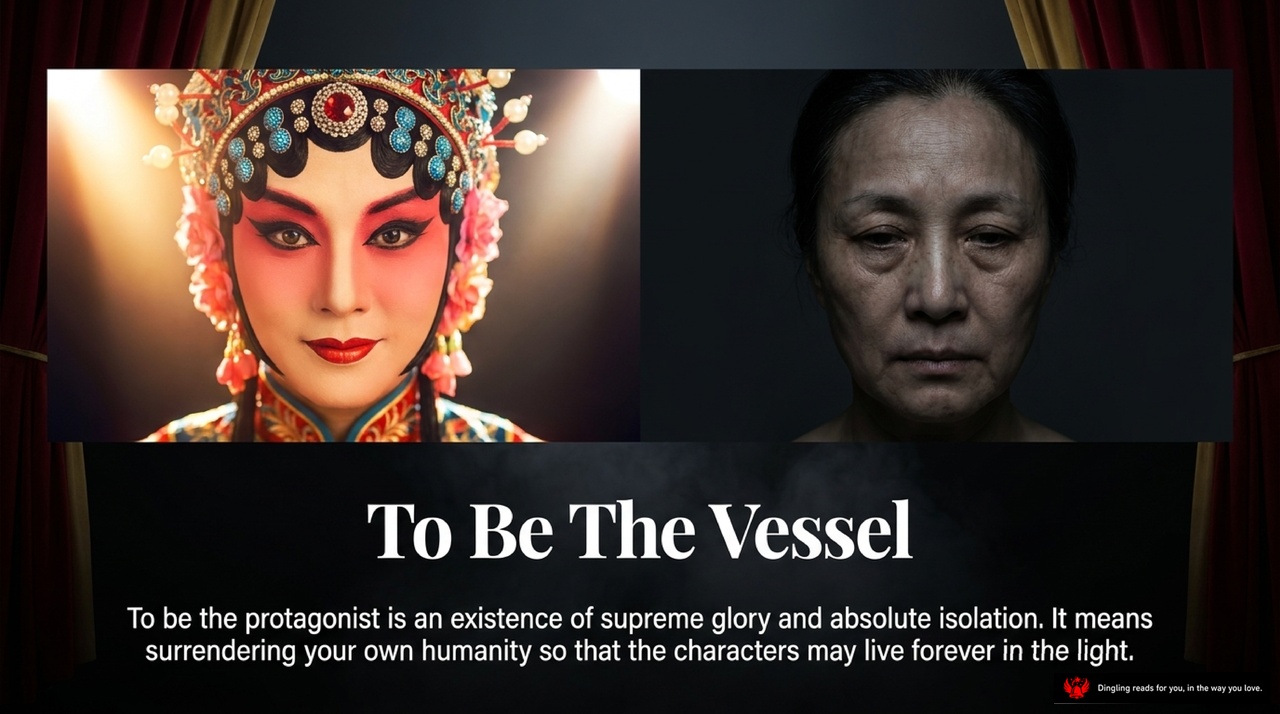
To Be The Vessel
Look at these two faces. On the left, the vibrant, painted mask of a Peking Opera star—glorious, perfect, and utterly artificial. On the right, the raw, unvarnished face of a woman, weathered by time and silence. This is the central tension of Yi Qing'e's life: the choice between being a legend or remaining human.
The slide asks us to consider the cost of stardom. "To be the protagonist is an existence of supreme glory and absolute isolation." It's a heavy truth. To live forever in the light, as the text says, you must surrender your own humanity. Think about Yi Qing'e's journey. She starts as a simple shepherd girl, but to become the famous "Yi Qin'e," she layers on costumes, makeup, and a new name, slowly erasing the girl from the mountains. She becomes a vessel for the art, holding the spotlight so brightly that it burns away her personal identity.
Even her relationships suffer this fate. Her love for Feng Xiaoxiao fades as her career soars; her marriage to Shi Huaiyu is sacrificed for her art; and her son, the one thing that could truly ground her, is lost to tragedy. Every time she climbs higher, she leaves a piece of herself behind. The tragedy isn't that she failed to be human; it's that the role demanded she become something else entirely. She became a masterpiece, but at the cost of her soul.
She conquered the world through her art, but sacrificed her entire world for the art. She became the immortal center of the stage, only to lose herself in its shadows.
Is the fleeting glory of the spotlight truly worth the eternal shadows it casts upon the soul?
Look at this image. It captures the tragic arc of Yi Qing'e, later known as Yi Qin'e. She rose from a simple sheepherding girl in the Qinling Mountains to become the undisputed "Golden Empress" of Qinqiang opera. For decades, she was the star, the one everyone cheered for, the face of the art form itself. But in her relentless pursuit of perfection and fame, she paid a terrible price. She watched her mentor die on stage, she buried her son in tragedy, she lost her husband to infidelity, and she was eventually torn apart by vicious rumors and public hatred.
The question posed here is hauntingly relevant. When you stand in the center of the spotlight, does the applause truly compensate for the isolation it creates? Does the eternal fame justify the loss of your humanity? Yi Qin'e's story is a stark reminder that while art can elevate a person to godhood, it can also strip them of their very soul, leaving them alone in the darkness they created.