
The Razor's Edge: Complete Chapter-by-Chapter Summary
Welcome to our book club discussion of W. Somerset Maugham's masterpiece, *The Razor's Edge*. Set against the majestic backdrop of towering, snow-capped mountains, this novel takes us on a profound journey of one man's courageous rejection of conventional materialism in his relentless pursuit of ultimate spiritual truth. It is a story that reflects the diverse paths to fulfillment in a fractured world, challenging us to look beyond the surface of success and wealth. As we delve into the narrative, we explore the stark contrast between a life defined by social status and luxury versus one dedicated to the search for meaning and wisdom. This book invites us to question our own values and consider whether the true edge of life lies not in what we acquire, but in who we become.

On this slide, we see the two forces that shaped Larry's life: the brutal trauma of war on the left, and the dazzling, hollow promise of the Roaring Twenties on the right.
The image captures the exact moment Larry Darrell's worldview shattered. On the left, under the title "The Encounter with Death," we see the chaos of the trenches. Larry, a young pilot, watches his friend Patsy sacrifice his life in aerial combat. That sheer, absurd finality of death doesn't just kill a friend; it shatters Larry's entire understanding of the world. It breaks the mold of the logical, predictable life he thought he knew.
But look at the right side. This is "The Rejection of the Boom." Larry returns to a booming 1920s America, poised for unprecedented wealth. He sees the conventional pursuit of money, the jazz, the parties, the endless chase for status. Yet, for a man who has stared into the abyss of death, this glittering world feels entirely meaningless. The pursuit of riches cannot answer the questions that war raised in his mind.
This disconnect leads us to the final box on the right: "The Unanswered Question." Larry is left with a singular, existential crisis that drives him out of Western civilization entirely. If the world is the manifestation of a perfect creator, why is there so much evil and pain? Why does suffering exist if the universe is perfect? This question has no answer in the books or the banks of the 1920s. It has no answer in the logic of the West.
So, Larry Darrell is broken by the trauma of war and disillusioned by the emptiness of the boom. He cannot find answers in the places everyone else is rushing toward. He is forced to leave the familiar shores of Europe and America behind, seeking a truth that lies somewhere else, somewhere beyond the reach of conventional society. This is the starting point for his journey.
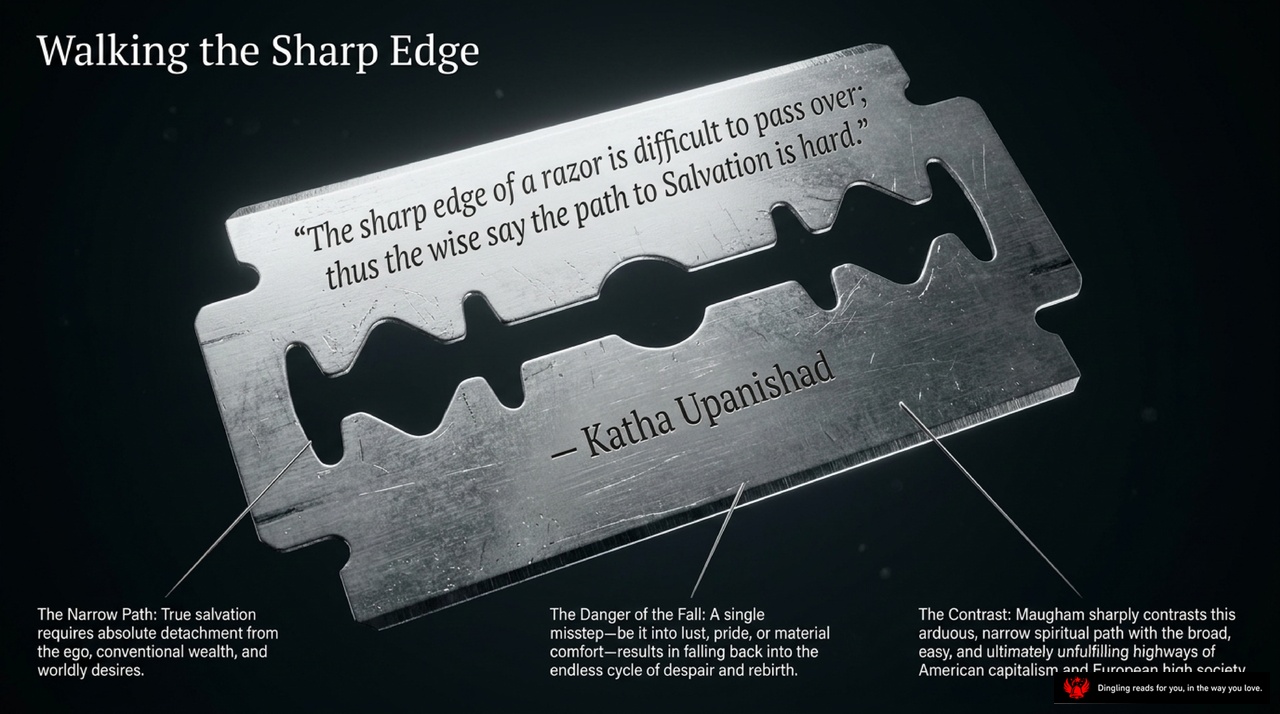
Walking the Sharp Edge. Look at this razor blade. It's a perfect metaphor for what we're exploring today: the idea that true salvation isn't a comfortable walk down a highway, but a perilous journey along a razor's edge. As the *Katha Upanishad* warns us, "The sharp edge of a razor is difficult to pass over; thus the wise say the path to Salvation is hard."
In the book, this concept is brought to life through two contrasting paths. On one side, we have the "Narrow Path." This is the arduous spiritual journey that requires absolute detachment from the ego, conventional wealth, and worldly desires. It's the difficult climb Larry takes when he leaves behind the easy life to seek truth.
On the other side, we see "The Danger of the Fall." A single misstep—whether it's a moment of lust, pride, or material comfort—can send someone tumbling back into an endless cycle of despair and rebirth. It's a terrifying reminder of how fragile that spiritual balance is.
Finally, consider "The Contrast." The author sharply contrasts this narrow, difficult path with the broad, easy, and ultimately unfulfilling highways of American capitalism and high society. It's the seductive trap of the comfortable life that promises everything but delivers nothing. Maugham suggests that while the wealthy path looks safe, it is actually a dead end, whereas the dangerous path of the razor's edge is the only way to find meaning.
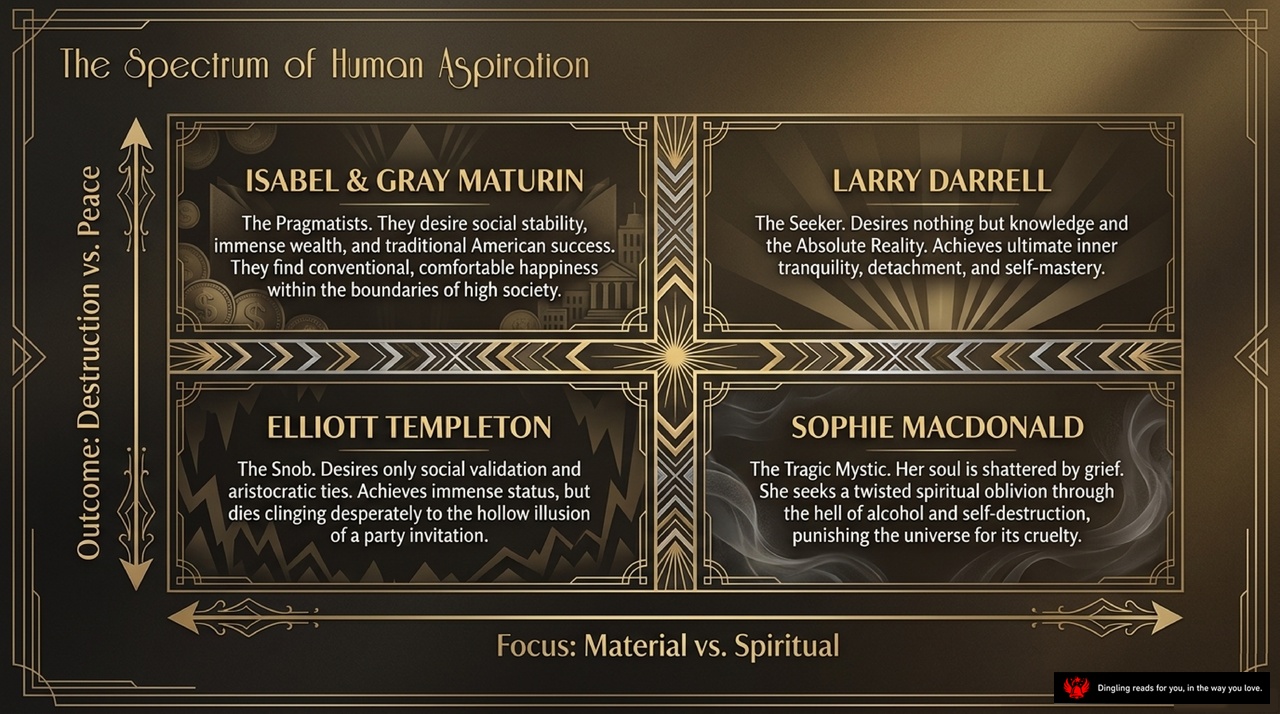
Look at this quadrant: Elliott Templeton, the Snob. He desires only social validation and aristocratic ties. He achieves immense status, but he dies clinging desperately to the hollow illusion of a party invitation.
This perfectly captures his tragic arc. For Elliott, success wasn't about who he was, but about the names he rubbed shoulders with. He saw the world through a lens of ancient titles and old money. He imagined himself as a modern-day crusader, living among French dukes and British earls, believing that proximity to these figures gave him a kind of heroic immortality. He couldn't see the rot beneath the glitter; he couldn't see that the people he courted were often hollow, that his "generosity" was just a transaction for entry into their clubs.
He was a man who built a palace of flattery, only to find himself trapped inside it. Even in his final days, when his health failed and his mind began to crack, his obsession never wavered. He didn't worry about the pain or the isolation; he worried about being forgotten by the elite. He needed that invitation, that ticket to the dance, to prove he still mattered. But in the end, he was just another ghost in a hall of mirrors, chasing a reflection that was slowly fading away.
In the fourth chapter, we dive into the glittering yet tragic lives of the Matullin family and the complex backstory of Suzanne Rivière. After the 1929 crash wiped out Henry and Gray's fortune, Elliott took them in, transforming their Parisian life into a study in high-society survival. Gray, once a promising partner, now relied on Elliott's charity, while Isobel navigated their new reality with a mix of resilience and irony, admitting they were "rich beggars."
Meanwhile, we are introduced to Suzanne, a woman who built her life on her own terms. From being a model for artists to raising a daughter alone, she faced rejection and hardship without crumbling. Her story highlights a different kind of strength—one rooted in independence rather than social climbing. As the narrative unfolds, we see how these characters, bound by Elliott's circle, reflect the shifting tides of wealth, power, and personal integrity in a changing world.
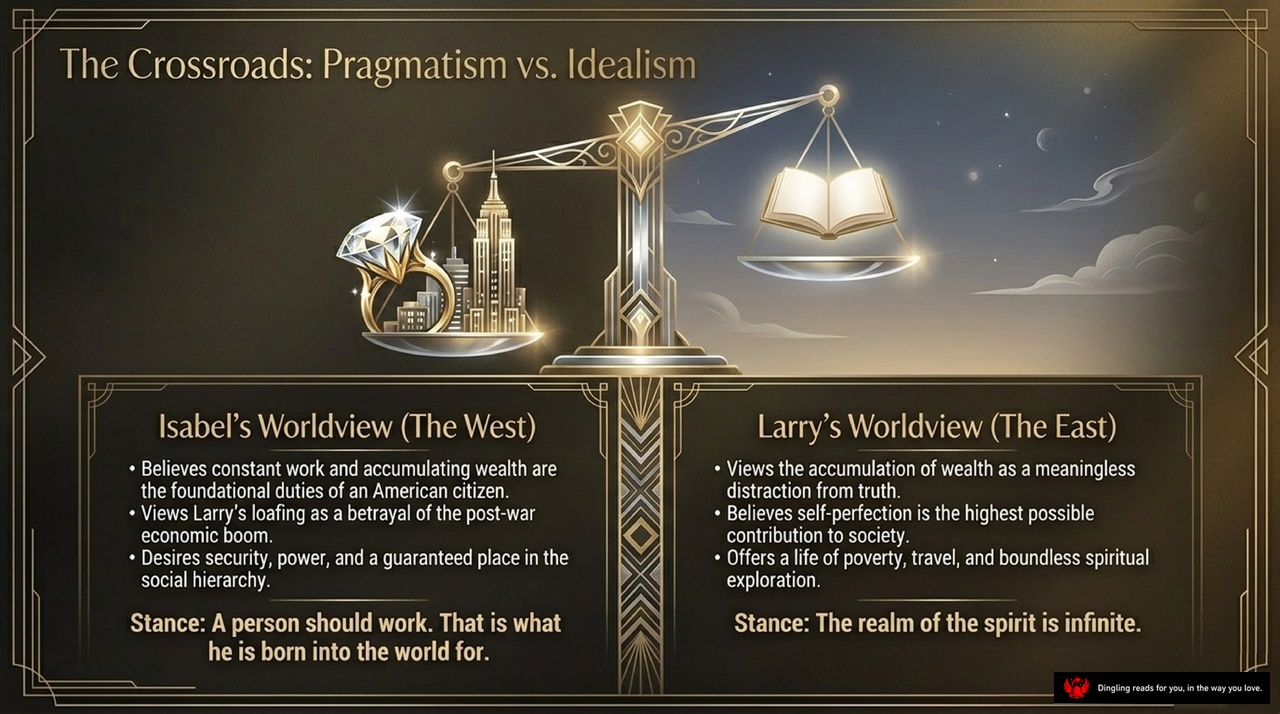
Welcome to the crossroads where pragmatism clashes with idealism. On one side, we see Isabel's worldview: the West. She believes constant work and accumulating wealth are the foundational duties of an American citizen. To her, Larry's loafing is a betrayal of the post-war economic boom. She desires security, power, and a guaranteed place in the social hierarchy. Her stance is clear: a person should work. That is what he is born into the world for.
On the other side stands Larry's worldview: the East. He views the accumulation of wealth as a meaningless distraction from truth. For him, self-perfection is the highest possible contribution to society. He offers a life of poverty, travel, and boundless spiritual exploration. His stance is equally firm: the realm of the spirit is infinite.
This balance scale captures the tragic tension of our story. Isabel wants the diamond and the city; Larry chooses the open book. One seeks a fixed place in the world, while the other seeks an infinite journey within it. This fundamental divide defines every choice Isabel and Larry make, leading them down paths that can never truly intersect again.
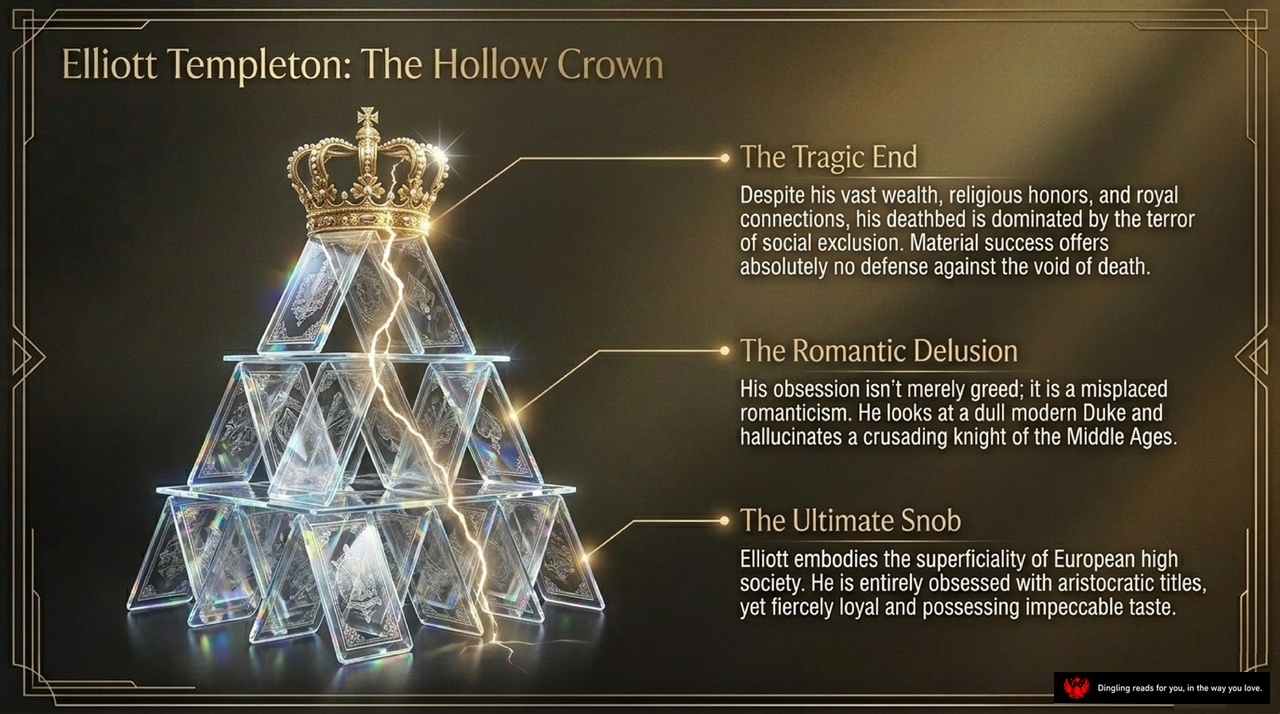
Elliott Templeton: The Hollow Crown. Look closely at this image of a fragile, glass-like pyramid crowned with a golden diadem, yet cracked by a bolt of lightning. This is the visual essence of a man who built an empire on sand, only to watch it shatter at the very end.
First, consider the Tragic End. Despite his vast wealth, religious honors, and royal connections, Elliott's deathbed is dominated by the terror of social exclusion. Material success offers absolutely no defense against the void of death. He spent his life climbing the social ladder, obsessed with titles and aristocratic status, yet in the final moment, he was utterly alone, unable to secure even a single invitation to the elite parties he once dominated.
Second, we see The Romantic Delusion. His obsession wasn't merely greed; it was a misplaced romanticism. He looked at a dull modern Duke and hallucinated a crusading knight of the Middle Ages. He was entirely obsessed with aristocratic titles, yet fiercely loyal and possessing impeccable taste. He tried to live in a fantasy world where history mattered more than reality, where ancient bloodlines outweighed modern competence.
Finally, this makes him The Ultimate Snob. Elliott embodies the superficiality of European high society. He believed that a name was everything, that a title could buy you entry into heaven. But the truth is, his hollow crown could not protect him from the silence of the grave. He died believing he was a king, but he was nothing more than a man who had lost his soul to the very vanity he worshipped.
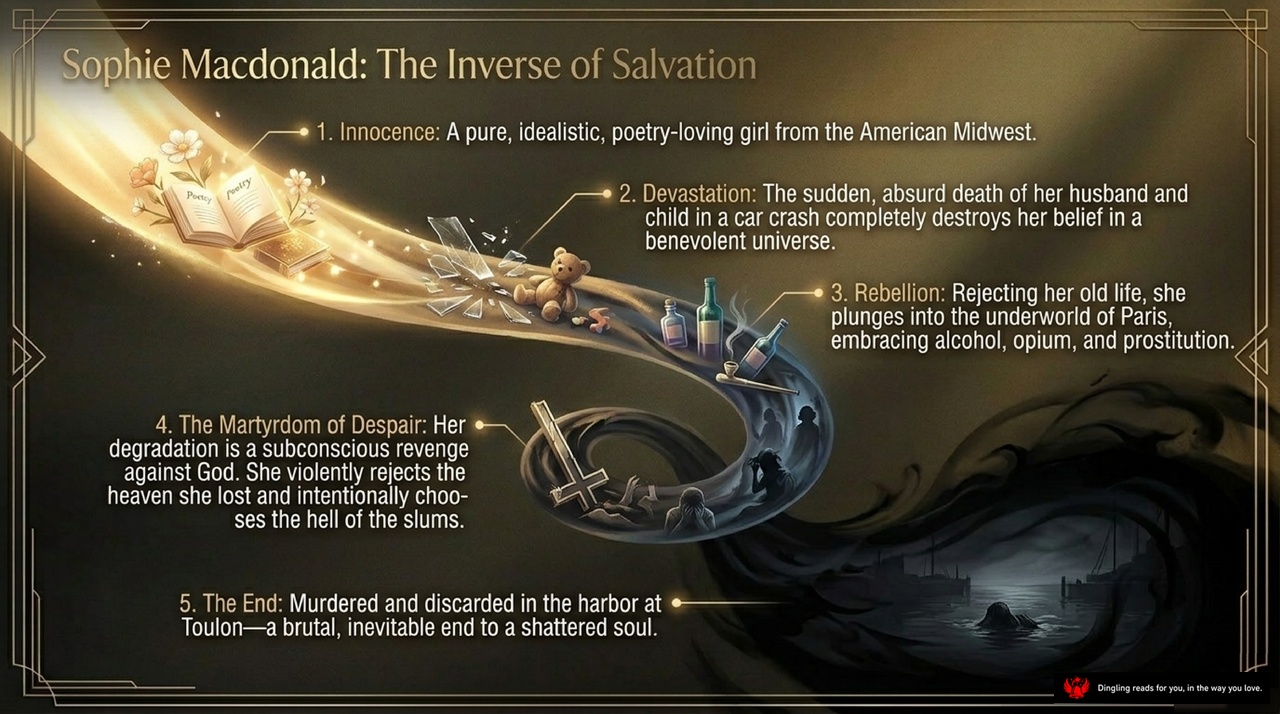
Sophie Macdonald: The Inverse of Salvation. This isn't just a story; it's a tragic arc of a soul shattered by loss and consumed by despair. Let's trace her journey through five devastating stages.
It begins with Innocence. Sophie was a pure, idealistic girl from the American Midwest, a poetry-loving dreamer who believed in a benevolent universe. But then came Devastation. In a sudden, absurd car crash, her husband and child were killed. The tragedy didn't just break her heart; it obliterated her faith in God and the goodness of the world.
In response, she chose Rebellion. Rejecting the life she once loved, she plunged into the dark underworld of Paris. She embraced alcohol, opium, and prostitution, actively seeking the degradation she felt she deserved. This was her Martyrdom of Despair—a subconscious revenge against the heavens she lost. She violently rejected the idea of heaven, intentionally choosing the hell of the slums as her only home.
And finally, we reach The End. After a brutal struggle, Sophie was murdered and discarded in the harbor at Toulon. It was a tragic, inevitable conclusion for a shattered soul. Her story stands as a haunting reminder of how quickly innocence can be destroyed, and how deeply despair can twist a human life.
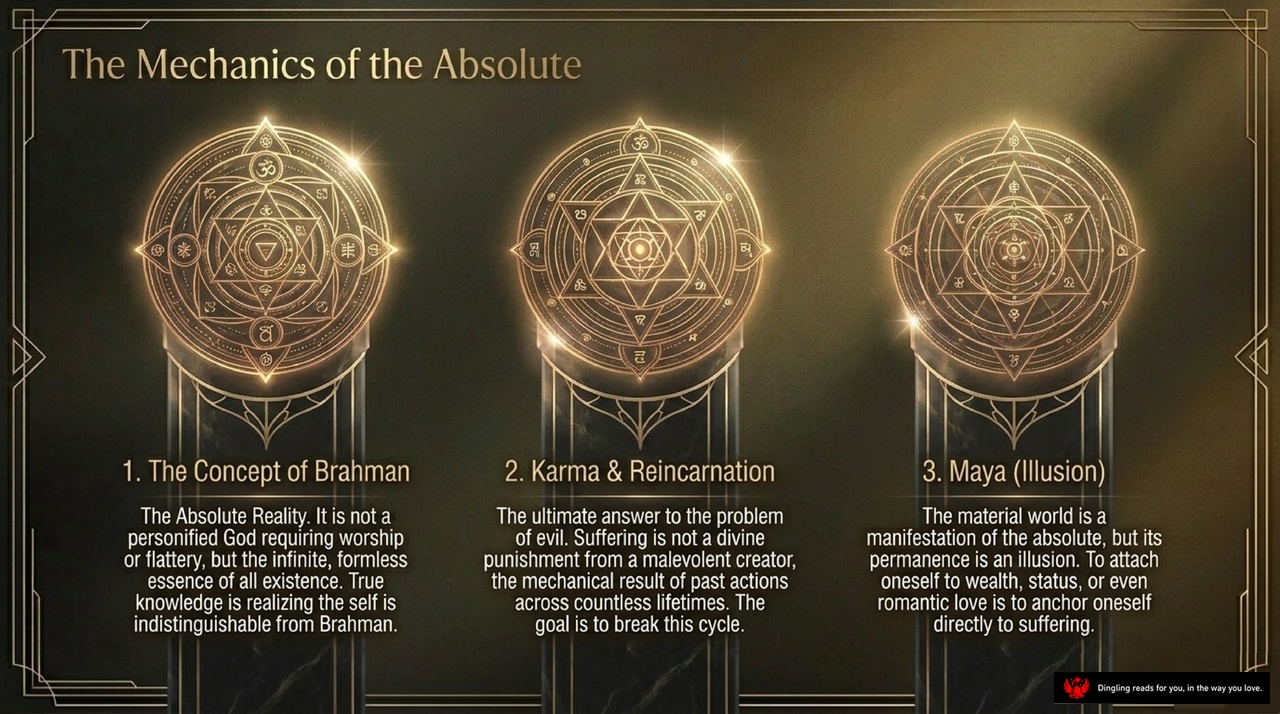
The Mechanics of the Absolute. Let's dive into the three core pillars that define this worldview. First, we have Brahman. This isn't a personified God you worship; it's the infinite, formless essence of all existence. True knowledge is realizing that your own self is indistinguishable from this absolute reality. Next, we move to Karma and Reincarnation. This is the ultimate answer to the problem of evil. Suffering isn't a divine punishment from a malevolent creator; it's simply the mechanical result of past actions across countless lifetimes. The goal here is clear: break the cycle. Finally, there's Maya, or illusion. The material world is a manifestation of the absolute, but its permanence is an illusion. To attach yourself to wealth, status, or even romantic love is to anchor yourself directly to suffering. Understanding these mechanics changes everything.

In the heart of a bustling modern metropolis, a profound transformation unfolds. Larry, once entangled in the safety net of financial security, deliberately sheds his inheritance, choosing instead to detach himself completely from the material world. This radical act of asceticism is not about rejection, but about liberation. By stepping away from wealth, he frees his mind from the constraints of ego and status, finding a clarity that money could never buy.
His journey takes him to New York, where he plans to drive a cab. For Larry, manual labor is more than just a job; it is a sanctuary. The physical rhythm of driving frees his mind from overthinking, while the mobility of the taxi allows him to observe the vast spectrum of humanity. Every passenger becomes a story, and the anonymity of the job protects him from the need to perform or impress. In this simple role, he finds a profound connection to the world around him.
Yet, Larry's path is also one of quiet influence. He believes he cannot change America's rampant materialism by preaching or grand gestures. Instead, he chooses to live a life of absolute purity, calm, and compassion. He sees himself as a pebble dropped into a still pond, understanding that his mere existence will ripple outward, subtly altering the fractured world around him. In the chaos of the city, his presence becomes a gentle reminder that there is another way to live, one rooted in inner peace and genuine connection.
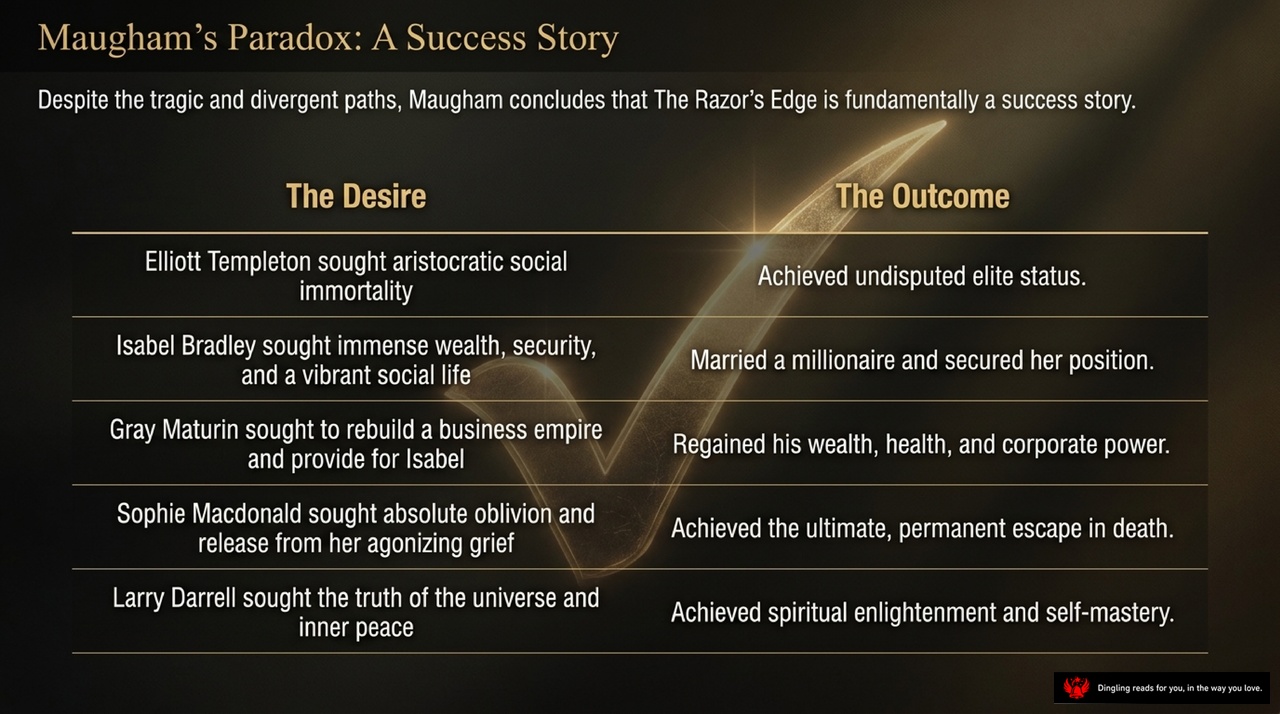
So, here is the ultimate verdict on Maugham's *The Razor's Edge*: despite the tragic and divergent paths taken by our characters, Maugham concludes that this is fundamentally a success story. Look at the table we have here. It perfectly maps out the desires versus the outcomes for each character.
On one side, we have **The Desire**. Elliott Templeton wanted aristocratic social immortality, and look at his outcome—he achieved undisputed elite status. Isabel Bradley sought immense wealth, security, and a vibrant social life, and she successfully married a millionaire and secured her position. Gray Maturin wanted to rebuild a business empire to provide for Isabel, and he regained his wealth, health, and corporate power.
But then we have the contrasting paths. Sophie Macdonald sought absolute oblivion and release from her agonizing grief, and she achieved the ultimate, permanent escape in death. Finally, Larry Darrell sought the truth of the universe and inner peace, and he achieved spiritual enlightenment and self-mastery.
So, while some found success in material terms and social standing, others found it in spiritual freedom. Maugham suggests that both are valid forms of success, depending on what you truly desire.

So, we've reached the final chapter of our journey through Somerset Maugham's masterpiece. If you've been following along, you know that Maugham masterfully orchestrates a tale where every character ultimately achieves their own version of success—be it social prominence, material wealth, self-destruction, or spiritual enlightenment. Look at the paths they took: the Matlins found fortune but lost it all to greed; the Elotes clung to status and religion, only to find themselves trapped in a hollow, dying world; and then there was Larry, who chose the hardest path of all, trading comfort for the absolute truth.
Now, let's leave them with a question that echoes far beyond the pages of this book. If every path, whether toward the divine or the abyss, is simply a pursuit of our deepest desires, then what is the true price of the life you have chosen to live? Is it worth the cost? Or did you simply follow the crowd, unaware of what you were sacrificing until it was too late?