
The Sea of Life: Complete Chapter-by-Chapter Summary

Welcome to our book club session. Today, we are diving into *The Sea of Life* by Mai Jia. As the title suggests, this story unfolds against the backdrop of a vast, turbulent ocean—a powerful metaphor for the relentless tides of history that sweep through our lives.
Imagine an unsung hero, a man navigating these chaotic waters, carrying the weight of trauma while holding onto the enduring resilience of the human spirit. This isn't just a story about war or politics; it's a profound saga about what it means to be human when everything around you is falling apart.
The cover art captures this perfectly: dark, rolling waves that seem to swallow everything in their path. It reminds us that life often feels like a storm we have no control over, yet within that chaos lies the courage to keep moving forward. Whether you're facing personal struggles or simply seeking a deeper understanding of history, this book offers a raw and honest look at the strength it takes to survive.
Grab your coffee, settle in, and let's explore how one man's journey through the sea of life changed everything.

Life is an ocean. This isn't just a metaphor; it's the raw truth of the human condition, as vast and unpredictable as the sea itself.
Look at this image: a lone boat battling towering, chaotic waves. That is the story of our protagonist. He didn't just face a storm; he absorbed the crushing weight of an entire chaotic century. From the brutality of war to the confusion of revolution, he carried it all on his shoulders, serving as a testament to what human endurance can truly achieve.
But what does it take to survive such a storm? The core philosophy here is simple yet brutal: true heroism isn't about choosing to die when life becomes unbearable. It's about recognizing the harsh reality of your situation and choosing to live anyway. Courage isn't found in avoiding the pain; it's found in walking through it.
This story follows a man who became a legend not by conquering the ocean, but by refusing to sink within it. He is the ultimate protagonist, proving that even in the darkest, most unfathomable waters, the will to live is the most powerful force of all.

Picture this: a small, isolated village where secrets are the only currency and privacy is a myth that never existed. This is the "Village Crucible," a microcosm of rigid traditions and communal judgment where the atmosphere is stifling and insular. In this ecosystem, rumors are the weapon of choice. Public perception doesn't just override truth; it erases it entirely. The collective village acts as judge and jury, convicting people without a shred of evidence.
Think about it: a man who saved countless lives, who showed kindness in the darkest times, gets labeled a monster simply because he refused to conform to the village's narrow definitions of masculinity and loyalty. His reputation is built not on facts, but on whispers and fear. The village creates a web of suspicion, trapping individuals in a cage of their own making, where being different is a death sentence. It's a brutal reminder that sometimes, the most dangerous enemy isn't out there; it's the mob right next to you, ready to burn anyone who doesn't fit their mold.

Imagine a man living two completely different lives, trapped in the same body. On one side, there's "The Eunuch"—a figure universally mocked, the subject of vicious rumors about wartime castration, and an outcast believed to carry bad karma. He's the village pariah, shunned and ridiculed.
But on the other side stands "The Colonel." In times of true crisis, he is addressed with deep respect. He lives an aristocratic life of paradox—refusing to farm, smoking premium cigarettes, and raising pedigree cats. He is the ultimate arbiter of village disputes, a man who commands fear and awe.
This stark contrast defines his existence. To the villagers, he is a monster; to the world in his moment of truth, he is a hero. It is a story of one man, torn between the identity the village forced upon him and the noble soul he truly was.

Look at this slide titled "Deconstructing the Legend." It lays out a stark contrast between the village myth and the historical reality of the Colonel.
For years, the village saw him as a cursed man, a coward who lost his manhood, a disgraced anti-revolutionary, and a perverse outcast. But the truth tells a completely different story. He wasn't cursed; he was a brilliant carpenter who became a military medic. He wasn a coward; he was a legendary battlefield surgeon known as "The Golden Scalpel" who saved countless lives. He wasn't an enemy of the revolution; he was a hero who spied in Shanghai, served the KMT, and ultimately saved CCP leaders. And he wasn't an outcast; he was a deeply loyal man who absorbed humiliation to protect others.
This slide captures the core tragedy of his life: a man who spent decades fighting for the very people who hated him, all while carrying the scars of a life lived in shadows.

Look at this iceberg. What we see above the water is just the tip of the problem: a humiliating tattoo forced onto his lower abdomen by his enemies during the war, marking him as a notorious traitor. But the real tragedy lies beneath the surface.
Below that physical mark, there is immediate danger—the constant threat of political execution if the radical Red Guards ever discovered his secret. Deeper still, we find psychological ruin. The regime didn't just want to kill him; they wanted to strip him of his dignity, his masculinity, and his honor as a soldier, turning a hero into a monster in everyone's eyes.
But the deepest layer of all is this historical burden. The ultimate tragedy isn't just his suffering, but the weight of carrying the unspeakable sins of a brutal era in absolute silence. While the world watched him fall, he bore the weight of a broken past alone, proving that the scars hidden underwater often hurt far more than the ones we can see.

The Cultural Revolution didn't just change China; it shattered the very fabric of a village like Shuangjia, turning neighbors into enemies and sacred traditions into targets for destruction. In the story, we see this chaos play out violently when the Red Guards, led by the arrogant "Commander Hu," march into the ancient Guande Temple. They don't care about the centuries of history or the spiritual peace of the village; to them, the temple is just a symbol of the "old society" that must be obliterated.
The image captures the brutal reality of this confrontation. As the Red Guards storm the temple, they don't hesitate. They smash the bronze statues, drag the revered Guanyin Bodhisattva down from its altar, and crush it into pieces on the stone floor. The smoke from burning scriptures fills the air, choking out the centuries of incense that once defined this place. Even the monks, trying to protect their faith with iron staffs, are overpowered and beaten until they collapse, powerless against the fervor of the youth.
This isn't just about breaking stone or wood; it's about destroying dignity. The image highlights the ultimate sacrifice of a man who chose to disappear rather than watch his village and its heroes be torn apart. The Colonel, a man of immense dignity and loyalty, realizes that staying means becoming a victim of this political storm. So, he makes the hardest choice of his life: he flees, leaving behind his beloved cats and his home, sacrificing his own safety to protect the innocent and preserve the last remnants of honor in a world gone mad. It is a heartbreaking moment where personal sacrifice becomes the only way to survive the madness of an era.

The Fracture of the Mind isn't just a metaphor; it's the tragic trajectory of Colonel's life, a downward spiral from pride to madness. As the slide illustrates, it begins with **Flight**. Driven by a desperate need to survive, the Colonel abandons his aristocratic pride and becomes a fugitive, living in a constant state of fear. He tries to outrun his past, but the past is relentless.
Eventually, this flight leads to **Capture**. He is caught, subjected to brutal public humiliation, and the final threads of his psychological endurance are snapped. He is stripped of his dignity, his identity, and his freedom. But here lies the cruel irony: **The Paradox of Madness**. When the weight of history, shame, and humiliation becomes too heavy for a human soul to bear, the mind breaks. Madness triggers not as a failure, but as the ultimate defense mechanism. To save his spirit, he erases his intellect. He retreats into a fractured reality because the real world has become too painful to face. This is the cost of his survival—a mind broken to keep the soul from crumbling completely.

The map before us isn't just a route; it's the life story of the Colonel, drawn in ink and blood. We are looking at "The Observer's Exile," a journey that spans two decades of hardship.
First, look at the start of this arc: **The Escape**. As the text describes, the narrator is forced to flee the village after a political fallout, embarking on a grueling 22-year exile. This isn't just a physical departure; it's a breaking of ties with a community that once defined him.
As the dotted line stretches across the globe, we see **The Mirror Arc**. The narrator's journey mirrors the Colonel's own resilience. Just as the Colonel survived poverty, tragic loss, and started as a scavenger to ultimately achieve massive success, the narrator learns to survive in the unknown. Their paths reflect each other across the ocean, showing that survival often looks the same, even when the stories differ.
Finally, consider **The Metaphor**. The narrator's physical exile across the globe represents the deep emotional alienation caused by the toxic cruelty of the village's rumors. He is forced to leave not just his home, but his own identity, carrying the weight of false accusations into a new world. This exile becomes a necessary space to heal, to rebuild, and to find a truth that the village could never offer.

Aunt Lin: The Architecture of Devotion. This slide tells the heartbreaking and redemptive story of a love that defied time and tragedy.
It begins in the past. Aunt Lin was a fierce military nurse who fell deeply for the Colonel in their youth. But he rejected her—not out of lack of feeling, but out of a desperate need to protect her from a curse he feared would destroy her.
Decades later, she tracks him down for a reunion. What she finds is a shattered man. The brilliant surgeon she once knew is broken, mentally regressed, and living as a child.
In response, she makes a vow. She abandons her own life to marry him in his madness. She becomes his anchor, his mother, and his guardian. Her love stands as the ultimate counter-force to the cruelty of the world, offering nothing but unconditional, redemptive love.

In his final years, the Colonel finds a profound peace that seems almost like a rebirth. He lives in a state of blissful ignorance, entirely free from the tortures of his past, embracing a childlike innocence that he once lost. This transformation is rooted in his deep, healing connection to nature. He becomes a master silkworm breeder, finding solace in the simple, rhythmic cycles of life. Every morning, he carefully selects the freshest mulberry leaves, ensuring each silkworm receives only the best, treating them with a tenderness that contrasts sharply with the harshness of his earlier life.
But perhaps the most powerful act of redemption is the reclaiming of his own body. In a final, devoted gesture, Aunt Lin learns the art of tattooing. She gently alters the humiliating characters that once scarred his abdomen—symbols of shame and trauma—into a beautiful painting of a tree and red lanterns. This new design erases the historical wounds forever, turning a place of pain into a symbol of resilience and hope. As he sits among the writhing white worms, surrounded by the quiet hum of life, the Colonel isn't just surviving; he is truly living again, healed by the very hands that once held a knife.
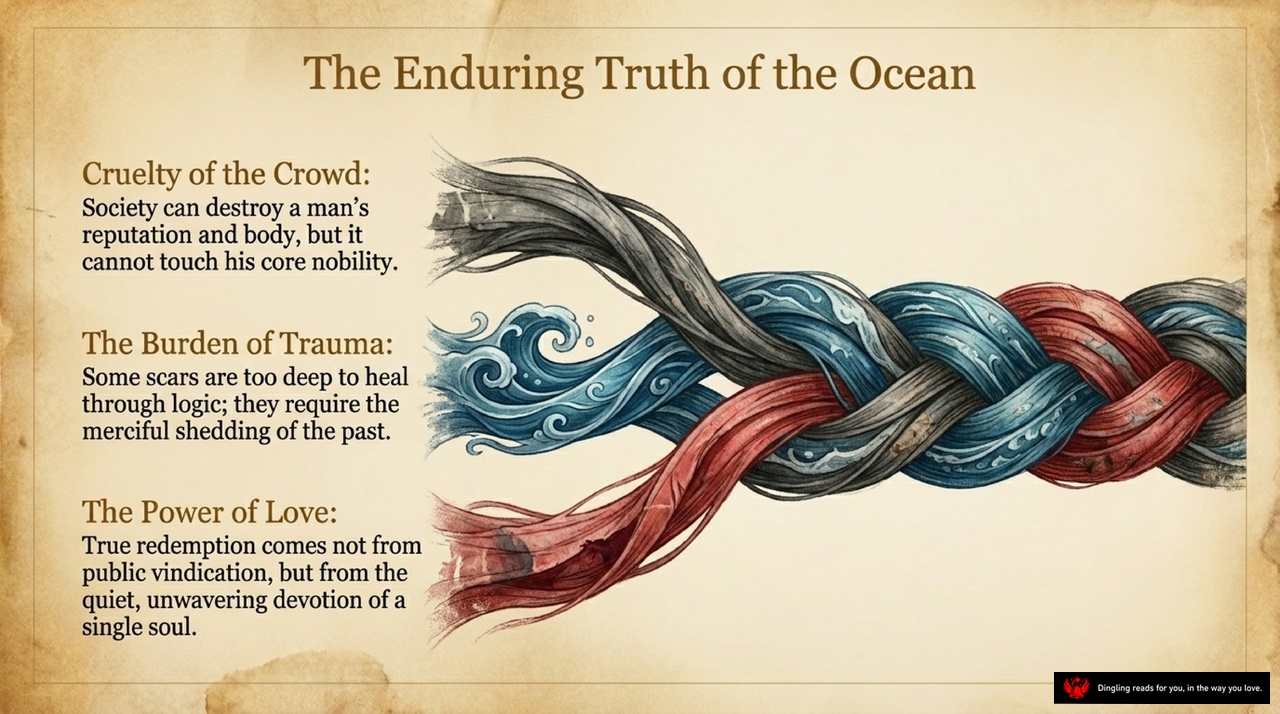
Look at this intricate braid of red, blue, and gray. It's not just a rope; it's a visual metaphor for the complex life of the Colonel, the central figure of our story. This slide, "The Enduring Truth of the Ocean," distills his entire journey into three powerful pillars: the cruelty of the crowd, the burden of trauma, and the ultimate power of love.
First, consider the "Cruelty of the Crowd." The image shows the strands fraying at the start, representing how society can destroy a man's reputation and body. We saw this when the Red Guards humiliated the Colonel, stripped him of his dignity, and even spread vicious rumors calling him a "pedophile" to ruin his family. The mob can tear you apart, but as the text suggests, they cannot touch your core nobility. The Colonel's spirit remained unbroken even when his body was battered.
Next, we see "The Burden of Trauma." The braid twists tightly, symbolizing scars that logic cannot heal. The Colonel carried the weight of a life filled with contradictions: a war hero who became a "traitor" in the eyes of the public, a man who loved cats more than people, and a survivor of Japanese torture who was branded a criminal. These weren't wounds that could be fixed with simple explanations; they required a merciful shedding of the past, a letting go that only true redemption could bring.
Finally, look at "The Power of Love." The red strand, often associated with passion and sacrifice, weaves through the whole rope, holding it together. True redemption for the Colonel didn't come from public vindication or official apologies. It came from the quiet, unwavering devotion of a single soul: Lin A-Yi. She stayed by his side for decades, caring for him when he was mentally broken, protecting his dignity, and eventually, covering his shameful tattoo with a tree of hope. Her love was the anchor that kept him from drifting away into the darkness.
This slide reminds us that while the world may be cruel and our scars may be deep, love is the enduring truth that binds us all together, offering a path back to the light.

The Colonel's life was an odyssey of unimaginable suffering, silenced heroism, and shattered dignity, ultimately salvaged by the profound grace of unconditional love and the mercy of forgetting. If the relentless sea of life eventually washes away both our greatest triumphs and our deepest traumas, is it the scars we bear, or the love we leave behind, that truly defines who we are?