
The Second Mountain: Complete Chapter-by-Chapter Summary

Welcome to a journey that changes how we see our lives. Today, we're opening David Brooks' masterpiece, *The Second Mountain*.
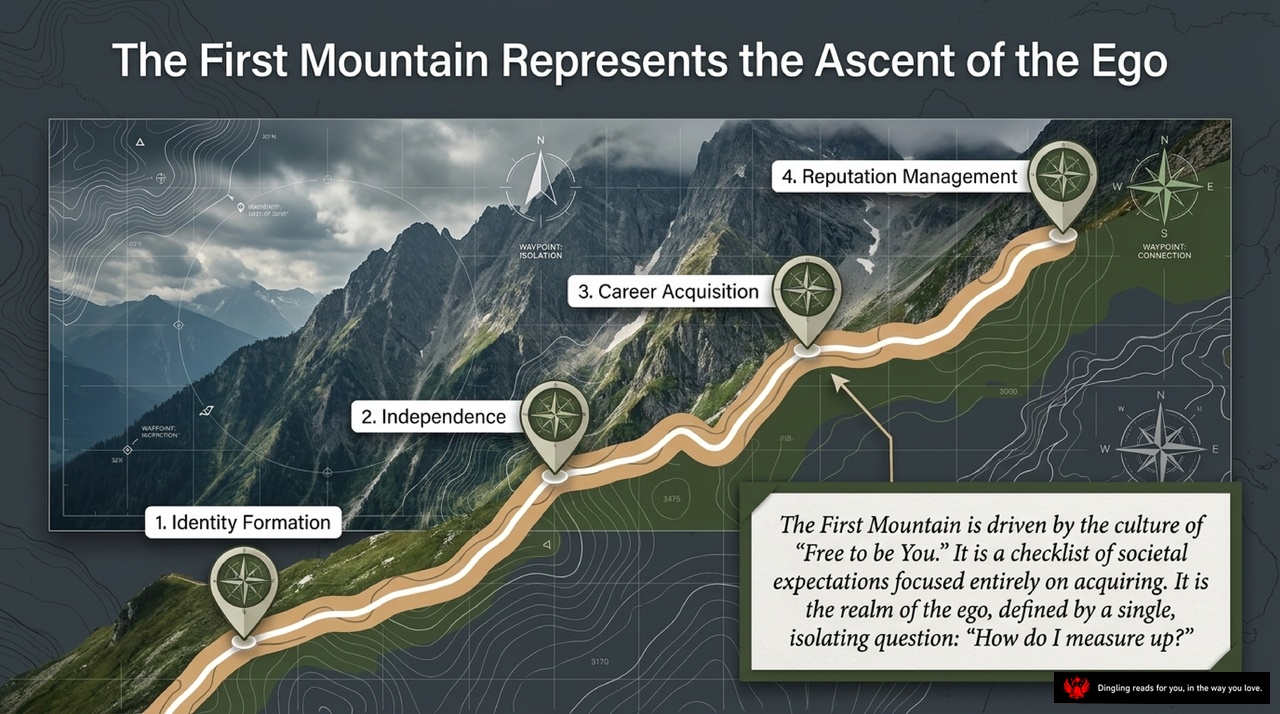
As the title suggests, imagine life as a mountain climb. We all start on the First Mountain. It's the path of the ego-driven pursuit of success—climbing for status, wealth, and personal glory. But Brooks argues that this path, while thrilling, is ultimately a trap. It's a life built on "ego," where we chase success to fill a void that can never be filled.
The Second Mountain is the guide to leaving that behind. It's not about quitting your job or running away from the world. Instead, it's about discovering a life of deep commitment, relational connection, and enduring joy. It's a shift from asking "What do I want?" to asking "What does the world need from me?"
Brooks invites us to move beyond the selfish pursuit of success and find a deeper meaning rooted in love, responsibility, and service to others. It's a call to stop climbing for ourselves and start building something together.
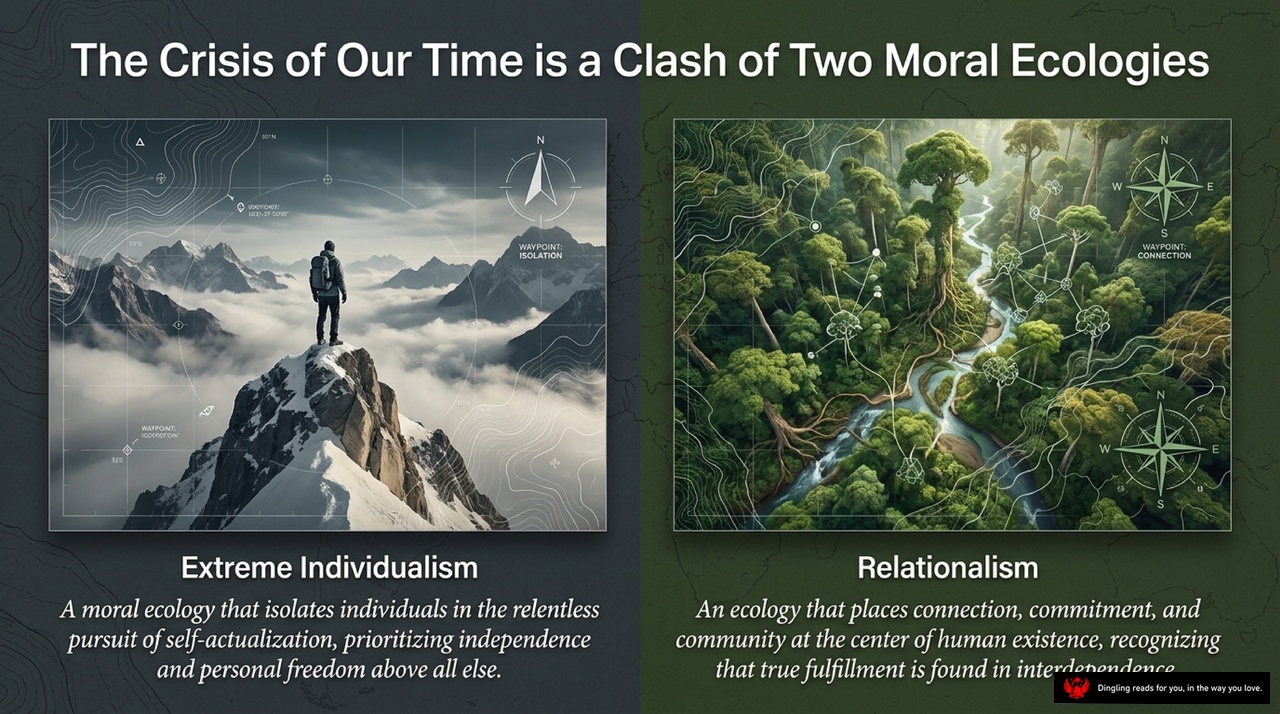
The crisis of our time isn't just political or economic; it's a fundamental clash between two ways of being human. Look at this slide: on the left, we have **Extreme Individualism**, and on the right, **Relationalism**.
The image on the left captures the essence of our modern struggle. It shows a lone figure standing on a jagged peak, surrounded by clouds and vast, empty space. The map overlay labels this state as "Isolation." This is the moral ecology of the First Mountain. It prioritizes independence and personal freedom above all else, treating the individual as an isolated unit whose only job is self-actualization. In this worldview, community is just a collection of people we choose, and true fulfillment comes from climbing higher, achieving more, and being distinct from everyone else.
But now, look at the image on the right. It depicts a lush, vibrant forest with a winding river connecting everything. Trees are linked by roots, and the map here points to "Connection." This is **Relationalism**. It argues that we are not separate islands, but part of an interconnected web. True fulfillment isn't found in isolation, but in interdependence. It places connection, commitment, and community at the very center of human existence.
The book explains that our current crisis stems from living in a moral ecology that isolates us. When we treat life as a solo climb, we lose our anchor. We become either lost in the chaos of aesthetic experiences or hollow in the pursuit of status. But the alternative, as shown in this green, thriving ecosystem, is to embrace our relational nature. We find our deepest satisfaction not by escaping our ties to others, but by diving into them. The path forward isn't about climbing higher alone; it's about learning how to belong.
Welcome back to our journey. Today, we are diving into the most practical of all commitments: your career. But here's the twist—we aren't talking about climbing the ladder for status or salary. We're talking about how your job can become a sacred calling that fulfills your soul.
Think about the moment you first felt truly alive. Maybe it was a childhood memory, like a boy named Edward Wilson discovering the hidden world of insects on a Florida beach, or a writer finding their voice after a moment of pure joy. These are "reporting moments"—sudden, electric signals from your soul telling you where you belong. Often, we ignore them, getting lost in analysis or the pressure to fit in. But true career fulfillment comes when you listen to that inner whisper and let it guide your path.
Once you find that calling, the real work begins. It's not about a perfect plan; it's about discipline and mastery. Imagine Benjamin Franklin rewriting essays over and over, or a baseball player practicing while blindfolded on a ship. Mastery requires "deliberate practice"—pushing yourself beyond comfort, focusing on the details, and building a rhythm that turns skill into intuition. This is where you stop being a novice and start becoming an expert.
But here's the secret that changes everything: your job is only a tool; your mission is the purpose. Don't just do your work to get paid; do it to serve others. Whether you're a teacher, a coder, or a manager, ask yourself: How can my specific skills make someone else's life better? When you shift your focus from "what can I get?" to "how can I give?", your work transforms from a chore into a source of deep meaning.
Finally, remember that true impact often happens right where you are. We live in a world obsessed with moving to new cities or chasing global trends, but the most profound work often happens by rooting yourself in your local community. By staying and serving the people around you, you build something lasting. Your career isn't just about you; it's about becoming a vital part of the world you live in. So, find your calling, practice with passion, and serve with purpose. That is how you climb the Second Mountain.

Have you ever wondered why some careers feel like a calling while others feel like a chore? The difference often lies in the moment we call the "transmission"—a sudden, electric realization that lights up a deep, unspoken desire within us. Think of E.O. Wilson, who as a seven-year-old boy on a Florida beach, was utterly captivated by a giant ray sliding beneath his foot. That single, mysterious encounter didn't just spark a childhood hobby; it anchored his entire life's mission in the study of biology.
But these moments don't always arrive with fanfare. Sometimes, life's detours are actually the path to our true calling. Consider Wilson again: after losing his sight in an eye from a stingray, he couldn't study birds anymore. Yet, by shifting his focus to ants, he found an even deeper connection to the microscopic world, eventually becoming a giant in the field of entomography. This teaches us a powerful lesson: don't fear the unexpected. When we stop clinging to a "perfect path" and instead listen to our soul's whispers, we often find that the obstacles are just the universe helping us focus on what truly matters.
However, hearing that inner voice isn't enough; we need guidance to translate it into action. This is where mentors become indispensable. They aren't just teachers of facts; they are guides who pass down what philosopher Michael Oakeshott called "tacit knowledge"—the kind of practical wisdom you can't find in a textbook but only learn by watching a master at work. A great mentor, like Wilson's, doesn't just teach you the craft; they show you the life of the craft. They teach you that true mastery requires "deliberate practice," pushing you to refine your skills even when it's boring or difficult. They help you break through the illusion that "good enough" is acceptable, showing you that the path to greatness is paved with discipline and a willingness to embrace the struggle.
Ultimately, finding your calling is just the beginning. The real work is the daily choice to stay committed to that calling, even when the initial excitement fades. It's about transforming your job from a mere paycheck into a mission that serves others. Whether you're a writer, a teacher, or a community builder, your work has its highest value not in your personal success, but in the contribution you make to the world. So, look back at your past for those moments where you lost track of time, listen for that quiet pull in your chest, and then have the courage to follow it. Your unique transmission is waiting to change your life and the lives of others.

We often chase the perfect life, building a flawless image to hide our true selves. But the text reminds us that this "perfect self" is just a shield. In the wilderness of our lives, that armor becomes too heavy. We realize that the labels we cling to—being smart, successful, admired—can't fill the emptiness inside. Just like C.S. Lewis described, we suddenly hear a new song or smell a different flower, a quiet call from our real selves.
When that false shell cracks, something profound happens. We stop trying to be perfect and start being real. We see our deepest desires not for power or fame, but for connection, for care, and simply to be seen. This shift is the turning point. Our identity changes from being the master of our own story to becoming a servant of something greater. We no longer live to impress the world; we live to answer the call of our own soul. This is the gift of the wilderness, and it is the true beginning of climbing the Second Mountain.

When we step off the first mountain of ego-driven success, we don't just find a new path; we find a new way of being. The wilderness, that stark and beautiful expanse, acts as a refining fire. As the slide illustrates, it burns away the superficial layers of our lives—specifically, "The Ego Ideal." We spend so much of our time curating a perfect image, protecting ourselves with a shell of arrogance and ambition. But isolation and silence, the harsh realities of the wild, strip that shell away.
In this raw state, we stop chasing external validation. We lose interest in the applause of the crowd and the metrics of success that defined our first mountain journey. What remains, after the fire has done its work, is not emptiness, but something far more profound: a heart that longs to fuse with others and a soul that yearns for goodness. The text reminds us that this isn't about losing ourselves, but finally finding who we truly are beneath the noise. It's a shift from a life of self-gratification to a life of deep connection. We realize that our true identity isn't built on what we achieve alone, but on how deeply we can care for the people around us. This is the moment the wilderness gives us—the chance to rebuild our lives not on a foundation of self, but on the solid ground of genuine human connection.
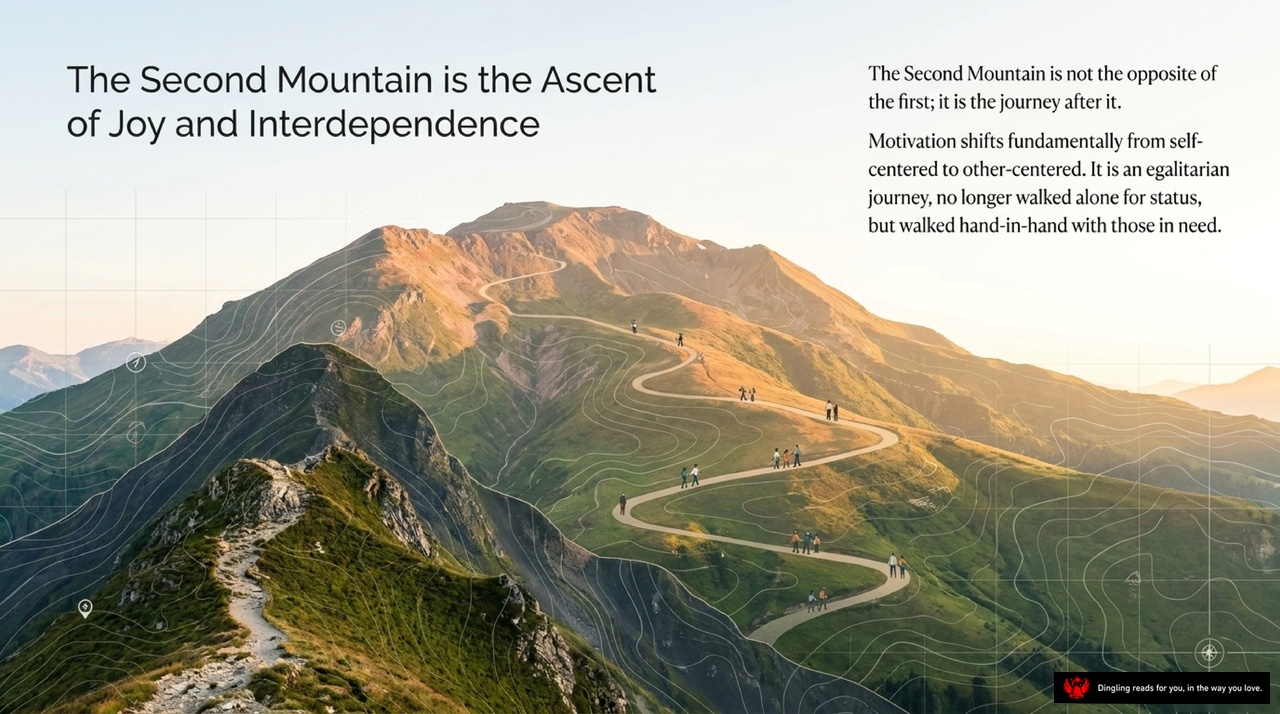
Friends, we've climbed the First Mountain, chasing status, autonomy, and the illusion of a self-made life. But as we've seen, that path often leads to isolation, anxiety, and a hollow sense of achievement. It's time to turn our gaze toward the Second Mountain.
The Second Mountain isn't a retreat from the first; it's the journey that follows. It represents a fundamental shift in our motivation—from being self-centered to becoming other-centered. Think of it as an egalitarian journey where we no longer walk alone to climb for status, but instead walk hand-in-hand with those in need.
This ascent is about joy and interdependence. It's the realization that we are not isolated individuals, but deeply connected parts of a whole. The core of this climb is living out our commitments—whether to our families, our communities, our faith, or our professions. We discover that true freedom isn't found in having no limits, but in finding the right ones that allow us to serve something greater than ourselves.
As we climb, we learn that giving is the only way to truly receive. We find that our deepest happiness comes not from what we can get, but from what we can give. It's a life defined not by what we achieve for ourselves, but by the relationships we build and the lives we touch along the way. This is the Second Mountain: a path of connection, service, and the profound joy of belonging to something bigger than our own small selves.
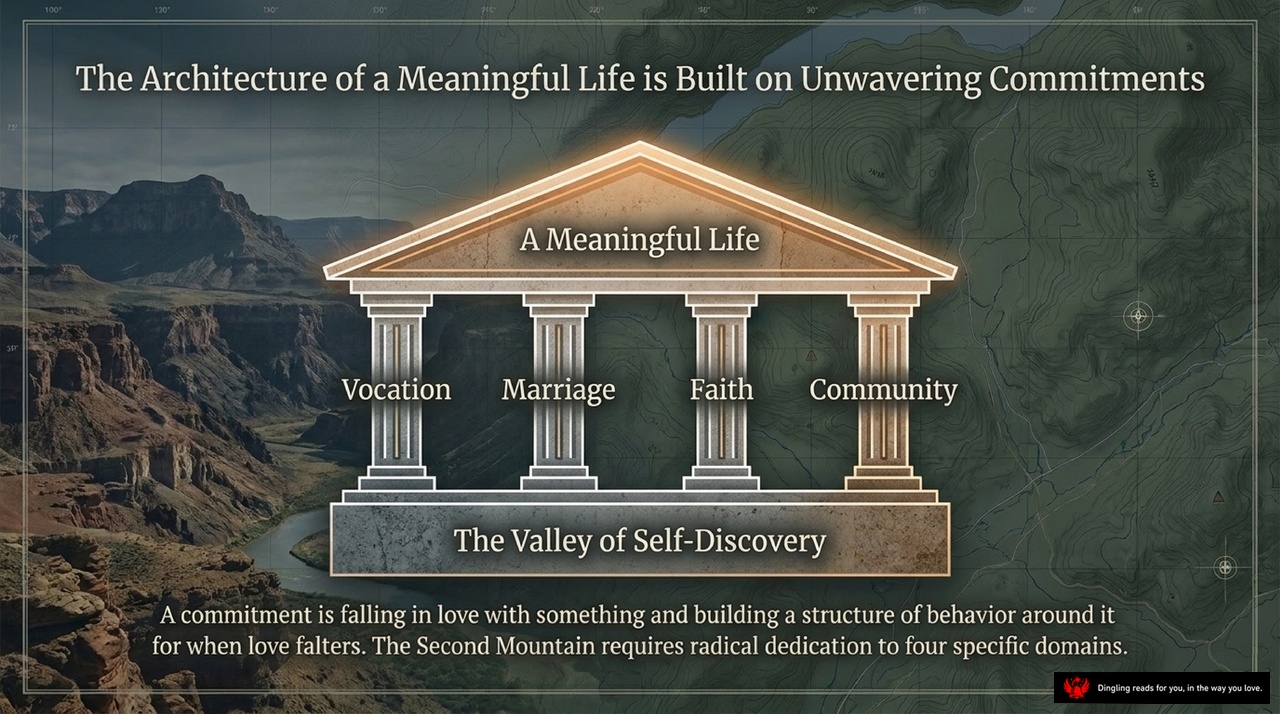
The architecture of a meaningful life isn't built on fleeting feelings or self-serving choices; it's built on unwavering commitments. Think of it like a classical temple. The roof is "A Meaningful Life," but that structure can't stand on its own. It needs four massive pillars to hold it up: Vocation, Marriage, Faith, and Community. Without these four, the roof collapses.
But what does "commitment" actually mean? It's not just a contract or a promise you make when things are easy. A true commitment is falling in love with something—be it your work, your spouse, your faith, or your neighbors—and then building a rigid structure of behavior around it. You build that structure specifically for the moments when your feelings might falter. It's about showing up even when you don't feel like it.
The second mountain of life requires radical dedication to these four specific domains. Before we can reach the roof of a meaningful life, we must first pass through "The Valley of Self-Discovery." We have to go through the pain of realizing who we are not, before we can commit to who we are meant to be. When we make these four commitments, we stop drifting and start building. We move from a life defined by what we want for ourselves, to a life defined by what we owe to the world. That is the only way to construct a life that actually holds weight.
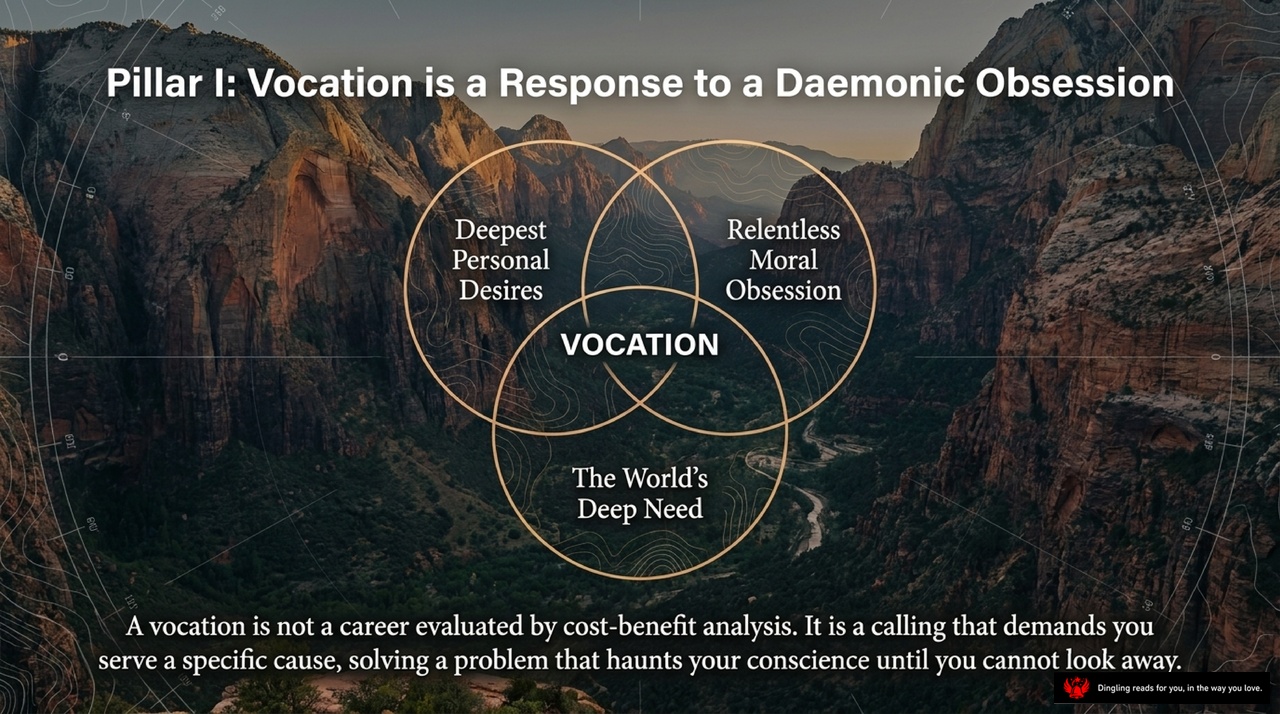
Pillar I: Vocation is a Response to a Daemonic Obsession. Look at this diagram. True vocation sits right in the center, where three circles overlap. On the left, we have your deepest personal desires. On the right, a relentless moral obsession. And at the bottom, the world's deep need. This is the sweet spot.
The text reminds us that vocation isn't a career you choose based on a cost-benefit analysis. It's a calling that demands you serve a specific cause. It's solving a problem that haunts your conscience until you literally cannot look away. Think about that. It's not about what you can get out of a job; it's about a problem that won't let you sleep.
So, how do you find this intersection? It starts with listening. We often get lost in the noise of the first mountain, chasing status and external validation. But true vocation comes from a "daemonic obsession"—a pull that feels almost too strong to ignore. It's that moment when you realize your deepest personal desires align with a moral imperative that serves the world's deepest need. When your inner fire matches the world's hunger, you stop guessing and start serving. That is where your vocation lives.
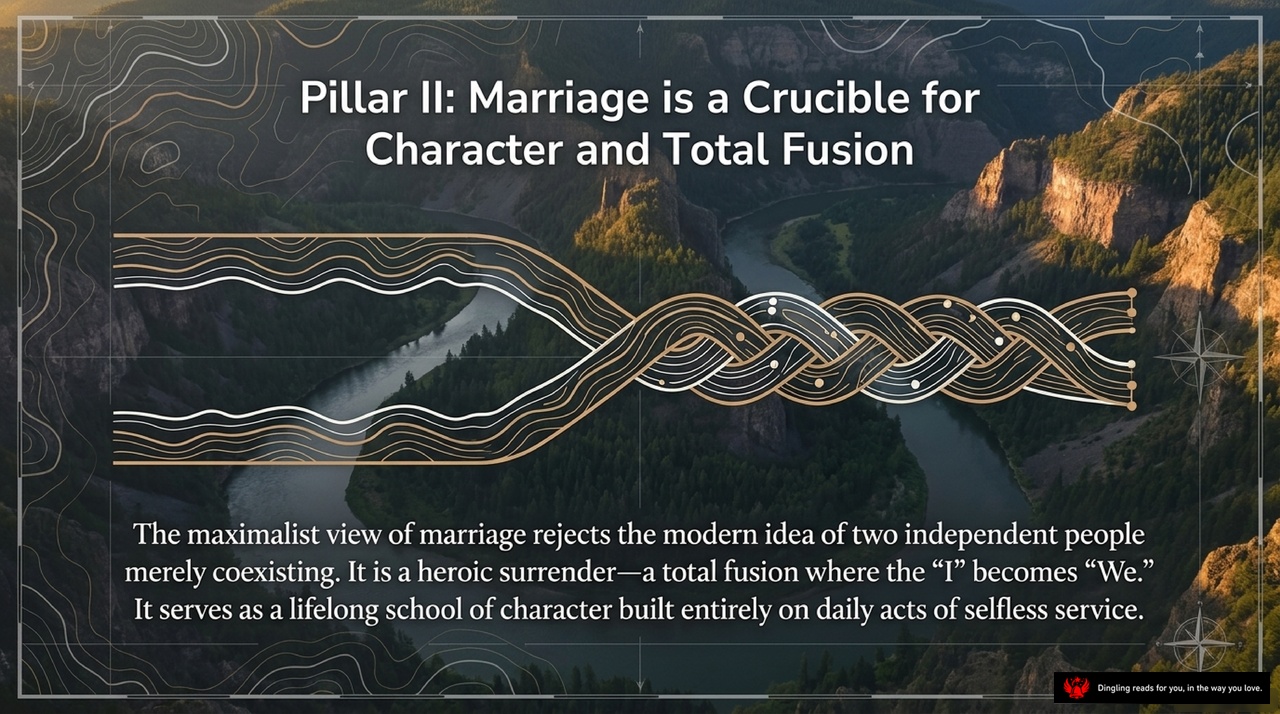
Look at this beautiful graphic: two separate paths flowing through a valley, only to intertwine into a single, braided rope. This visual perfectly captures the core of our second pillar: Marriage is a Crucible for Character and Total Fusion.
The text on the slide challenges a very modern idea—that marriage is just two independent people coexisting. Instead, it presents the maximalist view: marriage is a heroic surrender. It's a total fusion where the "I" becomes the "We." Think of those two lines in the image; they don't just run parallel anymore. They merge, twist, and become one.
This isn't just about romance; it's about character building. The slide tells us that marriage serves as a lifelong school of character, built entirely on daily acts of selfless service. In the book, we learn that the start of marriage is pure joy, but the long journey is a continuous education. It forces us to confront our own selfishness, our control issues, and our fears. It's a mirror that shows us our flaws, requiring us to practice patience, empathy, and forgiveness every single day.
When we choose to stay committed through the hard times, when we choose to listen instead of defend, we are essentially forging a new kind of person. We are learning to serve. As the text suggests, true freedom isn't about being unconstrained; it's about finding the right constraints that allow us to flourish. In marriage, the "constraint" of another person actually liberates us from our own isolation. We stop trying to be perfect individuals and start becoming a complete, unified team.
So, as we look at that braided rope, remember that this fusion is the path to a deeper, more meaningful life. It's where we find the courage to let go of the ego and embrace the greater good of our relationship. That is the essence of the second mountain.

Pillar III: Philosophy and Faith Reveal the Hidden Dimension.
Imagine looking through a magnifying glass at a simple rock. Suddenly, that ordinary stone glows with a complex, hidden network of energy and meaning. That is exactly what philosophy and faith do for us. They don't just explain the world; they reveal the invisible moral and spiritual dimension that permeates our physical reality.
The text reminds us that committing to a philosophy or a faith requires recognizing what it calls the "dark play"—that unseen layer of life where our deepest values and spiritual truths actually live. It's the realization that our daily grind isn't random; it is tethered to a much larger, transcendent story.
When we embrace this hidden dimension, we stop seeing life as a series of isolated transactions. Instead, we begin to see the connections that bind us all. We realize that our choices matter beyond ourselves, and that there is a purpose to our existence that goes far beyond personal success or survival. This shift in perspective is the key to moving from the confusion of the first mountain to the clarity of the second. It invites us to live with intention, rooted in a truth that is deeper than what our eyes can see.

Look at this transition on the screen. On the left, we see a sparse, scattered network of dots. On the right, a dense, intricate web. This visual perfectly captures the core of our fourth pillar: Community is a Dense Web of Intentional Relationships.
We must shift our cultural narrative from "My Story" to "Our Story." For too long, we've treated the isolated individual as the fundamental unit of societal change. But a true community views the neighborhood, not the lonely person, as the engine of progress.
Think about the difference between these two images. The scattered dots represent the extreme individualism we've been taught to value—a life defined by personal success, where neighbors are just strangers we pass on the street. It's a world of transaction, where everyone is racing up the first mountain, focused only on their own summit. But as we've seen, that path leads to isolation, anxiety, and a profound lack of meaning.
Now, look at that dense web on the right. This is what happens when we commit to the second mountain. Here, relationships aren't optional; they are the infrastructure of our lives. It's the difference between a collection of strangers and a family. It's the difference between a neighborhood where no one knows your name, and a community where you can knock on a door at midnight and find help.
This shift requires us to stop seeing our lives as solo projects. Instead, we must weave ourselves into a tapestry of care. When we build these intentional connections, we create a safety net that no single person could build alone. We move from a culture of "me" to a culture of "us," where our strength comes not from how high we climb, but from how deeply we are connected to the people around us. That is the only way to build a society that can truly endure.
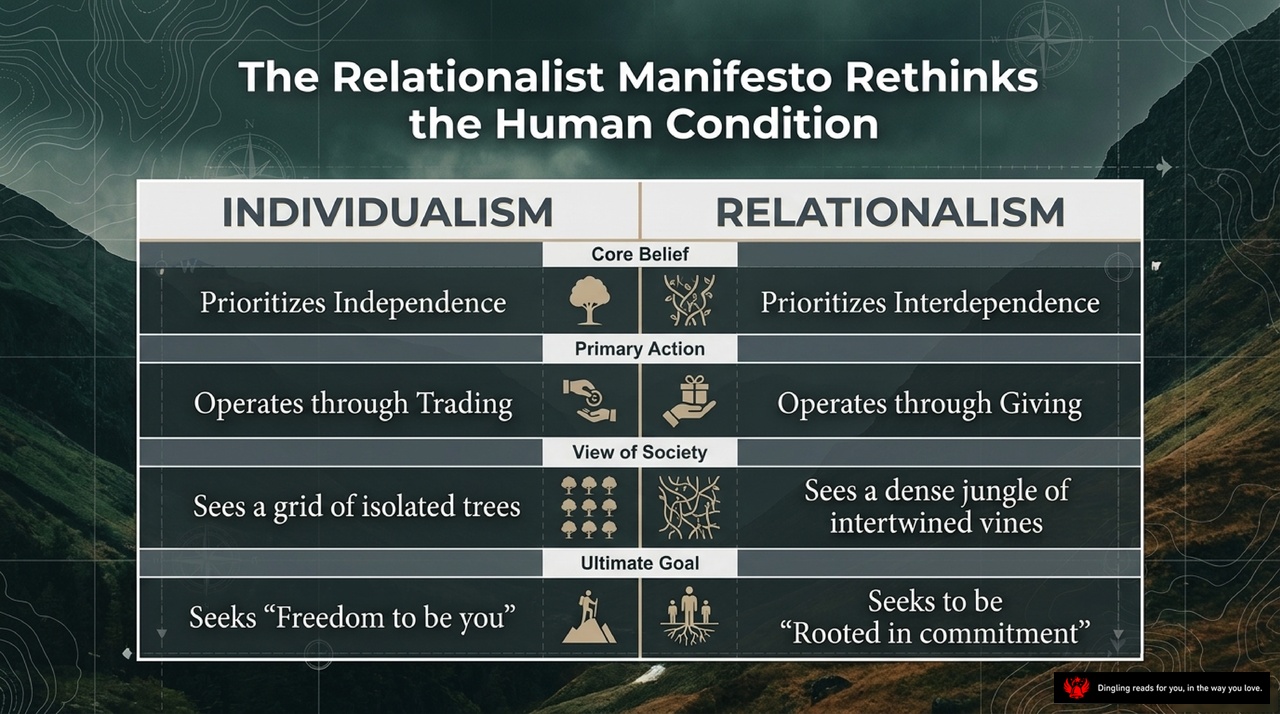
Today's slide contrasts two fundamentally different ways of being human: Individualism and Relationalism. On the left, Individualism prioritizes independence, viewing society as a grid of isolated trees where we operate through trading to achieve the ultimate goal of "freedom to be you." It sees us as separate units, seeking to be free from obligation.
But look at the right side: Relationalism. This worldview prioritizes interdependence, seeing society not as isolated trees, but as a dense jungle of intertwined vines. Instead of trading, we operate through giving. Our primary action isn't about protecting our independence, but about deep connection. Our ultimate goal isn't to be free from others, but to be "rooted in commitment."
The book argues that while the first mountain of life often traps us in the pursuit of isolated self-fulfillment, the second mountain invites us into this relational reality. It suggests that true freedom isn't found in escaping our connections, but in embracing them. When we stop trying to be alone and start choosing to be connected, we move from a fragile, transactional existence to a life defined by love, responsibility, and the profound strength of being truly rooted in something greater than ourselves.

Today's slide illustrates the core thesis of our book: a thriving society isn't built from the top down by mandates or laws. Instead, it is reconstructed from the bottom up, woven together by millions of daily, localized acts of care.
Look at that concentric circle diagram. At the very center, we start with "Self-Surrender." This is the radical act of letting go of our own ego and making "Deep Commitments" to something or someone larger than ourselves. These commitments then expand outward, forming our "Local Community." When enough of us do this, those local communities interlock to create "A Thriving Society."
The text on the right reinforces this beautifully. It reminds us that a healthy society cannot be forced upon us. It is rebuilt one relationship at a time. By making those deep commitments, we are essentially re-weaving the social fabric. We aren't waiting for a leader to save us; we are the architects. Every time we choose to care for our neighbor, honor our spouse, or serve our community, we are literally building a better world from the ground up. This is the power of moving from the individual "I" to the collective "We."

We are born into a culture that tells us to conquer the mountain of personal success, only to find the summit empty. True fulfillment requires falling into the valley of self-discovery, abandoning the ego, and climbing the Second Mountain—a life defined by radical commitment to a vocation, a partner, a belief, and a community.
When the superficial pursuits of the First Mountain finally lose their appeal, what is the ultimate commitment you are willing to bind yourself to in order to truly become free?