
The Second Sex: Complete Chapter-by-Chapter Summary

Welcome to the book club. Today, we're diving into a title that changed the world: *The Second Sex* by Simone de Beauvoir.
This isn't just a book; it's the groundbreaking manifesto that redefined what it means to be a woman and launched the modern fight against gender oppression. For centuries, people tried to define women using simple biological formulas, reducing them to just their reproductive functions. But de Beauvoir argues that "woman" isn't a fixed biological destiny. She reveals that while biology gives us our bodies, it is society, culture, and history that actually shape our lives.
She challenges the idea that women are naturally inferior or destined to be "the Other." Instead, she shows how women are gradually formed through social expectations, turning potential into a specific, often limiting, identity. This book doesn't just explain history; it gives us the tools to understand our own lives and imagine a future where women are free to define themselves, rather than being defined by others.
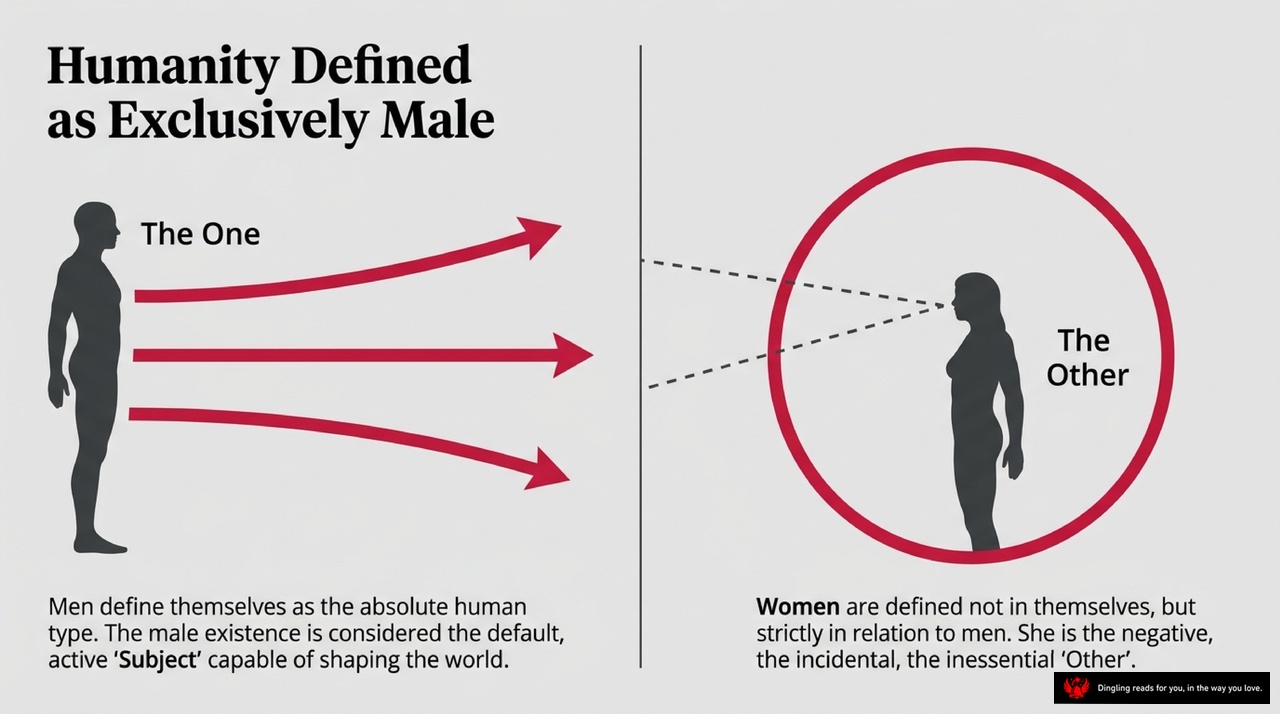
Look at this diagram. On the left, we see "The One"—a man standing as the absolute standard of humanity. The red arrows point outward, showing how men define themselves as the active subjects capable of shaping the world. They see their existence as the default, the norm. But on the right, enclosed in a red circle, is "The Other"—a woman. She isn't defined by her own essence. Instead, she is defined strictly in relation to men. She is the negative, the incidental, the inessential.
This visual perfectly captures the core argument from our book: humanity has historically been defined as exclusively male. Women were never treated as full human beings in their own right; they were merely a reflection of men, a mirror used to confirm male identity. As the text explains, men view themselves as the active creators, while women are relegated to the role of the passive, the accidental. This isn't about biology or nature. It's a social construction. Society taught women to be objects to be looked at, while men were taught to be subjects who look back. This fundamental split created a world where women could never truly be "subjects" themselves, trapped forever in the shadow of "The Other."
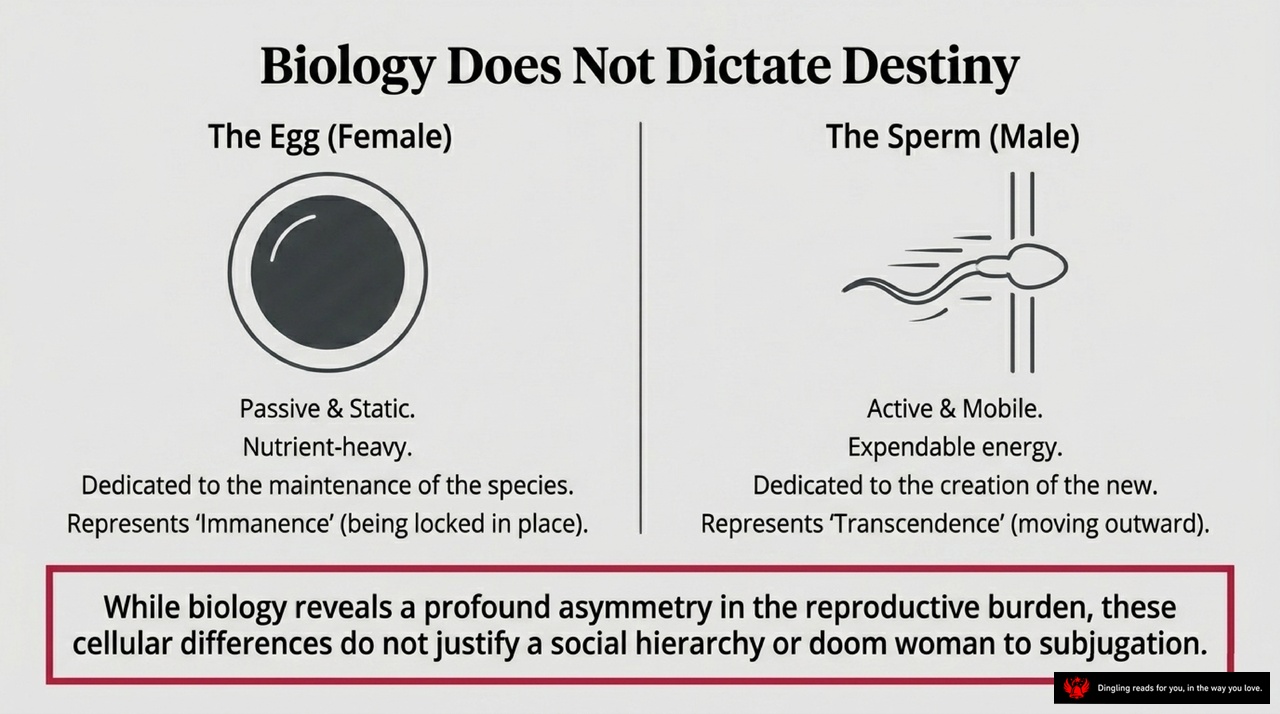
Look at this slide: "Biology Does Not Dictate Destiny." It breaks down the stark difference between the egg and the sperm. The egg is passive, static, and nutrient-heavy, designed to maintain the species. The sperm is active, mobile, and expendable, dedicated to creating something new.
This creates a profound asymmetry in the reproductive burden. Women carry the heavy load of pregnancy and birth, while men's contribution is minimal and risk-free. But here is the crucial point: these cellular differences do not justify a social hierarchy. Biology reveals a disparity in burden, but it does not doom women to subjugation.
Just because a woman's body is biologically structured for reproduction doesn't mean her social destiny is fixed. The physical reality of being female is not the same as the social reality of being subordinate. We must separate the biological facts from the cultural interpretations. The asymmetry exists, but it is not a verdict. Our destiny is not written in our DNA; it is shaped by the society we live in.
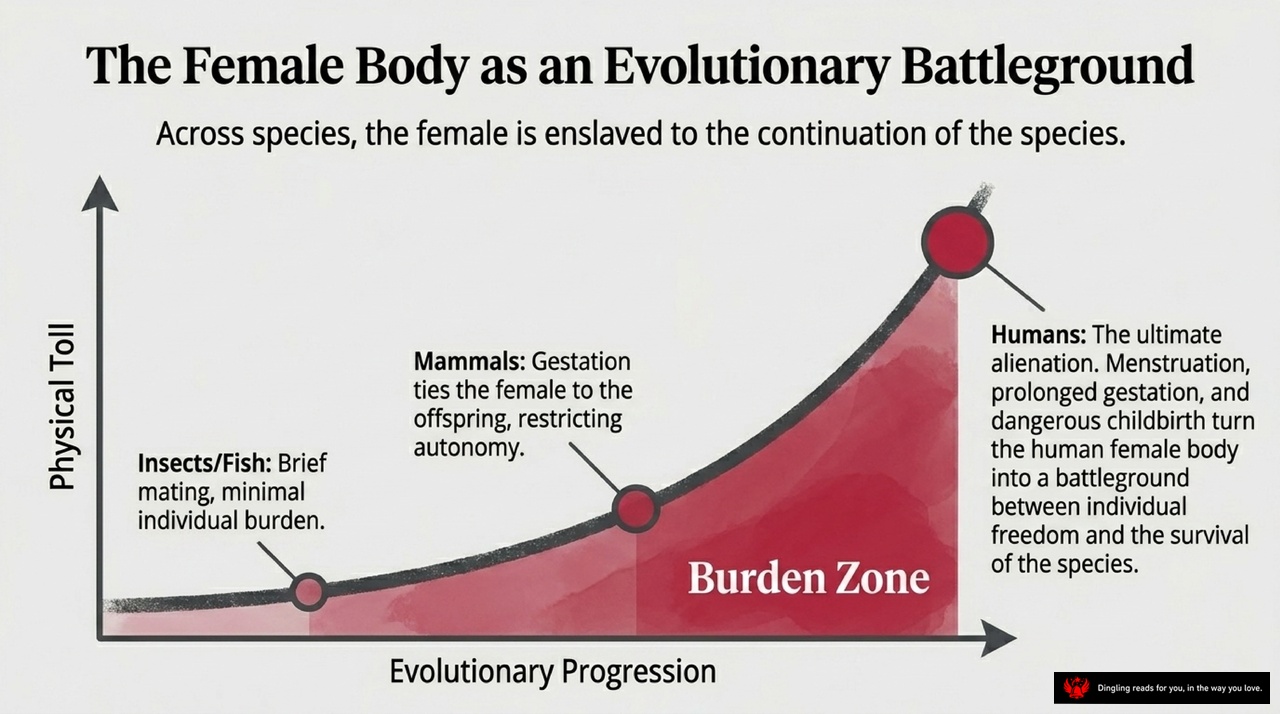
The graph on your screen lays bare a harsh evolutionary truth: as species advance, the physical toll on the female body skyrockets. While insects and fish face minimal burdens, mammals—and especially humans—enter what we call the "Burden Zone." Here, menstruation, prolonged gestation, and dangerous childbirth transform the female body into a battleground between individual freedom and the survival of the species. Across the animal kingdom, females are often enslaved to the continuation of their kind. But here is the critical shift: biology does not dictate destiny. These biological facts do not equal a fixed fate. While the male body remains relatively constant, the female body is shaped by a complex interplay of biology, culture, and social structures. We must understand that the pain and constraints women face are not just natural laws, but also the result of how society has historically defined and restricted female roles. Recognizing this distinction is the first step toward reclaiming autonomy.
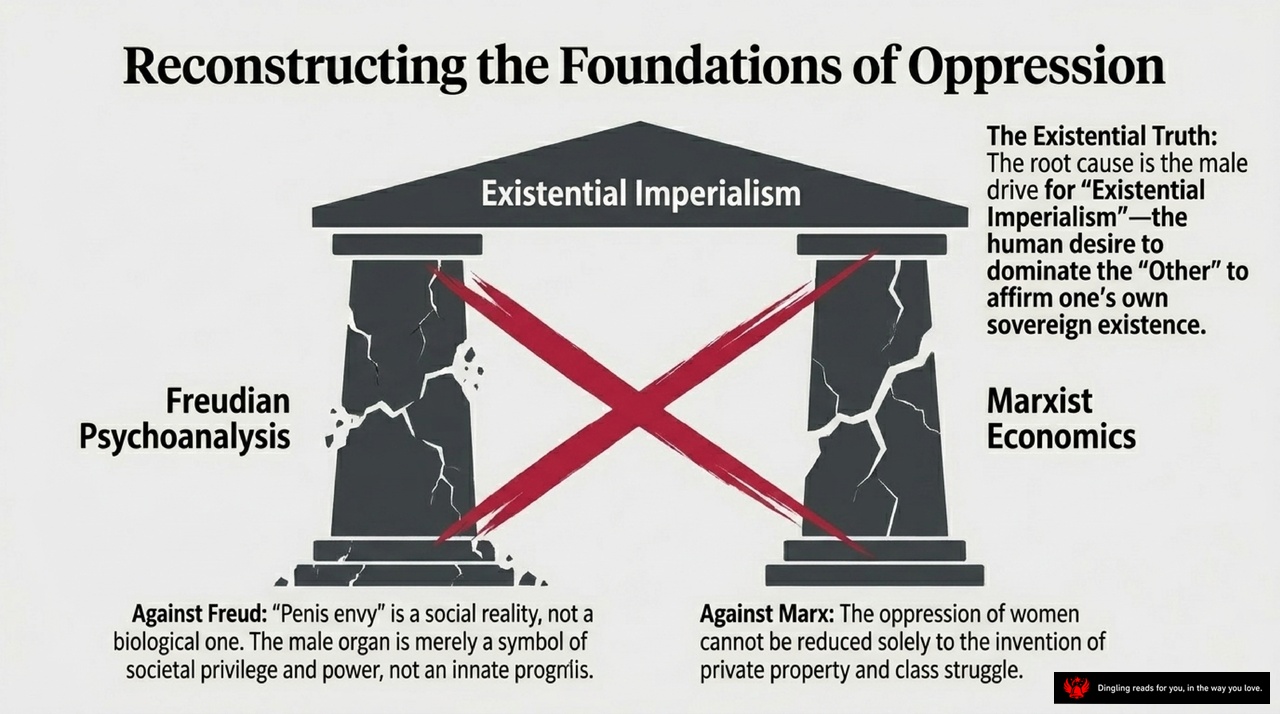
When we look at the slide, we see a clear architectural metaphor: a crumbling temple labeled "Existential Imperialism," supported by two broken pillars—Freudian Psychoanalysis on the left and Marxist Economics on the right. The red X crossing them out tells us something profound: neither Freud nor Marx alone can explain the oppression of women. The slide explicitly states the "Existential Truth": the root cause is the male drive to dominate the "Other" to affirm their own sovereign existence.
This visual argument challenges the traditional frameworks we often rely on. On the left, the slide critiques Freud, noting that "Penis envy" is a social reality, not a biological one. It argues that the male organ is merely a symbol of societal privilege and power, not an innate superiority that defines a woman's worth. On the right, it pushes back against Marx, stating that the oppression of women cannot be reduced solely to the invention of private property and class struggle.
The image of the cracked pillars illustrates that while biology and economics play roles, they are insufficient foundations. The true structure holding up this system of oppression is the existential need for male dominance. Men, in their quest to define their own sovereignty, have constructed a world where women are the "Other"—a necessary contrast to prove their own existence. This isn't about biology or money; it's about the fundamental human desire to control and define what is not oneself. By rejecting the limitations of psychoanalysis and economics, we arrive at a deeper understanding: women are not defined by their bodies or their economic status, but by how they are positioned in a power dynamic designed to exclude them from true sovereignty.

Phase 1, Reverence: In early societies, female fertility was revered. Women were intrinsically linked to the mysterious, vital forces of Mother Earth. But then came the Pivot. With the invention of tools, mankind learned to control nature. This shift marked the move into Phase 2, Subjugation. Suddenly, giving life—mere reproduction—became seen as repetition. Risking life through hunting, war, and creating tools or agriculture was elevated to true transcendence. Humanity began to elevate the sex that risks life over the sex that merely gives it. This historical pivot fundamentally changed how we value existence, turning the act of creating life into a secondary role compared to the conquest and domination of the natural world.
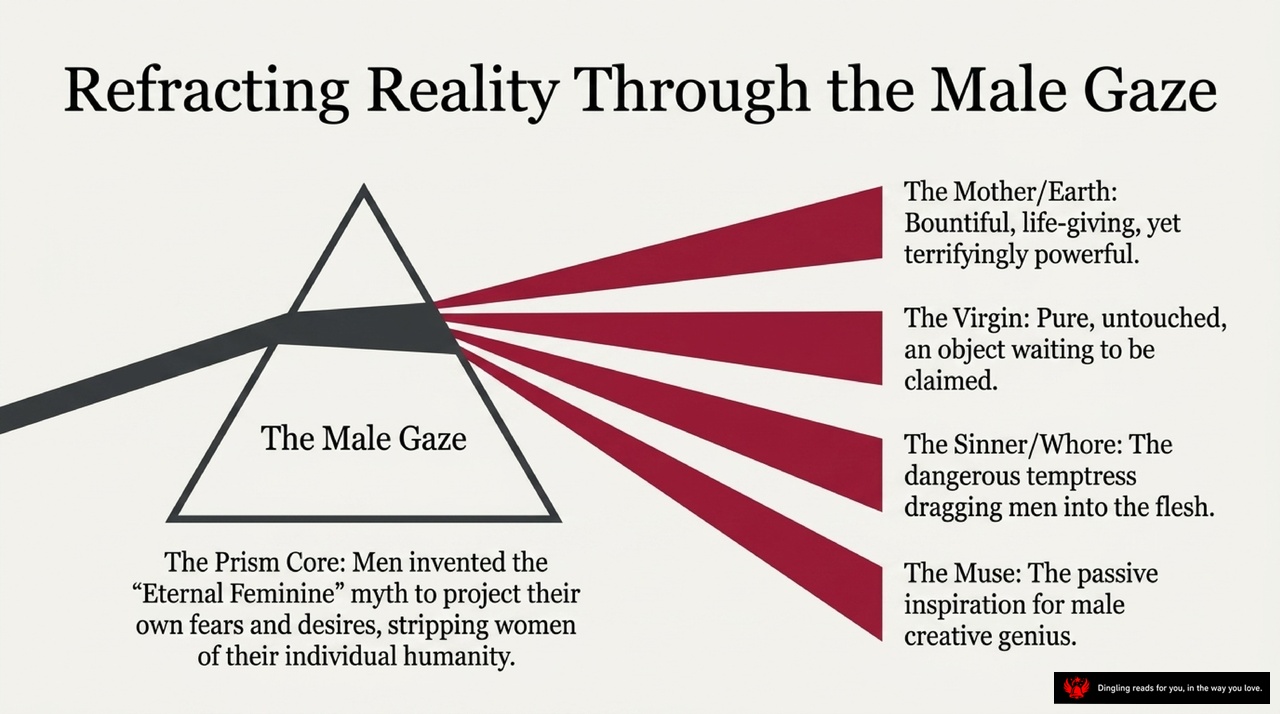
Refactoring Reality Through the Male Gaze: How Men Invented the "Eternal Feminine"
Imagine a beam of white light hitting a prism. It doesn't just pass through; it shatters into a spectrum of colors. Today, we're looking at a similar phenomenon in our culture. The slide shows us "The Male Gaze" acting as that prism, taking the raw, complex reality of women and refracting it into four distinct, often contradictory, myths.
At the base of this prism lies the "Prism Core." This is the foundational lie men constructed: the "Eternal Feminine." Men invented this myth not to understand women, but to project their own fears and desires onto them, effectively stripping women of their individual humanity. Instead of seeing real people, men created four specific archetypes that serve their psychological needs.
First, we have "The Mother/Earth." In this lens, women are seen as bountiful and life-giving, yet terrifyingly powerful. They are the source of nature's abundance, but also a force that men feel they cannot fully control.
Next is "The Virgin." Here, the woman is pure, untouched, an object waiting to be claimed. This archetype satisfies the male desire for conquest and the fantasy of possessing something pristine that has never been touched by another man.
Then, we have "The Sinner/Whore." This is the dangerous temptress, the one dragging men into the flesh. She represents the fear of being seduced, of losing control to one's own desires, and of being led astray by a woman's power.
Finally, there is "The Muse." In this role, the woman is passive, merely the inspiration for male creative genius. She is the tool that helps the man create, but she has no agency of her own; she exists only to serve the man's artistry.
These four rays of light aren't just descriptions; they are cages. By reducing women to these roles—the nurturing mother, the pure virgin, the dangerous sinner, or the passive muse—men have created a distorted reality. They refuse to see women as complex individuals with their own agency, fears, and desires. Instead, they force women into these static categories that fit neatly into the male narrative. This is the power of the "Eternal Feminine" myth: it allows men to define women entirely, ignoring the messy, unpredictable reality of actual human life. To truly see each other, we must stop looking through this prism and start seeing the full, unrefracted spectrum of who women actually are.
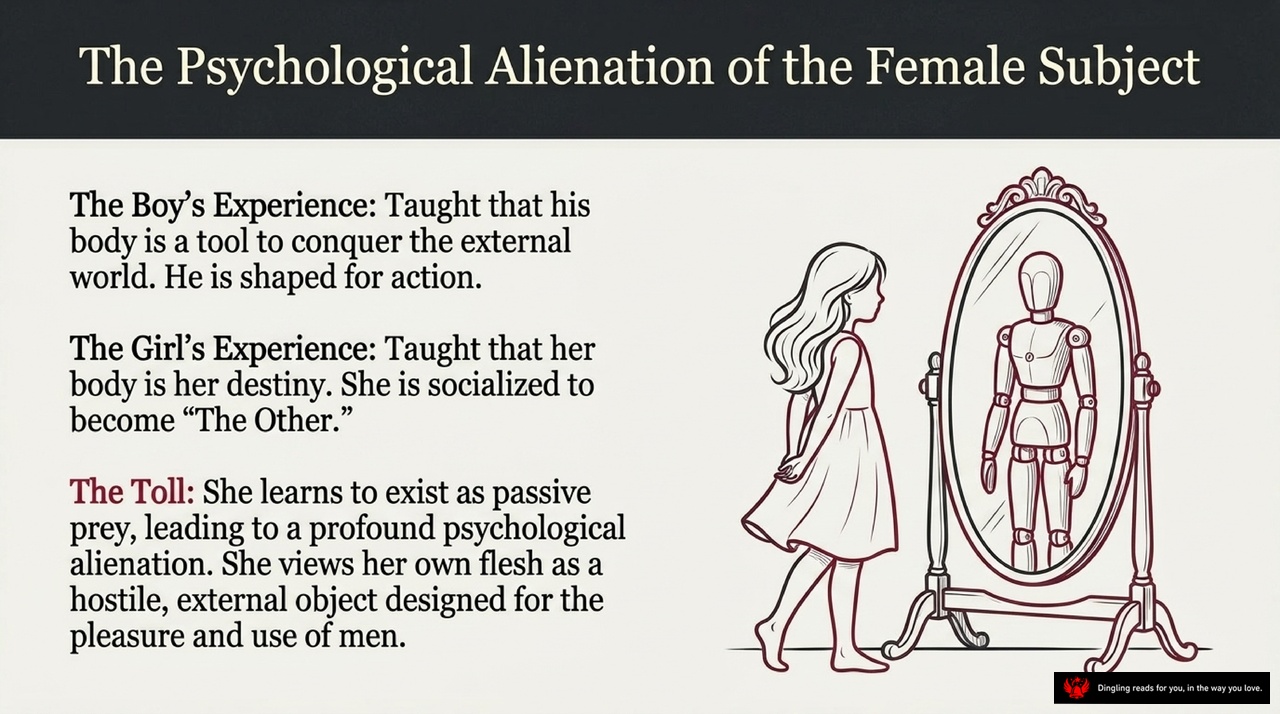
Look at this striking image: a young girl standing before a mirror, but instead of seeing herself, she sees a mannequin—a lifeless, constructed object. This visual perfectly captures the core argument of today's slide: The Psychological Alienation of the Female Subject.
The slide breaks this down into three critical stages. First, it contrasts the foundational experiences of boys and girls from childhood. Boys are taught that their bodies are tools for conquering the world, shaping them for action and agency. In contrast, girls are taught that their bodies are their destiny. They are socialized to become "The Other," defined not by what they can do, but by how they are perceived.
This conditioning leads directly to the second point, labeled "The Toll." Because girls are taught to view their own flesh as a hostile, external object designed for the pleasure and use of men, they learn to exist as passive prey. They don't see their bodies as their own; they see them as something separate, something to be managed or displayed. This creates a profound psychological alienation. As the text suggests, women are never born this way; they are gradually formed by a civilization that constantly instructs them to be objects rather than subjects.
Ultimately, this slide illustrates how patriarchy strips women of their subjectivity. By forcing women to view themselves through the male gaze—seeing themselves as mannequins waiting to be admired or used—they prevent them from ever truly owning their own lives. The path to liberation, as we will explore further, begins only when women stop looking at themselves as objects and start reclaiming their status as active, free subjects.
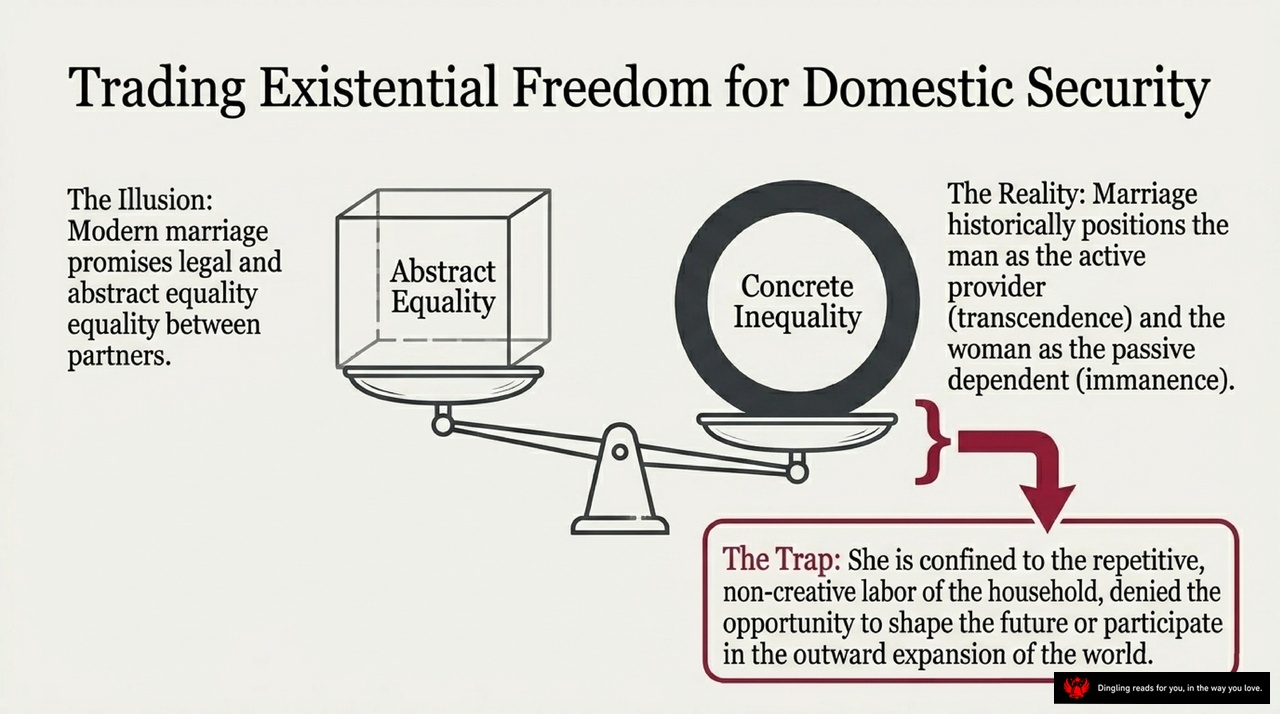
Trading existential freedom for domestic security is a trade many women have unknowingly made, and it sits at the heart of a profound imbalance. As our slide illustrates, modern marriage often sells us an "illusion" of abstract equality, promising that partners are legally equal. But look at the other side of the scale: the reality is often "concrete inequality." Historically, marriage has positioned the man as the active provider, transcending the daily grind, while the woman is cast as a passive dependent, confined to the realm of immanence.
This dynamic creates a trap. Women are frequently confined to repetitive, non-creative household labor, denied the opportunity to shape their own futures or participate in the outward expansion of the world. While the law promises us a box of abstract equality, the weight of concrete inequality often tips the scales heavily against us, trading our potential for existential freedom in exchange for a fragile sense of domestic security.
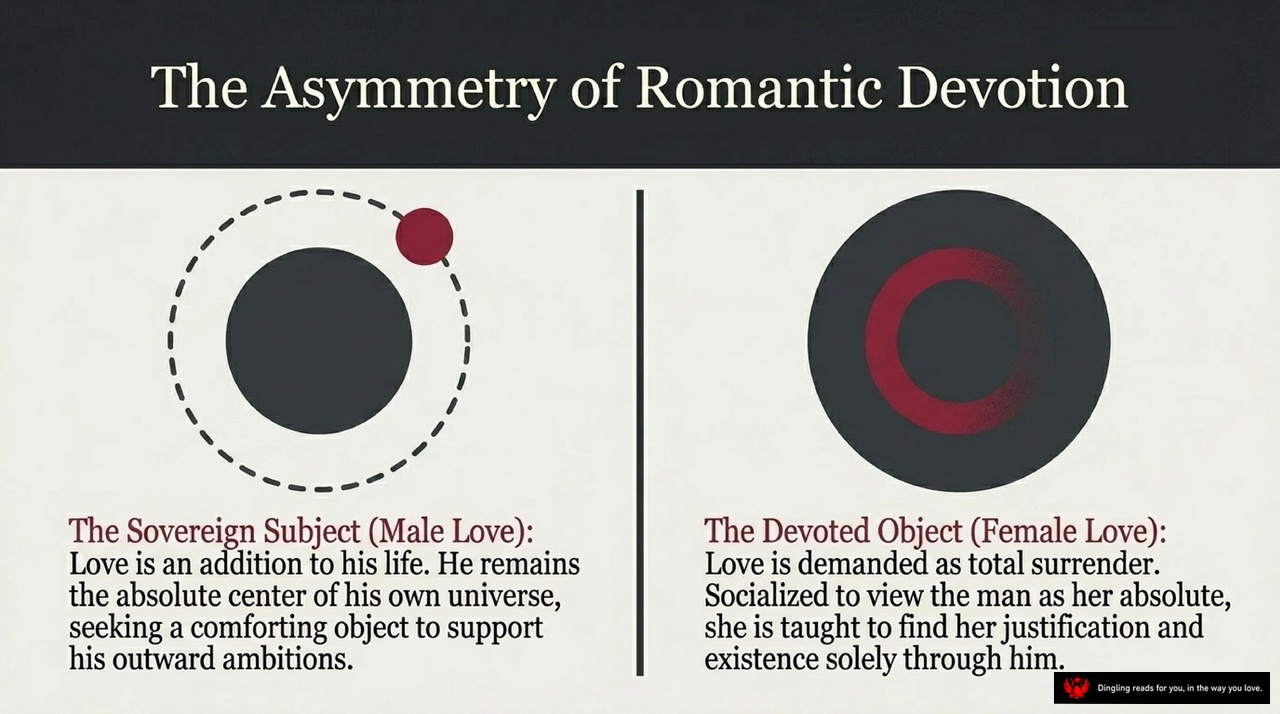
Look at this slide. It perfectly captures a painful truth about romance: the asymmetry of devotion. On the left, we have the Sovereign Subject, representing the male experience. For him, love is just an addition to life. He remains the absolute center of his own universe, seeking a comforting object to support his outward ambitions. He is the one in control, the one orbiting freely.
But look at the right side. This is the Devoted Object, the female experience. Here, love is demanded as total surrender. She is socialized to view the man as her absolute, to find her justification and existence solely through him. Instead of orbiting him, she is drawn into his center, losing her own shape.
This isn't just about biology; it's about how we are taught to live. Men are raised to be subjects who act upon the world, while women are conditioned to be objects who wait to be acted upon. We see this everywhere, from the way we define success to the expectations placed on us in relationships. True equality isn't just about voting rights or job titles; it's about breaking this fundamental asymmetry. It's about moving from being a devoted object to becoming a sovereign subject, where love is a choice between two free individuals, rather than a demand for total surrender.

Today's slide breaks down how women reclaim their autonomy by rejecting the role of the "object." It highlights three distinct paths. First, the Intellectual or Career Woman seeks transcendence through her work and creation, demanding to be recognized as a peer rather than a subordinate. Second, the Homosexual Woman makes an existential choice to reject biological destiny and male domination, reconciling her sexuality with personal autonomy on her own terms. Finally, the Narcissist attempts to reclaim sovereignty by making herself the absolute center of her own gaze, effectively denying the male gaze its power over her. These three arrows breaking free from the circle illustrate that there is no single way to be a woman; liberation comes from defining oneself outside the traditional framework of being defined by others.

The image captures the exhausting reality of the modern independent woman: a constant battle on two fronts. On one side, we see "The Societal Demand," where society insists she must be passive, alluring, and exist merely as an object for others. On the other, "The Human Drive," urging her to be active, creative, and a sovereign subject. She is caught in a paradox, forced to fight this war while trying to assert her professional worth and manage the oppressive demands of traditional femininity.
This tension isn't new; it's the result of centuries of conditioning. From childhood, girls are taught to be "objects for others," while boys are pushed to be independent producers. This societal script creates a deep internal conflict. Women are told their value lies in their appearance and their ability to please, yet they are driven by a human need for autonomy and self-creation.
The result is a profound exhaustion. Many women find themselves trapped in a cycle where they must constantly perform femininity to be accepted, even as they strive for intellectual and professional recognition. They are told that being a "true woman" means sacrificing their ambition, yet their existential nature demands they be the architects of their own lives. This isn't just about balancing work and home; it's about reconciling two opposing definitions of who she is. The path to true independence requires more than just entering the workforce; it demands a fundamental shift in how society values women, moving them from being objects of desire to being subjects of their own destiny.
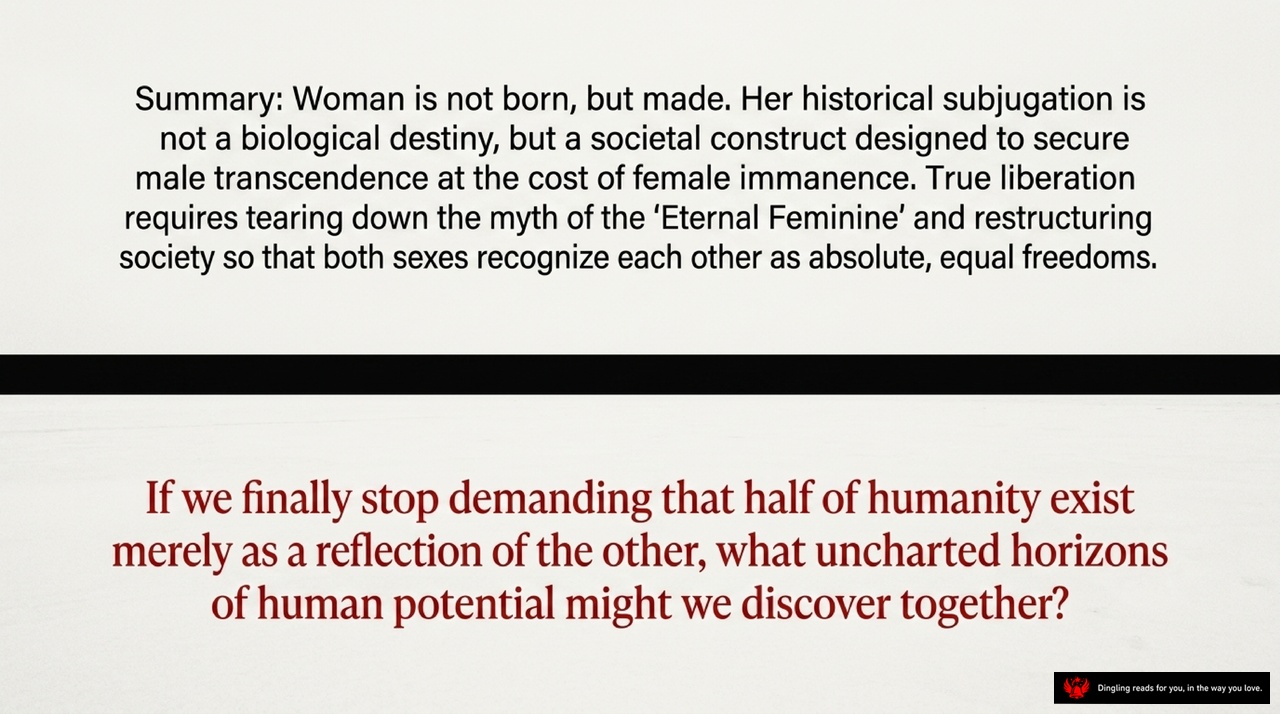
What if we stopped seeing women as mere reflections of men, and started recognizing them as absolute equals? This slide captures the core argument: women aren't born this way; they are made. For centuries, society constructed a myth of the "Eternal Feminine," trapping women in a role designed to secure male transcendence while suppressing female immanence. This isn't about biology or destiny; it's a societal construct. True liberation begins the moment we tear down this myth and restructure our world so that both sexes recognize each other as free individuals with equal rights. When we finally stop demanding that half of humanity exist solely to serve the other, imagine the uncharted horizons of human potential we could discover together. It's not just about equality; it's about unlocking the full spectrum of what it means to be human.