
The Silent Majority: Complete Chapter-by-Chapter Summary

Welcome to *The Silent Majority* by Wang Xiaobo. Imagine a vast, shadowy crowd where everyone stands in silence, yet one person is suddenly illuminated by a beam of golden light, standing alone in the center. This image captures the book's core promise: a manifesto for independent thought, individual dignity, and the sheer joy of human intellect in an age of noise.
Wang Xiaobo argues that silence isn't always cowardice; sometimes, it's a necessary response to a world that demands conformity. He challenges us to move from being part of the silent majority to becoming that single, illuminated figure—someone who dares to think for themselves, to question the "truths" imposed upon us, and to find the freedom in the quiet act of independent reasoning. This book invites you to step out of the shadows and embrace the courage of your own mind.

When physical hunger collides with deafening, irrational propaganda, a fundamental distrust of grand discourse is born. Compared to the soaring rhetoric of the era, a starving stomach is an undeniable, empirical truth.
Look at this diagram. At the top, we have "The Noise: Ideological Loudspeakers." This represents absurd propaganda—claims like "300,000 catties of grain per mu" or loudspeakers sounding like flying beetles. It's a deafening, irrational noise designed to obscure reality.
But below that lies "The Hunger: Physical Reality." This is where children were so starved they had to eat the wood and rubber off their pencils. When your body is screaming for food, no amount of political rhetoric can silence it. That collision creates a red dot in the middle: "The Individual," where the birth of absolute skepticism happens.
As the author puts it, even if you knew that steel produced in earth furnaces was like cow dung, or that the food statistics were lies, you couldn't ignore the hunger in your own belly. Hunger is a truth that cannot be faked. It forces people to see through the noise and realize that when physical reality contradicts ideological noise, the only logical response is to trust your own senses over the lies above.
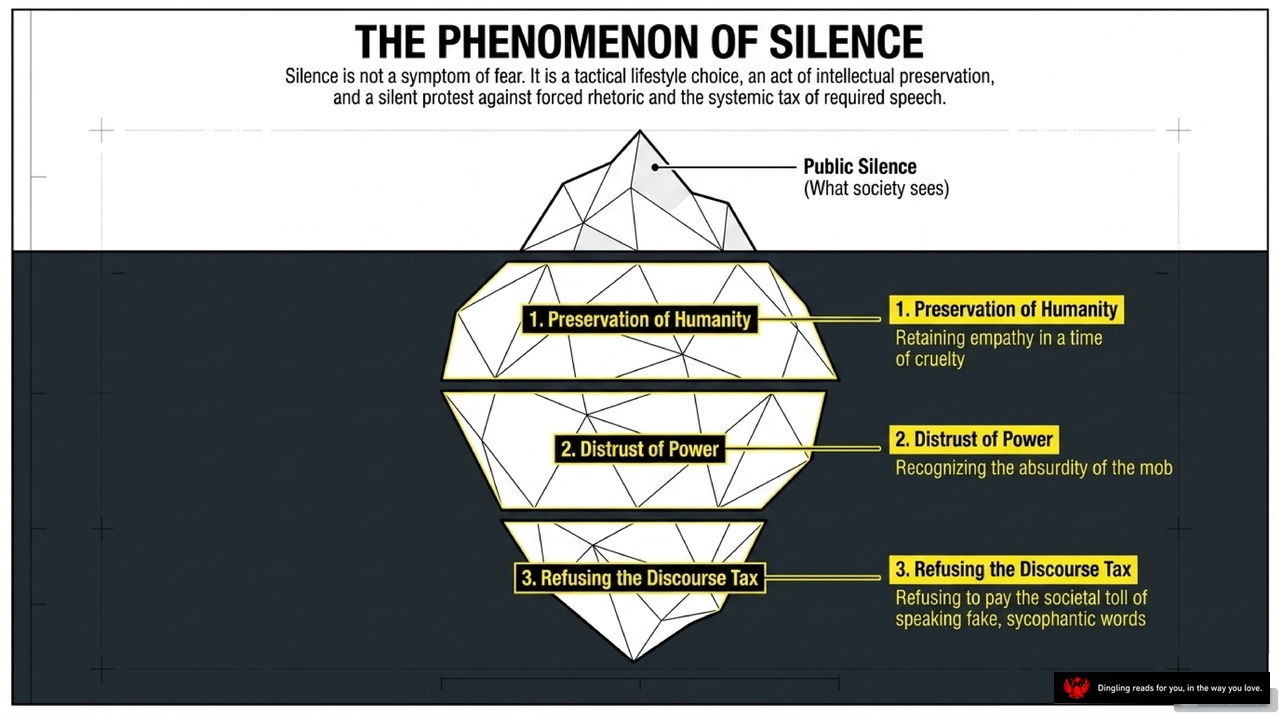
Look at this iceberg diagram titled "The Phenomenon of Silence." It challenges a common misconception right from the top: silence isn't a sign of fear or weakness. Instead, it's presented as a tactical lifestyle choice, an act of intellectual preservation, and a quiet protest against the pressure to speak when you have nothing meaningful to say.
The image breaks this down into three layers beneath the surface. The first layer is about the "Preservation of Humanity." It's about retaining our empathy even when the world around us becomes cruel. The second layer highlights a "Distrust of Power," specifically recognizing the absurdity of the mob mentality and refusing to be swept away by it. The third and deepest layer is "Refusing the Discourse Tax." This is the most powerful concept here—it means refusing to pay the societal toll of speaking fake, sycophantic words just to fit in.
Think about it this way: in a chaotic environment, staying silent is often the only way to keep your humanity intact and avoid becoming part of the problem. It's not about hiding; it's about protecting your integrity and rejecting the expectation that you must constantly perform or agree with things you don't believe in. True silence is a form of strength, a deliberate refusal to participate in a culture that values empty noise over genuine thought.
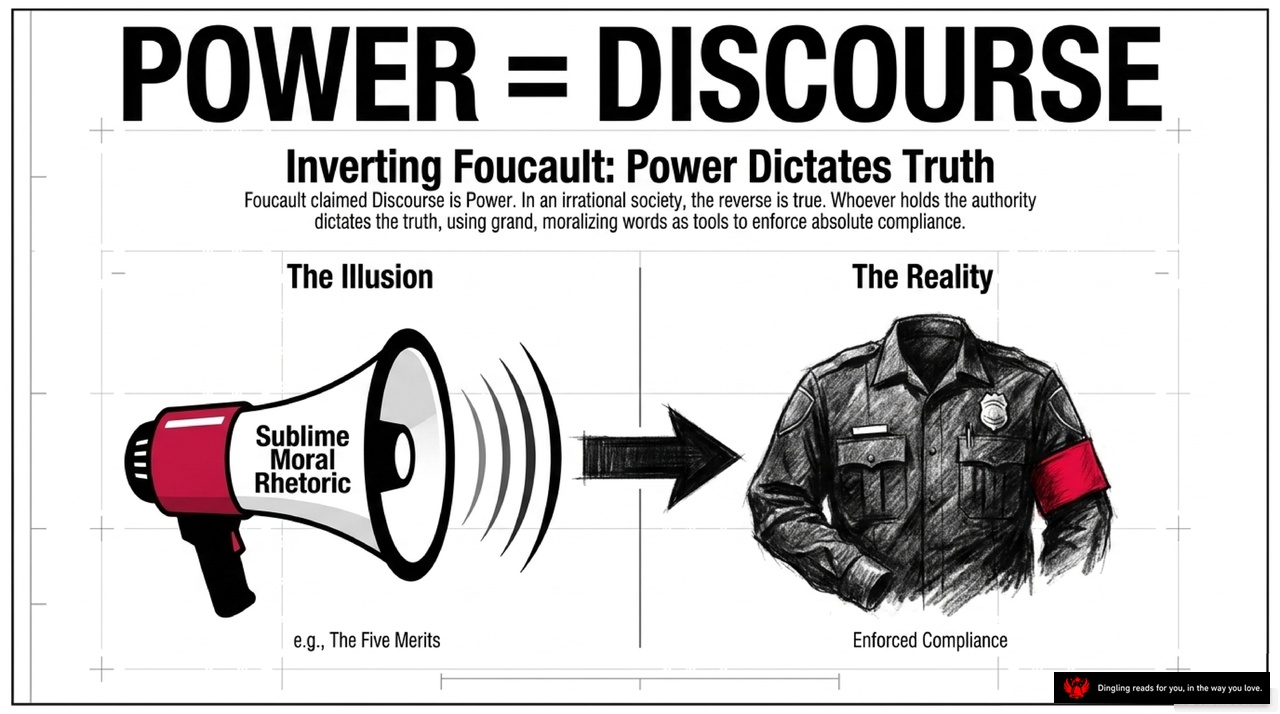
Power equals discourse, but in an irrational society, the equation flips: power dictates truth. As the slide illustrates, authority doesn't just speak; it enforces reality by using grand, moralizing words to demand absolute compliance.
On the left, we see "The Illusion": a megaphone blasting "Sublime Moral Rhetoric," like the old propaganda about "The Five Merits." It sounds noble and high-minded. But look at the arrow pointing right. That rhetoric is just a tool to manufacture "The Reality." On the right stands the uniformed enforcer, representing "Enforced Compliance."
This is the trap. When you hear someone preaching lofty ideals without any real power behind them, it's just an illusion. But when you hear those same words coming from someone with authority, or backed by force, they become the only "truth" you're allowed to accept. The system demands you choose between speaking the official language to stay safe, or staying silent and letting others define what is right. True freedom begins when you realize that the words you are forced to repeat are not the truth, but merely the voice of power trying to control your mind.

Imagine a world where the only goal of thinking is survival or obedience. That is the trap of dogma. It strips away the very things that make us human: the joy of discovery, the thrill of logic, the beauty of art, and the endless curiosity that drives us forward. This slide shows a pyramid collapsing under the weight of forced morality and utilitarian function. But look at the bottom—the golden triangle. That is the ultimate antidote: The Joy of Thinking.
True rebellion isn't about shouting slogans or following a rigid script. It's about finding sheer, unadulterated joy in your own intellect. It's the moment you solve a complex equation not because you have to, but because the logic clicks into place. It's the awe you feel when reading a great poem, or the excitement of uncovering a new truth. When we prioritize "mere survival" or "obedience," we lose our edge. We become mere cogs in a machine.
But when we embrace the joy of thinking—when we value logic, art, and curiosity above all else—we unlock a radical freedom. We stop fearing the unknown and start embracing it. We stop accepting what we are told and start asking why. This isn't just an academic concept; it's a lifestyle choice. It's the courage to think for yourself, to question the status quo, and to find beauty in the complexity of the human mind. So, let's stop eradicating the peak of human potential and start celebrating the joy of being truly alive thinkers.

True intellectuals prioritize being elites of thought over elites of morality. They abandon the medieval urge to preach and serve power, choosing instead the independent pursuit of logic and truth.
This slide contrasts two distinct mindsets. On the left, we see the "Medieval Legacy," where the ultimate goal is to rule the world. In this framework, power is everything. The attitude toward authority is subservient; one is eager to pay the "discourse tax"—saying whatever is required to please those in charge. Morally, this stance involves imposing values on others, often ignoring common sense. The vulnerability here is clear: falling into the trap of pleasing authority leads to a loss of intellectual freedom.
On the right stands "Modern Independence." Here, the goal shifts from ruling to seeking empirical truth. The attitude toward power transforms into independence and skepticism. Instead of imposing morality, the focus is on upholding common sense and logic. Yes, this path carries a vulnerability: the thinker may become marginalized, but they remain intellectually free.
This isn't about choosing sides in a culture war; it's about a fundamental choice in how we engage with the world. Do we speak to serve power, or do we speak to uncover truth? The modern independent mind dares to be skeptical, even when it means standing alone. It values the freedom to think over the safety of conforming. True intellectual courage lies in prioritizing the pursuit of truth above all else, regardless of the cost to one's status or comfort.
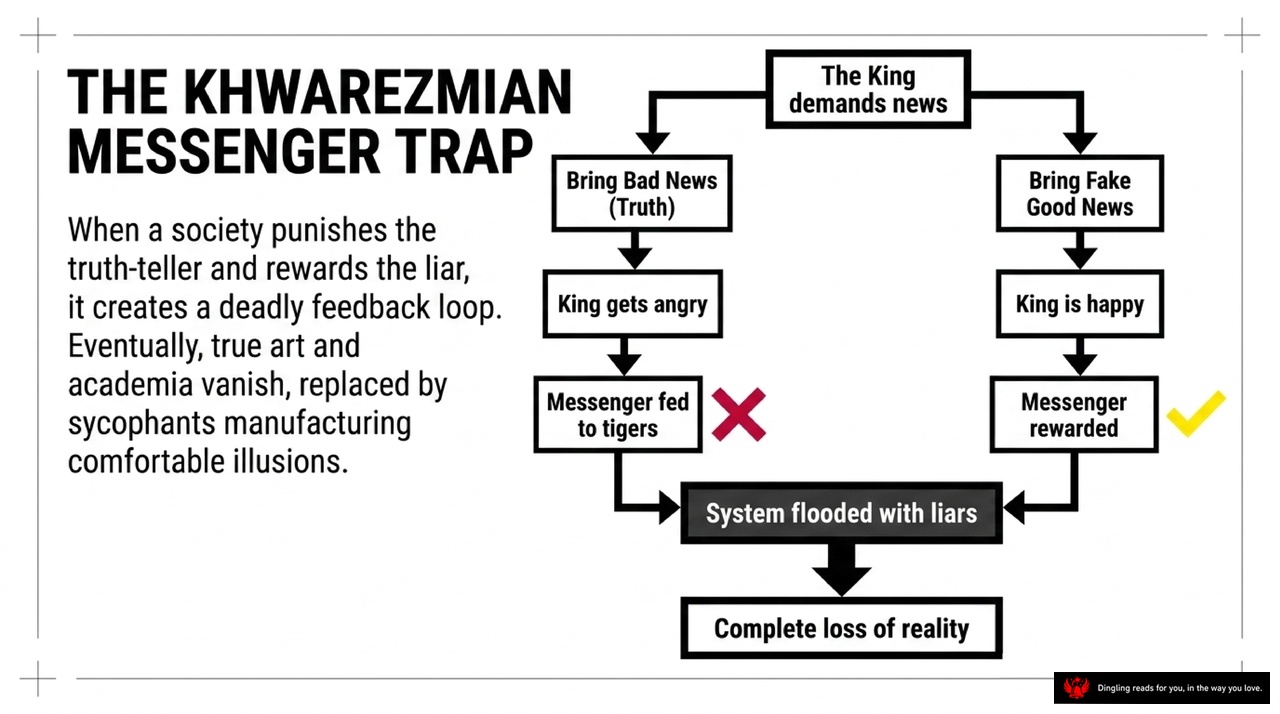
The Khwarezmian Messenger Trap illustrates a terrifying reality: when a society punishes truth-tellers and rewards liars, it creates a deadly feedback loop. Imagine a king who demands news. If a messenger brings bad news—the truth—the king gets angry, and the messenger is fed to tigers. But if the messenger brings fake good news, the king is happy, and the messenger is rewarded. Over time, the system floods with liars, leading to a complete loss of reality.
This isn't just a historical story; it's a warning for our modern world. Think about it: if you speak up about a problem at work and get fired, but your colleague lies to the boss and gets a promotion, who do you think will be the next one to speak the truth? Eventually, true art and academia vanish, replaced by sycophants manufacturing comfortable illusions. We see this when uncomfortable truths are silenced, and only "feel-good" narratives are celebrated.
The lesson is clear: we must protect the truth-tellers. We cannot allow a culture where honesty is punished and deception is profitable. If we do, we risk losing our grip on reality itself.

Deconstructing Sublime Suffering: Why Enduring Pointless Hardship Breaks the Human Spirit
Look at this scale. On the left, we have "Fake Sublimity." It depicts a person trapped in a cycle of meaningless labor and coercion, endlessly carrying buckets of water only to watch them leak away. This is the trap of traditional dogmas that falsely equate meaningless suffering with moral superiority. The belief that enduring pointless hardship elevates the soul is a lie; in reality, it merely breaks the human spirit and instills blind obedience.
On the right side, we see "True Human Progress." Here, the gears turn smoothly, driven by common sense and tangible benefits, leading to the simple, powerful truth that 1+1 equals 2. This represents a life where effort yields actual results, where logic replaces superstition, and where we move forward rather than spinning our wheels in the mud.
The text reminds us that suffering is not a badge of honor. True progress comes from understanding the world as it is, not as we wish it to be through self-inflicted pain. We must reject the idea that misery makes us noble. Instead, we should embrace rationality, seek concrete benefits, and build a future based on evidence and common sense, not on the romanticized myth of suffering. Let's stop glorifying the struggle and start celebrating the results.

Welcome to the defense of interestingness. Look at this diagram: a life worth living sits right in the center, where Wisdom, Joy, and Diversity intersect. Wisdom is our rationality; Joy is the pleasure of thought; and Diversity is the sheer variety of human existence. Without diversity, we lose the very source of happiness.
Imagine a society that dictates a single, uniform definition of a good life. It sounds like a utopia, but in reality, it rapidly degrades into a dull, terrifying place. When everyone thinks and acts the same, the result isn't perfection; it's boredom. Being interesting, therefore, isn't just a personality trait—it's a moral imperative.
Think about the "good life" we often chase. If we strip away all the different ways people live, love, and think, we are left with a hollow shell. A society that suppresses diversity in the name of order is actually suppressing the spark that makes life vibrant. We need the friction of different perspectives, the joy of unexpected thoughts, and the rationality to navigate them.
So, why does a diverse life feel so much better? Because it keeps us awake. It challenges our assumptions and prevents us from sliding into that comfortable, stagnant uniformity. True wisdom doesn't come from following a script; it comes from engaging with the messy, beautiful, and unpredictable reality of being human. Don't settle for a safe, predictable existence. Embrace the chaos. Embrace the difference. That is the only path to a life that is truly worth living.

SYNTHESIS: BLUEPRINT OF AN INDEPENDENT MIND
Let's look at this blueprint for building an independent mind. Imagine the "Independent Human Being" as a grand structure, built on four essential pillars that support our freedom in an irrational world.
First, the foundation starts with "Absolute Skepticism of Noise." We must refuse the "Discourse Tax"—the choice of silence when we are forced into performative rhetoric that adds no value. Think about it: just like those absurd "Ten Route Struggles" I memorized during the Cultural Revolution, which I even forgot while driving in America and almost crashed my car, much of what we are told is just noise. We need the courage to stay silent rather than polluting our minds with empty slogans.
Next, we must "Embrace Common Sense" as the anchor of our rationality. This means rejecting the "Great Pill" mentality where scholars promise instant cures for complex human problems, much like selling fake medicine. True wisdom isn't about grand, empty theories that please power; it's about sticking to undeniable logic and admitting what we don't know, just as Russell did.
The third pillar is to "Defend Individual Dignity." This is the demand for equality, treating every person as an independent unit of dignity, not just a body or a tool for the collective. We've seen how ignoring personal dignity leads to chaos, from crowded trains to dirty public spaces. True strength comes from respecting oneself and others, refusing to let anyone strip away your humanity.
Finally, we must "Pursue Interestingness" as the engine of joy. Life shouldn't be a miserable struggle to please others or fit into a mold. Instead, we should seek the pure joy of intellect, exploring knowledge for its own sake, whether it's science or art. As I learned from my own life, the real freedom comes from living authentically, pursuing what truly matters to us, and finding joy in the process of thinking and creating.
This blueprint isn't just theory; it's a survival strategy. By rejecting noise, embracing logic, defending our dignity, and seeking true joy, we build a mind that can withstand the chaos of the world.
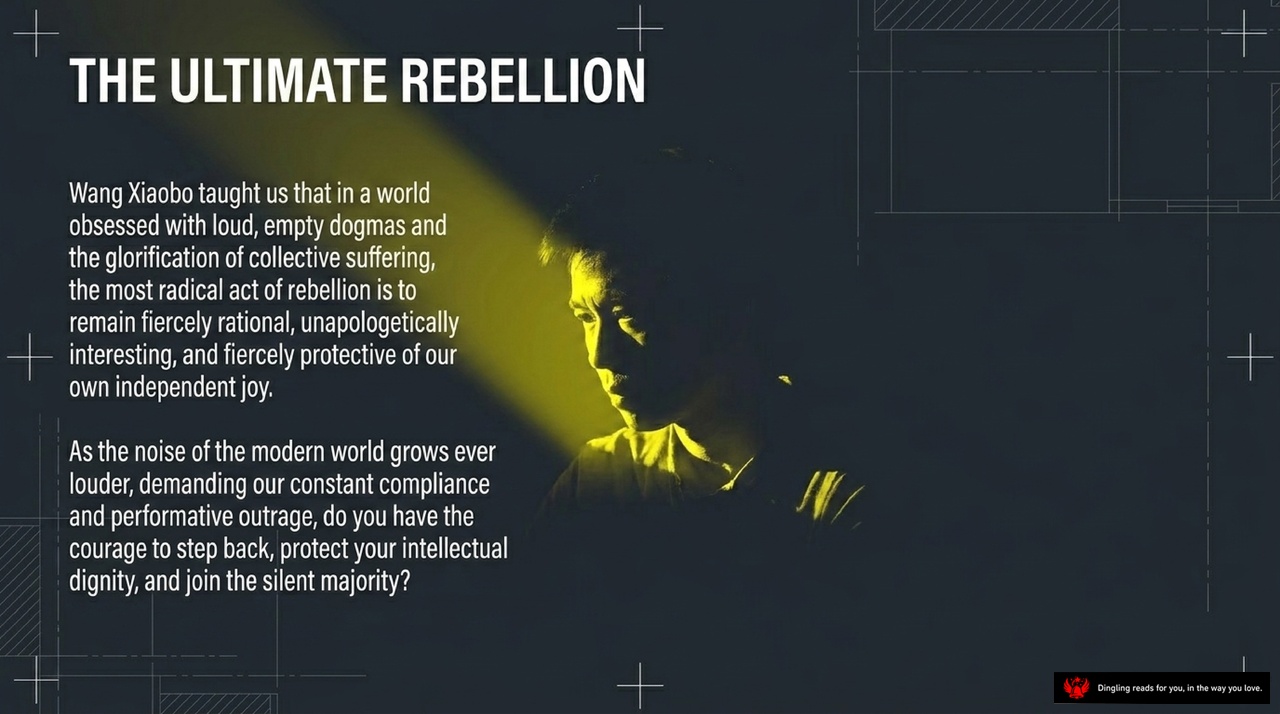
Wang Xiaobo's most radical act of rebellion isn't shouting louder, but staying fiercely rational in a world obsessed with empty dogmas. In a culture that glorifies collective suffering and demands performative outrage, true courage is the quiet power to protect your own independent joy.
As the noise of the modern world grows ever louder, demanding our constant compliance, do you have the bravery to step back? It's about protecting your intellectual dignity and joining the silent majority. True rebellion isn't about breaking things; it's about refusing to be shaped by a system that values blind obedience over clear thinking. In a world that often forces us to choose between silence and foolishness, the ultimate act of defiance is simply to remain yourself—unapologetically interesting and unbreakably free.