
The Social Contract: Complete Chapter-by-Chapter Summary

Welcome to our deep dive into *The Social Contract* by Jean-Jacques Rousseau. This isn't just another political treatise; it is the foundational blueprint for how free individuals can legitimately unite to form a sovereign society governed by the general will.
Imagine a world where every person is born free, yet somehow finds themselves trapped in chains. Rousseau asks the hard question: How do we move from being isolated, competing individuals into a cohesive community without losing our freedom? His answer lies in a radical idea—a social contract. It's not about surrendering to a tyrant or a king; it's about free people voluntarily agreeing to pool their rights and powers to create a collective entity that protects everyone equally.
In this vision, the "general will" becomes the guiding force. It's not about what one person wants, but what benefits the whole. When we join this collective, we don't lose our freedom; we actually gain a higher form of it. We trade the fragile, chaotic freedom of the natural state for the security and moral liberty of a citizen. We become our own masters, bound not by force, but by laws we helped create. This book explores exactly how that transformation happens, turning a group of strangers into a true community where justice and self-interest finally align.
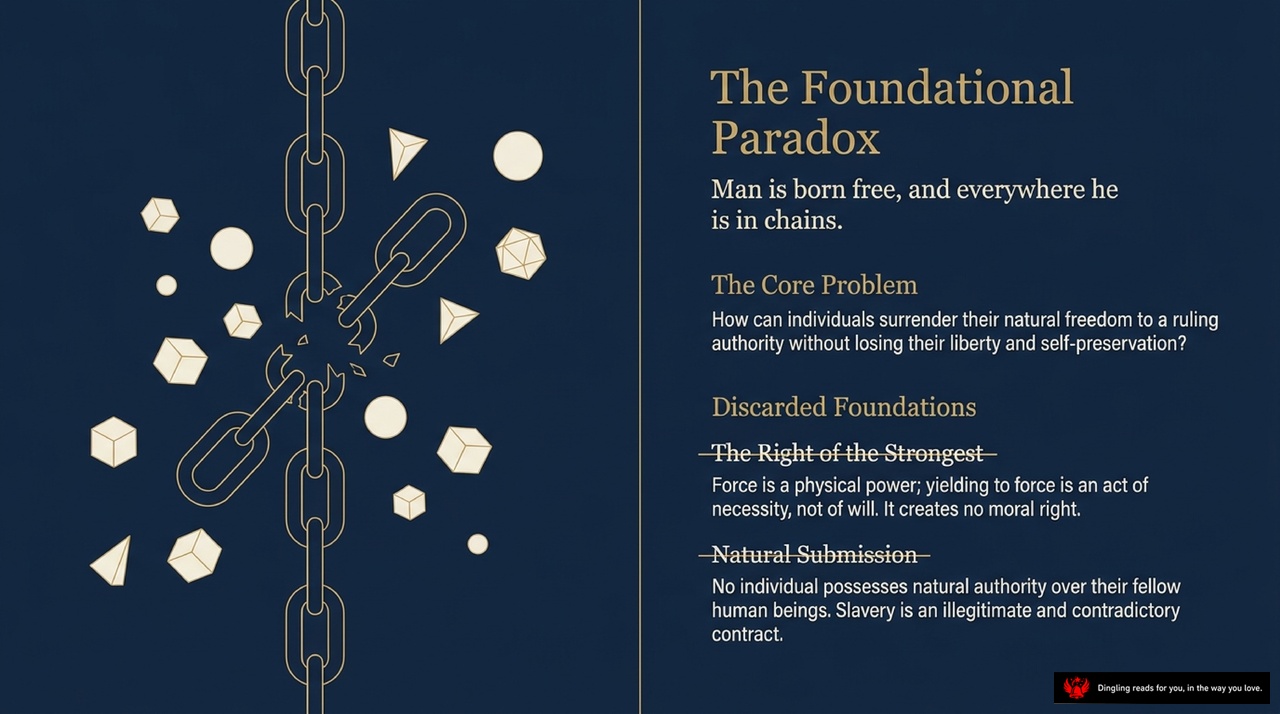
Look at this image of a breaking chain. It perfectly captures the central tension of Rousseau's *The Social Contract*: "Man is born free, and everywhere he is in chains." This is the foundational paradox we must solve. How do individuals surrender their natural freedom to a ruling authority without losing their liberty and self-preservation?
To answer this, we have to discard the old, flawed foundations. The first is "The Right of the Strongest." Rousseau argues that force is merely physical power. Yielding to violence is an act of necessity, not a free choice of will. Therefore, violence creates no moral right. If force equals right, then anyone stronger than you can just take everything.
The second discarded foundation is "Natural Submission." The idea that one person has a natural right to rule others is a lie. Slavery is an illegitimate and contradictory contract. No individual possesses natural authority over their fellow human beings.
So, if force and natural submission are out, what remains? The only logical answer is the Social Contract. It is the only way to transform that broken chain into a voluntary bond, where freedom isn't lost, but rather elevated into a higher form of moral and civic liberty.

Imagine a single point of light, glowing brightly and connected to every other point within it. This image represents the ultimate goal of the social compact: the creation of a unified, moral, and collective body that substitutes a public person for the individual personalities of the contractors. But how do we get from scattered individuals to this powerful, interconnected sphere?
It starts with a radical mechanism. Each individual entirely alienates all of their natural rights to the whole community. Think of it as a total surrender. Because this surrender is total, the condition becomes equal for everyone. No one has an interest in making it burdensome for others. In giving oneself to all, one effectively gives oneself to nobody.
This structural logic creates a perfect balance. When you dedicate yourself completely to the collective, you aren't losing your freedom; you are gaining a higher form of it. You become part of a sovereign entity where the general will guides the state toward the common good. The result is a stable, organic union where the safety and rights of every member are guaranteed by the strength of the whole. This is the true power of the social compact: transforming isolated, vulnerable individuals into an unbreakable, just, and free community.
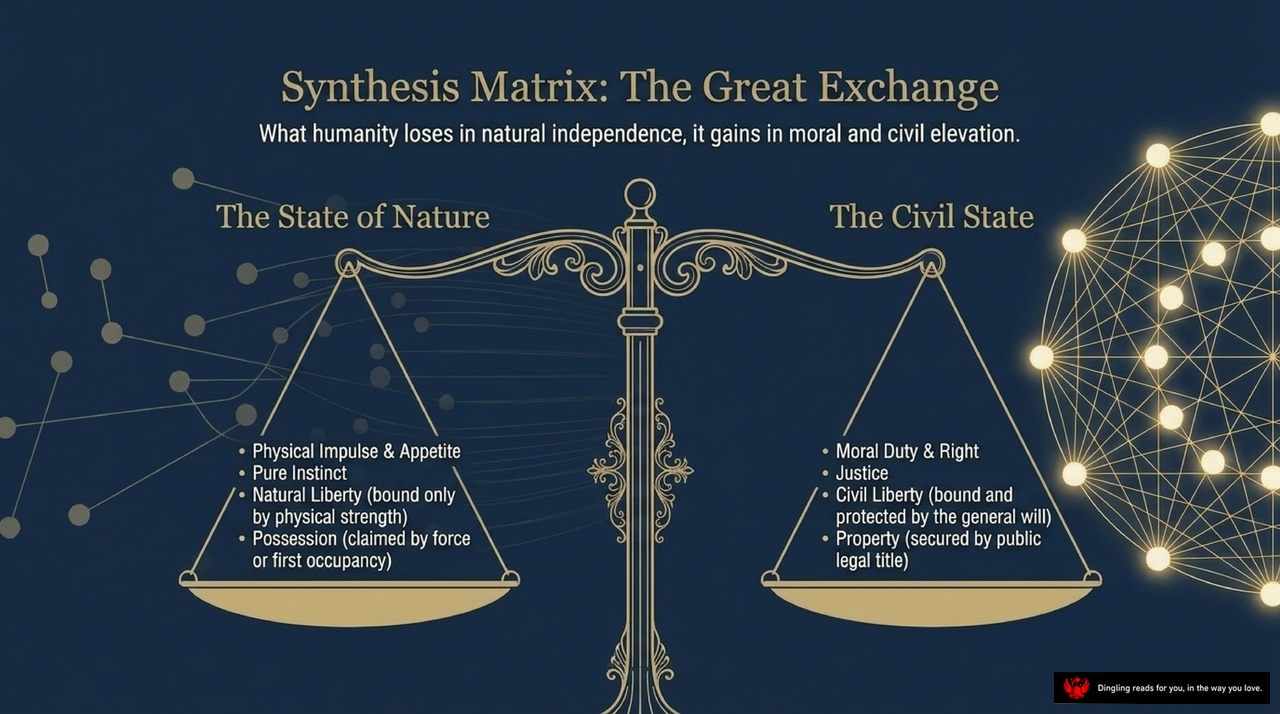
Look at this scale. On the left, we have "The State of Nature"—a world driven purely by physical impulse, instinct, and raw strength. Here, liberty is bound only by what your body can do, and possession is claimed simply by force or who gets there first. It's chaotic, governed by appetite.
But look at the right side: "The Civil State." This is where humanity trades its natural independence for something far more valuable: moral and civil elevation. We exchange the freedom to do whatever we can for the right to do what we should.
Notice the shift. In nature, you have "Natural Liberty" and "Possession by force." In the civil state, you gain "Moral Duty," "Justice," and "Civil Liberty"—a freedom that is actually protected by the general will of the society, not just your own muscles. Your property is no longer just something you grabbed; it is secured by a public legal title.
This is the Great Exchange. We lose the wild, unbridled freedom of the individual, but we gain the security, justice, and moral standing of a citizen. As the slide perfectly illustrates, what humanity loses in natural independence, it gains in moral and civil elevation. We stop being slaves to our own impulses and become masters of our own destiny through law and reason.
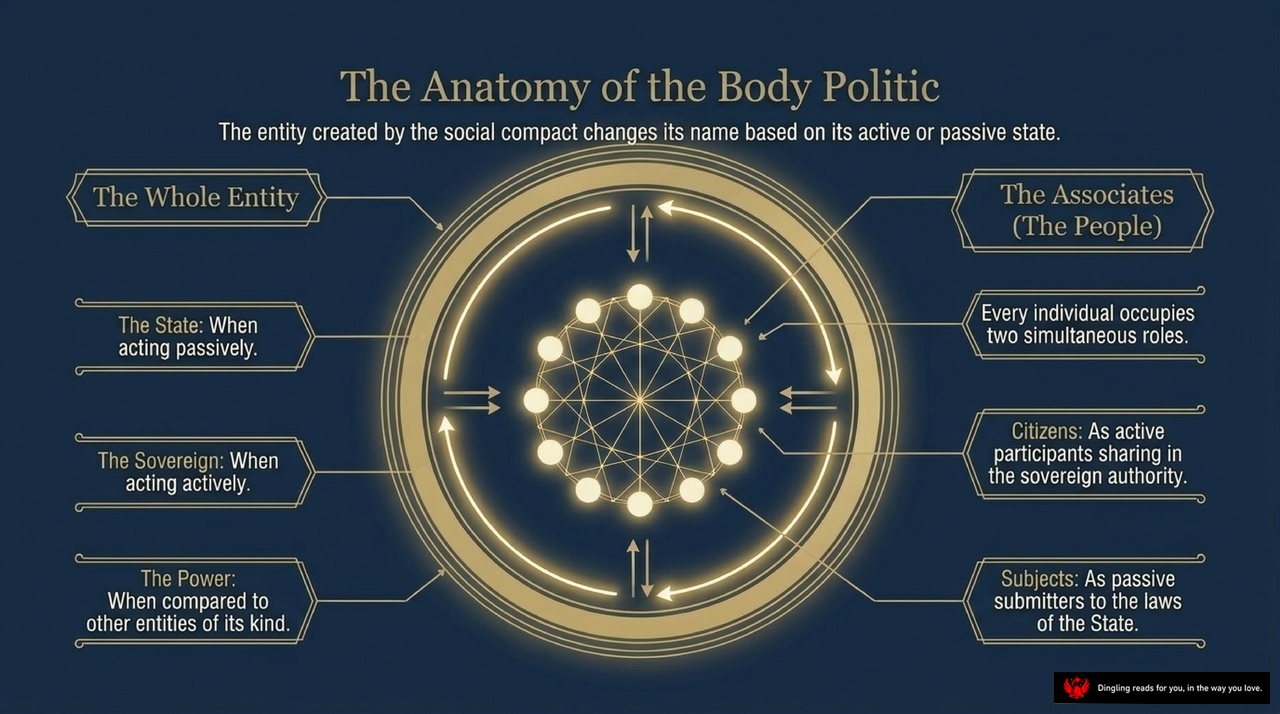
In this chapter, Rousseau lays out the blueprint for a nation's soul, arguing that the true structure of a state isn't found in its marble statues or written laws, but in the invisible, living laws of the people's mind. He identifies four distinct types of law that must work in harmony to create a stable society.
First, there are the **Political Laws**, which define the relationship between the sovereign and the state—essentially, the fundamental rules of the game. Second, come the **Civil Laws**, which govern the daily interactions between citizens and their relationship to the state, ensuring that individual freedom thrives within the framework of public order. Third, we have the **Criminal Laws**, which establish the boundaries of right and wrong and the necessary penalties to uphold them.
However, Rousseus insists that the fourth type is the most critical, often overlooked by political theorists, yet it is the actual foundation of the state. These are the **Moral Laws, Customs, and Public Opinion**. Unlike the others, these aren't carved in stone; they are etched into the hearts and minds of the citizens. They are the habits, the shared values, and the collective sentiment that keep a nation running when the written laws fail or become obsolete.
Rousseau warns that creating a perfect constitution requires a genius who can see the whole picture—someone who can reshape human nature, stripping away old dependencies and replacing them with a new, stronger social identity. He compares the constitution-maker to an architect who designs the machine, while the ruler is merely the mechanic who operates it. But without these internal moral laws to guide the public's conscience, no external legal system can truly hold a nation together. The state's true strength lies not in its power to punish, but in its ability to shape the character of its people.

Here is the spoken-word script for Slide 5, tailored for an American audience and based on the provided text and image content.
**Slide 5 Script:**
"Let's talk about the engine that actually drives this whole system: the General Will. Think of it as the difference between harmony and chaos. On one side, you have the 'Will of All,' which is just the sum of everyone's selfish interests. It's chaotic, messy, and essentially just a collection of individuals looking out for themselves. On the other side, you have the 'General Will,' which aims purely at the common good. It's the harmony that emerges when you take those conflicting private interests and find the underlying truth that benefits everyone equally.
Now, here's the critical part: how do you actually get there? This is what Rousseau calls the 'Calculus of Consensus.' It's not about forcing people to agree, but rather discovering the general will by taking the sum of individual votes and canceling out the extremes. When you strip away the pluses and minuses of private gain, the remaining intersection is the true public interest.
But this system has a massive threat. Factions and partial associations can destroy the general will by substituting group interests for the common good. If you let small clubs or special interests dominate, you lose the true voice of the people. So, the goal is clear: avoid these factions or balance their power so that no single group can hijack the process. Only then can the state function not as a machine for the powerful, but as a true expression of the collective will."

Look at this slide. We see a glowing sphere on the left and a shattered puzzle on the right. This visual perfectly captures the core of sovereignty: it must be both **inalienable** and **indivisible**.
Let's break down why this matters. On the left, the sphere represents the concept of **inalienable** power. The text explains that while authority can be passed from one person to another, the actual *will* of the people cannot be represented by anyone else. The sovereign—the collective people—must remain the only one who can express that will. If you surrender your will to a master, you aren't just changing leaders; you are effectively dissolving the political body itself. You lose your humanity in the process.
Now, look at the right side. The scattered puzzle pieces with a sharp line cutting through them illustrate **indivisible** sovereignty. The text argues that the will is either general, belonging to the whole, or it is merely the will of a part. Trying to split sovereignty into separate legislative and executive branches is an illusion. These functions are just tools, mere instruments of one supreme, indivisible power. If you divide the power, you destroy the unity of the public will.
So, the lesson here is clear: true sovereignty is a single, unified force that belongs entirely to the people and cannot be handed over or chopped up.

When we look at the concept of "Public Obligation," it's easy to get lost in the abstract idea that citizens owe everything to the state. But Rousseau gives us a very clear, practical boundary for this duty. He argues that while the state demands your life and loyalty, it cannot ask for anything that is useless to the community. If a burden imposed on you serves no purpose for the common good, the sovereign has no right to force you to carry it. This is the limit of what you can be asked to sacrifice.
Furthermore, there is a specific rule about how laws must be applied: The Rule of Generality. This means that sovereign power can only act through general conventions that apply equally to everyone. The government cannot pass judgments on specific individuals or target particular facts. Laws must be broad rules for all, not a bill of particulars for one person. This ensures that the law remains a standard of justice rather than a tool for arbitrary persecution.
Finally, we must acknowledge The Ultimate Price. While the social contract guarantees your life, it is a conditional gift from the state. In exchange for that protection, the sovereign can demand that you risk your life if the survival of the state is at stake. This willingness to sacrifice yourself for the collective is the extreme limit of the social compact. It is the highest form of public obligation, balancing your private independence with the collective need for survival.

Today, we are looking at the "Enlightenment Blueprint," a visual summary of how a legitimate society should be structured according to Rousseau. At the center of this diagram stands the Law, depicted as a radiant column, symbolizing that laws are the sole conditions of civil association and the voice of the General Will. This isn't just about rules; it's about the mechanism that transforms a crowd into a community.
On the left, we see two foundational pillars. First is "The Mechanism: The Law," which reminds us that laws must be general—they act as the voice of the collective, not individuals. Second is "Universal Authorship." Rousseau argues that laws must be made by the whole people, for the whole people. When the people decree for themselves, they aren't obeying a master; they are only obeying themselves. This is the essence of political freedom: self-legislation.
Moving to the right, the blueprint highlights two critical constraints. We have "Absolute Abstraction." A law can establish a royal government or create privileges, but it can never name a specific king or bestow privileges on named individuals. The object of the law must remain general to preserve equality. Finally, we arrive at "The Ultimate Function." The true purpose of law is to unite the universality of the will with the universality of the object. It bridges the gap between our shared desires and our shared reality, creating a stable social order where freedom and authority coexist without contradiction. This blueprint shows that true liberty comes not from doing what you want, but from living under laws you have collectively authored.
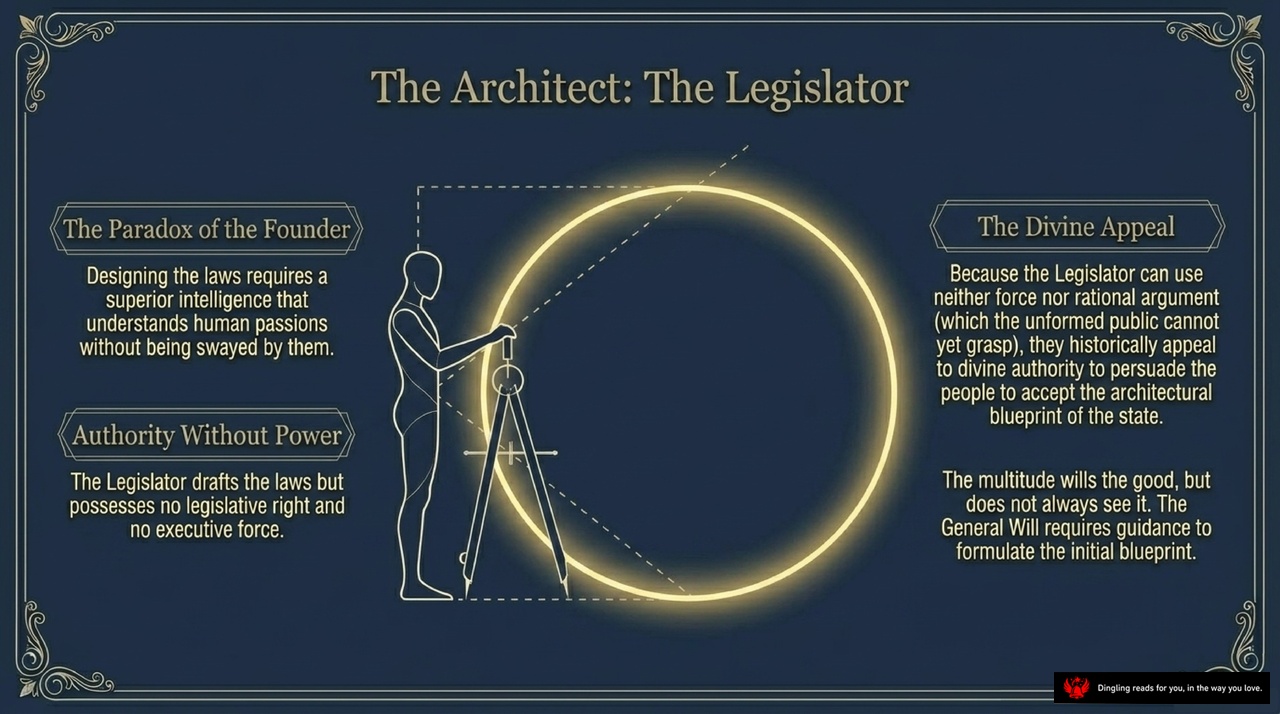
The Architect: The Legislator
We often imagine the state as a machine, but Rousseau asks us to see it as a masterpiece of design. On this slide, we see the Legislator—the "Architect"—standing before the great circle of the state, using compass and straightedge to draw its perfect blueprint.
This figure represents a unique paradox: a Founder who possesses supreme wisdom yet holds no actual power. As the text explains, the Legislator drafts the laws, but possesses neither legislative right nor executive force. He is the mind behind the machine, not the operator. Why? Because designing a system requires an intelligence that understands human passions without being swayed by them. The Legislator must be a superior mind, almost divine, capable of seeing the general will clearly when ordinary people are blinded by their own private interests.
But here lies the tension: how do you convince a crowd of self-interested individuals to follow a plan they don't fully grasp? The slide points to "The Divine Appeal." Since the Legislator cannot use force or simple rational argument to persuade the unformed public, history has shown that he must appeal to divine authority. He presents the state not just as a political contract, but as a sacred architecture. The multitude wills the good, but often cannot see it. They need a guiding hand to formulate that initial blueprint.
This leads to another critical constraint: "Authority Without Power." The Legislator is an outsider. He cannot rule, he cannot command, and he cannot be part of the government he designs. If he tried to hold office, his personal interests would corrupt the very laws he created. He must remain detached, like a sculptor who steps back to admire the work, ensuring that the structure serves the public good rather than his own ambition.
Ultimately, the Legislator's role is to bridge the gap between the chaotic desires of the people and the necessary order of the state. He provides the vision, but the people must provide the will to build it. Without this perfect, invisible architect, our political systems remain flawed structures, prone to collapse under the weight of their own contradictions.

The Enlightenment Blueprint reveals the delicate balance required to build a stable state, starting with the fundamental materials: the people and the territory. As the slide illustrates, this isn't just about population count or land area; it's about finding the exact ratio where the land can feed its inhabitants, and the population is large enough to defend itself. If a state grows too large, it becomes impossible to govern, drowning in bureaucracy and losing social cohesion. Conversely, if it's too small, it lacks the strength to defend against neighbors. The key lies in achieving this perfect equilibrium.
But there's another critical condition for peace that often gets overlooked: timing. A social blueprint can only be established during a period of peace and plenty. When a state is forming, it is incredibly vulnerable to destruction. You cannot build a house while the foundation is still shaking. Similarly, you cannot forge a new society amidst war, famine, or rebellion. The slide correctly points out that a state in formation is highly susceptible to collapse. Therefore, the ideal moment to draft a constitution and establish laws is when the nation is stable and prosperous. Only then can the fragile social bonds harden into a lasting structure, ensuring that the state survives not just by force, but by the genuine consent and unity of its people.

The Intermediary: The Government. Look at this diagram. We see three gears turning in perfect sync: The Sovereign, The Government, and The Subjects. Today, we're zooming in on that middle gear. The text calls it "The Intermediary." But what does that actually mean?
Let's break down the mechanics here. On the left, we have The Sovereign, representing the Legislative Will. On the right, we have The Subjects, which is simply The People. Now, look at the center: The Government. The slide defines its function clearly: it is charged with the execution of laws and the maintenance of civil and political liberty. It's not the source of power; it's the engine that makes power move.
Here is the crucial distinction the slide highlights. The Sovereign possesses the "Will to act." The Government merely possesses the "physical force" to execute that will. Think of it this way: The Sovereign is the mastermind, the architect of the rules. The Government is the minister, the builder who follows the blueprints. As the slide states, "The Government is a minister, not the master." It is an intermediate body established for the mutual correspondence between the subjects and the Sovereign.
This relationship is temporary and conditional. The text reminds us that the Government exists solely through the Sovereign's commission. This means it can be altered or recalled at any time. The People, through the Sovereign, hold the ultimate authority. They do not own the government; they rent it. If the government stops serving the public interest or fails to execute the laws fairly, the Sovereign has the right to change the gear or replace it entirely.
So, in our political system, the government is just the tool. The real power—the moral and legal authority—always remains with the collective will of the people, represented by the Sovereign. The government ensures that the will of the people actually translates into action, keeping society safe and orderly. Without this clear separation between the will and the force, without this "intermediary" role, the state would either be paralyzed by too many voices or tyrannical with too much unchecked power.

The Enlightenment Blueprint isn't just a philosophy; it's a mathematical equation for state survival. As we look at this matrix, the core insight is that there is no single "perfect" government. The ideal form is mathematically relative to the size of the state.
On the left, we have Democracy, defined by many magistrates. Rousseau argues this is only suited for very small, highly equal states. Here, the sovereign commits power to the whole people. But the verdict is harsh: it's prone to civil war. Rousseau famously noted that a true democracy has never existed in reality; it would only work for a nation of gods.
In the center stands Aristocracy, governed by a select minority. This form fits medium-sized states. It's not about rule by the masses, but by the wise. Rousseau calls elective aristocracy the most natural form, provided the elite govern for the public profit rather than their own. It balances the chaos of pure democracy with the risks of absolute power.
Finally, on the right, we have Monarchy, the single magistrate. This is the most vigorous form, designed specifically for large, wealthy states where direct participation is impossible. However, it carries the highest danger. The particular will of the monarch constantly threatens to dominate the General Will. If the king's private desires override the public good, the state collapses.
So, the lesson is clear: match your government to your reality. Small, equal societies need democracy. Medium, complex societies need an aristocratic elite. Large, diverse empires require a strong monarch. Choose the wrong scale, and you don't just fail; you invite tyranny or anarchy.

The Enlightenment Blueprint: The Inevitable Decay
Look at this timeline. It starts with pure, golden energy—representing a state in its prime, where the government and the people are perfectly aligned. But notice the path ahead. It doesn't stay bright. It cracks. And eventually, it shatters into pieces. This visual perfectly captures Rousseau's grim but brilliant insight: every political system has a natural lifespan. Just like a human body, a state carries the seeds of its own destruction from the very beginning.
Why does this happen? It's what Rousseau calls "Inherent Friction." There is a constant, unavoidable conflict. The government, driven by the specific will of its leaders, constantly exerts force against the Sovereignty—the General Will of the people. The rulers want to expand their power; the people want to preserve their freedom. This friction is the engine of decay.
Eventually, this friction becomes too strong. The government inevitably usurps Sovereign power. At that critical moment, the social treaty is broken. The citizens are no longer free to obey; they are forced to submit, but they are no longer obligated. When the bond breaks, the state dissolves. It doesn't just fade away; it explodes into either anarchy or tyranny. That broken circle on the right? That is the death of the state. There is no escaping this cycle unless we understand the mechanics of the decay and how to manage the balance before the light turns to cracks.

So, where does this journey leave us? We've moved from the abstract idea of a "social contract" to the very real mechanics of how a nation actually functions.
The slide asks us to reflect on two profound truths. First, remember this: legitimate political authority isn't something we are born with, nor is it something we can grab with force. It is constructed. It is built every single day through the active participation of free individuals united by the general will.
This leads us to the second, perhaps more unsettling question: If our collective will is the ultimate foundation of power, are we just passive subjects obeying laws we inherited? Or are we actively functioning as the sovereign masters of our own society?
The answer lies in your choice to participate. If you stop showing up, if you stop engaging, you aren't just ignoring politics; you are dismantling the very structure that protects your freedom. As the text reminds us, true freedom isn't the absence of rules, but the ability to live under laws you helped create.
So, the final takeaway is clear: Don't wait for a savior. Don't wait for a perfect leader. The only way to ensure we remain the masters of our own society is to stay vigilant, stay involved, and keep that general will alive. Because without our continuous, active participation, the contract breaks, and with it, our liberty goes with it.