
The Society of the Spectacle: Complete Chapter-by-Chapter Summary

Welcome to the Society of the Spectacle. Today, we're diving into Guy Debord's masterpiece—a sharp philosophical and visual diagnosis of how our authentic lived experience has been hijacked and replaced by mediated representation. Think about it: our modern era loves images over reality, copies over originals, and performance over truth. In this world, the sacred is just an illusion, while the mundane becomes the only "truth."
But here's the twist: when that illusion peaks, it actually becomes the most "sacred" thing in our eyes. We don't just live in a society; we live inside a massive accumulation of spectacle. Everything we directly experience drifts away, turning into a show. It's not just a pile of pictures; it's a social relationship built through images, a worldview made visible. From news and ads to entertainment, these spectacles form the dominant mode of life, turning consumption itself into the main form of production.
We've shifted from an era where economy ruled life, sliding us from "being" to "having." Now, economy has completely taken over, pushing us from "having" to "appearing." To have status or function, you must be seen. Your reality depends on social power—only what is allowed can exist. Spectacle demands passivity; its means become its end, shining brightly over our empire of inaction. It's a society where development is everything, and the goal is worthless.
Ultimately, spectacle is the material reconstruction of religious illusion. It hasn't cleared away the clouds of superstition; instead, it has linked human power to earthly foundations, making daily life dark and suffocating. It's the separation of our inner selves, turning our dreams into necessities and trapping us in a nightmare where the only desire is to sleep.

So, let's dive straight into the book's central argument: "The Great Separation."
Look at this diagram. On the left, we have "Lived Experience"—that raw, messy, real stuff we actually feel and do. On the right, we have "Representation"—the polished, packaged version of reality that we see in ads, news, and social media. The red arrow between them isn't just a flow; it's a one-way trap.
The book argues that everything that was once directly lived has become mere representation. We no longer experience the world; we consume images of it. Think about it: instead of actually connecting with a person, we consume their curated Instagram feed. Instead of experiencing a holiday, we buy the "experience" of it through travel packages and photo ops.
This creates a totalizing separation. Authentic social life gets fragmented, extracted, and projected back to us as an alien, consumable image. We are living in a society where the only thing that matters is how we appear, not who we are. The foundation of our modern condition is this gap between what we live and what we display. We are trapped in a world where the image has completely replaced the reality, and we are watching our own lives play out on a screen we can't touch.

Imagine a world where you don't feel real because you're too busy looking at yourself. That's the core of what this slide is about: The Evolution of Alienation. We are moving through three distinct stages of how we define our own identity.
First, look at the bottom left. Before capitalism, in the "From Being" era, our identity was rooted in direct relationships and survival. You were who you were based on your authentic existence and how you connected with others. It was about being.
Then, as we move up the steps to the middle, we enter the "To Having" phase. This is the era of Industrial Capitalism. Here, identity shifts entirely to material accumulation. Your human value gets reduced to the simple ownership of mass-produced goods. You aren't valued for who you are, but for what you own.
But now, look at that glowing red block at the top. This is where we are today: "To Appearing." We've entered the age of Spectacular Capitalism. Identity is no longer about what you have, but about how you look. Even material ownership is meaningless unless it's validated by public display and media images. In this stage, you are not a person; you are a performance. Your worth is dictated by optical prestige and the ability to project an image. We have traded our lives for a stage, and sadly, that red spotlight is the only thing that matters anymore.

Defining the Spectacle isn't just about looking at pretty pictures; it's about understanding how those images actually control our relationships. As the slide shows, the Spectacle is not a collection of images. It is a social relationship between people that is mediated by images. It replaces direct human connection with a unilateral, unanswerable monologue of power.
Think about it: instead of talking to each other face-to-face, we are now connected through screens and symbols. The image acts as a barrier, turning a two-way conversation into a one-way broadcast from the top down. You aren't seeing the other person anymore; you are seeing a representation of them, or worse, a representation of what they should be. This creates a society where we are all watching each other, but no one is really listening. We are trapped in a loop of consumption and display, where our worth is determined by what we show, not who we are. The Spectacle demands our passive attention, turning us into an audience for our own lives. It tells us that the only thing that matters is how we appear, effectively silencing any real dialogue or genuine human interaction. We are no longer active participants in our world; we are just viewers of a show that was written for us long ago.

Welcome back. Today, we're diving into the concept of "The Commodity as Spectacle." Look at these stacked blocks under the spotlight—each one represents a product, a brand, a QR code, a barcode. But here's the twist: in our modern world, the commodity isn't just something you buy; it has become a spectacle that completely occupies our social life.
As the text reminds us, the Spectacle is the moment when the commodity takes over everything. We often think we have endless choices because the market offers so many variations. But let's be honest: we aren't choosing how to live. We are merely choosing which brand of survival to consume. This is the illusion of choice. The abundance of options is just endless variations of the exact same alienation.
Think about it: do you pick your lifestyle, or does the market dictate it for you? We trade our authentic existence for the appearance of it. We don't just own things anymore; we need to display them to feel real. The commodity has transformed into a powerful force that shapes our relationships, our values, and even our very identity. It's no longer just an object; it's a stage where we perform our lives, hoping to be seen and validated.
So, the next time you scroll through your feed or walk past a store window, ask yourself: Am I choosing, or am I just watching the spectacle unfold? Because in this world, the commodity isn't just a thing you buy—it's the script you're forced to follow.

Imagine you're scrolling through your feed, and suddenly you realize you're not just watching life—you're performing it. That's the core of what we're discussing today: The Star System. As the slide clearly states, celebrities aren't just famous people; they are the avatars of the Spectacle. Think about it: in a world where our daily reality feels fragmented and often impoverished, these stars step onto a global stage to act out a life of superficial luxury. They exist to compensate for what we can't have, turning our lack into their excess.
But here's the darker part, and it's written right there on the screen: "The Star consumes true individuality so the audience doesn't have to." This is a psychological trap. We are encouraged to surrender our own messy, complex identities and instead consume the curated, perfect version of life presented by the star. We don't have to be unique; we just have to be like them. The star takes the burden of being a real, distinct individual upon themselves, so you can feel safe in your conformity. It's a transaction where your freedom is exchanged for their image.
This isn't just about entertainment; it's about how modern society manages our need for identity. Instead of building our own lives, we borrow them from the screen. The star becomes a mirror that reflects back a hollow version of ourselves, one that requires no effort, no risk, and no real growth. We watch them live so we don't have to. It's a powerful mechanism that keeps us passive, turning our potential for action into a passive gaze. The star system doesn't just sell products; it sells us a way out of the discomfort of being ourselves, promising a life that is already done, already perfect, and already for sale.

Imagine you are trapped behind a giant, glowing screen. You aren't just watching a movie; you are living inside one. This is the essence of what Guy Debord called the "Spectacle."
Look at the text on your screen: "The Spectacle is not a pile of images." That is the most important point to grasp. It is not just about what you see; it is about the social relations between people that are mediated by these images. It is a worldview that has become so powerful it feels like a physical reality.
Debord argues that in the Spectacle, the real world has been replaced by its representation. We no longer live to experience life; we live to display it. The text warns us that "the real world has become a spectacle," meaning that our actual existence is secondary to how we appear to others. Your value, your identity, even your freedom, depends on this "spectacle of being."
Think about your daily life. Are you consuming products, or are you consuming the image of what those products represent? The Spectacle tells you that you need these things to be someone. It creates a world where "the separation of the subject from his own life" is the norm. We are forced to watch our own lives as if they were a performance, disconnected from our true needs and desires.
This isn't just about passive watching. The Spectacle is an active force. It demands that you participate in the illusion. It turns your life into a series of staged moments, where the only goal is to look successful, happy, or powerful. As the text puts it, "the spectacle is the dominant mode of life." It has replaced all other forms of social interaction with a single, unified image.
In this world, truth is secondary. The text notes that "the spectacle is the dominant mode of life," and in this mode, reality is constantly being rewritten to fit the narrative. You are no longer the author of your life; you are the audience in a play you didn't write, and you are expected to cheer for the actors.
So, when you look at the word "Spectacle" on this slide, don't just see it as a noun. See it as a verb. See it as a force that is constantly acting upon you, shaping your thoughts, your desires, and your very sense of self. The challenge Debord poses is to wake up from this dream. To realize that behind the images, there is a real world waiting to be lived, not just watched.

The Integrated Spectacle isn't just a buzzword; it's the ultimate fusion of two opposing forces: the concentrated power of a dictatorship and the diffuse, seductive allure of democratic consumerism. Think of it as a global distortion where reality is entirely manufactured. On one side, you have the "Concentrated" force—the pervasive, unanswerable control that dictates your life. On the other, the "Diffuse" force—the invisible commodity consumption that tricks you into thinking you're free. Together, they create a world where the goal isn't to live, but simply to appear. In this society, your reality depends entirely on being allowed to show up. It's a passive empire where development is everything and the actual purpose of life is worth nothing. We've moved from a world where we just "owned" things, to a world where we must constantly "display" them to gain status. This spectacle is the material reconstruction of religious illusions, turning our mundane, suffocating daily lives into a dark, speculative theater where we are just spectators in our own lives, trapped behind a screen of images that tell us who we are, while hiding the truth of who we actually are.

Look at this timeline stretching from 1920 to 1968. It's not just a list of dates; it represents the very fabric of history. But look at what happens after 1968. That wall shatters, and everything gets sucked into a glowing green screen labeled "NOW." This visual perfectly captures the central danger of our time: the erasure of history.
According to Deleuze and Guattari, the Spectacle—our modern system of control—must erase historical knowledge to maintain total authority. How? By isolating every event from its context, its past, and its consequences. They create an "eternal present." The text warns us bluntly: if the Spectacle ignores an event for just three days, that event ceases to exist.
Think about this in our daily lives. We live in a world where the past is constantly being rewritten or deleted to serve the "now." Whether it's how we view political movements, cultural shifts, or even personal struggles, we are conditioned to believe that the present moment is the only reality that matters. The past becomes a disposable artifact, a glitch to be fixed, rather than a foundation for understanding.
This isn't just about forgetting; it's about a strategic amnesia. By severing our connection to history, we lose the ability to critique the present or imagine a different future. We become trapped in a loop where the new is always just a repackaged version of the old, stripped of its revolutionary potential. The "NOW" on the screen isn't a fresh start; it's a cage. It's a place where we are told that everything that happened before was irrelevant, that we must start from zero every single day.
But why does this matter? Because without history, we have no compass. We can't see the patterns of oppression, the cycles of exploitation, or the paths to liberation. We become passive observers of our own lives, drifting along with the currents of the moment, unable to question why things are the way they are. The erasure of history is the erasure of our power. It's a tool used to keep us compliant, to ensure that the status quo remains unchallenged because we've been taught that there was no other way, and there never will be.
So, the next time you feel like the world is spinning out of control, or that history is repeating itself without any lessons learned, remember this image. Remember that the wall between the past and the present is artificial. It's a construct designed to keep us small and manageable. We need to break through that green screen. We need to reconnect with the struggles of our ancestors, the triumphs and failures that shaped us. Only by reclaiming our history can we truly understand our present and build a future that is truly our own. The past is not dead; it's not even gone. It's just waiting for us to stop erasing it and start listening.

Have you ever felt like time has stopped spinning, trapped in a loop where yesterday feels exactly like today? We often think we are living in history, moving forward with purpose, but Deleuze and Guattari argue we've actually been hijacked by something far more insidious: the "Paralysis of Time."
Look at this slide. On the left, we have "Lived Historical Time"—that's the real deal. It's conscious, irreversible, and transformative. It's the kind of time where your actions actually change your future, where you grow and evolve. But on the right, we see "Pseudo-Cyclical Time." This is the trap the Spectacle has built for us. It's consumable, fragmented, and repetitive. Instead of moving forward, we are stuck in a manufactured loop of seasons, holidays, and events designed purely to sell leisure back to the worker.
The Spectacle steals our lived time. It replaces authentic history with this endless cycle of artificial moments. Think about it: we consume pre-packaged experiences, only to feel empty once the novelty wears off, forcing us to wait for the next cycle. We aren't living history anymore; we are just watching a replay of our own lives, trapped in a pseudo-cyclical rhythm that serves the market, not us. True progress requires breaking free from this paralysis and reclaiming the irreversible flow of real life.
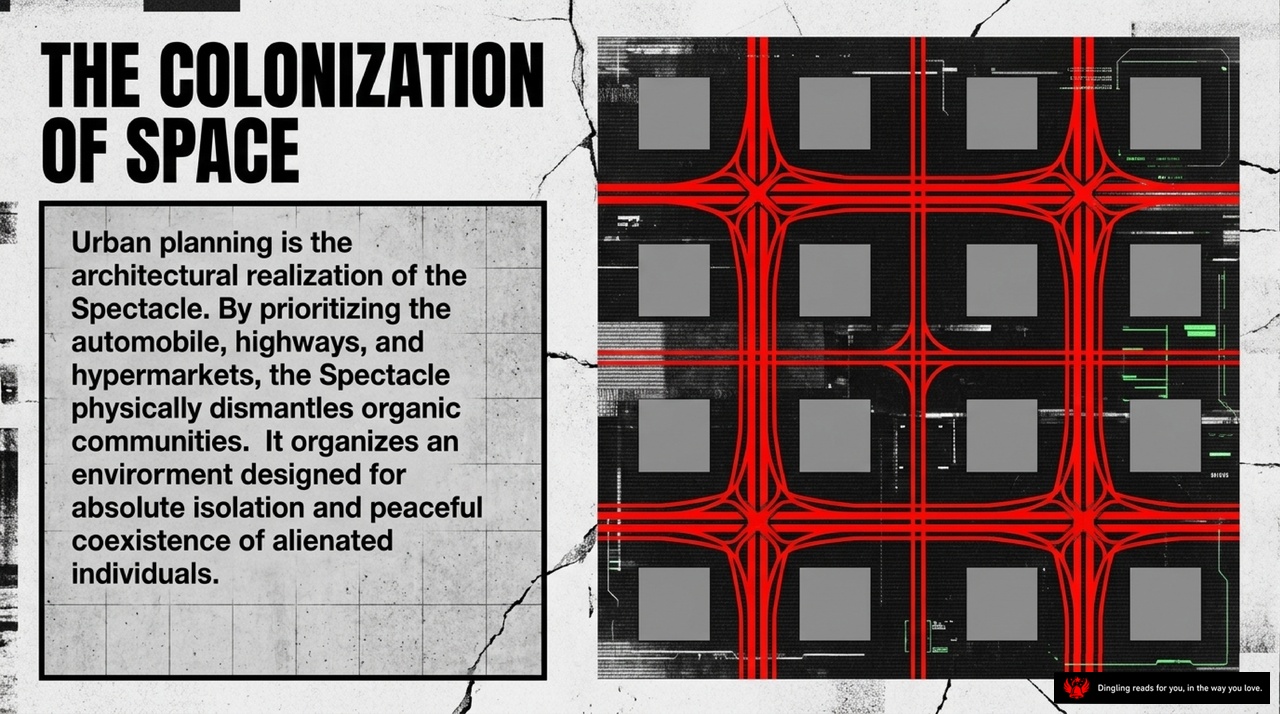
Urban planning isn't just about drawing lines on a map; it's the physical architecture of isolation. As the slide starkly illustrates, the modern city is designed not to connect people, but to separate them. By prioritizing the automobile, sprawling highways, and massive hypermarkets, we've dismantled organic communities. The result is an environment engineered for absolute isolation—a place where the "peaceful coexistence" of individuals is actually a forced solitude.
This isn't an accident; it's the direct realization of what Guy Debord called "The Spectacle." In our world, we no longer live together; we exist side by side in a grid of concrete and glass, watching our lives pass by on screens and roads rather than sharing them in person. The slide captures this perfectly with its rigid, red grid lines cutting through the city—symbolizing how we've replaced human connection with a system of efficient, yet alienating, movement. We trade our neighbors for drivers, and our community for the convenience of the supermarket.
Ultimately, this urban design creates a society of "alienated individuals." We are surrounded by millions of people, yet we are completely alone. The city has become a machine that produces loneliness, ensuring that while we are physically close, we are spiritually distant. It's a powerful reminder that how we build our cities directly dictates how we feel about ourselves and each other.

Culture as a commodity? That's the brutal reality we're facing today. Look at these ancient artifacts, once symbols of human creativity and rebellion, now neatly packaged in plastic with price tags. This image perfectly captures what Guy Debord meant when he said, "Rebellion is commodified and sold back to the rebels."
When art becomes fully independent, it doesn't soar; it dies. The Spectacle captures the history of human culture, strips it of its subversive danger, and repackages it as a museumized, consumable pseudo-culture. It's a dark irony: the very things that once challenged the status quo are now the safest investments on the shelf.
In this world, the Spectacle doesn't just show us images; it turns our entire existence into a product to be sold. It takes the raw energy of culture and the fire of dissent, sterilizes them, and sells them back to us as safe, manageable items. We aren't just buying objects; we are buying a sanitized version of our own potential. The moment culture becomes a commodity, it loses its power to change anything. We are left staring at a world where everything has a price, but nothing has a soul.

Look at this equation: take a [Capitalist Artifact]—like a standard ad—and add [Radical Recontextualization], and you get [Revolutionary Awakening]. This is the weapon of inversion known as détournement. The core idea is simple but powerful: you cannot fight the Spectacle by creating something new from scratch. Instead, you must hijack its own imagery. By forcibly recombining familiar, spectacular images in subversive ways, the illusion is broken, revealing the capitalist reality beneath. It's about taking the very tools the system uses to sell you dreams and turning them into mirrors that show the truth.
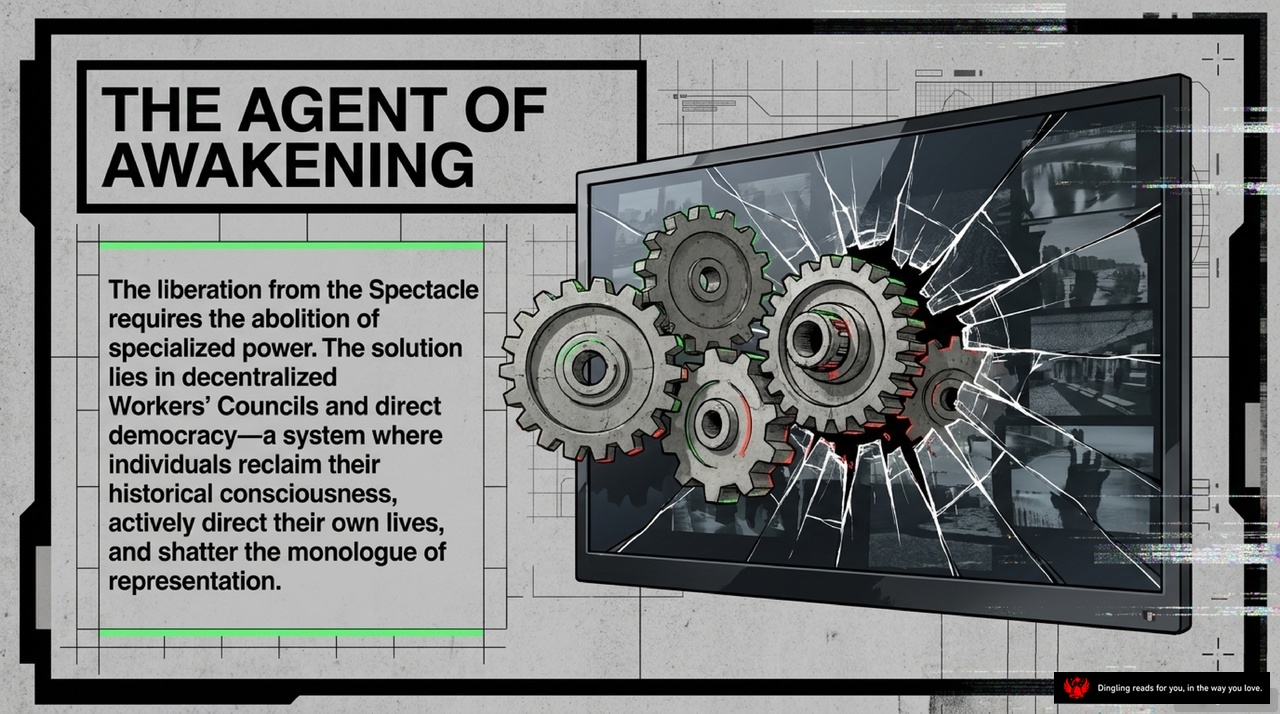
The slide boldly declares "THE AGENT OF AWAKENING," and behind that shattered screen, we see the gears of a broken system. This visual perfectly captures the core message from the text: true liberation from the Spectacle isn't just about changing our minds; it demands the abolition of specialized power. We need to move away from the top-down control that defines our current reality and embrace a future built on decentralized Workers' Councils and direct democracy.
Imagine a world where individuals reclaim their historical consciousness, actively directing their own lives instead of waiting for permission from distant authorities. This is the system where we shatter the monologue of representation—the endless, one-sided broadcast that tells us what to want and how to live. The text emphasizes that this shift is the only path to breaking free from the alienation that has turned our society into a passive audience. It's time to stop watching the spectacle and start becoming the agents of our own awakening, taking direct control of the very world we inhabit.

The Spectacle is the totalizing architecture of modern alienation—a system that replaces authentic human existence with the passive consumption of manufactured images, erasing history to maintain absolute control. Look at that intricate, spiraling structure in the center; it represents a world where everything is mediated through images, creating a feedback loop that traps us in a cycle of observation rather than action.
But here is the core question we must confront: Are you living your own history, or are you merely watching a representation of life unfold on a screen you do not control? In our modern landscape, the distinction between what is real and what is a simulation has collapsed. We no longer create our own narratives; instead, we consume pre-packaged versions of success, happiness, and even rebellion, all designed by the very system that profits from our passivity.
This isn't just about watching TV or scrolling through feeds. It's about a fundamental shift in how we relate to reality. When we stop creating and start only consuming, we lose our agency. We become spectators in our own lives, drifting through a world where the past is rewritten to serve the present, and the future is sold to us as a product. True liberation begins the moment we realize that we are not the audience, but the authors of our own story. It requires the courage to turn off the screen, both the literal and the metaphorical, and start building a life that isn't a reflection of someone else's design.