
The Sociological Imagination: Complete Chapter-by-Chapter Summary

Welcome to the opening of our exploration into the heart of sociology. Today, we are spotlighting a work that fundamentally changed how we understand our place in the world: "The Sociological Imagination" by C. Wright Mills.
As you see on this slide, this book is described as a foundational manifesto. But what does that really mean for us? It is a challenge to connect our intimate personal troubles with the grand sweep of historical and social structures.
Think about it: why do we often feel powerless when facing life's difficulties? We tend to get trapped in our small circles—work, family, neighborhood. We see our problems as purely personal failures, not realizing they are often the result of larger, impersonal changes in society. Mills argues that only by weaving individual lives with social history can we truly understand these struggles.
This book promises to give us a new lens. It invites us to break free from the illusion that our fate is solely our own making. Instead, it asks us to anchor our understanding in the specific time and place we live, recognizing that our personal lives are deeply shaped by the era's history and the structures of power around us. It's an invitation to see the private as public, and the personal as political.
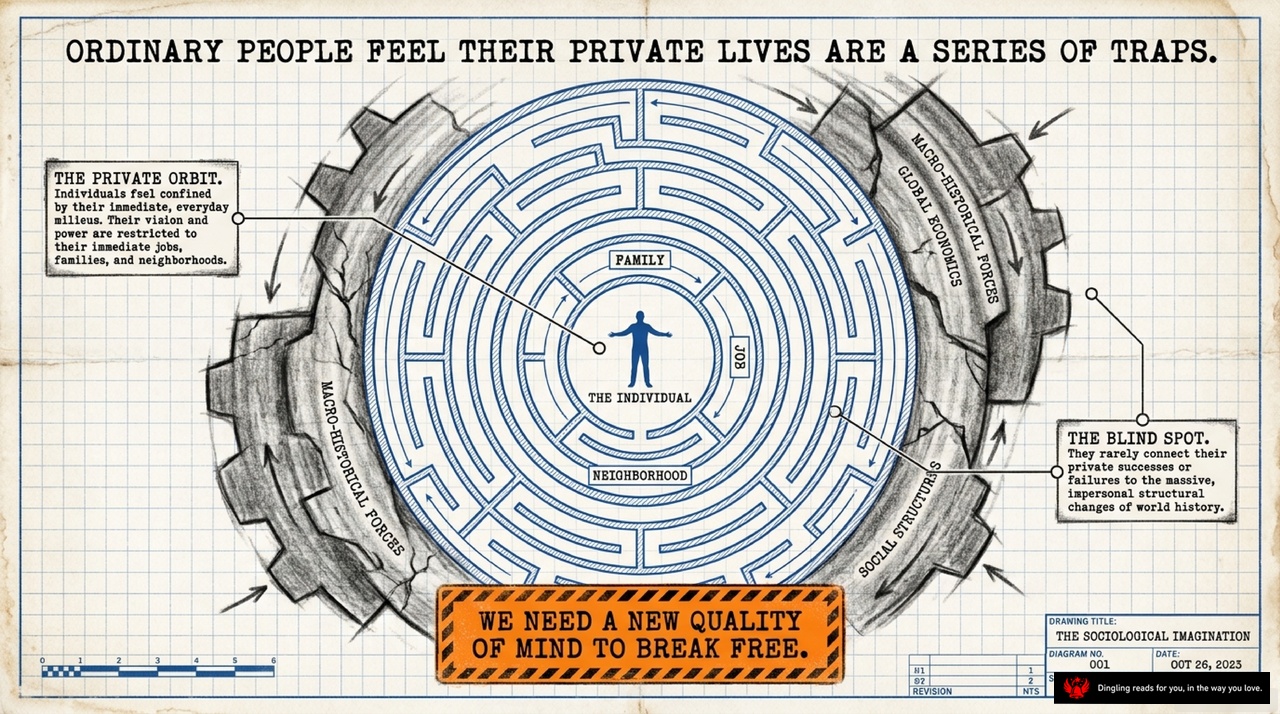
Ordinary people often feel trapped in a maze of their own lives. It's a feeling that your private world—your job, your family, your neighborhood—is just a series of traps with no way out. You feel confined by your immediate surroundings, powerless against forces far bigger than yourself.
But here's the thing: that feeling of being trapped isn't just about your personal choices or bad luck. It's a blind spot. We rarely connect our private successes or failures to the massive, impersonal shifts happening in world history. We don't see how global economics, social structures, or historical forces are actually shaping our daily reality.
To break free from this mental trap, we need a new quality of mind. We need to stop seeing our lives as isolated islands and start seeing them as part of a larger story. We need to weave our individual experiences together with the grand tapestry of social and historical change. Only then can we truly understand why we feel stuck and find the strength to break free.
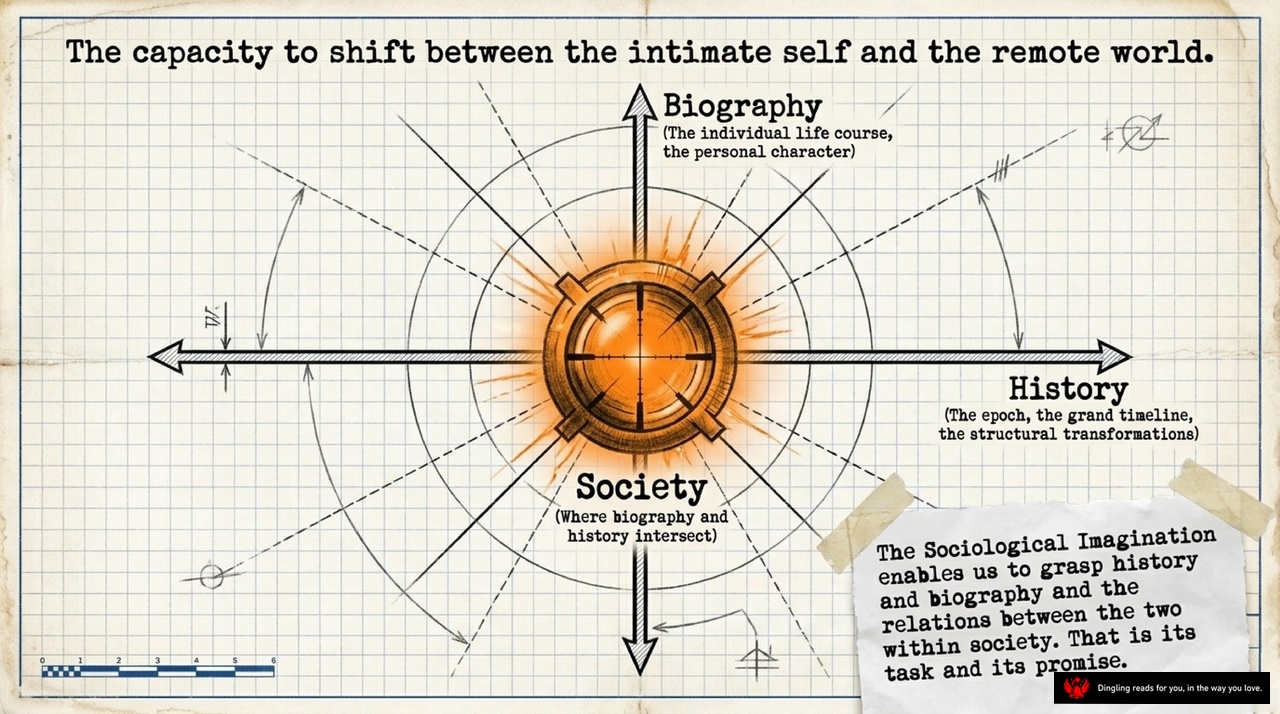
Look at this diagram. It's a blueprint for understanding our lives, and it rests on a single, powerful concept: the Sociological Imagination. This isn't just an academic buzzword; it's the ability to shift seamlessly between our intimate, personal selves and the vast, remote world of history and society.
The image breaks this down into three intersecting forces. On one axis, we have **Biography**—the story of our individual life course, our personal character, and the choices we make every day. On the other, we have **History**—the grand timeline, the sweeping structural transformations, and the epoch in which we live. Where these two lines cross is **Society**. That intersection is where biography and history meet. It is the space where our private troubles become public issues, and where our personal destiny is shaped by forces far larger than ourselves.
The note on the right explains the promise of this framework: the Sociological Imagination enables us to grasp the relationship between history, biography, and society. It allows us to see that we are not just isolated individuals drifting through life. Instead, we are active participants in a larger historical process. By understanding this connection, we can move beyond feeling trapped by our own personal struggles and start to see the broader social and historical forces that shape our opportunities, our limitations, and our very identity. It's the key to unlocking a deeper understanding of who we are and where we fit in the world.

On this slide, we see the core distinction that defines the entire field of sociology: the difference between personal troubles and public issues. Look at the left side, labeled "Personal Troubles of Milieu." Here, the focus is on the individual character and immediate relations. The threat is felt as a private matter, where one's own values are at risk. A classic example is a single person unemployed in a city of 100,000. In this scenario, the solution lies within the individual—fixing their character, skills, or seeking new opportunities. It's a problem to be solved by the person themselves.
Now, shift your gaze to the right side, "Public Issues of Social Structure." This is where the scope expands dramatically. The locus of the problem moves from the individual to institutions and historical social structures. The threat is no longer private; it's public, affecting the values we all share. The example here is stark: 15 million unemployed in a nation of 50 million. This isn't about one person's resume; it's about the collapse of the economic and political structure itself. The solution requires looking at the system, not just the individual.
Mills argues that confusing these two is a trap. When we treat a massive structural crisis as merely a personal failure, we ignore the real root causes. Conversely, when we ignore the individual experience, we lose sight of how the system actually affects people. Sociology's job is to bridge this gap, transforming private anxieties into public debates so we can truly understand and fix the society that shapes us all.

In this slide, we see the three pillars of classic social analysis: History, Human Nature, and Structure. These aren't just abstract concepts; they are the essential questions every serious analyst must ask to truly understand society.
First, look at **History**. The slide asks, "Where does this society stand in human history?" It challenges us to look beyond the present moment. We need to understand the mechanics of change and our specific place within the grand arc of human development. It's about seeing the forces that have shaped us over time.
Next, we have **Human Nature**. The question here is profound: "What varieties of men and women now prevail?" We must examine how people are selected, formed, liberated, or repressed by the society they live in. It's about understanding the diversity of human experience within a specific period.
Finally, there is **Structure**. This asks us to look at the society as a whole. What are its essential components? How do they fit together, and how do they differ from other social orders? It's about mapping the invisible framework that holds everything together.
Together, these three questions form the backbone of social analysis. They force us to move beyond individual complaints and see the larger historical and structural forces at play. Without answering these, we remain trapped in the details, unable to grasp the full picture of our world.
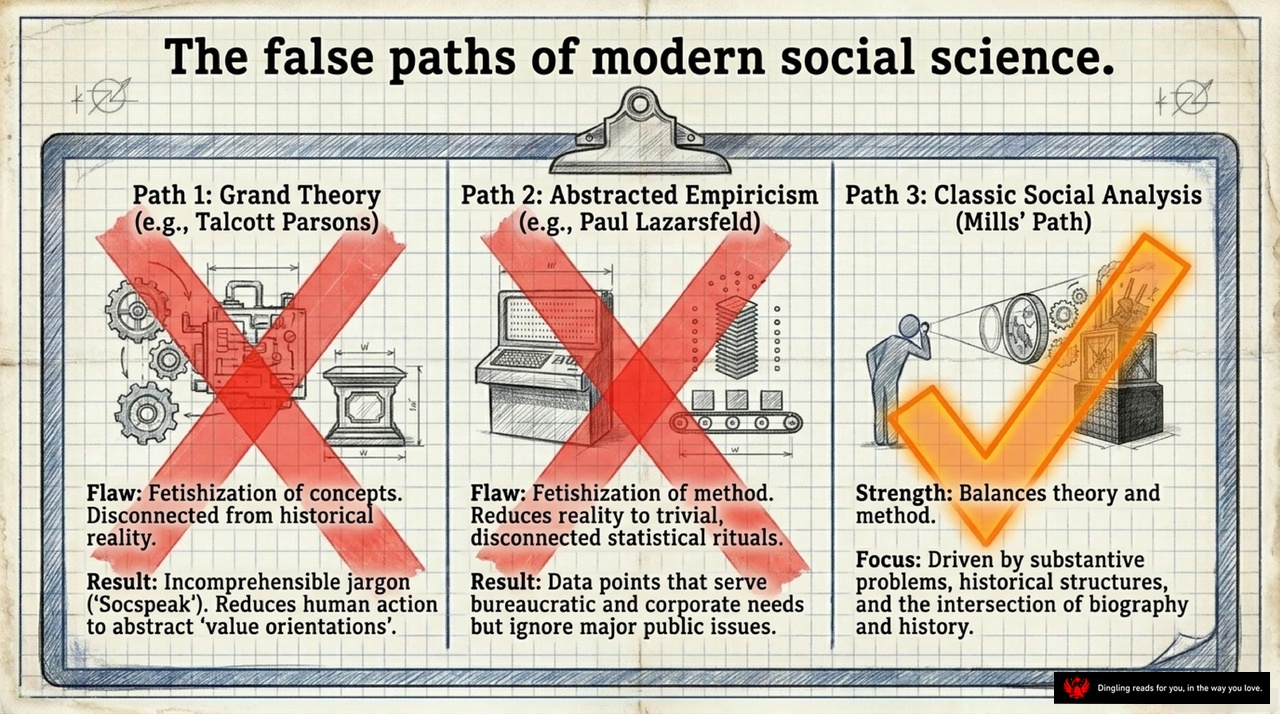
Let's talk about the bureaucratic spirit that has taken over modern social science. As we've seen, this trend isn't just about using fancy statistics; it's about how we actually think and work today. When research becomes a massive, expensive operation funded by big institutions like the military or corporations, it starts to look less like an exploration of human life and more like an engineering project. We're no longer trying to understand society; we're trying to manage it.
This shift has a direct impact on who gets to do research and how they think. The old idea of the independent scholar, the "craftsman" who follows their own curiosity, is being replaced by a new kind of academic: the technical expert. These researchers are trained in specific, narrow methods and often lack a deep understanding of the broader historical or social context. They might be brilliant at crunching numbers or following a procedure, but they often lack the "sociological imagination"—the ability to connect personal troubles to public issues and see the big picture.
The result is a form of "human engineering." Instead of asking questions about freedom, justice, or the nature of power, these studies focus on how to make things run more efficiently for those who pay for them. It's a dangerous trap because it accepts the status quo. If your job is to solve a specific problem for a client, you rarely question whether the problem itself is good or bad, or if the system creating that problem is even fair. You just optimize the outcome. This approach strips social science of its political soul and turns it into a tool for control, effectively silencing the very questions that matter most to our democracy.
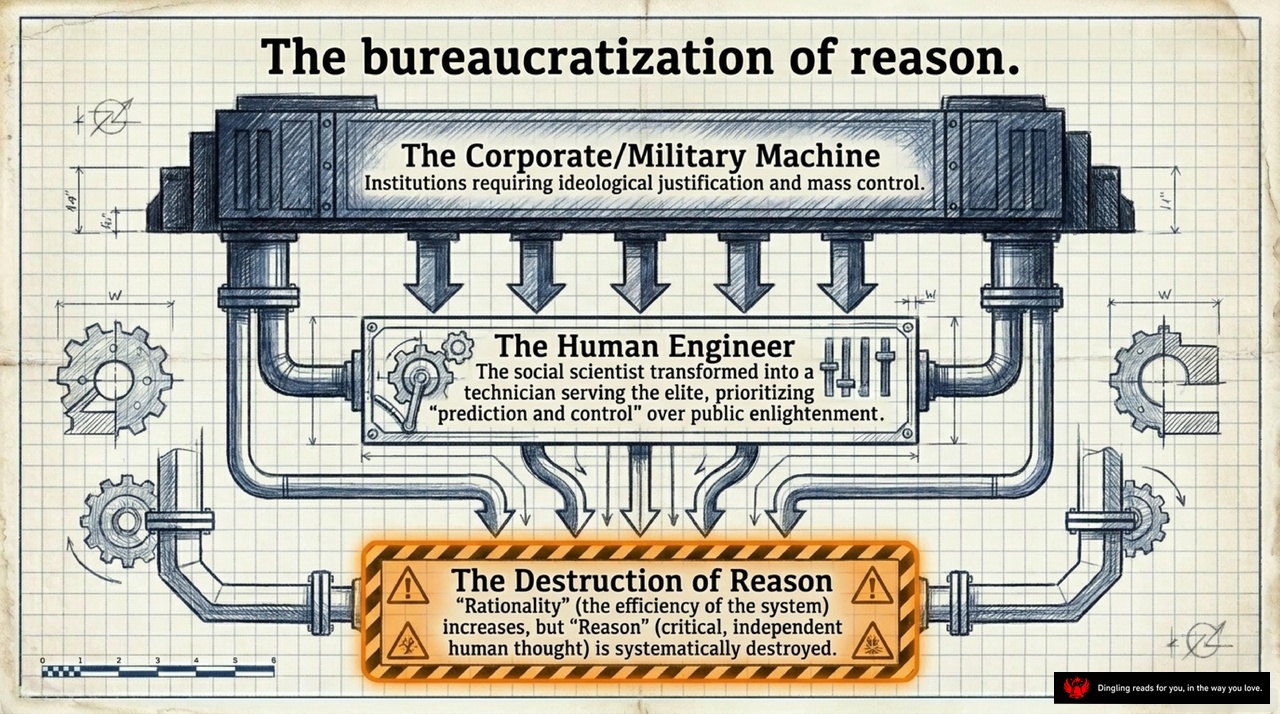
The diagram on your screen illustrates a chilling transformation in how we think: the bureaucratization of reason. At the top sits the corporate or military machine, institutions built on the need for ideological justification and mass control. These massive structures don't just make products or weapons; they process human thought itself.
That pressure flows downward into the middle layer: the human engineer. This is the social scientist transformed from a thinker into a technician serving the elite. Instead of prioritizing public enlightenment, the human engineer focuses on prediction and control, treating people like variables in a system rather than individuals with agency.
The result, highlighted at the bottom in that warning zone, is the destruction of reason. Notice the distinction carefully: "Rationality"—the efficiency of the system—increases. Machines work better, predictions get more accurate, and control becomes tighter. But "Reason"—that critical, independent human thought that questions the status quo and seeks truth—is systematically destroyed.
This is the core crisis we face. We have built a world that is highly rational in its operations but deeply irrational in its values. We have traded the freedom to think for the comfort of being managed. As we move forward, we must ask: can we reclaim that independent reason, or have we permanently outsourced our minds to the very machines we built?

The ultimate threat to freedom isn't a tyrant in a dark room, but a smiling, efficient machine in a bright office. As this slide illustrates, we are facing the rise of the "Cheerful Robot"—the antithesis of the democratic, free individual.
Look at the diagram: a human head filled with gears and cogs. The text warns that high rationality does not equal high freedom. In fact, individuals can adapt perfectly to rationalized organizations like factories or mass media, only to become entirely alienated. This is the trap. When we are too rational, we lose our independent reason and the very desire for freedom. Instead, we embrace total self-rationalization, convincing ourselves that our servitude is logical and necessary.
The "Cheerful Robot" loses all independent thought, embracing a system where everything makes sense, even if it destroys our humanity. This slide asks a terrifying question: Will this become the prevailing human type of the 'Fourth Epoch'? If we allow our institutions to prioritize efficiency and compliance over genuine human agency, we aren't building a better society; we are manufacturing a new kind of slave who loves their chains. The danger isn't that we are forced to work; it's that we willingly, cheerfully, and rationally choose to stop being free.

The imperative of historical specificity.
Look at this diagram. It contrasts the rigid, blocky structure of Feudalism with the streamlined, forward-moving shape of Modern Capitalism. The core message here is clear: there are no universal social laws that apply across all time. As the image states, mechanisms of change depend entirely on the specific historical structure being studied. We are currently transitioning from the "Modern Age" to a post-modern "Fourth Epoch," a shift that demands a new way of thinking.
To truly understand the unique trap of our current era, we must compare it historically to past epochs. You cannot study birth without studying the pregnancy. This is the essence of comparative analysis. By anchoring ourselves in history, we break free from the illusion that our personal troubles are just individual failures. Instead, we see them as symptoms of larger structural shifts. This historical perspective is what allows us to move from private confusion to public understanding, revealing how the grand sweep of history shapes the very fabric of our daily lives.
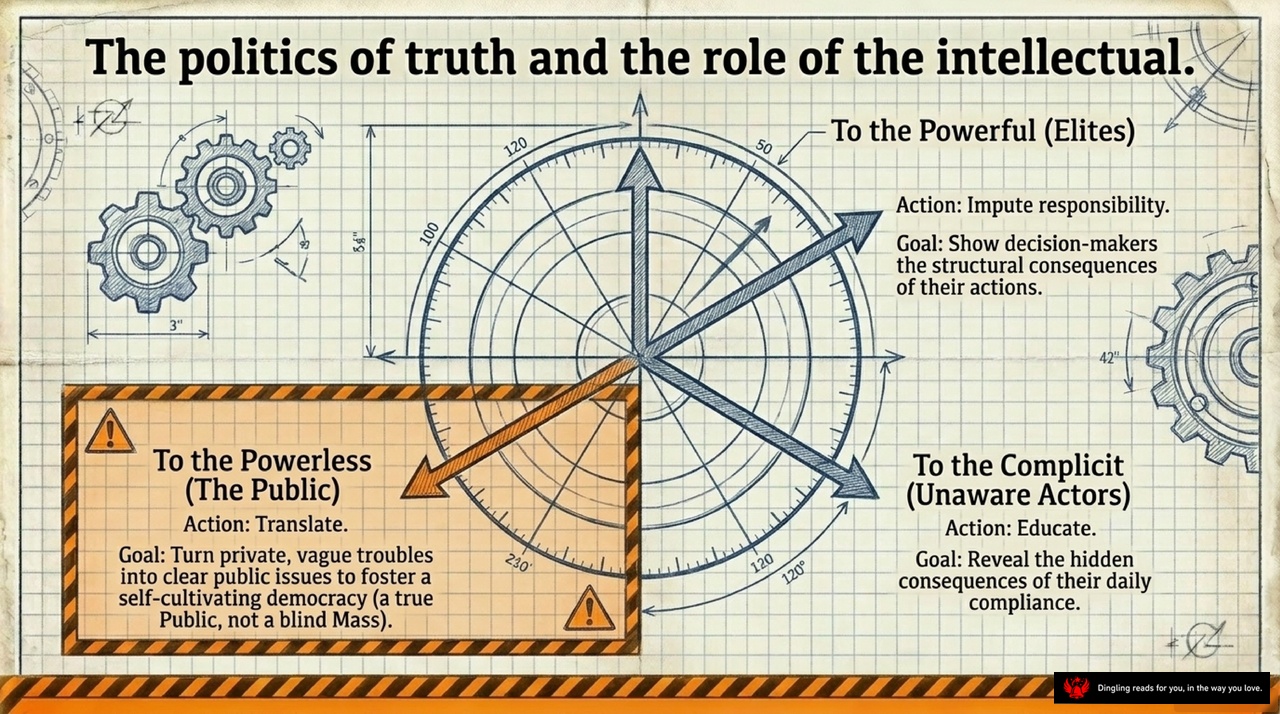
The politics of truth and the role of the intellectual is about who gets to define reality and who gets to live within it. Look at this diagram: it maps out three distinct audiences and the specific actions an intellectual must take to reach them.
First, we have the Powerful, or the Elites. For them, the action is to "impute responsibility." We need to show decision-makers the structural consequences of their actions, making it clear that their choices ripple outward and shape the world for everyone else.
Next, we have the Complicit, the Unaware Actors. These are people who go along with the system without realizing the hidden costs. The action here is to "educate." We must reveal the hidden consequences of their daily compliance, waking them up to the reality of the structures they silently uphold.
Finally, and perhaps most critically, we have the Powerless, which is the general Public. The action here is to "translate." We must turn private, vague troubles—like a personal job loss or a family struggle—into clear public issues. The goal is to foster a self-cultivating democracy, transforming a blind Mass into a true Public that understands its own power.
This framework reminds us that truth isn't just about facts; it's about translation and responsibility. It's the intellectual's job to connect the dots between individual suffering and systemic failure, ensuring that the powerless aren't just heard, but empowered to understand and change the world.

Welcome back to our book club. Today, we're diving into the final, most actionable chapter of C. Wright Mills' masterpiece: the practical art of being a true intellectual craftsman.
Look at this slide. It lays out three non-negotiable rules for anyone who wants to think clearly in a confusing world. First, "Merge Life and Work." Mills argues that you cannot split your personal experiences from your professional inquiries. If you keep a comprehensive file or journal, you aren't just hoarding notes; you are letting your real life inform your intellect. Your struggles, your joys, and your daily observations are the raw material for serious social science.
Second, we need to "Avoid Jargon." Notice the slide specifically calls out "Locospeak"—that thick, impenetrable academic dialect that often hides a lack of genuine thought. Mills was a fierce critic of writing that is deliberately obscure. He believed that if you can't explain your ideas simply, they probably aren't clear at all. True intellectual power lies in clarity, not in pretending to be smarter than your audience with heavy jargon.
Finally, the third point is perhaps the most radical: "Be Your Own Methodologist." This means rejecting rigid, bureaucratic research teams and standardized formulas. Instead, let the substantive problem you are trying to solve dictate your method. Don't let the tool decide the question; let the question guide the tool.
In this final chapter, Mills challenges us to stop being mere technicians and start being thinkers who connect the private troubles of individuals to the public issues of history. It's a call to arms for anyone tired of academic nonsense. So, what's one thing from this list that you can apply to your own work or studies this week? Let's discuss.

Imagine your deepest personal struggles—your job anxiety, your family tensions, your sense of being stuck—as not just private misfortunes, but symptoms of a much larger structural design. This slide captures that exact shift: the magnifying glass isn't just looking at a document; it's examining the invisible architecture of our era. As the text reminds us, the sociological imagination is our essential tool for human freedom. It teaches us to translate intimate, private troubles into grand, structural public issues.
When we learn to do this, we reclaim our reason from bureaucratic machines that often make us feel powerless. Instead of seeing our failures as personal defects, we recognize our place in the shaping of history. We see that the systems we live in—our economies, our political structures, our cultural norms—are not neutral backdrops, but active forces that shape our lives.
So, ask yourself: if your struggles are actually the result of how our society is built, what must you build, change, or tear down to finally be free? The sociological imagination doesn't just explain the world; it gives us the power to change it.