
The Storied Life of A.J. Fikry: Complete Chapter-by-Chapter Summary

Welcome to the story of A.J. Fikry. This is a tale about a solitary bookseller who discovers that a life without love—and without books—is no life at all.
Set against the backdrop of a cozy, dimly lit library filled with towering shelves of old books, we meet A.J., a man whose world has shrunk to the walls of his shop. He is stubborn, grumpy, and fiercely protective of his own tastes, often dismissing anything that doesn't fit his narrow definition of "literature." But deep down, he is a man who has lost his way, haunted by the absence of the love he once had.
This isn't just a story about selling books; it's a journey of rediscovery. As A.J. navigates the challenges of losing his beloved book, finding an unexpected child, and reconnecting with the woman he once rejected, he learns that the real value of a book lies not in its price or its genre, but in the connections it helps us make. It's a reminder that even the most closed-off hearts can be opened, and that sometimes, the best stories are the ones we write for ourselves.

Look at this vintage map titled "The Geography of Isolation." It's a beautiful metaphor for the story we're about to dive into. At the very center sits A.J. Fikry, a widower who's cynical, drinks frozen curry, and is financially struggling. He's the anchor of this lonely world.
Surrounding him are the forces that define his life. Right in the middle ring is "Island Books." It refuses diverse genres and acts as a temple of literary elitism. This is the fortress A.J. built to protect himself from the outside world. Then, moving outward, we see "Alice Island." It resents tourists and summer vacationers, feeling disconnected from town life. It's an island of isolation, just like A.J. himself.
Finally, at the outer edge, lies "Tamerlane." This represents an ultra-rare Poe first edition, which serves as the only financial safety net for his lonely retirement. It's the one thing keeping him from going completely under.
So, this map isn't just about geography; it's a portrait of a man trapped in his own head, surrounded by books he loves but fears, on an island he can't escape. Welcome to the world of *The Book of Lost Things*.

Today's slide, "The Catalysts of Disruption," breaks down the three pivotal moments that fundamentally changed A.J. Fikry's life. It's not just about plot points; it's about the forces that forced him out of his shell.
First, look at the tombstone on the left: "The Death of Harvey Rhodes." This wasn't just a loss; it was the shattering of A.J.'s rigid routine. It forced him to meet Amelia Loman, breaking his isolation and introducing a new literary perspective he had long ignored.
In the center, we see the display case labeled "Tamerlane." This represents "The Disappearance of Tamerlane." That stolen book stripped A.J. of his financial safety net. He could no longer afford to retire and hide from the world, forcing him to face his responsibilities head-on.
Finally, on the right, is the boot: "The Arrival of Maya." An abandoned toddler demands immediate, selfless action. Maya anchors A.J. to the present, forcing him to re-engage with humanity and the community he had previously avoided.
Together, these three catalysts moved A.J. from a closed-off, grieving man to a father, a partner, and finally, a fully living person.

The Tamerlaine Butterfly Effect: A single act of theft orchestrated a town's salvation.
It all began with a crime of passion. Ismay, driven by jealousy, stole the rare first edition of *Tamerlane* from A.J. to punish her husband. But fate has a way of twisting our worst intentions into something beautiful. That stolen book drifted through the town, eventually finding its way back to A.J. years later, damaged but recovered. Its sale fetched seventy-two thousand dollars—a sum that didn't just buy books; it bought A.J. precious time. With those funds, he secured the surgery and radiation he desperately needed, extending his life with his family during his final months.
But the story doesn't end with the book's return. The butterfly effect spread far beyond that. Because the book was stolen, Ismay was forced to confront a mother she had abandoned: Mary Ann. In her desperation to find money for her daughter, Maya, Mary Ann left the child at the Island Bookstore. A.J., who had lost his own wife, found himself in the position of a father, raising Maya. This unexpected bond softened A.J.'s heart, transforming him from a bitter recluse into a loving husband and father.
So, one theft led to a child's rescue, a father's redemption, and a love story that saved a life. A single mistake didn't just change a book's location; it rewrote the destiny of an entire town.
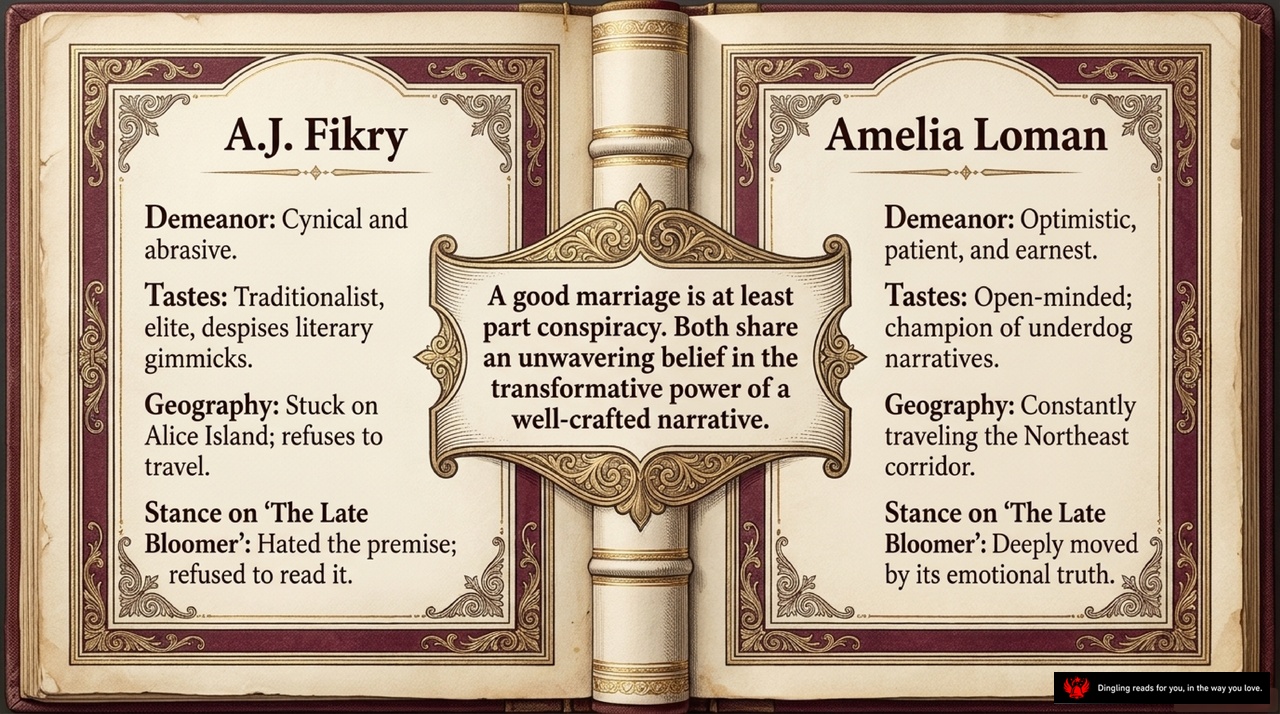
The story reaches its emotional climax with A.J.'s passing and the quiet rebirth of the shop. After losing his battle with cancer, A.J. leaves behind a legacy that proves his life mattered far beyond the books he sold. At his funeral, the future of the shop becomes the real question. Amelia, who fell in love with A.J. through literature, realizes she has no experience running a business. She sits behind the counter, looking at the familiar shelves, and seriously considers closing it all down.
But not everyone is ready to let go. Captain Lambias and Ismay gather at the restaurant to discuss it. Lambias firmly states that a place without a bookstore isn't a real place. He proposes they take over. Ismay, initially hesitant, suddenly lights up at the idea. She envisions adding a coffee corner and a small stage for local children to perform plays, finally realizing the creative potential she had always dreamed of. They agree immediately, sealing a plan that honors A.J.'s memory while keeping the shop alive.
Lambias and Ismay quickly transform the shop. They keep A.J.'s literary soul but expand its horizons. The coffee corner fills the air with the scent of fresh beans, and the stage becomes a hub for community stories. Lambias manages the crime and young adult sections, while Ismay becomes a master of events, hosting lively book clubs and author talks. The shop becomes even more popular than before.
Meanwhile, Amelia returns to her publishing career but with a new purpose. She organizes A.J.'s notes and Maya's writings, eventually becoming a freelance editor who champions young, promising voices. She visits the shop regularly, bringing new manuscripts to share with Lambias and Ismay. Maya, now a young writer herself, eagerly tells her new stories to Amelia, who leaves helpful notes for future sales representatives, reminding them that the shop is now in good hands.
In the final scene, a young man in a blue suit enters, holding a stack of books. He excitedly presents a mystery novel featuring a literary detective to Lambias. Ismay brings coffee, and the boy marvels at the coffee corner and the stage, calling it the best bookstore he's ever seen. The wind chimes ring again, echoing A.J.'s presence. Sunlight floods the room, illuminating the pages of the books, symbolizing that the story of the shop, and the love within it, continues forever.

Look at this timeline of Maya's growth. It's a beautiful map of how a little girl transforms into a storyteller.
At age two, Maya arrives at the Island Book Shop, clutching that beloved *Where the Wild Things Are*. That book marks her entry into A.J.'s life, becoming her first constant companion.
By age four, things start to change. A.J. expands the inventory to include picture and board books. This decision does something magical: it draws local mothers into the store, turning the shop into a vital community hub.
As she turns six, Maya reads *The Monster at the End of This Book*. It's a pivotal moment where she learns that sometimes, the monster is right there at the end, waiting for you.
Finally, at fourteen, Maya transitions from consumer to creator. She writes her own award-winning short story, *A Day at the Beach*, written from the perspective of sand. She takes the story of her mother's sacrifice and turns it into art.
From a lonely toddler to a published author, Maya's journey proves that the right environment can turn anyone into a writer.

Look at this Character Evolution Matrix. It's not just a chart; it's the heartbeat of the story. Let's talk about how these three souls transform.
First, Chief Lambiase. He starts as a non-reader with a failing marriage, stuck in his own head. But by the end, A.J. hands him crime novels, he finds a book club, and he becomes the savior of Island Books. He evolves from a lonely cop into a community pillar.
Then there's Ismay. She begins trapped, betrayed, mourning miscarriages and a lost daughter. But she steals Tamerlane in desperate vengeance. That act of theft, however, leads to absolution, empowerment, and genuine love with Lambiase. She moves from a victim to a woman who finds her own power.
Finally, Daniel Parrish. He's arrogant and unfaithful, coasting on past success. He refuses to grow. As the matrix says, he dies a tragic, cliché death mimicking his own debut novel. The story proves that characters who refuse to evolve are simply written out of the story.
This is the power of growth. When they change, the story changes. When they stay the same, they disappear.

Look at this beautiful map of Island Books. It's not just a shop; it's a living ecosystem. At its very heart beats the store itself, with a simple but powerful truth: a place without a bookstore is not a place.
But what keeps this heart beating? It's the connections branching out to the community. On the left, you see tourists and transients. They provide the economic lifeline necessary for survival, bringing in cash and facilitating a cultural exchange with the mainland. Without them, the store couldn't survive the off-season.
On the right, we see the local mothers and children. For them, the bookstore is a sanctuary. Storytime and parenting advice sections combat the deep isolation of rural island motherhood, turning a quiet town into a connected community.
And look up at the top right: the Police Department. The Chief's Choice reading group builds empathy and intellect among local law enforcement. It's a bridge between the force and the citizens, proving that books can de-escalate tension and foster understanding.
Finally, read this at the bottom. The bookstore is not a retail operation; it is the town's living room, confessional, and cultural anchor. It's where everyone comes to be themselves. This is the true anatomy of Island Books.

The scale in front of us perfectly captures the central conflict of our story: the war between tradition and technology. On one side, we have the weight of the past, represented by A.J.'s stack of physical books. He believes that the smell of paper, the texture of the cover, and even the human element of a friend's recommendation create a serendipity that algorithms simply cannot replicate. To him, technology threatens the very soul of literary culture.
But on the other side sits Amelia, the pragmatist. She argues that the medium matters far less than the act of reading itself. For her, technology is a bridge, not a barrier. It allows aging readers to enlarge fonts, making the world accessible again. It provides immediate access to vast libraries for those in isolated geographies like Alice Island.
This tension drives A.J.'s entire journey. His refusal to embrace e-readers almost costs him his life, yet it is also this stubborn adherence to tradition that eventually leads him to the very book—*The Late Bloomer*—that saves him. While he fights against the digital age, Amelia fights to bring him into it. Their clash isn't just about books; it's about how we connect with the world. A.J. wants to protect the sanctuary of the physical page, while Amelia wants to expand the reach of stories. In the end, we see that the future isn't about choosing one side over the other, but about finding a way where the warmth of tradition and the efficiency of technology can coexist, ensuring that stories continue to be told and heard.

So, here's the twist that changes everything about how we look at truth.
The slide on the left shows the book cover of *The Late Bloomer*. For years, everyone believed this was written by Leon Friedman, an eighty-year-old widower who spent his life alone until he married at seventy-eight. It was marketed as a heartbreaking memoir of a man finally finding love, only to lose it again. But the reality, revealed on the right side of the slide, is far more surprising. The author wasn't Leon Friedman at all. It was Leonora Ferris, a young woman who hired an actor to play the grieving widower.
The tragic backstory of the book was a complete fabrication. The "widower" was hired specifically because the true author's identity was deemed unsellable. It was a calculated illusion created to make the story palatable for the market.
But here is the profound lesson at the bottom: Fiction often contains reality. Even though the authorship was a lie and the events were made up, the emotional impact was undeniably real. This fake memoir actually brought two people, A.J. and Amelia, together. It proved that the emotional truth of a story matters far more than its factual provenance. Sometimes, a beautifully crafted lie is the only way to tell the truth about what it means to love and lose.

Imagine a world where losing your vocabulary feels like losing your soul. That is the terrifying reality A.J. faces as he battles aphasia, a condition that slowly erases the words he has spent a lifetime curating. In this chapter, we see the tragic cost of silence: A.J. can no longer distinguish "grapefruit" from "grapefruit," and the very language that defined his identity begins to crumble. Yet, amidst this disintegration, a profound realization takes root. He discovers that when words fail, something far more essential remains intact—physical presence and love. It is in the silence that true connection is found.
This journey mirrors a deeper truth about storytelling itself. As the narrative reminds us, "We are not quite novels. We are not quite short stories. In the end, we are collected works." Our lives, like A.J.'s, are not defined by a single perfect sentence or a grand plot twist, but by the accumulation of moments, relationships, and the quiet resilience we show when everything falls apart. Even when the language of the world fades, the love between a father, a daughter, and a partner continues to speak louder than any word ever could.

The Legacy Transfer isn't just about money; it's about the soul of a place. When A.J. passes, Island Books faces a crisis: without him, the store could easily become a chain store or a bank. But the community refuses to let it die. Chief Lambiase and Ismay step in, driven by a simple, powerful belief: a place without a bookstore is no place at all. They buy the shop, preserving the cultural heartbeat of Alice Island. Even after losing its founder, the physical space survives because the community insists on its survival. And in a quiet, glowing note left for Jacob Gardner, Amelia ensures the torch is passed, proving that the love for books here is stronger than any single person.

The Perpetual Cycle of Literature. Individuals pass on, but the ecosystem of storytelling is immortal. Look at this circular journey: it starts when the author writes, like Daniel and Leonora. Then the publisher champions the work, just as Knightley Press did for Amelia. Next, the sales rep pitches the book to the bookseller, where Amelia and Jacob connect. The bookseller curates the selection, bridging the gap between the book and the reader—think of A.J. and Lambiase. Finally, the reader consumes the story, completing the loop. In our story, the community and Maya read the books, which then inspires the new writer, Maya, to win an award and write her own stories. This cycle shows that while individuals like A.J. eventually pass on, the ecosystem of storytelling remains eternal, passing wisdom and love from one generation to the next.

Look at these three pillars defining the soul of a great bookstore. First, Curation Over Algorithm. In a world drowning in endless, impersonal recommendations, the human touch creates something algorithms can't: serendipity. A passionate bookseller doesn't just sell based on purchase history; they understand the reader's soul, guiding them to books that feel like they were written just for them.
Next, The Community Anchor. Physical retail survives only when it transcends simple transactions. A store must become a vital community hub—a living room and a safe haven. It's not just about the books on the shelves; it's about the people who gather there, creating a space where strangers become friends and the shop becomes the heart of the town.
Finally, The Empathy Engine. Reading is fundamentally an exercise in empathy. It is the only mechanism that forces us to inhabit lives and perspectives entirely outside our own. When we turn a page, we step into someone else's shoes, breaking down walls and building bridges. These aren't just business strategies; they are the essential insights for a modern world that desperately needs connection, understanding, and a little bit of magic.
A single bookstore transformed an isolated man into a beloved father, husband, and community pillar, proving that no one is truly an island.
In the beginning, A.J. Freceri was a man trapped in his own grief, viewing the world through a lens of cynicism and bitterness. He believed books were just commodities, and people were obstacles. But then, a little girl named Maya arrived, abandoned on his doorstep. That moment of unexpected responsibility forced him to open up, to care for someone else, and to rediscover the joy of connection.
As Maya grew, she didn't just fill the space in his life; she filled the space in his heart. She taught him that literature isn't just about serious themes or literary prestige, but about empathy, imagination, and the simple act of sharing stories. Under her influence, A.J. slowly let go of his rigid rules, embracing children's books and diverse voices he once dismissed. He became a father, a partner to Amelia, and a bridge between the town's residents, all because he chose to love another person.
Every book we read changes the trajectory of our lives, creating an endless chain of shared humanity. A.J.'s journey shows us that our lives are ultimately a collection of the stories we have loved. If our lives are defined by the people we touch and the stories we share, then what story will you leave behind on the shelf?