
The Story of My Experiments with Truth: Complete Chapter-by-Chapter Summary

Welcome to the beginning of a journey that changed the world. Today, we step into the life of Mohandas K. Gandhi, the man who would become a symbol of peace and truth for billions.
This slide introduces us to his masterpiece, *The Story of My Experiments with Truth*. But what does this title really mean? Gandhi didn't just write a biography; he described his entire life as a lifelong laboratory of the soul. He viewed every decision, every mistake, and every moment of silence as an experiment in living.
In this book, he reveals that non-violence, self-restraint, and absolute truth were not just abstract ideas to him. They were the tools he used to forge a weapon powerful enough to liberate a nation. Through his own words, we see how a young man from a privileged family in India struggled with his own doubts, his failures, and his conscience, eventually discovering a path where truth becomes the ultimate power.

Look at this magnifying glass hovering over a tiny speck of dust. It carries a profound reminder: "A seeker after truth should be humbler than the dust." This image perfectly captures the essence of Gandhi's life and the core of his philosophy.
He structured his entire journey into three distinct pillars. First, "The Hypothesis." He believed that Absolute Truth could be realized entirely through Ahimsa, or non-violence. It wasn't just a political slogan; it was a spiritual conviction that truth and non-violence were inseparable.
Second, "The Methodology." Gandhi didn't just preach; he tested his ideas on himself. He conducted public, transparent experiments on his own life, rigorously testing variables like diet, celibacy, and political action. He lived his principles before he asked anyone else to follow them.
And finally, "The Golden Rule." This was his ultimate litmus test for any action: "If an experiment yields pride, the method is flawed." He insisted that the ultimate result of any struggle must always be profound humility. If the process made him feel superior, he knew he had lost the way.
In a world often obsessed with power and ego, Gandhi's life was a masterclass in the opposite. He taught us that true strength lies not in dominating the world, but in having the courage to be humble, to serve, and to remain smaller than the dust beneath our feet.

Welcome back to our exploration of Gandhi's life. Today, we dive into a pivotal moment from his teenage years, illustrated on this slide: "The Early Variables: The Meat-Eating Experiment."
On the left, we see the variable of fear. As a shy, fearful teenager, young Gandhi was terrified of ghosts, thieves, and the dark. Influenced by a local poem claiming that British rule was sustained because the English ate meat, he formed a flawed hypothesis: that consuming meat would generate the physical courage he needed to overcome his fears and defeat the British.
This led to the observation shown on the right. He secretly began eating goat meat, but instead of finding strength, he experienced severe nightmares and overwhelming guilt. Every time he lied to his mother about having no appetite, the moral weight crushed him.
The conclusion was profound. He realized that deceiving his parents to eat meat violated the very Truth he sought to uphold. He understood that physical strength cannot be built on a foundation of moral deception. This painful experiment taught him that courage comes from within, not from what we eat, and that honesty is the bedrock of true strength.

When we talk about identity, it's not just about who we are born as, but how we evolve through our choices. Look at this timeline: Phase 1 is Assimilation. In his early days, Gandhi tried to bridge the cultural gap by purchasing expensive suits, taking violin lessons, and studying elocution. He was trying to become a standard British gentleman, believing that adopting their customs would help him belong. But as he moved into Phase 2, Awakening, the reality hit him. He encountered his own culture through Western eyes, reading the Bhagavad Gita and Edwin Arnold's The Light of Asia. He realized that true identity wasn't about mimicking others, but reconnecting with his own roots.
This journey led him to Phase 3: Discipline. Here, he stopped the pursuit of being a gentleman and chose a path of strict ethical living. He implemented ledger accounting for every penny, walked to save bus fare, and embraced vegetarianism not just as a habit, but as a conscious ethical choice. This shift from external validation to internal discipline defined his life. It taught us that discovering who we truly are often requires letting go of what the world expects of us and embracing the hard work of living according to our own values.

South Africa: The Crucible of Satyagraha. Look at this map; from Durban to Johannesburg, Gandhi didn't just travel—he transformed from a confused lawyer into a political pioneer. The journey began with a catalyst: a simple order from a magistrate demanding he remove his turban. Instead of bowing to injustice, his response was to refuse, realizing that preserving dignity was essential for future battles. But one courtroom victory wasn't enough; he evolved by organizing the Natal Indian Congress, moving beyond legal practice to build a tangible, organizing force. This was the insight he gained: written petitions to the government are empty unless backed by real power. Through these struggles in Pretoria and beyond, he recognized that truth alone is fragile without a disciplined, united people. This period wasn't just about winning a case; it was about birthing a new political identity. He learned that non-violence requires courage, sacrifice, and the willingness to adapt local customs while holding fast to core rights. It was in this harsh environment that the concept of Satyagraha—the force of truth—was forged, turning a small group of immigrants into a movement that would eventually shake the foundations of an empire.

This slide presents a crucial comparison between "Passive Resistance" and "Satyagraha," or Truth-Force. Think of this not just as a historical distinction, but as a fundamental shift in how we approach conflict.
On the left, we see Passive Resistance. The text describes it as "the weapon of the weak." This approach often stems from hatred or a desire to harass and defeat an opponent. Because it is driven by anger, it carries the risk of escalating into physical violence. It's a strategy of self-defense born out of weakness.
In stark contrast, look at the right column: Satyagraha. Gandhi redefined resistance as "the weapon of the strong." It is based entirely on love and Ahimsa—non-violence. It absolutely excludes violence under all circumstances. The ultimate goal isn't to defeat the enemy, but to convert them through self-suffering.
As we read about Gandhi's journey, from his early struggles with anger toward his wife to his later years in South Africa, we see him evolving from someone who wanted to defeat his opponents into someone who sought to transform them. This matrix captures that transformation perfectly. Passive resistance fights against a person; Satyagraha fights for the truth, using love as its only tool. This is the core of his philosophy: that strength lies not in the ability to harm, but in the courage to suffer without retaliation.

Welcome to the blueprint of Gandhi's soul. This slide outlines what we call "The Spiritual Infrastructure"—the hidden framework that held his entire life together. Look at the diagram: it's not just a building; it's a philosophy made physical.
On the left, we see "Aparigraha," or Non-Possession. Inspired by John Ruskin's *Unto This Last*, Gandhi adopted a radical idea: a universal flat wage of three pounds a month for every worker, regardless of their nationality or role. This was his attempt to erase the gap between the elite and the laborer, ensuring that dignity was distributed equally, not hoarded by the few.
In the center, the core of the structure is the "Dignity of Labor." Notice how the illustration blends a printing press with a communal living space and a garden. Gandhi believed in erasing the line between intellectual and manual work. He wanted lawyers and mechanics to live and build together, proving that true strength comes from honest toil, not just abstract thought.
Finally, on the right, stands "Brahmacharya," or Self-Restraint. This wasn't just about celibacy; as the text notes, it was a 1906 vow born from a profound realization: one cannot dedicate oneself entirely to public service while still being bound by fleshy passions and private attachments. By mastering his own desires, Gandhi created the spiritual stability needed to lead a nation. Together, these three pillars formed the unshakeable foundation for his life's work.

Look at this graph. It visualizes the core mechanism of fasting as a journey where physical deprivation drives spiritual clarity. As we move along the curve from left to right, we see that true fasting isn't just about physical starvation; it starts with a strict mental restraint aimed at self-purification. This is the prerequisite. Once we reach a certain level of physical deprivation, we enter the application phase, where fasting becomes a tool for penance, like Gandhi used it to protect workers' pledges. However, the curve has a critical limit. This is the boundary. Fasting must never be used to unfairly coerce an opponent. It is strictly a weapon of self-suffering directed inward to awaken the conscience of others. This distinction between using fasting for purification versus coercion is the key to understanding its power.

The Return to India: Testing the Weapon
When Gandhi returned to his homeland, he didn't just bring back a law degree; he brought a new philosophy ready to be put to the test. His first major challenge came in Champaran in 1917, where he stood against the exploitative indigo planter system. Instead of leading a violent uprising, he used systematic, transparent research and polite defiance to challenge unjust expulsion orders, showing the power of truth over force.
Just a year later, in Ahmedabad, he faced a textile labor dispute. Here, he initiated his first public fast, not to starve himself into victory, but to maintain the morale of starving workers and keep their non-violent pledge intact. This was a crucial lesson in empathy and moral courage.
Finally, in Kheda in 1918, he led a peasant tax revolt against unfair assessments made after crop failures. His method was revolutionary: he taught rural masses to shed their deep-seated fear of government officials. By empowering them to question authority through non-violence, he turned passive victims into active participants in their own liberation. These early campaigns proved that non-violence was not just a theory, but a powerful weapon capable of changing the course of history.

Look at this cycle: Chamates, Civil Disobedience, and Protest. This diagram illustrates what Gandhi called "The Himalayan Miscalculation." It captures a critical moment in history where the intention of peaceful protest collided with the reality of an unprepared crowd.
The action began with a call for a nationwide Hartal, or strike, to protest the draconian Rowlatt Act. The goal was pure: to demonstrate through civil disobedience. However, the consequence was tragic. The masses, largely unprepared for the strict discipline of non-violence, erupted into mob violence in cities like Amritsar and Ahmedabad. The peaceful intent shattered into chaos.
This failure led to Gandhi's profound insight, the core of the Himalayan Miscalculation. He realized that a person must first willingly and respectfully obey normal laws before they earn the moral qualification to break unjust ones. Civil disobedience isn't an impulsive act of rebellion; it requires rigorous prior training. Without that foundation, the movement risks destroying the very cause it seeks to protect.
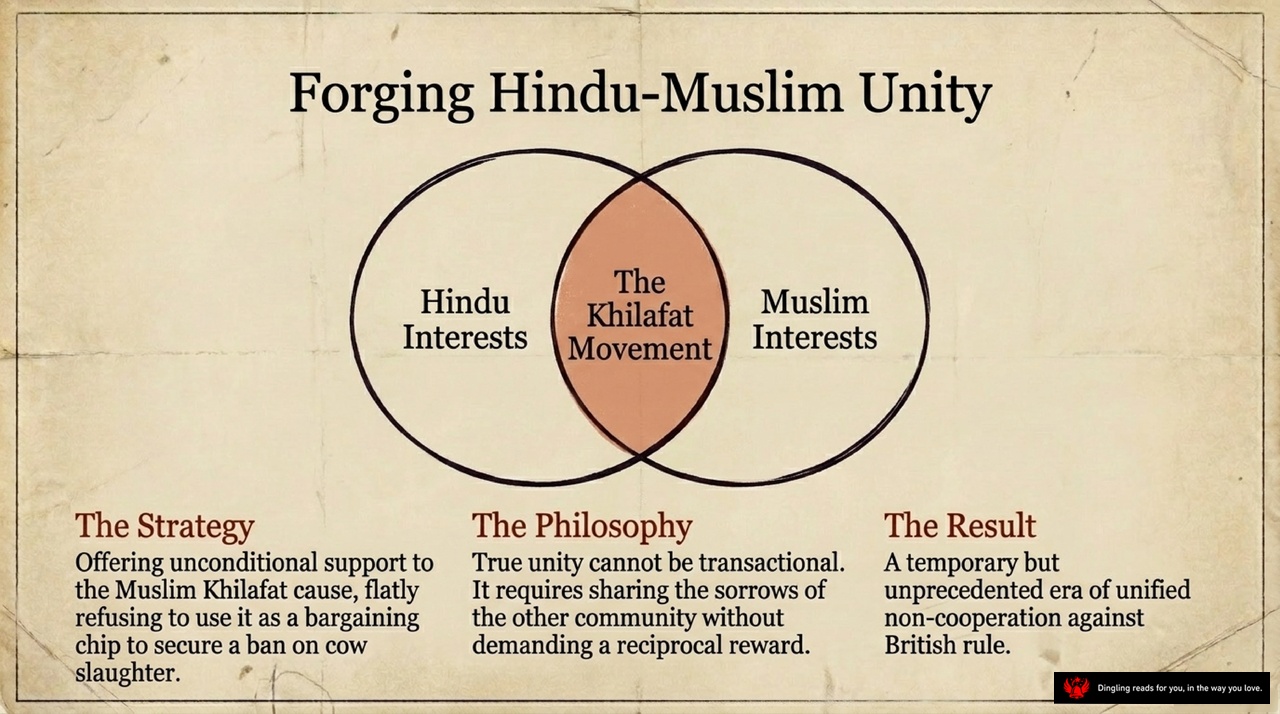
Forging Hindu-Muslim Unity through the Khilafat Movement
This slide illustrates a pivotal moment in India's history: the strategy of bridging the Hindu and Muslim communities. At the center of this Venn diagram lies the Khilafat Movement, the shared ground where both communities found common cause against British rule.
The strategy was bold and uncompromising. By offering unconditional support to the Muslim Khilafat cause, the movement flatly refused to use it as a bargaining chip to secure a ban on cow slaughter. This decision was crucial because it prioritized solidarity over specific communal demands, signaling that the fight for freedom was greater than any single religious grievance.
Underpinning this strategy was a profound philosophy: true unity cannot be transactional. It requires sharing the sorrows of the other community without demanding a reciprocal reward. This selfless approach fostered an unprecedented era of non-cooperation, where Hindus and Muslims stood together as one people, united by a shared vision of independence.
The result was a temporary but powerful alliance that significantly strengthened the independence movement, proving that when diverse communities unite without conditions, the power of their collective voice becomes unstoppable.

The Charkha, or spinning wheel, wasn't just a tool for making cloth; it was Gandhi's revolutionary strategy for total economic independence. As the slide illustrates, every part of this simple machine symbolized a profound shift in India's soul. The Drive Band represents self-reliance, designed to break the nation's absolute dependence on British textiles and the power of Indian mill owners. By spinning our own yarn, we reclaimed our sovereignty. The Drive Wheel stands for egalitarianism; it forced the educated elite to perform manual labor, effectively bridging the vast social gap between the wealthy and the untouchables. Finally, the Spindle was about eradicating poverty, providing immediate, supplementary income to starving, semi-unemployed peasants across millions of villages. This wasn't just about manufacturing; it was a spiritual and social revolution that empowered the common man and dismantled the structures of oppression.

Friends, look at this pyramid. It's not just a chart; it's the very architecture of Gandhi's life, a visual equation of how he believed true freedom is built. At the very top, we see "Satyagraha," or True Civil Disobedience. But notice the arrow pointing down to the middle layer, the "Constructive Program." Gandhi knew that political independence isn't a magic switch you flip from London; it must be rooted in the soil of your own nation. That's why the middle layer matters so much: it's about Khadi, the spinning wheel, uniting Hindus and Muslims, and eradicating the evil of untouchability. You cannot have a free nation if half its people are treated as less than human.
But the foundation, the broad base of this pyramid, is what most people overlook. It is "Personal Purification." Before you can change the world, you must change yourself. This bottom layer is built on dietary restraint, Brahmacharya, or celibacy, Aparigraha, meaning non-possession, and absolute humility. Gandhi's insight, written clearly on the side, is profound: "Political freedom is an impossibility without the foundation of economic self-reliance and rigorous moral purification." He taught us that we cannot fight for external liberty while our own souls remain enslaved by greed, lust, or arrogance. True freedom starts with the discipline of the individual, rising up to build a just society.
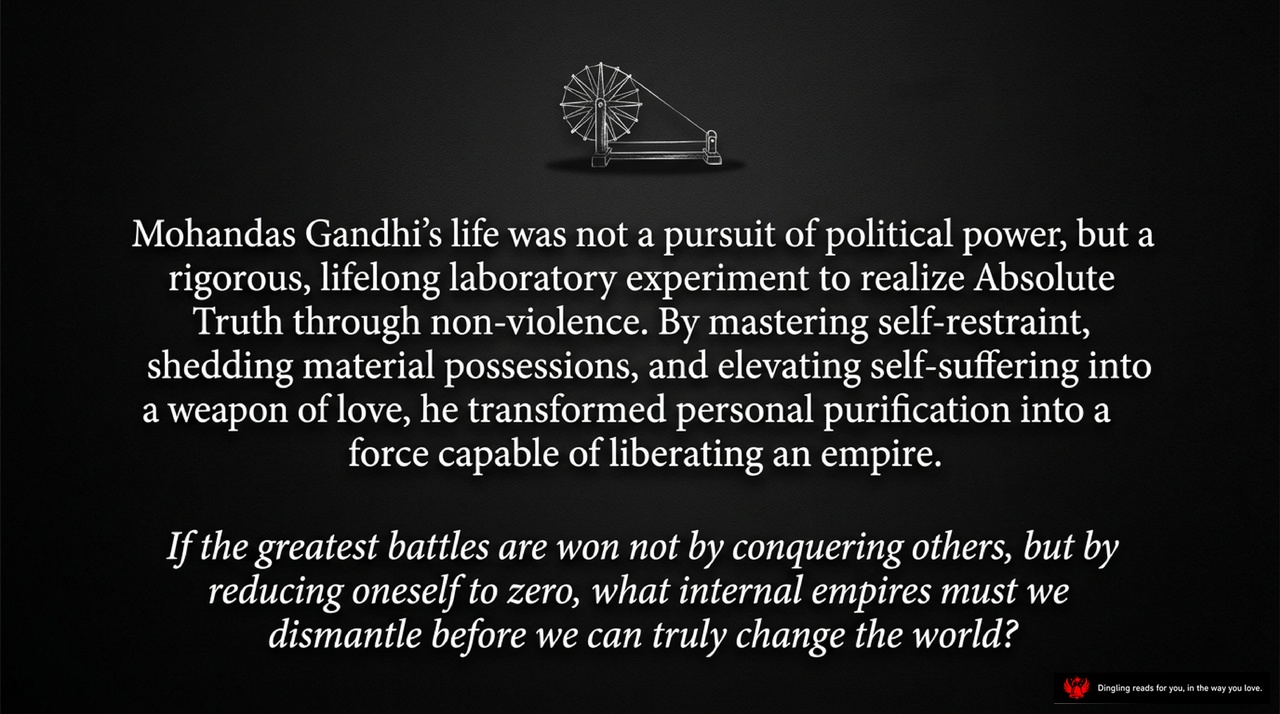
Gandhi's life wasn't about chasing political power; it was a lifelong experiment to realize Absolute Truth through non-violence. By mastering self-restraint and shedding material possessions, he transformed personal purification into a force capable of liberating an entire empire. He turned self-suffering into a weapon of love, proving that the greatest battles are won not by conquering others, but by reducing oneself to zero. This radical idea challenges us today: what internal empires must we dismantle before we can truly change the world?