
The Story of Philosophy: Complete Chapter-by-Chapter Summary

Welcome to *The Story of Philosophy* by Will Durant. This isn't just a history of ideas; it's a 2,500-year journey tracking the evolution of human thought. We're going to see how the world's greatest minds built the frameworks we still use today to understand existence.
Think of philosophy as the pioneer of truth. While science eventually takes over specific fields with precise formulas, philosophy remains the explorer at the edge of the unknown. It doesn't just analyze facts like science does; it seeks to explain the meaning behind them, connecting our scattered experiences into a coherent whole. Without philosophy to guide our values and purpose, we'd have knowledge but no wisdom, facts but no future.
As we begin this tour, remember that philosophy isn't about abstract nonsense. It's about living a life of wisdom—simple, independent, and confident. From the ancient Greeks asking "what is justice?" to modern thinkers grappling with the nature of reality, this book is your guide to understanding how we think, why we act, and what it truly means to be human. Let's dive in.

Look at this slide. On the left, we have Science, depicted as scattered, sharp shards—fragmented and analytical. On the right, we see Philosophy as a unified, glowing sphere, representing synthesis and wisdom. This visual perfectly captures the core distinction: Science gives us the tools to dissect the world, breaking it down into mechanisms and processes; it tells us *how* to save or kill. But it doesn't tell us *when* to do either. That is where Philosophy steps in.
Philosophy provides the synthetic wisdom to understand the meaning behind those facts. While Science reduces organisms to organs and focuses on the "what," Philosophy explores ultimate values and ideal possibilities, coordinating our desires to decide the "why." The slide outlines the five pillars of this philosophical wisdom: Logic, Aesthetics, Ethics, Politics, and Metaphysics. Together, they form the framework we need to navigate a world where scientific knowledge is abundant, but wisdom is often missing. Without this balance, we risk having all the answers about how things work, but no guidance on what truly matters.

Welcome to the blueprint of the Western mind. Today, we're diving deep into Plato's *The Republic*, a text that didn't just imagine a perfect city, but mapped out the very architecture of a just soul.
Look at this pyramid. Plato's genius was realizing that the state is simply the individual writ large. He argued that to build a just society, we must first understand the anatomy of the human soul. It all comes down to three distinct engines driving human behavior: the boundless energy of physical desire, the spirited drive for honor and power, and the illuminating pursuit of truth.
In Plato's vision, these forces must be perfectly balanced. At the base, we have the Producers, driven by **Desire** and focused on industry and wealth. Above them sit the Auxiliaries, guided by **Emotion** and the **Heart**, tasked with military defense and upholding honor. But at the very peak, glowing like a beacon, sits the Philosopher King. This ruler is governed by **Knowledge** and the **Mind**.
Plato believed that just as a healthy individual needs reason to guide their desires and emotions, a healthy state needs these elite philosophers to guide the producers and soldiers. These rulers aren't just politicians; they are elites who have survived a grueling 50-year education to perceive the eternal, unchanging Ideals that govern reality. Without this rational guidance at the top, the whole structure collapses into chaos. This is Plato's enduring legacy: true justice isn't just about laws, but about the right order of our souls and our society.

The Great Divergence isn't just a historical footnote; it's the fundamental fault line in Western thought, and understanding it changes how you see everything from politics to your own life choices. Look at this slide: it contrasts Plato, the ultimate Idealist, with Aristotle, the pragmatic Realist.
Plato looked up. He believed truth lived in a separate, perfect realm of eternal Forms, far above our messy physical world. His method was utopian theorizing and geometric deduction, aiming for a radical political vision where philosopher elites rule a theoretical communist society. For Plato, the goal of life was to perceive that ultimate Idea of the Good.
Aristotle, on the other hand, looked down. He insisted truth exists strictly within the physical matter of the present world. His methodology was grounded in biological taxonomy, empirical observation, and strict logic. Politically, he favored a conservative, middle-class governance that protects private property and stability. His goal wasn't abstract perfection, but achieving happiness through the Golden Mean—finding that exact midpoint between extremes of behavior.
This split between looking up to abstract ideals and looking down at tangible reality defined the schism in Western thought. Plato taught us to dream of perfect forms; Aristotle taught us to observe the real world and find balance in it.

The slide we see here captures a pivotal moment in the history of thought: The Empirical Awakening led by Francis Bacon. Look at that visual metaphor—the chaotic tangle of lines on the left represents the "Idols of the Mind," the deep-seated prejudices and linguistic traps that had long clouded human understanding. Bacon argued that before we could ever truly understand the world, we had to aggressively clear our minds of these inherited idols.
This is where the transformation happens. The golden prism in the center symbolizes "The Inductive Method." Unlike the abstract deduction that dominated philosophy for centuries, Bacon championed relentless observation, experimentation, and data gathering. He believed that by replacing old theories with evidence, we could finally pierce through the fog.
On the right, the structured grid represents "The New Organon"—Bacon's blueprint for a new way of thinking. This shift didn't just change how we do science; it changed how we live. By moving from passive contemplation to active inquiry, Bacon transformed philosophy into a tool for conquering nature. As the slide reminds us with his famous declaration, "Knowledge is Power." It wasn't just about knowing things for the sake of knowing; it was about using that knowledge to improve the human condition, to heal, to build, and to liberate ourselves from the limits of the natural world.

Welcome to the geometric universe of Baruch Spinoza. As science began fragmenting the world, this excommunicated thinker sought ultimate unity, crafting a philosophy as precise and inescapable as Euclidean geometry. For Spinoza, the cosmos isn't ruled by a personal, intervening creator. Instead, God and Nature are identical. There is only one infinite Substance in the universe. Everything we see—mind and matter, thought and extension—are merely different facets of this single, divine geometry.
Look at the diagram here. You see three overlapping circles labeled God, Nature, and Substance, all converging at a central point: The One. This visual perfectly captures his radical insight. Because everything is governed by natural law, free will is an illusion. True freedom, Spinoza argued, comes from understanding the absolute necessity of all things and viewing the universe sub specie aeternitatis—under the aspect of eternity. By seeing the world as an eternal, necessary whole rather than a series of random events, we finally find our place within the divine order.

Imagine a perfect, geometric crystal representing the ideal worlds philosophers spent centuries building—flawless, logical, and complete. Now, watch as a heavy, iron cannonball smashes right through it, shattering that perfect illusion into a thousand sharp fragments. This isn't just a graphic; it's the visual heartbeat of Voltaire's life.
While other thinkers were busy constructing these theoretical universes, Voltaire looked at the brutal reality of 18th-century Europe. He saw blood, earthquakes, and innocent suffering, and he scoffed at the arrogant claim that we live in "the best of all possible worlds." Through his masterpiece, *Candide*, he ruthlessly dismantled naive optimism. He rejected grand metaphysical systems that tried to rationalize human pain, arguing that ultimate cosmological answers are simply beyond our reach.
So, what is the alternative? Voltaire proposed a pragmatic retreat. Instead of arguing endlessly over the divine purpose of disasters, humanity must focus on practical, terrestrial progress. We need tolerance, we must fight superstition, and most importantly, we have to do the actual work of living. As *Candide* famously concludes, we must cultivate our garden. It's not about finding a perfect world; it's about building a better one, right here, right now.

Welcome to the next chapter of our journey through the history of ideas. Today, we're stepping into the 18th and 19th centuries, a time when the very definition of reality began to fracture and reshape itself.
On your screen, you see a striking visualization titled "The Kantian Prism: Architect of the Mind." This image perfectly captures the revolutionary shift Immanuel Kant brought to philosophy. Before Kant, thinkers like David Hume argued that our minds were passive blank slates, simply recording whatever the world threw at us. But Kant flipped this script entirely. He argued that our minds are actually active architects.
Look at the left side of the diagram: "Raw Sensory Data," labeled as the unknowable "Thing-in-Itself." This represents the chaotic stream of sensations we receive from the outside world. But notice what happens next. These raw data points pass through the central pyramid—the "Kantian Prism." This prism represents the built-in filters of our own cognition, specifically the categories of the mind like space, time, and causality.
Because of these filters, the raw chaos on the left transforms into the structured cube on the right, labeled "Perceived Reality" or "Phenomena." We never actually see the world as it truly is in itself; we only ever see the structured projection our mind creates. As the text notes, Kant executed a "Copernican Revolution in thought," saving science and causality from skepticism by proving that our mind shapes reality, rather than just passively receiving it.
This distinction is crucial. It means we can never know the ultimate reality behind the veil, but by mapping these limits of pure reason, Kant protected the realm of science. He safely sequestered morality, free will, and faith into a separate domain of practical reason, untouched by empirical doubt. In a world where science and faith often clash, Kant gave us a way to let them coexist. He showed that while our senses are limited, our reason gives us the power to understand the world—and, more importantly, to shape our moral destiny within it.

History isn't just a timeline of dates; for G.W.F. Hegel, it's a living, breathing engine of progress. Imagine the universe as the "Absolute Idea," slowly waking up to self-consciousness through human history. But this journey isn't peaceful or linear. It's driven by inherent contradiction. Every idea or social structure—the **Thesis**, representing the status quo—inevitably generates its opposite, the **Antithesis**, or the opposing force.
When these two collide, they don't simply destroy each other. Instead, that clash and struggle elevate them into a higher, more complex harmony, known as the **Synthesis**, which becomes the new reality. This cycle repeats, creating a spiral of growth. As Hegel famously noted, periods of happiness are actually blank pages in history because they are periods of harmony. True progress, he argued, comes from strife. It is a rational, albeit violent, progression where conflict is the very mechanism that drives us forward. So, when you look at the engine of history, remember: without the tension between the old order and its challenge, there is no evolution, only stagnation.

Philosophy often strips away the illusion of pure rationality to reveal something far more primal and driving: The Will. As we move into this section, we see a stark contrast between two powerful currents of thought. On the left, we have Schopenhauer's pessimism. He argued that beneath our logic lies a blind, endless, insatiable Will to Live. Because desire is never-ending, suffering becomes inevitable. For him, the only escape from this tragic cycle was extinguishing desire through ascetic renunciation, a path leading to a state akin to Nirvana.
But on the right, the narrative shifts dramatically to Nietzsche's heroic overcoming. While Nietzsche agreed that the Will is primary, he redefined it as the Will to Power—the drive to expand, conquer, and excel. Rejecting Schopenhauer's retreat, Nietzsche declared God is dead and urged humanity to transcend conventional morality. He championed the Übermensch, a creator of new values who embraces the danger and suffering of existence with joyful, defiant strength. This isn't just about survival; it's about becoming who you are meant to be through the relentless assertion of your own power.

Welcome to the final chapter of our journey through the history of ideas. Today, we shift our lens from the grand narratives of evolution to the biological lens itself, exploring a fundamental clash that defined the late 19th century: Mechanism versus Vitalism. As Darwinism reshaped the intellectual landscape, philosophers rushed to interpret evolution's meaning for the human soul, splitting into two distinct camps.
On one side, we have Herbert Spencer and his view of mechanical adaptation. Imagine the universe as a giant clockwork machine. Spencer attempted to map the entire cosmos using the laws of mechanics. To him, progress was an inevitable physical transition, driven by the pressure of survival, moving from simple homogeneity to complex heterogeneity. He viewed the mind not as a mysterious spark, but simply as an organ of mechanical adaptation—a part of a machine that fits into a larger, deterministic system.
But not everyone was comfortable with a lifeless materialism. Enter Henri Bergson, who revolted against this rigid mechanistic view. Bergson argued that life cannot be reduced to physical mechanics or predictable formulas. He introduced the concept of *Élan Vital*—the vital impulse. This is an original, creative, and unpredictable life force that drives evolution forward. While intellect and logic can only analyze dead matter, Bergson insisted that to truly understand living reality, we must rely on intuition. He believed evolution is not just a slow adaptation to the environment, but an active, creative process driven by this inner drive.
So, we are left with a choice: do we see the universe as a clockwork mechanism where everything is predetermined, or as a dynamic, creative flow driven by a vital impulse? This debate between the cold gears of mechanism and the fiery energy of vitalism continues to echo in how we understand life today.
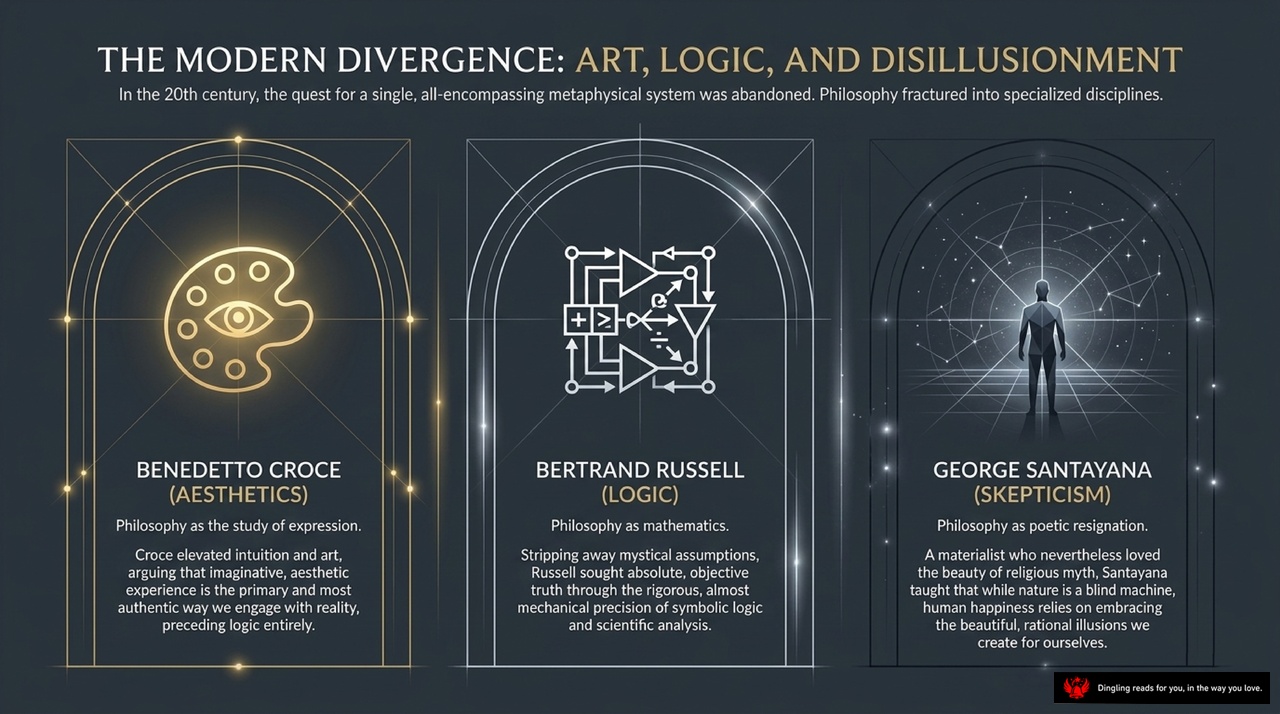
The 20th century marked a profound shift: the dream of a single, all-encompassing metaphysical system was finally abandoned. Philosophy fractured into specialized disciplines, giving rise to what we call the modern divergence. This era defined itself through three distinct, often competing, paths: Art, Logic, and Disillusionment.
On the left, we see the path of aesthetics championed by Benedetto Croce. For Croce, philosophy was not about abstract logic, but the study of expression. He elevated intuition and art above all else, arguing that the aesthetic experience is the primary and most authentic way we engage with reality—preceding logic entirely. In his view, it is through art that we truly understand the world.
In the center stands the rigorous path of logic, led by Bertrand Russell. Moving away from mystical assumptions, Russell sought absolute, objective truth through the almost mechanical precision of symbolic logic and scientific analysis. His approach treated philosophy as mathematics, stripping away emotion to reveal the bare structures of reality.
Finally, on the right, we find the path of skepticism and poetic resignation, embodied by George Santayana. As a materialist, Santayana neverthless loved the beauty of religious myths. He taught a profound lesson: while nature is a blind machine, human happiness relies on embracing the beautiful, rational illusions we create for ourselves.
Together, these three figures illustrate how modern philosophy moved from seeking one grand truth to exploring multiple, specialized ways of understanding our existence.

After 2,500 years of chasing absolute, eternal truths, American Pragmatism finally brought philosophy down from the heavens and into the classroom and the factory. This slide introduces John Dewey and his "Pragmatic Shift."
Look at this cycle on the left: it connects **Thought / Theory** with **Environment / Action**. Dewey argued that the mind is not a mirror passively reflecting the universe; it is a biological organ designed to solve problems. Ideas are not true or false in the abstract—they are simply instruments.
An idea's validity is proven only by its practical consequences and its success in helping us adapt to and control our environment. The loop shows that theory and action must constantly interact. Philosophy's job is no longer to puzzle over useless metaphysical riddles, but to actively participate in the messy, secular realities of human life. It must guide education, mediate social conflict, and become a living toolkit for human progress.

Today, we step into the final quadrant of our Master Matrix of Thought: The Vitalists. While the Rationalists sought order, logic, and external laws, the Vitalists argue that life is driven by an internal, creative force—Will and Intuition. This axis splits into two distinct paths: The Idealists, who focus on the mind and abstract concepts, and The Realists, who ground their philosophy in matter and action.
Let's look at the Idealists first. Here, we find the blind, driving force of existence. Schopenhauer famously described the world as "The Blind Will"—a relentless, irrational impulse that pushes us forward regardless of our desires. Similarly, Croce championed "Aesthetic Intuition," suggesting that true understanding comes not from logic, but from a direct, creative grasp of reality.
Now, shifting down to the Realists, we encounter a more aggressive, evolutionary drive. Nietzsche introduced the concept of "The Will to Power," rejecting traditional morality in favor of a life force dedicated to self-overcoming and becoming the "Overman." He declared "God is dead" not to mourn, but to liberate us from old constraints. Bergson took this further with "Creative Evolution," arguing that life isn't just adapting to a pre-existing world, but actively creating it through an upward "Life Impulse." Finally, we have Dewey's "Instrumental Pragmatism," which grounds this vital energy in action, treating ideas not as eternal truths, but as tools to solve real-world problems.
From the blind will to the creative evolution of life, these thinkers remind us that human consciousness isn't just about calculating facts—it's about the raw, powerful drive to create, survive, and redefine what it means to be alive.

Philosophy has never been a static monument; it is a living pendulum, swinging between reason and instinct, heaven and earth, and abstract systems with grounded action. Over two and a half millennia, our journey began with Plato mapping the eternal heavens, but through the fires of science and skepticism, we have transformed that quest into a pragmatic toolkit for shaping the earth itself. As the slide suggests, philosophy is not a graveyard of dead ideas; it is the living architecture of human consciousness.
If philosophy has evolved from simply explaining the universe to actively transforming it, the question remains: what blueprint are you drawing for your own mind? Are you building a rigid structure of dogma, or are you designing a flexible framework that allows for creativity and adaptation? In an era where facts are abundant but meaning is often scarce, the choice of your philosophical foundation determines not just how you see the world, but how you change it.