
The Structure of Scientific Revolutions: Complete Chapter-by-Chapter Summary

Welcome to the world of *The Structure of Scientific Revolutions* by Thomas S. Kuhn. This book isn't just about science; it's a philosophical earthquake that shatters the myth of linear progress. For centuries, we were taught that science simply accumulates facts, building a straight line of truth from Newton to Einstein. Kuhn dismantles this idea entirely, revealing that scientific advancement is actually cyclical and disruptive.
The core of his argument revolves around the concept of the "paradigm." Think of a paradigm not as a rigid rulebook, but as a shared framework—a set of laws, theories, and methods that a scientific community agrees on. It's like a lens through which scientists view the world. When this framework works, science enters a period of "normal science." During this time, scientists aren't trying to invent new theories; they are like puzzle solvers, working within the existing rules to fill in the gaps, refine measurements, and solve specific puzzles. It's efficient, stable, and creates the illusion of steady progress.
However, Kuhn teaches us that this stability is fragile. Over time, anomalies—observations that don't fit the current paradigm—begin to pile up. At first, scientists ignore them or try to force them into the old framework. But eventually, these anomalies become so numerous and troubling that the entire system enters a crisis. The old paradigm can no longer explain reality. This is the moment of revolution.
When the crisis deepens, the scientific community fractures. One group fights to defend the old paradigm, while another, often led by young, unburdened scientists, champions a new one. This isn't a logical debate where the better theory always wins; it's a clash of worldviews. As Kuhn brilliantly illustrates, once a new paradigm takes hold, it doesn't just add to the old knowledge; it fundamentally changes how we see the world. What was once considered a "puzzle" might suddenly become an "impossible question," or a "constant" might be revealed as a "variable." We don't just learn more; we see reality differently. This is the true nature of scientific revolution: not a slow climb up a mountain, but a sudden shift to a new plateau where the landscape itself has changed.

The slide beautifully contrasts two very different ways we often think science works. On the top, we see the "Myth of Linear Accumulation"—the idea that science is just like building a brick wall, slowly adding facts to a growing stockpile of objective truth. But look at the bottom: that's the reality. It's not a straight line; it's a series of "Disruptive Cycles." Science progresses through stable periods that get abruptly shattered by radical, worldview-altering revolutions.
Think about it this way: for centuries, we believed the sun revolved around a stationary Earth. That was our stable "brick wall." Then came Copernicus, and suddenly, that entire worldview cracked. We had to rebuild our understanding of the universe from scratch. Or consider chemistry before Lavoisier. Scientists were convinced that "phlogiston" was released when things burned. It was a consistent, working theory for a long time. But when experiments kept failing to fit the data—like metals gaining weight when burned—the old model collapsed. That crisis forced a complete shift to the oxygen theory, rewriting the rules of the game entirely.
This is why the spiral on your screen is so important. It shows that true scientific progress isn't just about adding more bricks; it's about occasionally knocking the whole wall down to build a stronger, more accurate one. The stability we enjoy today was only possible because someone, somewhere, had the courage to shatter the old cycle and start a new one.

So, what exactly is a paradigm? Think of it not as a rigid set of rules, but as a universally recognized scientific achievement that, for a time, acts as the foundation for an entire community of practitioners. It's the shared model that dictates what entities actually exist in the universe, which questions are even legitimate to ask, and what methods are valid for finding answers. Without this shared framework, science would just be a chaotic collection of competing opinions.
Consider the visual on your screen: on the left, we have scattered, chaotic dots representing the pre-paradigm state where different schools of thought argue past each other with no common ground. The lens in the middle represents the paradigm itself—it focuses that scattered light into a sharp, organized grid on the right. That grid is the order and predictability that allows a science to mature.
History is full of examples where a new paradigm transformed everything. Take Ptolemaic astronomy, Newtonian mechanics, or Lavoisier's chemistry. Before Newton, physics was a mess of conflicting theories about light and electricity. But once a dominant paradigm emerged, like Franklin's theory of electricity, it unified the field. Suddenly, scientists stopped fighting over basic definitions and could focus on solving specific, deep problems within that framework. This shared standard is what allows a novice to quickly learn the ropes and for experts to push the boundaries of knowledge efficiently. In short, a paradigm is the invisible lens through which a scientific community sees and understands the world.

Phase 1: Pre-Paradigm Chaos. Think of the early days of any science not as a structured lab, but as a crowded room where everyone is shouting their own version of reality. There's no unifying theory yet, just random fact-gathering. Imagine looking at a scatter of circles, squares, and triangles with no pattern—this is the chaos we see in the slide. Back then, multiple competing schools of thought fought for dominance. You had Epicureans arguing against Aristotelians, each claiming their way was the only truth. Every researcher had to build their foundation from scratch, reinventing the wheel constantly. Without a shared rulebook, all facts seemed equally relevant, and observations were random and undirected. Scientists weren't solving puzzles; they were just collecting whatever they could find, hoping one day it would all make sense. It was a time of high energy but zero focus, where the lack of a common paradigm meant no one could really build on what others had done.

Phase 2: Normal Science as Puzzle Solving. Once a scientific paradigm is established, science shifts into a mode of intense puzzle-solving. Imagine a jigsaw puzzle where the picture on the box is already fixed by the paradigm. The scientist's job isn't to change the picture or invent new pieces; it's to force nature to fit perfectly into that pre-formed, rigid conceptual box. This is the core paradox of normal science: it doesn't aim to discover novel facts or invent new theories. If a piece of evidence doesn't fit the paradigm's box, it is often ignored or deemed a failure of the scientist, rather than a failure of nature itself. By treating anomalies as errors in observation or calculation, scientists can focus their energy on refining the existing model, making predictions more precise, and solving the puzzles the paradigm presents. This discipline allows for deep, cumulative progress within a specific domain, but it also creates a blind spot where the true nature of reality might be hidden behind the edges of the box.

So, how do we actually measure progress in science? Why does it seem to march forward steadily, unlike art or philosophy? The answer lies in the very nature of scientific communities. Unlike social scientists who might chase trendy social issues, natural scientists operate in a highly insulated environment. They don't need to please the public or solve urgent political crises; they only need to convince their peers. This isolation allows them to focus intensely on the subtle, difficult problems that their current framework can actually solve.
This focus is supercharged by our unique educational system. Imagine a student who spends their first few years mastering a specific set of tools and rules through textbooks, only touching the original, messy research papers years later. By the time they are ready to do original work, they are already experts at solving the "normal" puzzles of their field. They are trained to fit nature into the box, and because the whole community shares the same box, everyone works efficiently together.
But what about the revolutionary leaps? How does science progress through a crisis? Here is the key insight: progress isn't a slow climb up a ladder. It's a sudden shift in perspective. When a new theory wins, it doesn't just add to the old one; it completely redefines what we are looking at. Think about it: once a new paradigm takes hold, the winners rewrite history. They edit textbooks to make it look like the old scientists were always on the right track, just waiting for the final piece. They erase the chaos of the revolution.
So, when you look back at the history of science, you aren't seeing a straight line of discovery. You are seeing a series of blind spots. We only see the "correct" path because the winners have successfully hidden the fact that we were once looking at the world completely differently. Real progress happens when a new generation, unburdened by the old dogmas, finally sees the world clearly again.

Phase 3: The Emergence of Anomaly. Look at this puzzle. Most pieces fit perfectly into the blue frame, representing the comfortable world of "Normal Science" where everything follows the rules. But then, that red starburst appears. It doesn't fit. It's an anomaly.
In the book, we learn that nature sometimes stubbornly refuses to be assimilated into our existing paradigms. Even with strict scientific constraints, reality can violate our expectations. And here is the crucial insight: these anomalies aren't instantly recognized as discoveries. Initially, scientists see them as errors. They try to force the red piece into the blue frame, hoping to explain it away without changing the whole picture.
But history proves that this resistance is exactly where breakthroughs happen. Take Lavoisier and his discovery of Oxygen. He didn't just find a new gas; he disrupted the entire Phlogiston theory, forcing a fundamental shift in how we understood combustion. Or consider Roentgen's X-rays. When he first saw the glowing screen, he didn't immediately realize he had discovered a new type of radiation. He struggled because the phenomenon refused to fit into the known physics of his time.
So, the emergence of an anomaly is the catalyst for everything. It's the moment the red starburst forces us to redraw the blue frame. Without these stubborn anomalies, science would just be a repetitive puzzle game. It is the friction between what we expect and what actually exists that drives the entire scientific revolution forward.

Phase 4: Crisis and the Loosening of Rules. Think of the scientific community as a puzzle team working on a picture. As long as the pieces fit together perfectly, everything is smooth sailing. But what happens when you keep finding pieces that just don't match the image? That's the anomaly. As these mismatches pile up and refuse to fit, the whole picture starts to blur. Normal science goes off the rails. This is the crisis.
You'll see this play out in two main ways. First, you get a proliferation of competing theories. Everyone tries to force their own puzzle piece into the frame, and suddenly, there are too many different pictures being argued over. Second, there's explicit discontent within the scientific community. The shared agreement breaks down. Scientists stop just tweaking the model and start asking the big, scary questions: Are our fundamental rules even right?
History gives us clear examples of this chaos. Look at Ptolemaic astronomy before Copernicus. The system was getting so cluttered with extra circles just to fix small errors that it was becoming a nightmare. Or look at classical physics before Einstein. The old rules couldn't explain the new data, and the community was left debating philosophy instead of doing experiments. When the rules loosen like this, it's not time for minor adjustments. It's time for a revolution.
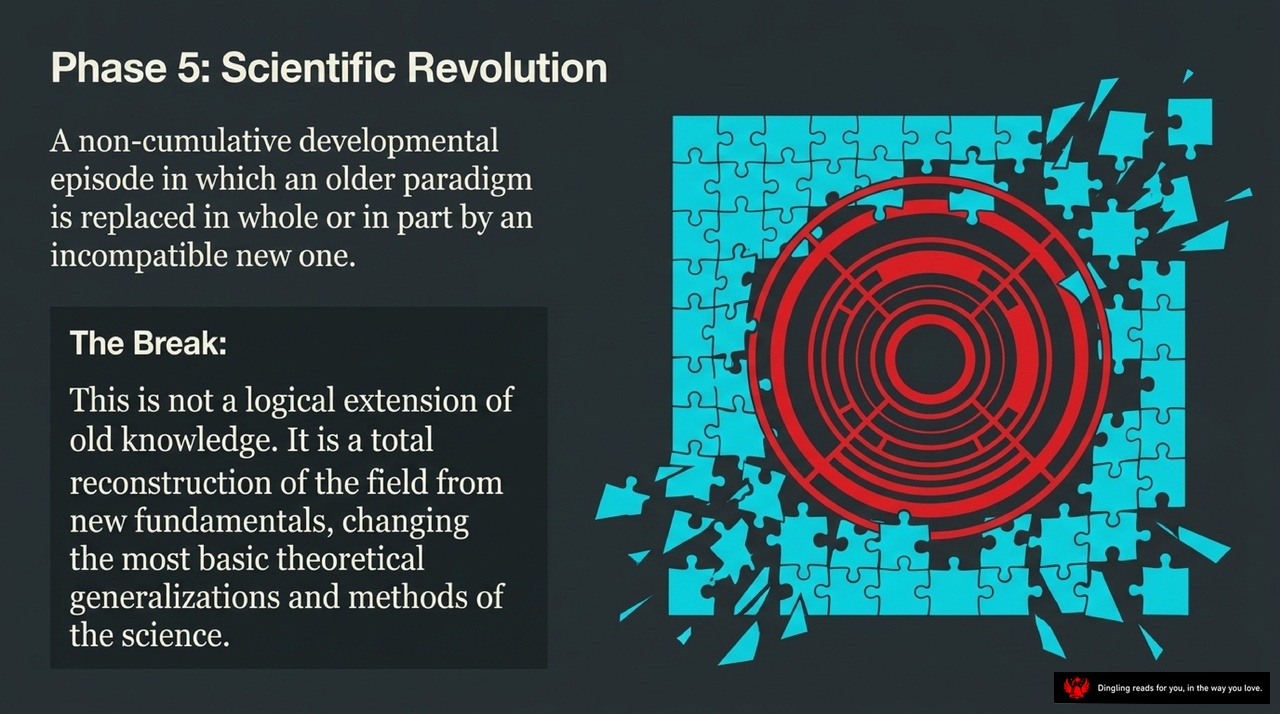
Phase 5: Scientific Revolution. Look at this image. Those blue puzzle pieces represent our old way of seeing the world—our established paradigm. But watch what happens when a new, incompatible idea emerges. The old pieces don't just get added to; they shatter. In their place, a new, red, circular structure rises from the chaos. This isn't a logical extension of what we knew before; it's a total reconstruction of the field from new fundamentals.
In a scientific revolution, an older paradigm is replaced in whole or in part by a new one. This is what Thomas Kuhn calls "The Break." It's not about fixing the old theory; it's about changing the most basic theoretical generalizations and methods of the science itself. Think of it like wearing reverse glasses. Under the old norm, you might see a stone falling. Under the new norm, you suddenly see a pendulum swinging. The data hasn't changed, but the entire world you see has.
This shift is often driven by a crisis where the old rules simply stop working. When that happens, the scientific community splits. One side tries to defend the old framework, while the other pushes for a complete overhaul. It's a non-cumulative developmental episode. We aren't just building on the past; we are fundamentally redefining reality. This is the moment science truly evolves, moving from a period of puzzle-solving to a period of radical transformation.

Have you ever looked at an image and suddenly seen something completely different? Think of the classic "duck-rabbit" illusion. At first glance, you might see a duck. But then, just by shifting your perspective, it transforms into a rabbit. This isn't just a party trick; it's a profound metaphor for what Thomas Kuhn calls "The Gestalt Shift"—a fundamental change in worldview.
In our book, we explore how this psychological phenomenon mirrors the history of science. Kuhn argues that after a scientific revolution, scientists don't simply interpret the same data differently; they effectively work in a different world. It's a total retraining of the visual and conceptual apparatus.
Consider the example of oxygen. Before the shift, a traditional chemist like Priestley saw a specific gas as "dephlogisticated air." But after the paradigm shifted, Lavoisier looked at the exact same substance and saw an entirely new element: oxygen. Their eyes were on the same thing, but their worldviews had diverged.
Kuhn likens this to psychological experiments with anomalous playing cards. Imagine being shown a card that looks like a red spade but has strange markings. If you are trained to see only standard cards, you might ignore the odd details or force them into a familiar pattern. But once the paradigm shifts, you immediately spot the anomaly.
This shift is the essence of scientific progress. It's not just adding new facts to an old framework; it's realizing that the framework itself was wrong, and stepping into a new reality where the old rules no longer apply.

Incommensurability: The Unbridgeable Chasm. This slide highlights a fundamental truth about scientific revolutions: competing paradigms are like two different languages. They simply cannot be directly translated into one another. As the text explains, they use entirely different vocabularies, possess different standards, and define the universe in completely distinct ways.
Look at the visual on the right. We have an "Old Paradigm" on the left and a "New Paradigm" on the right, separated by a deep, unbridgeable chasm. The diagram illustrates the famous clash between Aristotle and Galileo. To an Aristotelian, a swinging stone is a constrained body struggling to achieve its natural state of rest. But to Galileo, that same object is a pendulum exhibiting repeating motion. They are literally looking at the exact same physical object, yet their theoretical languages are so incompatible that they cannot smoothly merge.
This concept of incommensurability means that when a scientific revolution happens, scientists don't just add new facts to the old pile; they fundamentally change how they see the world. It's not just a matter of having new data; it's about adopting a new cognitive framework that makes the old data look completely different, often rendering the old perspective unintelligible.

Have you ever stopped to ask why science feels like a straight, unbroken line of facts piling up on top of each other? It seems logical, right? We learn Newton, then Einstein, and everything just gets a little clearer. But the truth is, science isn't a smooth accumulation. It's actually a series of invisible revolutions, and the reason we don't see them is because of the textbooks themselves.
As you can see on this slide, we are talking about "The Invisible Revolution." The core idea here is that textbooks rewrite history. Once a major scientific shift happens, new textbooks are created to teach the new paradigm. These books act as powerful pedagogical tools, but they do something subtle and dangerous: they disguise the chaotic, worldview-shattering nature of the actual revolution. Instead of showing you the messy struggle where old ideas were destroyed, textbooks frame past scientists as if they were simply working toward the current conclusion all along. They erase the reality of paradigm shifts.
Look at that graphic on the right. On the left, you have those jagged, chaotic lines representing the messy, conflicting theories of the past. Then, that single "Authoritative Textbook" steps in and smooths it all out into a straight, blue line. It tells the next generation that the transition was inevitable and logical, rather than a radical break. This is what we call "The Erasure." By sanitizing history, textbooks make it seem like science is always progressing linearly, when in reality, it's often about completely replacing one way of seeing the world with another.
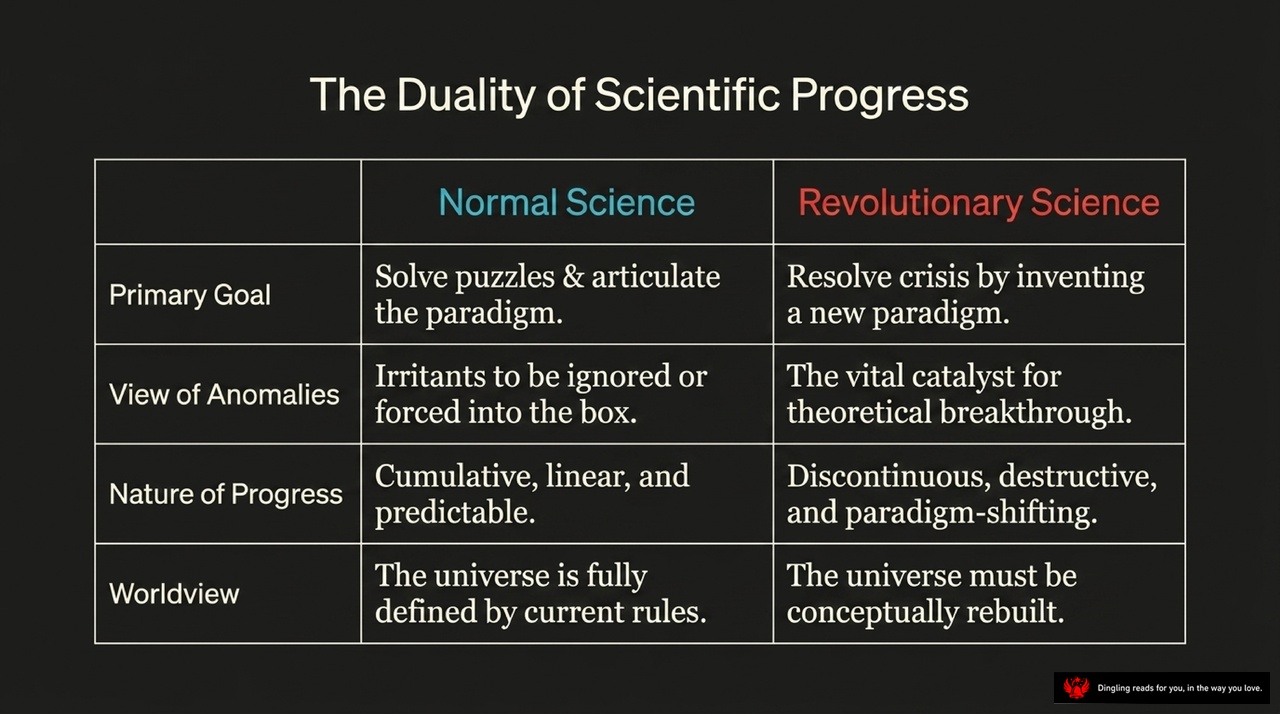
The dual nature of scientific progress is best understood as a cycle between two distinct modes: Normal Science and Revolutionary Science.
In Normal Science, the primary goal is to solve puzzles and articulate the existing paradigm. Scientists treat anomalies as irritants to be ignored or forced into the box, viewing progress as cumulative, linear, and predictable. Their worldview assumes the universe is fully defined by current rules.
However, when anomalies pile up and become a crisis, the field shifts to Revolutionary Science. Here, the goal changes to resolving that crisis by inventing a new paradigm. Anomalies are no longer ignored; they become the vital catalyst for theoretical breakthrough. Progress becomes discontinuous, destructive, and paradigm-shifting, requiring the universe to be conceptually rebuilt.
This transition is often driven by a minority of scientists—often young newcomers who aren't yet bound by the old rules—who eventually convince the community that the new paradigm is superior. Ultimately, science isn't just a steady accumulation of facts; it's a series of paradigm shifts that fundamentally change how we see the world.

Synthesis: The Evolutionary Spiral of Progress. Look at this spiral—it perfectly captures how science actually moves. We often think progress means climbing a straight ladder toward a single, perfect Truth. But Thomas Kuhn teaches us a different story: science evolves like Darwinian life, not by aiming for a specific destination, but by adapting to survive.
Just as Darwinian evolution progresses from primitive beginnings without a teleological goal of a perfect organism, science progresses away from primitive explanations toward increasingly detailed and adaptable frameworks. Notice the key phrase here: "Progress Without a Goal." This means we aren't necessarily marching toward a singular, objective Truth. Instead, we are constantly refining our tools. When an old paradigm fails to explain the anomalies we see, we don't just tweak the theory; we often discard the entire framework and build a new one. It's a spiral, not a line. Each revolution changes how we see the world, making new data visible that was previously invisible. So, scientific progress isn't about getting closer to a final answer. It's about developing better instruments and sharper perspectives to solve the problems of our time. We don't know where we are going, but we are constantly becoming more capable of navigating the unknown.

What if I told you that science isn't a straight line of facts piling up, but actually a cycle of shifting worldviews? As this slide suggests, scientific progress isn't a steady accumulation of objective facts. Instead, it's a rhythm of rigid conceptual frameworks—what Thomas Kuhn called "Normal Science"—interrupted by disruptive, worldview-altering anomalies or "Crisis," which ultimately lead to a total reconstruction of reality under a new set of rules, a "Revolution."
Think about it: the lens you use to see the world dictates the very facts you are capable of seeing. If your current paradigm limits your vision, what glaring anomalies are you currently blind to? History shows us that when an existing framework can no longer solve the problems it was built to address, the entire scientific community must undergo a profound transformation. It's not just about finding new data; it's about fundamentally changing how we interpret the data we already have. So, ask yourself: are you stuck in a rigid framework, or are you ready to embrace the anomalies that signal the need for a new way of seeing?