
The Taste of Diet: Complete Chapter-by-Chapter Summary

Welcome to "The Taste of Diet" by Xu Wenbing. Today, we step into a kitchen that feels less like a place for cooking and more like a sanctuary for the soul. Look at the ingredients spread out before us—star anise, goji berries, millet, and fresh herbs. These aren't just random items; they represent an ancient Chinese wisdom that invites us to stop following rigid data and start listening to our bodies.
Unlike Western nutrition, which often reduces food to numbers and forces us to eat based on external standards, this approach asks a simple, profound question: How does your body truly feel? It's about harmonizing your unique constitution with nature, time, and spirit. Imagine a meal not as a task, but as a conversation between your food and your body. Whether it's warming cold fruits for a sensitive stomach or choosing seasonal vegetables that match the time of year, the goal is always the same: to eat with awareness and respect.
This isn't about restriction; it's about returning to our innate ability to sense hunger and fullness. By honoring these signals and understanding the true nature of the food we eat, we transform eating from a mechanical routine into a nourishing ritual that heals both the body and the mind.
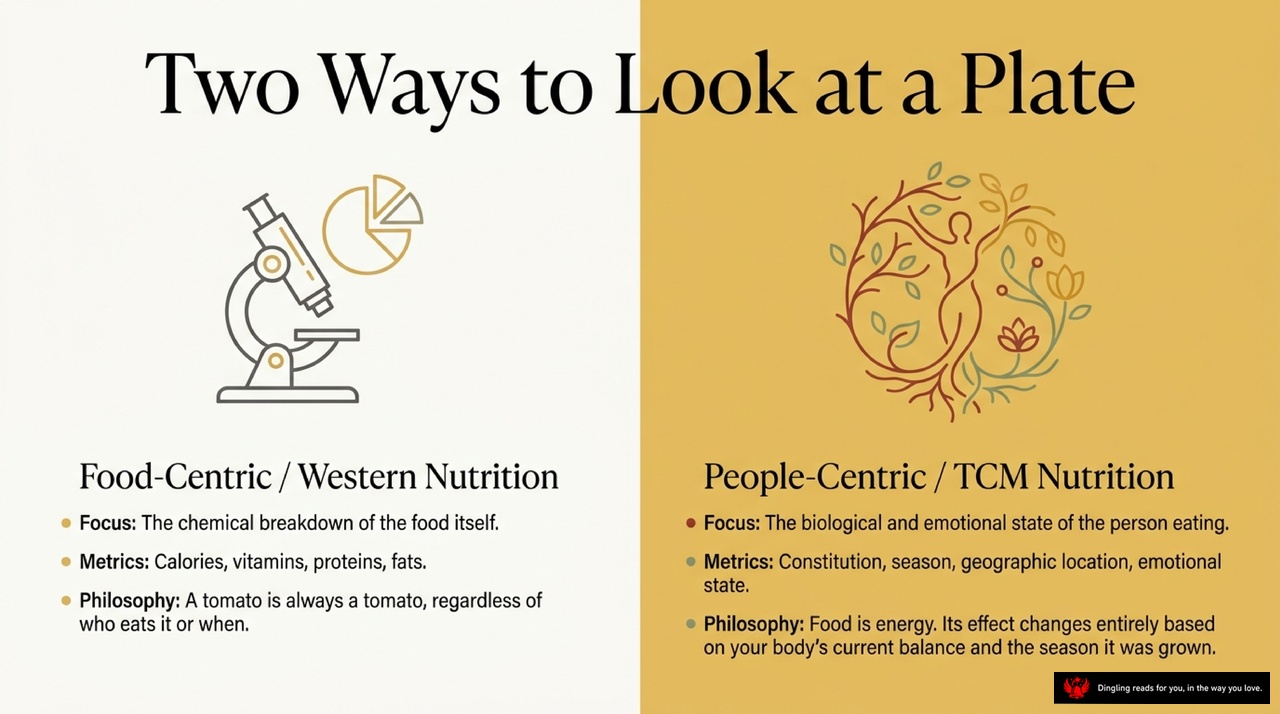
Imagine you're sitting down for a meal. How you look at that plate changes everything, and today we're exploring two completely different worlds of nutrition. On the left, we have the Food-Centric approach, which is the standard Western Nutrition model. It's all about the microscope and the data. Here, the focus is strictly on the chemical breakdown of the food itself. We measure everything in calories, vitamins, proteins, and fats. The philosophy is rigid and universal: a tomato is always a tomato, regardless of who eats it or when. It treats food as a standardized product, ignoring the unique human who is consuming it.
Now, look to the right. This is the People-Centric approach, rooted in Traditional Chinese Medicine or TCM Nutrition. This is where the real wisdom lies. Instead of staring at the food, we look at the person eating. The focus shifts to the biological and emotional state of the individual. Your metrics aren't just numbers on a label; they are your constitution, the season, your geographic location, and even your current mood. The philosophy here is dynamic and alive: food is energy, and its effect changes entirely based on your body's current balance and the season the food was grown.
Think about it this way: Western nutrition asks, "What is in this food?" while TCM asks, "What does my body need right now?" One approach ignores the human element, while the other embraces it. By shifting from a food-centric view to a people-centric one, you stop blindly following data and start listening to your body's true signals. This is the key to unlocking a more personalized, intuitive, and ultimately healthier way of eating.

So, let's dive into the engine room of your body. Imagine digestion isn't just one thing, but a two-stage relay race that happens inside you.
The first leg is called "Xiao," or Physical Reduction. Think of this as the heavy lifting. It happens right where you eat—your mouth and stomach. The image on the left shows gears grinding together, and that's exactly what's happening. You need to chew thoroughly, breaking down the physical mass of your food into smaller pieces. But it's not just about your teeth; your stomach needs to generate enough heat to do its part. If you skip the chewing or your stomach is too cold, this first phase fails before it even starts.
Once the food is physically broken down, the baton is passed to the second stage: "Hua," or Qualitative Transformation. Look at the right side of the slide. Now, instead of gears, you see a flask inside the intestines and spleen. This is where the magic happens. The broken-down food isn't just waste anymore; it's being transformed into actual human tissue and vital energy. This requires more than just enzymes; it needs biological warmth and what we call Yuan Qi, or vital life force.
Here's the critical part: if this second phase, the "Hua," fails, your body doesn't just digest poorly. The undigested food ferments, turning into toxins and dampness. That's the root of many modern health issues. So, remember, digestion is a partnership between the mechanical grinding in the stomach and the energetic transformation in the spleen and intestines. Without that inner fire and vital energy, you're just moving food through your body, not actually nourishing it.

Look at this diagram. It presents a fascinating, counter-intuitive truth about hydration: "Saliva is the body's great medicine." But here's the catch—it warns us that constantly flooding our bodies with water actually dilutes our digestive fire and weakens our natural defenses.
The slide breaks this down into three critical points. First, it explains "The Source." True saliva isn't just plain water; it's synthesized directly from your Kidney Essence. It's clear, potent, and rich in vital energy. Think of it as high-octane fuel for your digestion, not just a hydrant you're turning on.
Then, there's "The Rule of Thirst." This is where most of us go wrong. We think drinking more equals being healthier. But this slide argues that constantly sipping water dilutes your saliva and gastric juices. It effectively drowns your digestive fire. If you're drinking constantly, you're actually suppressing your body's ability to break down food and absorb nutrients.
Finally, look at "The Indicator." How do you know if you're over-hydrating or simply eating too much? The slide points to a thick tongue coating or bad breath. These aren't just hygiene issues; they are urgent biological alarms. They signal that your digestive capacity is overloaded. The advice is clear: if you see these signs, stop eating immediately.
So, the takeaway is simple but profound: don't force-feed your body water. Listen to your body's natural thirst mechanism. Respect the quality of your saliva as a sign of your kidney health, and trust that when your digestion is overwhelmed, the smartest thing you can do is pause.
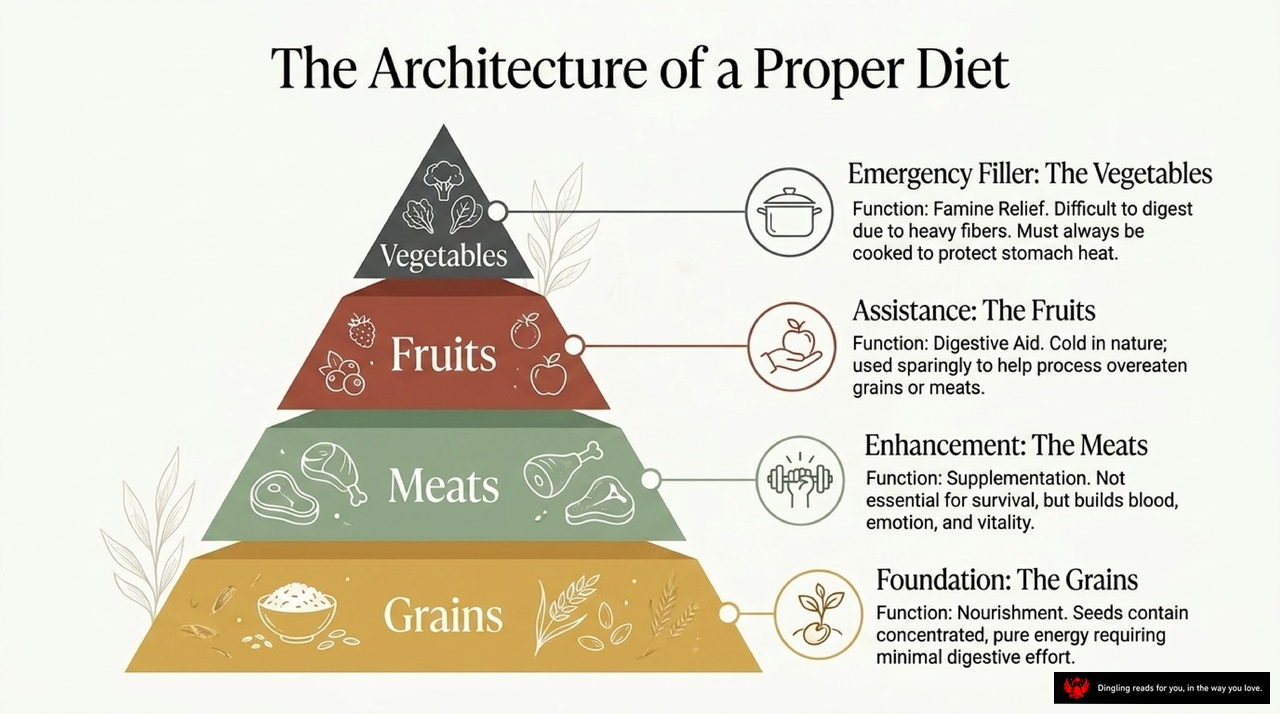
Today's slide breaks down the "Architecture of a Proper Diet," a pyramid that flips the Western nutritional model on its head. Instead of focusing on isolated nutrients like protein or carbs, this system organizes food by its energetic function and how it interacts with your body's survival needs.
At the very bottom, labeled "Foundation," are the Grains. In this philosophy, grains aren't just fuel; they are the concentrated, pure energy source. Think of them as the seeds of life that require minimal digestive effort to provide the raw power your body needs to function. They are the base upon which everything else is built.
Moving up to the "Enhancement" layer, we have Meats. Here, meat isn't viewed as a daily staple for survival, but rather as a supplement. Its role is to build your blood, stabilize your emotions, and boost vitality. It's about adding depth and strength to your foundation, not filling your plate with it.
Above that sits the "Assistance" layer: Fruits. These are described as digestive aids. Because fruits are naturally "cold," they are meant to be used sparingly. Their job is to help your body process heavy grains or rich meats, acting as a gentle counterbalance to prevent stagnation.
Finally, at the very top is the "Emergency Filler": Vegetables. In this specific framework, vegetables are seen as a last resort for famine relief. They are noted as being difficult to digest due to heavy fibers, which can create "stomach heat." This is why the diagram emphasizes that they must always be cooked before eating to make them safer and easier for your system to handle.
This pyramid teaches us that a proper diet isn't about eating everything equally. It's about stacking your foods correctly: starting with pure energy at the bottom, adding strength in the middle, using fruit to aid digestion, and reserving vegetables for when you truly need them, always cooked. It's a strategy designed to align your eating habits with your body's natural architecture.

Grains as Medicine: Tuning the Organs
Welcome to this deep dive into Traditional Chinese Nutrition. Today's slide maps out a powerful, ancient system: using specific grains to directly tune and balance our five core organs. This isn't just about calories; it's about matching the energy of your food to the specific needs of your body's internal landscape.
Let's walk through the five elements, starting with the **Wood/Liver**. Think of wheat and oats here. Their energy is warm and expansive. If you feel your liver is sluggish, cold, or weak, these grains act like a gentle heater, soothing that stagnation and restoring flow.
Next, we move to the **Fire/Heart** with broomcorn, or sorghum. This grain is your go-to when you feel scattered or anxious. It clears the mind and gently grounds that hyperactive heart fire, helping you find your center when life feels chaotic.
Then, we hit the **Earth/Spleen** with millet. This is arguably the easiest grain for your body to absorb. If your digestive system feels weak or sluggish, millet rapidly repairs that foundation, giving your stomach the support it needs to function without stress.
Moving up to the **Metal/Lungs**, we have rice. Its primary job is to cool and moisturize dry lungs. However, there's a crucial caveat here: rice can cause acidity in cold stomachs. If you have a sensitive or cold digestion, you need to be careful.
Finally, we arrive at the **Water/Kidneys**, represented by beans and soy. These are essential for nourishing kidney essence, the root of our vitality. But they can be heavy on the digestion. To avoid bloating, it's best to consume them fermented—like in tofu—or ground up, making them much easier for your system to handle.
The beauty of this approach is that every grain has a specific role. It's about listening to your body and choosing the grain that acts as the right medicine for your current state.
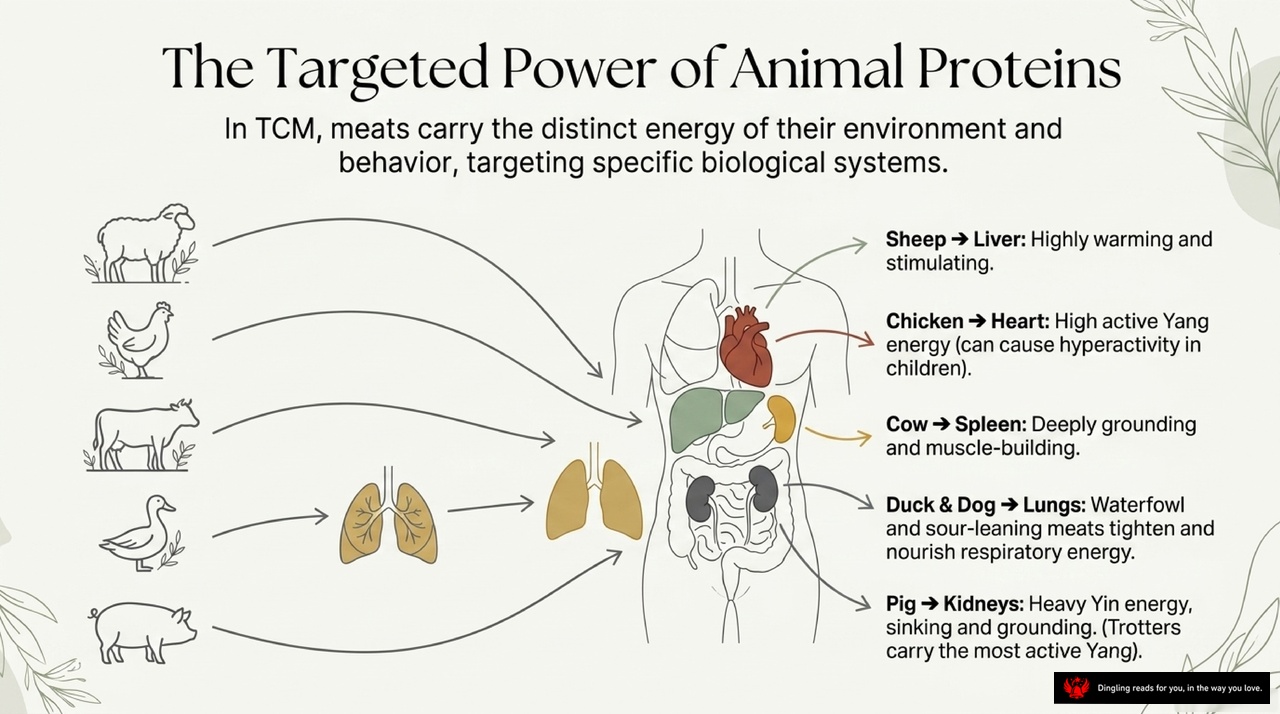
In Traditional Chinese Medicine, we believe that animal proteins carry the distinct energy of their environment and behavior, allowing them to target specific biological systems. This is the targeted power of what we eat.
Look at the chart here. Each animal offers a unique energetic signature. For instance, sheep are highly warming and stimulating, making them ideal for nourishing the liver. Chickens possess high active Yang energy; while great for adults, this intense heat can actually cause hyperactivity in children, which is why many experts advise limiting chicken intake for kids.
Then we have cows, which provide deeply grounding energy that supports the spleen and builds muscle. If you look at waterfowl like ducks, or land animals like dogs, they target the lungs. Their sour-leaning nature helps tighten and nourish our respiratory energy. Finally, pigs offer heavy Yin energy that sinks and grounds us, specifically benefiting the kidneys. Interestingly, trotters carry the most active Yang among pork parts, so they serve a different purpose than the main cuts.
The key takeaway is that not all proteins are created equal. By choosing the right animal for your body's specific needs—whether you need to calm a fiery liver or ground a scattered spirit—you can use food as a precise tool for healing and balance.

Here is the spoken script for Slide 7, tailored for an American audience with a natural, engaging tone.
**Slide 7 Script:**
Look at this slide, and it hits a major point that modern Western nutrition often gets wrong: the idea that eating raw vegetables is always the "healthiest" choice. The myth suggests raw veggies give you the maximum nutrients, but in Traditional Chinese Medicine, the reality is quite different. Humans aren't herbivores like cows; our digestive systems aren't built to handle the long, tough fibers in raw plants without help. Plus, many raw vegetables carry a deep "cold" energy that can actually drain your body's vital heat, or what we call Yuan Qi.
So, what happens if you force your body to digest raw food? The consequence is that you lose more metabolic energy trying to break down those tough fibers than you gain from the vitamins themselves. It's like burning your own fuel just to process the food. The fix is simple but often overlooked: always blanch, steam, or stir-fry your vegetables. By applying heat, you break down those tough fibers and neutralize the cold nature of the food, making it much easier for your body to absorb the nutrients without exhausting your energy reserves. Cooking isn't just about taste; it's a necessary step to align the food with your body's natural needs.
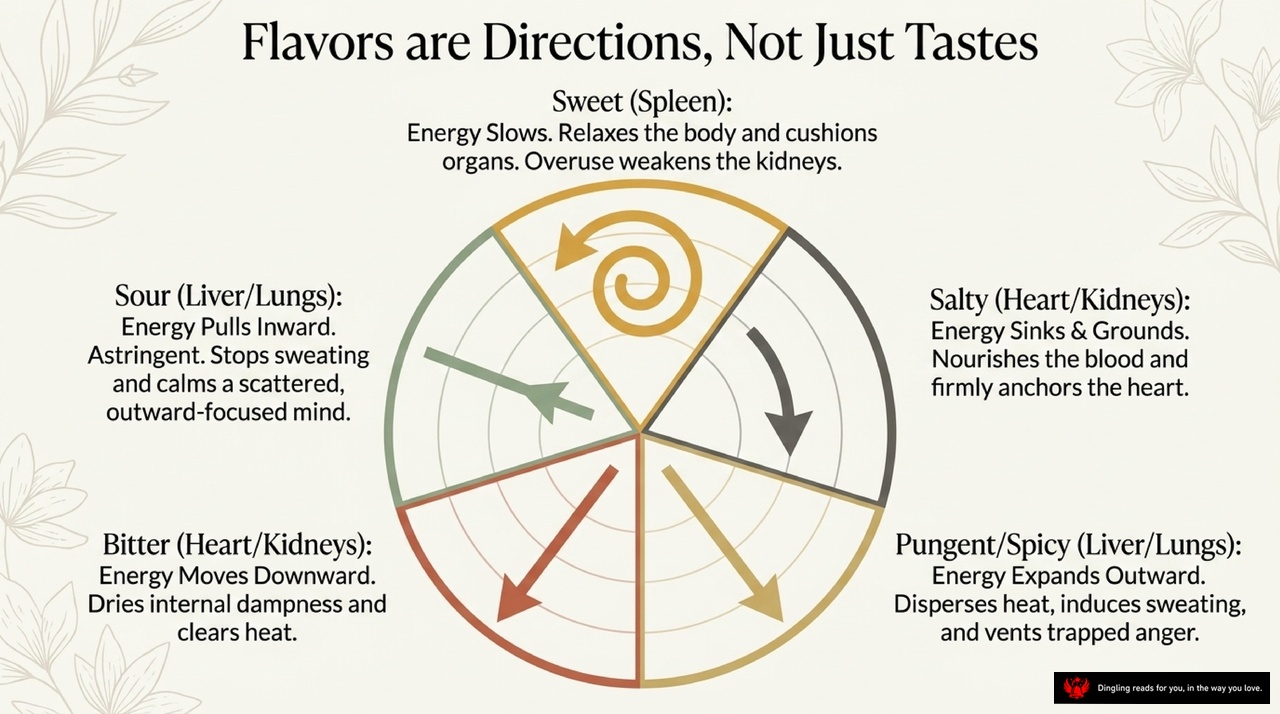
Flavors are Directions, Not Just Tastes. Think about it: when you eat something sour, do you just taste the tartness? No. In Traditional Chinese Medicine, that sour flavor is actually a command telling your Liver and Lungs to pull energy inward. It's like a gentle anchor, stopping sweat and calming a scattered mind. On the flip side, if you crave something sweet, your Spleen is signaling that energy needs to slow down and relax the body, though we must be careful not to overdo it, as too much sweetness can weaken the Kidneys.
Now look at the salty and pungent sides of this circle. Salt tells your Heart and Kidneys to sink and ground your energy, nourishing the blood and firmly anchoring your spirit. It's the difference between floating away and staying rooted. Conversely, spicy or pungent foods send a different message: they push energy outward. They expand your chest, disperse trapped heat, and even help vent that frustration or anger you've been holding inside. Finally, bitter flavors direct energy downward, drying up internal dampness and clearing away excess heat.
The real magic here isn't about which taste you like most, but understanding which direction your body needs to go. Are you feeling scattered and need to pull back? Choose sour. Are you feeling sluggish and need to ground yourself? Choose salt. Are you feeling trapped and need to release? Choose spice. By viewing flavors as dynamic directions rather than static tastes, you stop eating blindly and start listening to the subtle, intelligent signals your body is sending you every single day.

Not all fluids are created equal. In fact, how you drink matters just as much as what you drink. Think of water as the baseline. Drinking too much cold water stresses your kidneys and dilutes your stomach acid, essentially poisoning your digestion. But tea? It adds a bitter, warming element that helps your body absorb fluids without the rush to the bathroom.
Then we move to juices. In traditional wisdom, these are plant fluids filtered through biological membranes, making them easier to absorb, though they carry a bit of cold energy. Broths take it a step further as the absolute essence of meats—highly absorbable nourishment with zero solid fiber burden. Finally, there's congee, where water and grain are perfectly fused. It's the ultimate healing fluid requiring absolutely zero digestive effort.
The key takeaway? Your body doesn't need more liquid; it needs the right type of liquid for your current state. Stop treating water like medicine and start respecting the hierarchy of fluids.
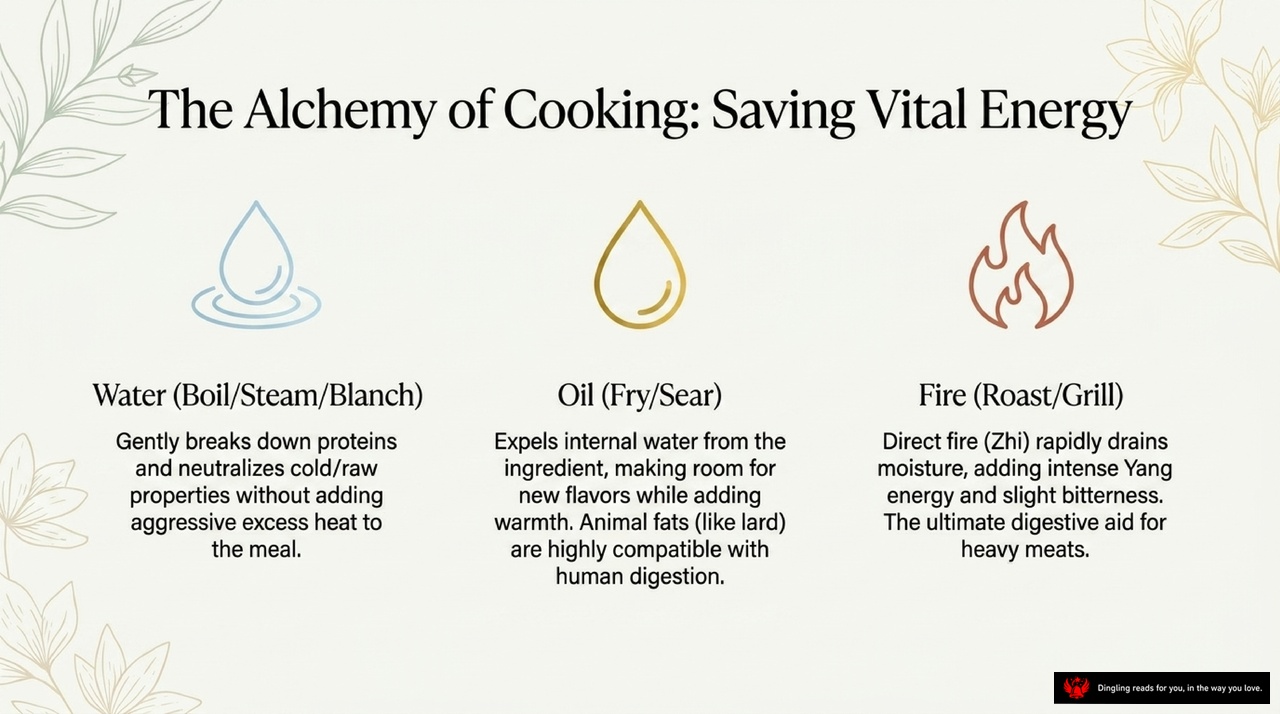
The Alchemy of Cooking: Saving Vital Energy
When we think about cooking, we often focus just on flavor or nutrition labels. But in Traditional Chinese Medicine, cooking is actually a sophisticated form of energy management. It's about how we prepare food to save our body's vital energy, or "Yuan Qi." The slide breaks this down into three elements: Water, Oil, and Fire. Each one plays a unique role in how our body digests and absorbs nutrients without exhausting us.
First, look at **Water**. This includes boiling, steaming, or blanching. Think of it as a gentle approach. When you cook with water, you softly break down proteins and neutralize the cold or raw nature of ingredients. Crucially, it does this without dumping aggressive excess heat onto your meal. It's like a soft hug for your food, making it easy for your stomach to handle without you having to work too hard to digest it.
Next is **Oil**, used for frying or searing. The goal here isn't just to make things crispy; it's to expel internal water from the ingredient. By removing that excess moisture, you create room for new flavors and add a sense of warmth. Interestingly, animal fats like lard are highlighted here because they are highly compatible with human digestion. They help the body process the meal more efficiently, acting as a natural lubricant for your digestive system.
Finally, we have **Fire**, representing roasting or grilling. This is the most intense method. Direct fire, or "Zhi," rapidly drains moisture and adds intense Yang energy, which can bring a slight bitterness. While this might sound harsh, it's actually the ultimate digestive aid, especially for heavy meats. The intense heat breaks down tough fibers quickly, allowing your body to absorb the dense energy of the meat without getting bogged down.
So, the real secret isn't just picking a recipe; it's choosing the right element for your specific situation. Are you feeling cold? Use water. Do you need warmth and flavor depth? Use oil. Eating a heavy steak? Use fire. By mastering this alchemy of water, oil, and fire, you align your cooking with your body's natural needs, ensuring you get maximum nourishment with minimal energy cost.

The Wisdom of Fermentation isn't just about making food taste better; it's a brilliant biological hack that our ancestors discovered thousands of years ago. Think about it: certain foods like soybeans and heavy meats are incredibly tough for your stomach to break down on its own. Your body literally struggles to chemically digest them.
So, what was the ancient solution? They outsourced the digestion. Instead of forcing your stomach to do all the heavy lifting, they utilized natural fermentation. By creating foods like soy sauce, stinky tofu, natto, and cured hams, they allowed microorganisms to do the work outside your body. These fermented pastes, known as Jiang, act as essential enzymatic keys designed to unlock complex meals.
This leads to a golden rule you should never forget: Never eat without your sauce. In the traditional Chinese view, these fermented items are the missing link that helps you absorb nutrients efficiently. Without them, you're trying to digest a meal that your body simply isn't built to handle alone. It's a simple principle, but it's the difference between struggling with digestion and enjoying nourishment effortlessly.
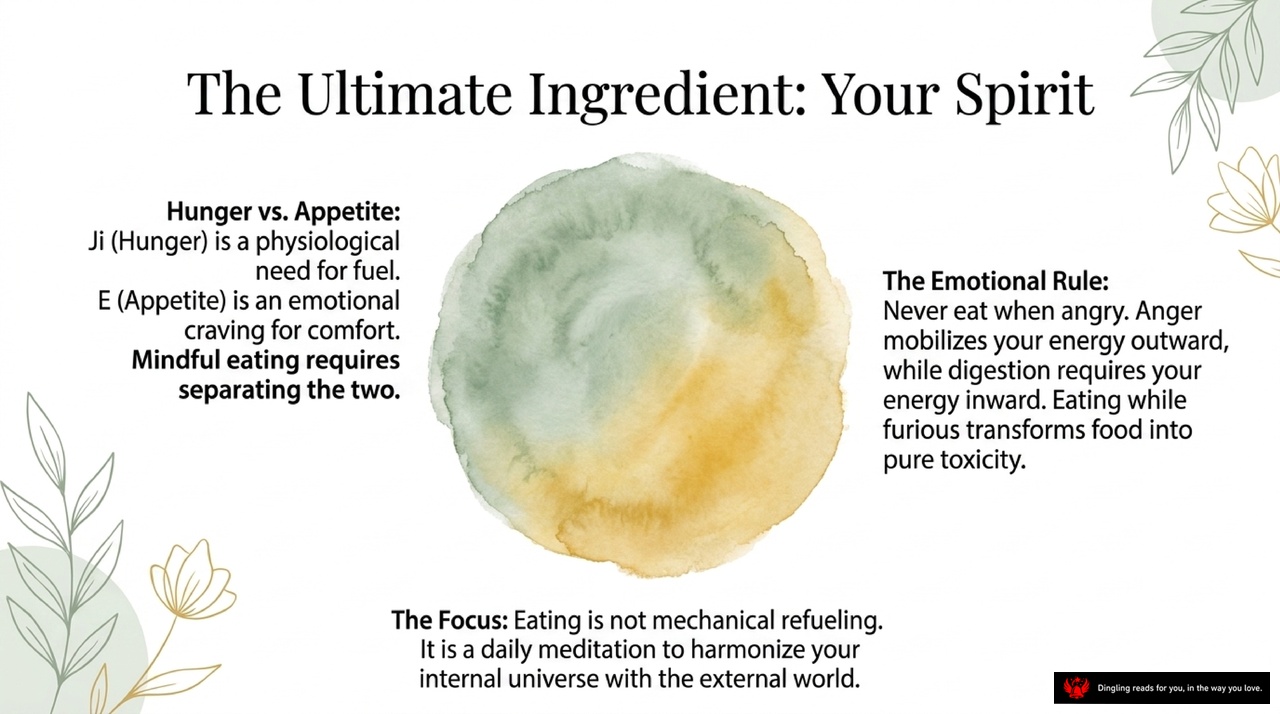
Welcome to the final, most critical ingredient in our nutrition journey: your Spirit. In Traditional Chinese Medicine, we don't just count calories or grams of protein; we honor the dynamic relationship between your physical hunger and your emotional appetite.
Let's clarify the difference. Ji is your true physiological hunger—a biological signal asking for fuel. But E, or Appetite, is often an emotional craving for comfort. Mindful eating requires you to separate these two distinct signals. If you ignore this distinction, you risk feeding your emotions rather than nourishing your body.
This brings us to a vital rule: never eat when you are angry. Anger mobilizes your energy outward, toward the world, while digestion demands your energy inward, toward your stomach. When you eat while furious, you are essentially transforming your food into pure toxicity because your body cannot process it correctly.
So, what is the true focus of eating? It is not a mechanical act of refueling. Instead, view every meal as a daily meditation. It is a practice to harmonize your internal universe with the external world. By aligning your spirit with your food, you transform a simple meal into a powerful act of healing and balance.

Have you ever stopped to ask yourself: Are you just fueling a machine to survive the day, or are you mindfully nourishing your spirit to fulfill your life's true purpose? The slide in front of us challenges this very question. It reminds us that true nutrition transcends the obsession with calories and macros. It is the profound art of matching the energy of what you consume with the unique rhythms of your body, the seasons of the earth, and the state of your mind.
Think about it: eating well isn't just about hitting a number on a scale; it is about minimizing the energy spent on digestion so you can maximize the energy spent on living. When we disconnect from our body's natural signals and follow rigid data, we often end up fighting against our own biology. But when we align our food choices with our internal rhythms and the external world, we unlock a deeper form of vitality.
So, take a moment to reflect on your relationship with food. Are you eating out of habit or out of awareness? The goal is not just to fill your stomach, but to nourish your entire being, ensuring that every bite serves a purpose beyond mere survival.