
The Tibetan Book of Living and Dying: Complete Chapter-by-Chapter Summary

Welcome to our journey into *The Tibetan Book of Living and Dying* by Sogyal Rinpoche. Today, we open with a profound perspective that shifts how we see the end of life. As the title suggests, this book isn't just about dying; it's about living with awareness. The central message on this page reminds us that death is not the final end, but a mirror. Through it, we discover the luminous nature of our own minds and the true meaning of life. Instead of fearing the darkness, we are invited to see the light within. This book serves as a guide to help us navigate this transition, transforming our fear into wisdom and our uncertainty into clarity. Let's explore how embracing death can actually bring us to the most vibrant life.

Death as the Ultimate Mirror of Life. Look at this split image: on the left, a cracked, locked door representing the modern view, and on the right, an open gateway bathed in light, symbolizing the Tibetan perspective.
Here is the core distinction. Modern society often treats death as a failure to be hidden, a source of anxiety that disconnects us from life's true meaning. We operate as if there is no afterlife, focusing only on immediate gain. But the Tibetan tradition offers a radical alternative. It views death not as an end, but as a mirror reflecting life's ultimate reality.
As the text reminds us, preparing for death is actually the most profound preparation for living fearlessly. When we stop running from the inevitable, we uncover the true nature of our mind. We realize that our identity isn't tied to our name or job—those are fragile things. Instead, we tap into an unchanging essence within us. This shift transforms death from a terrifying monster into a natural transition, a spiritual gateway. By embracing this truth, we stop being slaves to fear and finally learn to live with courage and clarity.
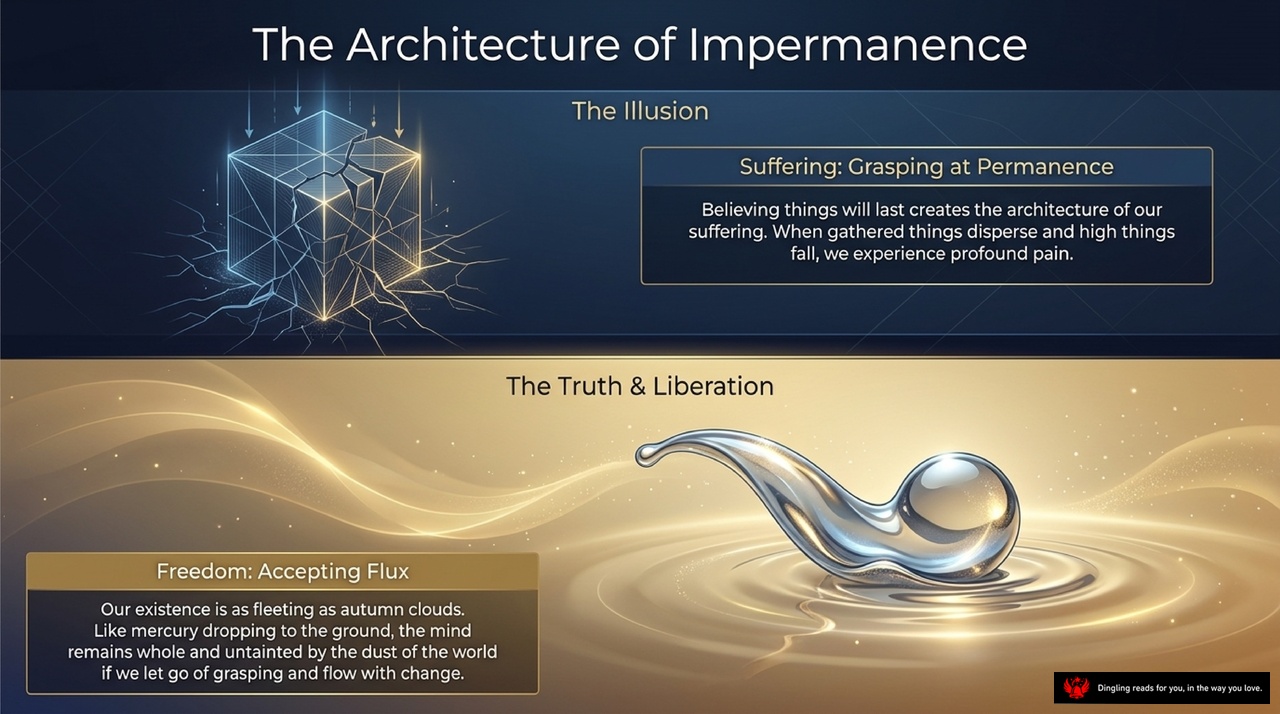
The Architecture of Impermanence is the blueprint of our suffering. We create pain by believing that the things we gather will last forever. When reality shifts—when loved ones leave or fortunes fall—we experience deep anguish because we are fighting against the natural flow of change. But there is a profound truth and liberation waiting for us if we accept flux. Our existence is as fleeting as autumn clouds. Like mercury dropping to the ground, the mind remains whole and untainted by the dust of the world if we let go of grasping and flow with change. Instead of fearing the inevitable, we can find freedom by embracing the impermanence of all things.

The slide contrasts two states of being: the "Ordinary Mind," depicted as a chaotic storm, and "The Nature of Mind," or Rigpa, shown as a clear, radiant sky. The Ordinary Mind is constantly projecting outward, driven by grasping, fear, and reactive emotions. In contrast, Rigpa is inner-looking, spontaneously perfect, and represents pure awareness or emptiness.
The core challenge, labeled as "The Four Faults," explains why recognizing this true nature is so difficult. First, it is too close to us, much like we cannot see our own face without a reflection. Second, it is too profound to fully fathom with our limited intellect. Third, it is too simple, which makes our complex, skeptical minds refuse to believe in such a straightforward truth. Finally, it is too wonderful for our narrow, conditioned minds to accommodate.
This visual metaphor illustrates that our daily struggle isn't about finding something new, but about seeing the sky behind the clouds. We are trapped in the storm of our own projections, forgetting that the vast, peaceful sky of our true nature has been there all along.

Facing death often feels like walking into the dark, but what if we reimagined it not as an end, but as a doorway to our truest self? In the Tibetan tradition, death isn't a sudden collapse; it's a gradual unfolding of consciousness, a journey through three distinct stages that mirror our very waking life. Think of it this way: just as you transition from waking into sleep, or from a quiet moment into a sudden surge of emotion, your life itself is a series of these transitions. The first stage, often called the "Natural Bardo," is our entire lifetime. It's where we build our habits and fears, trapped in the illusion of a separate self. But the second stage, the "Chödé," is the moment of death itself. Here, the physical body dissolves, and for a brief, brilliant instant, the pure, radiant light of our true nature—what we call the "Clear Light"—shines forth. It's like the sky after all the clouds have cleared. Most people miss this moment because they are too busy fighting the darkness, but those who have trained their minds to recognize this light can instantly realize their true essence and be freed. If we miss that, we enter the third stage, the "Bardo of Becoming," a turbulent period where our deepest fears and desires manifest as terrifying or alluring visions, pulling us toward our next rebirth. The profound wisdom here is that these same stages play out every single day. When you fall asleep, when you get angry, or when you feel lost, you are practicing for the ultimate moment of death. By learning to recognize the "Clear Light" in these small, everyday moments, we stop fearing the big one. We realize that our true home isn't a place we go after we die; it's the peaceful, luminous awareness we've been carrying all along, waiting to be remembered.

Consciousness as a Continuous Flow, Not a Fixed Soul. Imagine two very different ways we often picture the journey from life to life. On the left, we see "Pearls on a String." This represents the common Western misconception of a permanent soul—an unchanging entity that travels from life to life, carrying all our memories and personality intact, like a string of beads sliding along a thread. But this view misses the dynamic reality of existence.
On the right, we see "Stacked Dice." This is the true nature of consciousness in Tibetan Buddhism. There is no unchanging entity here. Instead, consciousness connecting lifetimes is an unbroken chain of cause and effect, known as Karma. Think of it like lighting one candle from another. The flame in the new candle isn't identical to the first one; it's a fresh manifestation born from the previous flame. Yet, the continuity remains. It is not the same fire, but it is not a completely separate one either.
This concept is the foundation of the Bardo teachings, or the intermediate states. Our existence isn't a series of isolated snapshots separated by a permanent self. It is a continuous flow of energy and awareness. The dice are stacked because each moment supports the next, linked by the invisible thread of intention and action. This understanding liberates us from the fear of losing our identity, because our true nature isn't a fragile, fixed object that can break. It is a fluid, evolving stream of potential, always being created in the present moment and flowing into the future.

Mapping the Four Transitional States of the Bardos isn't just a theoretical diagram; it's a map for navigating the most profound journey of our lives. Let's walk through these four segments together.
First, we have Segment 1, The Natural Bardo of This Life. This is your current reality, from birth to the very first moment of death. Think of it as the only time you truly have to practice, prepare, and get familiar with the mind's true nature. If you don't do this now, you are flying blind.
Next comes Segment 2, The Painful Bardo of Dying. This is the transition from the onset of death until clinical death. Here, the physical elements begin to dissolve. It is a critical time to let go of all earthly attachments before the light of your true nature can shine.
Then, we enter Segment 3, The Luminous Bardo of Dharmata. This is the immediate afterlife experience. In this state, the mind's true nature, often called Clear Light, flashes brightly. If you have recognized this nature during your life, you can achieve liberation right here and now. If not, you will be swept away by the next phase.
Finally, Segment 4, The Karmic Bardo of Becoming. This is the transition toward rebirth. Driven by past karma, your consciousness is pulled toward a new physical existence in one of the six realms.
Understanding these four states gives us the power to transform fear into wisdom, turning the moment of death into the greatest opportunity for awakening.
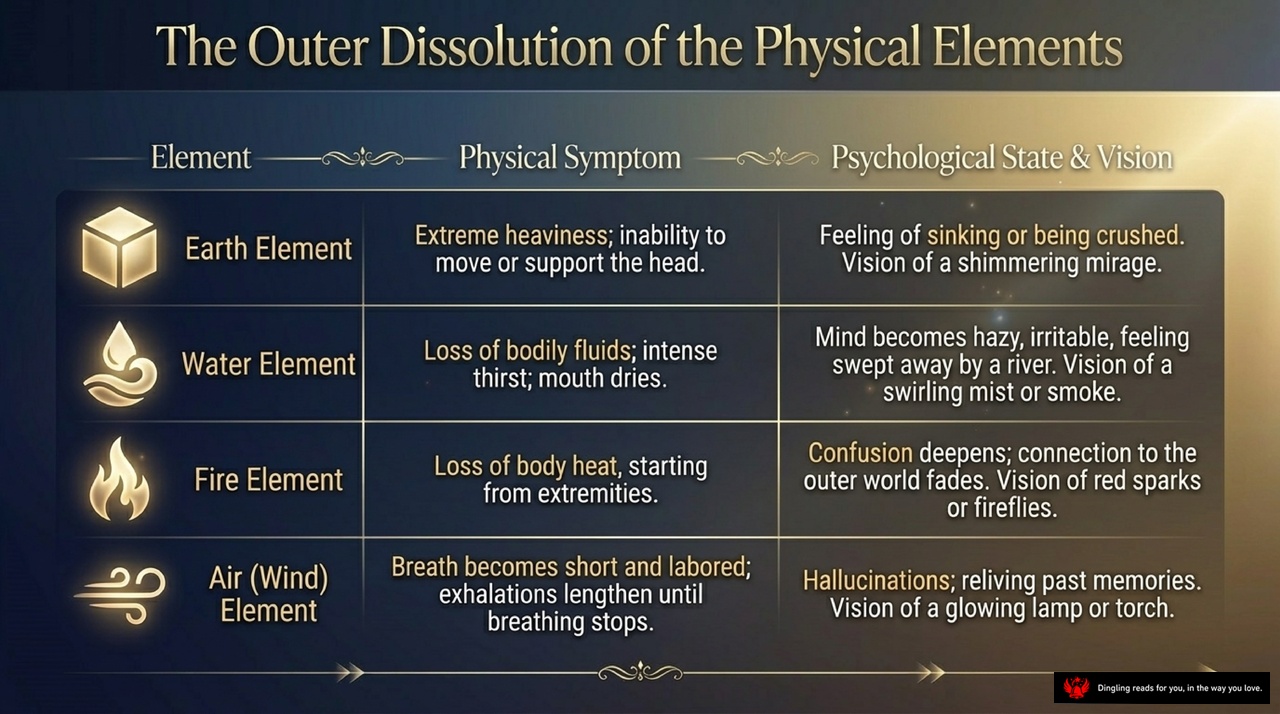
The final stage of dissolution is the most profound, where the element of air or wind finally surrenders to the mind. As the breath becomes short and labored, and exhalations lengthen until they stop, the physical connection to the world severs completely. In this moment, the mind is no longer anchored to the body; instead, it enters a state of intense hallucination, reliving past memories with crystal clarity. This is the vision of a glowing lamp or torch—a final, brilliant flash of consciousness before the journey into the next phase begins. It is a reminder that even as the body dissolves, the mind retains a vivid, luminous awareness, preparing us for the transition beyond.

Recognizing the Ground Luminosity at the Moment of Death
When our breath finally stops, something profound happens. The mind briefly detaches from the heavy pull of karma and the physical body, and for a fleeting instant, the true nature of our mind—the Clear Light—spontaneously arises. Think of it as a brilliant star exploding in the darkness of space, a pure, naked reality that is always there, waiting to be seen.
This is the phenomenon we call the Ground Luminosity. But here lies the critical difference between liberation and suffering. If you have spent your life practicing to recognize this light, death becomes your greatest opportunity. You can merge your consciousness with that light instantly, like a child leaping into their mother's arms, achieving immediate freedom. However, if you have never trained your mind to recognize it, fear takes over. That unrecognized light triggers terror, and the weight of karma pulls your consciousness back down into illusion, trapping you in the cycle of rebirth.
So, the question isn't just about what happens when we die, but how we live right now. We must prepare our minds to welcome this light before the moment of death arrives.

Today's slide brings us to a fascinating intersection of cultures: "Cross-Cultural Glimpses Beyond the Threshold." It beautifully illustrates how different traditions describe the same profound reality when we step past the door of life. On the left, we see Western Near-Death Experiences. These are often described as journeys through tunnels, encounters with brilliant light, and feelings of deep peace, sometimes meeting deceased loved ones or a "Being of Light." These experiences frequently lead to a radical shift in how people value their lives.
On the right, we have the Tibetan tradition of Deloks, or Returners from Death. Unlike the Western accounts, this is a structured journey. Individuals who clinically die travel through the *bardo*—a transitional state—where they face visions of judgment and the six realms. They then return to their bodies with urgent messages, urging the living to practice compassion.
In the center, bridging both worlds, is "The Universal Truth." Whether in the West or Tibet, the core message remains consistent: consciousness persists beyond physical death, our actions have real consequences, and the very fabric of reality is woven from love and wisdom. Both traditions agree that facing death isn't about fear, but about recognizing the enduring nature of our true self and the power of compassion.
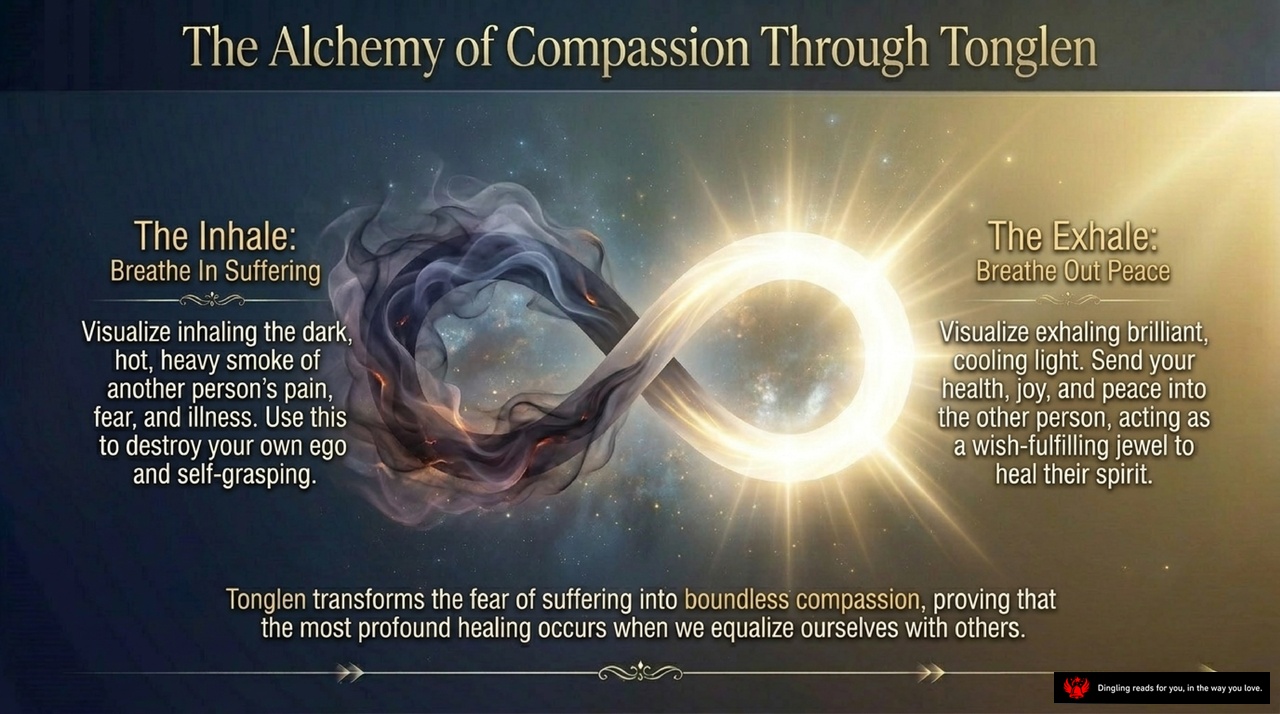
When we face the end of life, the moment isn't just about the body stopping; it's about the mind recognizing its true nature. Tibetan wisdom teaches that death is a doorway to liberation, but only if we've prepared for it. This preparation happens through a practice called Tonglen, which literally means "sending and taking." It's a powerful mental exercise that transforms our fear into compassion.
Imagine a simple, yet profound cycle. On the inhale, we visualize breathing in the dark, heavy smoke of another person's suffering—their pain, fear, and illness. We take this in not to harm ourselves, but to destroy our own ego and self-grasping. By accepting their pain, we dissolve the walls we've built around our own heart. Then, on the exhale, we visualize breathing out brilliant, cooling light. We send our health, joy, and peace into that person, acting as a wish-fulfilling jewel to heal their spirit.
This practice of Tonglen transforms the fear of suffering into boundless compassion. It proves that the most profound healing occurs when we equalize ourselves with others. Instead of running away from pain, we embrace it, realizing that our own happiness is deeply connected to the well-being of everyone around us. In doing so, we find that the end of life isn't a terrifying void, but a moment of awakening where love becomes the only reality.

Phowa and the Art of Guiding the Dying
Welcome to Step 3: The Transfer, the final and most crucial moment in guiding a dying person. Imagine the consciousness of the dying person visualizing itself as a radiant white syllable, like the sound "Ah," or a glowing sphere of light. This isn't just a metaphor; it's a powerful technique to help them detach from the physical body. Guide them to shoot this light upward, straight through the crown of their head, merging flawlessly into the wisdom heart of the invoked presence we created earlier.
This connects directly to Step 2, The Invocation. Remember, we must first invoke the presence of a realized being, Buddha, or a figure of ultimate compassion appearing in the sky above the dying person. That presence acts as the destination for that beam of light. Without that connection, the transfer has no anchor.
And finally, don't forget Step 1, The Environment. We spent time creating an atmosphere of unconditional love and truth, helping the dying person clear unfinished business and let go of worldly attachments. It's like clearing the runway so the plane can take off safely. When you combine these three steps—setting the stage, invoking the presence, and guiding the transfer—you are offering the dying person the best possible chance for a peaceful transition. It's about turning a moment of fear into a moment of liberation.

The Bodhisattva Ideal Merges Emptiness with Action
Look at this image. It beautifully captures the core of the Bodhisattva path: a seamless union of Wisdom and Compassion. On the left, we see Wisdom—the profound understanding that all phenomena are impermanent, illusion-like, and empty of inherent existence. This realization frees us from fear and ego. But here is the crucial point: this wisdom does not lead to escapism. As the slide reminds us, it births a fierce, active love and earthly action.
On the right, we see The Bodhisattva in practice. It is the one who marries the vast, cosmic view of the sky with the meticulous, gritty work of ending suffering on earth. The text highlights that the world desperately needs these Bodhisattvas—doctors, artists, politicians, and scientists—to act as conduits of peace.
So, how do we move from understanding emptiness to becoming a Bodhisattva? It's about realizing that liberation isn't found by withdrawing from the world, but by diving deeper into it. True compassion isn't just pity; it's the courage to engage fully with the pain of others while remaining unattached to the illusion of a separate self. When we understand that the world is empty of inherent existence, we stop being trapped by our own fears and judgments. This freedom allows us to step forward with clear, compassionate action. We don't abandon the world; we transform it, right here and now, by meeting every moment with awareness and kindness. That is the true spirit of the Bodhisattva.
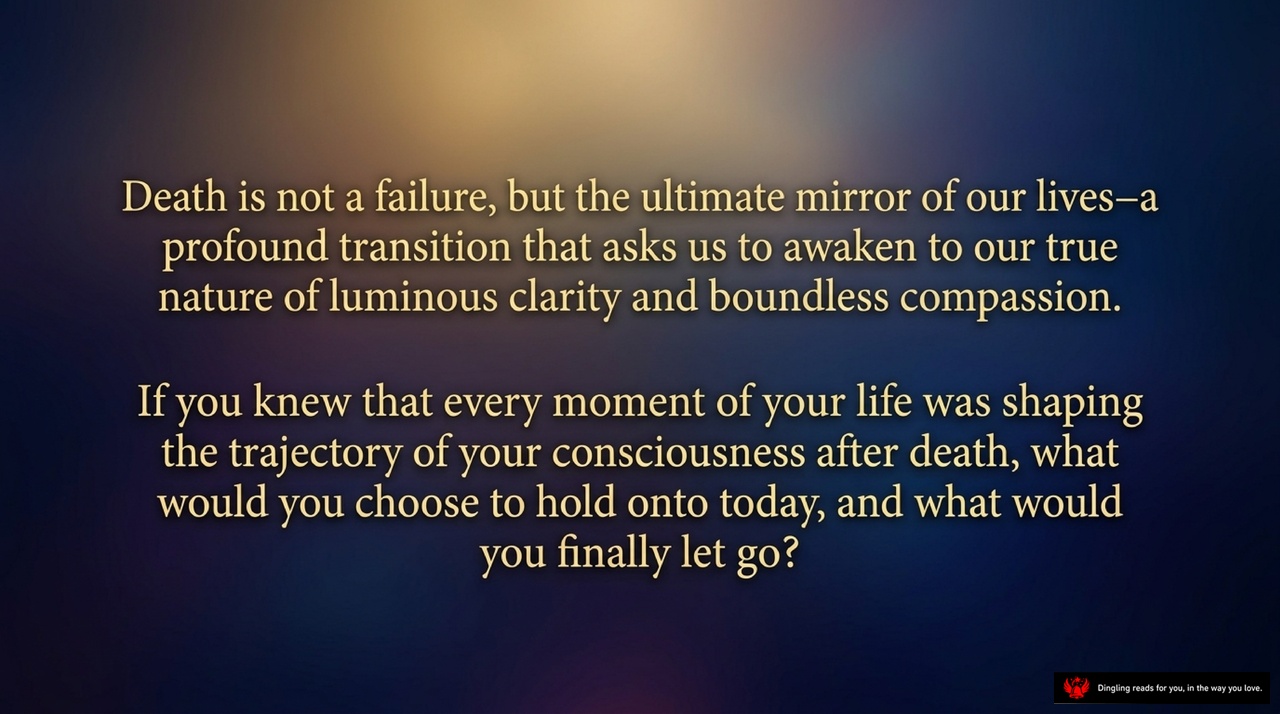
Death isn't a failure; it's the ultimate mirror of our lives, a profound transition asking us to awaken to our true nature of luminous clarity and boundless compassion. If you knew that every moment of your life was shaping the trajectory of your consciousness after death, what would you choose to hold onto today, and what would you finally let go?
In the West, we often try to deny death or pretend it solves everything, but both approaches miss the mark. True wisdom lies in facing the inevitable. As the text reminds us, death is not something to fear, but a key to liberation. By preparing for it now—through meditation and understanding our true nature—we can transform the moment of death from a terrifying end into a gateway to freedom. When we stop clinging to our temporary identities and embrace the impermaness of all things, we find that the very thing we fear most becomes the greatest opportunity for awakening.