
The Unbearable Lightness of Being: Complete Chapter-by-Chapter Summary

Welcome to our deep dive into Milan Kundera's masterpiece, *The Unbearable Lightness of Being*. Set against a deep red backdrop, this iconic image captures the book's very soul: a delicate feather resting atop a heavy iron anvil. It is a perfect visual metaphor for the central philosophical struggle that drives the entire narrative—the terrifying tension between the lightness of existence and the crushing weight of our choices.
Kundera proposes a structural deconstruction of love, existence, and the philosophical weight of our inescapable choices. The book asks a profound question: if life happens only once, does it lack gravity? Or does that very singularity make every moment infinitely heavy? The cover suggests that while our lives might feel weightless, like a feather drifting on the wind, the decisions we make carry the burden of an anvil. There is no second chance to correct our mistakes, no opportunity to try again. This "unbearable lightness" is the defining characteristic of our condition. We are thrown into the world without a safety net, forced to make choices that will echo forever, unable to return to the void from which we came.
As we explore this story, we will follow Thomas and Tereza as they navigate this landscape of lightness and gravity, learning that while life may be light, the responsibility of living it is undeniably, unbearably heavy.

Imagine a world where time doesn't move forward, but loops back on itself endlessly. Friedrich Nietzsche called this the "Eternal Return." If every second of your life repeated infinitely, would it become a heavy, unbreakable burden? Or, as Milan Kundera suggests, would a single life that happens only once be so light it might as well never have happened?
This slide presents the ultimate paradox: Weight versus Lightness. On the left, under the concept of Weight, we see Nietzsche's *The Eternal Return*. He argues that if life repeats forever, every action gains undeniable weight, terror, and profound meaning. You are nailed to eternity. A tragedy or a joy becomes a permanent monument, a heavy stone that can never be erased.
On the right, we find Kundera's *The Unbearable Lightness of Being*. He flips the script. If we only live one life, it is merely a sketch. It offers absolute freedom, but also absolute meaninglessness. What happens once might as well not have happened at all. This is the fear of being too light, of having no gravity to anchor us.
In the center stands the Parmenides Paradox, the question that haunts our characters. Is light positive and weight negative? Or is it the other way around? For Thomas and Tereza, this philosophical battle defines their entire existence. Tereza feels the crushing weight of her mother's shadow and her own insecurities, while Thomas struggles with the lightness of his affairs, fearing that his life lacks substance. Yet, when they finally find each other, they realize that true love is not about choosing between weight and lightness, but about balancing them. It is the terrifying, beautiful struggle of living a single, unrepeatable life with the gravity of an eternal one.

Imagine a world where four distinct souls collide, each carrying a unique burden of lightness and weight. This is the dynamic at the heart of our story, mapped out in the "Quartet of Beings." Look at the axes defining their existence: one axis measures the tension between Weakness and Strength, while the other balances the philosophical weight of Lightness against the gravity of Weight.
In the top left, we find Tomas. He is a surgeon seeking the "lightness of existence" through detached affairs, trying to float above his life. Yet, as the diagram notes, he is hopelessly anchored by the unexpected weight of his own compassion. He tries to be light, but his love for Teresa pulls him down.
Opposite him, in the top right, is Sabina. She embodies the lightness of betrayal. For her, fleeing all weight and obligation is the path to total freedom. She finds a strange liberation in emptiness, yet ultimately, she must face the absolute void that her detachment creates. She is strong in her rebellion but light in her refusal to commit.
Now, look to the bottom left for Teresa. She demands the absolute weight of fidelity. She uses her psychological weakness not as a flaw, but as an aggressive, grounding force. Her love is heavy, a dense anchor that pulls Tomas firmly to the earth, preventing him from drifting away into his own indifference.
Finally, in the bottom right, stands Franz. He chases the heavy idealism of political movements and the "Grand March." He is the heaviest of all, carrying the burden of grand narratives and political dogma. However, the diagram reveals a tragic irony: he fundamentally misunderstands the nature of Sabina's lightness. He cannot see the beauty in her betrayal because he is too weighed down by his own rigid convictions.
Together, these four characters create a perfect square of human experience, constantly pulling against one another in a dance of love, betrayal, faith, and despair.
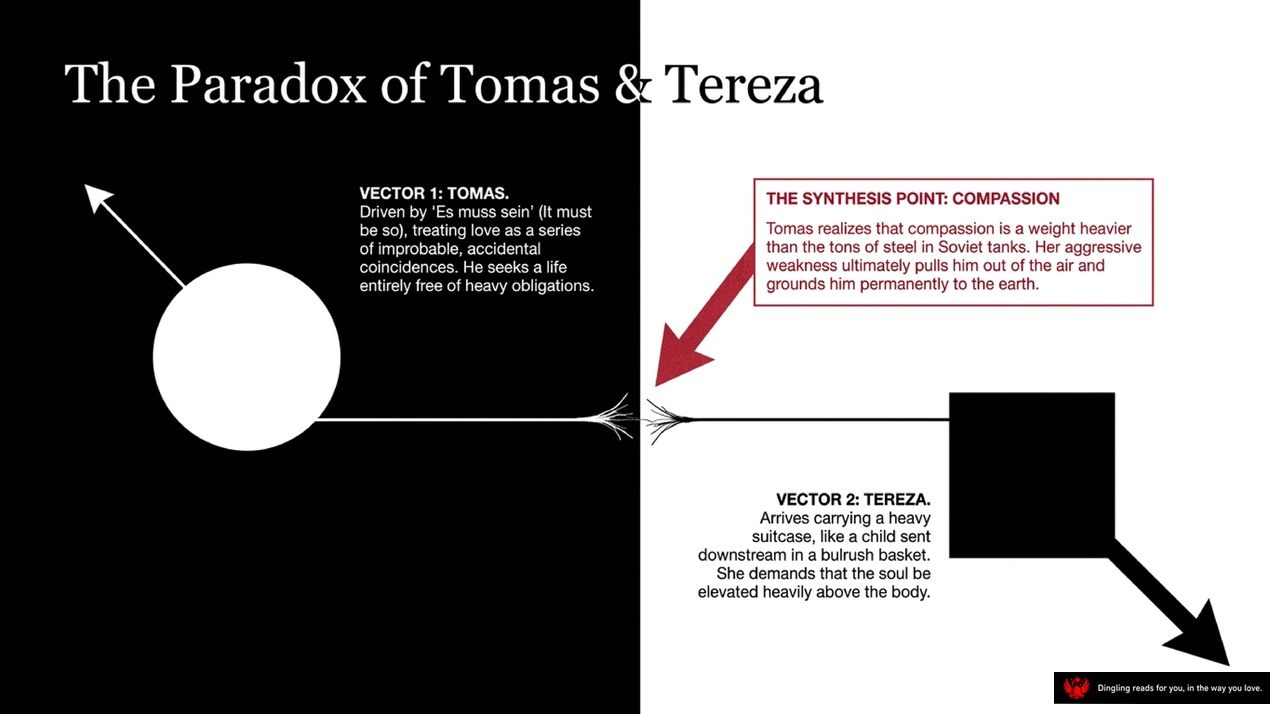
Look at this diagram illustrating the tragic yet beautiful dynamic between Tomas and Teresa. On the left, we see Tomas's vector: driven by the Nietzschean concept of "it must be so," he treats love as a series of improbable accidents, seeking a life entirely free of heavy obligations. He wants to remain light, untethered, and unburdened. On the right, Teresa arrives carrying a heavy suitcase, like a child sent downstream in a basket. She demands that the soul be elevated heavily above the body, insisting on a deep, grounding connection that refuses to let go.
The synthesis point, marked by that bold red arrow, is compassion. It is the heavy weight that pulls Tomas out of the air and permanently grounds him to the earth. Tomas realizes that compassion is a burden heavier than the tons of steel in Soviet tanks. Teresa's aggressive weakness ultimately pulls him down, making him realize that their love is not just about lightness or freedom, but about the heavy, undeniable responsibility of being together. This paradox defines their entire journey: the lightness of Tomas's existence and the heaviness of Teresa's soul, finding their only true home in the terrifying and beautiful weight of loving each other.
Thomas and Tereza have finally traded the suffocating noise of the city for the quiet rhythm of the countryside, escaping the secret police and the toxic memories that plagued their days. But even in this pastoral peace, life continues to demand its heavy toll. Their dog, Karlnin, was once the symbol of their simple, cyclical happiness, a creature that knew no duality of soul and body. Yet, cancer has now invaded him, and the neighbor's cold pragmatism—telling Tereza she shouldn't cry for a dog—only deepens her isolation. For Tereza, Karlnin represents a pure, unburdened love, a "pastoral" ideal where there is no need to test or measure affection, unlike her complex and painful relationship with Thomas.
As Karlnin's suffering becomes unbearable, they face the ultimate moral test: how to end a life with dignity. Tereza draws a rectangle in the dirt, a grave prepared in advance, while Thomas struggles with the decision. When the moment finally comes, they bury Karlnin together, placing his collar and the chocolate he loved inside. This act of final mercy is a profound rebuke to the world that sees animals as mere machines. Yet, as they prepare to leave for the airport, Thomas receives a mysterious summons. In the end, the weight of the world catches up to them again. As they fly over the rain clouds, the fear transforms into a terrible realization: they are no longer two people, but a single target. When they land and see the rifles, Thomas is struck down, shrinking into a small, helpless rabbit in Tereza's arms. In that moment of death, the heavy burden of existence is lifted, leaving only the terrifying lightness of being erased.
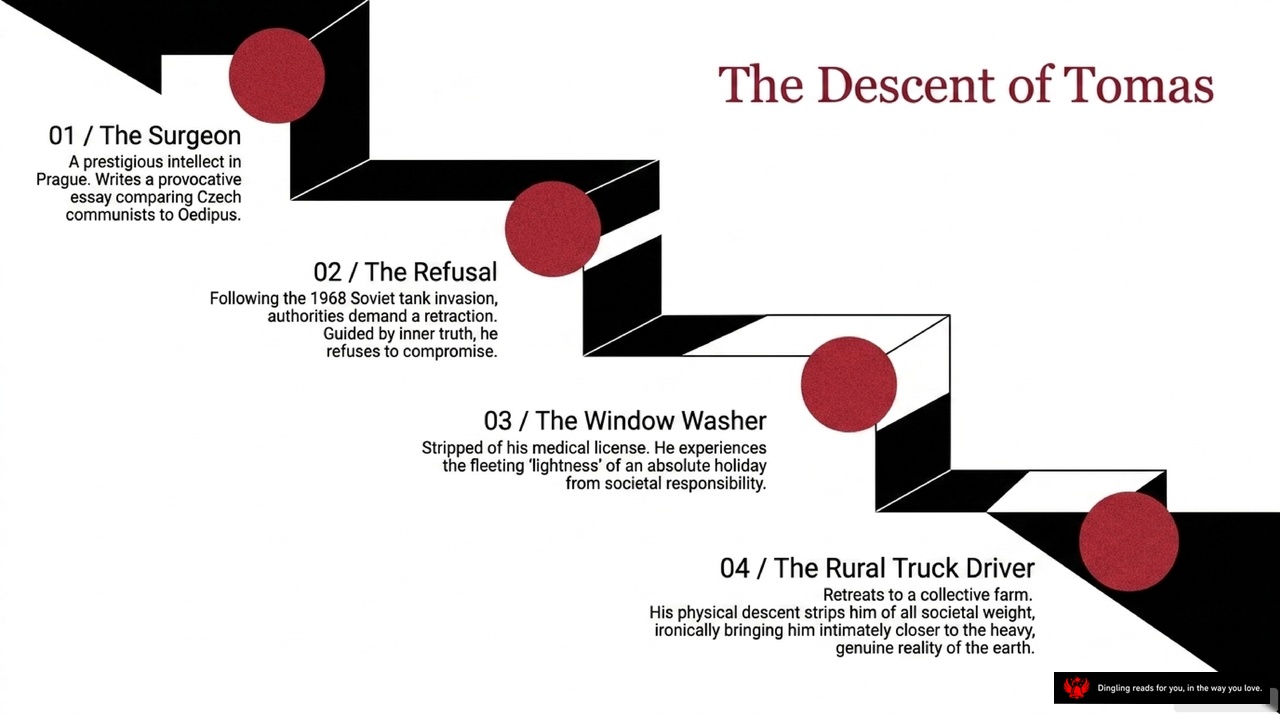
The Descent of Tomas: From the City to the Fields.
Imagine leaving behind the chaotic noise of a city—where secret police lurk, drunkards disturb your peace, and the scent of another woman's perfume constantly threatens your wife's heart. Tomas and Teresa make a radical choice: they sell their car, their TV, and their radio, trading urban anxiety for the quiet rhythm of country life. They buy a small house and a garden from farmers, becoming voluntary settlers in a village where government control is surprisingly loose. Here, they find a strange freedom. They befriend the collective farm chairman, whose pig, Morpheus, becomes best friends with their dog, Karel. Tomas trades his scalpel for a steering wheel, becoming a rural truck driver, while Teresa tends to forty cows, carrying her books like a shield against the silence.
But this pastoral peace is fragile. Karel, their beloved dog, becomes a mirror for their own spiritual struggles. When Karel gets cancer, the neighbors mock Teresa's grief, suggesting she shouldn't cry for a dog. They are right, in a way—livestock are machines for survival. Yet Teresa sees something deeper. She realizes that true human virtue only shines when we show compassion to those with no power to fight back, like animals. In a world that often denies animals souls, treating Karel with love is a radical act of rebellion.
The tragedy of Karel is inevitable. As his condition worsens, he refuses to participate in the usual morning ritual of going for a walk, knowing he is dying. Teresa carves a grave in the garden with her shoe heel, a simple rectangle for a life that mattered more than it should have. When the time comes, Tomas decides to end Karel's suffering himself, holding the dog close as he injects the final dose. It is a heavy moment, a death that binds them even tighter.
Karel's death forces Tomas and Teresa to confront the end of their story. They fly to a nearby airport, only to find themselves surrounded by armed men. In a shocking twist, Tomas is shot and collapses, shrinking in Teresa's mind to the size of a rabbit. She holds him, terrified yet strangely peaceful, as if finding a final, terrible home. This descent—from a prestigious surgeon to a truck driver, from a city lover to a hunted man—culminates in a final revelation. Tomas confesses he receives letters from his son, a man who has rejected the world's politics to find God. As Teresa watches her husband grow old and gray, fixing a tire on their broken truck, she realizes her guilt: it was her weakness that dragged him away from his career. Yet, as they dance in a village basement, Tomas reassures her. He admits that chasing a career was foolish; realizing you are free from it is the ultimate liberation. They are at the end of the road, but they are still together.

Have you ever felt that the love between a human and a dog is the only truly pure thing in the world? This slide captures that profound idea with the title, "The Idyll of Karenin." On the left, we see "Human Time" represented by a straight arrow rushing aggressively toward death. This linear path, driven by the endless pursuit of the new, creates deep anxiety because life feels like an un-rehearsed sketch with no chance to repeat or perfect itself.
In stark contrast, on the right, is "Dog Time," symbolized by a simple circle. This represents Karenin, the dog who lives in an unbroken circle. Animals were never exiled from Paradise; for them, time moves in repetition, free from the burden of linear progress. True happiness, as the text suggests, is the longing for this repetition.
The key insight at the bottom ties it all together: the love between humans and dogs is idyllic because it is free of conflict. Karenin provides the only uncorrupted gift of love in the entire novel. While Thomas and Tereza struggle with jealousy, betrayal, and the heavy weight of human history, Karenin offers a sanctuary of unconditional devotion. In a world obsessed with progress and the fear of death, Karenin's circular time offers a glimpse of a perfect, conflict-free existence.

The slide before us, titled "The Chinese Translation Legacy," sets the stage for a profound shift in how we understand the book's soul. It visually contrasts two worlds: Han Shao-gong's 1987 edition and Xu Jun's 2003 edition. On the left, we see the indirect translation from English, born during China's cultural reconstruction in the 80s. Its tone was poetic but constrained, softening the political and sexual realities of the original to fit the era. On the right stands Xu Jun's 2003 edition, translated directly from the French with Kundera's authorization. This version is raw, philosophical, and absolute. It restores the omitted texts and emphasizes "Being" rather than just biological life.
This distinction is crucial because it changes everything we read. The 1987 title, "The Lightness in Life," captures a poetic rhythm but misses the weight of existence. Xu Jun's translation, "The Unbearable Lightness of Existence," adds a critical layer of gravity that the original French possessed. It reminds us that the characters in this story—Thomas and Tereza—are not just living; they are grappling with the philosophical burden of a life that happens only once. Without this direct translation, we might miss the deeper philosophical stakes Kundera intended. The legacy of these translations teaches us that context shapes meaning, and sometimes, to truly understand a story, we need to see it through the most authentic lens possible.

The image captures a profound tension: the inescapable paradox of life, where heaviness grounds us in truth, yet lightness offers a hollow freedom. As the slide suggests, Kundera structures the novel not as a straight line, but as a polyphonic musical quartet, weaving together philosophical themes, historical trauma like the 1968 Prague Spring, and recurring textual motifs that echo like musical themes. We cannot simply choose between the weight of our burdens and the lift of our wings; we must survive the tension between them.
Consider Thomas and Tereza. Their love is the ultimate heavy burden. It anchors them to the earth, making their lives real and truthful, even when it means enduring pain, jealousy, and the constant threat of political persecution. Without this weight, they would be lighter than air, half-real, and their movements would be meaningless. But look at Sabina. She chooses the absolute absence of burden. She becomes a master of "lightness," constantly betraying her husband Franz and fleeing the constraints of history and duty. She feels free, yet her freedom is terrifying. Her movements are as free as they are meaningless, leading to a life that, despite its artistic brilliance, ultimately feels like an unbearable lightness.
This is the trap of the human condition. The heavy burden of love and responsibility makes us real, but the absolute absence of burden makes us ghostly. As the novel shows, we cannot choose between light and heavy; we merely survive the tension between them. Thomas returns to Prague not because he wants the heavy burden again, but because he realizes that without it, he is nothing. Sabina, conversely, drifts into the void, her lightness eventually consuming her. In the end, the only way to be truly alive is to carry the weight, to embrace the burden that makes us human, and to find meaning in the struggle against the void.
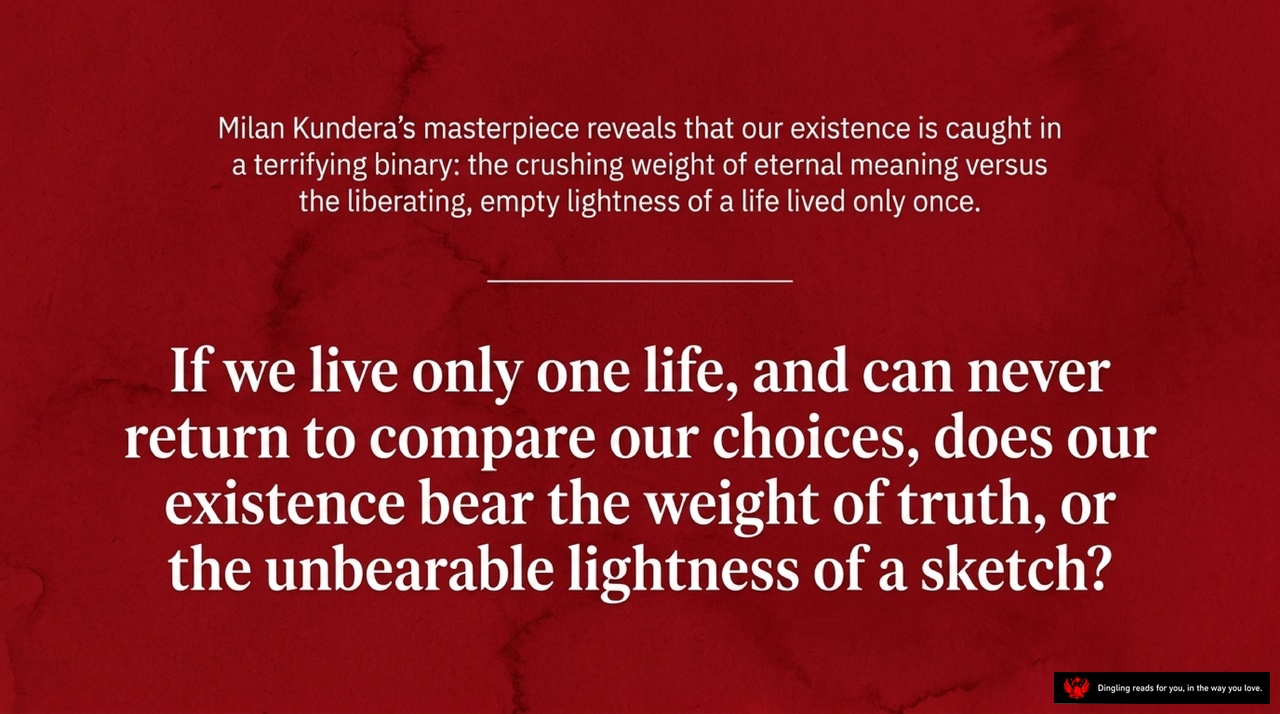
Milan Kundera's masterpiece exposes a terrifying binary: the crushing weight of eternal meaning versus the liberating, empty lightness of a life lived only once. This dilemma defines Thomas and Tereza's entire journey. If we live only one life, with no chance to return and compare our choices, does our existence bear the weight of truth, or the unbearable lightness of a sketch?
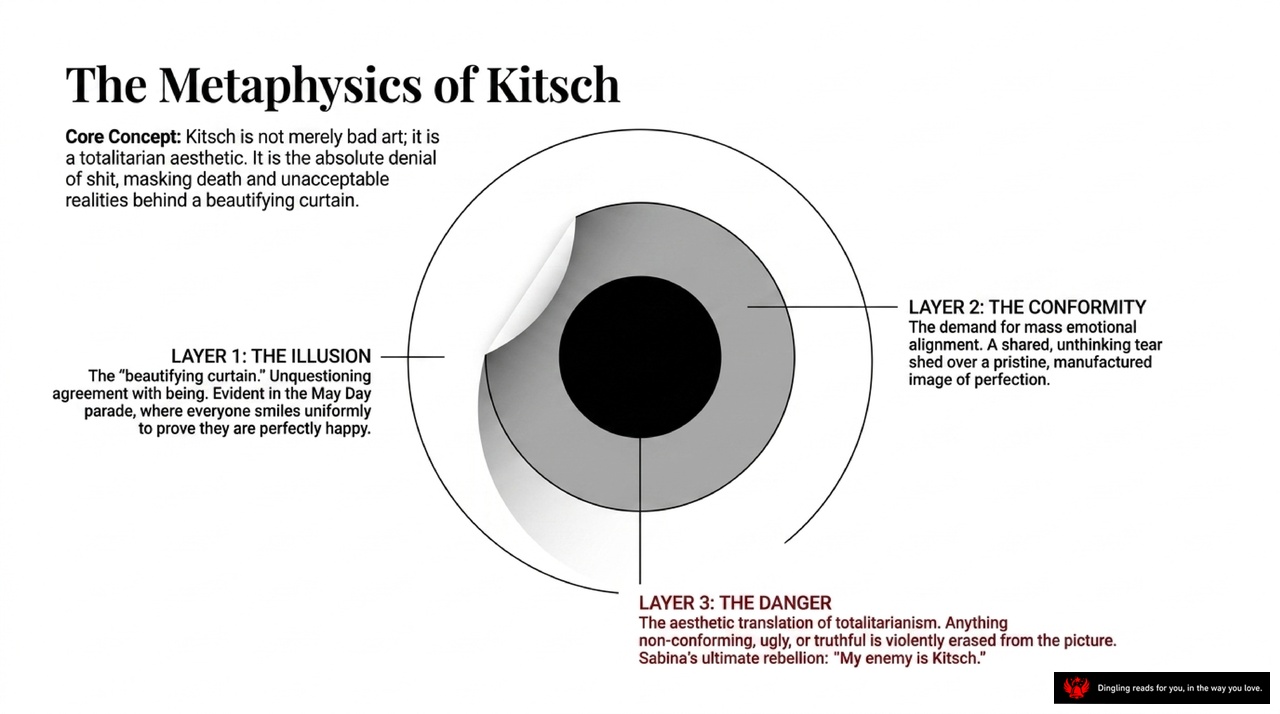
Consider the weight of their love. Tereza's life was a desperate struggle against the "kitsch" of her mother's world, where she was humiliated and forced to hide her soul. When she finally found Thomas, their connection felt like a heavy anchor in a sea of absurdity. Thomas, a former surgeon now working as a window washer, found solace in Tereza's intense, almost painful devotion. She was his only constant, the one person who could ground him against the chaotic, shifting world of political oppression and personal betrayal.
But this heavy love was fragile. The weight of Tereza's jealousy, her nightmares, and her fear of being replaced by other women constantly threatened to crush them. Thomas tried to balance his professional life with his moral conscience, refusing to sign petitions that would endanger her, even at the cost of his own safety. He chose the heavy path of responsibility over the light escape of indifference. Yet, as they fled to the countryside to escape the city's corruption, they found that even in simplicity, the weight of their existence remained. Their love was not a light sketch; it was a dense, unyielding reality that defined them both, a heavy truth in a world that desperately wanted to make everything light and forgettable.