
The User's Manual for Human Body: Complete Chapter-by-Chapter Summary
Welcome to *The Human Body User Manual* by Wu Qingzhong. Today, we're not just looking at a body; we're looking at a highly advanced, self-repairing machine that comes with a complete, built-in operating system.
Imagine your body not as a collection of separate parts, but as a sophisticated computer. Just like a computer, if your power supply drops, the hard drive fails. But modern medicine often mistakes the symptom—the broken hard drive—for the root cause, ignoring the missing power. Our book argues that the same thing happens with chronic diseases like diabetes or cancer. Instead of fixing the underlying "energy voltage," doctors often just patch the symptoms, leaving the real problem unsolved.
The good news? Your body is far smarter than a computer. It has an incredible ability to self-repair and regenerate, but it needs one thing to run: sufficient energy. When we drain this energy through poor habits or unnecessary treatments, we crash the system. This manual is your guide to unlocking that hidden potential, teaching you how to live according to your body's true instructions so it can heal itself.
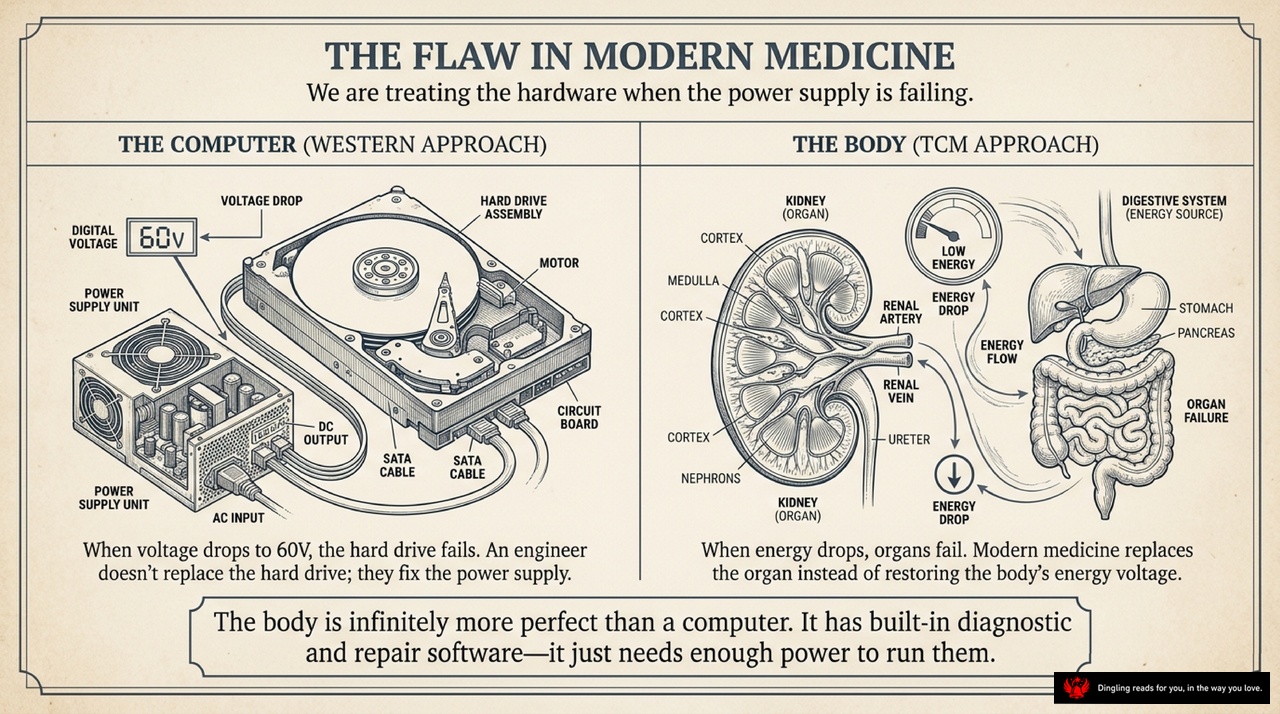
Imagine a hard drive failing simply because the power supply dropped to 60 volts. A smart engineer wouldn't replace the drive; they'd fix the power. Now, look at our own bodies. Modern medicine often treats the hardware—the organs—while ignoring the failing power supply: our body's energy voltage. When that energy drops, organs fail. Instead of restoring our body's "energy voltage," we replace the organ itself. But here's the truth: the body is infinitely more perfect than a computer. It has built-in diagnostic and repair software. It just needs enough power to run them. By shifting from fixing broken parts to restoring the body's fundamental energy, we unlock its incredible ability to heal itself.
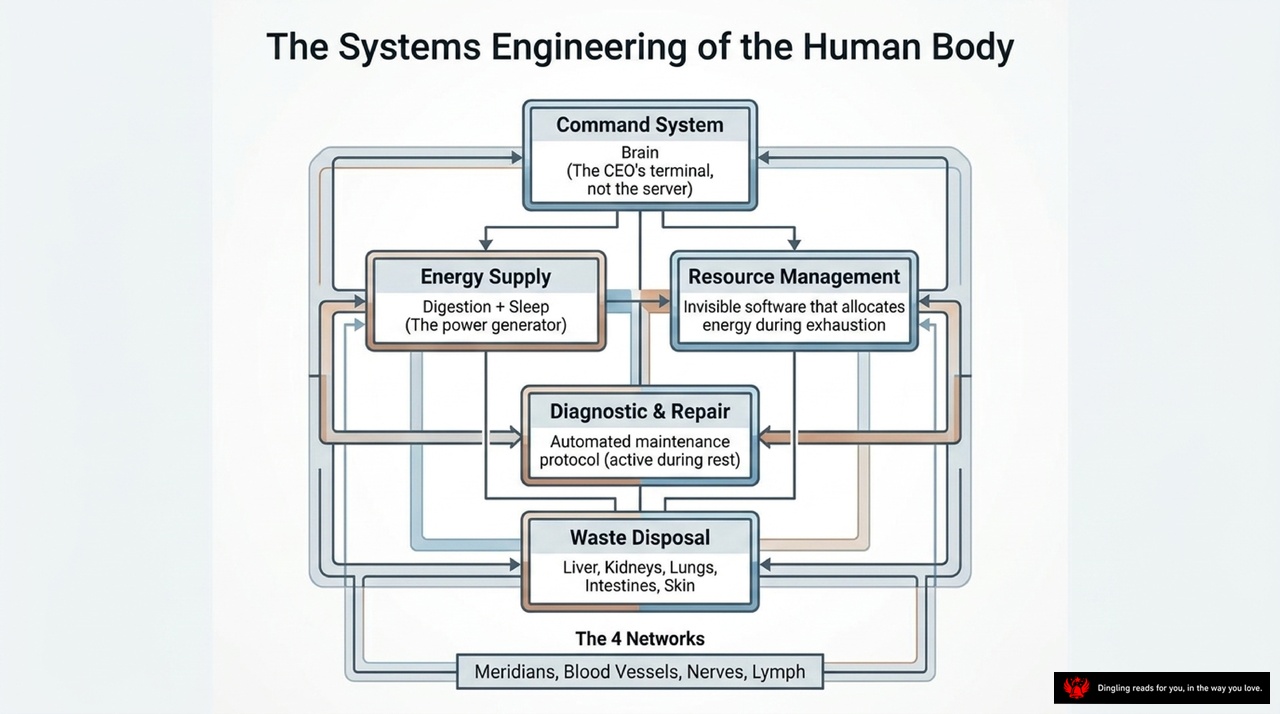
The Systems Engineering of the Human Body: It's not just a machine; it's a smart, self-repairing ecosystem. Look at this diagram. At the top sits the Command System—the brain. Think of it as the CEO's terminal, not the server itself. It doesn't run the organs; it manages the flow. Below it, we have the Energy Supply, your digestion and sleep, acting as the power generator. Then comes Resource Management, an invisible software that allocates your energy, especially when you're exhausted.
Everything connects through Diagnostic & Repair and Waste Disposal, handled by your liver, kidneys, lungs, and skin. But what ties all these boxes together? The four networks at the bottom: Meridians, Blood Vessels, Nerves, and Lymph. These aren't just pipes; they are the high-speed internet and logistics network of your body.
Here's the key insight: Your body is smarter than any computer we've built. While a computer crashes when its voltage drops, your body has an intelligent system that detects when your "energy voltage" is low. Instead of just fixing a broken kidney, your body realizes the issue is a lack of fuel. It stops non-essential functions to save energy for repair. This is why you might feel worse when you finally rest after a long week—it's not a breakdown; it's a massive cleanup operation. Your body is prioritizing its internal maintenance over your daily tasks. When you understand this, you stop fighting your symptoms and start supporting your body's natural engineering.
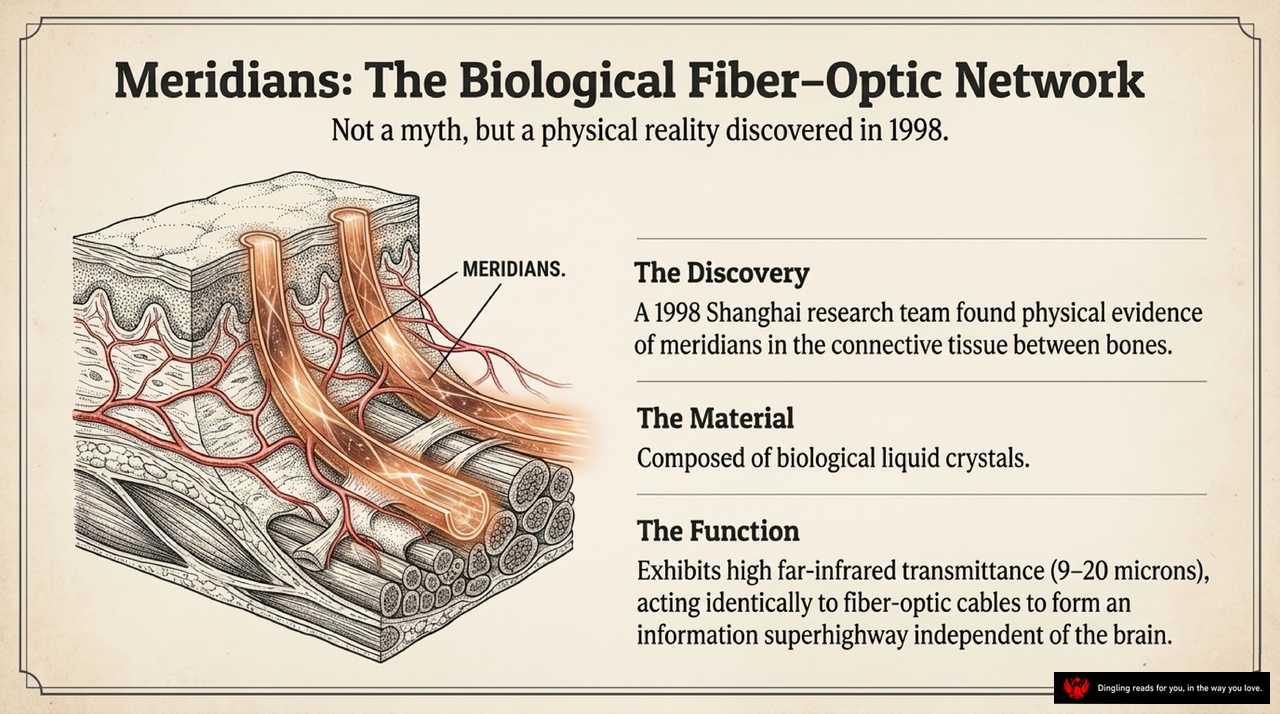
Meridians are far more than ancient myths; they are a physical reality confirmed by science in 1998. As this slide illustrates, a research team in Shanghai discovered that these energy pathways exist as tangible structures within the connective tissue between our bones.
What makes this discovery truly revolutionary is the material itself. These meridians aren't made of nerves or blood vessels; they are composed of biological liquid crystals. Think of them as your body's own fiber-optic network. They possess the unique ability to transmit far-infrared light with nearly 100% efficiency, acting as a superhighway for information that operates independently of your brain.
This means your body has a built-in, intelligent communication system that predates the need for a central processor. While modern medicine often focuses on fixing individual organs like separate hardware components, this discovery reveals a complex, interconnected software running beneath the surface. It suggests that health isn't just about repairing parts, but about ensuring this entire biological network flows smoothly, delivering the energy and information your cells desperately need to heal themselves.
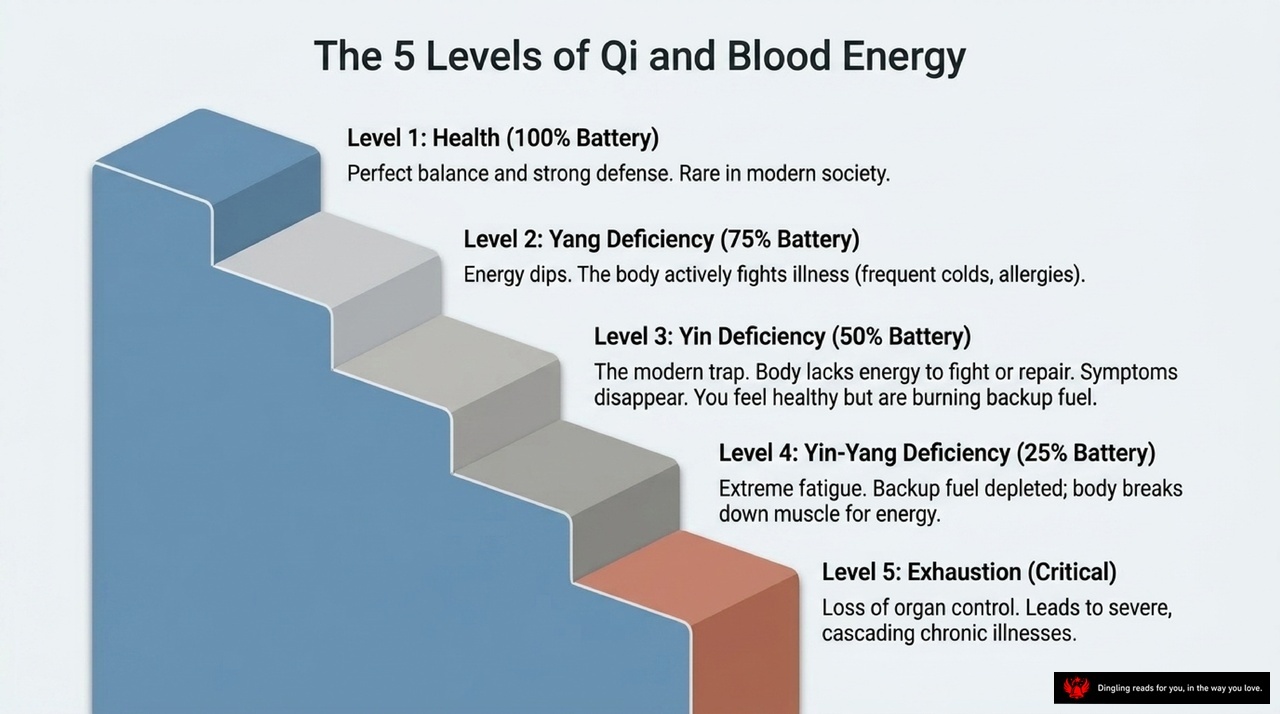
Modern medicine often treats symptoms like a computer technician fixing a hard drive when the real issue is a low battery. But the human body isn't a machine; it's a complex system that needs fuel to heal itself. This brings us to the core concept of our health: **Qi and Blood Energy**. Think of it as your body's internal battery level.
As shown on this slide, there are **five distinct levels** of this energy, ranging from perfect health to critical exhaustion.
At the top, **Level 1** represents **Health**, or a full 100% battery. In this state, you have perfect balance and strong defenses. The problem? This level is incredibly rare in modern society.
Most of us are actually stuck in **Level 2: Yang Deficiency**, which is like a 75% battery. You might experience energy dips, frequent colds, or allergies. Your body is actively fighting illness, but it's already running on a lower charge.
Then comes the dangerous trap of **Level 3: Yin Deficiency**, or a 50% battery. This is the "modern trap." Paradoxically, you might feel healthy because your body lacks the energy to fight or repair anything. Symptoms disappear, but you are silently burning through your backup fuel. You feel fine until you crash.
When you drop to **Level 4: Yin-Yang Deficiency**, your battery is at a critical 25%. You experience extreme fatigue. Your stored energy is gone, so your body starts breaking down your own muscles just to keep you alive.
Finally, **Level 5** is **Exhaustion**, a critical state where you lose control over your organs. This leads to severe, cascading chronic illnesses.
The key takeaway here is that you aren't just sick because of a virus or a broken organ; you are sick because your "battery" is too low to support your body's natural repair systems. Understanding where you stand on this ladder is the first step to truly healing.
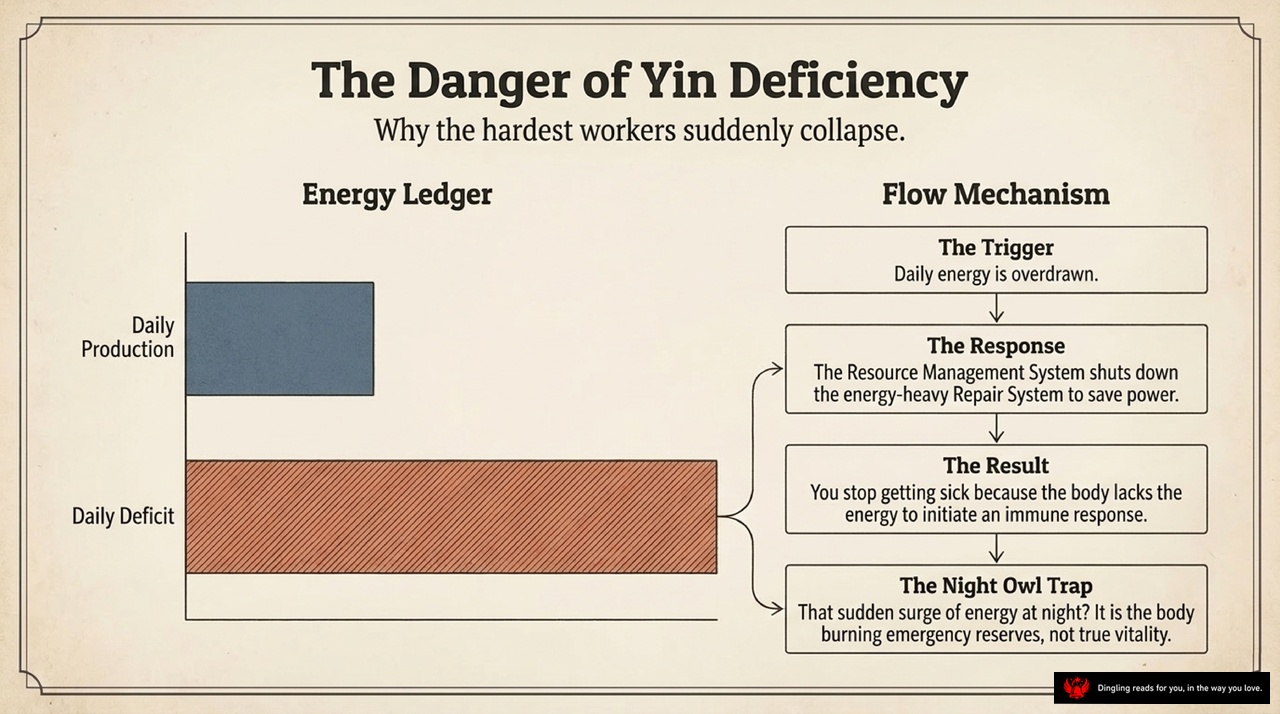
Have you ever noticed a strange paradox? The people who work the hardest, the ones who never seem to stop, are often the first to suddenly collapse. Why does this happen? The answer lies in a concept called "Yin Deficiency," which is essentially a dangerous energy deficit.
Think of your body as an energy ledger. On the left side, you have your "Daily Production"—the energy you generate. But on the right side, you have your "Daily Deficit." For the high-performers, this deficit bar is massive. They are constantly overdrawn.
So, what happens when you hit this wall? Let's look at the flow mechanism. First, there is **The Trigger**: your daily energy is simply overdrawn. The system runs out of cash.
Next comes **The Response**. Your body's Resource Management System, acting like a smart accountant, makes a desperate move. To save power, it shuts down the energy-heavy Repair System. It stops maintaining your organs and immune defenses because there isn't enough fuel.
This leads to **The Result**. You stop getting sick. You feel invincible. But this is a trap. You aren't healthy; your body has just run out of the energy required to initiate an immune response. It's a false sense of security.
Finally, we hit **The Night Owl Trap**. You might notice a sudden surge of energy late at night, right when everyone else is tired. Don't celebrate this. That isn't true vitality. That is your body burning through its emergency reserves. It's a panic mode, not a healthy state.
The danger of Yin Deficiency is that it hides in plain sight. It looks like productivity, but it's actually the slow collapse of your body's ability to repair itself.
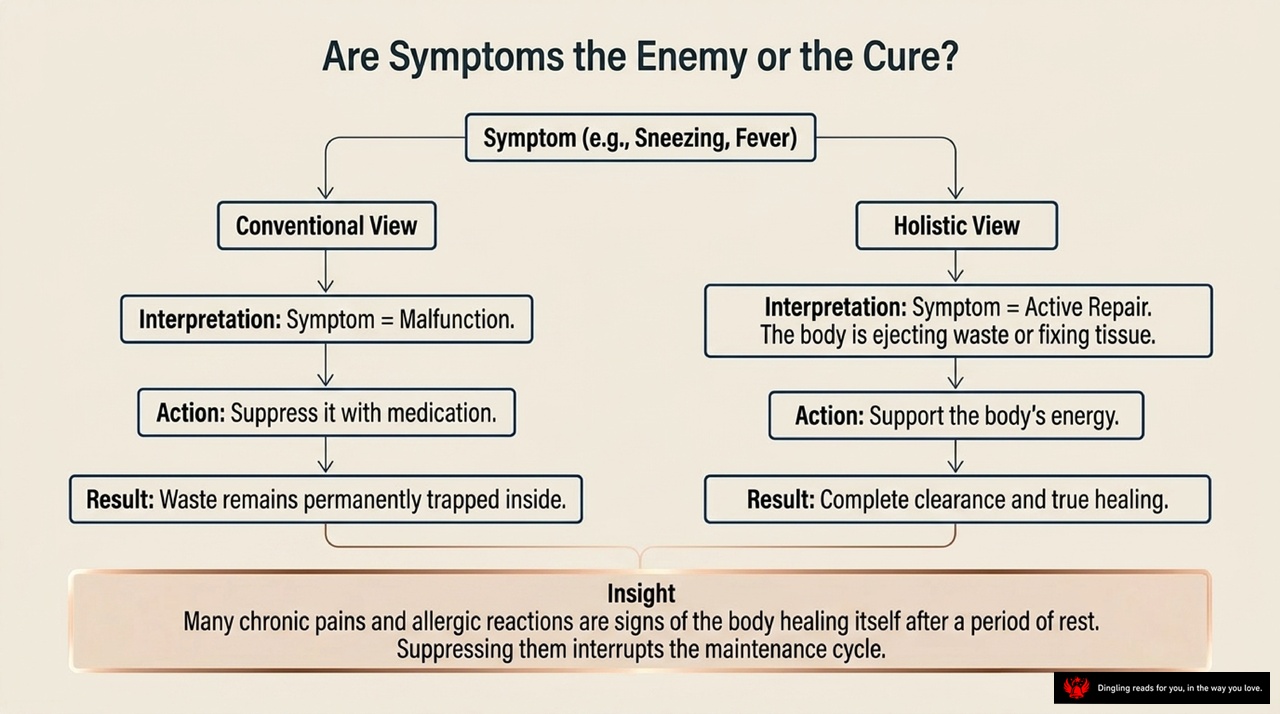
Are symptoms the enemy or the cure? Look at this flowchart. On the left, we have the conventional view: symptoms like sneezing or fever are seen as malfunctions, so the action is to suppress them with medication. The result? Waste remains permanently trapped inside. But look at the right side: the holistic view. Here, a symptom is interpreted as active repair—the body ejecting waste or fixing tissue. The action is to support the body's energy, leading to complete clearance and true healing.
This distinction explains why many chronic pains and allergic reactions persist. Often, these are signs of the body healing itself after a period of rest. By suppressing them, we interrupt the maintenance cycle. Consider a busy professional who suddenly gets sick during a vacation. Instead of panicking, recognize it as a signal that your blood energy has risen enough to start a deep clean. Don't fight the fever or the congestion; fuel the process. True healing isn't about silencing the alarm bells; it's about giving your body the resources to fix the problem. When you stop viewing symptoms as enemies and start supporting your body's intelligent repair system, you move from temporary control to lasting recovery.
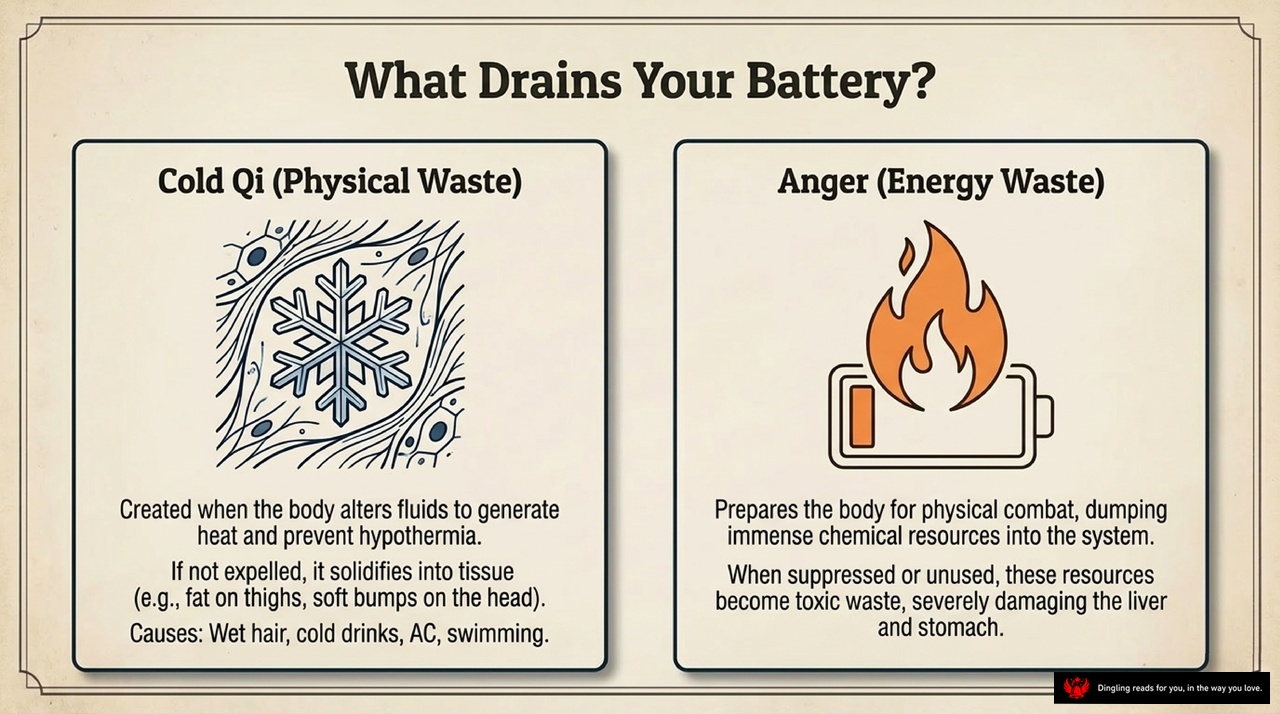
What drains your battery? Think of your body not just as a machine, but as a living system with a finite energy supply. This slide breaks down the two biggest energy thieves: Cold Qi and Anger.
On the left, we see Cold Qi, labeled as physical waste. This happens when your body tries to generate heat in a cold environment, altering fluids to prevent hypothermia. If this waste isn't expelled, it solidifies into tissue—think of it as the fat on your thighs or those soft bumps on your head. Common culprits include wet hair, cold drinks, air conditioning, and swimming. Essentially, you're storing toxicity instead of clearing it.
On the right, we have Anger, which is pure energy waste. When you get angry, your body prepares for physical combat, dumping immense chemical resources into your system. But what happens when you suppress that anger or let it sit unused? Those resources turn into toxic waste, severely damaging your liver and stomach. It's like revving an engine in neutral; you're burning fuel without going anywhere, only to create exhaust that poisons the system.
To stay healthy, you need to stop these leaks. Avoid the cold and manage your emotions, so your body's battery can actually charge and sustain you.
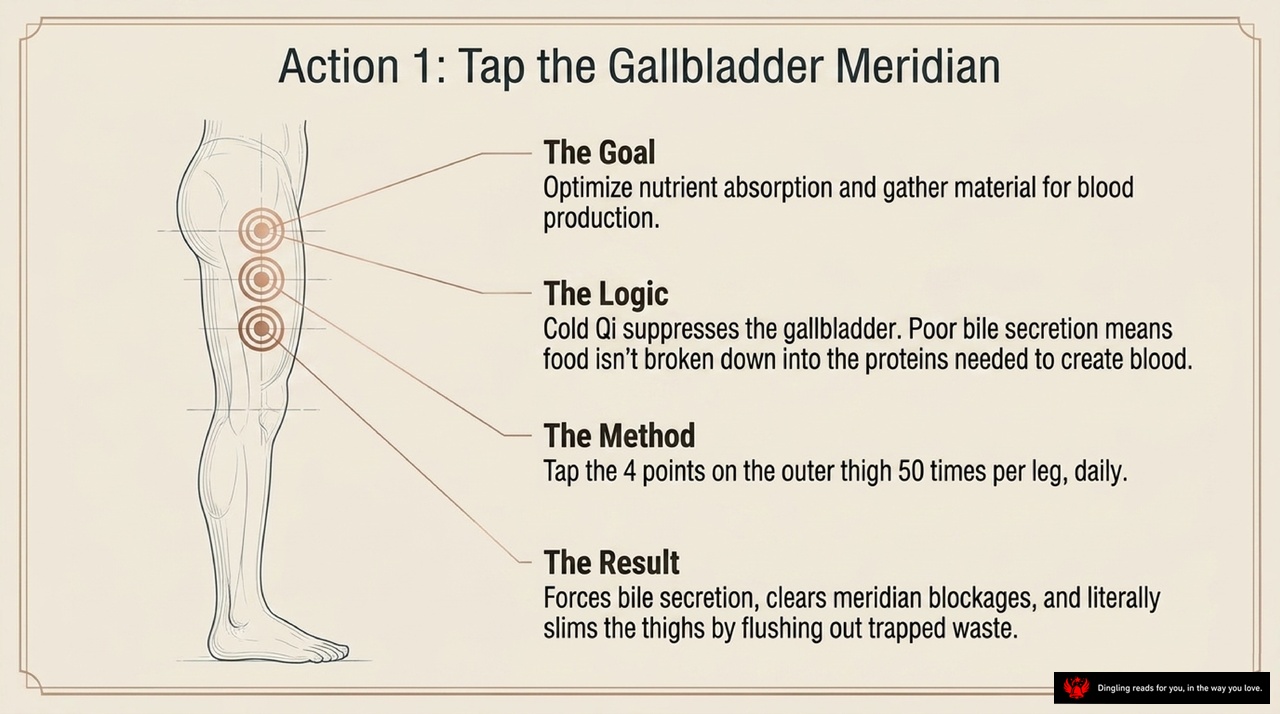
Action 1: Tap the Gallbladder Meridian. If you've ever felt that heavy, dragging sensation on the outside of your thigh, or noticed stubborn fat that just won't budge, this is likely where your body is holding onto trapped waste. The goal here is simple but powerful: optimize nutrient absorption and gather the raw materials your body needs to produce fresh, healthy blood.
Here's the logic behind it. When cold energy suppresses the gallbladder, bile secretion slows down. Without proper bile, your food isn't broken down into the proteins necessary to create blood. It's like a clogged pipeline; if the flow stops, the system backs up. That's why tapping these four specific points on your outer thigh is so effective.
The method is straightforward. Tap those four points on the outer thigh 50 times per leg, every single day. Consistency is key. The result? You force bile secretion, clear out those deep meridian blockages, and literally slim your thighs by flushing out the trapped waste that has been weighing you down. Think of it as giving your body a deep clean, allowing your natural energy to flow freely again.
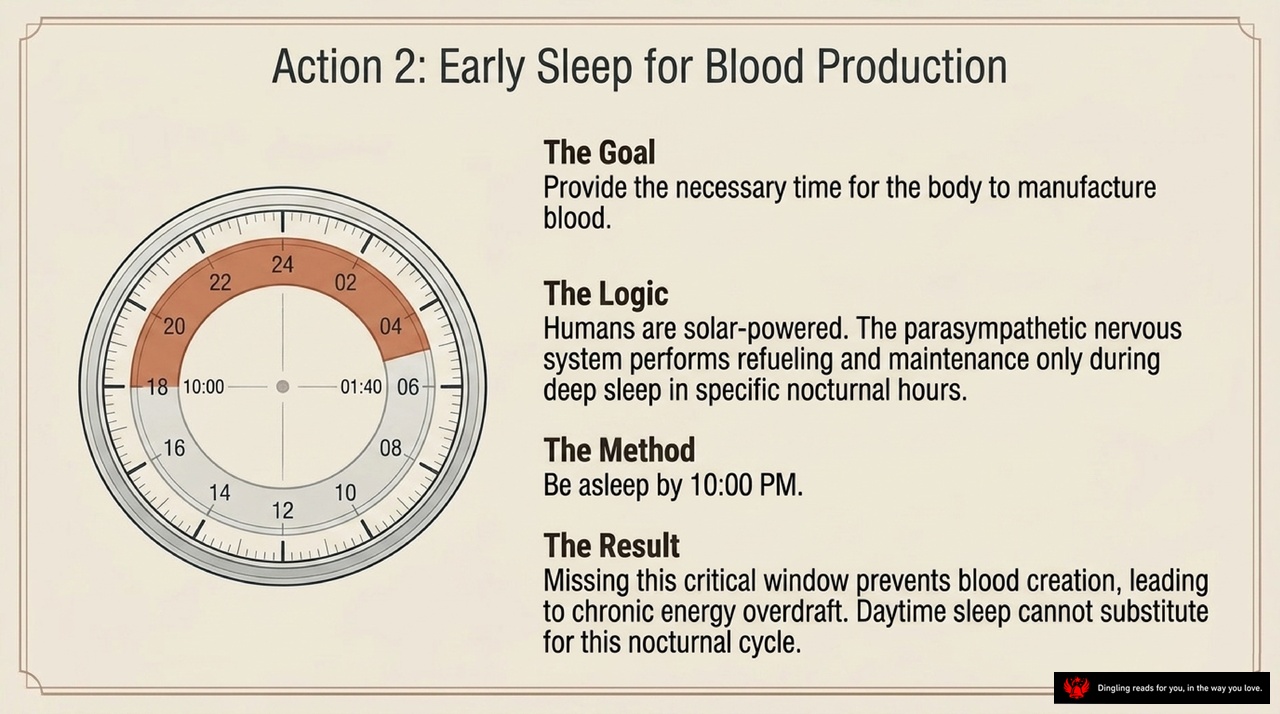
Let's talk about the hidden power of your sleep. Look at this clock on the slide. It highlights a specific window: from 10:00 PM all the way until 1:40 AM. This isn't just about getting rest; it's a critical biological deadline for your blood production.
The core logic here is simple yet profound. We are solar-powered beings, but our internal maintenance happens at night. Specifically, the parasympathetic nervous system—your body's "rest and repair" mode—only performs deep refueling and blood manufacturing during these specific nocturnal hours. If you miss this window by staying up late, you aren't just losing sleep; you are preventing your body from creating the very blood it needs to survive.
The method is straightforward: be asleep by 10:00 PM. This timing is non-negotiable for optimal health. The result of missing this critical window is chronic energy overdraft. Your body runs on borrowed time, burning through its reserves instead of replenishing them. And here is the hard truth: daytime sleep cannot substitute for this nocturnal cycle. No matter how long you nap during the day, you will never trigger that deep, restorative blood production phase. To truly fuel your body, you must respect this early bedtime.
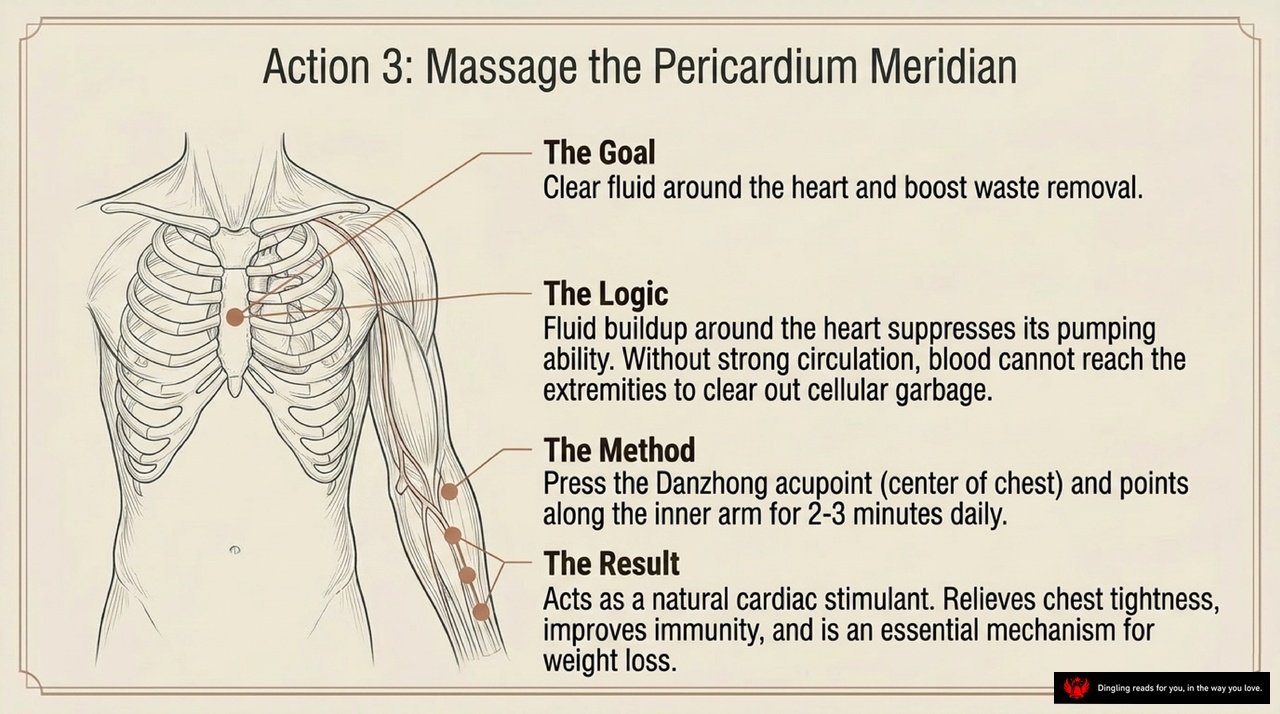
Action 3: Massage the Pericardium Meridian.
Think of your heart not just as a pump, but as a delicate engine that needs a clear workspace to function. When fluid builds up around the heart, it acts like a clog in a pipe, suppressing the heart's pumping ability. Without that strong circulation, your blood can't reach the extremities to clear out cellular garbage, leading to a cycle of stagnation.
That's why we focus on clearing fluid around the heart and boosting waste removal. The logic is simple: you can't fix the engine if the oil is clogged. To do this, we press the Danzhong acupoint right in the center of your chest, along with points running up your inner arm. Just spend two to three minutes daily pressing these spots.
This isn't just about relief; it acts as a natural cardiac stimulant. You'll feel chest tightness melt away, your immunity boost, and you'll create an essential mechanism for weight loss by finally allowing your body to clear out the backlog. It's about giving your heart the space it needs to do its job.
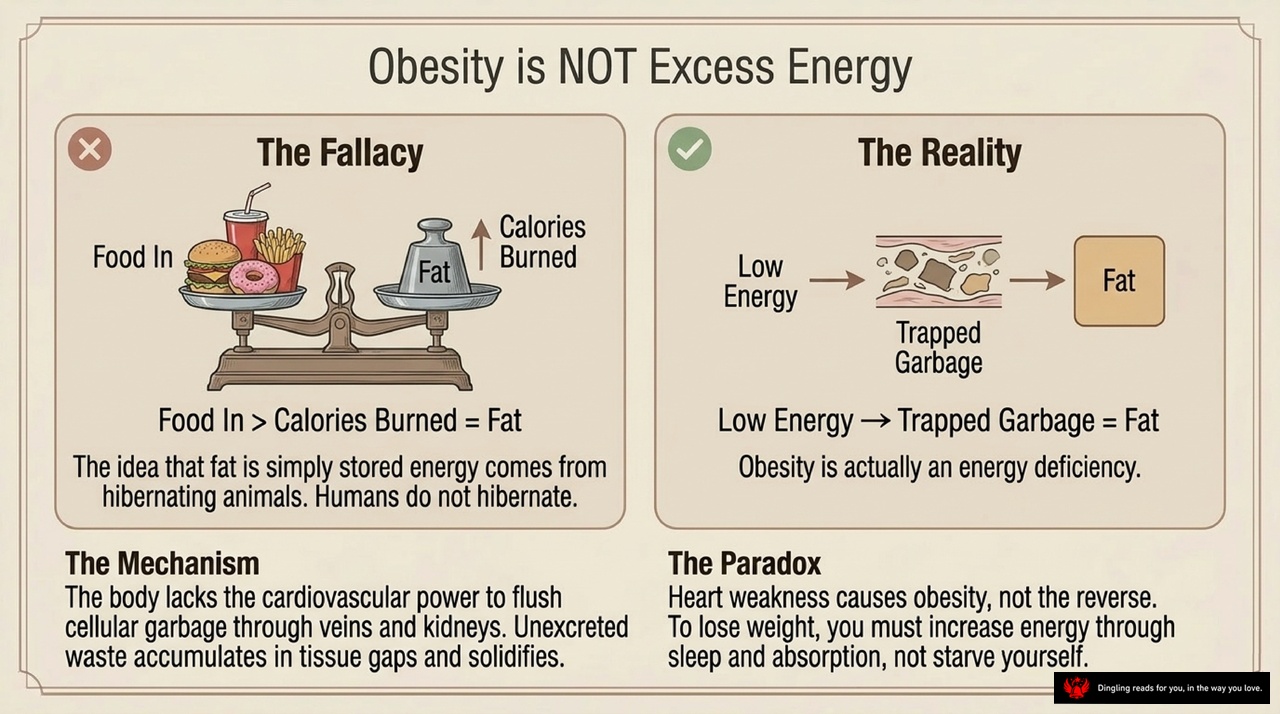
Obesity is NOT Excess Energy. Today, we're flipping the script on everything you've been told about weight loss.
On the left, we see the common fallacy: the belief that obesity is simply "Food In" exceeding "Calories Burned." It treats fat as just stored energy, like a hibernating animal. But here's the reality: humans do not hibernate. This old model is wrong.
Look at the right side. The truth is, obesity is actually an energy deficiency. When your body lacks energy, it can't flush out cellular waste. This "trapped garbage" accumulates in tissue gaps and solidifies, turning into what we call fat. It's not that you ate too much; it's that your system lacks the cardiovascular power to clean itself.
This creates a paradox: heart weakness causes obesity, not the other way around. To lose weight, starving yourself is the exact opposite of what you need to do. Instead, you must increase your energy through better sleep and absorption. When you fuel your body properly, the trapped garbage dissolves, and the weight follows. Stop counting calories and start building energy.
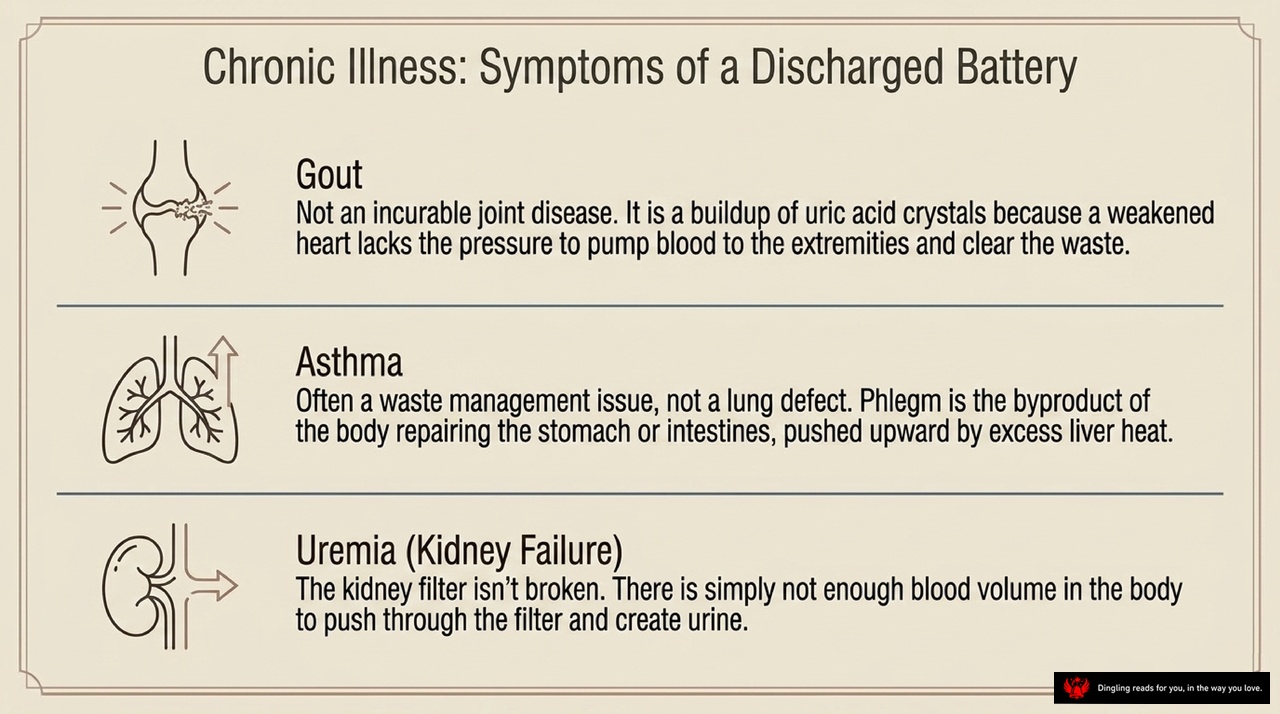
Chronic illness isn't just a medical mystery; it's often a sign that your body's battery is simply running out of power. Think of gout, asthma, or kidney failure not as broken machines, but as symptoms of a discharged battery. Take gout, for example. Modern medicine sees it as an incurable joint disease, but the real culprit is a weakened heart. When the heart lacks the pressure to pump blood to your extremities, waste like uric acid crystals gets stuck, causing pain. It's not a joint defect; it's a circulation failure caused by low energy.
Similarly, asthma is frequently misunderstood as a lung defect. In reality, it's often a waste management issue. Phlegm is just the body's byproduct while it repairs your stomach or intestines, pushed upward by excess liver heat. Your lungs aren't broken; they're just trying to clear a backlog because your system is overwhelmed. Even kidney failure, or uremia, isn't always about a broken filter. Often, there simply isn't enough blood volume in the body to push through the kidneys and create urine. The filter is fine, but the "fuel" to run it is gone.
The core message here is clear: these chronic conditions are the body's desperate attempt to function when its energy reserves are depleted. Instead of just treating the symptoms with drugs that mask the pain, we need to address the root cause—recharging the battery. By restoring your blood energy and clearing blockages, you give your body the power it needs to heal itself naturally, turning chronic illness from a lifelong sentence into a reversible condition.
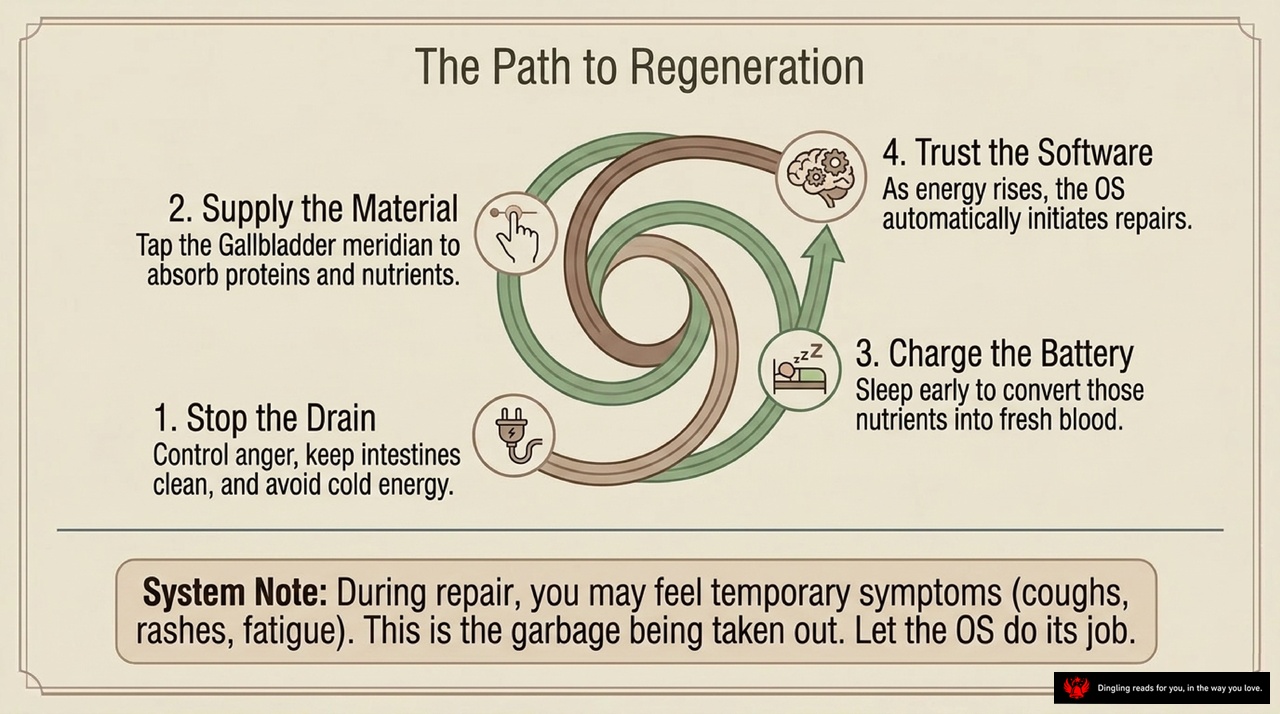
The Path to Regeneration isn't just a metaphor; it's a practical roadmap for healing your body from the inside out. Think of your body as a smart computer system, and this slide outlines the four essential steps to reboot it.
First, you must **Stop the Drain**. This means controlling your anger, keeping your intestines clean, and avoiding cold energy. If you're constantly leaking energy through stress or poor habits, your system can't function.
Next, **Supply the Material**. By tapping the Gallbladder meridian, you stimulate your body to absorb proteins and nutrients, giving it the raw materials it needs to rebuild.
Once you have the materials, step three is to **Charge the Battery**. This is where sleep becomes critical. Going to bed early allows your body to convert those nutrients into fresh blood, effectively recharging your system.
Finally, **Trust the Software**. As your energy rises, your body's operating system automatically initiates repairs. You don't need to force it; just let the natural healing process take over.
And a crucial system note: during this repair phase, you might feel temporary symptoms like coughs, rashes, or fatigue. Don't panic. This isn't a relapse; it's your body expelling the accumulated "garbage." Trust the process, let the OS do its job, and watch your regeneration begin.

True health isn't something you can manufacture in a lab or find in a pill. It's the natural result of aligning your daily habits with your body's brilliant, built-in operating system. Think of your body as a perfectly engineered machine designed to heal itself, but like any machine, it needs the right fuel and conditions to run. By restoring your internal energy, you aren't just fixing symptoms; you are empowering the ultimate physician that already resides within you.
If you view your body as a sophisticated system waiting to recover, the question becomes simple: What are you doing today? Are you actively charging its battery with restful habits and nourishment, or are you standing in its way with stress and exhaustion? The difference between thriving and merely surviving often comes down to one choice: trusting your body's innate wisdom to restore balance, or fighting against it with temporary fixes.