
The World as I See It: Complete Chapter-by-Chapter Summary

Welcome to "The World as I See It," a profound exploration of philosophy, pacifism, and humanity from the mind of history's greatest scientist, Albert Einstein. As you look at this page, surrounded by the vast cosmos and intricate equations, you're seeing the universe through his eyes—not just as a collection of stars and formulas, but as a deeply interconnected web of life. Einstein believed that the meaning of life isn't found in isolation, but in our connection to others. He argued that we live for those whose happiness depends on ours, and for strangers linked to us by shared fate. He championed a simple life, warning that class divisions lead to violence, and found true joy not in wealth or vanity, but in the pursuit of truth, goodness, and beauty. For Einstein, the most beautiful thing we can experience is the sense of mystery—the awe that fuels both art and science. Without that curiosity, without the feeling that the universe is a meaningful whole, life becomes empty. He didn't believe in a personal God who rewards or punishes, but found deep religious feeling in the wonder of life's eternal mystery. So, let this book be your guide to seeing the world not just as it is, but as it could be—a place where every individual matters, where peace is a moral duty, and where the pursuit of knowledge lifts us all.

Good morning, everyone. Today, we are diving into a profound concept that Albert Einstein explored: the dual nature of genius. As you can see on this slide, genius isn't a single trait but a balance between two seemingly opposing forces. On the left, we have "The Solitary Observer." Einstein described himself as a "lone traveler," someone who never fully belonged to his country, home, or even family. This solitude wasn't isolation for its own sake; it was a necessary condition for "absolute independence of mind." He believed that true intellectual freedom requires this distance, allowing the mind to soar without the constraints of social expectations.
However, on the right side of our visual, we see "The Social Conscience." Here, the logic flips. Einstein argued that while independence is vital, a life without serving humanity is ultimately empty. He felt deeply connected to the "labors of other men, living and dead." For him, the purpose of that solitary work was to give back to society, to contribute to the collective progress of humankind. He saw his inner and outer life as a bridge between individual discovery and shared human experience.
The center of this diagram holds the key to this duality: "True intellectual freedom requires absolute independence of mind, yet a life without serving humanity is empty." It is a delicate equilibrium. We need the solitude to think deeply and the connection to ensure our work matters. Without one, the other fails. Without the solitude, we lose our unique perspective; without the social conscience, we lose our purpose. This balance is what defined the greatest minds in history, reminding us that being a genius means being both a solitary explorer and a devoted servant to humanity.

Good morning, everyone. Today, we are exploring the very foundation of a meaningful life. As we look at this image, we see a temple built upon three pillars: Truth, Goodness, and Beauty. These are not just abstract concepts; they are the ideals that illuminate our path forward.
Let's start with the first pillar, Truth. It represents the relentless pursuit of understanding the universe's rational structure. It is about curiosity and the awe of mystery—the very roots of true science and art. Without this drive to understand, life can feel like wandering in the dark.
Next, we stand on the pillar of Goodness. This is about social justice, empathy, and the active reduction of human suffering. It reminds us that we do not live in isolation; our actions ripple out to affect others. True morality doesn't need a divine foundation; it springs from our shared humanity, our sympathy, and our social ties.
Finally, we have Beauty. This is the awe we feel when looking at art, nature, or the sheer mystery of existence. It is what gives life its depth and prevents it from becoming hollow.
Contrast this with what we call "The Rejected Foundation"—the "Pig's Ideal." This is the pursuit of mere property, outward success, luxury, and purely selfish comfort. While these things might seem appealing, they ultimately lead to a shallow existence.
The image also highlights a crucial point: morality does not require a divine foundation. Instead, ethical behavior should be based on sympathy, education, and social ties. We are called to be the guardians of these ideals, to reject the narrow pursuit of material gain, and to embrace a life dedicated to understanding, helping others, and appreciating the profound beauty of our world.

The slide before us outlines a profound evolution in how humanity understands the divine. It traces a journey from "Fear Religion" to "Moral Religion," and finally to "Cosmic Religion."
Let's look at where we started. In the earliest stages, religion was born out of a "primitive dread of hunger, beasts, and death." God was seen as a volatile force, something you had to appease with sacrifice, mediated by a powerful priestly caste. This was about survival through fear.
As society matured, we moved into the "Moral Religion." Here, the origin shifted to social feelings and a desire for guidance and love. God transformed into a providence that protects, rewards, and punishes human behavior. This was a step toward order and ethics.
But the slide highlights the most advanced stage: "Cosmic Religion." This is where the origin is no longer fear or social contract, but "awe at the harmony and rational structure of nature." In this view, there is no anthropomorphic creator. God is not a person judging us, but the universe itself. The mediator is no longer a priest, but "true art and scientific research."
This aligns perfectly with Einstein's view that the strongest motive for scientific research is this cosmic religious feeling. It's about experiencing the mystery of life and the universe's intricate structure. As he noted, without this sense of wonder, without the feeling that we are part of a meaningful whole, life becomes hollow. This isn't about worshiping a being; it's about revering the laws of nature and our place within the grand, rational order of the cosmos.

On this slide, we see a stark contrast between two visions of governance: the oppressive "Master State" and the liberating "Servant State." On the left, under "The Threat," we see militarism and autocracy depicted as a dark fortress, stripping human dignity and relying on violence. As Einstein warns, this system inevitably attracts low morality and leads to tyranny, where the state becomes a master over its people. On the right, under "The Ideal," we find a radiant network representing democracy and individuality. Here, the state is clearly defined as a servant, made for man, not man for the state. True progress comes only from the free, sensitive individual who can create the noble and the sublime. Einstein believed that the highest duty of the state is to protect this freedom, ensuring that no one is turned into an idol or a tool of the regime. This visual dichotomy captures his lifelong struggle against the dehumanizing machinery of war and authoritarianism, championing instead a society where human creativity and moral integrity reign supreme.

Friends, look at the blueprint before us. This isn't just a diagram of gears; it is a roadmap for a world where peace is not a fragile hope, but an engineered reality. The core idea, as the slide reminds us, is radical: disarmament cannot happen gradually. It must be absolute, backed by international law. Why? Because as long as the possibility of war exists, nations will inevitably prepare for it, and their populations will be conditioned to crave conflict rather than peace.
To make this work, we need to dismantle the psychological roots of war. Step one is abolishing conscription. Mandatory military service is the primary engine of aggressive nationalism; it turns citizens into soldiers and destroys personal dignity. We must protect conscientious objectors with international laws, ensuring that refusing to serve in a war machine is a protected right, not a crime.
But laws alone aren't enough. We need Step three: international arbitration. We must create a supranational court whose decisions are unequivocally binding on all nations. No more unilateral actions. Finally, we need Step four: unified enforcement. We must guarantee security through a combined international force capable of sanctioning any nation that breaks the peace. Only when we have a mechanism to enforce the rules can we truly disarm. This is the only path to saving our civilization.

Look at this cycle in the center of our slide: "The Crisis of Abundance." It's a powerful diagram showing how modern technology creates a paradox that threatens our entire society.
It starts with technological progress. Machines drastically reduce the human labor required to produce goods. This is a good thing, right? But it leads directly to the next point: workers are systematically eliminated from the production cycle. We end up with mass unemployment.
And here is the core of the problem: false overproduction. The crisis isn't caused by a lack of human need; we have plenty of needs. The real issue is a lack of purchasing power. Without wages, the masses cannot consume. When factories can't sell their goods, they stall, and society suffers. This is what I call economic paralysis.
The diagram shows a solution in the center: Regulated Interventions. We need to statutorily reduce working hours to eliminate unemployment, set minimum wages to guarantee mass purchasing power, and control prices on monopolized goods. This isn't just theory; it's the only way to break this cycle and ensure that our abundance actually benefits everyone.
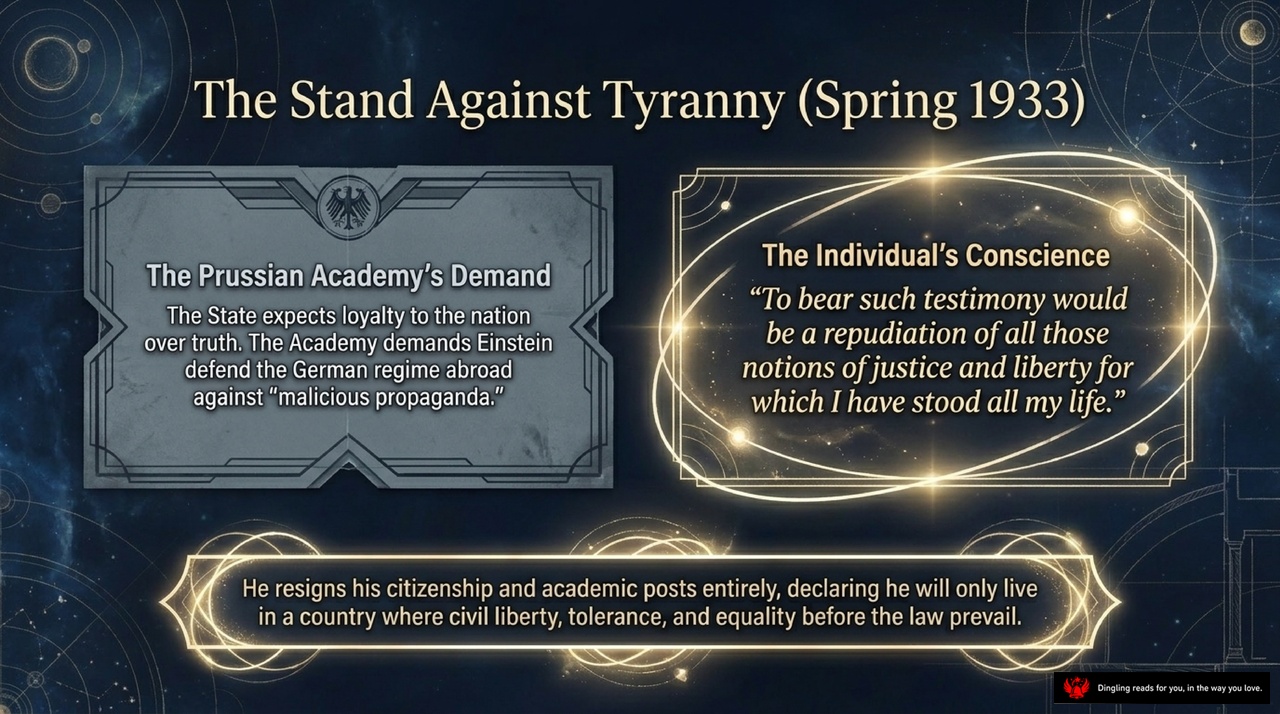
The state in 1933 demanded absolute loyalty to the nation, placing it above the truth. The Prussian Academy explicitly asked Einstein to defend the German regime abroad against what they called "malicious propaganda." But for Einstein, the individual's conscience was non-negotiable. He refused to bear testimony that would repudiate all notions of justice and liberty for which he had stood all his life. To compromise his principles would be a betrayal of his entire existence.
Faced with this impossible choice, he made a radical decision. He resigned his citizenship and academic posts entirely, declaring he would only live in a country where civil liberty, tolerance, and equality before the law prevail. This wasn't just an escape; it was a moral stand. He prioritized the values of a free society over the comfort of national belonging, proving that true integrity sometimes requires walking away from the very place you call home.
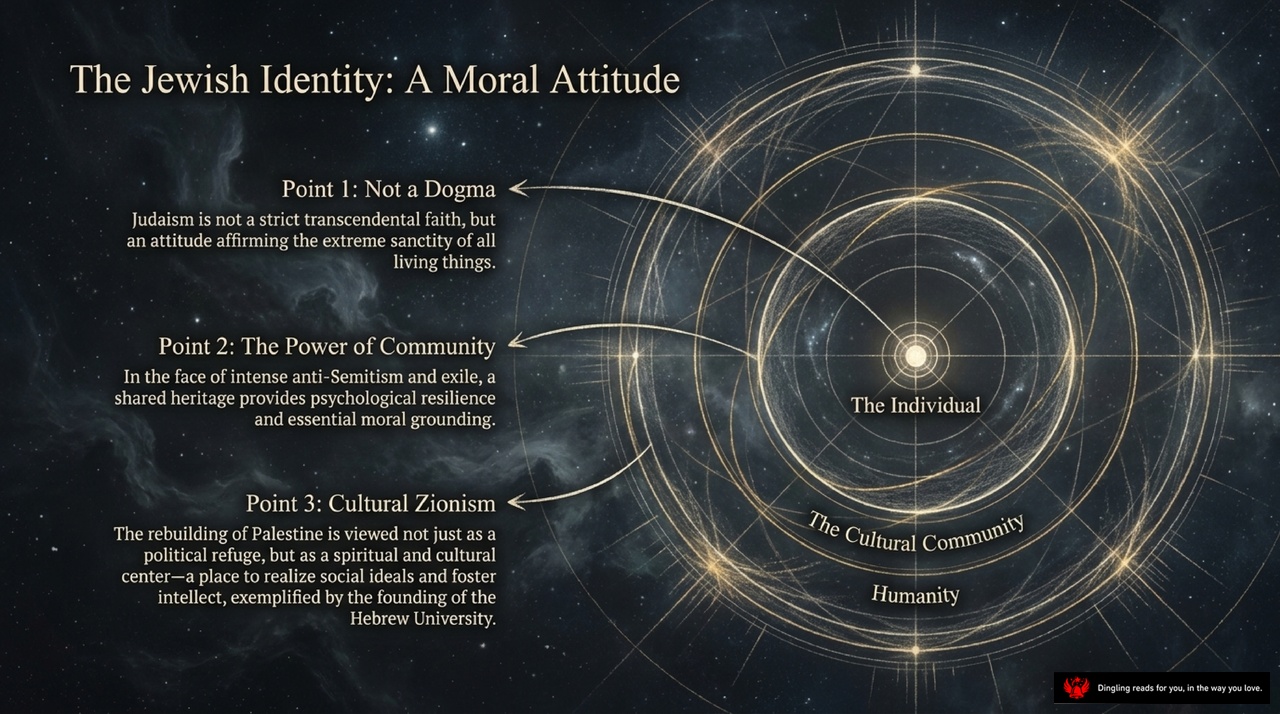
The Jewish identity, as we see it here, isn't about rigid dogma or blind faith. It's fundamentally a moral attitude—a deep-seated reverence for the sanctity of all living things. This perspective transforms Judaism from a set of rules into a lifestyle that affirms the value of every creature.
This moral core is powerfully reinforced by community. History shows us that in the face of intense anti-Semitism and exile, a shared heritage provides the psychological resilience and moral grounding necessary to survive. It's the individual within the cultural community, and the community within humanity, creating a protective and empowering circle.
Finally, this identity evolves into what we call Cultural Zionism. The rebuilding of Palestine is viewed not merely as a political refuge, but as a spiritual and cultural center. It's a place to realize social ideals and foster intellect, exemplified by the founding of the Hebrew University. This vision moves beyond survival to the creation of a new civilization, ensuring that the Jewish people contribute meaningfully to the future of all humanity.

The Enduring Vision. Einstein didn't just see the universe through a lens of cosmic wonder; he saw humanity through a lens of uncompromising pacifism and deep moral responsibility. He proved that true genius requires a fiercely independent mind paired with an unwavering commitment to the dignity of all people.
Consider this: if the architect of the modern universe believed that humanity's greatest duty is to serve and protect one another, then we must ask ourselves a critical question. Are we using our brief existence to build walls, or are we building bridges?
The choice is ours. We can either retreat into isolation, fortified by our differences, or we can step forward and construct connections that transcend borders and beliefs. Einstein's legacy challenges us to move beyond the fear that drives us apart and embrace the curiosity that brings us together. It is up to us to decide whether our short time on this planet will be defined by division or by the profound act of building bridges.