
The World as Reference Answers: Complete Chapter-by-Chapter Summary

Welcome to today's reading club. We are diving into a profound conversation between two renowned scholars, Liu Qing and Yan Fei, as they explore the concept of "The World as a Reference Answer."
Imagine standing in a grand library where the shelves stretch endlessly into a starry night sky. This image perfectly captures the book's core message: Break free from the prescribed standards of a canned existence and embrace the boundless complexities of a pluralistic universe.
In our fast-paced modern world, we often feel trapped by rigid expectations, like living in a pre-packaged life designed by someone else. But Liu and Yan invite us to do something radical: stop waiting for a perfect formula and start living authentically. They suggest that instead of seeking a static "answer," we should treat the world itself as a reference guide that helps us navigate our own unique journeys.
Whether you are struggling with career choices, personal relationships, or finding your place in society, this book offers a fresh perspective. It reminds us that there is no single right way to live. By embracing uncertainty and exploring the diverse possibilities around us, we can find our own path to a meaningful and fulfilling life.
So, let's turn the page and discover how we can rewrite our own stories, turning the world into our personal reference answer.

Imagine your life as either a grid of identical cans or an endless, unfolding map. On the left, we see "The Canned Life"—a rigid, factory-made script where every person is packed into a standard box with a strict expiration date. Society tells us when to study, work, marry, and retire, and if we deviate from this timeline, like being unemployed at thirty-five or feeling unlovable at forty, we are simply labeled a failure. We live like canned goods, terrified of going bad before the date hits.
But on the right, we have "The Open Canvas." This is the alternative. It suggests that life isn't a multiple-choice test with one correct answer; it's a vast, pluralistic landscape with no single right path. The shift we need is to shatter those cognitive frames—the mental lenses we use to project our own anxieties onto the world. Instead of seeing a limited menu of options, we must learn to perceive the world's actual, unscripted possibilities. We stop waiting for permission to live and start exploring the infinite terrain of our own potential.
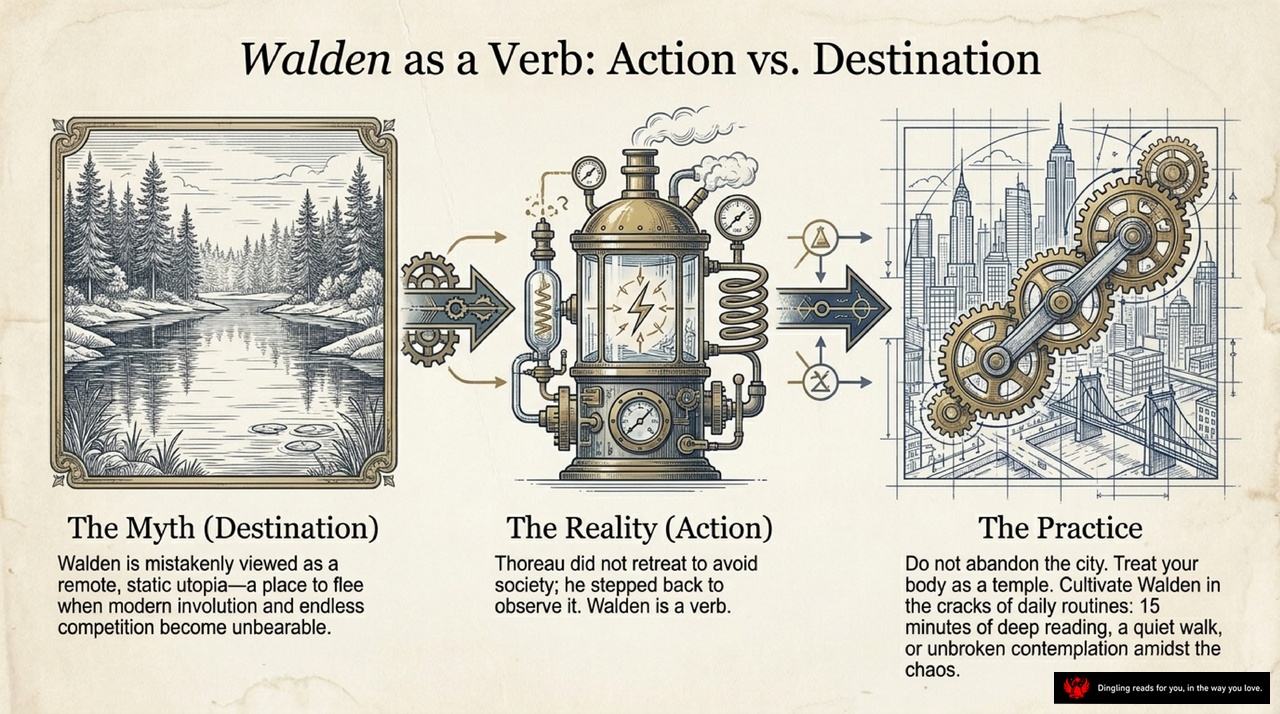
Walden as a Verb: Action vs. Destination.
Look at this image. On the left, we see the forest and the lake—the classic symbol of escape. Many of us view Walden as a distant utopia, a static place to flee to when modern life becomes too overwhelming. We treat it as a destination, a mythical refuge from our chaos.
But Thoreau never saw it that way. As the text reminds us, he didn't retreat to avoid society; he stepped back to observe it. He didn't run away; he chose a different perspective. This is the reality: Walden is not a place you go to; it is a verb. It is an action you practice.
So, how do we live this? The practice isn't about abandoning the city or hiding in the woods. It's about treating your body as a temple and cultivating Walden within the cracks of your daily routine. You don't need to quit your job to find peace. You can find it right here. Whether it's fifteen minutes of deep reading, a quiet walk, or simply a moment of unbroken contemplation amidst the noise, you are already living Walden. It's not about escaping the world, but about re-entering it with a clear, intentional heart.

Modern society often whispers a dangerous lie: that there is a perfect, permanent home waiting for us if we just go back to the right place. But as sociologist Yan Fei reminds us, nostalgia is often just a taste memory, a fleeting sensation of the salted duck or the wood-fired wontons that can't rebuild a lost world. When we return to our hometowns, we often find the physical streets have changed, and worse, the human connections that once anchored us have vanished. This is what anthropologist Xiang Bing calls the disappearance of the "nearby"—the erosion of the very fabric that makes a place feel like a home.
Consider the story of Eric Li, who left his working-class background in France to escape a crushing social mirror of poverty and shame. He spent decades climbing the ladder in Paris, only to realize that true belonging wasn't found in distance, but in returning to listen to his mother's stories and rebuild that broken connection. His journey teaches us a profound truth: the essence of home isn't a fixed geography; it is an active creation. As he famously wrote, "What matters is not what we become, but what we do in the process of changing ourselves."
So, how do we settle this eternal ache of displacement? We must shatter the myth of the static homeland. The true "home" we need is not a place we return to, but a state of mind we build right now. It's about shifting our perspective from "nowhere" to "now here." As Chen Yinke suggested, we can treat every new location as our home if we choose to root ourselves deeply within it. Whether it's joining a community night school to learn calligraphy or simply sitting on a park bench talking to a neighbor, these small acts of connection rebuild the "nearby." As Su Dongpo wisely put it, "Where the heart finds peace, that is home." We don't need to wait for the past to return; we just need to plant our roots firmly in the present moment, in this very place, and grow.
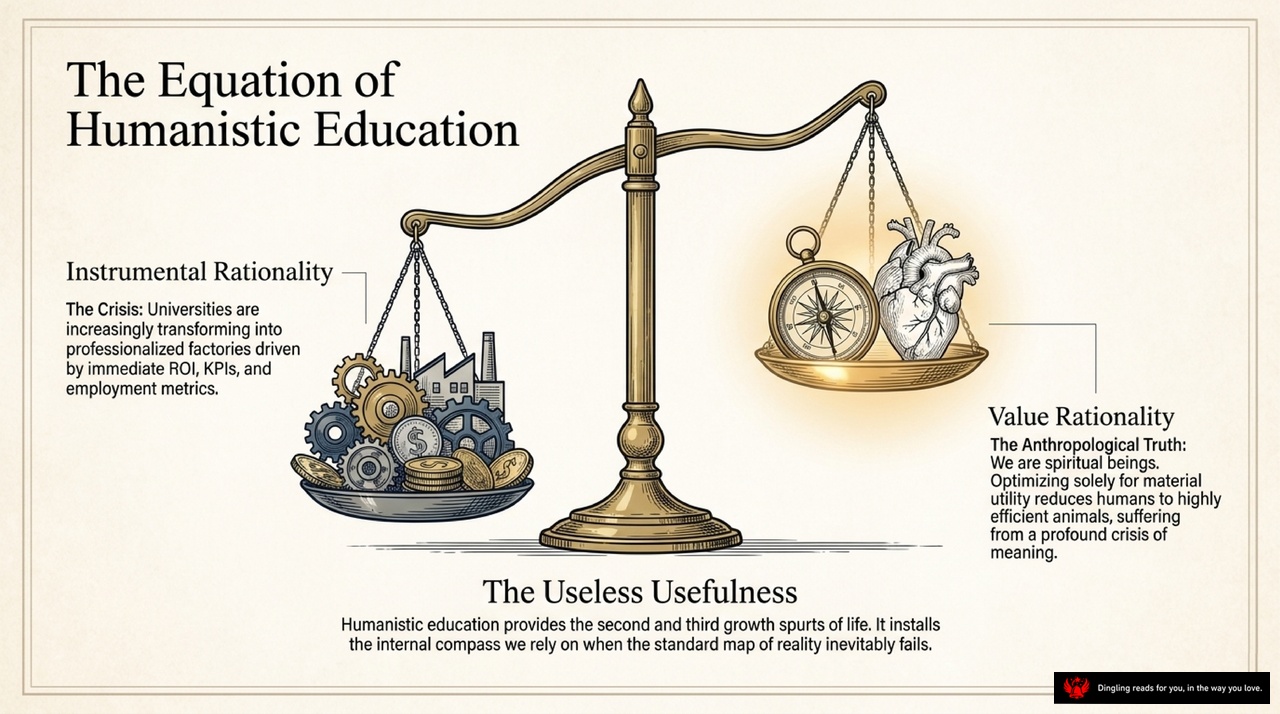
Modern life often feels like a relentless chase, where we constantly search for a fixed "home" to anchor our souls. But as we explore the complexities of nostalgia, we realize that the idea of returning to a perfect, unchanged past is actually a myth. True belonging isn't about geography; it's about connection.
Consider the story of a young man named Junjun in Jiangxi. He sacrificed everything to get close to his parents in Beijing, only to find himself trapped in a cycle of disappointment when his dreams didn't match his parents' expectations. His pain wasn't just personal; it was a clash between his desire for self-definition and the weight of traditional expectations. This mirrors a universal struggle: we leave home because we are dissatisfied, and we return hoping to find peace, only to discover that the "home" we remember has already changed.
So, how do we find our way? We must stop waiting for a magical place to appear. Instead, we should embrace the concept of "nowhere" as "nowhere"—being fully present in the here and now. Just as Su Dongpo famously said, "Wherever the heart finds peace, that is home." We can rebuild our sense of community by engaging with our immediate surroundings, whether it's joining a local night school or simply sitting on a bench and talking to a neighbor. By rooting ourselves in the present moment and forging genuine connections with the people and places around us, we transform every "foreign land" into a home. The journey isn't about going back; it's about growing forward, finding our true home in the very act of living authentically today.
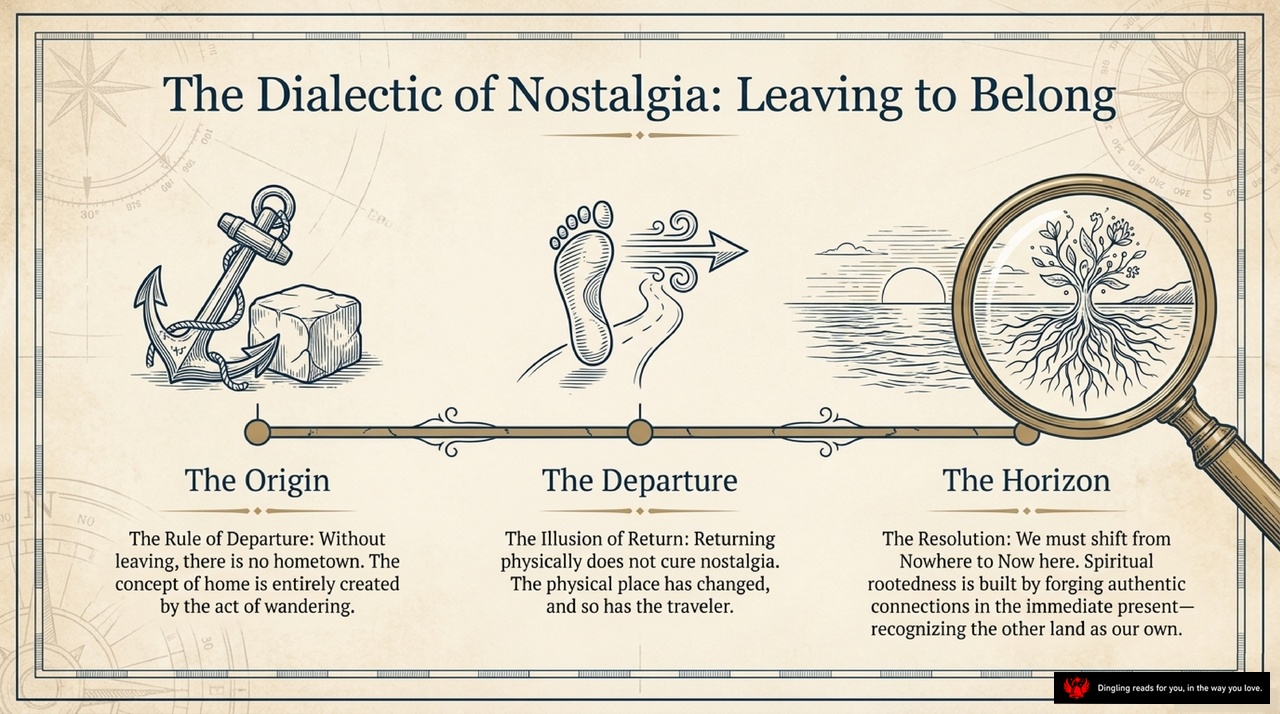
Modern society has developed a strange fear of pain, often treating it as something to be avoided at all costs. We see endless content promising quick fixes for anxiety, yet we remain trapped in a paradox of wanting to escape suffering while secretly needing to express it. The real issue isn't just that we feel pain, but that we refuse to look deeply into it. We try to explain it away with simple slogans about human nature seeking pleasure, or we mask our feelings with an emoji, completely avoiding the raw experience.
But let's be clear: pain is not an enemy to be defeated. It is an inevitable part of being human. From a sociological perspective, pain starts as an individual reaction to loss or failure, but when shared, it becomes a collective memory that binds us together. Think of how generations pass down stories of hardship, turning personal trauma into cultural identity. Philosophically, pain and the feeling of pain are inseparable; you cannot have one without the other. A life without pain is not truly human.
So, how do we face it? We don't need a magic solution. Sometimes, the best way is to simply record and tell our stories. Writing, talking to friends, or even creating fiction can help us process these heavy emotions. For others, facing pain head-on, analyzing the painful details, and integrating them into our life narrative is the path to freedom. As we learn, the opposite of pain isn't happiness; it is liberation. True healing comes from growing through our suffering, moving from self-negation to understanding and compassion. We don't need to hide; we just need to find a way to carry our pain with courage and grace.

Travel isn't just about changing your scenery; it's about expanding your soul. When cities look the same and screens show us every view, why do we still pack our bags? The answer lies in seeking diversity and truly meeting the "Other." As sociologist Peter Berger once imagined, the joy of travel is chatting with invisible passengers on a toy train—curiosity about another's story is the essence of the journey.
But be careful not to turn travel into mere tourism. Chasing a checklist of landmarks and snapping photos often leaves us feeling empty, seeing things but not people. Real travel requires an on-the-ground attitude, building genuine connections. I remember buying a car in Boston and chatting with an Iranian salesperson named Bob. What started as a transaction turned into a friendship, filling my trip with the warmth of local life.
Travel is also a two-way mirror. Just as Milan Kundera said, "Others are mirrors," encountering strangers helps us escape our own familiar caves. By facing the "Other," we realize our own cultural biases and understand that our way of life isn't the only one. If we stretch this travel into long-term living, we engage in deep cultural exchange. During my year in the US, I bonded with a doctor from Kuwait over their children's school, and I even helped publish a translation of a humanist's work. These moments are far richer than just experiencing foreign culture.
Culture isn't static; it changes through encounter. Even amidst current tensions between China and the US, we are already intertwined. We must guard against cultural hegemony and promote equal, voluntary exchange. True travel also means diving into daily details. Walking in Cambridge, I found benches honoring ordinary residents who served their community for decades. Sitting there, watching children play, I felt connected to their lives. History lives in these places too; walking on a street once visited by Chen Yinke makes time feel fluid.
Finally, treat travel like fieldwork. Keep one foot inside and one foot outside, like being on a threshold. This critical distance lets you see details others miss. Whether healing from personal struggles or simply broadening horizons, the true goal is to return home with a renewed perspective. Even if your body stays put, your mind can travel far, discovering new meaning in the familiar.
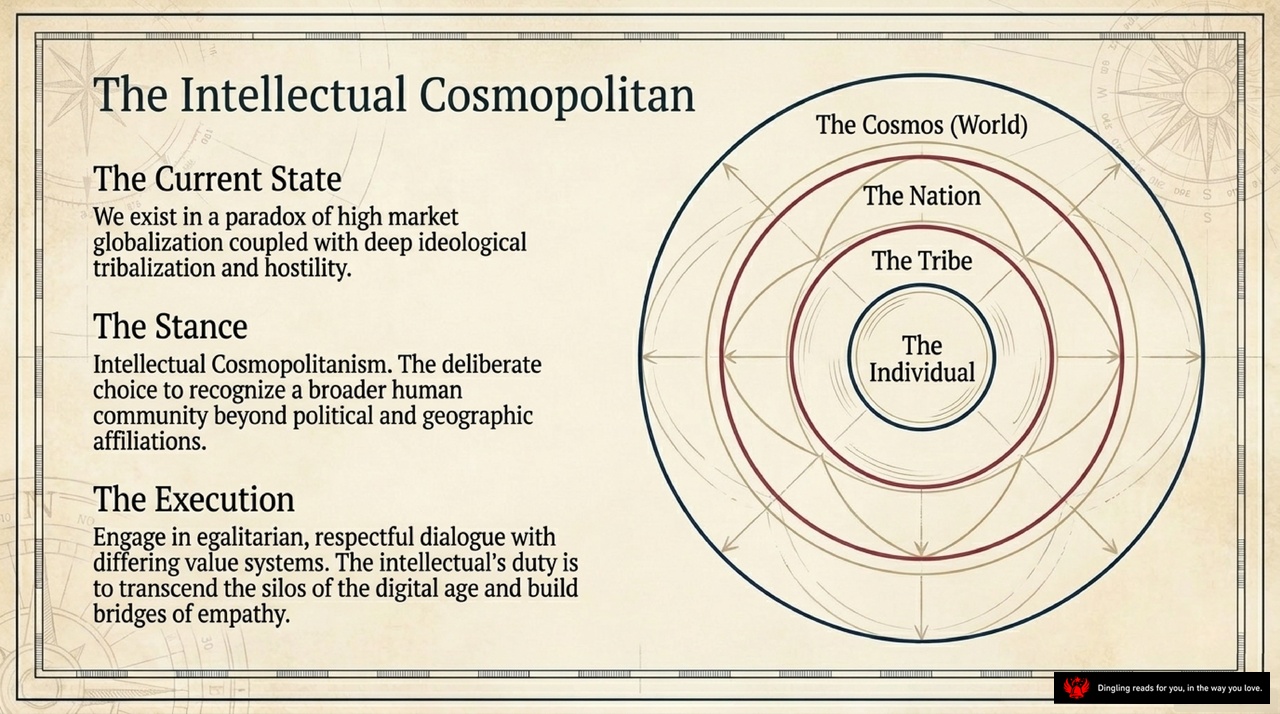
The Intellectual Cosmopolitan. Look at this diagram on the right. It maps out our world in concentric circles: starting from the very center with The Individual, expanding outward to The Tribe, then The Nation, and finally, The Cosmos, or the World. This visual perfectly captures the core tension of our modern era. We live in a paradox. On one hand, we have high market globalization that connects us all economically. On the other, we suffer from deep ideological tribalization and hostility. We are hyper-connected yet deeply divided.
So, what is the solution? The slide proposes a deliberate choice: Intellectual Cosmopolitanism. This isn't just about traveling or knowing foreign languages. It is a conscious decision to recognize a broader human community that exists beyond our political borders and geographic affiliations. It means stepping out of the narrow circle of your tribe or nation to see the larger human story.
But how do we actually do this? The slide outlines the execution. It calls for egalitarian, respectful dialogue with differing value systems. We must engage with those who think differently without dismissing them. The intellectual's duty here is clear: we must transcend the silos of the digital age. Instead of letting algorithms push us into echo chambers, we need to build bridges of empathy. We need to move from the comfort of our specific "tribe" toward a shared understanding of the "Cosmos." It is about finding common ground in our differences and recognizing that our individual lives are part of a much larger, shared human experience.
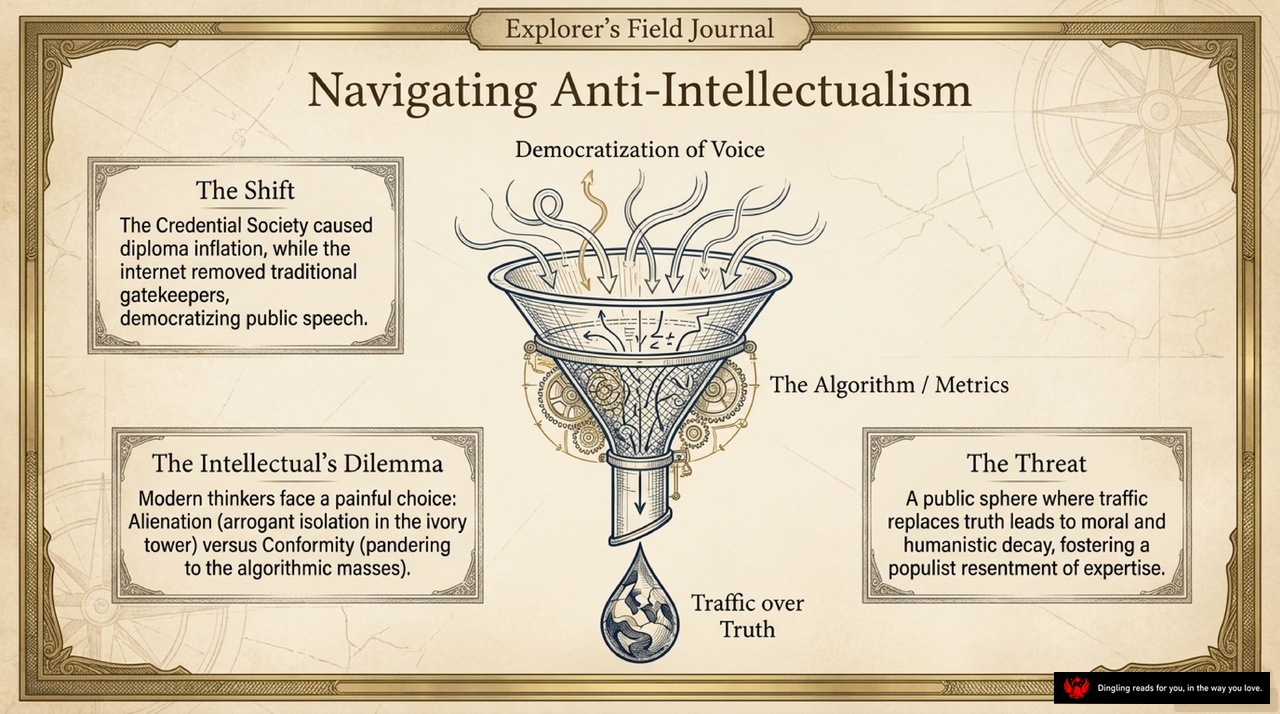
Navigating Anti-Intellectualism: The Shift, The Dilemma, and The Threat.
Let's talk about how we got here. It all started with a major shift. The "Credential Society" caused diploma inflation, while the internet removed traditional gatekeepers, democratizing public speech. Suddenly, everyone had a voice. But look at what happened next. We moved from "Democratization of Voice" straight into a funnel controlled by "The Algorithm / Metrics."
This funnel doesn't filter for truth; it filters for engagement. The output? "Traffic over Truth." We've built a public sphere where traffic replaces truth, leading to moral and humanistic decay. This fosters a populist resentment of expertise, which is the real threat we face today.
So, where does this leave us? We face the Intellectual's Dilemma. Modern thinkers are stuck between two painful choices: Alienation, which is arrogant isolation in the ivory tower, or Conformity, which means pandering to the algorithmic masses. Neither path is a victory.
The solution isn't to hide behind credentials or to chase clicks. It's about reclaiming our agency. We need to move from being passive consumers of traffic to active seekers of truth. We must rebuild a public sphere that values understanding over virality. Because if we let traffic dictate our reality, we lose our humanity. The choice is ours: will we build a bridge to truth, or just another funnel for our attention?

Imagine standing right at the threshold of two worlds: one side buzzing with the chaotic energy of society, the other quiet and solitary. This is the core of what we call "The Engaged Observer Protocol." It asks us to stand firmly on that dividing line, neither fully swallowed by the crowd nor completely lost in isolation.
To the left, we have "Immersion." This means stepping inside to truly feel the empathy, pain, and raw reality of the crowd. You have to get close enough to understand the human experience from the inside out. But to the right, we need "Distance." Stepping outside allows us to maintain that critical space necessary for analysis, protecting us from being overwhelmed by mass emotional contagion.
The action here is simple yet profound: break down those high academic walls. Bring real, marginalized voices—like the delivery rider or the window installer—right into the center of public discourse. By translating abstract theory into lived reality, we don't just observe the world; we engage with it authentically.

We live in an age obsessed with the fear of pain. Social media is flooded with quick fixes for anxiety, promising to bypass any discomfort, even the heartbreak of love. But this desire to escape leaves us trapped in a contradiction: we want to flee, yet we crave to speak. The real issue isn't avoiding pain, but refusing to understand its source. We often reduce human nature to a simple equation of seeking pleasure and avoiding pain, using an "emo" emoji to dismiss deep feelings. But pain is not a bug in the system; it's a feature of being human.
Think of pain not as a solitary object, but as a shared experience that connects us across generations. Just as 1980s literature captured the collective trauma of a political era, or how the memory of the Nanjing Massacre has become a cultural anchor for a nation, our personal struggles can transform into something that binds us together. Pain and the feeling of pain are inseparable; you cannot have one without the other. A life without pain isn't human life at all.
The modern trap, however, is what philosopher Byung-Chul Han calls the "affirmative society"—a meritocracy that demands constant positivity. In this "tyranny of optimism," admitting you are struggling or that your work feels meaningless is seen as a weakness. We are forced to wear a mask of happiness, even when we are exhausted. But we don't need to suffer silently, nor do we need to pretend everything is fine. We have choices.
The most powerful antidote to pain is not a magical solution, but the act of recording and telling our stories. Writing, whether in a journal or a letter, allows us to face our emotions without shame. As we process our pain, we move from being victims of it to becoming its authors. True healing isn't about returning to a state of constant happiness; it's about growth. It's about moving from narrow self-doubt to a broader capacity for empathy and understanding. We don't need a pill to cure our pain; we just need the courage to sit with it, understand it, and find our way through it.
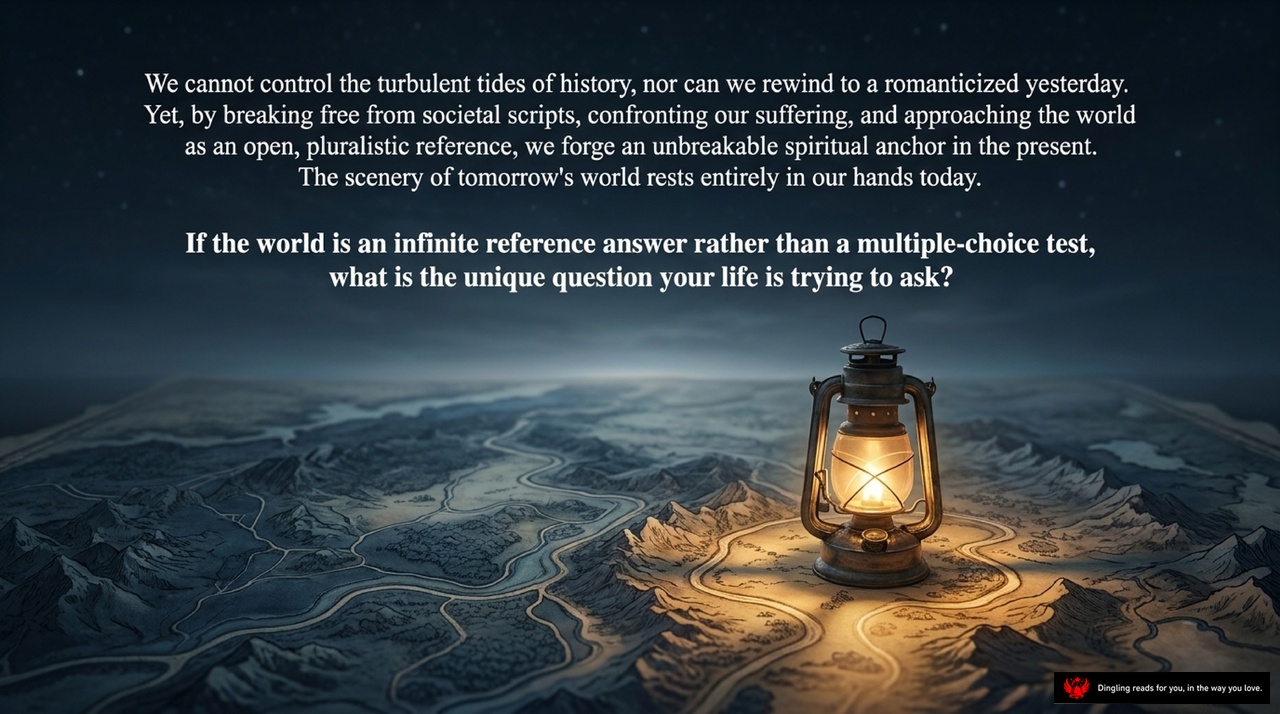
We cannot control the turbulent tides of history, nor can we rewind to a romanticized yesterday. Yet, by breaking free from societal scripts, confronting our suffering, and approaching the world as an open, pluralistic reference, we forge an unbreakable spiritual anchor in the present. The scenery of tomorrow's world rests entirely in our hands today.
If the world is an infinite reference answer rather than a multiple-choice test, what is the unique question your life is trying to ask?
In a world that often feels like a rigid exam with only one right answer, we are constantly pressured to check the boxes of success, productivity, and conformity. But what if life isn't a test to be passed, but an open-ended inquiry to be lived? The image before us—a lone lantern standing amidst vast, shadowed mountains—captures this very moment of solitude and possibility. That lantern represents our agency, our ability to illuminate our own path even when the landscape around us is dark and uncertain.
Liu Qing and Yan Fei remind us that we cannot escape the chaos of the times, but we can choose how we relate to it. Instead of hiding from the "turbulent tides of history," we can break free from the scripts society has written for us. By facing our pain head-on and treating life as a vast, pluralistic reference rather than a narrow set of rules, we build a spiritual anchor that holds us steady. This anchor allows us to stop looking back at a romanticized past or fearing an unknown future, and instead focus on what we can do right now.
The question posed on this slide is profound: If life is an infinite reference answer, what unique question is your life asking? Are you living to please others, or are you asking the world, "What is my truth?" Are you following a path laid out for you, or are you defining your own direction? The lantern in the image suggests that the answer doesn't come from the distant peaks or the dark valleys, but from the light you carry within yourself. It is up to us to decide what that question is, and more importantly, to have the courage to live out the answer.