
Things to Think About in Life: Complete Chapter-by-Chapter Summary

Welcome to today's session. We are diving into *Things to Think About in Life* by Jiddu Krishnamurti.
This book isn't just another guide on how to succeed or fit into society. It invites us on a profound journey to unlearn the conditioning of our world, break free from the heavy chains of fear and ambition, and rediscover the true essence of education, freedom, and love.
Krishnamurti challenges us to ask the hard questions: Is our education truly helping us understand life, or are we just training ourselves to compete for grades and jobs? He argues that living solely for survival is missing the point entirely. Life is vast—it includes the beauty of nature, our inner conflicts, and our relationships. True education should cultivate wisdom, a quality that allows us to think freely without fear or rigid formulas.
But here is the core message: as long as we are driven by fear or the desire to become someone else, true freedom is impossible. We often chase success, status, or approval, but this only enslaves us. Real freedom comes from knowing yourself completely, without comparison or judgment. It is about being present in every moment, observing your own thoughts, and understanding that wisdom isn't something you accumulate from books. It arises when you stop running from yourself and start loving life as it is.
So, let's begin by exploring what it means to live with clarity and love, free from the noise of the world.

Look at this blueprint of our modern life. We've built a concrete pool, completely cut off from the river of life. Inside this pool, we stagnate, filling our days with exams, jobs, marriage, and the inevitable march toward death. We call this stagnation "security." We feed on routine, imitation, and the slow decay of our potential, convinced that this tiny, enclosed corner is the only place where we can be safe.
But look to the right of that pool. There is the river. It flows, it changes, it is alive. Life is a great mystery, vast and deep, and yet we prepare ourselves to understand only a tiny corner of it. We dig this small pool away from the river and stagnate in it, calling it security. We are terrified of the current, so we build walls around ourselves. We think that by limiting our experience, by sticking to what we know and avoiding the unknown, we are protecting ourselves. But in reality, we are just trapping ourselves in a system of fear and limitation.
The text reminds us that life is not just about fitting into a pre-made mold or securing a comfortable spot in a decaying structure. True life is in that flowing river—the uncertainty, the risk, the constant becoming. When we cling to the pool, we lose the very essence of existence. We trade the infinite possibilities of the river for the illusion of safety in the stagnant water. It is a tragic irony that in our desperate attempt to find security, we have actually created a prison for our own souls.

Imagine a world split into two distinct paths. On the left, we have "The World's Way," which we might call "The Mechanic." This is a life driven by the fear of failure and an obsessive desire for security. It's a system built on passing exams, blindly conforming to authority, and endlessly accumulating titles. The result? We become machines—minds that are dull, exhausted, and ultimately cruel to one another.
But look to the right. That is "True Education," or "The Creator." This path isn't about fear; it's cultivated by intelligence and the complete absence of it. True education isn't about unlearning facts, but unlearning the conditioning that limits us. It's about understanding the totality of life, not just a syllabus. Instead of becoming a machine, this path leads you to find what you truly love. It creates a mind capable of independent discovery, one that isn't just reacting to the world, but actively creating it.
The contrast is stark: one path creates a society of fearful followers, while the other unlocks the potential for a creator who lives with freedom and wisdom. Which side of the blueprint will you choose to build your life on?
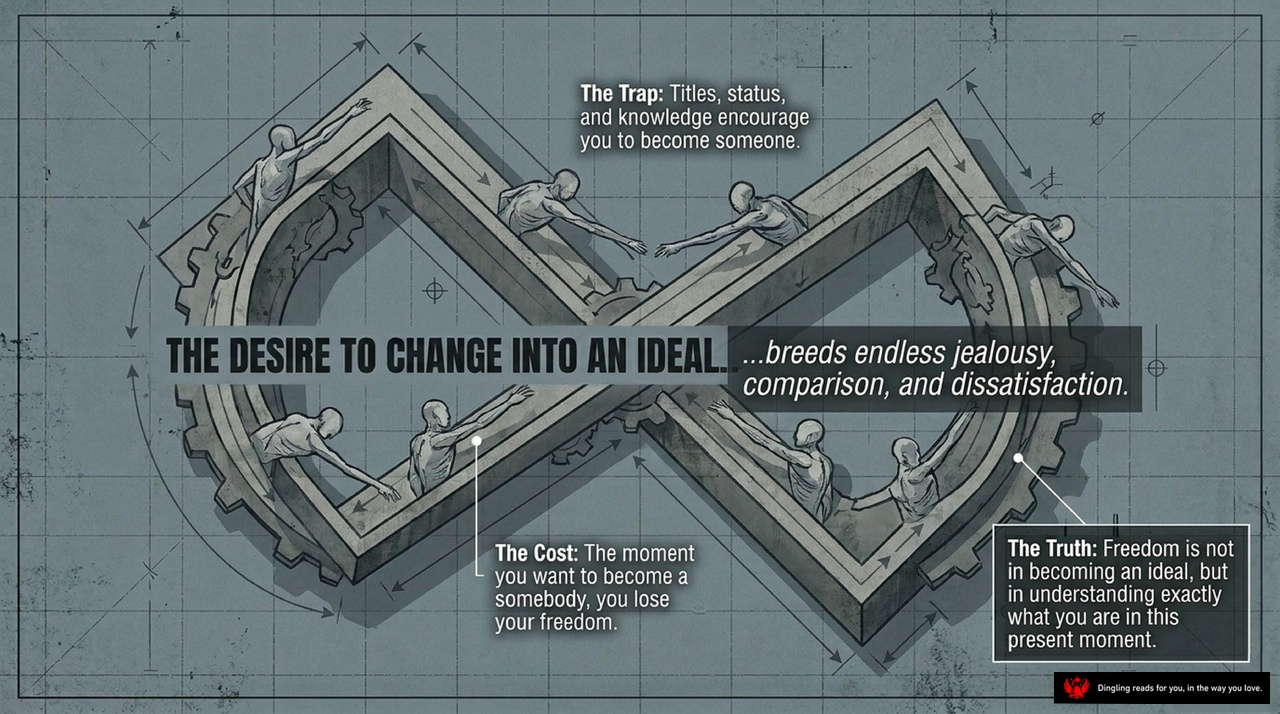
Look at this diagram. It illustrates a dangerous cycle we all fall into: the desire to change into an ideal.
The Trap is right there at the top. We are constantly told that titles, status, and knowledge will help us "become someone." But this very desire to become something else breeds endless jealousy, comparison, and deep dissatisfaction. It creates a loop where we are never satisfied with who we are right now.
The Cost of this cycle is heavy. The moment you decide you want to become a "somebody"—whether that's a successful professional or a spiritual master—you lose your freedom. You become a slave to the future, always chasing an image that isn't real.
But there is a Truth to break this cycle. Freedom isn't found in becoming an ideal. True freedom is simply understanding exactly who you are in this present moment. It's about stopping the frantic attempt to transform yourself and instead seeing your reality clearly. When you stop trying to be someone else, the endless competition and fear disappear, and you finally find the space for genuine freedom.
Imagine a small, stagnant pool cut off from the river, filled with waste and dead fish, while right beside it, the river flows endlessly, vibrant and full of life. This is the trap we all build for ourselves. We construct walls around our minds using family, ambition, religious beliefs, and fear, creating a stagnant little pond where we mistake corruption for survival. We cling to this stagnation, building elaborate philosophies to justify our lack of growth, terrified that anything might break this fragile "safety."
But life is not meant to be static. Look at the bare tree standing stark against the sky. It has lost every leaf, yet it is beautiful in its vulnerability, waiting for the spring breeze to bring new life. This is the natural rhythm of existence—there is no such thing as permanent security. Our fear of death, of losing our loved ones or our possessions, is actually just a fear of the unknown, a refusal to live in the present moment. We invent theories of an afterlife to escape this reality, but true freedom comes from living fully in every single second.
True religion isn't found in temples, rituals, or statues; it is a living, flowing river of love that doesn't seek to possess. We often worship gods because we are filled with fear, using these idols to fill the void inside us. But if you face your own unhappiness and fear directly, you find the truth without needing any external savior. The real work of humanity isn't to compete for status, power, or money, but to break free from the self and merge with the river of life itself. When you do this, you stop worrying about security, and you discover a profound, terrifying beauty that is the only thing that truly matters.

Look at this image. It depicts a heavy, industrial cage constructed from words like "Rules," "Tradition," "Authority," "Obedience," and "Dogma." This visual perfectly captures a central tension we face today: the difference between discipline that binds you and true order that liberates you.
The slide suggests that when we are trained solely to obey, to follow rules and respect authority without question, our minds stop discovering. We become prisoners of a "do and don't" mentality. But true order doesn't come from imposed rules or blind obedience. It springs from deep, inner understanding and sensitivity.
Consider your own life. How often do you follow a path simply because your parents, teachers, or society told you it was the "right" way? We often mistake compliance for discipline. But as the text reminds us, a mind that has stopped asking questions is a mind that has stopped living. True freedom isn't about breaking rules; it's about understanding the truth so deeply that external constraints become unnecessary. When we stop relying on authority to tell us who to be, we finally stop the endless, exhausting struggle to become someone else. That is where real creativity and a meaningful life begin.

Imagine a river flowing endlessly, full of life and vitality, right next to a stagnant, isolated pool dug by a fisherman. That stagnant pool represents most of us. We have built walls around ourselves using family, ambition, religious beliefs, and deep-seated fears, cutting ourselves off from the living flow of existence. We mistake this stagnation for safety, convincing ourselves that this small, static life is the only way to be, while the river beside us remains free and dynamic.
But life isn't meant to be a stagnant pool. It is a river of constant change. Look at the bare tree standing against the sky; its beauty lies in its willingness to let leaves fall and wait for spring. We fear death because we are terrified of losing the familiar—the person we loved, the wealth we accumulated, the status we hold. But birds don't fear death; they live fully in every moment, catching insects and building nests without worrying about the future. Our fear of death is just a fear of losing what we think we know.
The text reminds us that true religion isn't about rituals, hymns, or statues; it is a living, flowing love. We often worship a god because we are filled with fear, using temples and prayers to escape our own unhappiness. But if we stop running away from our pain and face it directly, we find the truth and joy right here, without needing an idol.
We also need to rethink how we focus. Usually, we try to narrow our minds, blocking out distractions like noise or thoughts. But real focus isn't about building walls; it's about creating space. It's the ability to hear the sound of a bell and the silence between the rings simultaneously. It's listening to someone without judgment, catching the meaning in their words and the pause in their speech. When we learn this effortless focus, we become aware of everything around us, from the teacher's hidden biases to our own inner reactions.
Ultimately, the goal isn't to accumulate more knowledge or reach a higher status. That endless pursuit of "more" creates conflict and sorrow. True freedom comes from understanding that we are part of this living river. When we stop fighting the current and stop trying to control the flow, we stop struggling. We become part of life itself, experiencing a profound freedom and beauty that no stagnant pool could ever offer.
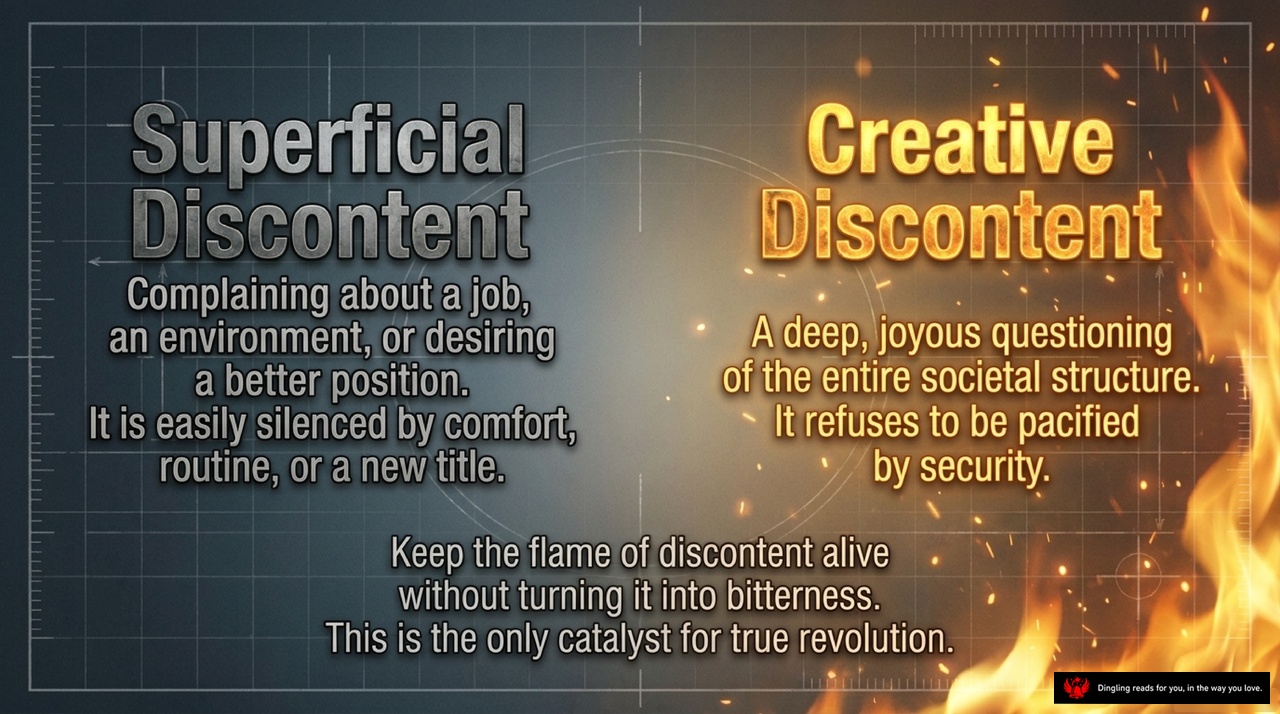
Look at this slide. It presents a powerful distinction between two types of discontent. On the left, we have "Superficial Discontent." This is the kind of dissatisfaction that stops at the surface—complaining about a job, an environment, or simply wanting a better title. It's easily silenced by comfort, routine, or a new promotion. It keeps us stuck in the same cycle.
But on the right, we see "Creative Discontent." This is the kind of dissatisfaction that sparks real change. It is a deep, joyous questioning of the entire societal structure. It refuses to be pacified by security or the promise of a better position. While superficial discontent asks for a better seat in the existing game, creative discontent asks us to rethink the game itself.
The bottom of the slide reminds us of the crucial balance: keep the flame of discontent alive without turning it into bitterness. This is the only catalyst for true revolution. As we've discussed, true change doesn't come from adapting to a broken system, but from the courage to question it. It requires moving beyond the fear that drives us to seek security, and embracing the freedom to create something entirely new.

Imagine your mind as a complex system, constantly bombarded by layers of noise. Look at this diagram: at the very center, we have "Pure Observation." But try to reach it, and you'll see it's surrounded by thick, concentric rings of interference. The innermost ring is "The Desire to Find an Answer." How many times have you listened to someone, not to hear them, but to figure out what they mean or to confirm your own opinion? The moment you start looking for an answer, you stop listening. That desire creates a barrier.
Moving outward, we hit "Personal Biases & Past Memories." Your childhood, your culture, your past failures—all of this filters what you hear. You aren't hearing the person in front of you; you're hearing a reflection of your own history. Then, the next layer is "Societal Conditioning." We are taught how to speak, how to dress, and how to think from the moment we are born. We mimic the leaders, the teachers, and the society around us, creating a rigid framework that limits our perception.
The text at the bottom captures this perfectly: "If you listen to find an answer, you are not listening." True listening requires a quiet mind. It means stripping away the desire to fix, the urge to judge, and the weight of our past. It's about observing without the interference of the ego. Only when these layers—the answer-seeking, the biases, the conditioning—dissolve, can you finally touch the core: Pure Observation. In that silence, without the noise of the "me," truth reveals itself.

Look at this split screen. On the left, we see "Accumulating (Dead)"—a rusted filing cabinet stuffed with old books, scrolls, and hard drives. This represents how most of us treat learning: hoarding facts, memorizing data, and storing memories like static files. It's bound by time, useful only for mechanical tasks, and ultimately lifeless.
But on the right, we see "Learning (Alive)" swirling like a vibrant blue river. True learning isn't about collecting the past; it's a constant, fresh discovery of the present moment. It flows without the heavy burden of yesterday's knowledge. When we stop trying to accumulate dead memory and start engaging with the living now, we unlock a dynamic intelligence that can actually solve the complex problems of our world. Let's stop filling our minds with dust and start flowing with life.

Have you ever noticed how we often build little, stagnant pools for ourselves? We separate our lives from the flowing river of existence, constructing walls out of ambition, fear, family expectations, and rigid religious beliefs. We trap ourselves in these isolated spots, convincing ourselves that this static, stagnant life is the only way to survive, and we even create complex philosophies to justify our refusal to change. But look around you: the river beside the pool is always moving, deep, and full of life, while the pool within it is filled with rot and has no fish.
True freedom isn't found in these comfortable, self-made prisons. It requires the courage to step out of the pool and merge with the river. Life itself is a constant rhythm of change—leaves falling, snow melting, trees shedding their branches only to bloom again in spring. We fear this because we cling to what we know, terrified of losing our status, our loved ones, or our accumulated possessions. But this fear is the root of our suffering. Birds do not fear death; they live fully in every moment, focused on the joy of flying and feeding. When we stop resisting the flow of life and embrace the present moment without worry for the future, we finally find peace.
This brings us to a crucial distinction: the difference between knowledge and wisdom. Knowledge is essential for practical things like building bridges or curing diseases, but when it turns into rigid tradition or dogma, it becomes a shackle that divides us and blinds us to truth. True wisdom is the ability to let go of these accumulated patterns and see things as they are. It is a fresh, living understanding that cannot be taught in a classroom. It arises only when your mind is quiet, free from fear and ambition, and ready to explore the unknown. Only then can you discover the beauty of life and experience the profound freedom that comes from being truly part of the whole.
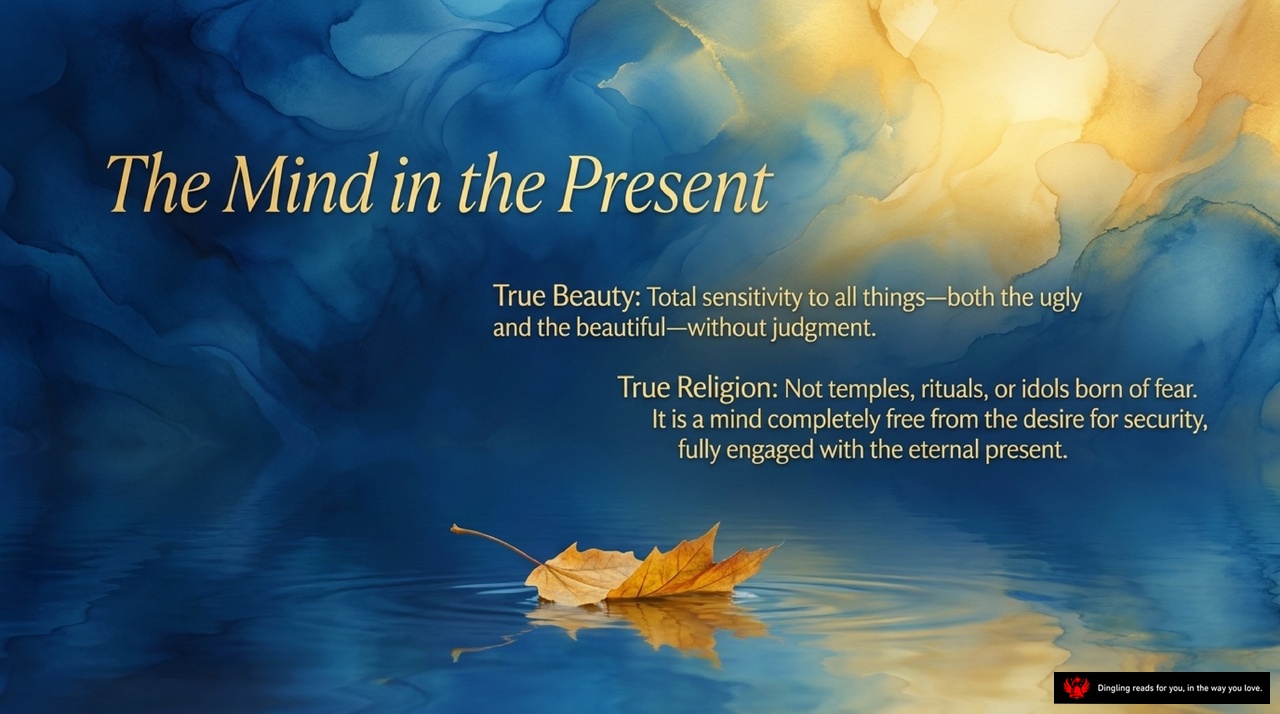
Imagine a single leaf drifting on a calm, deep blue lake, reflecting the golden light of the sun above. This image captures the essence of what it means to live fully: being completely present. Today, we explore the profound idea of "The Mind in the Present."
True beauty, according to this philosophy, isn't just about seeing the pretty parts of life. It is a total sensitivity to everything—both the ugly and the beautiful—without any judgment. When we stop labeling things as good or bad, we open ourselves up to the fullness of existence.
But what about religion? We often think of it as temples, rituals, or idols born out of fear. Yet, true religion is something far deeper. It is not about external structures or blind faith. True religion is a mind that is completely free from the desperate desire for security. It is a state where you are fully engaged with the eternal present, living in the now without the weight of the past or the anxiety of the future.
When we let go of the need to control our safety or our image, we find a freedom that allows us to see the world clearly. Just like that leaf on the water, we don't need to fight the current; we just need to be there, fully aware, and that is where true life begins.
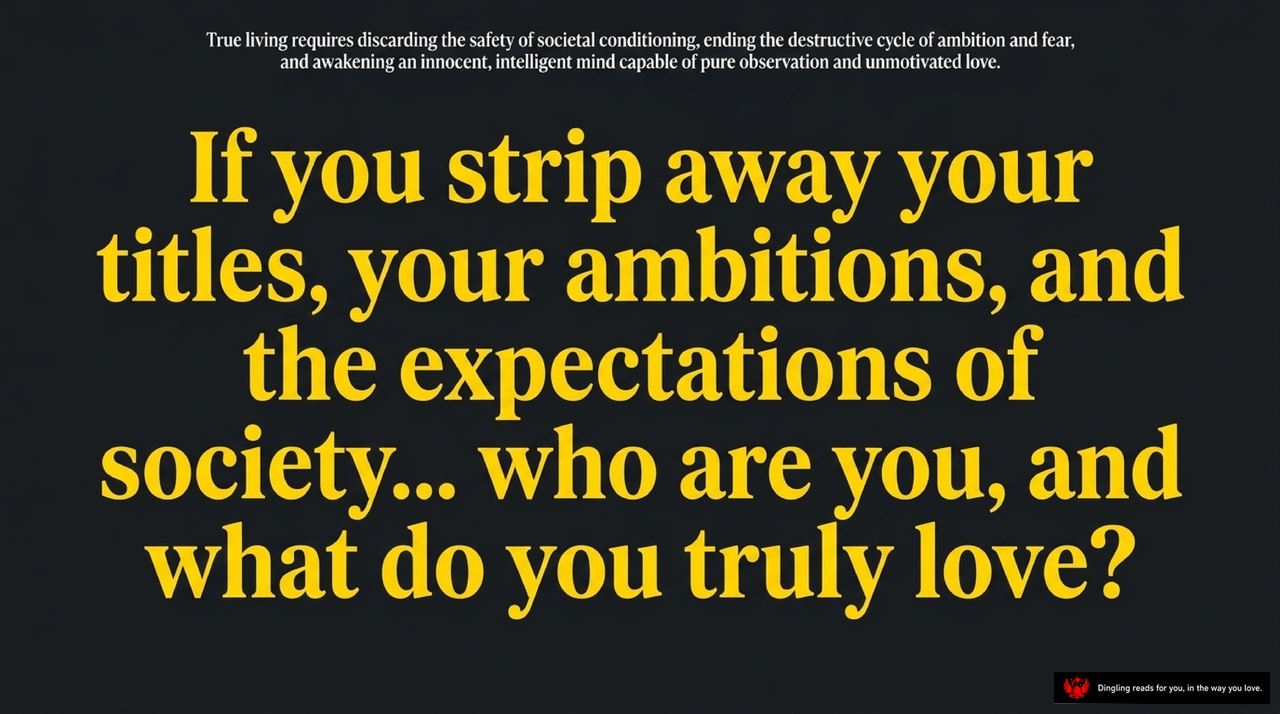
Have you ever stopped to ask yourself: if you strip away your titles, your ambitions, and the heavy expectations of society... who are you, and what do you truly love?
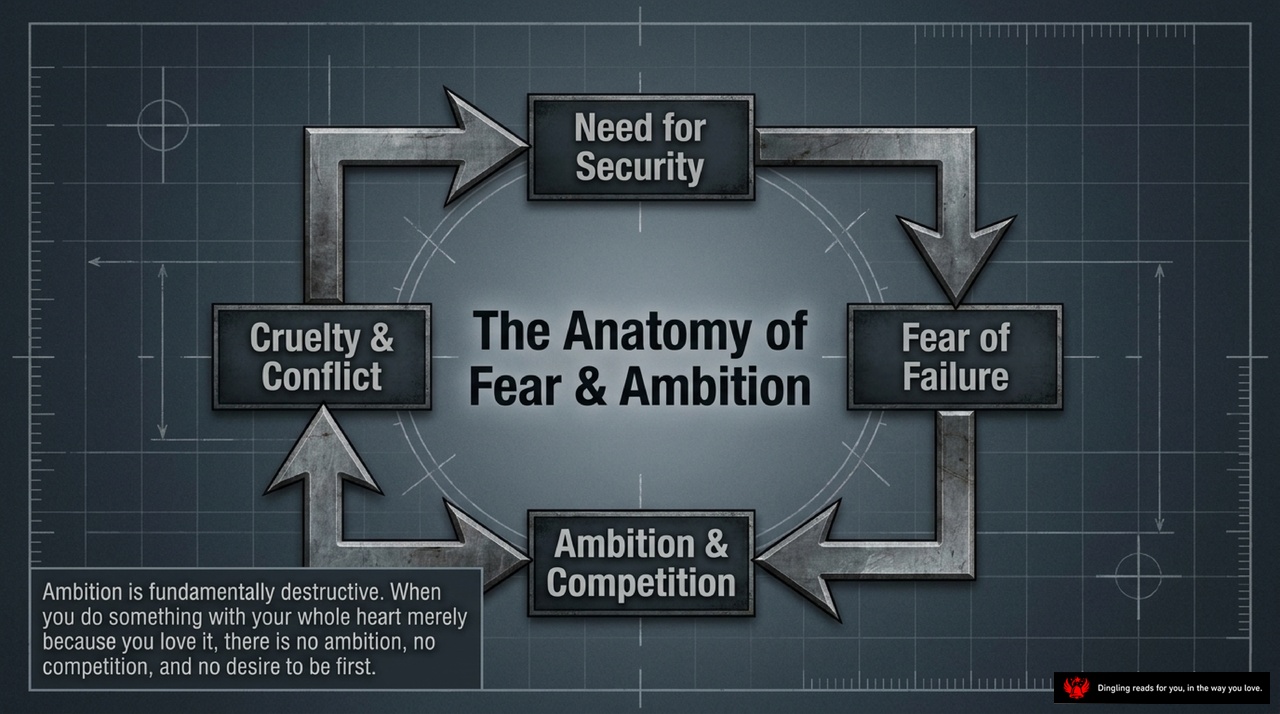
This slide challenges the very foundation of how we live. We are conditioned to believe that true living means accumulating status, chasing goals, and fitting into a pre-made mold. But the text above suggests something radical: that real freedom begins only when we discard the safety of this conditioning. It's about ending that destructive cycle of ambition and fear that keeps us trapped.
Think about it. When you remove the labels society has stuck on you—the CEO, the parent, the successful candidate—what remains? A mind capable of pure observation and unmotivated love. This isn't about doing nothing; it's about waking up to who you actually are, free from the need to become someone else. True innovation and a new world don't come from trying to be better versions of ourselves within the old system. They emerge when we stop competing for power and start connecting with life itself, with the birds, the trees, and the quiet moments we often ignore.
So, the question isn't just theoretical. It's a call to action: strip away the noise, stop the constant striving, and look inward. Who are you without the mask? And once you see that, what will you choose to love?