
Three Days to See: Complete Chapter-by-Chapter Summary
Welcome to today's session. Imagine a hand gently touching the surface of water at sunrise, sending ripples across the golden light. That image perfectly captures the heart of Helen Keller's story: a profound journey from silence and darkness into an awakened universe of light, love, and intellect.
In this book, *Three Days to See & The Story of My Life*, Helen takes us back to her very beginning. Born into a warm, loving family, she was a curious toddler who crawled toward the shadows of leaves on the floor, exploring her world with her whole being. For the first nineteen months of her life, she knew the world through sight and sound. She could smell the roses on her porch, feel the warmth of the sun, and hear the buzzing of bees. It was a world of bright colors and clear sounds—a world she would soon lose forever.
Suddenly, illness struck. A fever took away her sight and her hearing, plunging her into a chaotic silence and darkness. For years, she was trapped in a world without boundaries, unable to understand the people around her or express her own needs. She felt frustrated and angry, realizing she was different from everyone else. But then, a miracle arrived in the form of her teacher, Anne Sullivan.
Helen describes that moment as the dawning of a new life. When Anne taught her the word "water" by spelling it into her hand while cool water flowed over her fingers, something shifted inside her. She realized that things had names. That single word unlocked her mind, giving her a new way to see and understand the world. From that day on, Helen's life changed forever, transforming her from a child lost in darkness into a woman who could touch the soul of the universe.
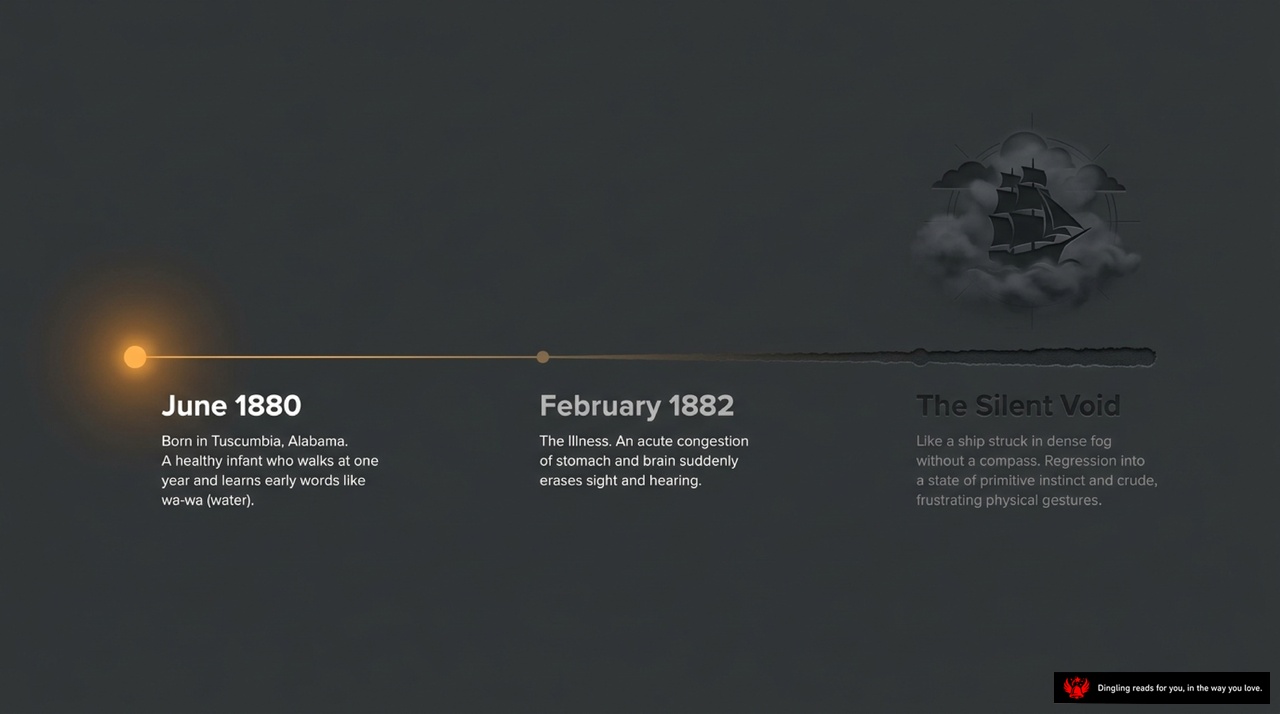
Imagine your life as a ship suddenly trapped in a thick, impenetrable fog. You have no compass, no map, and no idea where you are going. This was Helen Keller's reality in February 1882. Born healthy and full of curiosity in Alabama, she walked, talked, and played in her garden just like any other child. But then, a sudden illness struck. It was a violent congestion of her stomach and brain that stole her sight and hearing in an instant.
Suddenly, the vibrant world she knew vanished. She didn't just lose her eyes and ears; she lost her connection to everything. It was what her own words call "The Silent Void." It felt like that ship lost in the fog, drifting without direction. She regressed into a state of pure instinct, acting on crude physical gestures, frustrated and confused because she could no longer understand the world around her. Her parents watched in heartbreak, loving her but utterly helpless, unsure how to pull her out of this dark, silent chaos.
But even in this void, life kept moving. Helen wasn't just sitting in the dark; she was actively fighting to understand. She invented her own language, using nods for "yes" and shakes for "no," mimicking adults to express her needs. She learned to dress herself and even playfully pretend for guests. Yet, the frustration was overwhelming. Standing among people, she could touch their lips but hear nothing, touch their words but see none. It was a lonely place to be, filled with anger and a deep sense of isolation.
However, hope began to flicker. Her parents refused to give up. They found a story about another blind and deaf girl who had learned to read, and they traveled across the country, from Baltimore to Washington, seeking a miracle. They met Dr. Bell, who offered a lifeline: a teacher from the Perkins School. That teacher, Anne Sullivan, would arrive the following March. For Helen, that date felt like seeing a lighthouse beam cut through the endless fog. She stood on her porch, feeling the familiar scent of honeysuckle, unaware that the most important day of her life was about to begin.
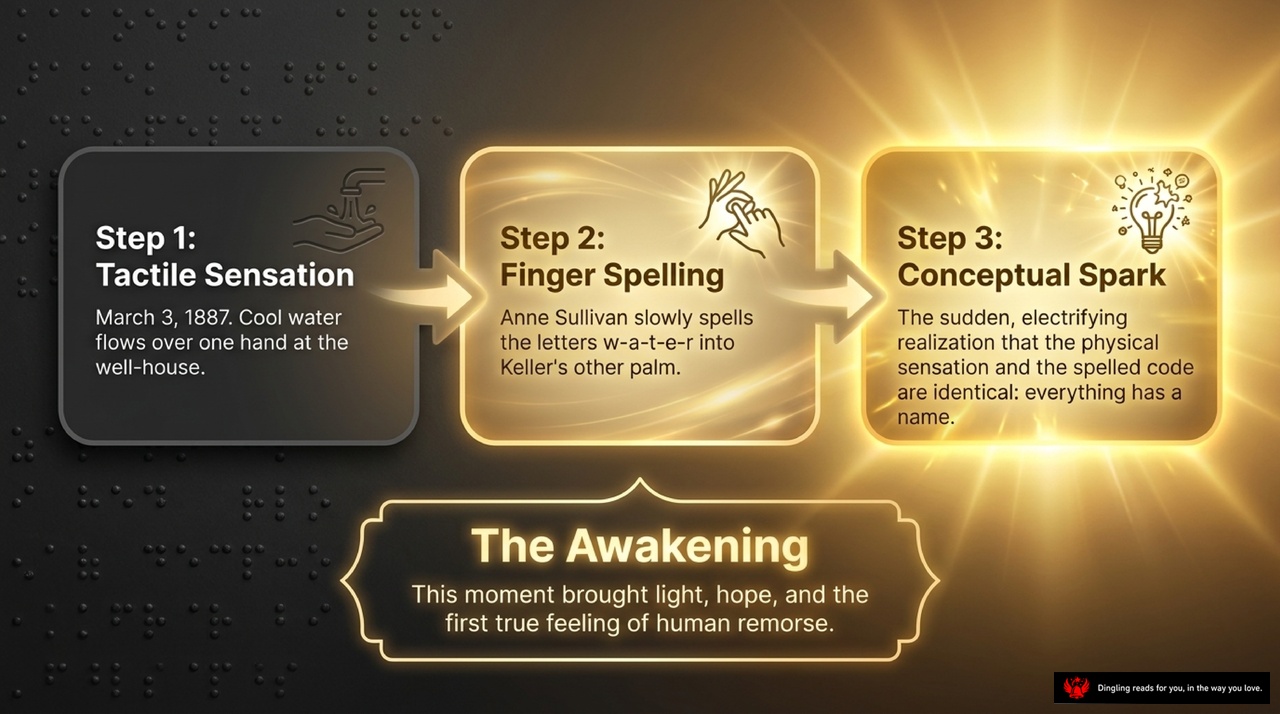
Imagine a moment that changes everything. It's March 3, 1887, and Helen Keller is standing by a well-house, feeling the cool water flow over her hand for the first time. But water alone isn't the magic. The true awakening happens when her teacher, Anne Sullivan, takes Helen's other hand and slowly spells the word "w-a-t-e-r" into her palm. Suddenly, the physical sensation of the cold water and the finger movements click together in Helen's mind. She realizes that the water she feels has a name. It's not just a feeling anymore; it's a concept. That electric realization—that everything has a name—is the spark that ignites her entire world. This moment brings light, hope, and the first true feeling of human remorse, as she understands that the world she touched has meaning, and she is finally waking up to life.

Have you ever felt like the world was just a series of disconnected sensations, where you could touch things but never truly understand their meaning? For Helen, that was the reality before her teacher arrived. She was like a ship lost in a fog, moving mechanically without a destination, unaware of who she was or what it meant to be alive.
But then, a miracle happened. Her teacher placed a doll in her hands and slowly spelled "d-o-l-l" into her palm. In that moment, the abstract concept of an object clicked into place. It wasn't just a lump of fabric anymore; it had a name. And once she understood that every thing had a name, a door opened in her mind.
This slide beautifully illustrates how that magic unfolded. At the base, we have **The Tangible**—the physical objects like dolls, cups, and water that she could hold. Moving up, we reach **The Action**, the verbs like sit, stand, and walk that gave her a sense of movement and agency. Finally, at the peak, we find **The Invisible**—abstract concepts like Think and Love.
The text reveals that this journey wasn't just about learning words; it was about waking up to her own existence. When she finally grasped the concept of "love," comparing it to clouds before the sun rises—something you can't touch but feel in your heart—she realized her soul was no longer empty. She had moved from being a confused animal driven by instinct to a thinking, feeling human being. It was the moment her inner world finally caught up with the outer one, lighting up a universe she had thought was dark.

Touch is my world's compass, my eyes in the dark, and the bridge between my soul and everything around me. It is the only sense that truly lets me know the truth of things. When I hold a rose, I don't just see red; I feel its velvety softness and smell its intoxicating fragrance. When I touch a marble statue, I don't see cold stone; through my imagination, I feel a beating heart and see flowing robes. My mind acts as a silent artist, taking these scattered sensations and building a complete, vibrant reality out of them.
Think about the hands of others. Each hand tells a story. Bishop Brooks' large hand feels warm and peaceful, while Mark Twain's hand feels full of humor and sympathy. I can't see their faces, but I can feel their emotions in their grip—tension when they are excited, relaxation when they are tired. Hands are the witnesses of human civilization, from the tools we build to the laws we make. They are just as essential as our eyes.
But my connection to the world goes deeper than just touch. It lives in vibrations. I can tell a child's age or a person's mood just by the rhythm of their footsteps. The lightness of a child's step, the heaviness of an adult's stride, or the slow, steady pace of an elder—all these tell me who is there without them speaking. Even the subtle vibrations of a violin string or the rumble of thunder travel through my fingertips, letting me feel the music and the power of nature directly in my bones.
And then there is smell, often called the "lost angel" of our senses. It is the most colorful sense for me. It carries memories and information that sight and sound cannot. The scent of a garden reminds me of my childhood; the smell of wood tells me a carpenter has been there. I can guess where people have been or what they do by the scent on their clothes. Without smell, the world would feel flat and gray.
If I had to rank my senses, I would place vision as the shallowest, often stopping us at the surface. Hearing can feel distant and arrogant. But smell is the most diverse, and touch is the most profound and calm. It is my most reliable weapon for understanding the truth. Even if I could see, I would never want to lose the memories etched into my palms—the warmth of a friend's hand, the texture of a loved one's skin. These tactile treasures are things sight can never replace.
True darkness isn't a lack of sight; it's a lack of understanding. Many sighted people miss the magic of the world because they rely too much on their eyes. They ignore the whispers of the trees and the breath of the ocean. I don't need to see to share in the joy of life. My inner will determines the width of my destiny. I can see the lightning of Mount Sinai and walk through deserts turned into gardens. My heart sees a world full of light and color, even when my eyes cannot. The truth exists only in the mind, and my mind is a place of endless wonder.
Touch is the compass that guides me through the dark, turning the invisible into something I can hold, feel, and truly know. It is my first teacher, my most trusted friend, and the bridge to a world that others see but I must learn to sense.
When I think of the world, I don't just see it; I experience it through the texture of things. I can feel the coolness of a water lily, the silkiness of a rose petal, the hardness of a rock, and the warmth of wood. By touching the upward slope of a mountain or the rhythmic pulse of flowing water, I build a mental map of reality. My imagination acts as a silent architect, taking these scattered sensations and weaving them into a complete, living picture. Without it, my world would be empty; but with it, even a cold marble statue seems to have a beating heart, and a headless Greek statue can feel the wind blowing her robes.
I also find deep joy in observing hands. Every hand tells a unique story—Bishop Brooks's large, peaceful hands that felt warm and kind, or Mark Twain's hands that felt full of humor and sympathy. While sighted people describe faces with words like "strong" or "patient," I describe hands with the same emotion because I can feel the truth of their character: the tension of excitement or the relaxation of sadness. Hands are the true symbols of human civilization, the tools that build our world and touch our souls.
Beyond touch, vibration is my secret language. I can hear the age and personality of a person just by their footsteps—a child's light, skipping steps versus an adult's steady, heavy stride. I can feel the work of a carpenter's saw or the thunder of a storm in the ground beneath me. Music, too, speaks directly to me; I can feel the rise and fall of notes on a piano or violin, and even sense the emotional heat of Wagner's fiery operas through the vibration of the air.
Air and scent are my other guides. I can smell the changing seasons—the fresh scent of spring soil, the sweet smell of summer grain, or the crisp, cold air of winter. These invisible signals help me navigate and remember. I can tell if someone is a carpenter by the sawdust on their clothes, or if I've been to the garden by the lingering scent of flowers. Even the smell of a loved one can stay with me for years, a permanent memory I can revisit anytime.
If I had to rank my senses, I would place sight as the most superficial and hearing as the most arrogant, for they often keep us at a distance. But smell is vibrant and full of memory, while taste is fickle. Touch, however, is the most profound and calm. It is the only sense that connects me directly to the truth of things and the warmth of human hearts. I would rather keep these precious memories of touch than regain my sight, because touch allows me to see the soul behind the surface.
True darkness isn't a lack of sight; it's a lack of understanding. Many sighted people miss the whispers of trees and the breath of the sea because they rely too much on their eyes. I don't need sight to share in life's joys, wisdom, and love. My inner will allows me to see the lightning of Sinai and turn the desert into a garden. I know that the real world lives in the mind. Even if I can't touch the stars, I know they shine there. Through my fingers, my books, and the stories of others, I have painted a complete, colorful world in my mind. I can smell a rose without holding one and hear the ocean without standing by the shore. My thoughts create music and light, ensuring that my world is never truly dark, but always full of wonder and color.

Touch is my eyes, my ears, and my voice in a world without sight or sound. It is the ultimate equalizer, stripping away every barrier to connect me directly with the truth of existence. While others rely on fleeting images or distant sounds, my hands build a solid, undeniable reality. I can feel the cool slip of a water lily, the rough grit of a rock, and the warm pulse of a living heart. Through my fingertips, I don't just see shapes; I feel the very soul of things.
This method of learning has unlocked a universe for me. I touch the vibrating strings of a piano to hear the music's heartbeat, feeling the rise and fall of notes like waves crashing against the shore. I read the air itself, sensing the subtle shifts in temperature and the distinct scent of seasons—spring's fresh earth, summer's grain, and winter's crisp chill. Even the invisible becomes tangible; I can "see" colors through the scent of flowers and "hear" the height of a voice through the vibration of a throat.
Some might call this a limitation, but I see it as a superpower. My mind is not trapped by a narrow sensory box; it is a vast, open plain where imagination builds the missing pieces. I can touch the marble of a statue and feel its courage, or reach out to the stars and hold the warmth of God's light. In this dark world, my hands are the bridge to everything, proving that true vision comes not from the eyes, but from the depth of the heart.

Imagine a world where seeing and hearing aren't just passive acts of receiving information, but often become lazy shortcuts. We glance at the kaleidoscope of life, assuming we understand it, or we hear the noise around us without truly listening to the profound rhythms beneath. We treat scent as mere background noise, ignoring its power to tell a story.
But for Helen, the world worked differently. Because she couldn't rely on sight or sound, she developed a "hyper-intentional" perception. She didn't just look at objects; she meticulously cataloged their symmetry, texture, and vibration. She didn't just hear sounds; she felt the rhythmic beats of nature and human emotion through the very air. And she didn't ignore smells; she constructed a vivid spatial geography, mapping time and weather purely by blending scents.
As Helen wrote, "The seeing see little." To those who rely solely on sight, the world is often shallow. But for Helen, who engaged with the world through touch, vibration, and scent, the reality was far deeper, richer, and infinitely more connected. Her blindness didn't limit her; it forced her to see the world with a clarity that many sighted people never achieve.

Imagine your hand not just as a tool, but as a super-sensor that lets you see, hear, and feel the world in ways sighted people can't. Helen Keller describes her hand as the "tendril connecting me to the world," a lantern in the dark, and the foundation that paves the rough path of life. For her, touch was everything. It captured the coolness of a water lily, the silkiness of a rose petal, and the hardness of a rock versus the warmth of wood. She could feel the upward pull of a mountain or the rhythmic pulse of a flowing stream, stitching together a complete picture of reality from these fragmented sensations.
But her hands did more than just feel texture; they were the key to understanding human emotion. By observing hands, she could read a person's soul. A bishop's large hand felt kind and peaceful, while Mark Twain's hand radiated humor and deep sympathy. She learned that hands record our truest feelings: muscles tighten with excitement, and they relax with sadness. This insight led her to realize that hands are the ultimate symbols of human civilization and faith, appearing everywhere from Shakespeare's tragedies to the Bible's creation stories.
Beyond texture and emotion, her hands detected the invisible vibrations of the world. She could distinguish a child's light footsteps from an adult's heavy stride, hear the rustle of a newspaper, and even feel the work of a carpenter or blacksmith through the specific tremors of their tools. Music became a physical experience when she placed her hands on a piano, feeling the soul of the notes rise and fall like waves. Even air and scent traveled through her fingertips, allowing her to identify seasons and places without seeing them.
Ultimately, Helen believed that while touch has limits, the human mind has none. She could touch a candle flame and imagine a firefly's glow, or feel a mountain's curve and understand an infant's softness. Her hands were her eyes, but her imagination was the light that turned those dark sensations into a vibrant, colorful, and deeply human world.
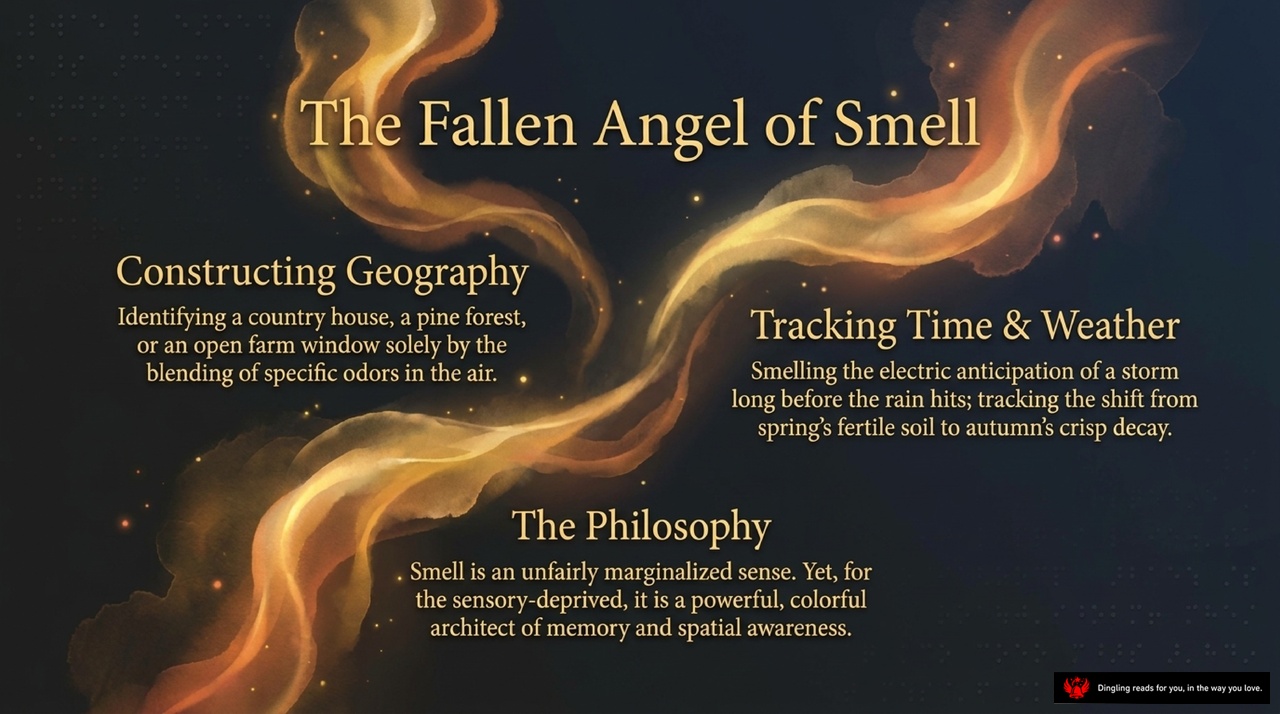
Have you ever stopped to think that your sense of smell is actually a map? In our world, we rely on sight and sound to navigate, but for those of us who live in the dark, scent becomes the primary architect of our reality. It constructs our geography. Just by blending specific odors in the air, I can identify a country house, distinguish a pine forest, or recognize an open farm window. It is an invisible GPS that tells me exactly where I am.
Beyond location, smell also tracks time and weather. I can smell the electric anticipation of a storm long before the rain even hits, sensing the shift from spring's fertile soil to autumn's crisp decay. It is a powerful, colorful tool that helps me understand the passage of days and seasons.
Yet, for too long, smell has been unfairly marginalized. We often ignore it, treating it as secondary to our other senses. But I want to challenge that view. For the sensory-deprived, smell is not just a nice bonus; it is a powerful, essential force. It builds our memory, anchors our spatial awareness, and allows us to see the world in a way that sight alone never could. It is the fallen angel of smell, brought back to life as our most trusted guide.

Imagine a world where the darkness isn't a wall, but a canvas. For Helen, her reality wasn't built by what she could see, but by the relentless power of her mind. She constructed entire landscapes in her head, piecing together the warmth of the sun, the rough texture of a rock, and the voices of friends to create a mental world that was structurally sound and vividly real. This is the power of the mind's eye.
But when her body rested, her soul found a different kind of freedom. In the dreamscape, she escaped the physical limitations that bound her during the day. While awake, she navigated a world of silence and shadows, but in sleep, she encountered visual phenomena with perfect clarity. She could see cities burning, feel the biting cold of the Arctic, and even chase a fat cat that had stolen her canary, only to be startled by a roaring tiger. In these dreams, she possessed all the senses she lacked in waking life, experiencing colors, sounds, and temperatures that felt as real as the air she breathed.
These weren't just random fragments; they were a bridge to a fuller existence. Even in her waking hours, Helen used daydreams to organize her chaotic thoughts, letting her imagination run wild like a masquerade ball of ideas where history, literature, and philosophy danced together. Through these inner journeys, she proved that true sight comes from within. She learned that while she couldn't touch the stars, she could navigate her life with a compass made of pure thought, proving that the soul's escape into the dreamscape was just as vital as her fight for reality.

Imagine you are granted three days of sight, and the first day is dedicated entirely to love and the present moment. Today, we explore Day 1: Humanity & Home, a time to truly see the people who shape us, the sanctuary of our home, and the breathtaking beauty of nature.
First, let's look at **The People**. This day is about gazing deeply into the faces of those we love. It's about studying the patience in Anne Sullivan's eyes, the woman who became the lighthouse in our life. It's about understanding that even without sight or sound, the connection between a teacher and a student can be profound, bridging the gap between silence and understanding.
Next, we turn to **The Home**. It's not just about the walls, but about seeing the vibrant colors of rugs and the printed books that served as the glowing lighthouse of an inner world. It reminds us that a home is defined by the stories it holds and the love that fills the space, creating a safe harbor for the soul to rest and grow.
Finally, we step outside to **The Nature**. Picture a walk in the woods to witness the splendor of nature, culminating in a colorful, vibrant sunset. It teaches us that even in the darkest times, there is always a horizon waiting to be seen, a beauty waiting to be felt, and a promise that the sun will always rise again.
So, let's take this moment to see with our hearts, appreciating the people, the home, and the world around us.
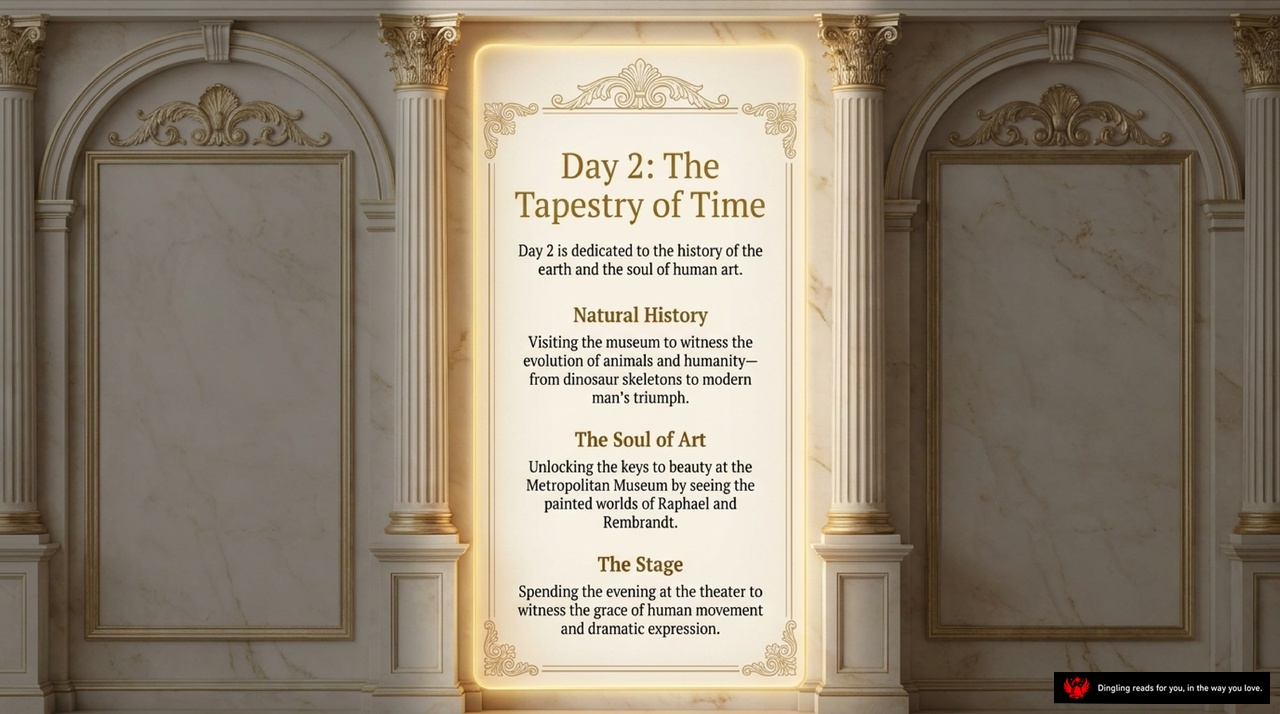
Welcome back to our journey through time. Today, we dive deep into the sensory world that Helen Keller describes as her true way of seeing life. While sighted people rely on their eyes, Helen reveals that her hands and other senses were actually far more powerful. She tells us that her hands act like antennas, capturing the coolness of water lilies, the smoothness of roses, and the hardness of rocks, building a complete picture of the world in her mind.
She also shares a fascinating insight about how she perceives the world through vibration. From the light footsteps of a child to the heavy tread of an elder, from the crackle of a new shoe to the deep rumble of thunder or the resonant hum of an organ, every sound is felt physically on her skin. Even the emotions of others are written on their hands; excitement tightens the muscles, while sadness brings a sense of relaxation.
Furthermore, she elevates the sense of smell, calling it a "lost angel" that most people ignore. Scents like the fragrance of daisies or the smell of hay can instantly transport her back to childhood memories or help her identify where someone has been. Ultimately, Helen argues that while sight is often superficial, touch is the most profound and reliable way to understand the truth of the world. It is through this rich tapestry of touch, vibration, and scent that she finds the beauty and reality that others might miss.
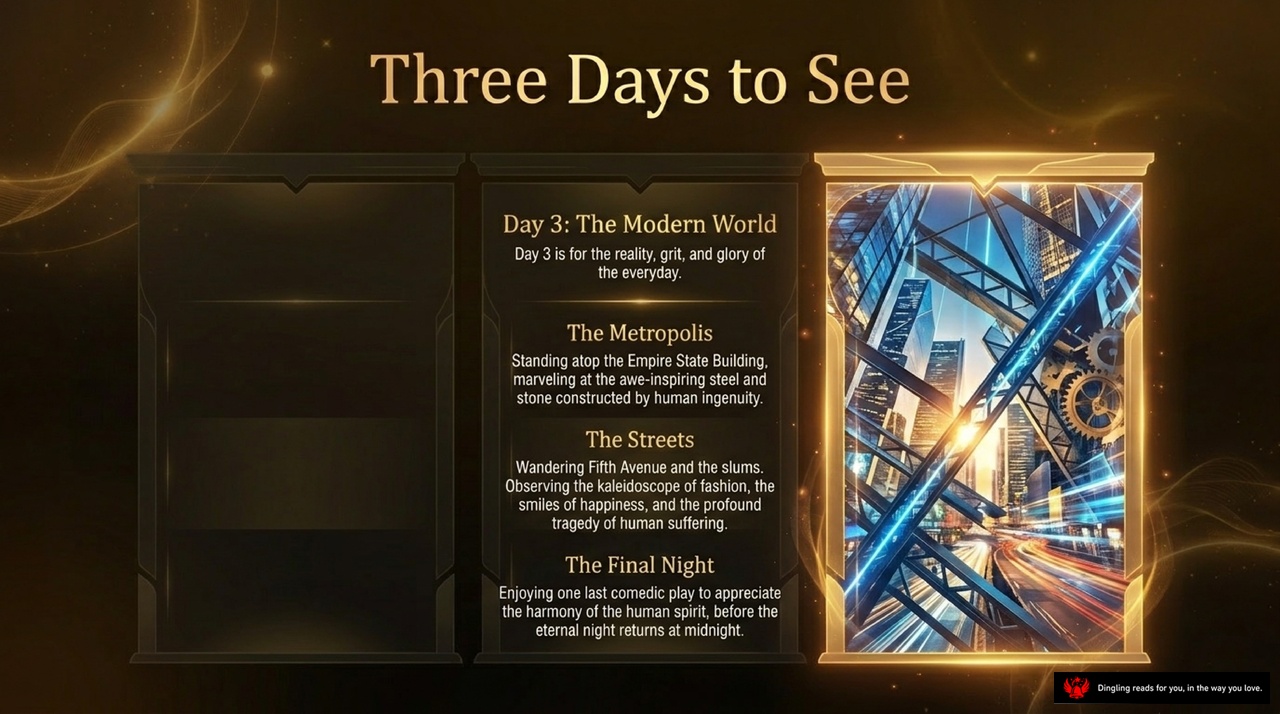
Today's slide, "Three Days to See," isn't just a poetic title; it's a profound invitation to re-examine our world through the lens of loss. Imagine standing on the 86th floor of the Empire State Building. For most, the view is a spectacle of steel and stone, a testament to human ingenuity. But for Helen, who has never seen the light, this "Metropolis" exists only as a concept, a story told by others. She marvels not at the sight, but at the sheer scale of what humanity can build when united by a shared vision.
Then, she steps down to the streets. For her, Fifth Avenue isn't a parade of fashion and luxury; it's a kaleidoscope of human emotion. She feels the frantic energy of the crowds, the warmth of a smile, and the heavy weight of suffering carried by those walking beside her. Without sight, she experiences the city not as a backdrop, but as a living, breathing entity defined entirely by touch and sound.
Finally, we reach "The Final Night." Helen describes attending a comedy, a genre often built on visual gags. Yet, she finds joy in the harmony of human spirit, in the laughter that travels through the air, vibrating in the chest. She realizes that before the eternal night of blindness truly takes over, she can still appreciate the fleeting beauty of the world. This isn't about pity; it's about a radical shift in perspective. When you lose your sight, you don't just lose the world; you gain a deeper, more intimate connection to the very soul of humanity.

Imagine holding a marble statue in your hands. To most people, it's just cold stone, lifeless and static. But for Helen Keller, that same statue could have a beating heart, flowing robes, and glowing wings. This isn't magic; it's the power of imagination. As Helen explains, our minds are silent architects, taking those scattered fragments of touch and smell and weaving them into a complete, vibrant world.
She challenges us to look at our own hands. We often just see them as tools, but she sees personalities. When she touched Bishop Brooks's hand, she felt warmth and peace. When she held Mark Twain's, she felt humor and deep sympathy. We can't see the muscles moving, but we can feel the emotion radiating from them. This ability to "read" the world through touch and vibration is something we take for granted, yet Helen mastered it to an incredible degree.
Think about the last time you heard a door slam or felt the floor vibrate from a train passing by. For Helen, these vibrations were the soundtrack of her life. She could tell exactly who was walking by—whether it was a child with light, quick steps or an elder with a heavy, slow gait—just by the rhythm of their footsteps. She could feel the texture of a woodcutter's sawing or the heavy thud of a blacksmith's hammer, knowing instantly what was happening without seeing a single thing.
And then there is the sense of smell, which she calls a "lost angel." While sight-seeing people focus on colors and shapes, Helen navigated the world through scents. She could identify seasons by the air—spring's soil, summer's grain, winter's cold bite. She could even guess where someone had been by the smell of wood shavings on a carpenter's clothes or iron on a blacksmith's. She reminds us that true vision isn't about biological eyes; it's about the intentional, profound appreciation of the life vibrating all around us.
So, I'm leaving you with a question from her page: If you were struck blind tomorrow, how would you use your eyes today? Would you stop to really feel the texture of the world, listen to the hidden vibrations, and smell the stories the air is telling you? True sight happens when we stop rushing past the beauty right in front of us and start truly experiencing it.