
Three Masters: Complete Chapter-by-Chapter Summary

Welcome to today's session on *Three Masters* by Stefan Zweig. Set against the backdrop of Paris, London, and St. Petersburg, we embark on an exploration of how Balzac, Dickens, and Dostoevsky transcended mere writing to become the architects of entire human universes. These three titans didn't just tell stories; they built worlds that still define how we understand the human condition. From Balzac's Napoleonic ambition to Dickens' comforting humor, and finally to Dostoevsky's soul-shaking depth, their legacies remain unmatched. Let's dive into the lives and works that shaped literature forever.
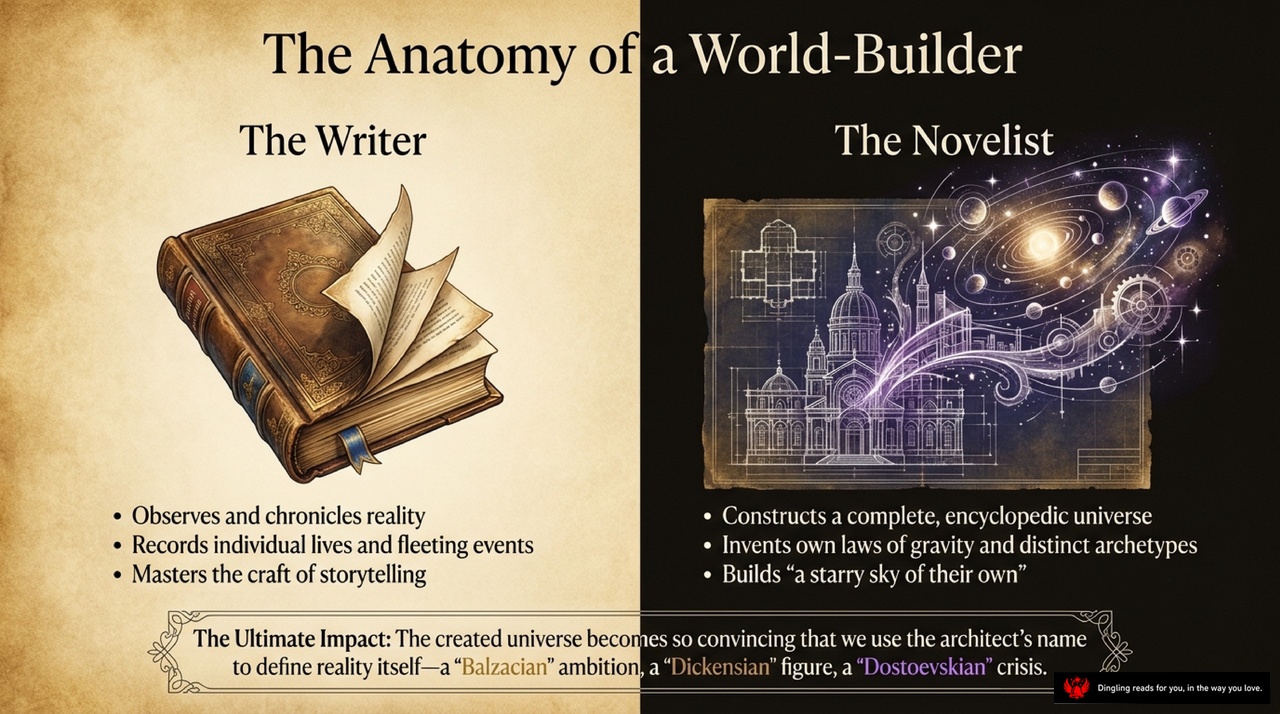
On this slide, we see a clear distinction between two literary giants: the Writer and the Novelist. On the left, under "The Writer," we see an image of an old, open book. This represents authors like Dickens who observe and chronicle reality. They record individual lives and fleeting events, mastering the craft of storytelling to create a world that feels familiar yet deeply human.
On the right, under "The Novelist," we see a striking image of architectural blueprints merging with a cosmic galaxy. This represents the true world-builders like Balzac and Dostoevsky. They don't just record; they construct a complete, encyclopedic universe. They invent their own laws of gravity and distinct archetypes, effectively building "a starry sky of their own."
The ultimate impact of this difference is profound. When a novelist creates a universe so convincing that we use the architect's name to define reality itself—like calling an ambition "Balzacian," a figure "Dickensian," or a crisis "Dostoevskian"—it proves that the greatest fiction has become our truth. While one writer documents the world as it is, the true world-builder constructs the very framework of how we understand it.
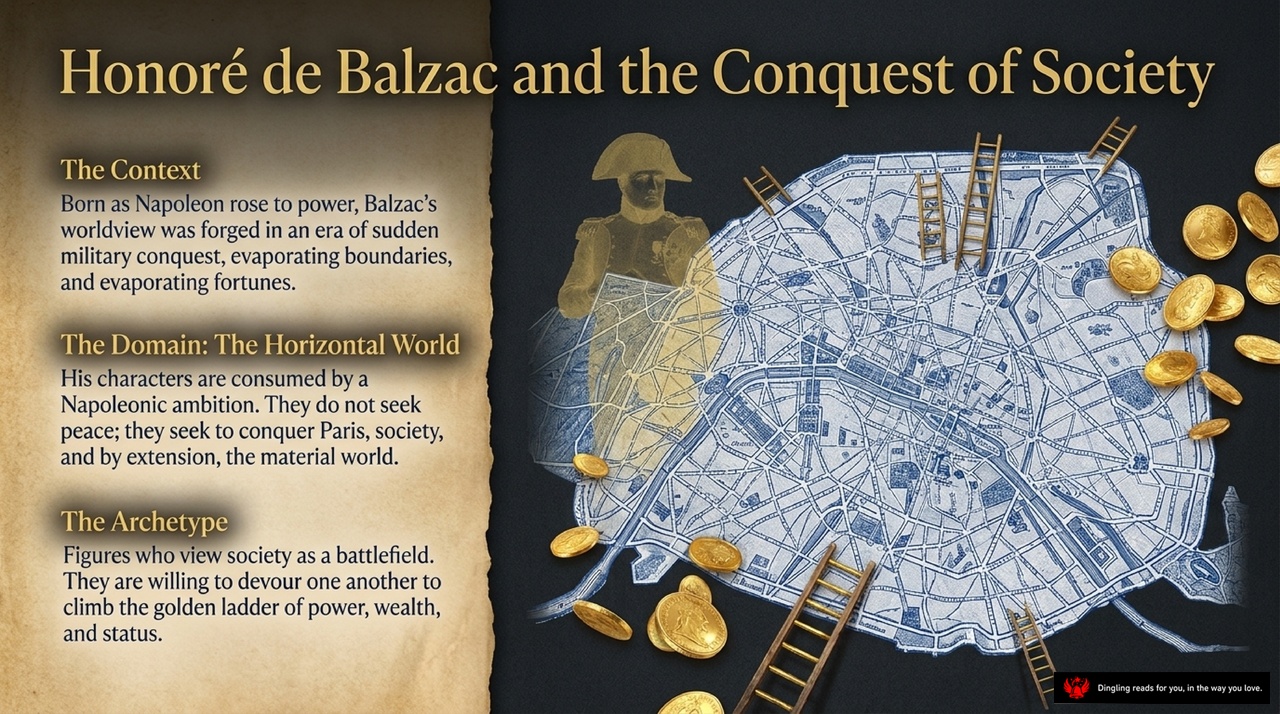
Born as Napoleon rose to power, Honoré de Balzac's worldview was forged in an era of sudden military conquest, where boundaries evaporated and fortunes vanished overnight. This chaotic backdrop shaped the domain of his work: the Horizontal World. His characters are consumed by a Napoleonic ambition; they do not seek peace. Instead, they seek to conquer Paris, society, and by extension, the entire material world. They view life not as a series of relationships, but as a battlefield. These figures are willing to devour one another to climb the golden ladder of power, wealth, and status. For Balzac, society itself was the ultimate prize, and every character was a soldier in this relentless civil war, driven by a singular, devouring desire to dominate the world.
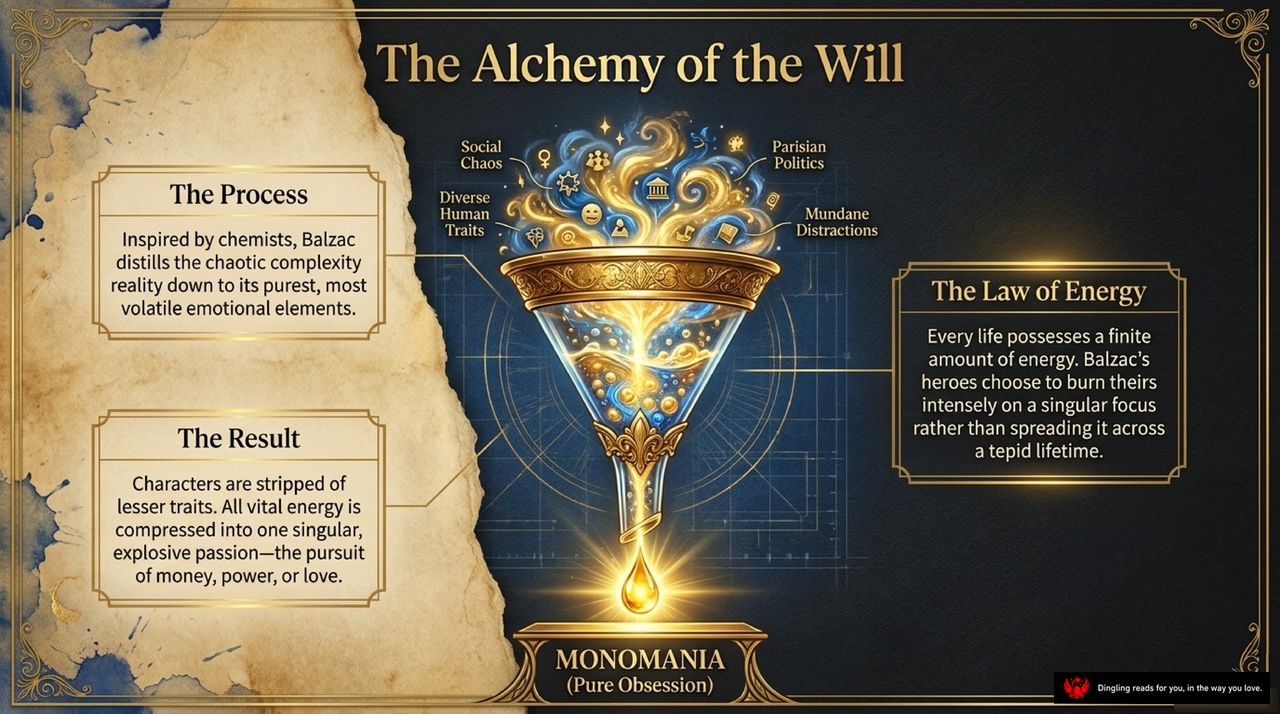
Look at this alchemical process Balzac describes: taking the chaotic mess of Parisian politics, social chaos, and diverse human traits, and distilling it down to its purest, most volatile emotional elements. It's all about a single, powerful rule: the Law of Energy. Balzac believed every life has a finite amount of energy, so his heroes don't spread it out across a tepid lifetime; instead, they choose to burn it intensely on a singular focus. This is the result we see in his characters: they are stripped of lesser traits, and all their vital energy is compressed into one explosive passion, whether it's money, power, or love. This intense, all-consuming focus is what Balzac called Monomania, or pure obsession. It's this very drive that allows him to turn the complex reality of his time into a literary empire, proving that when you pour all your energy into one thing, you can achieve the impossible.

Charles Dickens and the Sanctuary of the Hearth.
In a world often defined by grand conquests, Dickens chose a different path. Instead of the sweeping, violent narratives found in other literary traditions, he built a "walled garden" of English bourgeois tradition. This is the domain of the hearth: a fiercely enclosed world where his characters are shielded from the storms of a crueler, broader reality.
Look at the image. We see a cozy home, warm and inviting, contrasting sharply with the dark, industrial smoke swirling outside. This visual split perfectly captures Dickens's ambition. Unlike the conquerors of the world, his characters do not seek to rule empires. Their desire is modest and deeply human: an income of £100 a year, a loving family, a crackling fire, and a patch of green grass. It is a sanctuary of the hearth.
The atmosphere inside this sanctuary is sentimental, morally bounded, and democratic. Dickens elevates the forgotten poor, the eccentric, and the innocent child into poetic heroes of everyday life. He finds the sublime not in the exotic, but in the ordinary—turning the sound of a cricket by the fireplace into music and the tolling of the New Year's bell into human speech. For Dickens, the small house and the warm fire are worth more than any wild adventure. He creates a pastoral poetry for the industrial age, a place where life's will can rest, and where the simplest joys are celebrated as the ultimate triumph.
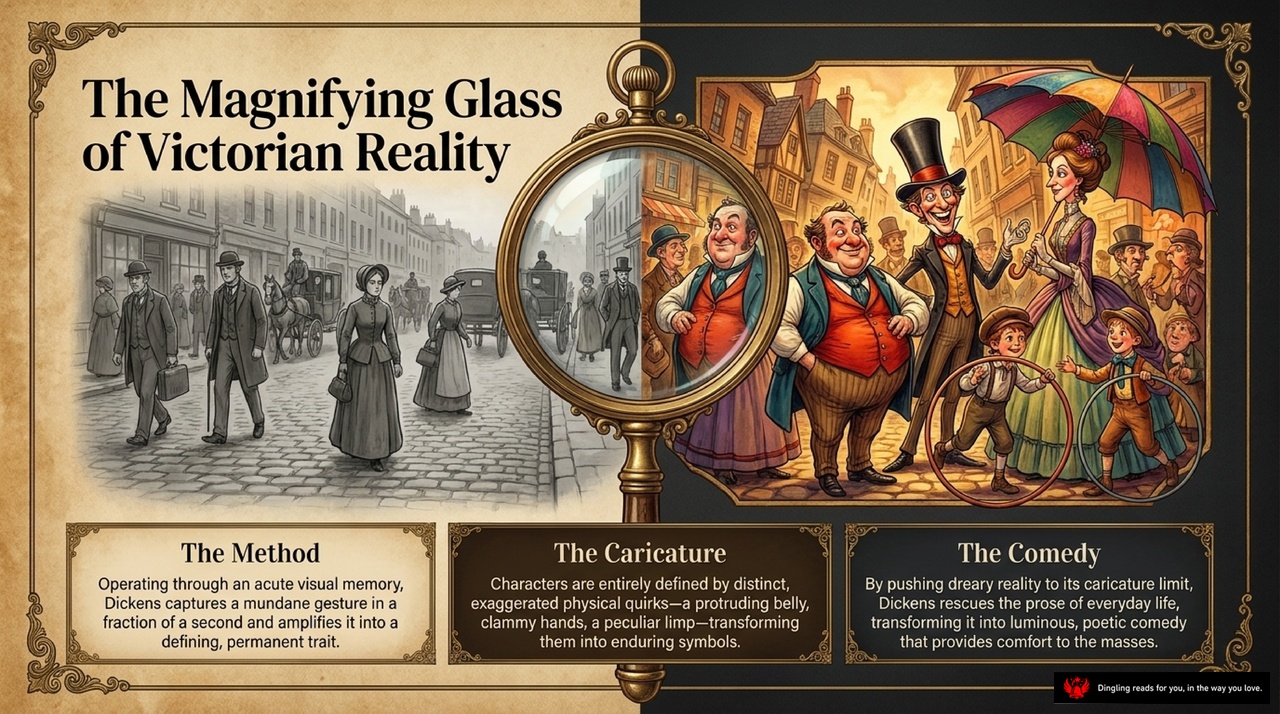
Imagine a Victorian street where reality suddenly fractures. On the left, we see the mundane truth: a grayscale world of cobblestones, stern businessmen, and women in heavy skirts, a life that feels flat and unremarkable. But look through the magnifying glass in the center. Suddenly, that same scene explodes into a riotous, colorful caricature. The stern man becomes a jovial giant; the quiet woman transforms into a figure of vibrant drama. This visual metaphor perfectly captures Charles Dickens' unique method of seeing the world.
Dickens didn't just observe his era; he used an acute visual memory to amplify the ordinary into the extraordinary. As the slide explains, he would catch a mundane gesture in a fraction of a second and turn it into a defining, permanent trait. This is the essence of his "Method." He took the dull reality of the Victorian age and pushed it to its limit, transforming it into a luminous, poetic comedy.
This transformation is what we call "The Caricature." Dickens defined his characters not by their complex inner thoughts, but by distinct, exaggerated physical quirks. Think of the protruding belly, the clammy hands, or the peculiar limp. These weren't just funny details; they were enduring symbols that made every character instantly recognizable. He didn't need deep psychology to make us feel; a single detail, like a character's trembling hand, could reveal their entire soul.
And finally, we arrive at "The Comedy." By pushing dreary reality to its caricature limit, Dickens rescued the prose of everyday life. He took the grim struggles of the working class and turned them into something that provided comfort and joy to the masses. His humor wasn't cruel; it was a warm, British light that made even the most foolish small characters lovable. In a world that often felt harsh and unforgiving, Dickens offered a sanctuary where life, even in all its absurdity, could be celebrated. He didn't just write stories; he painted a colorful, joyful version of a gray world, proving that even in the darkest times, there is always room for laughter and hope.

God has tormented me for my entire life, a scream etched into Fyodor Dostoevsky's very soul. Look at Ivan Karamazov in his masterpiece, clutching the devil and demanding, "Does God exist?" The devil merely laughs and tosses back, "I don't know," leaving that most piercing question hanging in the air, gnawing at him with endless torment. Or consider Shatov in *Demons*, trembling and pale as he is forced to tie his faith to the concept of Russia itself. Even Kirillov, who tries to deny God entirely, can only prove the inescapability of that question by taking his own life.
This "torment of God" isn't just a theme in his books; it is the biography of the man himself. Dostoevsky was a living contradiction, the most pious believer and the most extreme atheist rolled into one. To him, God wasn't a gentle presence in the clouds, but a spark between two electrodes of raw contrast—the source of all anxiety and the pain itself that can never be touched. He stood eternally torn between faith and doubt, with Alyosha representing pious submission and Ivan representing sharp negation, while Dostoevsky himself occupied the space between them, ripped apart by the pull of belief and skepticism.
Paradoxically, despite suffering the agony of doubt himself, he fought with everything he had to spare humanity from that torment. He nailed himself to a cross of unbelief to preach Orthodox faith to the masses, speaking like a frantic medieval monk, wielding a Byzantine cross like a whip to thunder down all dissent. He even projected this religious quest onto his nation, declaring, "I believe in Russia," creating a Russian Christ to offer happiness to the world. Like Sisyphus pushing a stone up a hill, he spent his life approaching God without ever truly touching Him, enduring that eternal torment in the cycle of faith and doubt.

Welcome to the final piece of our journey through the giants of literature. Today, we step into the mind of Fyodor Dostoevsky, a writer who didn't just tell stories; he forced us to feel the very pulse of human suffering and redemption.
Look at this slide: "The Oscillation of the Spirit." It perfectly captures the Dostoevskian Pendulum. His characters don't live in a balanced, comfortable middle ground. Instead, they swing violently between two extremes. On one side, you have the "Demonic Debauchery & Sin"—a world of madness, murder, and pure logic gone wrong. On the other, you have "Divine Redemption & Saintliness," a blinding light of grace and forgiveness.
Dostoevsky's figures live in a state of spasm and fever. They push past societal norms, leaping instantly from the depths of hell to the heights of heaven. This is what he meant when he said, "You must do everything to the point of frenzy." There is no moderation in his world. His characters bypass the tepid middle of human experience entirely. They dive into the deepest sins specifically to find the limits of their own humanity and reach toward absolute truth.
Think of Ivan Karamazov wrestling with the question of God, or Raskolnikov spiraling into madness after his crime. They are not static; they are in constant motion, torn by a binary conflict that refuses to resolve into a simple happy ending. They are split souls, half in paradise, half in hell, and it is precisely this friction that creates their terrifying power.
Dostoevsky himself was the ultimate embodiment of this pendulum. He was a man of extreme contradictions, torn between the most devout faith and the most radical atheism. He suffered from epilepsy, poverty, and exile, yet he loved his suffering because he believed that only through pain could one truly love life. He didn't seek to fix the world or offer easy answers. Instead, he wanted us to feel the full weight of our existence.
As we close our chapter on him, remember this: Dostoevsky taught us that the path to redemption is not a straight line, but a chaotic, painful oscillation. It is only by falling into the darkest depths of our own souls that we can ever hope to find the light. His legacy is a reminder that life is not about avoiding the storm, but about learning to dance in the rain, even when the thunder is deafening. Thank you for joining me on this incredible journey.

Imagine a coordinate system where the human soul is mapped across three distinct dimensions of literary genius. On the horizontal X-axis, we find Balzac, who expands outward to conquer the material society, treating the world as a vast empire to be ruled. Moving along the same axis but turning inward, we encounter Dickens, whose characters are enclosed within the safe, warm boundaries of the hearth, offering comfort rather than conquest. But then, look up at the vertical Y-axis. Here stands Dostoevsky, plunging infinitely inward and upward through the vertical soul. While Balzac charts the external world and Dickens barricades against it, Dostoevsky abandons the material entirely to explore the infinite depth of the human spirit. His universe isn't about geography or social status; it's a terrifying and magnificent descent into the abyss of consciousness, where every face holds a secret and every moment is a battle between heaven and hell.

The Anatomy of Desire reveals three distinct archetypes that define the literary landscape. On the left, we see Balzac's Hero, a figure climbing a pyramid of gold, driven by CONQUEST. This character wants power, money, and social dominion, embodying the ruthless ambition found in Balzac's work where every life is a battlefield. In the center stands Dickens's Hero, walking down a quiet path toward a cozy cottage, driven by COMFORT. This archetype seeks a modest income, a loving family, and peace, reflecting the desire for stability and the gentle, comforting world of the British middle class. Finally, on the right, we have Dostoevsky's Hero, a silhouette engulfed in electric lightning, driven by TRUTH. This figure craves suffering, confession, and ultimate reality, representing a deep, often painful search for the soul's essence. These three cards illustrate how different authors channel human desire: Balzac through the drive to conquer, Dickens through the need for comfort, and Dostoevsky through the relentless pursuit of truth, even if that truth requires us to face our darkest selves.
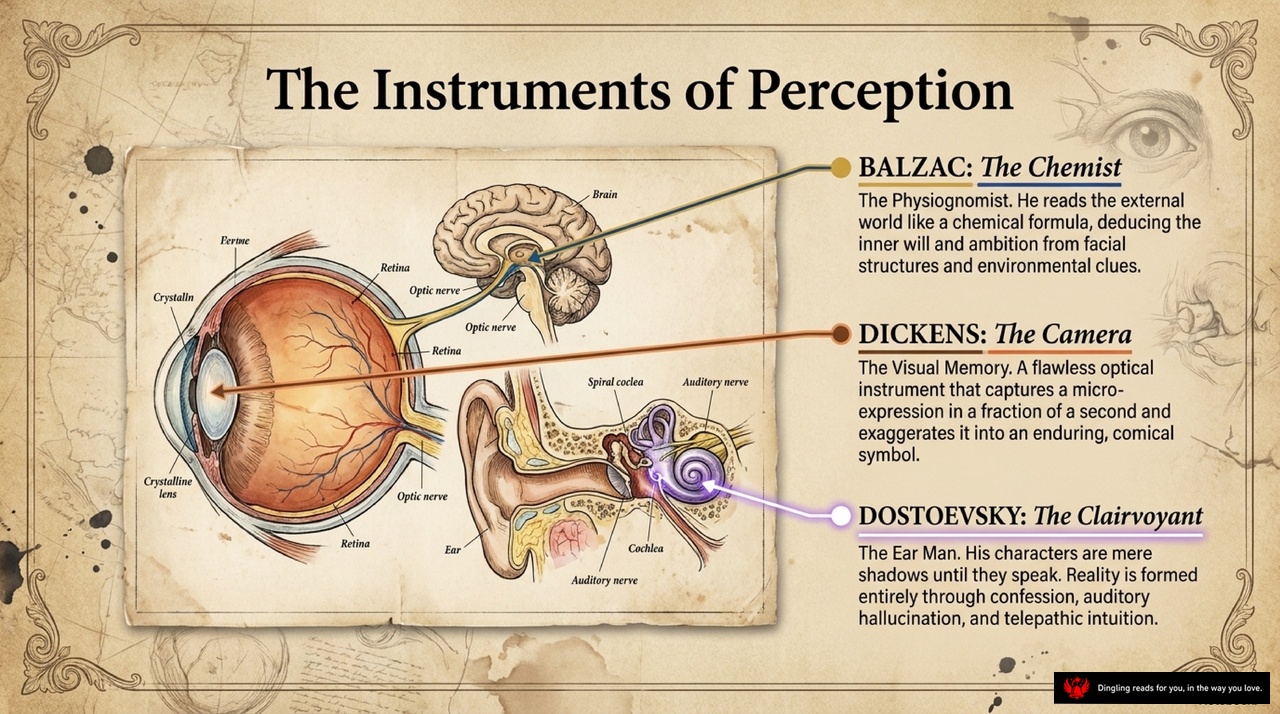
Look at this diagram titled "The Instruments of Perception." It brilliantly maps out how three literary giants saw the world through different senses. On the left, we see the eye, the brain, and the ear—our biological tools for reality. But on the right, we see how Balzac, Dickens, and Dostoevsky transformed these tools into unique literary instruments.
First, let's look at Balzac, labeled here as "The Chemist." The text describes him as a physiognomist who reads the external world like a chemical formula. Just as a chemist deduces the inner composition of a substance, Balzac deduced the inner will and ambition of his characters from their facial structures and environmental clues. He didn't just write stories; he analyzed society like a scientist, turning complex life into a grand literary system.
Next is Dickens, identified as "The Camera." The description calls him a "Visual Memory" and a flawless optical instrument. Unlike the analytical eye of Balzac, Dickens's camera captured micro-expressions in a fraction of a second, freezing them into enduring, comical symbols. He didn't dig deep into the soul immediately; instead, he focused on the visible details—the dirty coat, the twitching hand—letting the audience see the character's essence through the lens of his sharp observation.
Finally, we have Dostoevsky, described as "The Clairvoyant" or "The Ear Man." This is the most profound shift. While the others relied on sight, Dostoevsky believed reality was formed entirely through confession and auditory hallucination. His characters are mere shadows until they speak. For him, the true action happened not in the world around them, but in the space between their words. He used the ear to listen to the unspoken thoughts and telepathic intuitions that drive the human soul.
So, this slide reminds us that great literature isn't just about seeing the world. It's about choosing the right instrument to perceive it. Whether through the chemical analysis of Balzac, the photographic precision of Dickens, or the clairvoyant listening of Dostoevsky, each master found a unique way to make the invisible visible.

The Cartography of Genius is a powerful visual summary that breaks down the distinct literary DNA of three literary giants: Balzac, Dickens, and Dostoevsky. Let's dive into how each of them mapped out their own universe.
Starting with Balzac, his domain is Society. He wasn't just observing life; he was conquering it. His driving force was pure Will and Ambition, mirroring Napoleon's conquests with a pen. He used a method he called Chemical Distillation, treating life like a laboratory to extract typical characters and build his monumental *Comédie Humaine*. His prime archetype? The Monomaniac or The Conqueror—people obsessed with a single goal, whether it's wealth, power, or love, driven by an unyielding force.
Move over to Dickens, and the landscape shifts completely. His domain is The Family, reflecting the domestic concerns of the Victorian era. While Balzac sought to dominate, Dickens sought to comfort. His driving force was Morality and Comfort, aiming to heal the social wounds of his time rather than dissect them. He employed Visual Caricature, using exaggerated physical details to make characters instantly recognizable and memorable. His archetypes are The Innocent and The Eccentric—characters who often find beauty in the mundane or remain trapped in childhood, offering warmth and humor in a harsh world.
Finally, we arrive at Dostoevsky, whose domain is The Infinite Soul. He didn't look at the external world; he drilled deep into the human psyche. His driving force was Suffering and Redemption, believing that only through extreme pain could one find the truth of existence. His method was Psychological Confession, peeling back layers of the mind to reveal the chaotic, contradictory nature of the human spirit. His prime archetype is The Martyr or The Extremist—figures who push themselves to the brink, embracing the abyss to understand the divine.
Together, these three maps show us that genius isn't a single path. It's a choice of terrain: Balzac mapped the battlefield of society, Dickens mapped the sanctuary of the home, and Dostoevsky mapped the terrifying, infinite depths of the human soul.

Balzac mapped our ambitions, Dickens protected our innocence, and Dostoevsky laid bare our deepest spiritual chaos. Together, they did not just document the 19th century; they constructed the architecture of human experience.
Think of it this way: Balzac was the engineer of our drive, charting the vast landscapes of ambition and power. Dickens was the guardian of our soft spots, shielding our innocence and offering a warm hearth when the world got too cold. But then there is Dostoevsky. He didn't just write stories; he dragged us into the abyss. He exposed the terrifying, beautiful mess of our souls—the spiritual chaos we all try to hide.
If we are still navigating the cities, hearths, and abysses they built, who is the true author of our modern soul? The answer is simple: it's us. We are the living legacy of their struggles, their hopes, and their darkest fears. Their work isn't just history; it's a mirror we are still staring into every single day.