
To Kill a Mockingbird: Complete Chapter-by-Chapter Summary

Welcome to our deep dive into Harper Lee's timeless masterpiece, *To Kill a Mockingbird*. Set against the backdrop of the American South, this novel is far more than just a story; it is a masterful exploration of innocence, systemic prejudice, and the quiet, often overlooked courage of empathy. Through the eyes of young Scout, we witness the harsh realities of a society torn apart by racism, yet we also find a glimmer of hope in the unwavering moral compass of her father, Atticus Finch. As we journey through these pages, we'll uncover how one man's decision to stand up for what is right can challenge the very fabric of a community, reminding us that true bravery isn't about physical strength, but about the willingness to do what is right, even when the odds are stacked against you.

Welcome to the stagnant soul of Maycomb. Imagine a town so tired, the rain doesn't wash it clean; it just turns the streets into red mud. Here, time doesn't move forward; it loops. Generations repeat the same patterns, trapped by an invisible web of history and bloodlines. You're a Finch, a Cunningham, or an Ewell, and that name dictates your posture, your destiny, and even your worth.
But beneath this polite, slow-paced Southern charm lies a terrifying disease. It's an ingrained, irrational racial prejudice that strips otherwise reasonable people of their humanity. Look at the three great trees of Maycomb—Finch, Ewell, and the Cunninghams. They are all rooted in the same soil, yet they grow into different shapes because of the weight of tradition. The Ewells, for instance, represent the rot at the core. Beneath their pretense of being "white trash," they harbor a deep-seated hatred that makes them dangerous.
This isn't just about old ways; it's about a refusal to see the person behind the name. The town is an insular world where people move slowly, bound by unspoken rules. They fear change, and they fear anyone who doesn't fit their narrow definition of a "proper" person. This fear is the cancer that eats away at the community, turning neighbors into enemies and justice into a farce. Today, we explore how this stagnant soul sets the stage for the tragedy that is about to unfold.

The architecture of Southern society is built on a rigid, invisible pyramid, and today we're looking at the blueprint of Maycomb. At the very top sits the Town Elite—the Finches and the established professionals. They are educated and respected, yet they carry the heavy burden of "noblesse oblige," feeling a moral obligation to lead. Just below them are the Country Folk, like the Cunninghams. They are poor and uneducated, but fiercely proud, bound by a strict personal code of honor that they refuse to break.
Below that lies the bottom rung of the white world: The White Trash, represented by the Ewells. They are destitute, maliciously ignorant, and entirely reliant on the town's welfare, often responding with cruelty. But here, right in the middle of this social hierarchy, lies the most dangerous fault line: The Racial Divide. This jagged tear splits the white world from the Black Community. While the Black citizens are segregated and systematically oppressed, the novel reveals a tragic irony: they are often depicted as the town's moral and spiritual backbone, possessing a dignity that the Ewells desperately lack. This pyramid isn't just about wealth; it's a fortress of prejudice where the Ewells at the bottom of the white ladder look up to the elite, while the Black community is locked out entirely, defining the true tragedy of Maycomb.

Look at this image. It shows a pair of worn-out boots sitting on the floor, with a glowing outline of a human figure standing just above them. The text highlights "The Empathy Imperative," quoting Atticus Finch: "You never really understand a person until you consider things from his point of view... until you climb into his skin and walk around in it."
This isn't just a quote; it's the core lesson Scout learns throughout the story. Think about how this philosophy acts as the antidote to the ignorance that plagues Maycomb. We see it first with Walter Cunningham. When Miss Caroline tries to give him money, Scout defends him because she understands his family's pride. Later, she realizes that even though Walter's manners seem strange—like putting molasses on his vegetables—he is still a guest in their home, and treating him with respect is the right thing to do.
This mindset becomes the ultimate test for Atticus himself. He knows that defending Tom Robinson means facing the wrath of his neighbors, yet he stands firm because he understands that justice requires seeing beyond prejudice. Even in the end, when Arthur Radley finally steps out to save Jem, Scout realizes that the town's fears were unfounded. By truly walking in his shoes, she sees not a monster, but a shy, kind man who only ever wanted to help. Empathy, as Atticus taught us, is the only way to break the chains of fear and hate.

Look at this comparison chart. It's a stark reminder of a theme that runs through *To Kill a Mockingbird*: the difference between poverty and true moral failure. On the left, we have the Cunninghams. Despite being destitute, they cling fiercely to their dignity. They refuse charity, repay debts with crops like hickory nuts, and respect the law enough to be reasoned with. They earn our honor. On the right, we have the Ewells. They live in squalor, rely entirely on state relief, and spend that money on alcohol while their own children starve. They hunt out of season and show contempt for everything that matters. The verdict is clear: malice born of ignorance. This isn't just about money; it's about whether you have the courage to do the right thing when no one is watching.
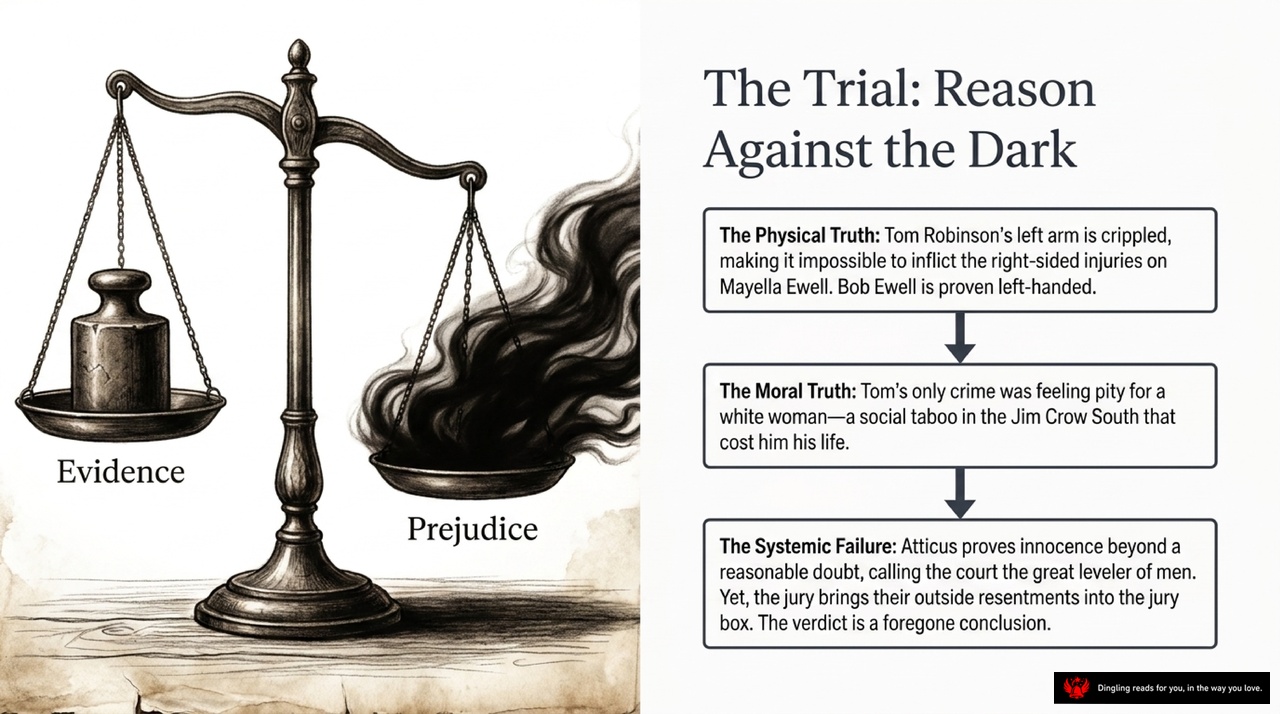
Tonight, the story of *To Kill a Mockingbird* reaches its emotional climax, and we stand on the precipice of a final, heartbreaking truth. Look at this slide: "The Trial: Reason Against the Dark." It captures the entire arc of Tom Robinson's case and its devastating aftermath.
On the left, we see the scales of justice. One side holds "Evidence," weighted by the physical reality of the world. The other side is filled with "Prejudice," a dark, smoky fog that obscures the truth. This visual perfectly illustrates the central conflict: the cold, hard facts versus the hot, irrational biases of the town.
Let's break down the three truths listed here. First, "The Physical Truth." Atticus proved beyond a doubt that Tom Robinson's left arm was crippled from an accident in his youth. He physically could not have inflicted the right-sided injuries on Mayella Ewell, especially since Bob Ewell is a left-handed man. The evidence was irrefutable.
Second, "The Moral Truth." The only crime Tom committed was showing pity to a white woman—a social taboo in the Jim Crow South that ultimately cost him his life. He was a kind man who helped a lonely girl, and that kindness was twisted into a crime against the social order.
Finally, "The Systemic Failure." This is the most tragic point. Atticus proved innocence beyond a reasonable doubt, calling the court the "great leveler of men." Yet, the jury brought their outside resentments into the jury box. They ignored the evidence because they were terrified of changing the status quo. The verdict was a foregone conclusion.
This failure wasn't just about one trial; it set the stage for the final tragedy. When Tom Robinson was executed in prison, and when Jem was attacked, we saw the full weight of that systemic failure. But in the end, the story gives us a moment of redemption. When Jem was beaten, Boo Radley stepped out of the shadows to save him. He was the true hero all along, a "mockingbird" who never harmed anyone, only protected us.
As we close this chapter, remember this lesson from Atticus: "You never really know a man until you stand in his shoes and walk around in them." That is the only way to fight the dark. We must look past the prejudice, see the evidence, and recognize the humanity in everyone, even those we've feared or misunderstood. The story ends not with a perfect justice, but with a call to understand and protect the innocent, no matter what the world says.
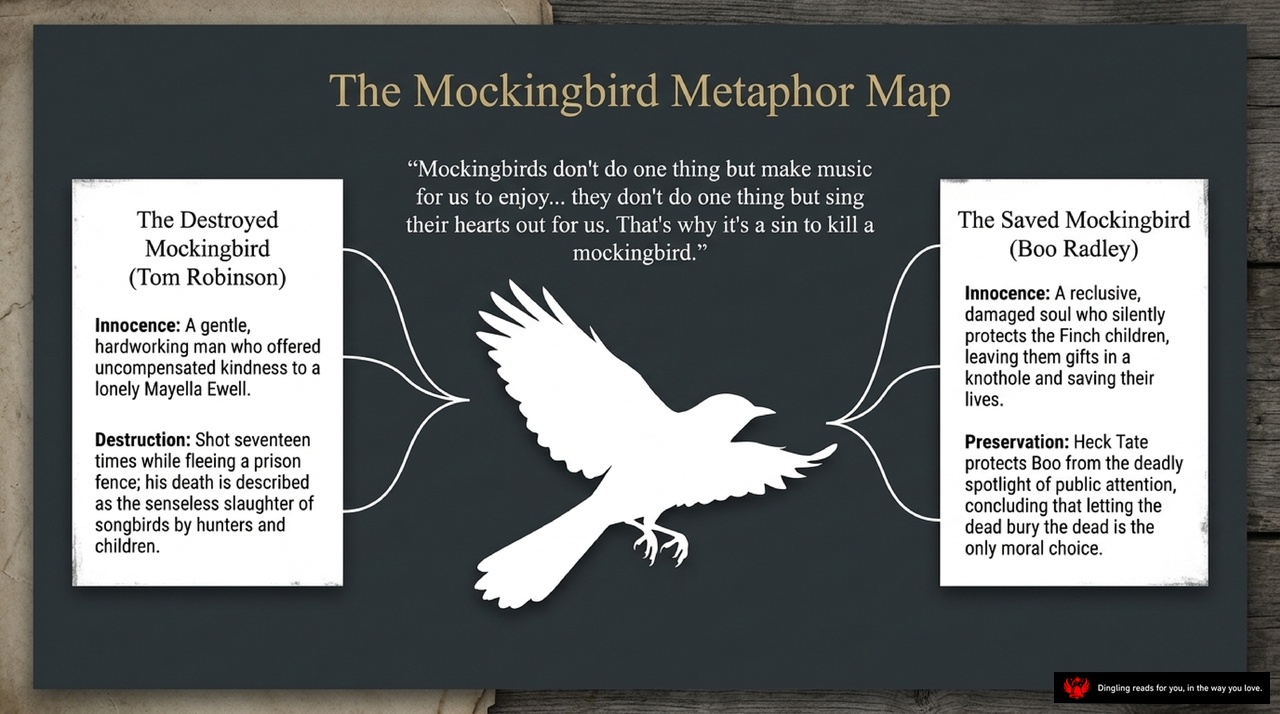
Look at this "Mockingbird Metaphor Map." It beautifully captures the tragic heart of *To Kill a Mockingbird* by contrasting two characters who share the same symbol: the innocent mockingbird.
On the left, we have Tom Robinson, the "Destroyed Mockingbird." He is described as a gentle, hardworking man who offered uncompensated kindness to a lonely Mayella Ewell. Yet, his innocence was met with destruction. The map highlights that he was shot seventeen times while fleeing a prison fence, and his death is described as the senseless slaughter of songbirds by hunters and children. He was a mockingbird who did nothing but try to help, only to be destroyed by the very people he tried to protect.
On the right, we see Boo Radley, the "Saved Mockingbird." While the town feared him, he was actually a reclusive, damaged soul who silently protected the Finch children, leaving them gifts in a knothole and saving their lives. The map points out a crucial moment of preservation: Heck Tate protects Boo from the deadly spotlight of public attention. He concludes that letting the dead bury the dead is the only moral choice.
The central quote ties it all together: "Mockingbirds don't do one thing but make music for us to enjoy... they don't do one thing but sing their hearts out for us. That's why it's a sin to kill a mockingbird." Both Tom and Boo sang their hearts out for others, and Atticus understood that destroying them was a moral crime.
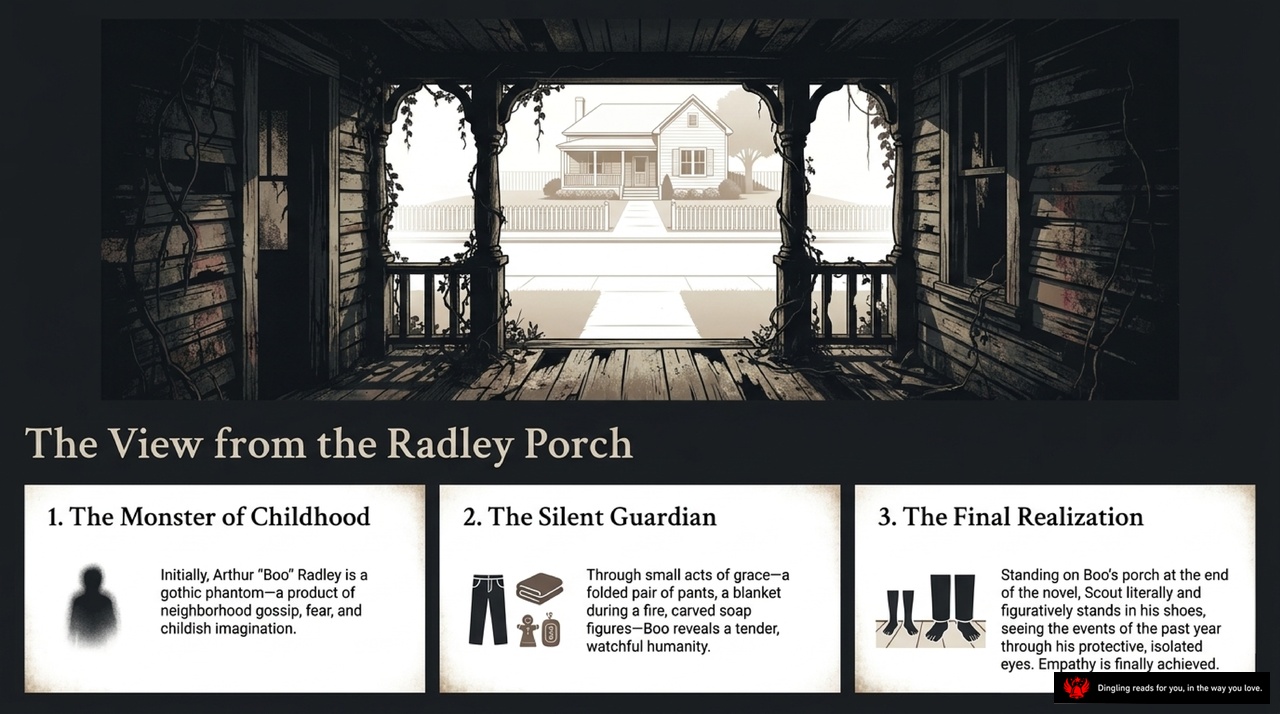
Look at this haunting view from the Radley porch. For Scout, this shadowy doorway wasn't just a house; it was the source of childhood fear. To the town of Maycomb, Arthur "Boo" Radley was a gothic phantom—a monster born from gossip, superstition, and the dark corners of a child's imagination. People whispered that he poisoned flowers or crawled through windows, creating a silence so thick it felt like a wall.
But as the story unfolds, that wall begins to crumble. Through small, silent acts of grace, Boo reveals a tender, watchful humanity. He leaves folded pants, a blanket during a fire, and carved soap figures in the tree knothole. He is the silent guardian we never knew we needed. Finally, standing on his porch at the end of the novel, Scout literally and figuratively steps into his shoes. Seeing the past year through his protective, isolated eyes, she achieves a profound empathy. The monster is gone, replaced by the neighbor we should have been all along.
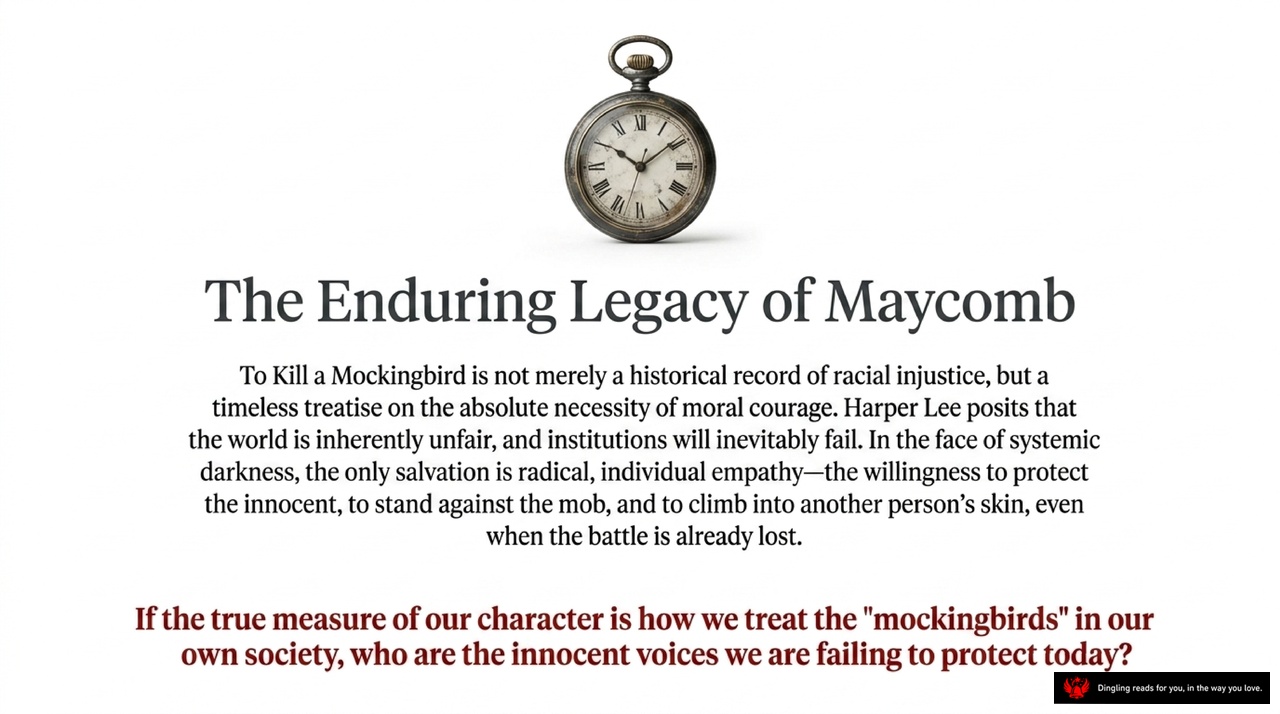
Look at this pocket watch on the slide. It's not just a prop; it represents the timeless nature of the story we are discussing today. The text on this page asks a profound question: Is *To Kill a Mockingbird* just a record of historical racial injustice, or is it something much more enduring?
The answer lies in the idea of moral courage. Harper Lee teaches us that the world is inherently unfair and institutions will inevitably fail. When you face systemic darkness, the only real salvation is radical, individual empathy. It is the willingness to protect the innocent, to stand against the mob, and to climb into another person's skin—even when the battle is already lost.
This slide challenges us to look beyond the history of Maycomb and ask a question that matters today: If the true measure of our character is how we treat the "mockingbirds" in our own society, who are the innocent voices we are failing to protect right now? Let's keep that question in mind as we reflect on the legacy of this book.