
To Live: Complete Chapter-by-Chapter Summary

Welcome to *To Live* by Yu Hua. This isn't just a story about a man named Fugui; it's a raw, unflinching look at what it truly means to endure. Imagine a life where everything you love is slowly stripped away, layer by layer, until all that remains is a pure, unadulterated will to simply exist. The cover captures this perfectly: a lone figure walking with an ox across cracked, barren earth. It's a visual metaphor for the systematic destruction of a man's attachments. Fugui starts as a spoiled rich kid, destined for greatness, but his own choices—gambling, recklessness—drag his family from a mansion into the mud. He loses his land, his father, his wife, and eventually, every child he ever had. Yet, amidst this crushing despair, there is a strange, quiet resilience. The story asks a profound question: when you have nothing left, what is the one thing that keeps you moving forward? It's not hope, not fortune, but the sheer, stubborn refusal to let go. This is the journey of a man learning that life isn't about the grand things you lose, but the quiet, enduring power to keep going when everything else has fallen apart.

The Author's Premise is built on two contrasting worlds: Remote Reality and Imminent Reality. On the left, we see the inspiration—a man outliving his entire family, yet treating the world with friendliness and zero complaint. On the right, the philosophy: a search for truth that rejects moral judgment, proving that man lives for the sake of living itself, not for any external reward.
Let's look at the split. The "Remote Reality" on the left represents the distant, abstract idea of suffering. It's the story of a man like Fugui, who loses everything—his wealth, his father, his children, his wife—and yet, he never complains. He survives not because he is a hero, but because he is simply human. He outlives his family, but instead of becoming bitter, he becomes kinder. This is the inspiration: finding dignity in the sheer act of enduring.
On the right, the "Imminent Reality" shows a cracked bowl, sitting on the earth. This is the philosophy. It's not about judging right or wrong, or blaming the gods. It's about the immediate, raw capacity to endure suffering. The cracked bowl isn't a symbol of failure; it's a symbol of resilience. It shows that life itself is the only reward. You don't live to get rich, to win, or to be praised. You live because you are alive. The moment you stop complaining and just start living, you touch the truth.
So, the author's premise isn't about telling us how to avoid pain. It's about showing us that pain is inevitable, but our response to it is a choice. By rejecting moral judgment and focusing on the simple, immediate act of living, we find a freedom that no external reward could ever give us.

On this slide, we see the stark duality of Fugui's life. To the left, we have "The Prodigal," represented by a loose, wild strand of hair. This side symbolizes wealth, ego, and indulgence—silk shirts, black hair oil, and the reckless pursuit of pleasure in brothels and gambling dens. It captures the arrogance of a young man who believes he can win everything back, only to lose it all.
On the right, we see "The Peasant," depicted by a simple, worn-out sandal. This represents earth, endurance, and humility. It's the life of coarse woven cloth, mud-caked skin, and quiet acceptance. It's the reality of plowing fields as an old man, finding dignity not in luxury, but in survival.
The text at the bottom tells us that this transformation begins in a "crucible." The aristocrat is stripped away to forge the survivor. Fugui starts as the Prodigal, drowning in debt and shame, but through the fire of losing his land, his father, and eventually his family, he is forced to shed that identity. He doesn't just lose his wealth; he loses his old self. In the end, he becomes the Peasant. He learns that true strength isn't found in silk or silver, but in the ability to keep walking forward, no matter how heavy the burden.

Look at this diagram. It illustrates "The Law of Diminishing Wealth." It shows a cycle: ancestors raised a chicken, which became a goose, then a sheep, then an ox. But Fugui reverses this ancestral cycle of wealth, yet ironically ends his life walking alongside a single, literal old ox.
In the story, Fugui starts as a spoiled young master. He squanders his family's fortune on gambling and women, turning the ox into nothingness. He loses everything—his land, his father, his son, his daughter, his son-in-law, and even his grandson. Every person he loved dies, and every asset he had vanishes.
At the end, the cycle completes in the most tragic way. He is left with only this old ox. In his hands, the goose became a chicken, and then even the chicken was gone. Now, he and the ox are the only ones left, moving together through the fields. This is the ultimate reality of his life: stripped of all wealth, he finds a strange, quiet peace with the one companion who never left him.
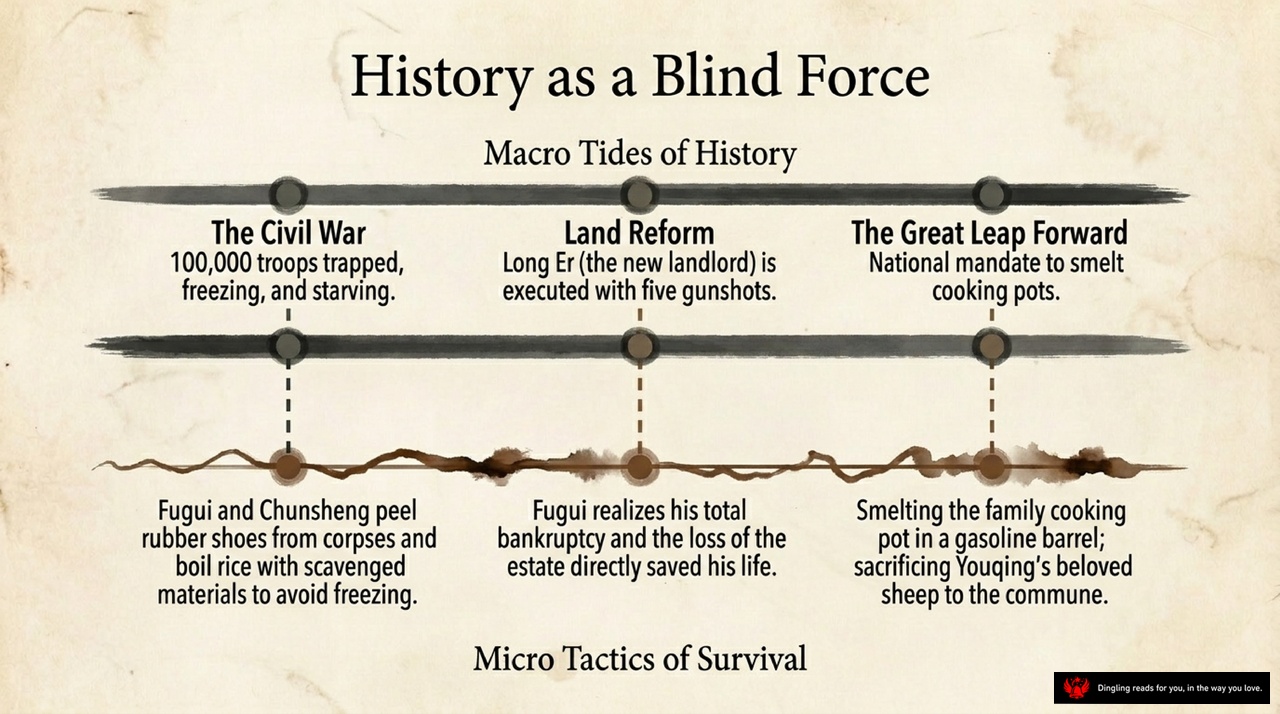
Look at this timeline. Above, we see the "Macro Tides of History"—the huge, unstoppable forces that swept through the 20th century. From the Civil War trapping 100,000 troops in freezing starvation, to the Land Reform where Long Er, the new landlord, was executed with five gunshots, and finally, the Great Leap Forward forcing the nation to smelt cooking pots. These were the events that no single person could stop.
But look below. That's the "Micro Tactics of Survival." While history moved in straight lines, life for Fugui was a jagged, chaotic struggle to stay alive. When the nation mandated the smelting of pots, Fugui didn't just obey; he sacrificed Youqing's beloved sheep to the commune, and he melted the family's cherished cooking pot in a gasoline barrel. Earlier, during the Civil War, instead of freezing to death, Fugui and Chunsheng peeled rubber shoes from corpses and boiled rice with scavenged materials just to survive another day. Even during the Land Reform, realizing his total bankruptcy and loss of the estate didn't kill him; it actually saved his life by forcing him to start over.
This slide shows the brutal truth: history is a blind force that crushes the individual, but survival is a series of desperate, personal choices. Fugui's life wasn't about winning the tide; it was about paddling hard enough just to stay afloat in it.
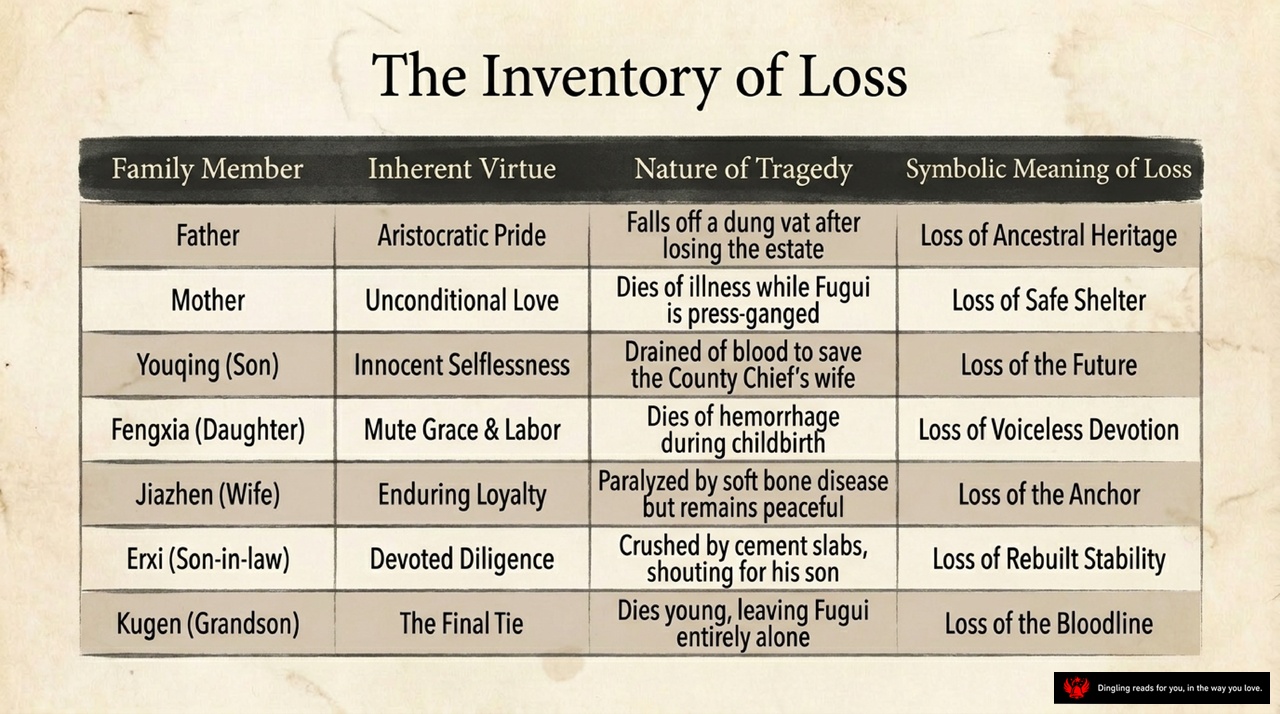
This slide, titled "The Inventory of Loss," maps out the heartbreaking journey of Fugui's family, showing how each member's unique virtue was tragically erased by fate. Let's look at this inventory together.
We start with the Father, whose Aristocratic Pride led to a fatal fall from a dung vat after the family lost its estate, symbolizing the total loss of ancestral heritage. Then there is the Mother, whose Unconditional Love was extinguished by illness while Fugui was away, representing the loss of safe shelter.
The tragedy deepens with Youqing, the Son, whose Innocent Selflessness cost him his life when he was drained of blood to save the County Chief's wife, a direct loss of the family's future. Fengxia, the Daughter, died of hemorrhage during childbirth, taking with her her Mute Grace and Labor, symbolizing the loss of voiceless devotion.
Jiazhen, the Wife, remained an Anchor of Enduring Loyalty until she was paralyzed by soft bone disease, representing the loss of that vital stability. Her son-in-law, Erxi, who showed Devoted Diligence, was crushed by cement slabs while shouting for his son, marking the loss of rebuilt stability. Finally, Kugen, the Grandson, was the Final Tie, who died young, leaving Fugui entirely alone and cutting off the bloodline forever.
Every row in this table tells a story of a specific virtue destroyed, illustrating how a single chain of misfortune pulled the entire family down, leaving Fugui to face the silence of total loss.

The Tragedy of the Absurd: When Survival Becomes a Drain on the Soul.
Look at this slide. On the left, we see "Organic Innocence"—footprints on cracked earth. This represents Youqing, a boy who ran fifty miles a day barefoot, carrying his shoes to save them, just to feed his sheep and go to school. His life was pure, driven by love and the desperate need to keep his family afloat.
But look at the right side: "Mechanical Brutality." A cold brick hospital bed and a syringe. This is the system. When Youqing rushed to donate blood to save the County Chief's wife, the indifferent medical machinery didn't just take his blood; it drained him dry. He was treated like a resource, not a person.
The darkest irony of survival lies right here. The very boy who fought relentlessly to preserve his family's meager assets is systematically emptied of his life force by the state apparatus. He isn't left with a hero's medal; he is left cold on a brick hospital bed, a victim of the very system he tried so hard to navigate. It's a brutal reminder that in the face of rigid machinery, human innocence can be crushed without a sound.
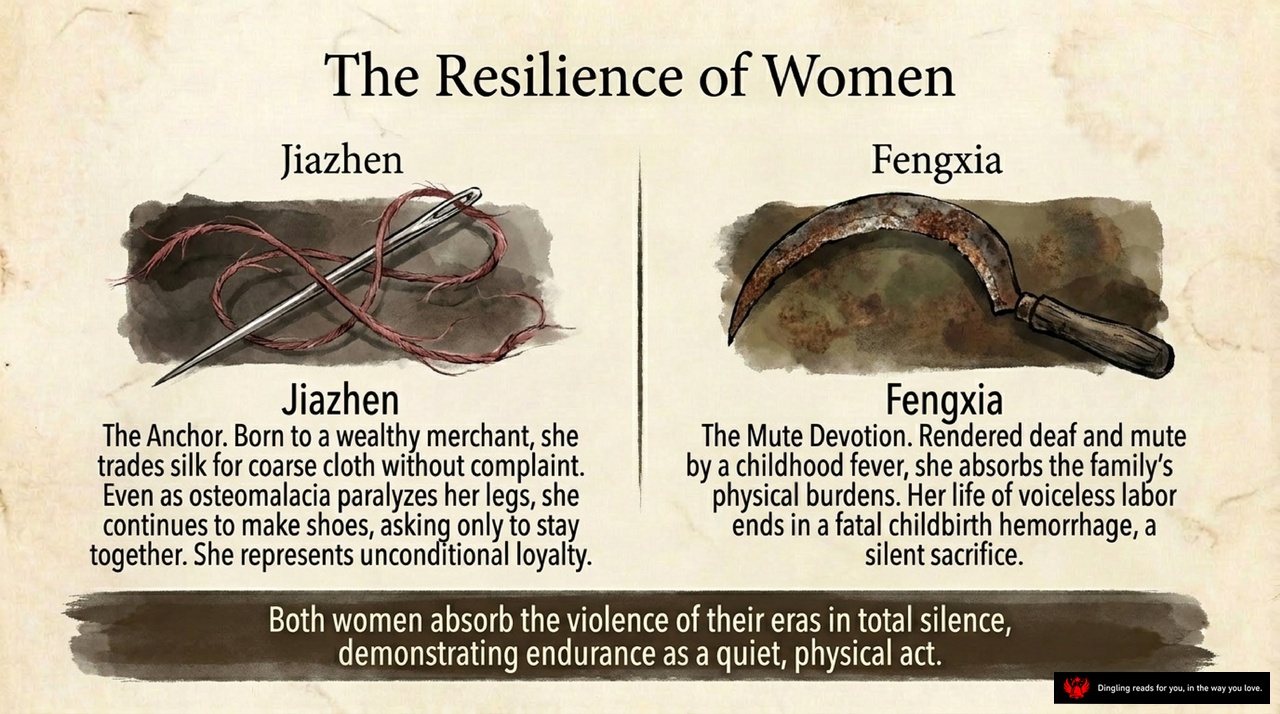
Look at these two women: Jiazhen and Fengxia. They represent the quiet, crushing weight of their era. Jiazhen, the anchor of the family, is shown here with a needle and thread. Born to a wealthy merchant, she traded her family's silk for coarse cloth without a single complaint. Even when osteomalacia paralyzed her legs, she refused to stop making shoes, asking for nothing but the right to stay by her husband's side. She embodies unconditional loyalty.
On the other side, we have Fengxia, labeled here as "The Mute Devotion." Rendered deaf and mute by a childhood fever, she absorbed the family's physical burdens with no voice of her own. Her life of silent labor ends in a fatal childbirth hemorrhage—a tragedy that speaks louder than words ever could.
Both women absorb the violence of their times in total silence. They don't scream or demand justice; instead, they demonstrate endurance as a quiet, physical act. They carry the family's survival on their broken bodies, proving that resilience isn't always loud—it's often just the stubborn refusal to let go, even when everything is taken away.

Look at this haunting image, titled "The Blurring of Man and Beast." It captures the most profound moment in Fugui's life: the moment he finally becomes one with his past, his family, and the earth itself.
In the center, we see an old ox plowing the cracked, dry land. This isn't just a cow; this is Fugui. Years ago, he saved this weeping ox from a butcher's blade, recognizing his own impending mortality in the animal. He named it Fugui. Now, the lines between the man and the beast have completely dissolved. They are both old, both have outlived their respective eras, and both are left with nothing but the simple, rhythmic act of plowing the earth.
Notice the names on the right: Erxi, Youqing, Jiazhen, Fengxia, Kugen, pull! These aren't just words; they are the voices of the people Fugui has lost. Erxi, his brother-in-law; Youqing, his beloved son; Jiazhen, his devoted wife; Fengxia, his daughter; and Kugen, his grandson. They are all gone, buried in the soil, yet their names are the only fuel Fugui has left to keep moving forward.
At the bottom, the text explains why he does this. Fugui calls out the names of his dead family members to the solitary ox. He does this to trick the ox into thinking it is not plowing alone. It's a desperate, beautiful act of companionship. He knows he is walking through a graveyard of his own making, but by calling their names, he keeps them alive in his mind. He refuses to let them be forgotten.
This scene is the ultimate testament to resilience. It tells us that even when you lose everyone you love, even when you are reduced to a solitary figure with an old animal, you can still find a way to keep going. You carry your loved ones with you, not in your arms, but in your heart, as you continue the work of life, one furrow at a time.

Look at this diagram. It captures the entire tragedy and redemption of *Fortress Shrouded in Clouds*. In the center, burning fiercely, is "The Will to Live." Everything else—the hope for the future, the family anchor, wealth, status, and even a safe shelter—is shown as layers of a circle being consumed by fire.
The text at the bottom sums it up perfectly: "Human beings are not living for family, for wealth, or for country. When the crucible burns away every external attachment, what remains is the profound, peaceful state of existing simply for the sake of existing."
Think about it. Fugui started with everything. He had a hundred acres of land, a beautiful wife named Jiazhen, a son named Youqing, and a daughter named Fengxia. He also had hope for the future and the safety of an ancestral home. But life, like that fire in the image, burned it all away.
First, the fire of his own vice took the land and the family's honor. Then, the fire of war and disease took his father, his wife, and his children. Even the man who bought his daughter, Erxi, and the child he raised, Kugen, were swept into the flames. The "Safe Shelter" and the "Anchor" were gone. The "Wealth & Status" turned to ash.
But notice what's left in the center. It's not empty. It's not destroyed. It's "The Will to Live." This is the ultimate synthesis. In America, we often talk about resilience, but Fugui teaches us something deeper. He didn't survive because he was strong; he survived because he refused to let go. He kept pulling himself up from the mud, not to regain his lost glory, but simply because he had to.
This isn't just about surviving tragedy. It's about finding a profound peace in the act of existing itself. When you lose everything, you stop pretending. You stop chasing the future or worrying about the past. You are just here, breathing, working, and living for the sake of living. That simple, stubborn refusal to die is the most powerful force in the universe. That is the only thing that truly remains when the fire goes out.

Look at this silhouette against the dying light. As the sun sets on a life systematically stripped of wealth, family, and future, all that remains is a man, an ox, and the rhythmic turning of the earth. When the crucible of history burns away every external attachment, we are left with a profound question: is the pure, unadorned act of existing our ultimate triumph, or our final tragedy?
Fugui's journey has taken him from a spoiled young master to a gambler who lost everything, from a soldier in the trenches to a father who buried his children one by one. His wife, his son, his daughter-in-law, his granddaughter, and even his young son-in-law—all gone. Now, he stands alone in the twilight, not as a man defined by his past glory or his current poverty, but simply as a human being who refuses to give up.
In the end, Fugui realizes that the value of life isn't found in the grandeur of the past or the accumulation of wealth. It is found in the stubborn refusal to stop moving forward, even when the road is empty and the sky is dark. He talks to his old ox, calling out the names of those he lost, as if they are still walking beside him. This isn't just about survival; it's a declaration that as long as you can breathe, you still have the power to shape the future. The tragedy of losing everything is real, but the triumph of continuing to live, to plant seeds, and to care for the land, is something far greater.