
To Sell Is Human: Complete Chapter-by-Chapter Summary
Welcome to today's session on "To Sell Is Human" by Daniel H. Pink. You're looking at the cover, which sets a powerful tone right from the start: "A revelation of the surprising truth that we are all in the business of moving others, and how to master the art of modern persuasion."
Forget the old idea that sales are just for people in suits. The reality is far more pervasive. As the book opens, it reminds us that while one in nine Americans might have a sales title, the other eight are actually doing sales work every single day. Whether you're a teacher trying to engage a student, a doctor persuading a patient to follow a treatment plan, or even just convincing your spouse to do the dishes, you are practicing persuasion. We are all salespeople, often without realizing it.
The story of Fuller Brush Company, featured early in the book, perfectly illustrates this. In the past, sales meant door-to-door visits with a neat leather portfolio. A salesman named Norman Hall would walk into homes, showing off products like ostrich feather dusters or stainless steel scrubbers. It wasn't about trickery; it was about connection, patience, and genuinely understanding what the customer needed. That human element—the ability to move others—remains the core of sales, whether you're selling a brush in 1950 or pitching an idea in a modern office today.
So, what does this mean for us? It means that if you want to succeed in any field, you need to master the skill of persuasion. It's not a niche talent; it's a fundamental life skill. Whether you're leading a team, closing a deal, or simply trying to make your point heard, understanding how to connect with and influence others is the key. We are all in the business of moving others, and the good news is that we all have the potential to become better at it.
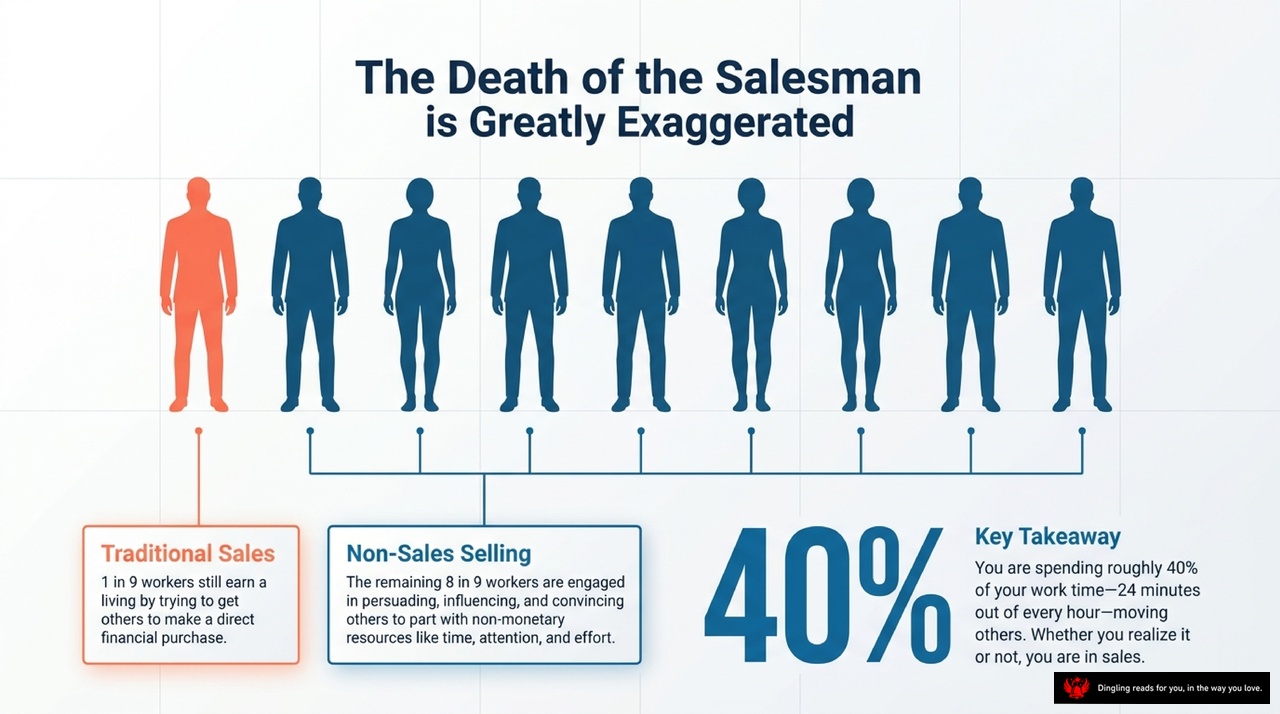
The Death of the Salesman is Greatly Exaggerated. Here's the truth: out of every nine Americans, one is a professional salesperson, but the other eight are doing sales work every single day. It's not just about closing deals for money; it's about persuading, influencing, and convincing others to share their time, attention, and effort.
Think about your own week. Roughly 40% of your work time—about 24 minutes out of every hour—is spent moving others, whether you realize it or not. You're selling ideas to your boss, convincing a colleague to help, or even persuading your family to support a cause. This "non-sales selling" is the real engine of our economy. From doctors guiding patients to teachers inspiring students, we are all salespeople. The old model of the lone wolf hawking products is gone, but the fundamental human ability to connect and influence is more vital than ever. You aren't just an employee; you're a salesperson in action, every day.
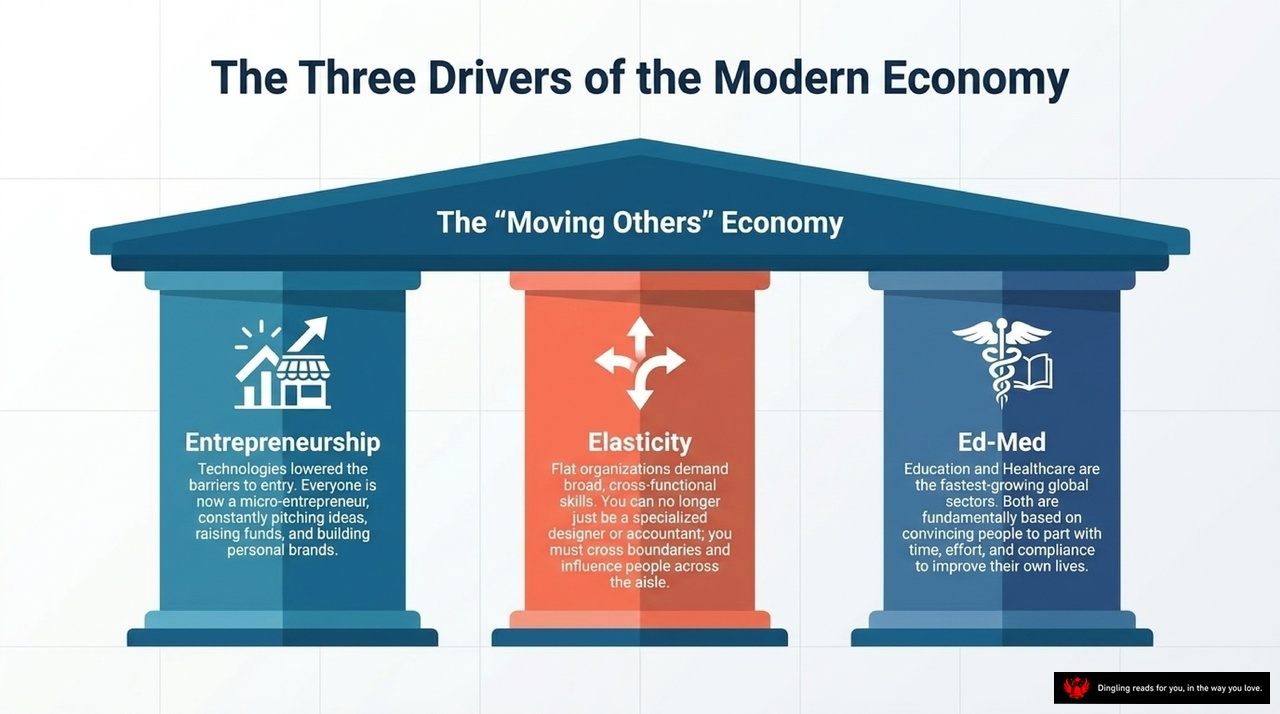
In the modern economy, three powerful pillars are holding everything up: Entrepreneurship, Elasticity, and Ed-Med.
First, look at **Entrepreneurship**. Technology has shattered the barriers to entry, turning almost everyone into a micro-entrepreneur. Whether you're pitching ideas to investors or building a personal brand on social media, you are constantly selling yourself. The old days of just making a product are over; now, you must be the salesman of your own life.
Next, we have **Elasticity**. The era of rigid, specialized jobs is fading. Flat organizations demand broad, cross-functional skills. You can't just be a specialist anymore; you must be adaptable, crossing boundaries and influencing people across different departments. Your ability to pivot and connect is your most valuable asset.
Finally, there is **Ed-Med**. Education and healthcare are the fastest-growing sectors globally. But here's the catch: they aren't just about delivering a lecture or a procedure. They are fundamentally about convincing people to part with their time, effort, and compliance. A doctor or a teacher is, at their core, a persuader who helps others improve their lives.
Together, these three drivers create what we call the "Moving Others" economy. In this world, the ability to influence and persuade isn't just a sales skill—it's the very engine of our society.

Look at this seesaw. In the past, the scale was tipped heavily toward the seller. That era was defined by information asymmetry. Sellers held all the power and the data, while buyers were left with a simple, old-school rule: *Buyer Beware*, or *Caveat Emptor*. To survive, sellers often relied on tactics like deception, sleaze, and withholding facts to close a deal. Think of the 1970s used-car salesman who controlled the inventory list; that was the game.
But the seesaw has flipped. We are now in the present, an era of information parity. Thanks to the internet, the buyer now holds equal power, data, and options. The rule has completely reversed to *Seller Beware*, or *Caveat Venditor*. In this new landscape, the old "sleazy sales" stereotype isn't human nature anymore; it was just a byproduct of not knowing what we were buying. Today, transparency is the only viable strategy.
The tactics have shifted from hard closing to honesty, transparency, empathy, and curation. Look at the modern consultant helping a client navigate overwhelming choices, or a car dealer like Tammy Davis who lets customers check their own pricing online. When information barriers dissolve, the seller's job changes from manipulating information to managing it. You can't hide the price or the flaws anymore; you must be open about them. As the slide shows, the modern winner isn't the one who knows the most secrets, but the one who helps the buyer make the clearest decision with full knowledge. Honesty and transparency aren't just nice values; they are now the essential tools for success.

In the old days, sales success was all about the "ABCs": Always Be Closing. You were taught that every word and every move had to push for a deal, treating sales like a high-stakes game where the only goal was signing the contract. But that mindset belongs to a different era. Today, we live in a world where everyone is selling, and information is no longer a secret held by the seller.
So, forget the old ABCs. Let's meet the New ABCs that actually work in this connected age. The first A stands for Attunement. This isn't just about being nice; it's about bringing your actions and outlook into harmony with the people you're trying to reach. It means stepping out of your own head and truly understanding their specific context and needs before you even say a word.
Next, we have B, which stands for Buoyancy. Think of this as your emotional floatation device. In the ocean of daily rejection, salespeople face a constant barrage of "no's." Buoyancy is the resilient mindset that allows you to stay afloat. It's not about being blindly optimistic, but about having the strength to bounce back, keep moving forward, and maintain a positive energy that actually draws people in, even after a tough day.
Finally, the third C is Clarity. In the past, salespeople were seen as the heroes who magically solved problems. But today, customers have all the information they need to solve their own problems online. The real value now lies in helping others see their situations in fresh ways. It's about identifying problems they didn't know they had or helping them clarify their messy thoughts. Instead of just pushing a product, you become a guide who brings clarity to their confusion, creating new opportunities where none seemed to exist before.

In the modern sales landscape, being a problem-solver isn't enough anymore. Thanks to the internet, buyers have all the answers. If they know their problem, they can fix it themselves. So, what makes a salesperson truly indispensable? The answer lies in Clarity—specifically, the ability to discover the right problem before the buyer even realizes it exists.
Think back to a famous creativity study from 1964. Students who spent time figuring out *what* to paint ended up with average work. But the students who spent time exploring *which* objects to use to create something new? Those became the masters. The quality of the question determines the quality of the answer.
Today's top performers aren't just fixing surface issues like "my vacuum doesn't suck." They are digging deeper to uncover the real struggle: maybe the issue isn't the vacuum, but dust trapped in window tracks or deep carpet fibers. By reframing the conversation, they stop competing on price and start competing on value.
To do this, you need to master specific cognitive tools. First, use contrast frameworks. Show people "less is more" by limiting choices to help them decide, or use "potential over power" to make a candidate look more exciting than a proven veteran. Second, challenge irrationality. Sometimes, asking a seemingly irrational question, like "Why did you give yourself a 10 out of 10 on your readiness instead of a lower score?", breaks down resistance better than logic ever could.
Finally, don't just ask questions; use tools to drill down. Keep asking "Why" five times to hit the root cause, or use the "Five Questions" recipe to turn statements into inquiries that clarify direction. Remember, in an age of information overload, your superpower isn't having the data. It's having the clarity to help others see the problem they didn't know they had, and guiding them to the solution they actually need.

Buoyancy is the emotional resilience that keeps us afloat in the vast ocean of rejection. It's not about blind optimism, but a balanced, strategic approach to handling setbacks before, during, and after they happen. Think of it as your personal life raft.
Before you even step out the door, the first step is to ditch empty affirmations like "I can do this!" Instead, try interrogative self-talk. Ask yourself, "Can I do this?" This simple shift triggers your brain to actively formulate strategies and uncover your intrinsic motivation, preparing you with a clear plan rather than just a vague feeling of confidence.
Once you're in the interaction, you need to manage the ratio of your emotions. Research shows that maintaining a 3:1 ratio of positive to negative emotions is the sweet spot for thriving. Too much positivity leads to blindness, but too much negativity causes collapse. By balancing your perspective, you broaden your view, allowing you to find creative solutions even when things get tough.
Finally, when rejection hits, your explanation style matters most. Don't let failure feel permanent, universal, or personal. Instead, reframe it as temporary, specific, and external. Maybe the client was just busy, or the timing wasn't right. By viewing rejection this way, you protect your self-worth and quickly bounce back to try again. This three-part approach transforms rejection from a stop sign into just another wave you navigate with ease.

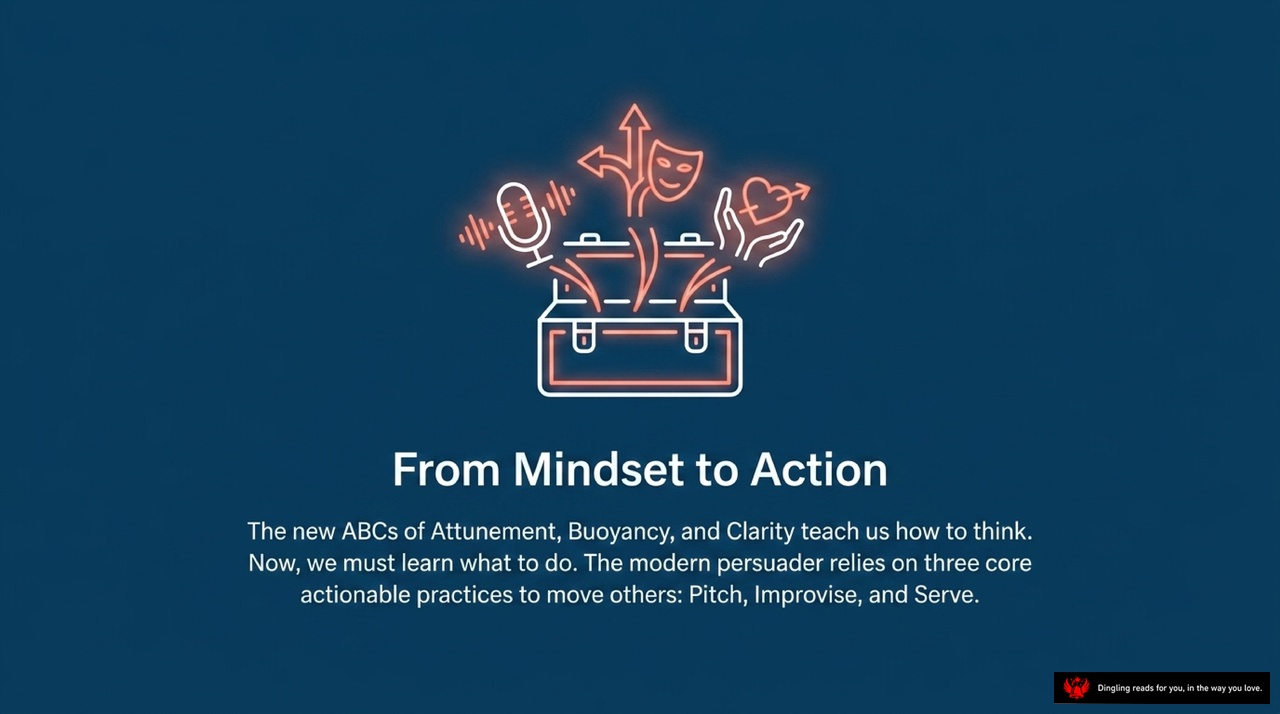
In the world of modern sales, rigid scripts are dead. The real magic happens when you improvise. Think of improvisation not as winging it, but as following three simple principles that turn every conversation into a win-win.
First, listen for the other person's proposal. Instead of trying to overcome their objections, treat their words as the starting point for your next move. If someone says, "I can't give money right now," don't argue. Listen for the hidden word "now" and ask, "When does now look like a good time for you?" True listening means letting your ideas live inside their words before you speak.
Second, say "Yes, and" instead of "Yes, but." That tiny word "but" kills creativity and starts a fight. "Yes, and" builds a bridge. If a classmate suggests a Vegas reunion, don't say, "Yes, but it's too expensive." Say, "Yes, and we could start a small crowdfunding drive to help everyone." Then add, "Yes, and booking six months early saves us money." You are no longer negotiating; you are collaborating.
Third, give your partner credit. Treat them as a teammate, not an opponent. When someone shares a half-baked idea, don't point out the flaws. Say, "That's a fresh angle. If we combine it with what we discussed earlier, it could be amazing." Protecting their dignity builds trust that lasts.
To master this, practice active listening by waiting five seconds before answering. Try the "Yes, and" game where you must build on every idea without rejecting it. Or play the "One Word" story game to keep the group's rhythm. These exercises train your brain to be flexible, responsive, and genuinely helpful, turning every interaction into a moment of connection.
In a world where every interaction is a chance to influence, true service goes far beyond a smile or a standardized script. It's about tangibly improving lives and making the world better. Consider the buses in Kenya, where reckless driving caused a crisis. By simply placing stickers on the dashboard that showed the faces of potential victims, passengers became active guardians, cutting accident claims by half. Or look at radiologists: when they saw actual patient photos next to their scans, their empathy spiked, and their diagnostic accuracy soared. These examples prove that when we shift from solving abstract problems to serving real people, our impact multiplies.
But how do we make this personal? The secret lies in "embodied service"—seeing your audience not as a crowd, but as specific individuals. An Italian restaurant owner who posted his personal number on the wall received mostly praise because customers felt he truly cared. Similarly, a medical website that sent handwritten notes instead of automated replies made its customers feel valued, not processed. Even a car dealer who shared her personal email built instant trust. These aren't grand gestures; they are small, human connections that transform cold transactions into meaningful relationships.
To truly embody this, you can add photos of your clients to your work, write personal thank-you notes, or simply remember a student's favorite hobby. The goal is to make your service feel human. When you anchor your work in the well-being of a specific person, boredom fades, and your motivation ignites. As a hospital experiment showed, reminding staff that their actions protect patients, rather than just themselves, dramatically increases compliance. So, ask yourself: Who exactly am I serving today? When you see the real human behind the request, you unlock the ultimate power to move others.
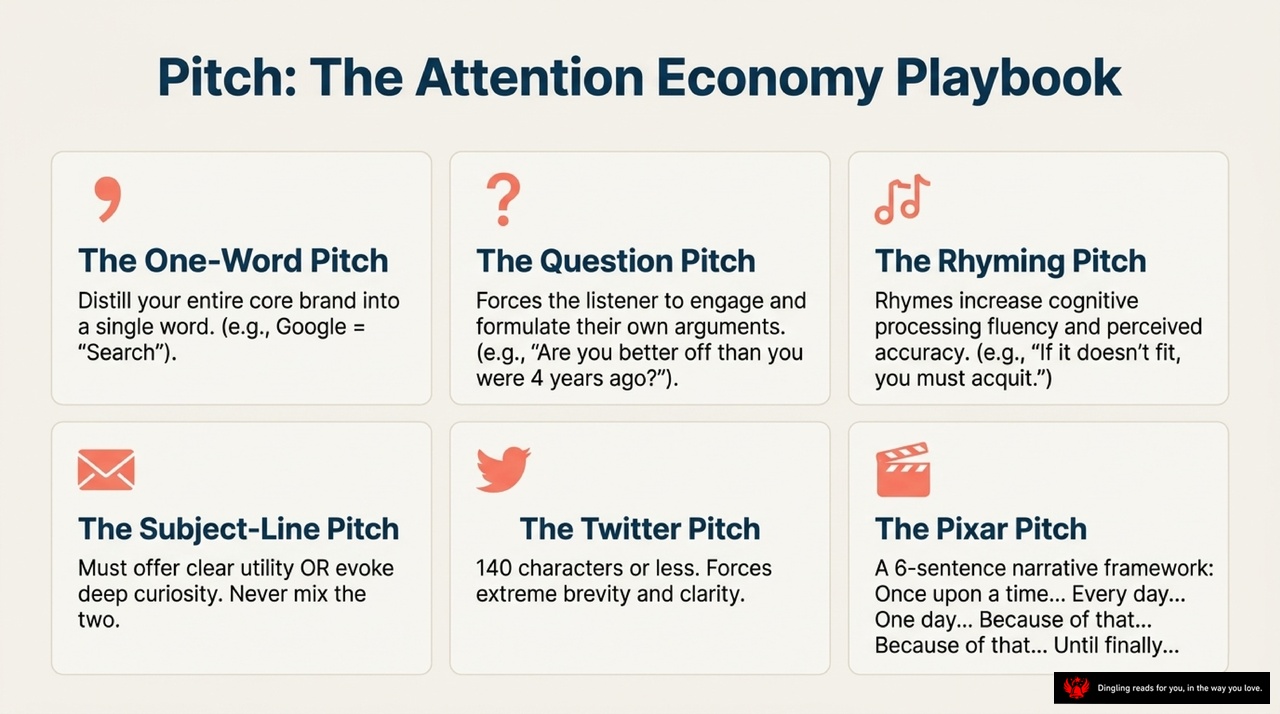
Welcome back. Today, we're diving into the final piece of the puzzle that makes a sales pitch truly stick: the six essential techniques for crafting your opening.
Think of your pitch not as a monologue, but as a strategic conversation starter. In a world where everyone is selling, your first few seconds determine whether you get a hearing or get ignored. Let's look at the six specific tools from the book that can transform your approach.
First, there's the **One-Word Pitch**. This is about extreme discipline. You have to distill your entire brand or message into a single, powerful word. Think of Google as "Search," Visa as "Priceless," or Obama's 2012 campaign built on "Forward." It's not just a slogan; it's a mental hook that instantly anchors your audience's understanding.
Next, try the **Question Pitch**. Instead of telling people what you think, ask them a question that forces them to formulate their own argument. When Reagan asked voters, "Are you better off now than you were four years ago?" he didn't just state a fact; he made them realize the answer was no. This technique engages the brain far more effectively than a direct statement.
Then we have the **Rhyming Pitch**. It might sound cheesy, but there's science behind it. Rhymes increase cognitive fluency, making your message feel more accurate and trustworthy. Just remember the famous courtroom line, "If it doesn't fit, you must acquit." The rhythm makes it impossible to forget.
For email communication, use the **Subject-Line Pitch**. You have split seconds to decide whether to open the message. Your subject line must either offer clear, immediate utility or evoke deep curiosity. Be specific. Vague subjects get deleted instantly.
The **Twitter Pitch** challenges you to convey your core message in 140 characters or less. This forces extreme brevity and clarity. It's about stripping away all the fluff and leaving only the essential value proposition that compels action.
Finally, the **Pixar Pitch**. This is a narrative framework designed to build emotional resonance. It follows a six-sentence structure: Once upon a time... Every day... One day... Because of that... Because of that... Until finally... This structure turns a dry business idea into a compelling story that people actually want to hear.
But mastering these words is only half the battle. You must practice them relentlessly. Record yourself, watch the playback, and refine the tone until it feels natural, not rehearsed. And don't forget to pair these verbal hooks with visuals. A picture of a bridge reinforces the word "Connection"; a short video of a patient finding hope amplifies a story about health.
In this visual era, your words need a visual partner to truly land. Combine these six techniques with the right imagery, and you'll stop just speaking to people—you'll start connecting with them.

In the world of improv and high-stakes negotiation, the old rule of "Yes, but..." is a trap waiting to happen. As the slide clearly illustrates, starting with "Yes, but..." creates a downward spiral of negativity and defensiveness. It shuts down collaboration before it even begins. Instead, we need to master the "Yes, And..." mindset. This simple shift transforms a downward spiral into an upward one, opening up endless possibilities for creative problem-solving.
Think about it this way: when someone offers an idea, a complaint, or even an objection, don't treat it as a barrier to overcome. Treat it as an "offer" to build upon. When you say "Yes, And," you are telling your partner, "I hear you, and now let's take this further together." This approach forces you to shift from a zero-sum, win-lose mentality to a positive-sum game where you actively work to elevate the other person's ideas and status. By making your partner look good, you build trust and unlock solutions that neither of you could have found alone. So, the next time you feel the urge to say "but," pause and choose "and" instead. Watch how the conversation—and your results—skyrocket.
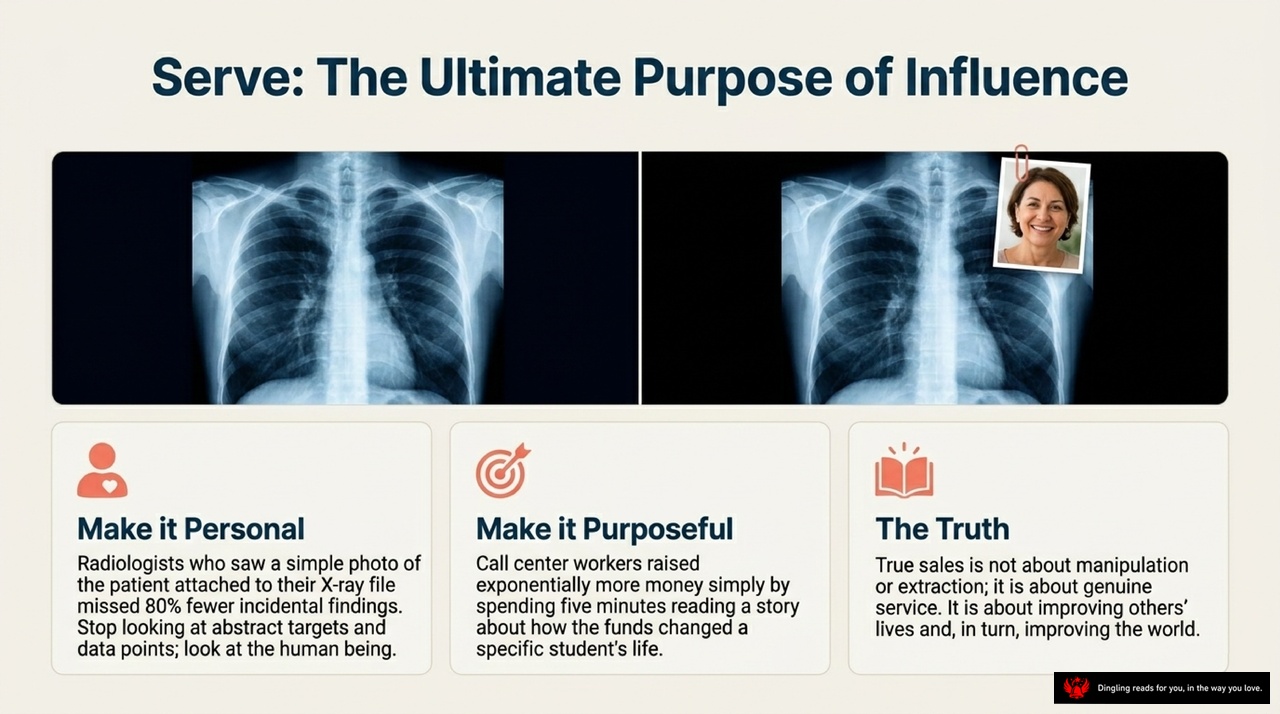
True sales isn't about manipulation or extraction; it's about genuine service. It's about improving others' lives and, in turn, improving the world. Think about the radiologists we discussed earlier. When they saw a simple photo of a patient attached to their X-ray, they missed 80% fewer incidental findings. Why? Because they stopped looking at abstract targets and data points and started seeing the human being.
Consider call center workers who raised exponentially more money simply by spending five minutes reading a story about how funds changed a specific student's life. Or look at that Italian restaurant owner who posted his personal cell number on the wall. He didn't just sell pizza; he made himself accountable to every single customer. Those 8 calls he received? Six were compliments. Only two were complaints. That's the difference between a transaction and a connection.
When you serve, you transform your work from a task into a purpose. You stop asking, "How do I close this deal?" and start asking, "How can I make this person's life better?" That shift is the ultimate purpose of influence.

Welcome to the final piece of our Modern Influencer Framework. As we wrap up, let's look at the complete picture.
At the very heart of this system are the gears labeled "The ABCs." These stand for Attunement, Buoyancy, and Clarity. Think of these as your internal engine. Attunement is about harmony—putting yourself in another's shoes. Buoyancy is that emotional resilience to keep floating when rejection hits. And Clarity is the ability to help others see problems they didn't know they had. Without these three, the rest of the system stalls.
Surrounding that core engine is the outer ring, "The Practices." This is where your mindset translates into action through three key behaviors: Pitch, Improvise, and Serve. You pitch your value, you improvise your responses when things get unpredictable, and you serve by genuinely improving someone's life.
But here is the critical context that frames everything: Information Parity. The old days of hiding secrets are over. Today, the rule is "Seller Beware." Because buyers know everything, your only path to success is total transparency and honesty. If you try to manipulate information, you will lose.
All of this—the mindset, the practices, and the environment—flows directly into one ultimate goal: Outcome. This isn't just about making a sale or getting a "like." It's about moving others, creating mutual value, and serving the world. It's about shifting from a transactional mindset to a relational one.
So, to be a modern influencer, you must master the ABCs inside, execute the practices outside, and operate with the humility of information parity. That is how you create real, lasting impact.
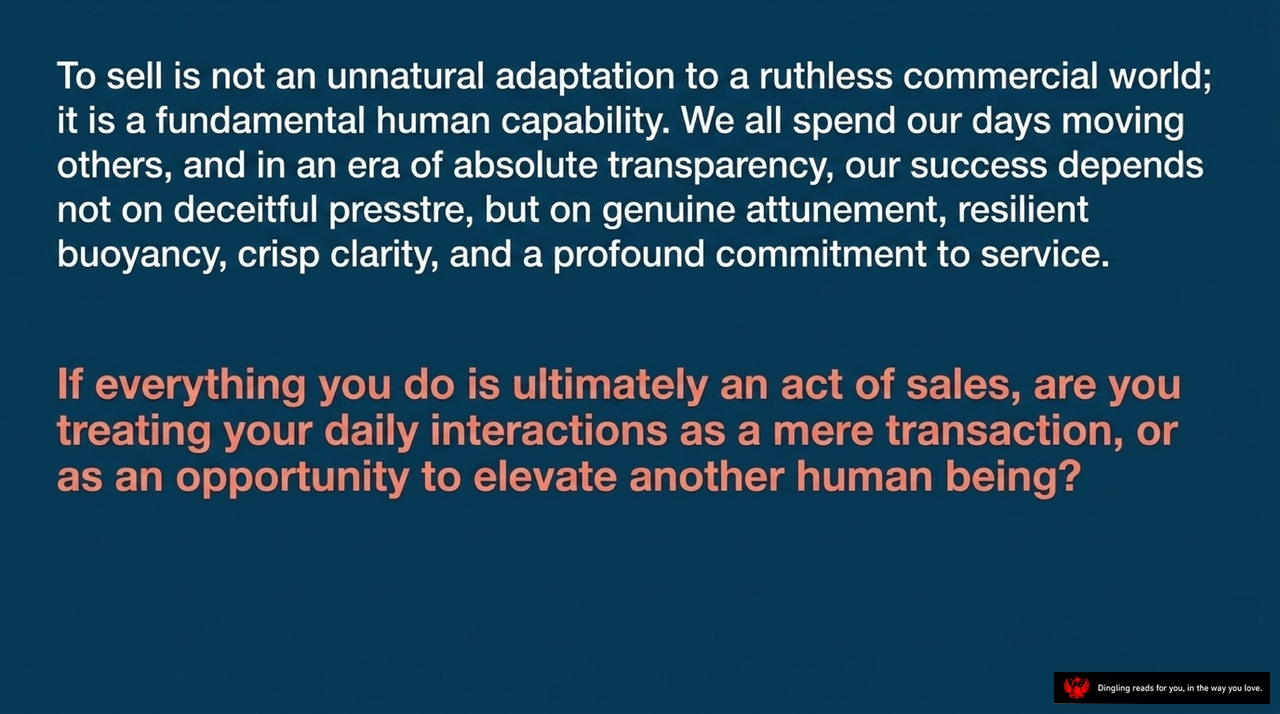
In today's world, selling isn't just about closing deals in a ruthless commercial arena; it's a fundamental human capability. We are all salespeople every single day. Whether you're persuading a colleague to approve a project, convincing an investor to fund your idea, or even just trying to get your kids to go to bed on time, you are engaging in an act of sales.
The slide asks a powerful question: Are you treating your daily interactions as mere transactions, or as an opportunity to elevate another human being? The answer lies in shifting from deceptive pressure to genuine attunement. Success today depends on resilient buoyancy, crisp clarity, and a profound commitment to service.
Think about the old sales playbook where you had all the information. That era is over. Now, buyers know more than sellers. Your job isn't to hide facts or manipulate them; it's to help them find clarity in a sea of information. Instead of pushing a product, you become a guide who helps them see their own needs and the best solutions.
When you approach every interaction with this mindset, you stop competing and start collaborating. You aren't just selling a thing; you're serving a person. By focusing on how your actions genuinely improve someone's life, you unlock a deeper level of trust and influence. So, the next time you reach out, ask yourself: am I here to serve, or just to sell? Because when you choose to serve, you don't just make a sale—you make a human connection that lasts.