
Too Loud a Solitude: Complete Chapter-by-Chapter Summary

Welcome to a journey into the heart of Bohumil Hrabal's masterpiece, *Too Loud a Solitude*. Imagine a man who has spent thirty-five years buried in a mountain of waste paper, working in a basement that feels less like a workplace and more like a tomb. He is Hans, a paper compactor, whose life is measured in tons of crushed books and the endless noise of a hydraulic press.
For Hans, this job is a tragic romance. He believes that while the physical books are destroyed, their ideas are indestructible, floating freely in the air like invisible ghosts. He drinks beer not to get drunk, but to sharpen his mind, diving deep into the text of the books he is about to crush. It is a melancholy ode to the power of the written word and the beauty hidden even in the world's trash.
Hans finds a strange peace in this destruction. He sees the collapse of buildings and the crushing of books as parallel acts of release. Yet, amidst the chaos, he becomes a guardian. He rescues precious books from the waste, treating them like relics. He wraps these saved books in beautiful paper—sometimes even using reproductions of masterpieces by Rembrandt or Monet—to give each package a soul. In the center of every package lies a classic, a secret treasure waiting to be read, even as the rest of the book is turned into pulp.
It is a story about the collision between romantic intellect and mechanical progress, where a soft-hearted soul is forced to become a "butcher" of culture, all while finding his own infinite solitude within the crushing weight of the world.
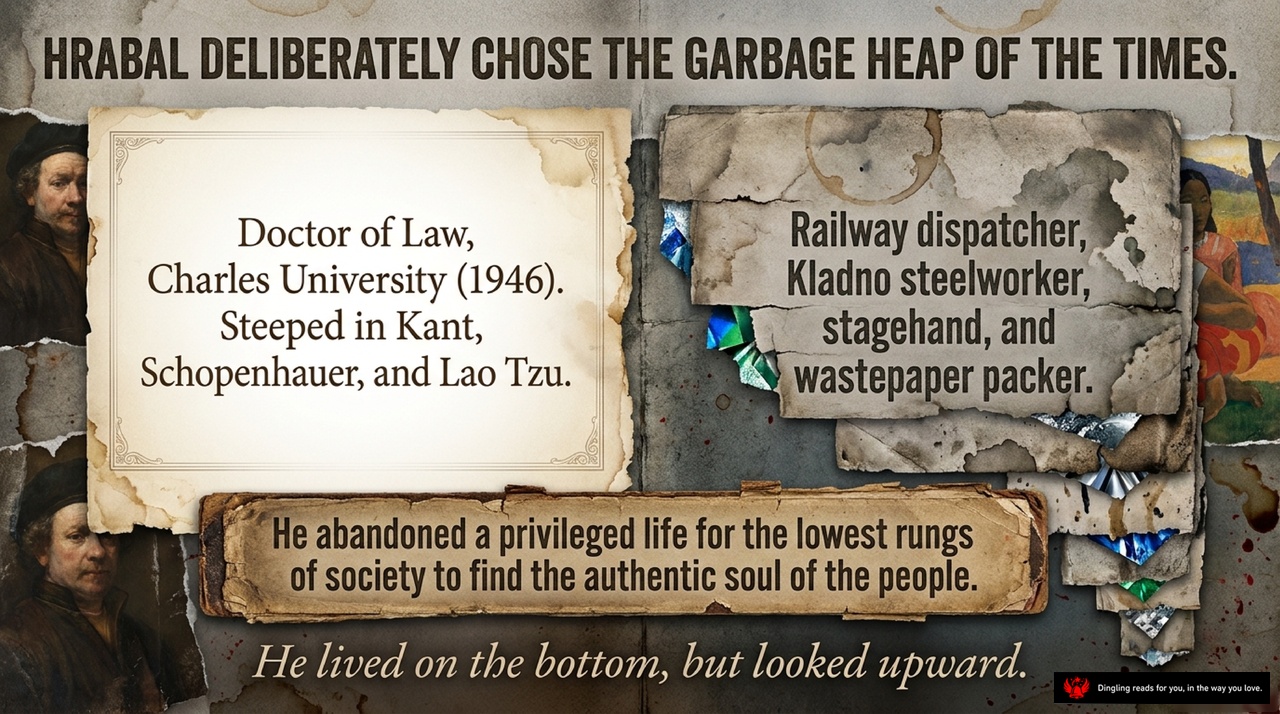
Thirty-five years ago, I made a deliberate choice to live on the garbage heap of the times. While others were chasing privilege, I traded a life of comfort for the lowest rungs of society, driven by a single, burning desire: to find the authentic soul of the people.
You see, my journey wasn't linear. I was a Doctor of Law, steeped in the deep philosophies of Kant, Schopenhauer, and Lao Tzu, earning my degree from Charles University in 1946. But I didn't stay there. I deliberately abandoned that privileged world to become a railway dispatcher, a steelworker, a stagehand, and eventually, a wastepaper packer. It was a radical shift from the ivory tower to the dirt and dust of the working class.
I lived on the bottom, but I never stopped looking upward. In that gritty reality, amidst the crushing weight of tons of paper and the relentless noise of the city, I found something rare: true connection. By immersing myself in the lives of the ordinary people, I realized that the most profound truths weren't found in abstract theories, but in the shared struggle and the quiet dignity of everyday existence. This wasn't just about survival; it was about understanding the human condition in its rawest form.
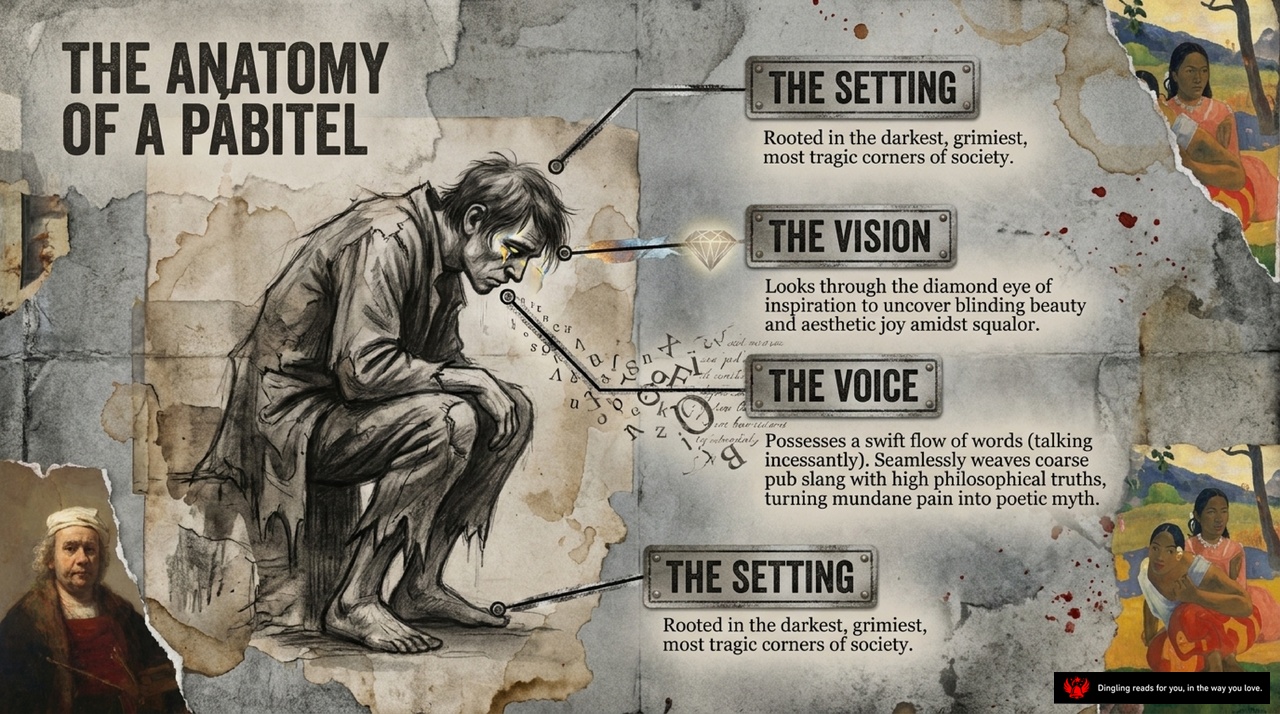
Have you ever felt like the world is just a giant, relentless press, crushing everything in its path? That's the reality Hans Jarabek faces in this story. He's spent thirty-five years working as a paper baler in the deepest, grimmest corners of society, surrounded by rot and the smell of decay. But here's the twist: amidst this chaos, he finds a hidden universe.
Look at the image. It breaks down the "Anatomy of a Paper Baler." First, **The Setting**. Hans isn't just working in a basement; he's rooted in the darkest, most tragic corners of society, a place where the air feels heavy with the weight of forgotten words.
Then, there's **The Vision**. Even while sitting there, covered in ink and dust, Hans looks through a "diamond eye of inspiration." He sees blinding beauty and aesthetic joy right in the middle of the squalor. He doesn't just see trash; he sees the soul of the books he's crushing.
And finally, **The Voice**. This is where it gets poetic. Hans possesses a swift flow of words. He talks incessantly, weaving together coarse pub slang with high philosophical truths. He turns mundane pain into a kind of poetic myth, finding deep meaning in the act of destruction itself.
It's a powerful reminder that even in the most crushing situations, you can find a way to speak, to see, and to create something beautiful from the ruins.
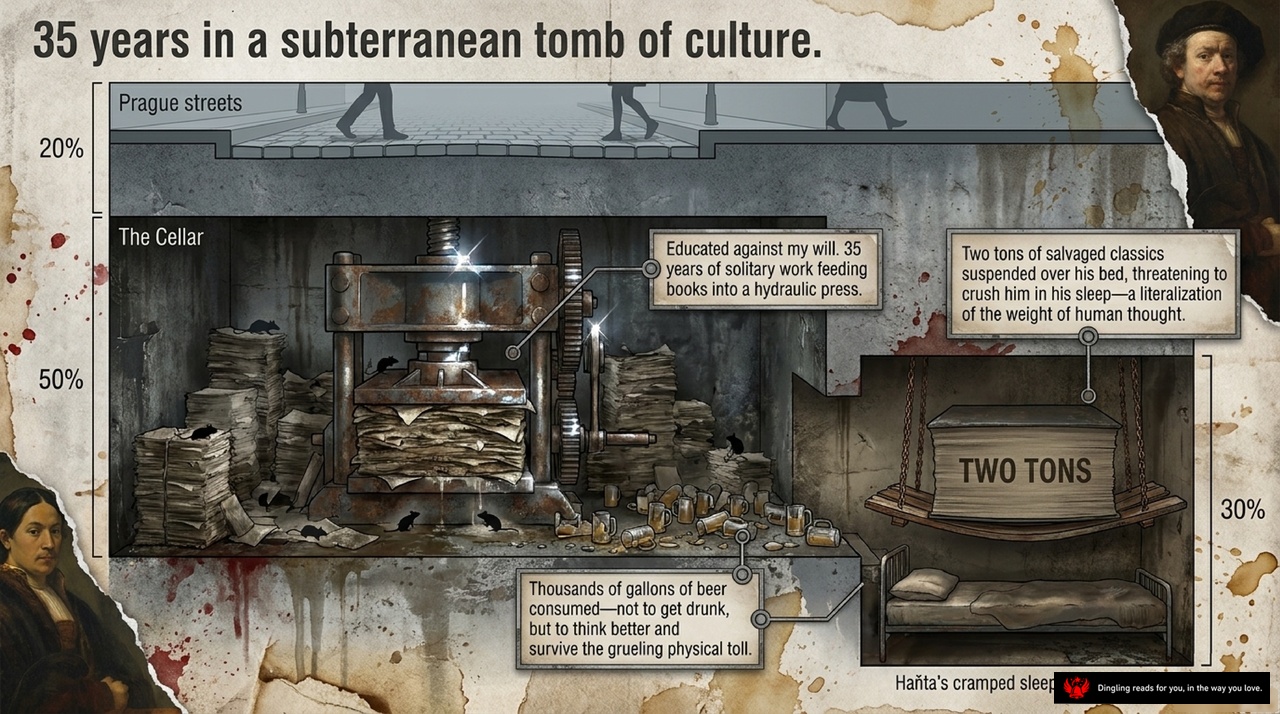
Thirty-five years buried beneath the earth, this is the story of my life. Imagine a subterranean tomb where culture rots and is reborn. I spent three decades in a cellar, forced to educate myself against my will, feeding books into a hydraulic press that crushed them into pulp. Two tons of salvaged classics hung suspended over my bed, threatening to crush me in my sleep—a literal weight of human thought that never let me rest. To survive the grueling physical toll of this solitary work, I drank thousands of gallons of beer. But I never drank to get drunk; I drank to think better, to dive deeper into the heart of a book and keep my mind awake.
In this chaotic underworld, the boundaries between reality and hallucination dissolved. When I worked, the smell of blood-soaked paper from the slaughterhouse made me see visions of Jesus and Lao Tzu standing by the machine. One wanted to change the world with passionate love; the other retreated into silence, contemplating the eternal way. They watched as thousands of green-headed flies, drawn by the slaughter, swarmed around us like atoms in a nucleus. Even the Gypsy women who came to collect our waste became part of this surreal landscape, their laughter echoing off the damp walls. This was not just work; it was a ritual of destruction and preservation, where the true essence of a book survived the fire of the press, leaving only the air it once occupied.
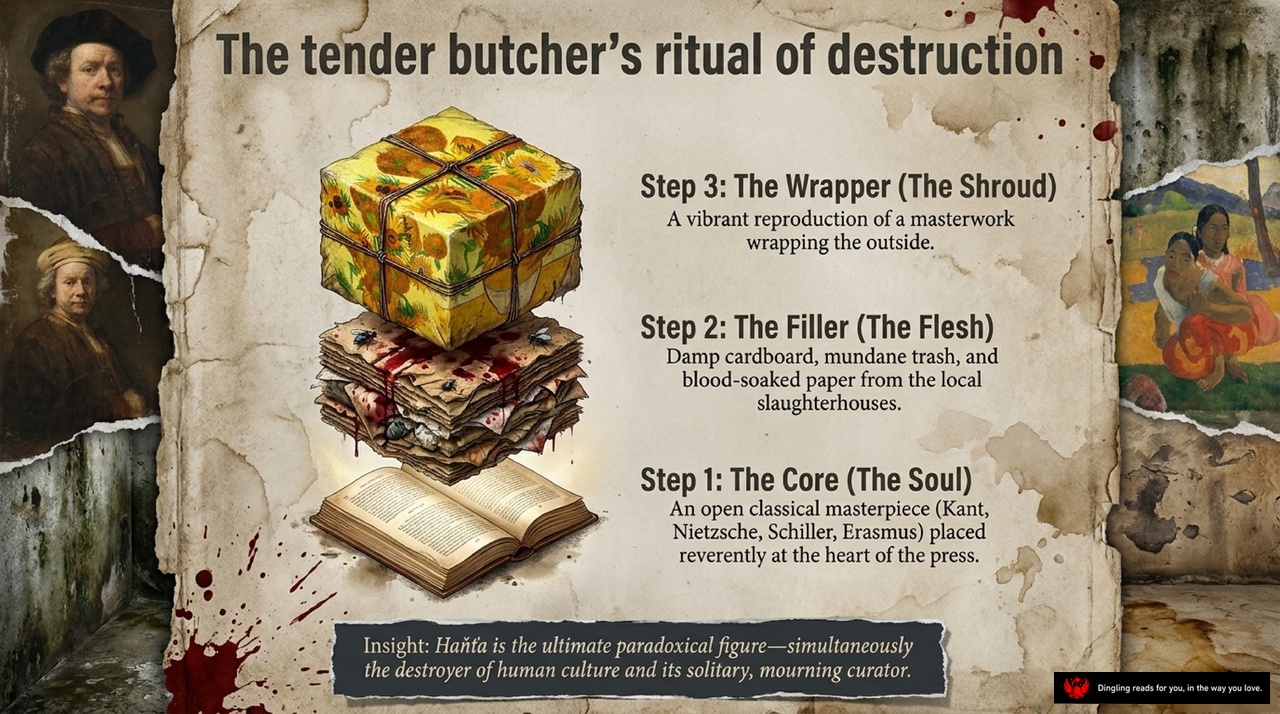
In the heart of the crushing machine, two figures appear: Jesus and Laozi. While Jesus stands on the edge of the machine, eager to change the world, Laozi sits quietly, embodying the wisdom of returning to the original simplicity. Amidst the chaos of flies and blood-soaked paper, I feel a profound conflict between the romantic rush toward the future and the spiritual retreat to the source. This is the tender butcher's ritual of destruction, where every step reveals a paradox. Step one is the core, the soul—classical masterpieces like Kant and Nietzsche placed reverently at the center. Step two is the filler, the flesh—damp cardboard and trash that surrounds the precious books. Finally, Step three is the wrapper, the shroud—vibrant reproductions of masterworks like Van Gogh's Sunflowers, wrapping the destruction in beauty. This ritual highlights a paradoxical truth: Hařita is simultaneously the destroyer of human culture and its solitary, mourning curator, finding a strange sanctity in the act of crushing the very books he loves.
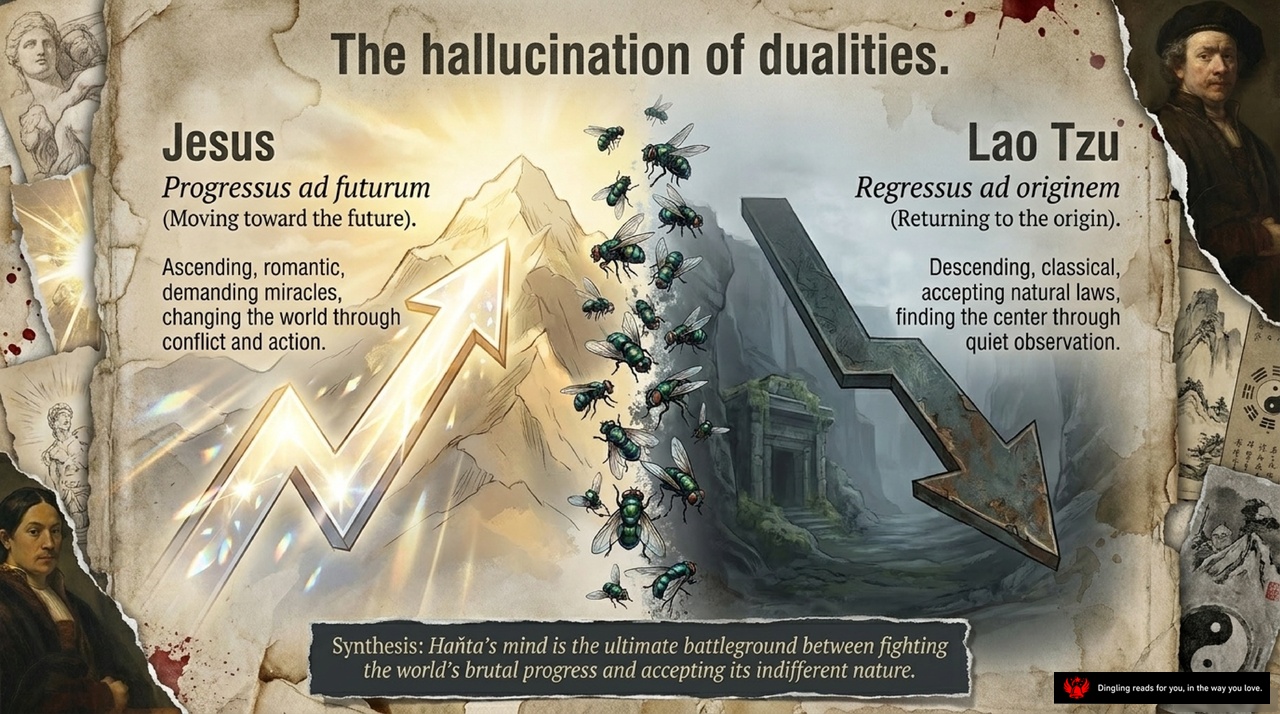
The hallucination of dualities isn't just a philosophical concept; it's the very engine driving the protagonist's life. On the left, we see the path of Jesus, labeled *Progressus ad futurum*—moving relentlessly toward the future. It's an ascending, romantic journey that demands miracles and seeks to change the world through conflict and action. On the right stands Lao Tzu, representing *Regressus ad originem*, the act of returning to the origin. This is a descending, classical path that accepts natural laws and finds the center through quiet observation.
The image vividly captures this clash. A glowing, jagged arrow shoots upward on the left, symbolizing the drive for progress and the struggle against the status quo. In stark contrast, a heavy, rusted arrow points downward on the right, representing the pull of gravity, the acceptance of decay, and the wisdom found in stillness. Between these two opposing forces, a swarm of green flies buzzes chaotically. They represent the confusion and the "brutal progress" of the world that Hańza constantly battles against.
This synthesis defines Hańza's mind as the ultimate battleground. He lives in a state of tension, torn between fighting the world's indifferent nature and accepting it. He is caught between the desire to be a hero who changes things and the reality of being a worker who simply processes the inevitable. As the text reveals, his life has been a cycle of crushing books, only to see them destroyed, mirroring the destruction of his own hopes. He tries to ascend through knowledge and art, yet he is constantly pulled down by the crushing weight of reality, the rats in the basement, and the relentless march of time. In the end, he realizes that true wisdom lies not in choosing one side, but in holding both truths: the need to act and the necessity of surrender.
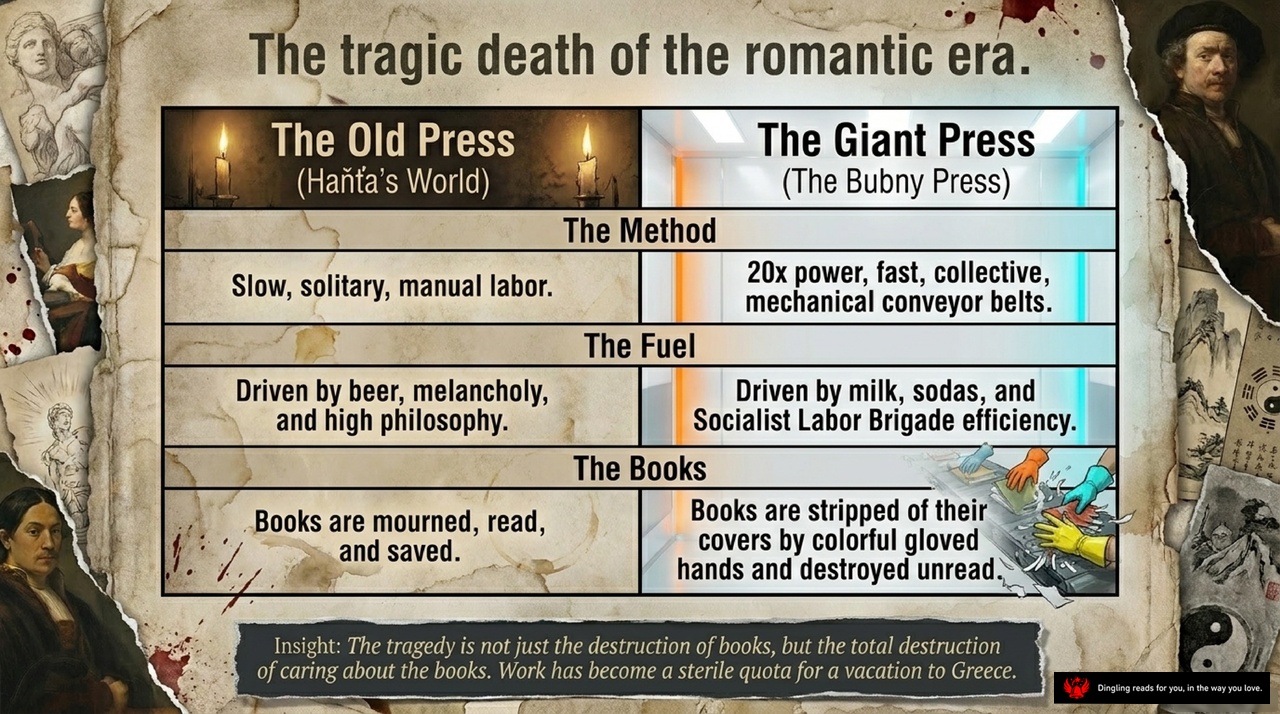
Welcome to the final chapter of our journey into the tragic death of the Romantic Era. Look at this slide: it contrasts "The Old Press" with "The Giant Press," symbolizing the clash between a world of soul and a world of efficiency.
On the left, we see Haňta's world—the old press. It was slow, solitary, and driven by manual labor, fueled by beer, melancholy, and high philosophy. Here, books were mourned, read, and saved with care. But on the right, we see the Bubny Press—the giant press. It represents a shift to 20x power, fast, collective, and mechanical conveyor belts. The fuel changes from poetry to milk, sodas, and Socialist Labor Brigade efficiency. The result? Books are stripped of their covers by colorful gloved hands and destroyed unread.
The insight at the bottom is crucial: the tragedy isn't just the destruction of books, but the total destruction of caring about them. Work has become a sterile quota. This mirrors Haňta's own realization in the final pages of his memoir. He describes visiting this new giant press, a terrifying glass structure where young workers in bright gloves tear pages from books to feed the machine, drinking milk and planning vacations to Greece. Haňta, who spent 35 years finding beauty in the dust of old paper, feels utterly betrayed. His machine, once a sacred altar for preserving thoughts, now mocks him, churning out sterile packages while he is left behind, unable to adapt to this new, soulless reality. The old world of deep reading and philosophical solitude has been crushed by the relentless, efficient engine of modernity.

Here is the spoken-word script for Slide 7, tailored for an American audience with a natural, storytelling tone.
**Slide 7 Script:**
"Let's talk about the three distinct voices that define the Czech soul. Think of it like a triptych of the human experience. On the left, you have Franz Kafka. He wrote in German, not because he chose to, but because it was the language of the empire that crushed him. His work, *The Alienation*, captures that suffocating bureaucratic nightmare—the feeling of being a tiny, insignificant cog in a massive, indifferent machine. It's the sound of isolation echoing in an empty hallway.
On the right, we have Milan Kundera. He wrote in French, turning his back on the land he loved to find a new perspective. His theme, *The Exile*, isn't just about leaving a country; it's about the philosophical distance from home. It's the detached, intellectual reflection of someone who carries their entire history in a suitcase, watching the world from a safe, yet painful, distance.
And right in the center, anchoring everything, is Bohumil Hrabal. He wrote in Czech, the language of the streets, the local pubs, and the gritty, beautiful dirt of Prague. His work, *The Grounding*, is about being deeply rooted in the messy reality of life. While Kafka and Kundera look up at the abstract or the distant, Hrabal looks down at the people, the slang, and the raw humanity that spills over the edges of the glass.
Together, they show us the full spectrum: the alienated mind, the exiled heart, and the grounded soul. This is the authentic rhythm of Czech literature."

Thirty-five years of crushing paper, and in that relentless rhythm, I found a diamond. Not a gem you can hold, but something far more precious: the idea that true thought is indestructible.
Look at the image. An ancient book opens to reveal a glowing diamond. This isn't magic; it's the philosophy of the man who spent his life destroying books. He believed that when you burn a book, you don't destroy its truth. You only release it. The words dissolve into the air, just like the complex math hidden inside a tiny calculator chip. Once a book is truly understood, its ideas float freely in the atmosphere, surviving the fire, the press, and time itself.
But here lies the tragedy. The man in the story absorbed the greatest thoughts of humanity, yet he worked for a machine designed to erase them. When cold, sterile efficiency replaced the poetic act of destruction, he realized he could no longer protect the art he loved. So, he made a final, radical choice: he stepped into the press himself. He became one with the paper, sacrificing his physical form to become part of the very knowledge he cherished.
We live in an age where information is processed with relentless, sterile efficiency. We speed through content without ever letting it sink into our souls. But what happens to the knowledge that requires time, solitude, and even suffering to truly understand? That diamond in the book represents the eternal truth that survives our destruction, waiting for us to stop the machine and finally read it.